Abstract
• To us, a green city is a city that has the cleanest and most efficient energy,
transportation, and building infrastructure possible.
• A green city derives its energy from renewable sources like solar and wind, and
distributes that energy through efficient and reliable systems.
• A green city is made up of buildings that are energy efficient, conserve water, and reduce
waste. A green city is connected by clean and accessible public transportation networks
and is biking- and walking-friendly. A green city is a healthier, more affordable, and more
pleasant place to live.
• In this project, we are building a township or a city which consists of houses, malls, office
buildings, signal lights, schools, drainage facility and amusement park.
• The city will have a drainage system that collects water from every house and recycles it.
• Renewable resources like wind power can be used to generate electricity which in turn is
used to light the city signal lights, street lights etc.
• Recharge ponds can be constructed to recharge the ground water.
• Rain water harvesting can be done to collect water for household uses such as flushing,
washing, gardening etc.
CONTOUR MAP
CITY SPECIFICATIONS
• Residential enclave
• Office area
• Shopping complex
• International school
• Mall and cinemas
• Golf range
• Landscaped gardens
• Hospital
• Sports complex
• Water treatment plant
• Wind mill farm
• Solar photovoltaic plant
• Water supply tanks
AMENITIES
• Gymnasium
• Children’s play area
• Tennis courts
• ATM
• Football/Athletics track
• Club house
• Jogging track
• Medical center
RESIDENTIAL ENCLAVE LAYOUT
RESIDENTIAL ENCLAVE
The residential area will comprise of 4752 apartment units
spread across 54 high rise towers.
Area : It covers a total area of 57 acres
Design Standards : The development is designed to comply with
National Building Codes (NBC) and is LEED certified.
Power : All towers have solar heaters on roofs to provide hot
water and PV panels to power different amenities such as lift,
generators etc.
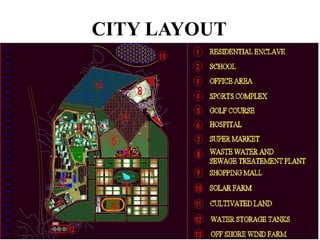
CITY LAYOUT
Individual areas covered
• Residential enclave = 57 acres
• Office, mall and school = 70 acres
• Solar farm = 30 acres
• Cultivated land = 17 acres
• Golf course = 20 acres
• Water treatment plant = 15 acres
• Green area = 50 acres
ELECTRICAL ENERGY CONSERVATION
CONVENTIONAL CITY GREEN CITY
Yearly consumption :-
Residential enclave = 44809 MWh/year
Office area = 132581 MWh/year
Mall = 1516 MWh/year
Other = 80000 MWh/year
TOTAL CONSUMPTION = 260000 MWh/year
Average saving using occupancy sensors/
photo sensors and daylight harvesting sensors
= 25%
Average saving using solar water heaters = 5%
TOTAL SAVINGS = 30%
Annual Saving in = 30% of 260000 MWh
electricity = 78000 MWh/year
WATER CONSERVATION
CONVENTIONAL CITY GREEN CITY
Water demand per capita per day = 150 L
Water consumed by 19000 people
= 150 X 19000
= 2,850,000 L
Average water consumption per year
= 1040 million liters
Recycling 80% of water used
= 80% of 2850000 L
= 2280000 L
Therefore, average annual conservation
= 2280000 X 365
= 832 million liters
Rain water harvesting :
Total catchment area = 1032 m2
Rain water harvested
= (Avg. annual rainfall) X (Catchment area) X
(Conversion factor) X 1000
= 0.862 X 1032 X 0.9 X 1000
= 800625 liters
CARBON FOOTPRINT REDUCTION
1070
662
35 29
0
200
400
600
800
1000
1200
Coal Gas PV Wind
CORBON EMISSION CHART
carbon emissions
gCO2/kWhr
Resources
CONVENTIONAL CITY GREEN CITY
Using coal as resource :
Electricity produced = 260 million kWh/year
Carbon emissions due to coal
= 1070 gCO2/kWh
Total carbon emissions = 260 X 106 X 1070
= 2.78 X 10¹¹ gCO2/year
Using gas as resource :
Carbon emissions due to gas
= 662 gCO2/kWh
Total carbon emissions = 260 X 106 X 662
= 1.72 X 10¹¹ gCO2/year
Average emissions = 2.25 X 10¹¹ gCO2/year
Using solar power as resource :
Electricity produced = 80 million kWh/year
Carbon emissions due to PV panels
= 35 gCO2/kWh
Total carbon emissions = 80M X 35
= 2.8 X 10⁹ gCO2/year
Using wind as resource :
Electricity produced = 180 million kWh/year
Carbon emissions due to wind energy
= 29 gCO2/kWh
Total carbon emissions = 180M X 29
= 5.22 X 10⁹ gCO2/year
Total carbon emissions = (2.8 + 5.22) X 109
= 8.02 X 10⁹ gCO2/year
Percentage carbon emission reduced = 100 – ((8.02 X 10⁹)/(2.25 X 1011) X 100)
= 96%
Construction Material
Water-based paints that have no volatile
organic compound, which harm human health
Reinforcing bars made of 100% recycled steel
• Green concrete that used ground
granulated blasted slag to replace cement,
resulting in a reduction of the concrete
carbon footprint by 30-40% of CO2
Renewable resources
The city is powered by a field of 30 acres with
53000 solar panels with additional panels on
roofs. There are no light switches or water taps
in the city; movement sensors control lighting
and water to cut electricity and water
consumption by 51 and 55 percent respectively.
The rest of the power demand will be fulfilled by
the electricity produced from the offshore wind
farm.
Water strategy
• Reduce consumption to 130
L/c/d
• Reduce water leakage to 3%
• Recycle 90% of grey water
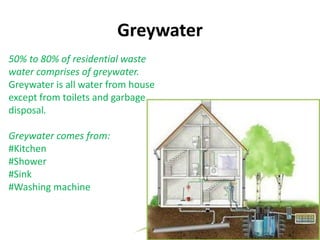
Greywater
50% to 80% of residential waste
water comprises of greywater.
Greywater is all water from house
except from toilets and garbage
disposal.
Greywater comes from:
#Kitchen
#Shower
#Sink
#Washing machine
Current system:
combine
greywater and
blackwater
Treat using
membrane
bioreactor
(MBR) plant
Treated
sewage
effluent will
be used for
landscaping
Biosolids
resulting from
the treatment
reused for
compositing and
in any future
waste-to-energy
plant
80% of water that is used is recycled
Water storage tank capacity
Water demand per capita per day = 150 L
Water consumed by 19000 people= 150 X 19000
= 2,850,000 L
Taking water tank capacity = 3,000,000 L
= 3,000 cum
Assuming three tanks of 1000 cum capacity
Assume depth of one tank = 8m
Area of one tank = 1000/8 = 125 sq. m
Therefore, Diameter of each tank = 12.6 m
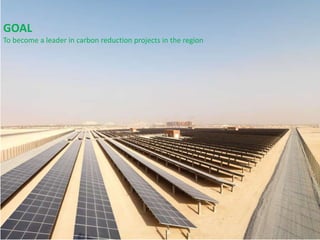
GOAL
To become a leader in carbon reduction projects in the region
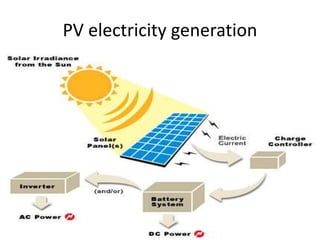
PV electricity generation
Solar Water Heaters Save Energy
Solar water heaters keep the standard of living high while keeping energy consumption
down. Solar water heaters use a combination of the sun’s heat and photovoltaic cells to
heat water. This example is produced by the German company Guersolar.
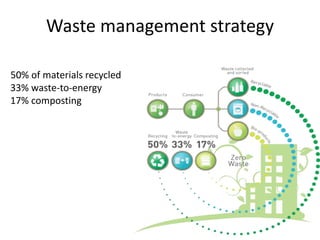
Waste management strategy
50% of materials recycled
33% waste-to-energy
17% composting
Carbon neutral
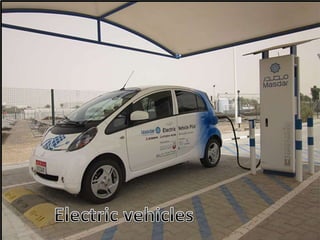
Personal Rapid Transit (PRT) system of 100% electric-
powered, automated vehicles has been in operation since
2010 with existing road and railways connecting to other
locations outside the city.
PRT vehicles are sized for individual or small group travel,
typically carrying no more than 3 to 6 passengers per
vehicle.
The PRT vehicles will travel at speeds up to 40km/h, with
the longest routes in the city taking around 10 minutes.
Personal Rapid Transit system
THANK YOU

Green city

  • 2.
    Abstract • To us,a green city is a city that has the cleanest and most efficient energy, transportation, and building infrastructure possible. • A green city derives its energy from renewable sources like solar and wind, and distributes that energy through efficient and reliable systems. • A green city is made up of buildings that are energy efficient, conserve water, and reduce waste. A green city is connected by clean and accessible public transportation networks and is biking- and walking-friendly. A green city is a healthier, more affordable, and more pleasant place to live. • In this project, we are building a township or a city which consists of houses, malls, office buildings, signal lights, schools, drainage facility and amusement park. • The city will have a drainage system that collects water from every house and recycles it. • Renewable resources like wind power can be used to generate electricity which in turn is used to light the city signal lights, street lights etc. • Recharge ponds can be constructed to recharge the ground water. • Rain water harvesting can be done to collect water for household uses such as flushing, washing, gardening etc.
  • 3.
  • 4.
    CITY SPECIFICATIONS • Residentialenclave • Office area • Shopping complex • International school • Mall and cinemas • Golf range • Landscaped gardens • Hospital • Sports complex • Water treatment plant • Wind mill farm • Solar photovoltaic plant • Water supply tanks
  • 5.
    AMENITIES • Gymnasium • Children’splay area • Tennis courts • ATM • Football/Athletics track • Club house • Jogging track • Medical center
  • 6.
  • 7.
    RESIDENTIAL ENCLAVE The residentialarea will comprise of 4752 apartment units spread across 54 high rise towers. Area : It covers a total area of 57 acres Design Standards : The development is designed to comply with National Building Codes (NBC) and is LEED certified. Power : All towers have solar heaters on roofs to provide hot water and PV panels to power different amenities such as lift, generators etc.
  • 8.
  • 9.
    Individual areas covered •Residential enclave = 57 acres • Office, mall and school = 70 acres • Solar farm = 30 acres • Cultivated land = 17 acres • Golf course = 20 acres • Water treatment plant = 15 acres • Green area = 50 acres
  • 10.
    ELECTRICAL ENERGY CONSERVATION CONVENTIONALCITY GREEN CITY Yearly consumption :- Residential enclave = 44809 MWh/year Office area = 132581 MWh/year Mall = 1516 MWh/year Other = 80000 MWh/year TOTAL CONSUMPTION = 260000 MWh/year Average saving using occupancy sensors/ photo sensors and daylight harvesting sensors = 25% Average saving using solar water heaters = 5% TOTAL SAVINGS = 30% Annual Saving in = 30% of 260000 MWh electricity = 78000 MWh/year
  • 11.
    WATER CONSERVATION CONVENTIONAL CITYGREEN CITY Water demand per capita per day = 150 L Water consumed by 19000 people = 150 X 19000 = 2,850,000 L Average water consumption per year = 1040 million liters Recycling 80% of water used = 80% of 2850000 L = 2280000 L Therefore, average annual conservation = 2280000 X 365 = 832 million liters Rain water harvesting : Total catchment area = 1032 m2 Rain water harvested = (Avg. annual rainfall) X (Catchment area) X (Conversion factor) X 1000 = 0.862 X 1032 X 0.9 X 1000 = 800625 liters
  • 12.
    CARBON FOOTPRINT REDUCTION 1070 662 3529 0 200 400 600 800 1000 1200 Coal Gas PV Wind CORBON EMISSION CHART carbon emissions gCO2/kWhr Resources
  • 13.
    CONVENTIONAL CITY GREENCITY Using coal as resource : Electricity produced = 260 million kWh/year Carbon emissions due to coal = 1070 gCO2/kWh Total carbon emissions = 260 X 106 X 1070 = 2.78 X 10¹¹ gCO2/year Using gas as resource : Carbon emissions due to gas = 662 gCO2/kWh Total carbon emissions = 260 X 106 X 662 = 1.72 X 10¹¹ gCO2/year Average emissions = 2.25 X 10¹¹ gCO2/year Using solar power as resource : Electricity produced = 80 million kWh/year Carbon emissions due to PV panels = 35 gCO2/kWh Total carbon emissions = 80M X 35 = 2.8 X 10⁹ gCO2/year Using wind as resource : Electricity produced = 180 million kWh/year Carbon emissions due to wind energy = 29 gCO2/kWh Total carbon emissions = 180M X 29 = 5.22 X 10⁹ gCO2/year Total carbon emissions = (2.8 + 5.22) X 109 = 8.02 X 10⁹ gCO2/year Percentage carbon emission reduced = 100 – ((8.02 X 10⁹)/(2.25 X 1011) X 100) = 96%
  • 14.
    Construction Material Water-based paintsthat have no volatile organic compound, which harm human health Reinforcing bars made of 100% recycled steel • Green concrete that used ground granulated blasted slag to replace cement, resulting in a reduction of the concrete carbon footprint by 30-40% of CO2
  • 15.
    Renewable resources The cityis powered by a field of 30 acres with 53000 solar panels with additional panels on roofs. There are no light switches or water taps in the city; movement sensors control lighting and water to cut electricity and water consumption by 51 and 55 percent respectively. The rest of the power demand will be fulfilled by the electricity produced from the offshore wind farm.
  • 16.
    Water strategy • Reduceconsumption to 130 L/c/d • Reduce water leakage to 3% • Recycle 90% of grey water
  • 17.
    Greywater 50% to 80%of residential waste water comprises of greywater. Greywater is all water from house except from toilets and garbage disposal. Greywater comes from: #Kitchen #Shower #Sink #Washing machine
  • 18.
    Current system: combine greywater and blackwater Treatusing membrane bioreactor (MBR) plant Treated sewage effluent will be used for landscaping Biosolids resulting from the treatment reused for compositing and in any future waste-to-energy plant
  • 19.
    80% of waterthat is used is recycled
  • 20.
    Water storage tankcapacity Water demand per capita per day = 150 L Water consumed by 19000 people= 150 X 19000 = 2,850,000 L Taking water tank capacity = 3,000,000 L = 3,000 cum Assuming three tanks of 1000 cum capacity Assume depth of one tank = 8m Area of one tank = 1000/8 = 125 sq. m Therefore, Diameter of each tank = 12.6 m
  • 22.
    GOAL To become aleader in carbon reduction projects in the region
  • 23.
  • 24.
    Solar Water HeatersSave Energy Solar water heaters keep the standard of living high while keeping energy consumption down. Solar water heaters use a combination of the sun’s heat and photovoltaic cells to heat water. This example is produced by the German company Guersolar.
  • 25.
    Waste management strategy 50%of materials recycled 33% waste-to-energy 17% composting
  • 26.
  • 29.
    Personal Rapid Transit(PRT) system of 100% electric- powered, automated vehicles has been in operation since 2010 with existing road and railways connecting to other locations outside the city. PRT vehicles are sized for individual or small group travel, typically carrying no more than 3 to 6 passengers per vehicle. The PRT vehicles will travel at speeds up to 40km/h, with the longest routes in the city taking around 10 minutes. Personal Rapid Transit system
  • 30.