SEMINAR PRESENTATION ON
AN INTRODUCTION TO
TRANSIT ORIENTED DEVELOPMENT
Presented By: Ridam Shah
Scholar No: 162111505
“TRANSPORTATION ENGINEERING SECTION”
DEPARTMENT OF CIVIL ENGINEERING
MAULANA AZAD NATIONAL INSTITUTE OF TECHNOLOGY
BHOPAL
JANUARY 6, 2017
Outline of Presentation
• Introduction
• Literature Review
• Goals of TOD
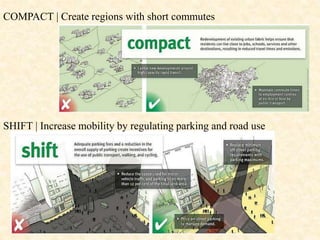
• Design Principles of TOD
• Advantages of TOD
• Present efforts in India
• Case Study
• Conclusions
• References
Introduction
What is TOD ?
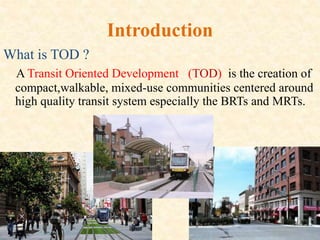
A Transit Oriented Development (TOD) is the creation of
compact,walkable, mixed-use communities centered around
high quality transit system especially the BRTs and MRTs.
Why TOD ?
Introduction
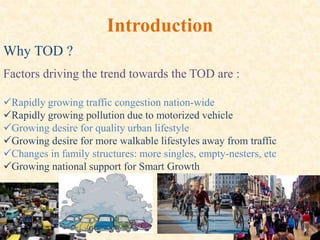
Factors driving the trend towards the TOD are :
Rapidly growing traffic congestion nation-wide
Rapidly growing pollution due to motorized vehicle
Growing desire for quality urban lifestyle
Growing desire for more walkable lifestyles away from traffic
Changes in family structures: more singles, empty-nesters, etc
Growing national support for Smart Growth
Literature Review
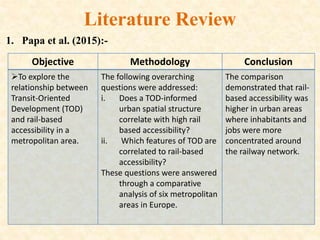
1. Papa et al. (2015):-
Objective Methodology Conclusion
To explore the
relationship between
Transit-Oriented
Development (TOD)
and rail-based
accessibility in a
metropolitan area.
The following overarching
questions were addressed:
i. Does a TOD-informed
urban spatial structure
correlate with high rail
based accessibility?
ii. Which features of TOD are
correlated to rail-based
accessibility?
These questions were answered
through a comparative
analysis of six metropolitan
areas in Europe.
The comparison
demonstrated that rail-
based accessibility was
higher in urban areas
where inhabitants and
jobs were more
concentrated around
the railway network.
Literature Review
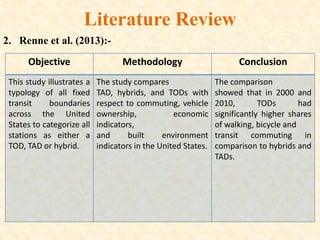
2. Renne et al. (2013):-
Objective Methodology Conclusion
This study illustrates a
typology of all fixed
transit boundaries
across the United
States to categorize all
stations as either a
TOD, TAD or hybrid.
The study compares
TAD, hybrids, and TODs with
respect to commuting, vehicle
ownership, economic
indicators,
and built environment
indicators in the United States.
The comparison
showed that in 2000 and
2010, TODs had
significantly higher shares
of walking, bicycle and
transit commuting in
comparison to hybrids and
TADs.
Literature Review
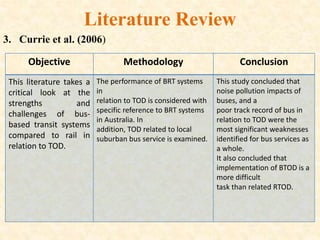
3. Currie et al. (2006)
Objective Methodology Conclusion
This literature takes a
critical look at the
strengths and
challenges of bus-
based transit systems
compared to rail in
relation to TOD.
The performance of BRT systems
in
relation to TOD is considered with
specific reference to BRT systems
in Australia. In
addition, TOD related to local
suburban bus service is examined.
This study concluded that
noise pollution impacts of
buses, and a
poor track record of bus in
relation to TOD were the
most significant weaknesses
identified for bus services as
a whole.
It also concluded that
implementation of BTOD is a
more difficult
task than related RTOD.
Literature Review
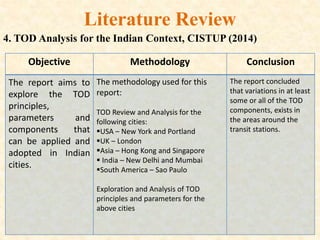
4. TOD Analysis for the Indian Context, CISTUP (2014)
Objective Methodology Conclusion
The report aims to
explore the TOD
principles,
parameters and
components that
can be applied and
adopted in Indian
cities.
The methodology used for this
report:
TOD Review and Analysis for the
following cities:
USA – New York and Portland
UK – London
Asia – Hong Kong and Singapore
 India – New Delhi and Mumbai
South America – Sao Paulo
Exploration and Analysis of TOD
principles and parameters for the
above cities
The report concluded
that variations in at least
some or all of the TOD
components, exists in
the areas around the
transit stations.
Goals of TOD
The goals of Transit Oriented Development are to:
• Reduce private vehicle dependency and promote
public transport use through design, policy and
enforcement
• Provide public transport access to the maximum
number of people through densification and
multimodal connectivity
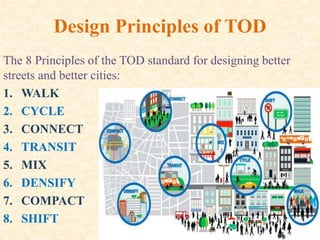
Design Principles of TOD
The 8 Principles of the TOD standard for designing better
streets and better cities:
1. WALK
2. CYCLE
3. CONNECT
4. TRANSIT
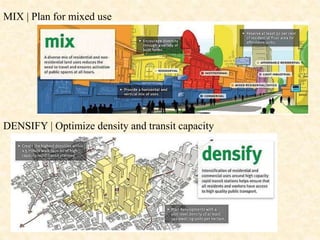
5. MIX
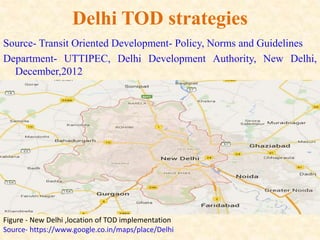
6. DENSIFY
7. COMPACT
8. SHIFT
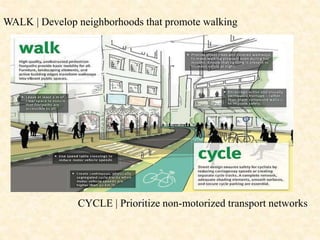
WALK | Develop neighborhoods that promote walking
CYCLE | Prioritize non-motorized transport networks
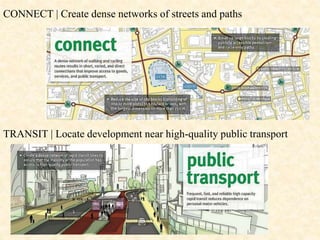
CONNECT | Create dense networks of streets and paths
TRANSIT | Locate development near high-quality public transport
MIX | Plan for mixed use
DENSIFY | Optimize density and transit capacity
COMPACT | Create regions with short commutes
SHIFT | Increase mobility by regulating parking and road use
Advantages of TOD
The advantages of Transit Oriented Development are:
• Higher quality of life
• Better places to live, work, and play
• Greater mobility with ease of moving around
• Increased transit ridership
• Reduced traffic congestion and driving
• Reduced car accidents and injuries
• Reduced household spending on transportation, resulting in more
affordable housing
• Reduced pollution to a great extent
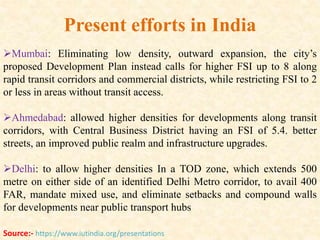
Mumbai: Eliminating low density, outward expansion, the city’s
proposed Development Plan instead calls for higher FSI up to 8 along
rapid transit corridors and commercial districts, while restricting FSI to 2
or less in areas without transit access.
Ahmedabad: allowed higher densities for developments along transit
corridors, with Central Business District having an FSI of 5.4. better
streets, an improved public realm and infrastructure upgrades.
Delhi: to allow higher densities In a TOD zone, which extends 500
metre on either side of an identified Delhi Metro corridor, to avail 400
FAR, mandate mixed use, and eliminate setbacks and compound walls
for developments near public transport hubs
Present efforts in India
Source:- https://www.iutindia.org/presentations
CASE STUDY
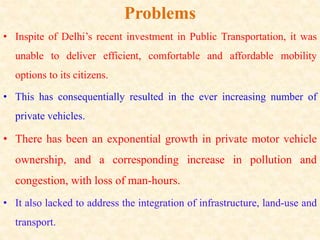
Delhi TOD strategies
Figure - New Delhi ,location of TOD implementation
Source- https://www.google.co.in/maps/place/Delhi
Source- Transit Oriented Development- Policy, Norms and Guidelines
Department- UTTIPEC, Delhi Development Authority, New Delhi,
December,2012
Problems
• Inspite of Delhi’s recent investment in Public Transportation, it was
unable to deliver efficient, comfortable and affordable mobility
options to its citizens.
• This has consequentially resulted in the ever increasing number of
private vehicles.
• There has been an exponential growth in private motor vehicle
ownership, and a corresponding increase in pollution and
congestion, with loss of man-hours.
• It also lacked to address the integration of infrastructure, land-use and
transport.
Solution
• UTTIPEC & Delhi Development Authority: framed a Transit Oriented
Development for Delhi.
Zoning of TOD for Delhi
• To facilitate an organized development and to bring transparency in
the development process as per TOD, the Influence Zone is further
divided as:
Zone 1: Intense TOD Zone (300 M influence zone of all MRTS
Stations)
Zone 2: Standard TOD Zone (800 M influence zone of all MRTS
Stations)
Zone 3: TOD Transition Zone. (2000 M influence zone of all MRTS
Stations)
Figure – Influence and coverage area under MRTS and BRTS, Delhi
Source – Transit Oriented development- Policy, Norms and Guidelines ,2012
Benefits of TOD to Delhi
• Transit Oriented Development envisages itself as a holistic approach
towards integrating existing infrastructure, land-use and future
transportation options.
• It provides a cheaper public transport, better liveable environment and
quality of life.
• It focuses on affordable housing, mixed-use & high density
development.
• It also focuses on PPP development opportunities to provide the
required infrastructure at an affordable and timely manner.
Conclusions
• The present study indicates that dependency on private vehicle can be
reduced there by promoting public transport by implementation of
TOD.
• TOD can provide a cheaper public transport, better liveable
environment and quality of life.
• TOD may help in integrating existing infrastructure, land-use and
future transportation options.
• It also implies that TOD focuses on PPP development opportunities to
provide the required infrastructure at an affordable and timely manner.
References
1. Currie, G., 2006. Bus transit oriented development—strengths and
challenges relative to rail. Journal of Public Transportation, 9(4), p.1.
Source- http://scholarcommons.usf.edu
2. Papa, E. and Bertolini, L., 2015. Accessibility and Transit-Oriented
Development in European metropolitan areas. Journal of Transport
Geography, 47, pp.70-83.
Source - http://www.sciencedirect.com
3. Renne, J.L. and Ewing, R., 2013. Transit-oriented development: an
examination of America’s transit precincts in 2000 & 2010.
Source- http://scholarworks.uno.edu
4. 'Sustainable Urban Transport - Principles and Implementation Guidelines for
Indian Cities' 2013, Shakti Sustainable Energy Foundation, IUT.
Source - http://shaktifoundation.in
5. 'TOD Analysis for the Indian Context' 2014, Centre for Infrastructure,
Sustainable Transport and Urban Planning (CiSTUP), Indian Institute of
Science, Bangalore.
Source – http://cistup.iisc.ernet.in/
6. ‘Transit Oriented Development – Policy, Norms and Guidelines’, 2012
UTTIPEC, Delhi Development Authority
Source- http://uttipec.nic.in
TRANSIT ORIENTED DEVELOPMENT

TRANSIT ORIENTED DEVELOPMENT

  • 1.
    SEMINAR PRESENTATION ON ANINTRODUCTION TO TRANSIT ORIENTED DEVELOPMENT Presented By: Ridam Shah Scholar No: 162111505 “TRANSPORTATION ENGINEERING SECTION” DEPARTMENT OF CIVIL ENGINEERING MAULANA AZAD NATIONAL INSTITUTE OF TECHNOLOGY BHOPAL JANUARY 6, 2017
  • 2.
    Outline of Presentation •Introduction • Literature Review • Goals of TOD • Design Principles of TOD • Advantages of TOD • Present efforts in India • Case Study • Conclusions • References
  • 3.
    Introduction What is TOD? A Transit Oriented Development (TOD) is the creation of compact,walkable, mixed-use communities centered around high quality transit system especially the BRTs and MRTs.
  • 4.
    Why TOD ? Introduction Factorsdriving the trend towards the TOD are : Rapidly growing traffic congestion nation-wide Rapidly growing pollution due to motorized vehicle Growing desire for quality urban lifestyle Growing desire for more walkable lifestyles away from traffic Changes in family structures: more singles, empty-nesters, etc Growing national support for Smart Growth
  • 5.
    Literature Review 1. Papaet al. (2015):- Objective Methodology Conclusion To explore the relationship between Transit-Oriented Development (TOD) and rail-based accessibility in a metropolitan area. The following overarching questions were addressed: i. Does a TOD-informed urban spatial structure correlate with high rail based accessibility? ii. Which features of TOD are correlated to rail-based accessibility? These questions were answered through a comparative analysis of six metropolitan areas in Europe. The comparison demonstrated that rail- based accessibility was higher in urban areas where inhabitants and jobs were more concentrated around the railway network.
  • 6.
    Literature Review 2. Renneet al. (2013):- Objective Methodology Conclusion This study illustrates a typology of all fixed transit boundaries across the United States to categorize all stations as either a TOD, TAD or hybrid. The study compares TAD, hybrids, and TODs with respect to commuting, vehicle ownership, economic indicators, and built environment indicators in the United States. The comparison showed that in 2000 and 2010, TODs had significantly higher shares of walking, bicycle and transit commuting in comparison to hybrids and TADs.
  • 7.
    Literature Review 3. Currieet al. (2006) Objective Methodology Conclusion This literature takes a critical look at the strengths and challenges of bus- based transit systems compared to rail in relation to TOD. The performance of BRT systems in relation to TOD is considered with specific reference to BRT systems in Australia. In addition, TOD related to local suburban bus service is examined. This study concluded that noise pollution impacts of buses, and a poor track record of bus in relation to TOD were the most significant weaknesses identified for bus services as a whole. It also concluded that implementation of BTOD is a more difficult task than related RTOD.
  • 8.
    Literature Review 4. TODAnalysis for the Indian Context, CISTUP (2014) Objective Methodology Conclusion The report aims to explore the TOD principles, parameters and components that can be applied and adopted in Indian cities. The methodology used for this report: TOD Review and Analysis for the following cities: USA – New York and Portland UK – London Asia – Hong Kong and Singapore  India – New Delhi and Mumbai South America – Sao Paulo Exploration and Analysis of TOD principles and parameters for the above cities The report concluded that variations in at least some or all of the TOD components, exists in the areas around the transit stations.
  • 9.
    Goals of TOD Thegoals of Transit Oriented Development are to: • Reduce private vehicle dependency and promote public transport use through design, policy and enforcement • Provide public transport access to the maximum number of people through densification and multimodal connectivity
  • 10.
    Design Principles ofTOD The 8 Principles of the TOD standard for designing better streets and better cities: 1. WALK 2. CYCLE 3. CONNECT 4. TRANSIT 5. MIX 6. DENSIFY 7. COMPACT 8. SHIFT
  • 11.
    WALK | Developneighborhoods that promote walking CYCLE | Prioritize non-motorized transport networks
  • 12.
    CONNECT | Createdense networks of streets and paths TRANSIT | Locate development near high-quality public transport
  • 13.
    MIX | Planfor mixed use DENSIFY | Optimize density and transit capacity
  • 14.
    COMPACT | Createregions with short commutes SHIFT | Increase mobility by regulating parking and road use
  • 15.
    Advantages of TOD Theadvantages of Transit Oriented Development are: • Higher quality of life • Better places to live, work, and play • Greater mobility with ease of moving around • Increased transit ridership • Reduced traffic congestion and driving • Reduced car accidents and injuries • Reduced household spending on transportation, resulting in more affordable housing • Reduced pollution to a great extent
  • 16.
    Mumbai: Eliminating lowdensity, outward expansion, the city’s proposed Development Plan instead calls for higher FSI up to 8 along rapid transit corridors and commercial districts, while restricting FSI to 2 or less in areas without transit access. Ahmedabad: allowed higher densities for developments along transit corridors, with Central Business District having an FSI of 5.4. better streets, an improved public realm and infrastructure upgrades. Delhi: to allow higher densities In a TOD zone, which extends 500 metre on either side of an identified Delhi Metro corridor, to avail 400 FAR, mandate mixed use, and eliminate setbacks and compound walls for developments near public transport hubs Present efforts in India Source:- https://www.iutindia.org/presentations
  • 17.
  • 18.
    Delhi TOD strategies Figure- New Delhi ,location of TOD implementation Source- https://www.google.co.in/maps/place/Delhi Source- Transit Oriented Development- Policy, Norms and Guidelines Department- UTTIPEC, Delhi Development Authority, New Delhi, December,2012
  • 19.
    Problems • Inspite ofDelhi’s recent investment in Public Transportation, it was unable to deliver efficient, comfortable and affordable mobility options to its citizens. • This has consequentially resulted in the ever increasing number of private vehicles. • There has been an exponential growth in private motor vehicle ownership, and a corresponding increase in pollution and congestion, with loss of man-hours. • It also lacked to address the integration of infrastructure, land-use and transport.
  • 20.
    Solution • UTTIPEC &Delhi Development Authority: framed a Transit Oriented Development for Delhi. Zoning of TOD for Delhi • To facilitate an organized development and to bring transparency in the development process as per TOD, the Influence Zone is further divided as: Zone 1: Intense TOD Zone (300 M influence zone of all MRTS Stations) Zone 2: Standard TOD Zone (800 M influence zone of all MRTS Stations) Zone 3: TOD Transition Zone. (2000 M influence zone of all MRTS Stations)
  • 21.
    Figure – Influenceand coverage area under MRTS and BRTS, Delhi Source – Transit Oriented development- Policy, Norms and Guidelines ,2012
  • 22.
    Benefits of TODto Delhi • Transit Oriented Development envisages itself as a holistic approach towards integrating existing infrastructure, land-use and future transportation options. • It provides a cheaper public transport, better liveable environment and quality of life. • It focuses on affordable housing, mixed-use & high density development. • It also focuses on PPP development opportunities to provide the required infrastructure at an affordable and timely manner.
  • 23.
    Conclusions • The presentstudy indicates that dependency on private vehicle can be reduced there by promoting public transport by implementation of TOD. • TOD can provide a cheaper public transport, better liveable environment and quality of life. • TOD may help in integrating existing infrastructure, land-use and future transportation options. • It also implies that TOD focuses on PPP development opportunities to provide the required infrastructure at an affordable and timely manner.

  • 24.
    References 1. Currie, G.,2006. Bus transit oriented development—strengths and challenges relative to rail. Journal of Public Transportation, 9(4), p.1. Source- http://scholarcommons.usf.edu 2. Papa, E. and Bertolini, L., 2015. Accessibility and Transit-Oriented Development in European metropolitan areas. Journal of Transport Geography, 47, pp.70-83. Source - http://www.sciencedirect.com 3. Renne, J.L. and Ewing, R., 2013. Transit-oriented development: an examination of America’s transit precincts in 2000 & 2010. Source- http://scholarworks.uno.edu
  • 25.
    4. 'Sustainable UrbanTransport - Principles and Implementation Guidelines for Indian Cities' 2013, Shakti Sustainable Energy Foundation, IUT. Source - http://shaktifoundation.in 5. 'TOD Analysis for the Indian Context' 2014, Centre for Infrastructure, Sustainable Transport and Urban Planning (CiSTUP), Indian Institute of Science, Bangalore. Source – http://cistup.iisc.ernet.in/ 6. ‘Transit Oriented Development – Policy, Norms and Guidelines’, 2012 UTTIPEC, Delhi Development Authority Source- http://uttipec.nic.in