QUANTUM PHYSICS An overview of some key ideas from Maxwell, Hertz and Planck.
Introduction Quantum theory ranks with relativity as one of the revolutionary theories in twentieth century physics. The basic idea, first put forward by Max Planck in 1900, was that oscillating particles (such as electrons in atoms) cannot radiate or absorb energy in continuous amounts. Energy is only transferred in multiples of some minimum amount. The term  quanta  means ‘fixed amount’. The idea of quanta was soon applied by Einstein to light, and so changed our understanding about the nature of light.
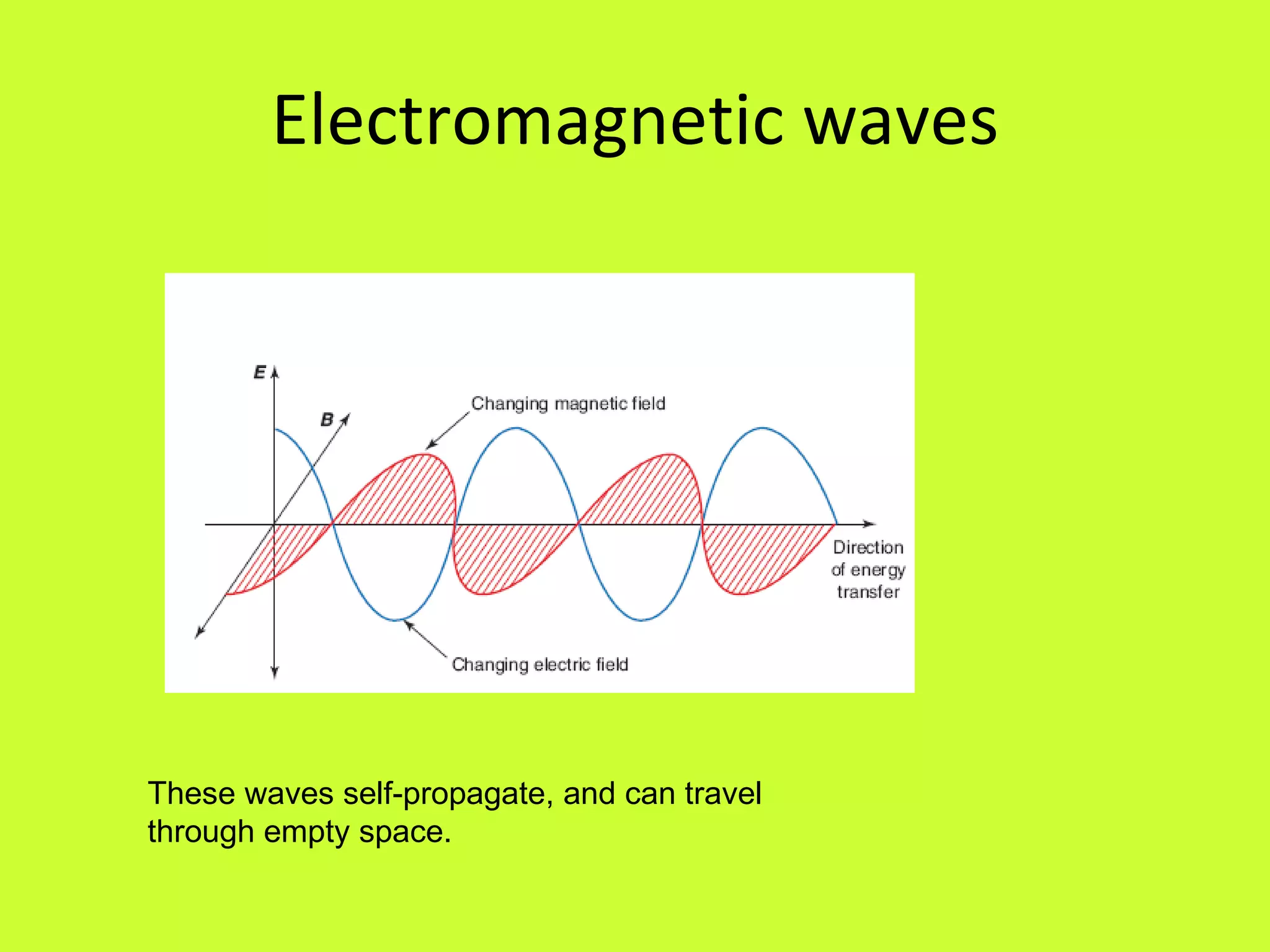
Electromagnetic radiation In 1873 James Maxwell formulated the laws of electromagnetism. One of his  predictions  was the existence of electromagnetic radiation. These waves should be produced by accelerated charges which make changing electric fields. These changing electric fields produce changing magnetic fields, which make changing electric fields..... The ‘waves’ were predicted by Maxwell to propagate at light speed, 3 x 10 8  m/s. Visible light was already known to travel at 3 x 10 8  m/s., so it was also suggested that visible light was an example of electromagnetic radiation. Heinrich HERTZ is credited as being the first person to experimentally demonstrate electromagnetic radiation. He made and detected radio waves.
Electromagnetic waves These waves self-propagate, and can travel through empty space.
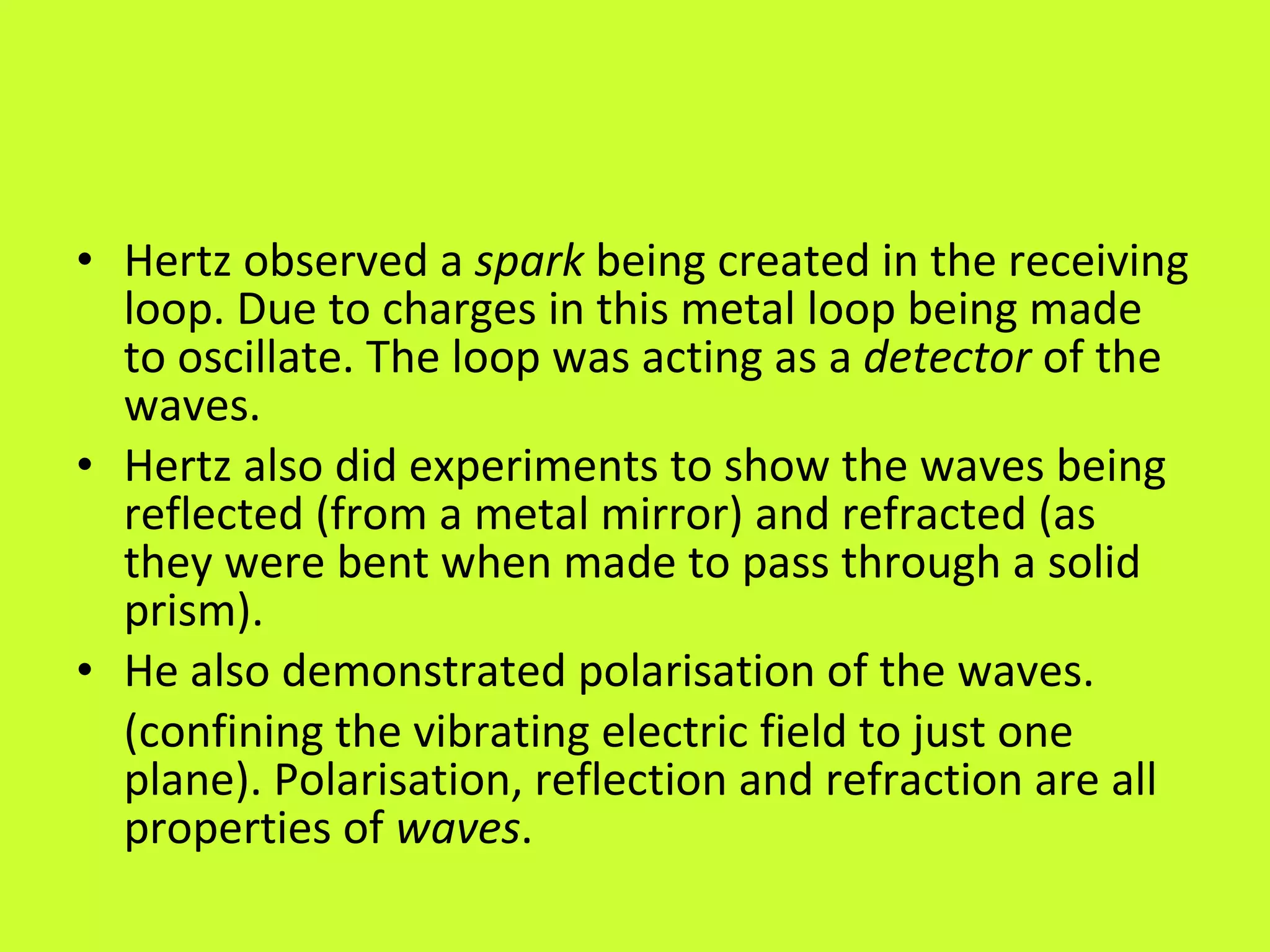
The Hertz Experiments: 1886-1888 Hertz used a rapidly oscillating spark (charge) in an induction coil to produce a rapidly changing electric field (creating a changing magnetic field…). This sent EM waves across a distance of a few hundred metres, where they were detected by a receiving loop.
Hertz observed a  spark  being created in the receiving loop. Due to charges in this metal loop being made to oscillate. The loop was acting as a  detector  of the waves. Hertz also did experiments to show the waves being reflected (from a metal mirror) and refracted (as they were bent when made to pass through a solid prism). He also demonstrated polarisation of the waves. (confining the vibrating electric field to just one plane). Polarisation, reflection and refraction are all properties of  waves .
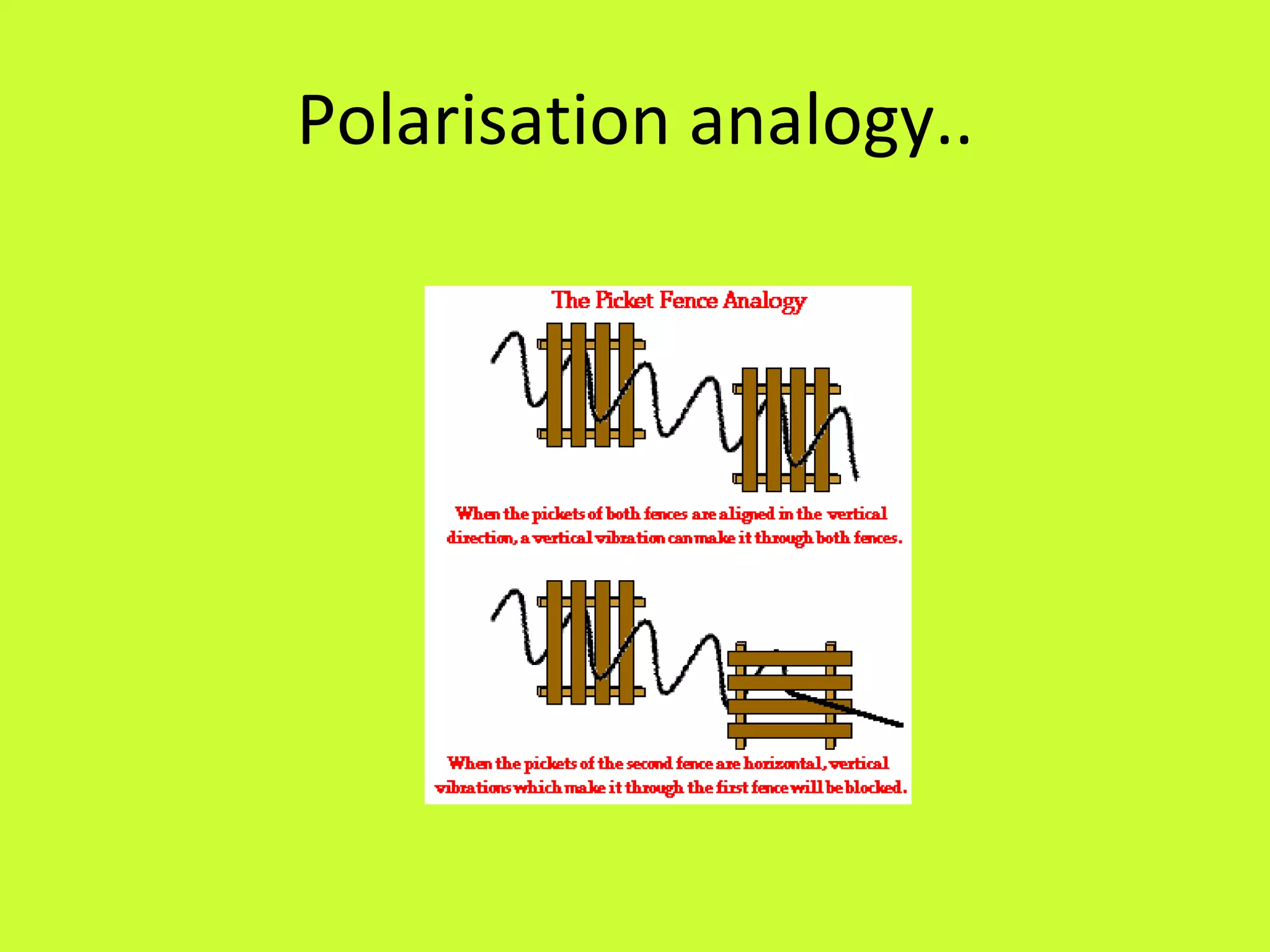
Polarisation analogy..
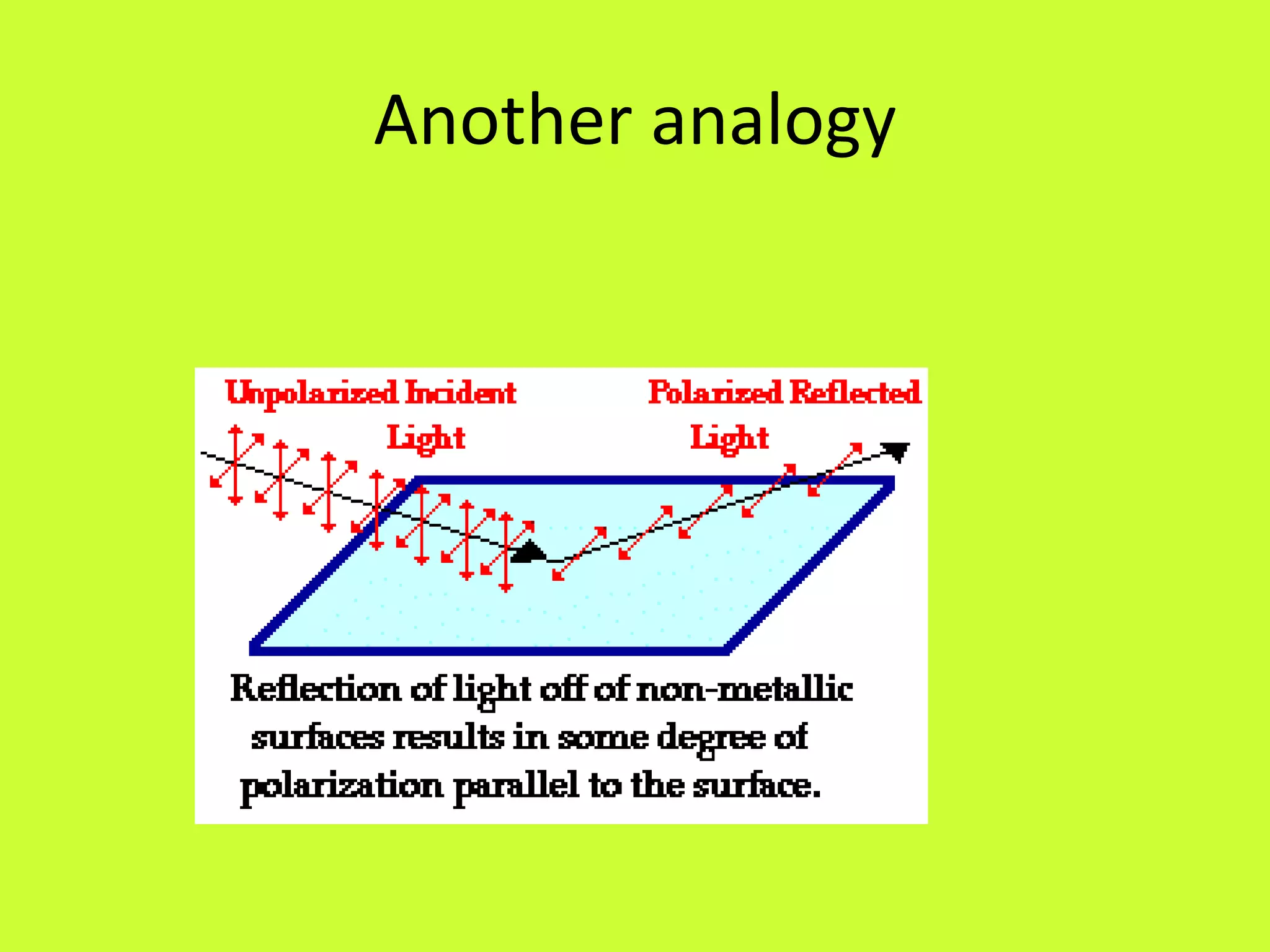
Polarisation by reflection Unpolarized light can also undergo polarization by reflection off of non-metallic surfaces. The extent to which polarization occurs is dependent upon the angle at which the light approaches the surface and upon the material that the surface is made of. Metallic surfaces reflect light with a variety of vibrational directions; such reflected light is unpolarized. However, non-metallic surfaces such as asphalt roadways, snowfields and water reflect light such that there is a large concentration of vibrations in a plane parallel to the reflecting surface. A person viewing objects by means of light reflected off of non-metallic surfaces will often perceive a glare if the extent of polarization is large.
Another analogy
Measuring the speed of Hertz’s radio waves Hertz reasoned that there had to be a tiny time delay between making and detecting his waves, as the speed of the EM waves was not infinitely fast. He found this speed by taking the known frequency of his waves (as controlled by him), and then finding the wavelength by doing interference experiments with the waves. The wave equation (v = f  λ ) is then used to find ‘v’. ‘ v’ matched the already known speed of light.
An extra discovery….. Hertz also observed that if he illuminated his receiving loop with UV light, the spark he made was more intense (brighter).  He also found that if he put glass in front of the loop, the spark decrease in intensity, as glass blocked UV light. Placing the coil in a dark box had a similar effect. Hertz had, unknowingly, discovered the photoelectric effect (the emission of electrons from a metal surface when struck by light above a certain frequency).  Hertz died before he investigated further.
Hertz quotes Hertz did not describe the application of the technology and seemed uninterested in the practical importance of his experiments. Asked about the ramifications of his discoveries, Hertz replied, " Nothing, I guess ." Hertz also stated, " I do not think that the wireless waves I have discovered will have any practical application."
Black body radiation Recall from yr 11  Cosmic Engine  module: Black bodies  are ideal objects that can absorb all incoming radiation (thus appearing ‘black’). They are also, in turn, perfect emitters of radiation.  Black bodies produce characteristic radiation curves, which depend only on the temperature of the body, not its chemical composition.
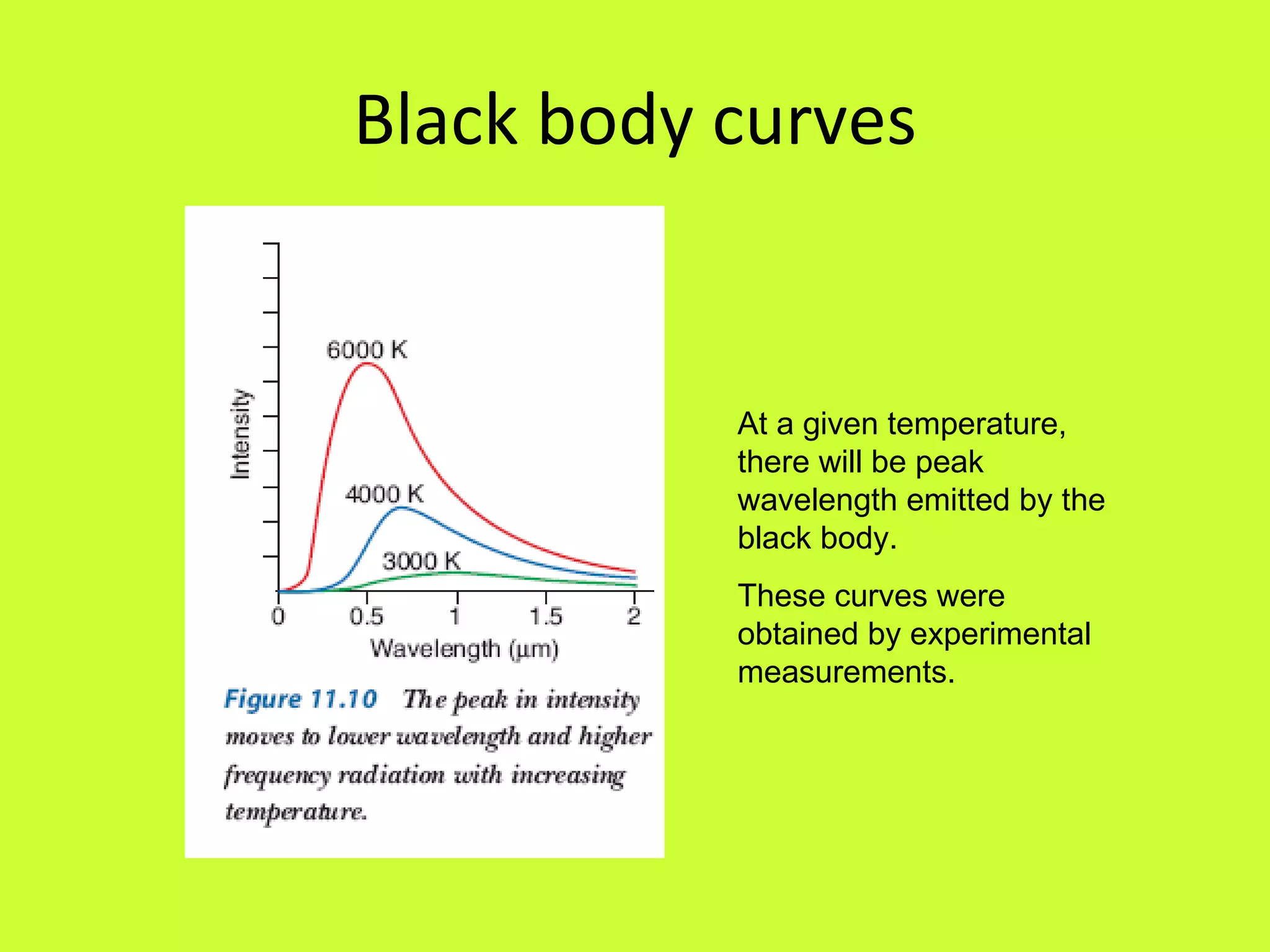
Black body curves At a given temperature, there will be peak wavelength emitted by the black body. These curves were obtained by experimental measurements.
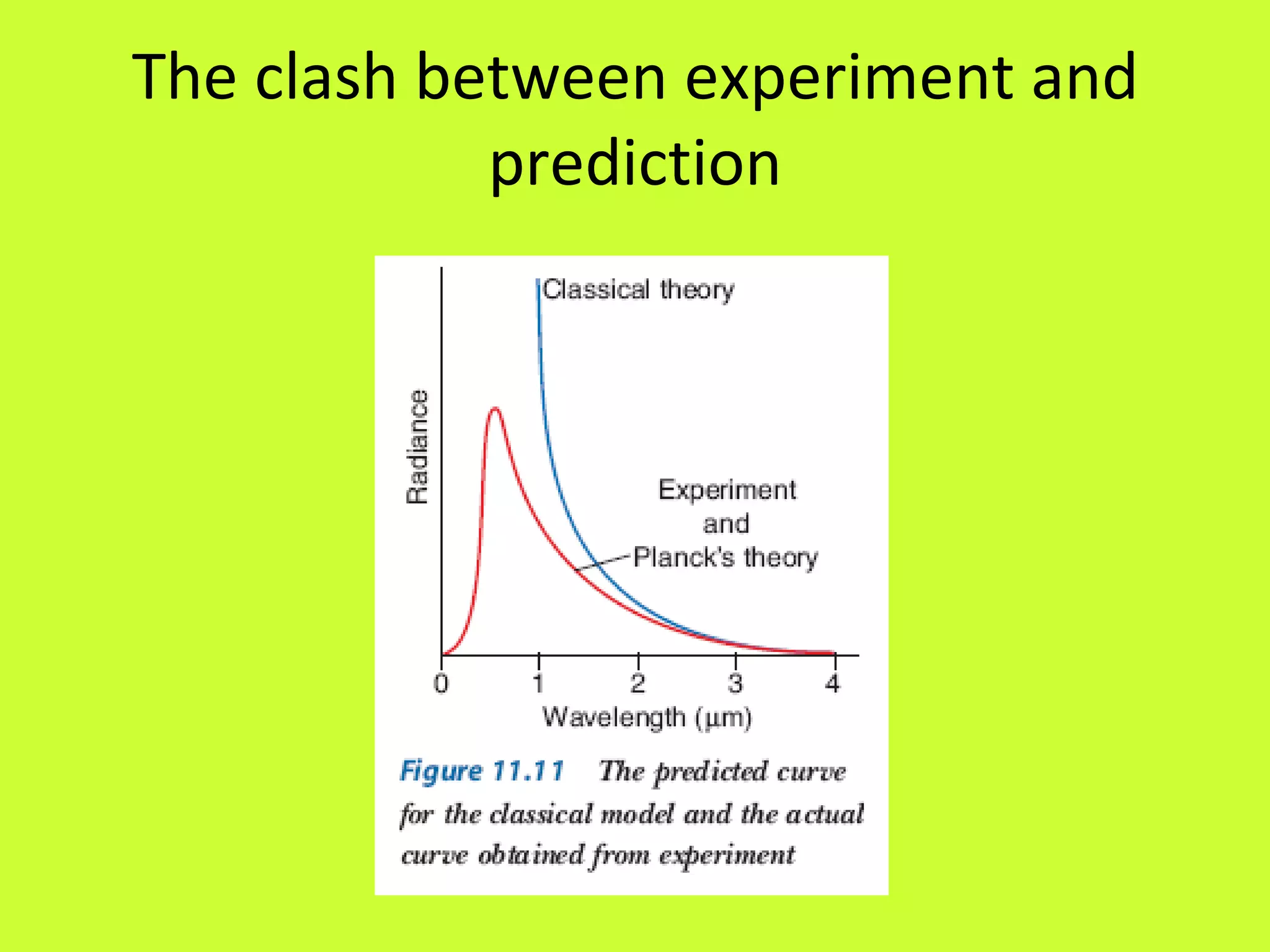
The Ultraviolet catastrophe Existing theories of light energy assumed that light acted as a continuous wave. Applying the appropriate formulae resulted in predictions that as the peak radiation approached the UV region ,the intensity should increase towards infinity. This would clearly violate energy conservation laws.
The clash between experiment and prediction
Max Planck -1900 Max Planck proposed that the experimentally measured curves could be explained statistically as if the radiation emitted was in multiples of some small minimum amount. Each ‘lump’ or ‘piece’ of radiation had an energy characteristic of the frequency of the radiation. These small packets were called  quanta .
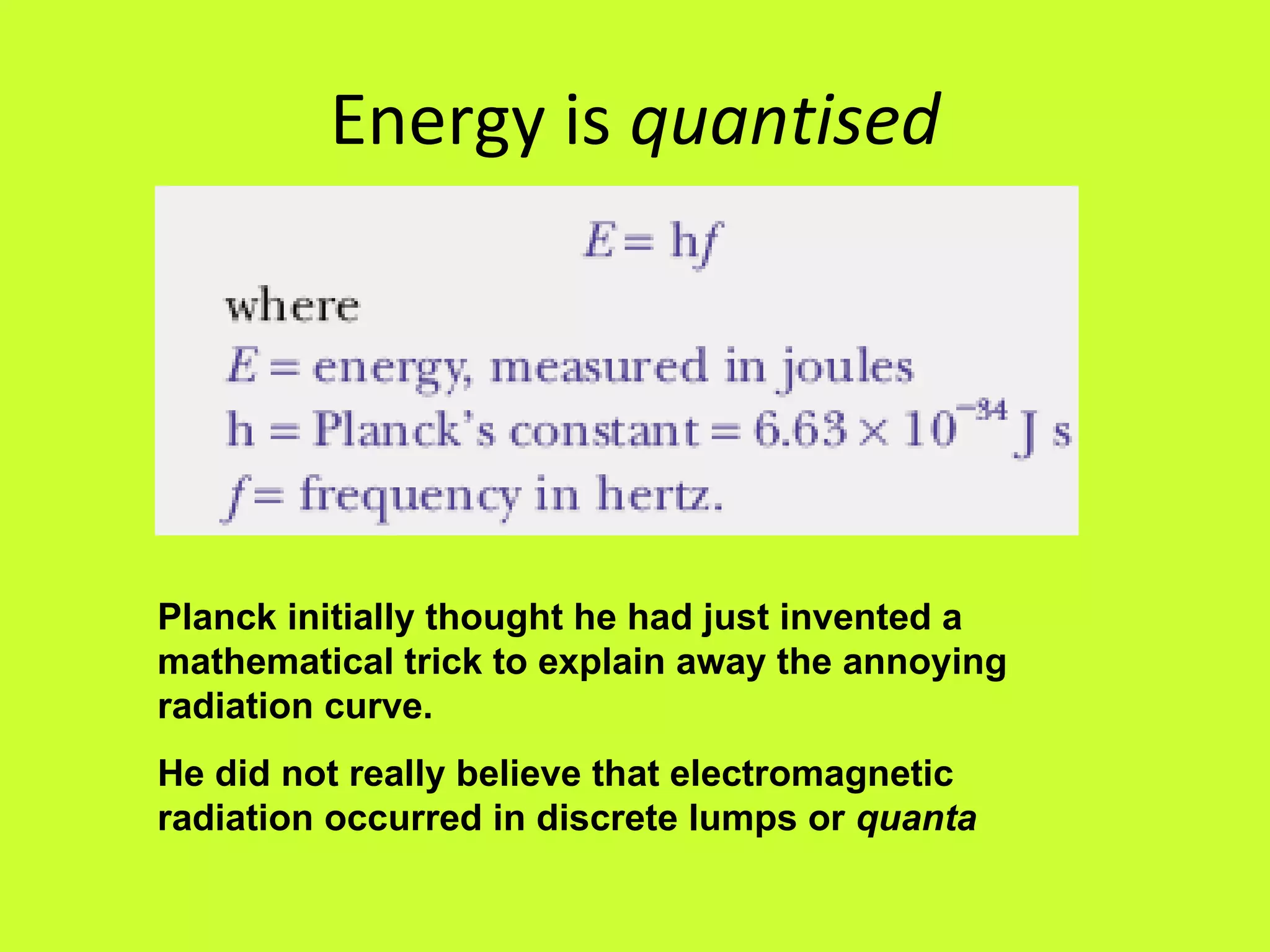
Energy is  quantised Planck initially thought he had just invented a mathematical trick to explain away the annoying radiation curve.  He did not really believe that electromagnetic radiation occurred in discrete lumps or  quanta

Quantum Physics ,Hertz and Planck ppt

  • 1.
    QUANTUM PHYSICS Anoverview of some key ideas from Maxwell, Hertz and Planck.
  • 2.
    Introduction Quantum theoryranks with relativity as one of the revolutionary theories in twentieth century physics. The basic idea, first put forward by Max Planck in 1900, was that oscillating particles (such as electrons in atoms) cannot radiate or absorb energy in continuous amounts. Energy is only transferred in multiples of some minimum amount. The term quanta means ‘fixed amount’. The idea of quanta was soon applied by Einstein to light, and so changed our understanding about the nature of light.
  • 3.
    Electromagnetic radiation In1873 James Maxwell formulated the laws of electromagnetism. One of his predictions was the existence of electromagnetic radiation. These waves should be produced by accelerated charges which make changing electric fields. These changing electric fields produce changing magnetic fields, which make changing electric fields..... The ‘waves’ were predicted by Maxwell to propagate at light speed, 3 x 10 8 m/s. Visible light was already known to travel at 3 x 10 8 m/s., so it was also suggested that visible light was an example of electromagnetic radiation. Heinrich HERTZ is credited as being the first person to experimentally demonstrate electromagnetic radiation. He made and detected radio waves.
  • 4.
    Electromagnetic waves Thesewaves self-propagate, and can travel through empty space.
  • 5.
    The Hertz Experiments:1886-1888 Hertz used a rapidly oscillating spark (charge) in an induction coil to produce a rapidly changing electric field (creating a changing magnetic field…). This sent EM waves across a distance of a few hundred metres, where they were detected by a receiving loop.
  • 6.
    Hertz observed a spark being created in the receiving loop. Due to charges in this metal loop being made to oscillate. The loop was acting as a detector of the waves. Hertz also did experiments to show the waves being reflected (from a metal mirror) and refracted (as they were bent when made to pass through a solid prism). He also demonstrated polarisation of the waves. (confining the vibrating electric field to just one plane). Polarisation, reflection and refraction are all properties of waves .
  • 7.
  • 8.
    Polarisation by reflectionUnpolarized light can also undergo polarization by reflection off of non-metallic surfaces. The extent to which polarization occurs is dependent upon the angle at which the light approaches the surface and upon the material that the surface is made of. Metallic surfaces reflect light with a variety of vibrational directions; such reflected light is unpolarized. However, non-metallic surfaces such as asphalt roadways, snowfields and water reflect light such that there is a large concentration of vibrations in a plane parallel to the reflecting surface. A person viewing objects by means of light reflected off of non-metallic surfaces will often perceive a glare if the extent of polarization is large.
  • 9.
  • 10.
    Measuring the speedof Hertz’s radio waves Hertz reasoned that there had to be a tiny time delay between making and detecting his waves, as the speed of the EM waves was not infinitely fast. He found this speed by taking the known frequency of his waves (as controlled by him), and then finding the wavelength by doing interference experiments with the waves. The wave equation (v = f λ ) is then used to find ‘v’. ‘ v’ matched the already known speed of light.
  • 11.
    An extra discovery…..Hertz also observed that if he illuminated his receiving loop with UV light, the spark he made was more intense (brighter). He also found that if he put glass in front of the loop, the spark decrease in intensity, as glass blocked UV light. Placing the coil in a dark box had a similar effect. Hertz had, unknowingly, discovered the photoelectric effect (the emission of electrons from a metal surface when struck by light above a certain frequency). Hertz died before he investigated further.
  • 12.
    Hertz quotes Hertzdid not describe the application of the technology and seemed uninterested in the practical importance of his experiments. Asked about the ramifications of his discoveries, Hertz replied, " Nothing, I guess ." Hertz also stated, " I do not think that the wireless waves I have discovered will have any practical application."
  • 13.
    Black body radiationRecall from yr 11 Cosmic Engine module: Black bodies are ideal objects that can absorb all incoming radiation (thus appearing ‘black’). They are also, in turn, perfect emitters of radiation. Black bodies produce characteristic radiation curves, which depend only on the temperature of the body, not its chemical composition.
  • 14.
    Black body curvesAt a given temperature, there will be peak wavelength emitted by the black body. These curves were obtained by experimental measurements.
  • 15.
    The Ultraviolet catastropheExisting theories of light energy assumed that light acted as a continuous wave. Applying the appropriate formulae resulted in predictions that as the peak radiation approached the UV region ,the intensity should increase towards infinity. This would clearly violate energy conservation laws.
  • 16.
    The clash betweenexperiment and prediction
  • 17.
    Max Planck -1900Max Planck proposed that the experimentally measured curves could be explained statistically as if the radiation emitted was in multiples of some small minimum amount. Each ‘lump’ or ‘piece’ of radiation had an energy characteristic of the frequency of the radiation. These small packets were called quanta .
  • 18.
    Energy is quantised Planck initially thought he had just invented a mathematical trick to explain away the annoying radiation curve. He did not really believe that electromagnetic radiation occurred in discrete lumps or quanta