SIMPLE DIPOLE ANTENNA
DESIGN AND SIMULATION
Vengalam Mahendra
AIM
• The aim is to design and simulate a basic
dipole antenna on a given ‘frequency’ and
study the radiation properties and frequency
responses through various antenna
parameters i.e.., relative Dielectric constant
(εr), substrate thickness (t).
Technical objective
• There are several important antenna
characteristics that should be considered
when choosing an antenna for your
application as follows:
1).Antenna radiation patterns
2).Gain
3).Frequency response
DESCRIPTION
• Half wave dipole antenna consists of two identical
conductive elements such as metal rods which are
bilaterally symmetrical. The "half-wave" term means
that the length of this dipole antenna is equal to a
half-wavelength at the frequency of operation.
• It is basically fed in the center where the impedance
falls to lowest. The voltage and current levels vary
along the length of the radiating section of the
antenna. For a dipole antenna that is an electrical
half wavelength long, the inductive and capacitive
reactance cancel each other and the antenna
becomes resonant.
DESIGN
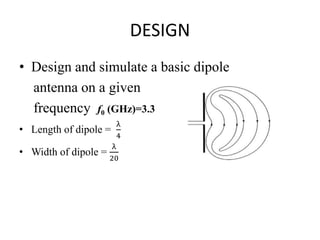
• Design and simulate a basic dipole
antenna on a given
frequency f0 (GHz)=3.3
• Length of dipole =
λ
4
• Width of dipole =
λ
20
SIMULATION
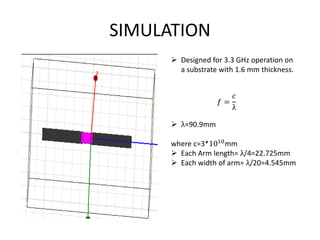
 Designed for 3.3 GHz operation on
a substrate with 1.6 mm thickness.
𝑓 =
𝑐
λ
 λ=90.9mm
where c=3*1010
mm
 Each Arm length= λ/4=22.725mm
 Each width of arm= λ/20=4.545mm
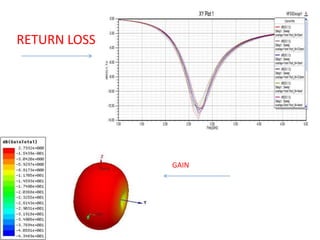
RETURN LOSS
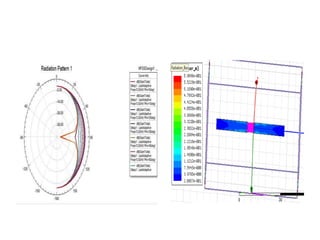
GAIN
RADIATION MECHANISM
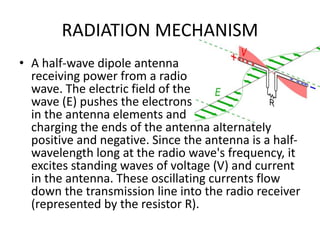
• A half-wave dipole antenna
receiving power from a radio
wave. The electric field of the
wave (E) pushes the electrons
in the antenna elements and
charging the ends of the antenna alternately
positive and negative. Since the antenna is a half-
wavelength long at the radio wave's frequency, it
excites standing waves of voltage (V) and current
in the antenna. These oscillating currents flow
down the transmission line into the radio receiver
(represented by the resistor R).
CONCLUSION
The aim of our project is to design & simulation
of Dipole antenna. The measured antenna gain
reaches about 2.732 dB. From the simulation
results, it shows that operates in 2.8GHz with a
return loss of -14.50dB

Dipole antenna

  • 1.
    SIMPLE DIPOLE ANTENNA DESIGNAND SIMULATION Vengalam Mahendra
  • 2.
    AIM • The aimis to design and simulate a basic dipole antenna on a given ‘frequency’ and study the radiation properties and frequency responses through various antenna parameters i.e.., relative Dielectric constant (εr), substrate thickness (t).
  • 3.
    Technical objective • Thereare several important antenna characteristics that should be considered when choosing an antenna for your application as follows: 1).Antenna radiation patterns 2).Gain 3).Frequency response
  • 4.
    DESCRIPTION • Half wavedipole antenna consists of two identical conductive elements such as metal rods which are bilaterally symmetrical. The "half-wave" term means that the length of this dipole antenna is equal to a half-wavelength at the frequency of operation. • It is basically fed in the center where the impedance falls to lowest. The voltage and current levels vary along the length of the radiating section of the antenna. For a dipole antenna that is an electrical half wavelength long, the inductive and capacitive reactance cancel each other and the antenna becomes resonant.
  • 5.
    DESIGN • Design andsimulate a basic dipole antenna on a given frequency f0 (GHz)=3.3 • Length of dipole = λ 4 • Width of dipole = λ 20
  • 6.
    SIMULATION  Designed for3.3 GHz operation on a substrate with 1.6 mm thickness. 𝑓 = 𝑐 λ  λ=90.9mm where c=3*1010 mm  Each Arm length= λ/4=22.725mm  Each width of arm= λ/20=4.545mm
  • 7.
  • 8.
    RADIATION MECHANISM • Ahalf-wave dipole antenna receiving power from a radio wave. The electric field of the wave (E) pushes the electrons in the antenna elements and charging the ends of the antenna alternately positive and negative. Since the antenna is a half- wavelength long at the radio wave's frequency, it excites standing waves of voltage (V) and current in the antenna. These oscillating currents flow down the transmission line into the radio receiver (represented by the resistor R).
  • 10.
    CONCLUSION The aim ofour project is to design & simulation of Dipole antenna. The measured antenna gain reaches about 2.732 dB. From the simulation results, it shows that operates in 2.8GHz with a return loss of -14.50dB