4.1.2 MICROWAVE SOLID-STATE
DEVICES (SEMICONDUCTOR
DIODE)
 Quantum Mechanic Tunneling – Tunnel diode
 Transferred Electron Devices – Gunn, LSA, InP and CdTe
 Avalanche Transit Time – IMPATT, Read, Baritt & TRAPATT

 Parametric Devices – Varactor diode

 Step Recovery Diode – PIN,

 Schottky Barrier Diode.


 Designed to minimize capacitances and transit time.
 NPN bipolar and N channel FETs preferred because free electrons move faster than holes
 Gallium Arsenide has greater electron mobility than silicon.
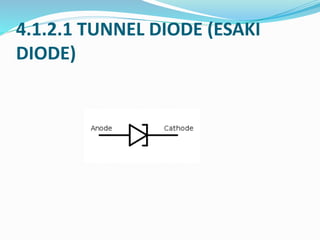
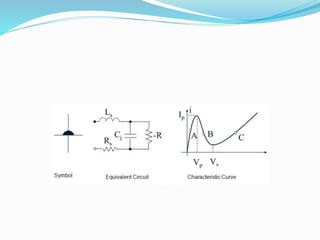
4.1.2.1 TUNNEL DIODE (ESAKI
DIODE)
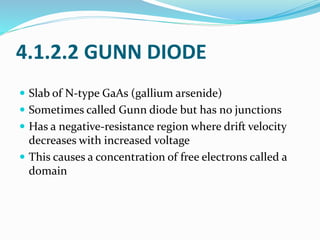
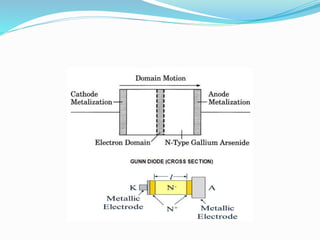
4.1.2.2 GUNN DIODE
 Slab of N-type GaAs (gallium arsenide)
 Sometimes called Gunn diode but has no junctions
 Has a negative-resistance region where drift velocity
decreases with increased voltage
 This causes a concentration of free electrons called a
domain
4.1.2.3 IMPATT DIODE
4.1.2.4 VARACTOR DIODES
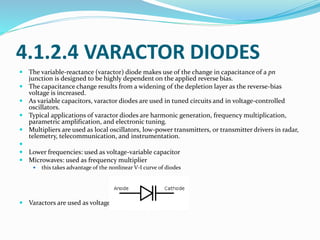
 The variable-reactance (varactor) diode makes use of the change in capacitance of a pn
junction is designed to be highly dependent on the applied reverse bias.
 The capacitance change results from a widening of the depletion layer as the reverse-bias
voltage is increased.
 As variable capacitors, varactor diodes are used in tuned circuits and in voltage-controlled
oscillators.
 Typical applications of varactor diodes are harmonic generation, frequency multiplication,
parametric amplification, and electronic tuning.
 Multipliers are used as local oscillators, low-power transmitters, or transmitter drivers in radar,
telemetry, telecommunication, and instrumentation.

 Lower frequencies: used as voltage-variable capacitor
 Microwaves: used as frequency multiplier
 this takes advantage of the nonlinear V-I curve of diodes
 Varactors are used as voltage-controlled capacitors
4.1.2.5 PIN DIODE
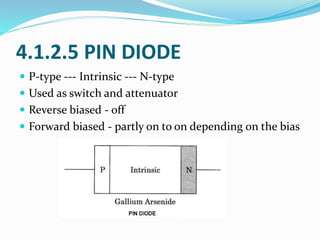
 P-type --- Intrinsic --- N-type
 Used as switch and attenuator
 Reverse biased - off
 Forward biased - partly on to on depending on the bias
LSA
4.1.2.7 SCHOTTKY BARRIER DIODE
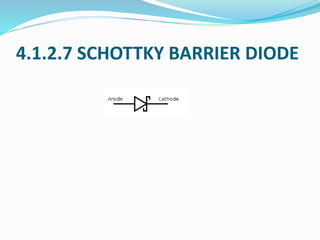
 A Schottky barrier diode (SBD) consists of a rectifying metal-
semiconductor barrier typically formed by deposition of a metal layer
on a semiconductor.
 The SBD functions in a similar manner to the antiquated point contact
diode and the slower-response pn-junction diode, and is used for signal
mixing and detection.
 The point contact diode consists of a metal whisker in contact with a
semiconductor, forming a rectifying junction.
 The SBD is more rugged and reliable than the point contact diode.
 The SBD's main advantage over pn diodes is the absence of minority
carriers, which limit the response speed in switching applications and
the high-frequency performance in mixing and detection applications.
 SBDs are zero-bias detectors.
 Frequencies to 40 GHz are available with silicon SBDs, and GaAs SBDs
are used for higher-frequency applications.

4_microwave_device.pptx

  • 1.
    4.1.2 MICROWAVE SOLID-STATE DEVICES(SEMICONDUCTOR DIODE)  Quantum Mechanic Tunneling – Tunnel diode  Transferred Electron Devices – Gunn, LSA, InP and CdTe  Avalanche Transit Time – IMPATT, Read, Baritt & TRAPATT   Parametric Devices – Varactor diode   Step Recovery Diode – PIN,   Schottky Barrier Diode.    Designed to minimize capacitances and transit time.  NPN bipolar and N channel FETs preferred because free electrons move faster than holes  Gallium Arsenide has greater electron mobility than silicon.
  • 2.
    4.1.2.1 TUNNEL DIODE(ESAKI DIODE)
  • 4.
    4.1.2.2 GUNN DIODE Slab of N-type GaAs (gallium arsenide)  Sometimes called Gunn diode but has no junctions  Has a negative-resistance region where drift velocity decreases with increased voltage  This causes a concentration of free electrons called a domain
  • 6.
  • 8.
    4.1.2.4 VARACTOR DIODES The variable-reactance (varactor) diode makes use of the change in capacitance of a pn junction is designed to be highly dependent on the applied reverse bias.  The capacitance change results from a widening of the depletion layer as the reverse-bias voltage is increased.  As variable capacitors, varactor diodes are used in tuned circuits and in voltage-controlled oscillators.  Typical applications of varactor diodes are harmonic generation, frequency multiplication, parametric amplification, and electronic tuning.  Multipliers are used as local oscillators, low-power transmitters, or transmitter drivers in radar, telemetry, telecommunication, and instrumentation.   Lower frequencies: used as voltage-variable capacitor  Microwaves: used as frequency multiplier  this takes advantage of the nonlinear V-I curve of diodes  Varactors are used as voltage-controlled capacitors
  • 9.
    4.1.2.5 PIN DIODE P-type --- Intrinsic --- N-type  Used as switch and attenuator  Reverse biased - off  Forward biased - partly on to on depending on the bias
  • 10.
  • 11.
  • 12.
     A Schottkybarrier diode (SBD) consists of a rectifying metal- semiconductor barrier typically formed by deposition of a metal layer on a semiconductor.  The SBD functions in a similar manner to the antiquated point contact diode and the slower-response pn-junction diode, and is used for signal mixing and detection.  The point contact diode consists of a metal whisker in contact with a semiconductor, forming a rectifying junction.  The SBD is more rugged and reliable than the point contact diode.  The SBD's main advantage over pn diodes is the absence of minority carriers, which limit the response speed in switching applications and the high-frequency performance in mixing and detection applications.  SBDs are zero-bias detectors.  Frequencies to 40 GHz are available with silicon SBDs, and GaAs SBDs are used for higher-frequency applications.