In the implementation of         the
curriculum,   there   are   processes
needed after it has been written and
before it is accepted for final
implementation. Pilot testing or field
try out is one of the common
practices of curriculum makers to
determine the strength and the
weaknesses of a written or planned
curriculum. Likewise monitoring and
evaluation of the curriculum are also
important in the implementation.
Whenever a curriculum is written as
in books, modules, etc. or the whole
curricular program, there is a need to
have a try-out or field testing. This
process will gather empirical data to
support whether the material or the
curriculum is useful, relevant, reliable
and valid.
Modification    and   revision    are
inherent    characteristics     of     a
curriculum. The pilot test or try-out is
a developmental process that gives
the signal as to whether the
particular curriculum can already be
implemented with confidence.
  However, as the curriculum is
implemented,     there is a need to
continuously monitor the process.
Monitoring ask the question: How
  are we doing? Is the curriculum
  accomplishing its intended purpose?
Monitoring is also important:
• To determine if the curriculum is still
  relevant and effective
• How the curriculum is working

• Provides decision on what aspects
  have to be retained, improved or
  modified
• Provides decision that would even end
  or terminate the program
Curriculum evaluation as part of
total educational evaluation refers to
a systematic process of judging the
value, effectiveness and adequacy of
a curriculum: its process, product and
setting which will lead to informed
decision. Evaluation should be useful
and systematic. The information
gathered should be important for the
improvement of and for final judgment
of the curriculum being evaluated.
In practice, there are two ways of
curriculum evaluation

1. School-based evaluation
2. Accreditation
- is an approach to curriculum
evaluation    which     places   the
content,   design,    operation  and
maintenance of evaluation procedure
in the hands of the school personnel.
The school personnel participate in
the planning and conduct of school
evaluation where the control and
management of the process rest on
the school personnel themselves.
This is a voluntary process of
submitting a curricular program to an
external accrediting body for review
in     any    level   of    education:
basic, tertiary or graduate school to
assure      standard.    Accreditation
studies    the   statement    of   the
educational intentions of the school
and affirms a standard of excellence.
Among the many purposes of
accreditation are to foster excellence
and improve programs. The curricular
accreditation     will   assure     the
academic community, other agencies
and the general public that curriculum
meets standards comparable to other
excellent institutions offering similar
programs.
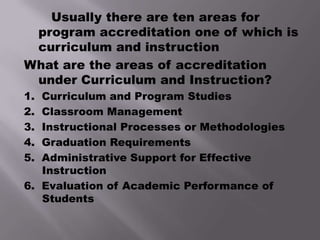
Usually there are ten areas for
 program accreditation one of which is
 curriculum and instruction
What are the areas of accreditation
 under Curriculum and Instruction?
1. Curriculum and Program Studies
2. Classroom Management
3. Instructional Processes or Methodologies
4. Graduation Requirements
5. Administrative Support for Effective
   Instruction
6. Evaluation of Academic Performance of
   Students
Program of studies includes the
clusters                             of
knowledge, skills, attitudes, values
and experiences that will provide the
students at any level with the
necessary competencies for effective
learning. A list of subjects or courses
to be taken and arrange in logical
order compose the program of
studies.
For effective instruction, the use of
appropriate classroom management is
suggested.      The     teacher     who
implements the curriculum sees to it
that management of teaching and
learning in the classroom follows
procedure and guidance to enhance
and create an environment conducive
to     learning.    An     environment
conducive to learning considers the
physical as well as the human factors.
The decision of choosing and using
the method of teaching is a crucial
factor in curriculum and instruction.
There are varied methodologies that
are compatible with the different
learning style of the students. These
emerging    strategies   of   teaching
follow principles and theories that
enhance    learning    outcomes.    As
teachers, there is a need to know not
only the steps or strategies of
teaching but to understand the
pedagogical content knowledge of
each strategy.
Graduation     means     successful
accomplishment of the curricular
program of studies. A student has to
accomplish its academic program as
prescribed in the program of studies.
These    requirements   are   clearly
understood    upon    enrollment    in
college by the students and by the
parents   for     students   in   the
elementary or high school. The grade
requirements of each subjects should
be known.
A curriculum can be best
implemented if there is support of the
school administration.
In curriculum, it is necessary that
learning outcomes be evaluated. After
all the best measure of a curriculum
is the learning outcome of the
students.
  The     evaluation    of    students’
performance should make use of valid
and    reliable   tools    which   are
periodically reviewed and revised.

Pilot testing, monitoring and evaluating the implementation

  • 1.
    In the implementationof the curriculum, there are processes needed after it has been written and before it is accepted for final implementation. Pilot testing or field try out is one of the common practices of curriculum makers to determine the strength and the weaknesses of a written or planned curriculum. Likewise monitoring and evaluation of the curriculum are also important in the implementation.
  • 2.
    Whenever a curriculumis written as in books, modules, etc. or the whole curricular program, there is a need to have a try-out or field testing. This process will gather empirical data to support whether the material or the curriculum is useful, relevant, reliable and valid.
  • 3.
    Modification and revision are inherent characteristics of a curriculum. The pilot test or try-out is a developmental process that gives the signal as to whether the particular curriculum can already be implemented with confidence. However, as the curriculum is implemented, there is a need to continuously monitor the process.
  • 4.
    Monitoring ask thequestion: How are we doing? Is the curriculum accomplishing its intended purpose? Monitoring is also important: • To determine if the curriculum is still relevant and effective • How the curriculum is working • Provides decision on what aspects have to be retained, improved or modified • Provides decision that would even end or terminate the program
  • 5.
    Curriculum evaluation aspart of total educational evaluation refers to a systematic process of judging the value, effectiveness and adequacy of a curriculum: its process, product and setting which will lead to informed decision. Evaluation should be useful and systematic. The information gathered should be important for the improvement of and for final judgment of the curriculum being evaluated.
  • 6.
    In practice, thereare two ways of curriculum evaluation 1. School-based evaluation 2. Accreditation
  • 7.
    - is anapproach to curriculum evaluation which places the content, design, operation and maintenance of evaluation procedure in the hands of the school personnel. The school personnel participate in the planning and conduct of school evaluation where the control and management of the process rest on the school personnel themselves.
  • 8.
    This is avoluntary process of submitting a curricular program to an external accrediting body for review in any level of education: basic, tertiary or graduate school to assure standard. Accreditation studies the statement of the educational intentions of the school and affirms a standard of excellence.
  • 9.
    Among the manypurposes of accreditation are to foster excellence and improve programs. The curricular accreditation will assure the academic community, other agencies and the general public that curriculum meets standards comparable to other excellent institutions offering similar programs.
  • 10.
    Usually there areten areas for program accreditation one of which is curriculum and instruction What are the areas of accreditation under Curriculum and Instruction? 1. Curriculum and Program Studies 2. Classroom Management 3. Instructional Processes or Methodologies 4. Graduation Requirements 5. Administrative Support for Effective Instruction 6. Evaluation of Academic Performance of Students
  • 11.
    Program of studiesincludes the clusters of knowledge, skills, attitudes, values and experiences that will provide the students at any level with the necessary competencies for effective learning. A list of subjects or courses to be taken and arrange in logical order compose the program of studies.
  • 12.
    For effective instruction,the use of appropriate classroom management is suggested. The teacher who implements the curriculum sees to it that management of teaching and learning in the classroom follows procedure and guidance to enhance and create an environment conducive to learning. An environment conducive to learning considers the physical as well as the human factors.
  • 13.
    The decision ofchoosing and using the method of teaching is a crucial factor in curriculum and instruction. There are varied methodologies that are compatible with the different learning style of the students. These emerging strategies of teaching follow principles and theories that enhance learning outcomes. As teachers, there is a need to know not only the steps or strategies of teaching but to understand the pedagogical content knowledge of each strategy.
  • 14.
    Graduation means successful accomplishment of the curricular program of studies. A student has to accomplish its academic program as prescribed in the program of studies. These requirements are clearly understood upon enrollment in college by the students and by the parents for students in the elementary or high school. The grade requirements of each subjects should be known.
  • 15.
    A curriculum canbe best implemented if there is support of the school administration.
  • 16.
    In curriculum, itis necessary that learning outcomes be evaluated. After all the best measure of a curriculum is the learning outcome of the students. The evaluation of students’ performance should make use of valid and reliable tools which are periodically reviewed and revised.