 International Educational Leadership Trainer.
Provides consultation on Lean and leads Kaizen,
TPM, Cellular system & Moonshine set up.
 A multi skill Innovator with Mechanical background
that adopts Green Living by Recycling and Reusing
Idle resources to eliminate waste to add Value.
 Founder of Tim’s Waterfuel, an alternative HHO gas
supplement using Water that adds power, add
millage & reduce Co2 emission on automobiles.
 An NGO Community worker for Prison, Drug
Rehab. and Crisis Relieve & Training (CREST)
Malaysia, an organization that respond to Crisis &
Flood.
Timothy Wooi
20C,Taman Bahagia,
06000, Jitra, Kedah
timothywooi2@gmail.com
Trainer’s ProfileTrainer’s Profile
Certified HRDF Trainer & Principal Consultant
for Lean Management and a Kaizen Specialist
with 30 over years working experience.
Baguio Convention Center, Baguio City
Concourse Convention Center, Legazpi City
April
13-17
2015
April
20-24
2015
Details: call / text 09175147952
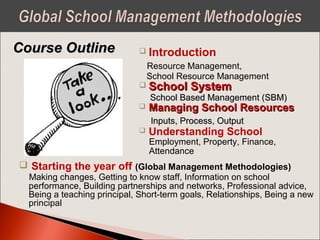
 Introduction
Resource Management,
School Resource Management
 School SystemSchool System
School Based Management (SBM)School Based Management (SBM)
 Managing School ResourcesManaging School Resources
Inputs, Process, OutputInputs, Process, Output
 Understanding School
Employment, Property, Finance,
Attendance
Course OutlineCourse Outline
 Starting the year off (Global Management Methodologies)
Making changes, Getting to know staff, Information on school
performance, Building partnerships and networks, Professional advice,
Being a teaching principal, Short-term goals, Relationships, Being a new
principal
To be the School of Choice, renown internationallyTo be the School of Choice, renown internationally
for excellence in Sfor excellence in School Management for
Performance and Students Achievements
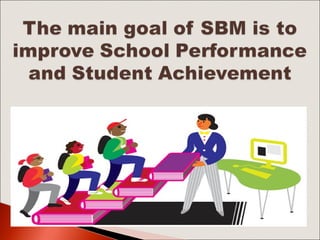
SSchool Performance (quality of instruction )
Students Achievements (equity in areas of student participation including the poorest sector society)
"Every school need to have systems that help
create the conditions for staff and students to
work effectively together.
School systems provide simple,
clear goals and effective
processes to effectively
communicate the ground rules for
everyone.
They ensure a measure of
consistency in approach and
action across the school".
These practical guide is for first-time and recently
appointed principals to have an insight of global school
management system methodologies,
aligned to Department of
Education in the Philippines
to adopt and apply it in
school leadership across
school systems on a day-to-
day basis.
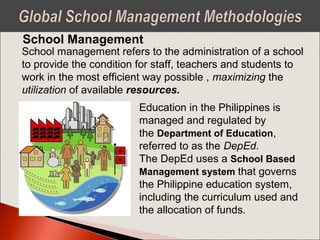
School Management
School management refers to the administration of a school
to provide the condition for staff, teachers and students to
work in the most efficient way possible , maximizing the
utilization of available resources.
Education in the Philippines is
managed and regulated by
the Department of Education,
referred to as the DepEd.
The DepEd uses a School Based
Management system that governs
the Philippine education system,
including the curriculum used and
the allocation of funds.
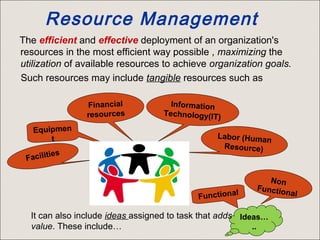
Resource Management
The efficient and effective deployment of an organization's
resources in the most efficient way possible , maximizing the
utilization of available resources to achieve organization goals.
Such resources may include tangible resources such as
Information
Technology(IT)
Facilities
Financial
resources
Ideas…
..
Equipmen
t
It can also include ideas assigned to task that adds
value. These include…
Functional
Non
Functional
Labor (Human
Resource)
In the past resource management, a key issue has been
how to improve or re-engineer the internal school process as
a whole to add value through school effectiveness.
The answer:-
a new trend in school management,
-knowledge based with empowerment
to its internal process to maximize
its resources for operation and
continuous development in
management, teaching & learning,
within the new changing 21st
century
that adds value
SBM, a key component of Basic Education Sector Reform Agenda or BESRA.
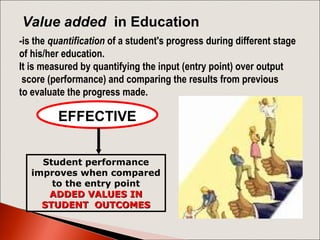
EFFECTIVE
Student performance
improves when compared
to the entry point
ADDED VALUES INADDED VALUES IN
STUDENT OUTCOMESSTUDENT OUTCOMES
-is the quantification of a student's progress during different stage
of his/her education.
It is measured by quantifying the input (entry point) over output
score (performance) and comparing the results from previous
to evaluate the progress made.
Value added in Education
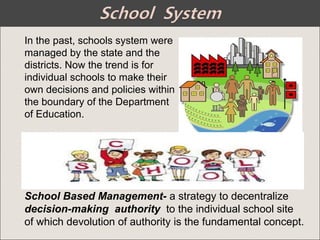
School Based Management- a strategy to decentralize
decision-making authority to the individual school site
of which devolution of authority is the fundamental concept.
In the past, schools system were
managed by the state and the
districts. Now the trend is for
individual schools to make their
own decisions and policies within
the boundary of the Department
of Education.
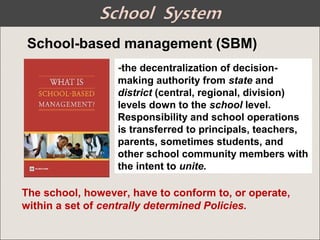
-the decentralization of decision-
making authority from state and
district (central, regional, division)
levels down to the school level.
Responsibility and school operations
is transferred to principals, teachers,
parents, sometimes students, and
other school community members with
the intent to unite.
School-based management (SBM)
The school, however, have to conform to, or operate,
within a set of centrally determined Policies.
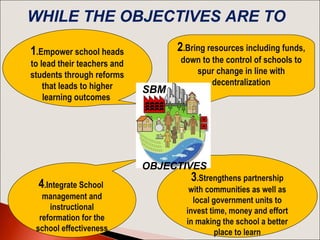
4.Integrate School
management and
instructional
reformation for the
school effectiveness
1.Empower school heads
to lead their teachers and
students through reforms
that leads to higher
learning outcomes
3.Strengthens partnership
with communities as well as
local government units to
invest time, money and effort
in making the school a better
place to learn
2.Bring resources including funds,
down to the control of schools to
spur change in line with
decentralization
SBM
OBJECTIVES
WHILE THE OBJECTIVES ARE TO
A need in paradigm shift in education governance, from being
school-centered to community- and child- (learner) centered and
towards enhancing the principle of shared governance to support
the stewardship of children’s learning outcomes.
It is also imperative in the review and refinement of SBM to account
for the evidence of successful practices. Conclusive findings
suggest that the reforms in education governance systems must be
linked tightly with the changes in curriculum and instruction.
Thus, the inception of K to 12 must be integrated
in the organizational change.
SBM reform for successful practice
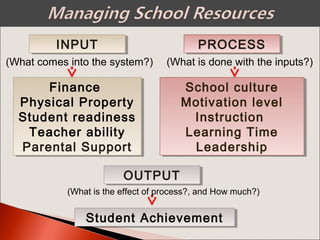
Finance
Physical Property
Student readiness
Teacher ability
Parental Support
Finance
Physical Property
Student readiness
Teacher ability
Parental Support
School culture
Motivation level
Instruction
Learning Time
Leadership
School culture
Motivation level
Instruction
Learning Time
Leadership
OUTPUTOUTPUT
Student AchievementStudent Achievement
INPUTINPUT PROCESSPROCESS
(What comes into the system?) (What is done with the inputs?)
(What is the effect of process?, and How much?)
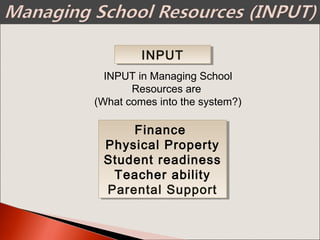
INPUT in Managing School
Resources are
(What comes into the system?)
Finance
Physical Property
Student readiness
Teacher ability
Parental Support
Finance
Physical Property
Student readiness
Teacher ability
Parental Support
INPUTINPUT
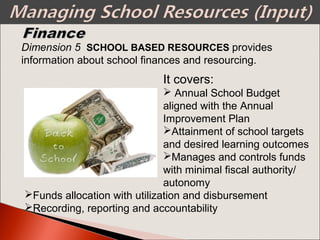
It covers:
 Annual School Budget
aligned with the Annual
Improvement Plan
Attainment of school targets
and desired learning outcomes
Manages and controls funds
with minimal fiscal authority/
autonomy
Dimension 5 SCHOOL BASED RESOURCES provides
information about school finances and resourcing.
Funds allocation with utilization and disbursement
Recording, reporting and accountability
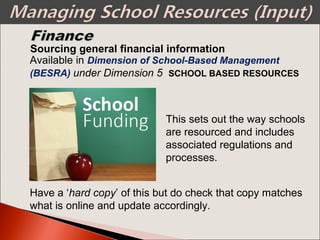
Sourcing general financial information
Available in Dimension of School-Based Management
(BESRA) under Dimension 5 SCHOOL BASED RESOURCES
This sets out the way schools
are resourced and includes
associated regulations and
processes.
Have a ‘hard copy’ of this but do check that copy matches
what is online and update accordingly.
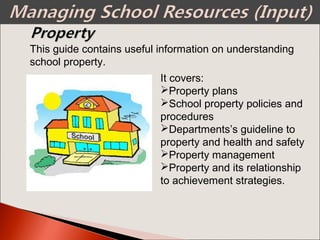
This guide contains useful information on understanding
school property.
It covers:
Property plans
School property policies and
procedures
Departments’s guideline to
property and health and safety
Property management
Property and its relationship
to achievement strategies.
Student Readiness is a student's current
understanding and knowledge towards a unit or
topic of study.
The potential to
learn is influenced
by our prior
knowledge and
connection to the
new material.
Student Readiness
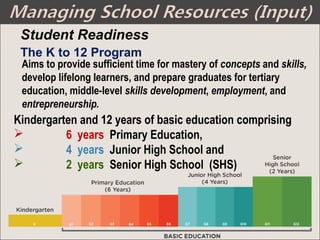
The K to 12 Program
Kindergarten and 12 years of basic education comprising
 6 years Primary Education,
 4 years Junior High School and
 2 years Senior High School (SHS)
Aims to provide sufficient time for mastery of concepts and skills,
develop lifelong learners, and prepare graduates for tertiary
education, middle-level skills development, employment, and
entrepreneurship.
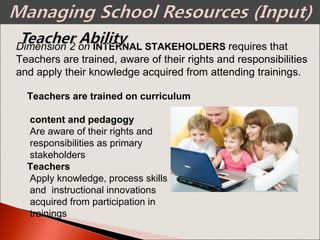
Dimension 2 on INTERNAL STAKEHOLDERS requires that
Teachers are trained, aware of their rights and responsibilities
and apply their knowledge acquired from attending trainings.
Teachers are trained on curriculum
content and pedagogy
Are aware of their rights and
responsibilities as primary
stakeholders
Teachers
Apply knowledge, process skills
and instructional innovations
acquired from participation in
trainings
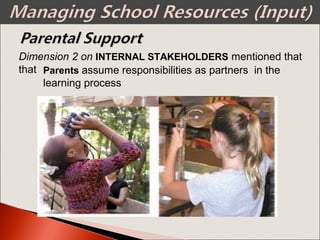
Dimension 2 on INTERNAL STAKEHOLDERS mentioned that
that Parents assume responsibilities as partners in the
learning process
‘PROCESS’ in Managing School Resources
are
(What is done with the INPUTS?)
PROCESSPROCESS
School culture
Motivation level
Instruction
Learning Time
Leadership
School culture
Motivation level
Instruction
Learning Time
Leadership
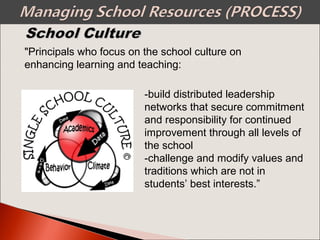
"Principals who focus on the school culture on
enhancing learning and teaching:
-build distributed leadership
networks that secure commitment
and responsibility for continued
improvement through all levels of
the school
-challenge and modify values and
traditions which are not in
students’ best interests.”
Engagement and attendance:
Promotion of the school as a
supportive and caring place is
commonly at the core of
strategies to strengthen
engagement.
The nature of teaching and
learning is being included in
strategies to reduce absence
levels.
Such strategies can be viewed as 'pull factors', working
to retain or increase engagement in learning.
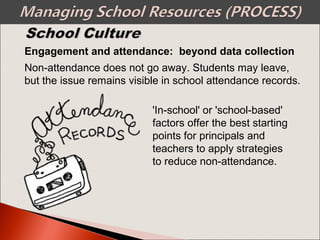
Non-attendance does not go away. Students may leave,
but the issue remains visible in school attendance records.
Engagement and attendance: beyond data collection
'In-school' or 'school-based'
factors offer the best starting
points for principals and
teachers to apply strategies
to reduce non-attendance.
Instruction
Instruction
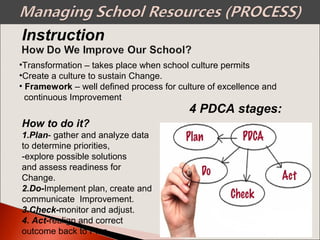
•Transformation – takes place when school culture permits
•Create a culture to sustain Change.
• Framework – well defined process for culture of excellence and
continuous Improvement
How to do it?
1.Plan- gather and analyze data
to determine priorities,
-explore possible solutions
and assess readiness for
Change.
2.Do-Implement plan, create and
communicate Improvement.
3.Check-monitor and adjust.
4. Act-realign and correct
outcome back to Plan
4 PDCA stages:
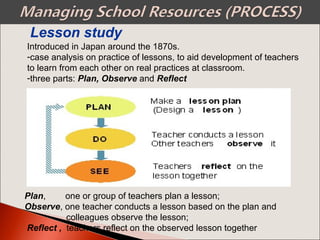
Introduced in Japan around the 1870s.
-case analysis on practice of lessons, to aid development of teachers
to learn from each other on real practices at classroom.
-three parts: Plan, Observe and Reflect
Lesson study
Plan, one or group of teachers plan a lesson;
Observe, one teacher conducts a lesson based on the plan and
colleagues observe the lesson;
Reflect , teachers reflect on the observed lesson together
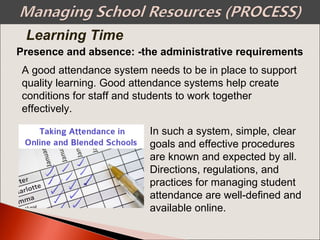
Presence and absence: -the administrative requirements
A good attendance system needs to be in place to support
quality learning. Good attendance systems help create
conditions for staff and students to work together
effectively.
In such a system, simple, clear
goals and effective procedures
are known and expected by all.
Directions, regulations, and
practices for managing student
attendance are well-defined and
available online.
Learning Time
use evidence to monitor progress,
plan, and manage change
delegate the running of systems to
appropriate staff
establish contingency strategies for
when unseen circumstances arise
analyse the attendance data to
understand school patterns.
Your school: attendance as it is now
Principals who use management systems to support and
enhance student learning: know effective management
practice and systems, use them, prioritize and select
targeted areas for improvement,:-
Learning Time
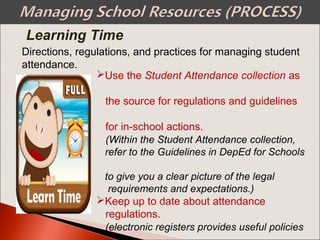
Directions, regulations, and practices for managing student
attendance.
Use the Student Attendance collection as
the source for regulations and guidelines
for in-school actions.
(Within the Student Attendance collection,
refer to the Guidelines in DepEd for Schools
to give you a clear picture of the legal
requirements and expectations.)
Keep up to date about attendance
regulations.
(electronic registers provides useful policies
Learning Time
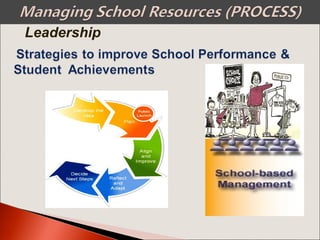
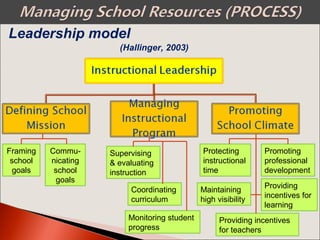
Leadership
(Hallinger, 2003)
Commu-
nicating
school
goals
Supervising
& evaluating
instruction
Providing incentives
for teachers
Leadership model
Framing
school
goals
Coordinating
curriculum
Monitoring student
progress
Protecting
instructional
time
Promoting
professional
development
Maintaining
high visibility
Providing
incentives for
learning
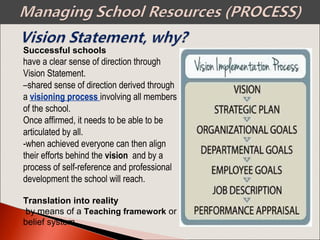
Successful schools
have a clear sense of direction through
Vision Statement.
–shared sense of direction derived through
a visioning process involving all members
of the school.
Once affirmed, it needs to be able to be
articulated by all.
-when achieved everyone can then align
their efforts behind the vision and by a
process of self-reference and professional
development the school will reach.
Translation into reality
by means of a Teaching framework or
belief system.
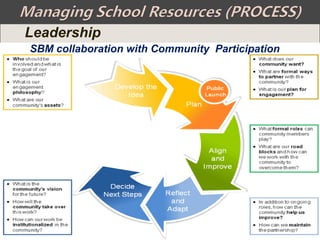
Leadership
SBM collaboration with Community Participation
OUTPUT in Managing School
Resources are
( What is the effect? and how much? )
OUTPUTOUTPUT
Student AchievementStudent Achievement
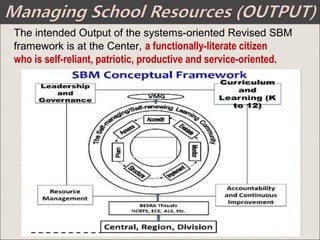
The intended Output of the systems-oriented Revised SBM
framework is at the Center, a functionally-literate citizen
who is self-reliant, patriotic, productive and service-oriented.
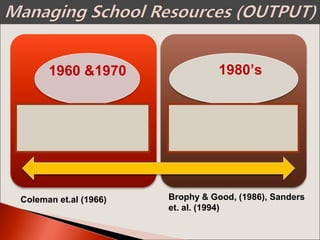
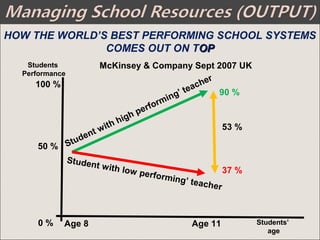
Coleman et.al (1966) Brophy & Good, (1986), Sanders
et. al. (1994)
1960 &1970 1980’s
Students
Performance
50 %
0 %
100 %
Age 11Age 8 Students’
age
Student with high performing’ teacher
Student with low performing’ teacher
90 %
53 %
37 %
HOW THE WORLD’S BEST PERFORMING SCHOOL SYSTEMS
COMES OUT ON TOPOP
McKinsey & Company Sept 2007 UK
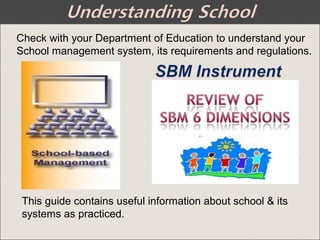
Check with your Department of Education to understand your
School management system, its requirements and regulations.
This guide contains useful information about school & its
systems as practiced.
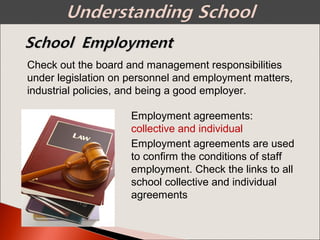
Check out the board and management responsibilities
under legislation on personnel and employment matters,
industrial policies, and being a good employer.
Employment agreements:
collective and individual
Employment agreements are used
to confirm the conditions of staff
employment. Check the links to all
school collective and individual
agreements
This guide contains useful information about school
employment.
It looks at:
legislation and regulations
payroll
appointing staff
concurrence
individual and team
performance.
Legislation and Regulations
A number of legal requirements and Department of
Education regulations exist for employment. The relevant
legislation is contained in these Act:
Details can be found on the
Department of Education
legislation and regulation
Act for requirements
pertaining to education
practice, including
employment.
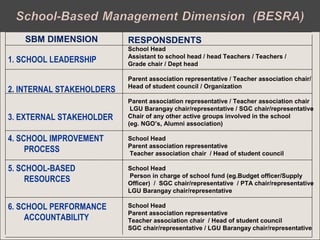
SBM DIMENSION
1. SCHOOL LEADERSHIP
2. INTERNAL STAKEHOLDERS
3. EXTERNAL STAKEHOLDER
4. SCHOOL IMPROVEMENT
PROCESS
5. SCHOOL-BASED
RESOURCES
6. SCHOOL PERFORMANCE
ACCOUNTABILITY
RESPONSDENTS
School Head
Assistant to school head / head Teachers / Teachers /
Grade chair / Dept head
Parent association representative / Teacher association chair/
Head of student council / Organization
Parent association representative / Teacher association chair
LGU Barangay chair/representative / SGC chair/representative
Chair of any other active groups involved in the school
(eg. NGO’s, Alumni association)
School Head
Parent association representative
Teacher association chair / Head of student council
School Head
Person in charge of school fund (eg.Budget officer/Supply
Officer) / SGC chair/representative / PTA chair/representative
LGU Barangay chair/representative
School Head
Parent association representative
Teacher association chair / Head of student council
SGC chair/representative / LGU Barangay chair/representative
Payroll
Check that your school is using all the staffing it is entitled to.
This list will help you to overview payroll elements.
These regular tasks mean that
your staff will get paid. The
regular arrival of correct pay
ensures that they can meet
their financial commitments.
Even a few dollars missed off a payment or, even worse,
having to wait a fortnight for pay can result in financial
difficulties for people.
Confirm:-
the staffing levels determined and paid
for by the Department of Education.
who is paid directly by the DepEd for
Teachers Salaries (TS).
other staffing determined and paid for
by the board of trustees.
who is paid from the Board Grant (BG).
Payroll
that the full cost of wages and salaries to be paid for from
BG for the year match with budget expectations.
 that your schools banking staffing processes follow the
pattern you expect.
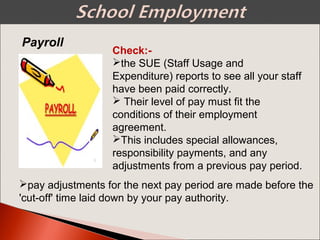
Check:-
the SUE (Staff Usage and
Expenditure) reports to see all your staff
have been paid correctly.
 Their level of pay must fit the
conditions of their employment
agreement.
This includes special allowances,
responsibility payments, and any
adjustments from a previous pay period.
Payroll
pay adjustments for the next pay period are made before the
'cut-off' time laid down by your pay authority.
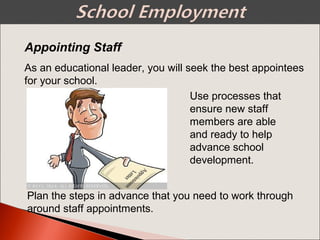
Appointing Staff
As an educational leader, you will seek the best appointees
for your school.
Use processes that
ensure new staff
members are able
and ready to help
advance school
development.
Plan the steps in advance that you need to work through
around staff appointments.
Appointing Staff
Identify what sort of appointment, if any, is possible or should
be made. Use curriculum needs, DepEd regulations,
confirmed staffing levels, and board of trustees budget
limitations to help.
Know and use the
school’s advertising and
appointment procedures,
and ensure your
procedures meet the
requirements of the
Collective Employment
Agreements. Use
guidelines to assist.
Appointing Staff
Start with registration, contact
all referees, ask searching
questions about capability, and
think of and ask about what
has not been stated on paper
or in an interview.
During the selection and appointment process, carefully
check the background and performance of applicants.
Be very methodical in building a picture of applicants on
your short list.
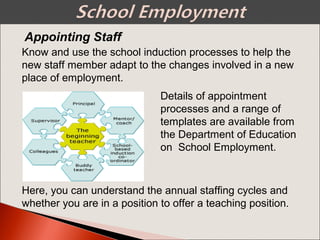
Appointing Staff
Know and use the school induction processes to help the
new staff member adapt to the changes involved in a new
place of employment.
Details of appointment
processes and a range of
templates are available from
the Department of Education
on School Employment.
Here, you can understand the annual staffing cycles and
whether you are in a position to offer a teaching position.
How staff changes link to leading learning
It is 29 June. A permanent teacher resigned yesterday,
taking effect from end of the month.
(if you are in a primary school) ,she is a composite year 3–4
class, or ( if you are in a secondary school), she is a teacher
of health and physical education
You are lobbied by some staff and your board chair to
immediately advertise the position in the Gazette that closes
at 5.00pm tomorrow.
What are you, as the educational leader, going to do
about this by noon tomorrow?
What are you going to do?
Concurrence
The State Services Commissioner, under the State Sector Act
1988 has delegated the authority to the Education Secretary to
agree (grant “concurrence”) to a board of trustees wishing to
provide additional remuneration and other benefits in addition
to those specified in the Individual Employment Agreement
(IEA).
Check with your DepEd on the
employment agreement for this
additional remuneration or
benefits, if applicable.
It is not legal or binding without
the Education Department
concurrence.
Additional remuneration or benefit are for the limited
purpose of recognizing and compensating the principal for
the performance of the additional duties or responsibilities.
The additional duties or
responsibilities performed must
be for the benefit of their
school.
Reasons usually considered
an acceptable basis for the
payment of additional
remuneration include (but are
not restricted to) management
of, and responsibility for:
Concurrence for additional Remuneration
Individual and Team performance
Teacher registration, performance management, and
appraisal are parts of many school scene. They are confirmed
as law in the Education Act and its amendments, and the legal
requirements of the Employment Relations Act.
You must follow their requirements.
You must be aware of how
collective or individual
employment agreements
regulate some aspects of
appraisal and performance
according to the legislation of
DepEd regulations and
requirements.
Individual and Team performance
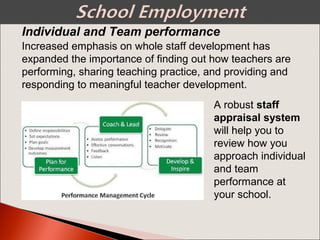
Increased emphasis on whole staff development has
expanded the importance of finding out how teachers are
performing, sharing teaching practice, and providing and
responding to meaningful teacher development.
A robust staff
appraisal system
will help you to
review how you
approach individual
and team
performance at
your school.
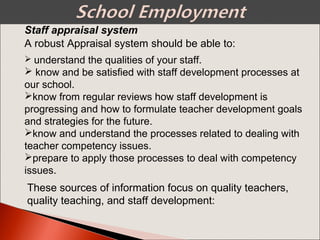
 understand the qualities of your staff.
 know and be satisfied with staff development processes at
our school.
know from regular reviews how staff development is
progressing and how to formulate teacher development goals
and strategies for the future.
know and understand the processes related to dealing with
teacher competency issues.
prepare to apply those processes to deal with competency
issues.
Staff appraisal system
A robust Appraisal system should be able to:
These sources of information focus on quality teachers,
quality teaching, and staff development:
A complaint about teacher performance
During the first month of being a principal, you have fielded
three expressions of concern about Mr Tim, a permanent
teacher, failing to provide his students with quality teaching.
Two of the concerns came from other staff and one is from
a parent you listened to at the latest school get-together.
The word 'concerns' is used because no-one has
specifically used the words 'complaint' or 'competency',
or committed their views to paper.
What are you going to do?
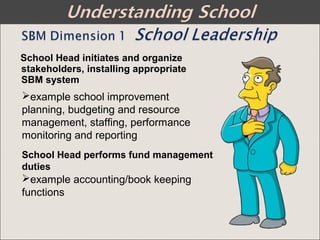
School Head initiates and organize
stakeholders, installing appropriate
SBM system
example school improvement
planning, budgeting and resource
management, staffing, performance
monitoring and reporting
School Head performs fund management
duties
example accounting/book keeping
functions
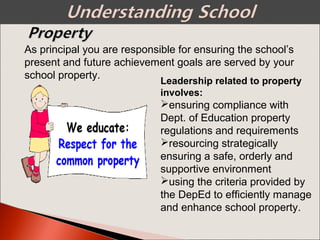
As principal you are responsible for ensuring the school’s
present and future achievement goals are served by your
school property.
Leadership related to property
involves:
ensuring compliance with
Dept. of Education property
regulations and requirements
resourcing strategically
ensuring a safe, orderly and
supportive environment
using the criteria provided by
the DepEd to efficiently manage
and enhance school property.
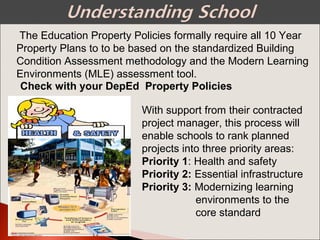
The Education Property Policies formally require all 10 Year
Property Plans to to be based on the standardized Building
Condition Assessment methodology and the Modern Learning
Environments (MLE) assessment tool.
With support from their contracted
project manager, this process will
enable schools to rank planned
projects into three priority areas:
Priority 1: Health and safety
Priority 2: Essential infrastructure
Priority 3: Modernizing learning
environments to the
core standard
Check with your DepEd Property Policies
Check to ensure you have the core principles of school
property management, use and development sorted.
School property policy and procedures
Ensure school policies/procedures take
account of the resourcing, school
environment and smart tools leadership
dimensions and their application to each
and every phase of property decision-
making and actions.
Reflect on your property knowledge and skills that it meet the
expectations confirmed by the demands of your 10 years plan
Property Strategy and your school’s achievement goals.
Property management
Each board manages school property through applying
systematic processes that meet the requirements and
responsibilities defined in the Property Occupancy Document.
These are:
The 10 Year Property Cycle.
General maintenance from the bulk
grant.
Dept. of Education general support,
advice and, in special cases, funding in
times of emergency.
Community support and funding
where locally generated funds provide
for district facilities on the school site.
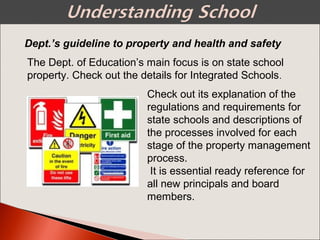
Dept.’s guideline to property and health and safety
The Dept. of Education’s main focus is on state school
property. Check out the details for Integrated Schools.
Check out its explanation of the
regulations and requirements for
state schools and descriptions of
the processes involved for each
stage of the property management
process.
It is essential ready reference for
all new principals and board
members.
Capture the view of the school facilities and their use
Find out property needs, safety issues and wish lists:
Discuss classroom
capacity to provide the
setting for meeting
achievement goals with the
teachers and students.
Do this in their space.
(If there is a worst classroom in the school go there first)
Property and its relationship to achievement strategies.
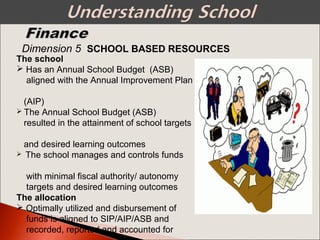
The school
 Has an Annual School Budget (ASB)
aligned with the Annual Improvement Plan
(AIP)
 The Annual School Budget (ASB)
resulted in the attainment of school targets
and desired learning outcomes
 The school manages and controls funds
with minimal fiscal authority/ autonomy
targets and desired learning outcomes
The allocation
 Optimally utilized and disbursement of
funds is aligned to SIP/AIP/ASB and
recorded, reported and accounted for
Dimension 5 SCHOOL BASED RESOURCES
Teachers’ salaries (TS)
The Principal is responsible for ensuring that the level of
staffing for the school does not exceed the levels confirmed
by the DepEd and that the specific payments to teachers
are correct in terms of employment agreements.
Each teacher should have
an employment file where
pay increases etc. are
located and noted through
a bring-up system.
It is important all principals fully understand how this works.
School funding sources
Aside from funding school property, government money for
state and integrated schools comes in two main 'parcels‘,
paid through generated roll-based formulae. One is salaries
of all teachers, the other is operational funding, commonly
called BG or Bulk Grant. Property funding for capital
works and funding for special
activities come from funds that
are administered through the
Department’s property division.
Community-generated funds collected from fundraising,
donations and parental payments, trusts or fee-paying
students are another source of income for schools.
It covers:
-presence and absence in schools:
-the administrative requirements
-your school attendance as it is now
-analyzing the data
- engagement and attendance
- getting beyond just data collection.
This guide focuses on the administration of attendance,
attendance levels at your school, and getting beyond the
collection of data.
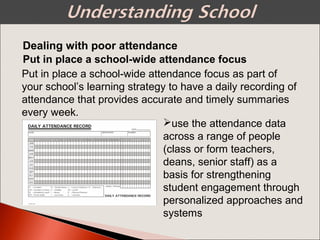
Put in place a school-wide attendance focus
Put in place a school-wide attendance focus as part of
your school’s learning strategy to have a daily recording of
attendance that provides accurate and timely summaries
every week.
use the attendance data
across a range of people
(class or form teachers,
deans, senior staff) as a
basis for strengthening
student engagement through
personalized approaches and
systems
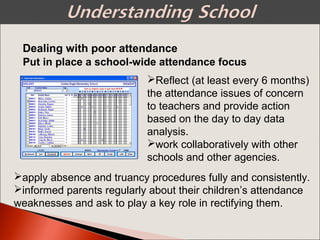
Dealing with poor attendance
Reflect (at least every 6 months)
the attendance issues of concern
to teachers and provide action
based on the day to day data
analysis.
work collaboratively with other
schools and other agencies.
Put in place a school-wide attendance focus
Dealing with poor attendance
apply absence and truancy procedures fully and consistently.
informed parents regularly about their children’s attendance
weaknesses and ask to play a key role in rectifying them.
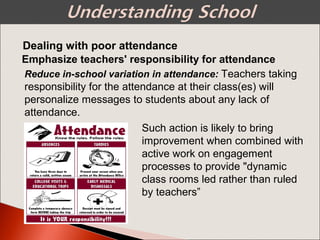
Emphasize teachers' responsibility for attendance
Dealing with poor attendance
Reduce in-school variation in attendance: Teachers taking
responsibility for the attendance at their class(es) will
personalize messages to students about any lack of
attendance.
Such action is likely to bring
improvement when combined with
active work on engagement
processes to provide "dynamic
class rooms led rather than ruled
by teachers”
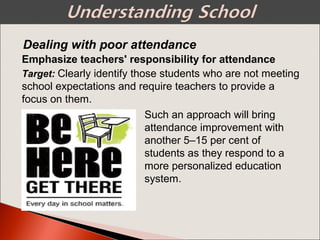
Target: Clearly identify those students who are not meeting
school expectations and require teachers to provide a
focus on them.
Dealing with poor attendance
Emphasize teachers' responsibility for attendance
Such an approach will bring
attendance improvement with
another 5–15 per cent of
students as they respond to a
more personalized education
system.
Dealing with poor attendance
-put in place a school-wide
attendance focus
-emphasize teachers'
responsibility for attendance
and
-to engage support agencies,
counselors, and other services
Decisions and actions to deal with poor attendance has to
be based on analysis of the school’s attendance data. A
guide as your school’s engagement in learning strategy:
Analyzing the data
Look at the bottom 10 %. What is the impact of their poor attendance on
both, their achievement and school? Compare this with the nationwide
picture.
Identify issues that need consideration – like in-school variations and
truancy.
Provide staff with regular snapshots of absence issues.
What do students think 'poor attendance‘ is? Need for a change of
perspective?
Are you satisfied with your school’s absence record, collection, analysis,
follow-up, and benefits gained from the processes involved?
Take your in-school attendance data for a period, (say the
month of May) and analyze the patterns for girls, boys, different
ethnic groups, year levels, and Mondays and Fridays
Who has excellent attendance?
•Take the data for those who have excellent attendance and analyze it.
•Provide a report to the staff and board on those who attend well.
•What is done about students with very high levels of attendance?
•Do the characteristics of those students who have excellent
attendance provide any understandings that will help raise the levels of
attendance of others?
•What do students think 'excellent attendance is'?
Your school attendance patterns
•What are the correlations between attendance patterns and student
achievement for specific groups?
•What can you do about altering the present attendance situation?
•Keep these results readily available to assist school decision making and
action.
Analyzing the data
This guide offers some suggestions that will help you
to: -make the first term a positive one, -avoid major
issues and -develop good processes.
.It covers:
Making changes
Getting to know staff
Information on school performance
Building partnerships and networks
Professional advice
Being a teaching principal
Short-term goals
Relationships
Being a new principal
Sharing challenges & rewards
Making the first term a positive one
Listen, ask, and observe
before acting on any issues.
Check out traditional school
activities.
Become familiar with the
board and community's
expectations of their principal.
Starting off well in a school will make all the difference for a
new principal. Tuning in to the culture of the school will be
one of your key tasks when you begin your new job.
Making changes
Every new principal will make some changes, and your staff
will expect this. Before making a change, make sure everyone
who will be affected knows why and remember that 'winning'
your first challenge is important.
Be considerate in your decision-
making around change.
Some people may raise issues
and want instant answers or
solutions. Premature action
could lead to the very
relationship problem you want to
avoid, so look at the issue
carefully first.
Making changes
Let staff know that you are going to work in this way, but
avoid statements like, “I won’t change anything during my
first term here.” You may miss a good opportunity.
Some issues 'hanging over' from the
previous administration might have
to be dealt with.
Not making any changes may
suggest your tacit acceptance of
situations that could come back to
bite you.
Getting to know staff
Gather information that will help you get to know staff and
learn about the school at the same time.
Organize individual meetings in
their space. This is an opportunity
for a personal connection and to
find out about the school:
What do you value most about 
the school? 
What needs changing?
Responses to the latter question may be shared as long as
privacy is maintained.
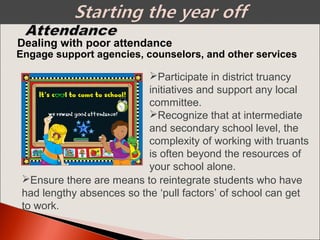
Engage support agencies, counselors, and other services
Dealing with poor attendance
Participate in district truancy
initiatives and support any local
committee.
Recognize that at intermediate
and secondary school level, the
complexity of working with truants
is often beyond the resources of
your school alone.
Ensure there are means to reintegrate students who have
had lengthy absences so the ‘pull factors’ of school can get
to work.
Getting to know staff
Showing a personal interest
in staff members is
important.
In this way, they know you
care about them as
individuals, not just as
teachers or support staff.
Be visible around the school. Attend school social functions,
even initiate them if nothing is planned.
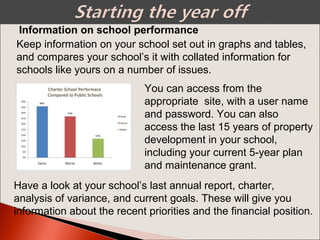
Information on school performance
Keep information on your school set out in graphs and tables,
and compares your school’s it with collated information for
schools like yours on a number of issues.
You can access from the
appropriate site, with a user name
and password. You can also
access the last 15 years of property
development in your school,
including your current 5-year plan
and maintenance grant.
Have a look at your school’s last annual report, charter,
analysis of variance, and current goals. These will give you
information about the recent priorities and the financial position.
Building partnerships and networks
Local community will see you as an important person, so work
on developing your profile with them. Use any local events to
make yourself known and demonstrate that you are interested
in what's happening.
In rural areas,
there are many
opportunities for
becoming involved
in local events.
Building partnerships and networks
Principals’ meetings are places to make contact with
colleagues in the schools that yours contributes to, or that
contribute to yours; this includes early childhood if yours is a
primary school.
However, it is your school that
really counts. Your parent
group, board of trustees, PTA,
and any other school groups
are your most important
contacts.
Make the most of these contacts and listen to what they say.
You will build a picture as you do.
Until you find your feet, you might need ongoing support for
everyday management and organizational matters and for
dealing with professional, personnel, or community issues.
Professional advice
Ask for help when you need it.
Your principal colleagues will
respond. Cultivate a relationship
with a valued and trustworthy
colleague who can provide
support.
Everyone needs professional support and advice, especially
in the early stages of principalship..
If you do not have a personal contact who can help you,
contact a local Leadership and Management adviser.
It is difficult to look too far ahead in a new job, so concentrate
on short-term goals until you have the confidence to start
thinking and planning for the longer-term future of the school.
Short-term goals
Research and experience make it clear that the vast majority
of problems in schools occur as a result of a breakdown in
relationships.
Relationships
As a new principal, one of your
most important tasks is to build
good relationships and help to
ensure that those of staff,
board, parents, and students
are working well too.
Make sure you deliver on what you promise, and avoid
statements like “at my last school …".
Being a new Principal
Sharing challenges & rewards

Global School Management Methodologies (Philippine Setting)

  • 1.
     International EducationalLeadership Trainer. Provides consultation on Lean and leads Kaizen, TPM, Cellular system & Moonshine set up.  A multi skill Innovator with Mechanical background that adopts Green Living by Recycling and Reusing Idle resources to eliminate waste to add Value.  Founder of Tim’s Waterfuel, an alternative HHO gas supplement using Water that adds power, add millage & reduce Co2 emission on automobiles.  An NGO Community worker for Prison, Drug Rehab. and Crisis Relieve & Training (CREST) Malaysia, an organization that respond to Crisis & Flood. Timothy Wooi 20C,Taman Bahagia, 06000, Jitra, Kedah timothywooi2@gmail.com Trainer’s ProfileTrainer’s Profile Certified HRDF Trainer & Principal Consultant for Lean Management and a Kaizen Specialist with 30 over years working experience.
  • 2.
    Baguio Convention Center,Baguio City Concourse Convention Center, Legazpi City April 13-17 2015 April 20-24 2015 Details: call / text 09175147952
  • 3.
     Introduction Resource Management, SchoolResource Management  School SystemSchool System School Based Management (SBM)School Based Management (SBM)  Managing School ResourcesManaging School Resources Inputs, Process, OutputInputs, Process, Output  Understanding School Employment, Property, Finance, Attendance Course OutlineCourse Outline  Starting the year off (Global Management Methodologies) Making changes, Getting to know staff, Information on school performance, Building partnerships and networks, Professional advice, Being a teaching principal, Short-term goals, Relationships, Being a new principal
  • 4.
    To be theSchool of Choice, renown internationallyTo be the School of Choice, renown internationally for excellence in Sfor excellence in School Management for Performance and Students Achievements SSchool Performance (quality of instruction ) Students Achievements (equity in areas of student participation including the poorest sector society)
  • 5.
    "Every school needto have systems that help create the conditions for staff and students to work effectively together. School systems provide simple, clear goals and effective processes to effectively communicate the ground rules for everyone. They ensure a measure of consistency in approach and action across the school".
  • 6.
    These practical guideis for first-time and recently appointed principals to have an insight of global school management system methodologies, aligned to Department of Education in the Philippines to adopt and apply it in school leadership across school systems on a day-to- day basis.
  • 7.
    School Management School managementrefers to the administration of a school to provide the condition for staff, teachers and students to work in the most efficient way possible , maximizing the utilization of available resources. Education in the Philippines is managed and regulated by the Department of Education, referred to as the DepEd. The DepEd uses a School Based Management system that governs the Philippine education system, including the curriculum used and the allocation of funds.
  • 8.
    Resource Management The efficientand effective deployment of an organization's resources in the most efficient way possible , maximizing the utilization of available resources to achieve organization goals. Such resources may include tangible resources such as Information Technology(IT) Facilities Financial resources Ideas… .. Equipmen t It can also include ideas assigned to task that adds value. These include… Functional Non Functional Labor (Human Resource)
  • 9.
    In the pastresource management, a key issue has been how to improve or re-engineer the internal school process as a whole to add value through school effectiveness. The answer:- a new trend in school management, -knowledge based with empowerment to its internal process to maximize its resources for operation and continuous development in management, teaching & learning, within the new changing 21st century that adds value SBM, a key component of Basic Education Sector Reform Agenda or BESRA.
  • 10.
    EFFECTIVE Student performance improves whencompared to the entry point ADDED VALUES INADDED VALUES IN STUDENT OUTCOMESSTUDENT OUTCOMES -is the quantification of a student's progress during different stage of his/her education. It is measured by quantifying the input (entry point) over output score (performance) and comparing the results from previous to evaluate the progress made. Value added in Education
  • 11.
    School Based Management-a strategy to decentralize decision-making authority to the individual school site of which devolution of authority is the fundamental concept. In the past, schools system were managed by the state and the districts. Now the trend is for individual schools to make their own decisions and policies within the boundary of the Department of Education.
  • 12.
    -the decentralization ofdecision- making authority from state and district (central, regional, division) levels down to the school level. Responsibility and school operations is transferred to principals, teachers, parents, sometimes students, and other school community members with the intent to unite. School-based management (SBM) The school, however, have to conform to, or operate, within a set of centrally determined Policies.
  • 13.
    4.Integrate School management and instructional reformationfor the school effectiveness 1.Empower school heads to lead their teachers and students through reforms that leads to higher learning outcomes 3.Strengthens partnership with communities as well as local government units to invest time, money and effort in making the school a better place to learn 2.Bring resources including funds, down to the control of schools to spur change in line with decentralization SBM OBJECTIVES WHILE THE OBJECTIVES ARE TO
  • 15.
    A need inparadigm shift in education governance, from being school-centered to community- and child- (learner) centered and towards enhancing the principle of shared governance to support the stewardship of children’s learning outcomes. It is also imperative in the review and refinement of SBM to account for the evidence of successful practices. Conclusive findings suggest that the reforms in education governance systems must be linked tightly with the changes in curriculum and instruction. Thus, the inception of K to 12 must be integrated in the organizational change. SBM reform for successful practice
  • 16.
    Finance Physical Property Student readiness Teacherability Parental Support Finance Physical Property Student readiness Teacher ability Parental Support School culture Motivation level Instruction Learning Time Leadership School culture Motivation level Instruction Learning Time Leadership OUTPUTOUTPUT Student AchievementStudent Achievement INPUTINPUT PROCESSPROCESS (What comes into the system?) (What is done with the inputs?) (What is the effect of process?, and How much?)
  • 17.
    INPUT in ManagingSchool Resources are (What comes into the system?) Finance Physical Property Student readiness Teacher ability Parental Support Finance Physical Property Student readiness Teacher ability Parental Support INPUTINPUT
  • 18.
    It covers:  AnnualSchool Budget aligned with the Annual Improvement Plan Attainment of school targets and desired learning outcomes Manages and controls funds with minimal fiscal authority/ autonomy Dimension 5 SCHOOL BASED RESOURCES provides information about school finances and resourcing. Funds allocation with utilization and disbursement Recording, reporting and accountability
  • 19.
    Sourcing general financialinformation Available in Dimension of School-Based Management (BESRA) under Dimension 5 SCHOOL BASED RESOURCES This sets out the way schools are resourced and includes associated regulations and processes. Have a ‘hard copy’ of this but do check that copy matches what is online and update accordingly.
  • 20.
    This guide containsuseful information on understanding school property. It covers: Property plans School property policies and procedures Departments’s guideline to property and health and safety Property management Property and its relationship to achievement strategies.
  • 21.
    Student Readiness isa student's current understanding and knowledge towards a unit or topic of study. The potential to learn is influenced by our prior knowledge and connection to the new material.
  • 22.
    Student Readiness The Kto 12 Program Kindergarten and 12 years of basic education comprising  6 years Primary Education,  4 years Junior High School and  2 years Senior High School (SHS) Aims to provide sufficient time for mastery of concepts and skills, develop lifelong learners, and prepare graduates for tertiary education, middle-level skills development, employment, and entrepreneurship.
  • 23.
    Dimension 2 onINTERNAL STAKEHOLDERS requires that Teachers are trained, aware of their rights and responsibilities and apply their knowledge acquired from attending trainings. Teachers are trained on curriculum content and pedagogy Are aware of their rights and responsibilities as primary stakeholders Teachers Apply knowledge, process skills and instructional innovations acquired from participation in trainings
  • 24.
    Dimension 2 onINTERNAL STAKEHOLDERS mentioned that that Parents assume responsibilities as partners in the learning process
  • 25.
    ‘PROCESS’ in ManagingSchool Resources are (What is done with the INPUTS?) PROCESSPROCESS School culture Motivation level Instruction Learning Time Leadership School culture Motivation level Instruction Learning Time Leadership
  • 26.
    "Principals who focuson the school culture on enhancing learning and teaching: -build distributed leadership networks that secure commitment and responsibility for continued improvement through all levels of the school -challenge and modify values and traditions which are not in students’ best interests.”
  • 27.
    Engagement and attendance: Promotionof the school as a supportive and caring place is commonly at the core of strategies to strengthen engagement. The nature of teaching and learning is being included in strategies to reduce absence levels. Such strategies can be viewed as 'pull factors', working to retain or increase engagement in learning.
  • 28.
    Non-attendance does notgo away. Students may leave, but the issue remains visible in school attendance records. Engagement and attendance: beyond data collection 'In-school' or 'school-based' factors offer the best starting points for principals and teachers to apply strategies to reduce non-attendance.
  • 29.
  • 30.
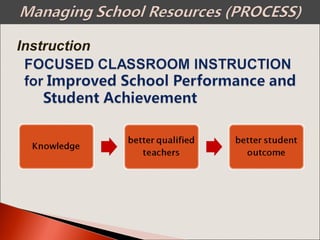
    Instruction •Transformation – takesplace when school culture permits •Create a culture to sustain Change. • Framework – well defined process for culture of excellence and continuous Improvement How to do it? 1.Plan- gather and analyze data to determine priorities, -explore possible solutions and assess readiness for Change. 2.Do-Implement plan, create and communicate Improvement. 3.Check-monitor and adjust. 4. Act-realign and correct outcome back to Plan 4 PDCA stages:
  • 31.
    Introduced in Japanaround the 1870s. -case analysis on practice of lessons, to aid development of teachers to learn from each other on real practices at classroom. -three parts: Plan, Observe and Reflect Lesson study Plan, one or group of teachers plan a lesson; Observe, one teacher conducts a lesson based on the plan and colleagues observe the lesson; Reflect , teachers reflect on the observed lesson together
  • 32.
    Presence and absence:-the administrative requirements A good attendance system needs to be in place to support quality learning. Good attendance systems help create conditions for staff and students to work together effectively. In such a system, simple, clear goals and effective procedures are known and expected by all. Directions, regulations, and practices for managing student attendance are well-defined and available online. Learning Time
  • 33.
    use evidence tomonitor progress, plan, and manage change delegate the running of systems to appropriate staff establish contingency strategies for when unseen circumstances arise analyse the attendance data to understand school patterns. Your school: attendance as it is now Principals who use management systems to support and enhance student learning: know effective management practice and systems, use them, prioritize and select targeted areas for improvement,:- Learning Time
  • 34.
    Directions, regulations, andpractices for managing student attendance. Use the Student Attendance collection as the source for regulations and guidelines for in-school actions. (Within the Student Attendance collection, refer to the Guidelines in DepEd for Schools to give you a clear picture of the legal requirements and expectations.) Keep up to date about attendance regulations. (electronic registers provides useful policies Learning Time
  • 35.
  • 37.
    (Hallinger, 2003) Commu- nicating school goals Supervising & evaluating instruction Providingincentives for teachers Leadership model Framing school goals Coordinating curriculum Monitoring student progress Protecting instructional time Promoting professional development Maintaining high visibility Providing incentives for learning
  • 38.
    Successful schools have aclear sense of direction through Vision Statement. –shared sense of direction derived through a visioning process involving all members of the school. Once affirmed, it needs to be able to be articulated by all. -when achieved everyone can then align their efforts behind the vision and by a process of self-reference and professional development the school will reach. Translation into reality by means of a Teaching framework or belief system.
  • 39.
    Leadership SBM collaboration withCommunity Participation
  • 40.
    OUTPUT in ManagingSchool Resources are ( What is the effect? and how much? ) OUTPUTOUTPUT Student AchievementStudent Achievement
  • 41.
    The intended Outputof the systems-oriented Revised SBM framework is at the Center, a functionally-literate citizen who is self-reliant, patriotic, productive and service-oriented.
  • 42.
    Coleman et.al (1966)Brophy & Good, (1986), Sanders et. al. (1994) 1960 &1970 1980’s
  • 43.
    Students Performance 50 % 0 % 100% Age 11Age 8 Students’ age Student with high performing’ teacher Student with low performing’ teacher 90 % 53 % 37 % HOW THE WORLD’S BEST PERFORMING SCHOOL SYSTEMS COMES OUT ON TOPOP McKinsey & Company Sept 2007 UK
  • 44.
    Check with yourDepartment of Education to understand your School management system, its requirements and regulations. This guide contains useful information about school & its systems as practiced.
  • 45.
    Check out theboard and management responsibilities under legislation on personnel and employment matters, industrial policies, and being a good employer. Employment agreements: collective and individual Employment agreements are used to confirm the conditions of staff employment. Check the links to all school collective and individual agreements
  • 46.
    This guide containsuseful information about school employment. It looks at: legislation and regulations payroll appointing staff concurrence individual and team performance.
  • 47.
    Legislation and Regulations Anumber of legal requirements and Department of Education regulations exist for employment. The relevant legislation is contained in these Act: Details can be found on the Department of Education legislation and regulation Act for requirements pertaining to education practice, including employment.
  • 48.
    SBM DIMENSION 1. SCHOOLLEADERSHIP 2. INTERNAL STAKEHOLDERS 3. EXTERNAL STAKEHOLDER 4. SCHOOL IMPROVEMENT PROCESS 5. SCHOOL-BASED RESOURCES 6. SCHOOL PERFORMANCE ACCOUNTABILITY RESPONSDENTS School Head Assistant to school head / head Teachers / Teachers / Grade chair / Dept head Parent association representative / Teacher association chair/ Head of student council / Organization Parent association representative / Teacher association chair LGU Barangay chair/representative / SGC chair/representative Chair of any other active groups involved in the school (eg. NGO’s, Alumni association) School Head Parent association representative Teacher association chair / Head of student council School Head Person in charge of school fund (eg.Budget officer/Supply Officer) / SGC chair/representative / PTA chair/representative LGU Barangay chair/representative School Head Parent association representative Teacher association chair / Head of student council SGC chair/representative / LGU Barangay chair/representative
  • 49.
    Payroll Check that yourschool is using all the staffing it is entitled to. This list will help you to overview payroll elements. These regular tasks mean that your staff will get paid. The regular arrival of correct pay ensures that they can meet their financial commitments. Even a few dollars missed off a payment or, even worse, having to wait a fortnight for pay can result in financial difficulties for people.
  • 50.
    Confirm:- the staffing levelsdetermined and paid for by the Department of Education. who is paid directly by the DepEd for Teachers Salaries (TS). other staffing determined and paid for by the board of trustees. who is paid from the Board Grant (BG). Payroll that the full cost of wages and salaries to be paid for from BG for the year match with budget expectations.  that your schools banking staffing processes follow the pattern you expect.
  • 51.
    Check:- the SUE (StaffUsage and Expenditure) reports to see all your staff have been paid correctly.  Their level of pay must fit the conditions of their employment agreement. This includes special allowances, responsibility payments, and any adjustments from a previous pay period. Payroll pay adjustments for the next pay period are made before the 'cut-off' time laid down by your pay authority.
  • 52.
    Appointing Staff As aneducational leader, you will seek the best appointees for your school. Use processes that ensure new staff members are able and ready to help advance school development. Plan the steps in advance that you need to work through around staff appointments.
  • 53.
    Appointing Staff Identify whatsort of appointment, if any, is possible or should be made. Use curriculum needs, DepEd regulations, confirmed staffing levels, and board of trustees budget limitations to help. Know and use the school’s advertising and appointment procedures, and ensure your procedures meet the requirements of the Collective Employment Agreements. Use guidelines to assist.
  • 54.
    Appointing Staff Start withregistration, contact all referees, ask searching questions about capability, and think of and ask about what has not been stated on paper or in an interview. During the selection and appointment process, carefully check the background and performance of applicants. Be very methodical in building a picture of applicants on your short list.
  • 55.
    Appointing Staff Know anduse the school induction processes to help the new staff member adapt to the changes involved in a new place of employment. Details of appointment processes and a range of templates are available from the Department of Education on School Employment. Here, you can understand the annual staffing cycles and whether you are in a position to offer a teaching position.
  • 56.
    How staff changeslink to leading learning It is 29 June. A permanent teacher resigned yesterday, taking effect from end of the month. (if you are in a primary school) ,she is a composite year 3–4 class, or ( if you are in a secondary school), she is a teacher of health and physical education You are lobbied by some staff and your board chair to immediately advertise the position in the Gazette that closes at 5.00pm tomorrow. What are you, as the educational leader, going to do about this by noon tomorrow? What are you going to do?
  • 57.
    Concurrence The State ServicesCommissioner, under the State Sector Act 1988 has delegated the authority to the Education Secretary to agree (grant “concurrence”) to a board of trustees wishing to provide additional remuneration and other benefits in addition to those specified in the Individual Employment Agreement (IEA). Check with your DepEd on the employment agreement for this additional remuneration or benefits, if applicable. It is not legal or binding without the Education Department concurrence.
  • 58.
    Additional remuneration orbenefit are for the limited purpose of recognizing and compensating the principal for the performance of the additional duties or responsibilities. The additional duties or responsibilities performed must be for the benefit of their school. Reasons usually considered an acceptable basis for the payment of additional remuneration include (but are not restricted to) management of, and responsibility for: Concurrence for additional Remuneration
  • 59.
    Individual and Teamperformance Teacher registration, performance management, and appraisal are parts of many school scene. They are confirmed as law in the Education Act and its amendments, and the legal requirements of the Employment Relations Act. You must follow their requirements. You must be aware of how collective or individual employment agreements regulate some aspects of appraisal and performance according to the legislation of DepEd regulations and requirements.
  • 60.
    Individual and Teamperformance Increased emphasis on whole staff development has expanded the importance of finding out how teachers are performing, sharing teaching practice, and providing and responding to meaningful teacher development. A robust staff appraisal system will help you to review how you approach individual and team performance at your school.
  • 61.
     understand thequalities of your staff.  know and be satisfied with staff development processes at our school. know from regular reviews how staff development is progressing and how to formulate teacher development goals and strategies for the future. know and understand the processes related to dealing with teacher competency issues. prepare to apply those processes to deal with competency issues. Staff appraisal system A robust Appraisal system should be able to: These sources of information focus on quality teachers, quality teaching, and staff development:
  • 62.
    A complaint aboutteacher performance During the first month of being a principal, you have fielded three expressions of concern about Mr Tim, a permanent teacher, failing to provide his students with quality teaching. Two of the concerns came from other staff and one is from a parent you listened to at the latest school get-together. The word 'concerns' is used because no-one has specifically used the words 'complaint' or 'competency', or committed their views to paper. What are you going to do? What are you going to do?
  • 63.
    School Head initiatesand organize stakeholders, installing appropriate SBM system example school improvement planning, budgeting and resource management, staffing, performance monitoring and reporting School Head performs fund management duties example accounting/book keeping functions
  • 64.
    As principal youare responsible for ensuring the school’s present and future achievement goals are served by your school property. Leadership related to property involves: ensuring compliance with Dept. of Education property regulations and requirements resourcing strategically ensuring a safe, orderly and supportive environment using the criteria provided by the DepEd to efficiently manage and enhance school property.
  • 65.
    The Education PropertyPolicies formally require all 10 Year Property Plans to to be based on the standardized Building Condition Assessment methodology and the Modern Learning Environments (MLE) assessment tool. With support from their contracted project manager, this process will enable schools to rank planned projects into three priority areas: Priority 1: Health and safety Priority 2: Essential infrastructure Priority 3: Modernizing learning environments to the core standard Check with your DepEd Property Policies
  • 66.
    Check to ensureyou have the core principles of school property management, use and development sorted. School property policy and procedures Ensure school policies/procedures take account of the resourcing, school environment and smart tools leadership dimensions and their application to each and every phase of property decision- making and actions. Reflect on your property knowledge and skills that it meet the expectations confirmed by the demands of your 10 years plan Property Strategy and your school’s achievement goals.
  • 67.
    Property management Each boardmanages school property through applying systematic processes that meet the requirements and responsibilities defined in the Property Occupancy Document. These are: The 10 Year Property Cycle. General maintenance from the bulk grant. Dept. of Education general support, advice and, in special cases, funding in times of emergency. Community support and funding where locally generated funds provide for district facilities on the school site.
  • 68.
    Dept.’s guideline toproperty and health and safety The Dept. of Education’s main focus is on state school property. Check out the details for Integrated Schools. Check out its explanation of the regulations and requirements for state schools and descriptions of the processes involved for each stage of the property management process. It is essential ready reference for all new principals and board members.
  • 69.
    Capture the viewof the school facilities and their use Find out property needs, safety issues and wish lists: Discuss classroom capacity to provide the setting for meeting achievement goals with the teachers and students. Do this in their space. (If there is a worst classroom in the school go there first) Property and its relationship to achievement strategies.
  • 70.
    The school  Hasan Annual School Budget (ASB) aligned with the Annual Improvement Plan (AIP)  The Annual School Budget (ASB) resulted in the attainment of school targets and desired learning outcomes  The school manages and controls funds with minimal fiscal authority/ autonomy targets and desired learning outcomes The allocation  Optimally utilized and disbursement of funds is aligned to SIP/AIP/ASB and recorded, reported and accounted for Dimension 5 SCHOOL BASED RESOURCES
  • 71.
    Teachers’ salaries (TS) ThePrincipal is responsible for ensuring that the level of staffing for the school does not exceed the levels confirmed by the DepEd and that the specific payments to teachers are correct in terms of employment agreements. Each teacher should have an employment file where pay increases etc. are located and noted through a bring-up system. It is important all principals fully understand how this works.
  • 72.
    School funding sources Asidefrom funding school property, government money for state and integrated schools comes in two main 'parcels‘, paid through generated roll-based formulae. One is salaries of all teachers, the other is operational funding, commonly called BG or Bulk Grant. Property funding for capital works and funding for special activities come from funds that are administered through the Department’s property division. Community-generated funds collected from fundraising, donations and parental payments, trusts or fee-paying students are another source of income for schools.
  • 73.
    It covers: -presence andabsence in schools: -the administrative requirements -your school attendance as it is now -analyzing the data - engagement and attendance - getting beyond just data collection. This guide focuses on the administration of attendance, attendance levels at your school, and getting beyond the collection of data.
  • 74.
    Put in placea school-wide attendance focus Put in place a school-wide attendance focus as part of your school’s learning strategy to have a daily recording of attendance that provides accurate and timely summaries every week. use the attendance data across a range of people (class or form teachers, deans, senior staff) as a basis for strengthening student engagement through personalized approaches and systems Dealing with poor attendance
  • 75.
    Reflect (at leastevery 6 months) the attendance issues of concern to teachers and provide action based on the day to day data analysis. work collaboratively with other schools and other agencies. Put in place a school-wide attendance focus Dealing with poor attendance apply absence and truancy procedures fully and consistently. informed parents regularly about their children’s attendance weaknesses and ask to play a key role in rectifying them.
  • 76.
    Emphasize teachers' responsibilityfor attendance Dealing with poor attendance Reduce in-school variation in attendance: Teachers taking responsibility for the attendance at their class(es) will personalize messages to students about any lack of attendance. Such action is likely to bring improvement when combined with active work on engagement processes to provide "dynamic class rooms led rather than ruled by teachers”
  • 77.
    Target: Clearly identify thosestudents who are not meeting school expectations and require teachers to provide a focus on them. Dealing with poor attendance Emphasize teachers' responsibility for attendance Such an approach will bring attendance improvement with another 5–15 per cent of students as they respond to a more personalized education system.
  • 78.
    Dealing with poorattendance -put in place a school-wide attendance focus -emphasize teachers' responsibility for attendance and -to engage support agencies, counselors, and other services Decisions and actions to deal with poor attendance has to be based on analysis of the school’s attendance data. A guide as your school’s engagement in learning strategy:
  • 79.
    Analyzing the data Lookat the bottom 10 %. What is the impact of their poor attendance on both, their achievement and school? Compare this with the nationwide picture. Identify issues that need consideration – like in-school variations and truancy. Provide staff with regular snapshots of absence issues. What do students think 'poor attendance‘ is? Need for a change of perspective? Are you satisfied with your school’s absence record, collection, analysis, follow-up, and benefits gained from the processes involved? Take your in-school attendance data for a period, (say the month of May) and analyze the patterns for girls, boys, different ethnic groups, year levels, and Mondays and Fridays
  • 80.
    Who has excellentattendance? •Take the data for those who have excellent attendance and analyze it. •Provide a report to the staff and board on those who attend well. •What is done about students with very high levels of attendance? •Do the characteristics of those students who have excellent attendance provide any understandings that will help raise the levels of attendance of others? •What do students think 'excellent attendance is'? Your school attendance patterns •What are the correlations between attendance patterns and student achievement for specific groups? •What can you do about altering the present attendance situation? •Keep these results readily available to assist school decision making and action. Analyzing the data
  • 81.
    This guide offerssome suggestions that will help you to: -make the first term a positive one, -avoid major issues and -develop good processes. .It covers: Making changes Getting to know staff Information on school performance Building partnerships and networks Professional advice Being a teaching principal Short-term goals Relationships Being a new principal Sharing challenges & rewards
  • 82.
    Making the firstterm a positive one Listen, ask, and observe before acting on any issues. Check out traditional school activities. Become familiar with the board and community's expectations of their principal. Starting off well in a school will make all the difference for a new principal. Tuning in to the culture of the school will be one of your key tasks when you begin your new job.
  • 83.
    Making changes Every newprincipal will make some changes, and your staff will expect this. Before making a change, make sure everyone who will be affected knows why and remember that 'winning' your first challenge is important. Be considerate in your decision- making around change. Some people may raise issues and want instant answers or solutions. Premature action could lead to the very relationship problem you want to avoid, so look at the issue carefully first.
  • 84.
    Making changes Let staffknow that you are going to work in this way, but avoid statements like, “I won’t change anything during my first term here.” You may miss a good opportunity. Some issues 'hanging over' from the previous administration might have to be dealt with. Not making any changes may suggest your tacit acceptance of situations that could come back to bite you.
  • 85.
    Getting to knowstaff Gather information that will help you get to know staff and learn about the school at the same time. Organize individual meetings in their space. This is an opportunity for a personal connection and to find out about the school: What do you value most about  the school?  What needs changing? Responses to the latter question may be shared as long as privacy is maintained.
  • 86.
    Engage support agencies,counselors, and other services Dealing with poor attendance Participate in district truancy initiatives and support any local committee. Recognize that at intermediate and secondary school level, the complexity of working with truants is often beyond the resources of your school alone. Ensure there are means to reintegrate students who have had lengthy absences so the ‘pull factors’ of school can get to work.
  • 87.
    Getting to knowstaff Showing a personal interest in staff members is important. In this way, they know you care about them as individuals, not just as teachers or support staff. Be visible around the school. Attend school social functions, even initiate them if nothing is planned.
  • 88.
    Information on schoolperformance Keep information on your school set out in graphs and tables, and compares your school’s it with collated information for schools like yours on a number of issues. You can access from the appropriate site, with a user name and password. You can also access the last 15 years of property development in your school, including your current 5-year plan and maintenance grant. Have a look at your school’s last annual report, charter, analysis of variance, and current goals. These will give you information about the recent priorities and the financial position.
  • 89.
    Building partnerships andnetworks Local community will see you as an important person, so work on developing your profile with them. Use any local events to make yourself known and demonstrate that you are interested in what's happening. In rural areas, there are many opportunities for becoming involved in local events.
  • 90.
    Building partnerships andnetworks Principals’ meetings are places to make contact with colleagues in the schools that yours contributes to, or that contribute to yours; this includes early childhood if yours is a primary school. However, it is your school that really counts. Your parent group, board of trustees, PTA, and any other school groups are your most important contacts. Make the most of these contacts and listen to what they say. You will build a picture as you do.
  • 91.
    Until you findyour feet, you might need ongoing support for everyday management and organizational matters and for dealing with professional, personnel, or community issues. Professional advice Ask for help when you need it. Your principal colleagues will respond. Cultivate a relationship with a valued and trustworthy colleague who can provide support. Everyone needs professional support and advice, especially in the early stages of principalship.. If you do not have a personal contact who can help you, contact a local Leadership and Management adviser.
  • 92.
    It is difficultto look too far ahead in a new job, so concentrate on short-term goals until you have the confidence to start thinking and planning for the longer-term future of the school. Short-term goals
  • 93.
    Research and experiencemake it clear that the vast majority of problems in schools occur as a result of a breakdown in relationships. Relationships As a new principal, one of your most important tasks is to build good relationships and help to ensure that those of staff, board, parents, and students are working well too. Make sure you deliver on what you promise, and avoid statements like “at my last school …".
  • 94.
    Being a newPrincipal Sharing challenges & rewards

Editor's Notes

  • #5 School Performance (quality of instruction ) Students Achievements (equity in areas of student participation including the poorest sector society)
  • #9 Ideas that add value making sure that people are assigned to task not to have too much under utilization. Human Resource Management Science of allocating and maximizing the utilization of available human resource (human skills) among various tasks to achieve organization goals; and performing the activities that are necessary in the maintenance of that workforce through: identification of staffing requirements, planning and oversight of payroll and benefits, education and professional development, and administering their work-life needs.
  • #10 In the past on School Resource Management, a key issue has often been how to improve or even re-engineer the internal school process so that the school as a whole can add value through school effectiveness. The answer to this issue requires a new knowledge base regarding internal school processes, indicating how a school can maximize use of its internal resources to achieve optimal conditions for operation and continuous development in management, teaching and learning, within the changing environment of the new 21th century.. With SBM, the school as key provider of education, will be equipped to empower its key officials to make informed and localized decisions based on their unique needs toward improving our educational system.
  • #13 School-Based Management (SBM) places significant decision-making power from the levels of authority State and district offices to schools. An alternative approach to improve the education system, it lets principals, teachers, students, and parents decide on education-related issues like concerns on budget, personnel, and the curriculum. According to the National Association of Secondary School Principals (NASSP), the School-based Management approach creates the following advantages to high schools: 1• provides opportunity to competent school leaders in the schools to make decisions • boosts the morale of teachers and encourages leadership at all levels • allows participation of the entire school community in making key decisions • has a wider pool of ideas in designing education programs • focuses resources to the goals and needs of each school. 
  • #14 1.Empower school heads to lead their teachers and students through reforms that leads to higher learning outcomes 2.Bring resources including funds, down to the control of schools to spur change in line with decentralization 3.Strengthens partnership with communities as well as local government units to invest time, money and effort in making the school a better place to learn 4.Integrate School management and instructional reformation for the school effectiveness
  • #15 We are now accelerating the implementation of School-Based Management (SBM), a key component of Basic Education Sector Reform Agenda or BESRA. With SBM, the school as key provider of education, will be equipped to empower its key officials to make informed and localized decisions based on their unique needs toward improving our educational system.
  • #16 All these insights drawn from the emerging models of SBM supported by the department and its development partners point also to the need for a new discourse on “school” as a concept where we managed learning without alienating other situations or practices where learning is taking place. Hence, the needed paradigm shift in education governance, from being school-centered to community- and child- (learner) centered and towards enhancing the principle of shared governance to support the stewardship of children’s learning outcomes. It is also imperative in the review and refinement of SBM to account for the evidence of successful practices. Conclusive findings suggest that the reforms in education governance or any management systems must be linked tightly with the changes in curriculum and instruction. Thus, the inception of K to 12 must be woven into or integrated in the structure and processes of organizational change.
  • #23 Participation of Stakeholders in School Administration Realization of the Spirit of School-based Management Introduction An Incorporated Management Committee (IMC) comprises managers from different sectors and backgrounds. Such composition not only enhances the transparency and accountability of school administration and ensures the proper use of public funds, but also brings about different perspectives and experiences which are useful for strengthening the school management system and formulating appropriate policies. Sponsoring Body Managers Participation of sponsoring body managers in the decision-making of the school ensures that decisions made by the IMC will be in line with the vision and mission set by the school sponsoring body (SSB) and that the communication and cooperation between the SSB and the IMC will be strengthened. The Principal (Ex-officio Manager) The Principal is school’s professional leader and in charge of school’s administration. Apart from supervising the daily operation of the school, the Principal should also provide IMC managers with useful and accurate information so that they would know more about existing school circumstances and the trend of education. Teacher Managers Teachers, as frontline educators, are at the heart of learning. Through their frequent contact with students, they can better understand students’ learning needs. Teacher managers can:  share their experiences in and advise on curriculum development, classroom instruction, student activities and educational enrichment;  provide professional expertise for the improvement of student learning; and  serve as an important link between the IMC and the staff of the school. “The Principal cannot replace the role of teacher managers in the IMC. It is more effective for teacher managers to collect and reflect the views of teachers, especially their views on policies closely related to them such as arrangements for redundant teachers. In this way, school policies will be implemented more smoothly. In addition, teacher managers, as frontline educators, can give the IMC appropriate advice on school curriculum, 1teaching and current situation of students.”
  • #24 Level 2. Exercise their rights and fulfill responsibilities as primary stakeholders to Support SBM Level 3. Are active co-leaders of the school and assume shared accountability on their performance Level 2. Pursue continuing professional development Level 3. Hold themselves accountable for student performance and positively influence learning and school outcomes, Are champions of SBM Level 2. Transfer/share learnings to peers Level 3. Hold themselves accountable for student performance as co-leaders and co-managers in school Level 2. Co-manage and co-monitor learning Level 3. Are held accountable for the performance of their children Level 2. Local government stakeholders expand support for educational subsidies through LSB and other sources Level 3. Local government stakeholders institutionalize LSB support for SBM practices
  • #25 Level 2. Exercise their rights and fulfill responsibilities as primary stakeholders to Support SBM Level 3. Are active co-leaders of the school and assume shared accountability on their performance Level 2. Pursue continuing professional development Level 3. Hold themselves accountable for student performance and positively influence learning and school outcomes, Are champions of SBM Level 2. Transfer/share learnings to peers Level 3. Hold themselves accountable for student performance as co-leaders and co-managers in school Level 2. Co-manage and co-monitor learning Level 3. Are held accountable for the performance of their children Level 2. Local government stakeholders expand support for educational subsidies through LSB and other sources Level 3. Local government stakeholders institutionalize LSB support for SBM practices
  • #26 Level 2. Exercise their rights and fulfill responsibilities as primary stakeholders to Support SBM Level 3. Are active co-leaders of the school and assume shared accountability on their performance Level 2. Pursue continuing professional development Level 3. Hold themselves accountable for student performance and positively influence learning and school outcomes, Are champions of SBM Level 2. Transfer/share learnings to peers Level 3. Hold themselves accountable for student performance as co-leaders and co-managers in school Level 2. Co-manage and co-monitor learning Level 3. Are held accountable for the performance of their children Level 2. Local government stakeholders expand support for educational subsidies through LSB and other sources Level 3. Local government stakeholders institutionalize LSB support for SBM practices
  • #31 School improvement requires more than a great idea. Transformations do not take place until the culture of the school permits it—and no long-term, significant change can take place without creating a culture to sustain that change. This Framework provides a well-defined process that helps to foster a culture of excellence and continuous improvement within your school.
  • #32 Lesson study was started in Japan around the 1870s. This is a method of case analysis on the practice of lessons, aiming to aid the professional development of teachers and to let them learn from each other based on real practices at classroom levels. Lesson study is divided into three parts: planning, observation and reflection (Figure 2). In the planning part, either one or group of teachers plan a lesson; one teacher conducts a lesson based on the plan and colleagues observe the lesson; and they reflect on the observed lesson together
  • #37 A. Background The implementation of the Governance of Basic Education Act of 2001 (RA 9155) provided the mandate for decentralizing the system of school management and recognized the role of the Local Government Units and other stakeholders as partners in education service delivery. In recognition of this, the department launched the School-Based Management, then the Schools First Initiative (SFI), to empower the school and its community stakeholders to effectively address access and quality issues in basic education. Subsequently, a more comprehensive package of policy reforms known as Basic Education Sector Reform Agenda (BESRA) was launched in 2005, to sustain and expand the gains of SFI through School-Based Management (SBM). Along with teacher education development, national learning strategies, quality assurance and monitoring and evaluation, and organizational development, SBM was identified as one of the key reform thrusts (KRTs) under BESRA which is envisioned to effect improvements at the school level. Since then, several enabling policies on SBM were formulated under the different KRTs which includes establishment of School Governing Councils (SGCs), Conduct of Assessment of the Level of Practice, School Improvement Planning (SIP) and reporting of accomplishments through School Report Cards (SRCs). These policies were supported by a budget line item in the General Appropriations Act (GAA) for installation of SBM in all the public elementary and secondary schools. All these helped lay the foundations for SBM models to emerge at the field level with varying degrees of stakeholder involvement.
  • #40 PSBM is development of school-based management with community participation. There are mainly three principles: (1) Adapting bottom up school planning with school committee and community, (2) Showing accountability and transparency regarding school activities and budget, and (3) School committee and community participation in school activities and development. Some examples of PSBM activities are: School makes a annual school plan with the school committee members. School implements educational events cooperating with parents and community. School carries out educational socialization for parents. School receives donation, materials and others from community. School reports its activities to parents and school committee members. School reports its income and expenditure to parents and school committee members.
  • #42 The output is a result of an interactive and collective problem-solving process that continuously raises the level of SBM practice until it culminates in the accreditation of the school. The process is enhanced and facilitated by a self- managing, self-renewing learning-community that assumes responsibility for basic education of all types of learners. The context of SBM is the school learning community itself to which the learner belongs. An intensive situational analysis of factors that impact learning is done to develop an educational plan that is responsive to contextual issues, problems, challenges, threats and opportunities. The system is guided by four ACCESs principles on leadership and governance, curriculum and learning, resource management and accountability for higher learning outcomes. The Central Regional and Division Offices provide technical, professional and administrative support and also oversee that policies are being observed, standards are being met and programs are being implemented. The boundary of the system indicated by a broken line denotes openness to inputs from the external environment, as well as a resistance to change that may injure its systemic integrity and stability. Schools must allow the framework to continuously morph and develop on the basis of its experience to meet the emerging needs of the learning community.
  • #49 B. Rationale The review mission reports of DepEd’s development partners cite that while most of the schools implemented SBM as reflected in the increase in number of schools with SIP, those receiving grants and MOOE on time, and those who conducted SBM assessment, systemic issues were noted in the operationalization of policies and guidelines at the field level. Among these are:  Unrealistic targets and inappropriate strategies in the SIPs of many of the schools visited; too much focus on the SIP templates, which is usually construed as a one-size-fits-all form overlooking the unique condition of their schools, the pupils/students they are providing learning environments for, and the peculiar issues they are confronting;  Across the four project Missions, it was observed that there are more schools with School Report Cards than School Improvement Plans which reflects a disconnect of these two SBM processes.  There is a possibility that the SBM Assessment process may be reduced to “bean counting” that over-emphasizes the collection of prescribed documentation, the compliance to some of which may not be within the control of the schools and are not reflective of a functional system of good practices.  While DepED reports that 100% of school heads in many divisions had been oriented on SBM, their practical understanding of the concept is not as palpable. These findings indicate that the system is beset with problems particularly in terms of stakeholders’ appreciation and understanding of SBM. In the assessment process for example, the focus was narrowed to complying with the documents in the SBM Checklist leading to accounting for quantitative scores only to assess the level of practice. Thus practices which may be qualitatively different such as behavior and attitude towards SBM implementation which are not evidenced by a document are
  • #70 Capture the view of the school facilities and their use through the eyes of the daily users, both students and staff.
  • #71 Level 2. Has an ASB augmented by the Local School Board (LSB) funds and other sources from the community and other agencies Has additional funding from the community and other agencies Level 3. Has an ASB with regular funding from LSB Has an ASB with additional funds from grants and other income generating projects Level 2. ASB resulted to learning outcomes surpassing school targets Level 3. ASB resulted in sustained excellent performance Level 2. Substantial fiscal authority/autonomy Level 3. Full fiscal authority/autonomy Level 2. Optimally utilized and disbursement of funds is systematically recorded, audited and reported/published Level 3. Optimally utilized and disbursement of funds is systematically recorded, audited and reported/published