Republic of the Philippines
                        MINDANAO STATE UNIVERSITY
                            GRADUATE STUDIES


                                       SYLLABUS
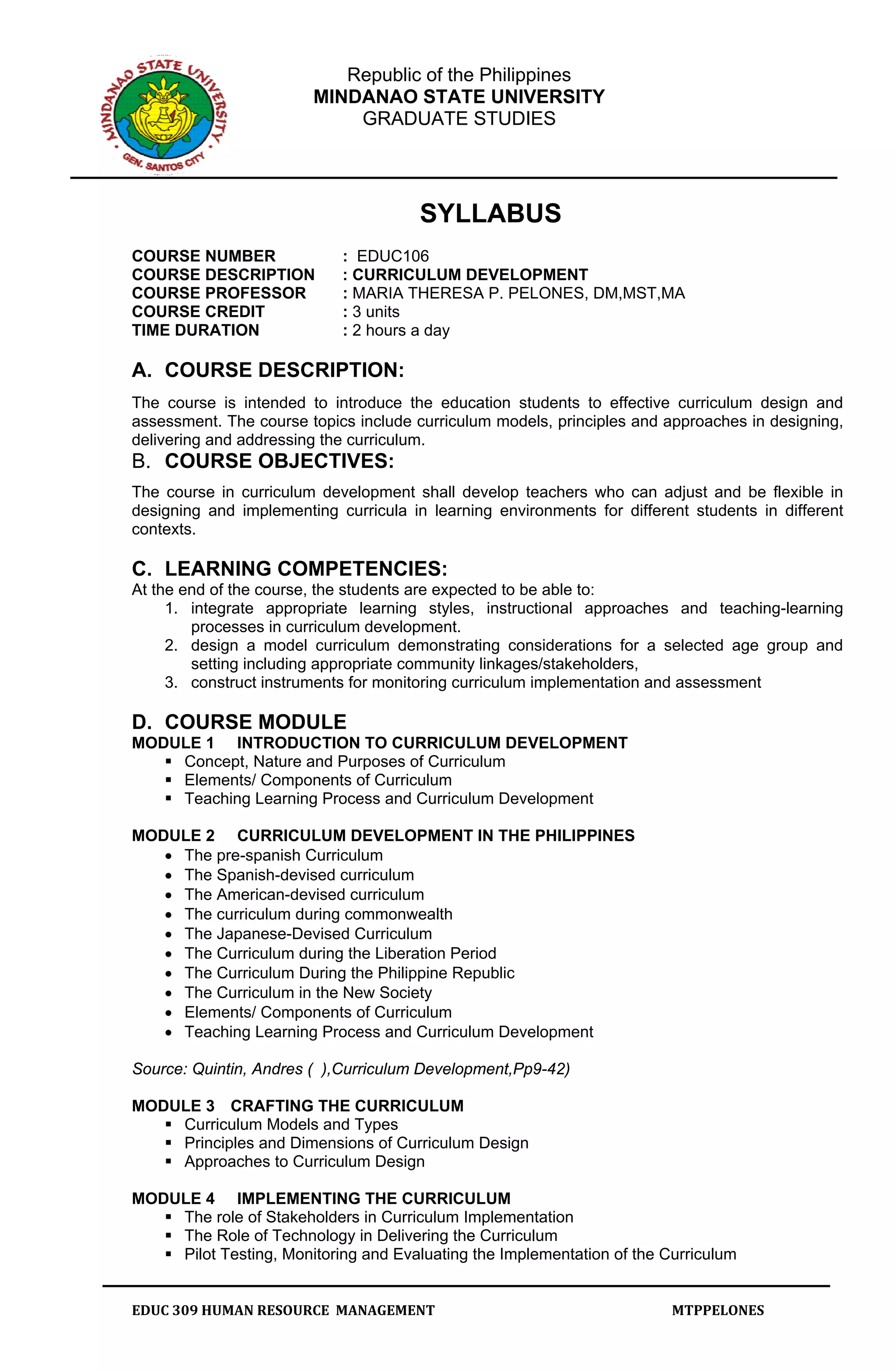
COURSE NUMBER               : EDUC106
COURSE DESCRIPTION          : CURRICULUM DEVELOPMENT
COURSE PROFESSOR            : MARIA THERESA P. PELONES, DM,MST,MA
COURSE CREDIT               : 3 units
TIME DURATION               : 2 hours a day

A. COURSE DESCRIPTION:
The course is intended to introduce the education students to effective curriculum design and
assessment. The course topics include curriculum models, principles and approaches in designing,
delivering and addressing the curriculum.
B. COURSE OBJECTIVES:
The course in curriculum development shall develop teachers who can adjust and be flexible in
designing and implementing curricula in learning environments for different students in different
contexts.

C. LEARNING COMPETENCIES:
At the end of the course, the students are expected to be able to:
     1. integrate appropriate learning styles, instructional approaches and teaching-learning
        processes in curriculum development.
     2. design a model curriculum demonstrating considerations for a selected age group and
        setting including appropriate community linkages/stakeholders,
     3. construct instruments for monitoring curriculum implementation and assessment

D. COURSE MODULE
MODULE 1 INTRODUCTION TO CURRICULUM DEVELOPMENT
    Concept, Nature and Purposes of Curriculum
    Elements/ Components of Curriculum
    Teaching Learning Process and Curriculum Development

MODULE 2 CURRICULUM DEVELOPMENT IN THE PHILIPPINES
   • The pre-spanish Curriculum
   • The Spanish-devised curriculum
   • The American-devised curriculum
   • The curriculum during commonwealth
   • The Japanese-Devised Curriculum
   • The Curriculum during the Liberation Period
   • The Curriculum During the Philippine Republic
   • The Curriculum in the New Society
   • Elements/ Components of Curriculum
   • Teaching Learning Process and Curriculum Development

Source: Quintin, Andres ( ),Curriculum Development,Pp9-42)

MODULE 3 CRAFTING THE CURRICULUM
    Curriculum Models and Types
    Principles and Dimensions of Curriculum Design
    Approaches to Curriculum Design

MODULE 4 IMPLEMENTING THE CURRICULUM
    The role of Stakeholders in Curriculum Implementation
    The Role of Technology in Delivering the Curriculum
    Pilot Testing, Monitoring and Evaluating the Implementation of the Curriculum


EDUC 309 HUMAN RESOURCE  MANAGEMENT                                      MTPPELONES 
Republic of the Philippines
                       MINDANAO STATE UNIVERSITY
                           GRADUATE STUDIES


MODULE 5     ASSESSING THE CURRICULUM

      Intended vs Implemented vs Achieved Curriculum
      Criteria for curriculum assessment
      Tools to assess curriculum
      Linking curriculum, Instruction and Assessment (CIA): Making a Fit

MODULE 6 ADDRESSING THE FUTURE: CURRICULUM INNOVATIONS

      Curriculum innovations: Local and Global Trends
      Issues and Concerns in Curriculum

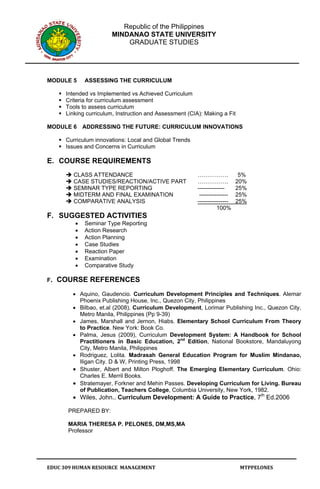
E. COURSE REQUIREMENTS
         CLASS ATTENDANCE                                …………….              5%
         CASE STUDIES/REACTION/ACTIVE PART               …………….             20%
         SEMINAR TYPE REPORTING                          --------------     25%
         MIDTERM AND FINAL EXAMINATION                    ---------------   25%
         COMPARATIVE ANALYSIS                            ----------------   25%
                                                                   100%
F. SUGGESTED ACTIVITIES
         •   Seminar Type Reporting
         •   Action Research
         •   Action Planning
         •   Case Studies
         •   Reaction Paper
         •   Examination
         •   Comparative Study

F.   COURSE REFERENCES
        • Aquino, Gaudencio. Curriculum Development Principles and Techniques. Alemar
          Phoenix Publishing House, Inc., Quezon City, Philippines
        • Bilbao, et.al (2008), Curriculum Development, Lorimar Publishing Inc., Quezon City,
          Metro Manila, Philippines (Pp 9-39)
        • James, Marshall and Jernon, Hiabs. Elementary School Curriculum From Theory
          to Practice. New York: Book Co.
        • Palma, Jesus (2009), Curriculum Development System: A Handbook for School
          Practitioners in Basic Education, 2nd Edition, National Bookstore, Mandaluyong
          City, Metro Manila, Philippines
        • Rodriguez, Lolita. Madrasah General Education Program for Muslim Mindanao,
          Iligan City. D & W, Printing Press, 1998
        • Shuster, Albert and Milton Ploghoff. The Emerging Elementary Curriculum. Ohio:
          Charles E. Merril Books.
        • Stratemayer, Forkner and Mehin Passes. Developing Curriculum for Living. Bureau
          of Publication, Teachers College, Columbia University, New York, 1982.
        • Wiles, John.. Curriculum Development: A Guide to Practice, 7th Ed.2006

       PREPARED BY:

       MARIA THERESA P. PELONES, DM,MS,MA
       Professor


EDUC 309 HUMAN RESOURCE  MANAGEMENT                                          MTPPELONES 

Syllabus educ 106 curriculum development

  • 1.
    Republic of thePhilippines MINDANAO STATE UNIVERSITY GRADUATE STUDIES SYLLABUS COURSE NUMBER : EDUC106 COURSE DESCRIPTION : CURRICULUM DEVELOPMENT COURSE PROFESSOR : MARIA THERESA P. PELONES, DM,MST,MA COURSE CREDIT : 3 units TIME DURATION : 2 hours a day A. COURSE DESCRIPTION: The course is intended to introduce the education students to effective curriculum design and assessment. The course topics include curriculum models, principles and approaches in designing, delivering and addressing the curriculum. B. COURSE OBJECTIVES: The course in curriculum development shall develop teachers who can adjust and be flexible in designing and implementing curricula in learning environments for different students in different contexts. C. LEARNING COMPETENCIES: At the end of the course, the students are expected to be able to: 1. integrate appropriate learning styles, instructional approaches and teaching-learning processes in curriculum development. 2. design a model curriculum demonstrating considerations for a selected age group and setting including appropriate community linkages/stakeholders, 3. construct instruments for monitoring curriculum implementation and assessment D. COURSE MODULE MODULE 1 INTRODUCTION TO CURRICULUM DEVELOPMENT Concept, Nature and Purposes of Curriculum Elements/ Components of Curriculum Teaching Learning Process and Curriculum Development MODULE 2 CURRICULUM DEVELOPMENT IN THE PHILIPPINES • The pre-spanish Curriculum • The Spanish-devised curriculum • The American-devised curriculum • The curriculum during commonwealth • The Japanese-Devised Curriculum • The Curriculum during the Liberation Period • The Curriculum During the Philippine Republic • The Curriculum in the New Society • Elements/ Components of Curriculum • Teaching Learning Process and Curriculum Development Source: Quintin, Andres ( ),Curriculum Development,Pp9-42) MODULE 3 CRAFTING THE CURRICULUM Curriculum Models and Types Principles and Dimensions of Curriculum Design Approaches to Curriculum Design MODULE 4 IMPLEMENTING THE CURRICULUM The role of Stakeholders in Curriculum Implementation The Role of Technology in Delivering the Curriculum Pilot Testing, Monitoring and Evaluating the Implementation of the Curriculum EDUC 309 HUMAN RESOURCE  MANAGEMENT    MTPPELONES 
  • 2.
    Republic of thePhilippines MINDANAO STATE UNIVERSITY GRADUATE STUDIES MODULE 5 ASSESSING THE CURRICULUM Intended vs Implemented vs Achieved Curriculum Criteria for curriculum assessment Tools to assess curriculum Linking curriculum, Instruction and Assessment (CIA): Making a Fit MODULE 6 ADDRESSING THE FUTURE: CURRICULUM INNOVATIONS Curriculum innovations: Local and Global Trends Issues and Concerns in Curriculum E. COURSE REQUIREMENTS CLASS ATTENDANCE ……………. 5% CASE STUDIES/REACTION/ACTIVE PART ……………. 20% SEMINAR TYPE REPORTING -------------- 25% MIDTERM AND FINAL EXAMINATION --------------- 25% COMPARATIVE ANALYSIS ---------------- 25% 100% F. SUGGESTED ACTIVITIES • Seminar Type Reporting • Action Research • Action Planning • Case Studies • Reaction Paper • Examination • Comparative Study F. COURSE REFERENCES • Aquino, Gaudencio. Curriculum Development Principles and Techniques. Alemar Phoenix Publishing House, Inc., Quezon City, Philippines • Bilbao, et.al (2008), Curriculum Development, Lorimar Publishing Inc., Quezon City, Metro Manila, Philippines (Pp 9-39) • James, Marshall and Jernon, Hiabs. Elementary School Curriculum From Theory to Practice. New York: Book Co. • Palma, Jesus (2009), Curriculum Development System: A Handbook for School Practitioners in Basic Education, 2nd Edition, National Bookstore, Mandaluyong City, Metro Manila, Philippines • Rodriguez, Lolita. Madrasah General Education Program for Muslim Mindanao, Iligan City. D & W, Printing Press, 1998 • Shuster, Albert and Milton Ploghoff. The Emerging Elementary Curriculum. Ohio: Charles E. Merril Books. • Stratemayer, Forkner and Mehin Passes. Developing Curriculum for Living. Bureau of Publication, Teachers College, Columbia University, New York, 1982. • Wiles, John.. Curriculum Development: A Guide to Practice, 7th Ed.2006 PREPARED BY: MARIA THERESA P. PELONES, DM,MS,MA Professor EDUC 309 HUMAN RESOURCE  MANAGEMENT    MTPPELONESÂ