Web-based Project
Web-based Project

The Web-based School Projects allows teachers
and students to use the Internet for real life
problem solving. For example, Tom March and Dr.
Bernie Dodge created the awesome WebQuests
activity formats that allows teachers to
involve PreK-Higher Education students in
cooperative groups as they develop a solution that
can take the form of oral presentations, web
pages and multimedia presentations. The
WebQuest and other Internet Projects in this
Web Ring allows educators easy navigation to
important sites.
World Wide Web (WWW or W3),
collection of globally distributed text
and multimedia, in personal computing,
software and applications that
combine text, high-quality sound, two-
and three-dimensional graphics,
animation, photo images, and full-
motion video.
Access to the Web is for everyone including visual, auditory,
physical, speech, cognitive, or neurological.

The Web is used for receiving information as well as providing
information and interacting with society, making it essential that
the Web be accessible in order to provide equal access and equal
opportunity to people.


Many countries regulate web accessibility as a requirement for
websites. International cooperation in the Web Accessibility
Initiative led to simple guidelines that web content authors as
well as software developers can use to make the Web accessible
 to persons who may or may not be using assistive technology.
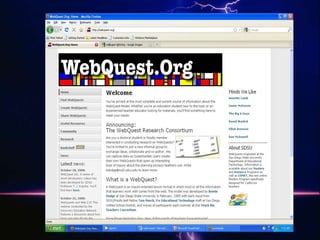
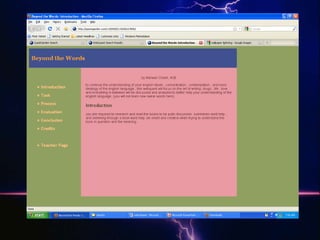
Web Quest


A Web Quest is an inquiry-oriented lesson
format in which most or all the information that
learners work with comes from the web. These
can be created using various programs, including
a simple word processing document that includes
links to websites.
Webquests in secondary education include the same
components as in primary education. Focus is on
understanding a concept through the use of the
Internet. Students have met the objective when they
have gathered information and are able to show what
they have learned. Webquests at the secondary level
can be used across the curriculum.

Secondary teachers can also make their own Webquest.
Developing a good webquest requires that teachers
analyze several webquests to become familiar with the
components and format.
WebQuests provide a practical way for students to
acquire information, debate issues, participate in
meaningful discussions, engage in role play simulations,
solve problems, and, perhaps most importantly, become
connected and involved learners.

The use of WebQuests in the middle school curriculum
presents an opportunity for classroom teachers to take
a fresh approach toward meeting the demands of the
curriculum, it is important to remember that their use
constitutes one tool among many to be used in the
classroom.
Web pesent
Web pesent

Web pesent

  • 1.
  • 2.
    Web-based Project The Web-basedSchool Projects allows teachers and students to use the Internet for real life problem solving. For example, Tom March and Dr. Bernie Dodge created the awesome WebQuests activity formats that allows teachers to involve PreK-Higher Education students in cooperative groups as they develop a solution that can take the form of oral presentations, web pages and multimedia presentations. The WebQuest and other Internet Projects in this Web Ring allows educators easy navigation to important sites.
  • 3.
    World Wide Web(WWW or W3), collection of globally distributed text and multimedia, in personal computing, software and applications that combine text, high-quality sound, two- and three-dimensional graphics, animation, photo images, and full- motion video.
  • 4.
    Access to theWeb is for everyone including visual, auditory, physical, speech, cognitive, or neurological. The Web is used for receiving information as well as providing information and interacting with society, making it essential that the Web be accessible in order to provide equal access and equal opportunity to people. Many countries regulate web accessibility as a requirement for websites. International cooperation in the Web Accessibility Initiative led to simple guidelines that web content authors as well as software developers can use to make the Web accessible to persons who may or may not be using assistive technology.
  • 5.
    Web Quest A WebQuest is an inquiry-oriented lesson format in which most or all the information that learners work with comes from the web. These can be created using various programs, including a simple word processing document that includes links to websites.
  • 6.
    Webquests in secondaryeducation include the same components as in primary education. Focus is on understanding a concept through the use of the Internet. Students have met the objective when they have gathered information and are able to show what they have learned. Webquests at the secondary level can be used across the curriculum. Secondary teachers can also make their own Webquest. Developing a good webquest requires that teachers analyze several webquests to become familiar with the components and format.
  • 7.
    WebQuests provide apractical way for students to acquire information, debate issues, participate in meaningful discussions, engage in role play simulations, solve problems, and, perhaps most importantly, become connected and involved learners. The use of WebQuests in the middle school curriculum presents an opportunity for classroom teachers to take a fresh approach toward meeting the demands of the curriculum, it is important to remember that their use constitutes one tool among many to be used in the classroom.