WHAT IS CURRICULUMEVALUATION?
Curriculum evaluation is a component of
curriculum development that responds to public
accountability. It looks into educational reforms or
innovations that happen in the teacher's
classrooms, the school, district, division or the
whole educational system as well. It is
establishing the merit and worth of a curriculum.
Merit refers to the value and worth of the
curriculum. Test results will only be used as one of
4.
Curriculum evaluation ispremised on the
concept of alignment of planned, written and
implemented curriculum. It is an attempt to
answer two big questions as:
1. Do planned courses, programs, activities as
written and implemented produce desired
outcomes?
➤ Acquire clearunderstanding of what curriculum
evaluation is
➤ Explain the need to evaluate the curriculum and
how it is being done
➤ Expand knowledge about different curriculum
evaluation models
DESIRED LEARNING
OUTCOMES
7.
Curriculum evaluation isa new idea for new teachers,
not knowing that every day, the teacher is involved in
several components of evaluation. There are two ways
of looking at curriculum evaluation:
1.Curriculum Program Evaluation. Refers to the
overall aspects of a curriculum as a subject, degree
program, curriculum reform program and the like.
Some examples are: The Curriculum Development as a
Subject, Bachelor of Education as a degree K to 12 as
a curricular reform, Outcomes-Based Education a
Process, Mother Tongue Based Multi-lingual
8.
Program evaluation willbe using program evaluation
models like Bradley Effectiveness Model, Tyler's Objective
Centered Model, Stufflebeam's CIPP Model, and Scriven
Consumer-Oriented Model among others.
2.Components of a Curricular Program. This will cover
separate evaluation for a curriculum component such as
(1) Achieve Learning Outcomes (2) Teaching Learning
Process (3) Instruction Materials (4) Assessment of the
Learning Outcomes.
Curricular program component evaluation refers direct to
the assessment of curriculum contents and processes as
9.
The first lessonwill attempt to teach us how to look
into curriculum evaluation from two examples which
are curriculum program evaluation using the
curriculum evaluation models and curriculum
evaluation of the specific component of curriculum
program as in instructional materials evaluation
(Books or Modules).
Lesson 2 will be all about curriculum evaluation in
the classroom for the formative and summative
assessment of the achieved learning outcomes.
10.
Curriculum Evaluation: AProcess and a Tool
Do you have a clear understanding of what curriculum
evaluation is all about? Is it synonymous to assessment of
learning? An analysis of the various definitions reveals that
evaluation is both a process and a tool. As a process follows
a procedure based on models and frameworks to get to the
desired results. As a tool, it will help teachers and program
implementers to judge the worth and merit of the program
and innovation or curricular change. For both process and a
tool, the results of evaluation will be the basis to IMPROVE
curriculum.
11.
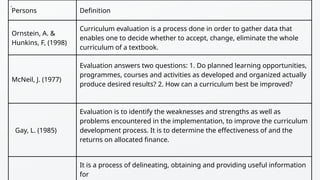
Persons Definition
Ornstein, A.&
Hunkins, F, (1998)
Curriculum evaluation is a process done in order to gather data that
enables one to decide whether to accept, change, eliminate the whole
curriculum of a textbook.
McNeil, J. (1977)
Evaluation answers two questions: 1. Do planned learning opportunities,
programmes, courses and activities as developed and organized actually
produce desired results? 2. How can a curriculum best be improved?
Gay, L. (1985)
Evaluation is to identify the weaknesses and strengths as well as
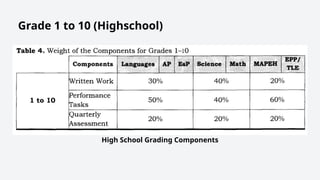
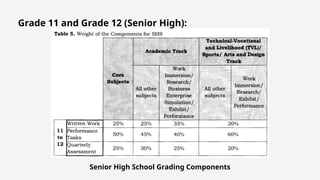
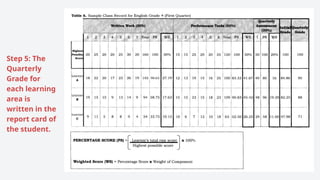
problems encountered in the implementation, to improve the curriculum
development process. It is to determine the effectiveness of and the
returns on allocated finance.
It is a process of delineating, obtaining and providing useful information
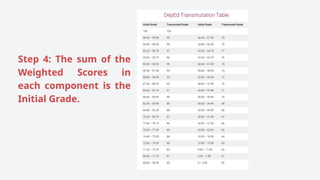
for
.
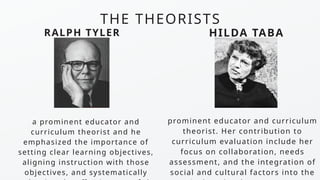
a prominent educatorand
curriculum theorist and he
emphasized the importance of
setting clear learning objectives,
aligning instruction with those
objectives, and systematically
prominent educator and curriculum
theorist. Her contribution to
curriculum evaluation include her
focus on collaboration, needs
assessment, and the integration of
social and cultural factors into the
HILDA TABA
RALPH TYLER
THE THEORISTS
14.
HY IS THEREA NEED TO EVALUATE CURRICULU
Curriculum evaluation identifies the strengths and
weaknesses of an existing curriculum that will be the
basis of the intended plan, design or implementation.
This is referred to as the needs assessment.
When evaluation is done in the middle of the
curriculum development, it will tell if the designed or
implemented curriculum can produce or is producing
the desired results. This is related to monitoring.
15.
WHY IS THEREA NEED TO EVALUATE CURRICULUM
Based on some standards, curriculum evaluation will
guide whether the results have equalled or exceeded
the standards, thus can be labelled as success. This is
sometimes called terminal assessment.
Curriculum evaluation provides information
necessary for teachers, school managers, curriculum
specialist for policy recommendations that will enhance
achieved learning. This is the basis of decision making
outcomes
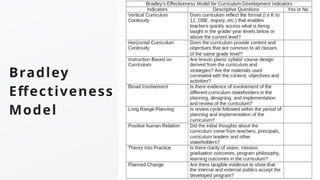
Bradley Effectiveness
Model
Referenced toL.H Bradley, the
educator and curriculum theorist who
developed the model.
It provides a comprehensive
framework for evaluating the
effectiveness of curricula and other
educational programs.
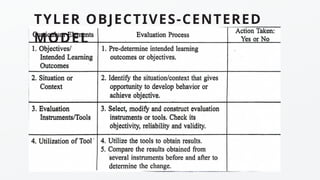
TYLER OBJECTIVES-CENTERED
MODEL
attainment modelis a foundational
framework for curriculum evaluation that
emphasizes the importance of clear
objectives and purposeful learning
experiences.
• determining objectives
• identifying experiences
• organizing experiences
• evaluating effectiveness.
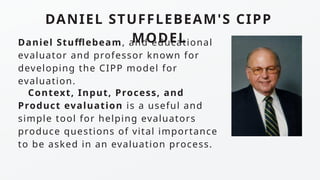
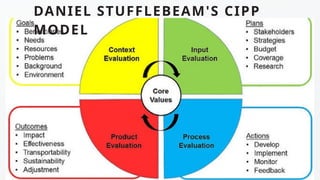
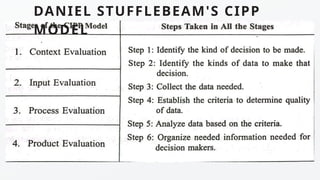
DANIEL STUFFLEBEAM'S CIPP
MODEL
Context,Input, Process, and
Product evaluation is a useful and
simple tool for helping evaluators
produce questions of vital importance
to be asked in an evaluation process.
Daniel Stufflebeam, and educational
evaluator and professor known for
developing the CIPP model for
evaluation.
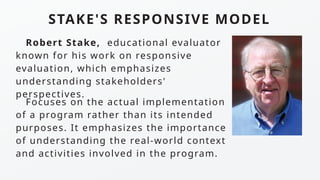
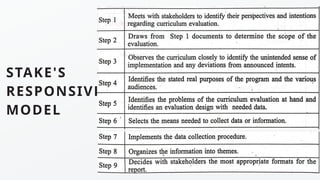
STAKE'S RESPONSIVE MODEL
Focuseson the actual implementation
of a program rather than its intended
purposes. It emphasizes the importance
of understanding the real-world context
and activities involved in the program.
Robert Stake, educational evaluator
known for his work on responsive
evaluation, which emphasizes
understanding stakeholders'
perspectives.
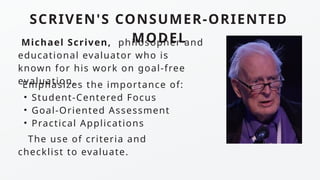
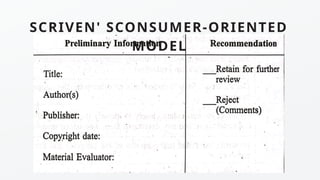
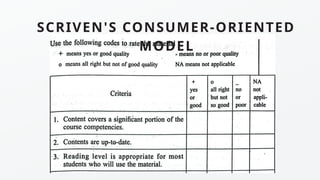
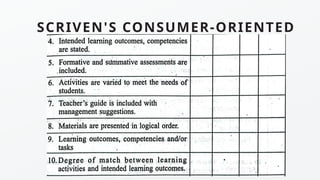
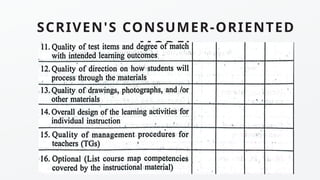
SCRIVEN'S CONSUMER-ORIENTED
MODEL
Emphasizes theimportance of:
• Student-Centered Focus
• Goal-Oriented Assessment
• Practical Applications
The use of criteria and
checklist to evaluate.
Michael Scriven, philosopher and
educational evaluator who is
known for his work on goal-free
evaluation.
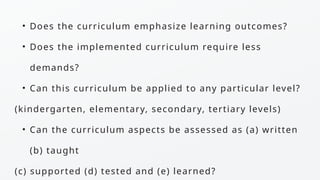
• Does thecurriculum emphasize learning outcomes?
• Does the implemented curriculum require less
demands?
• Can this curriculum be applied to any particular level?
(kindergarten, elementary, secondary, tertiary levels)
• Can the curriculum aspects be assessed as (a) written
(b) taught
(c) supported (d) tested and (e) learned?
33.
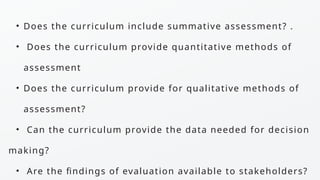
• Does thecurriculum include summative assessment? .
• Does the curriculum provide quantitative methods of
assessment
• Does the curriculum provide for qualitative methods of
assessment?
• Can the curriculum provide the data needed for decision
making?
• Are the findings of evaluation available to stakeholders?
34.
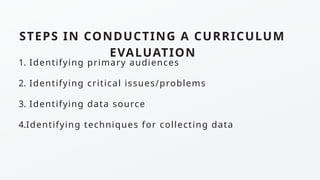
1. Identifying primaryaudiences
2. Identifying critical issues/problems
3. Identifying data source
4.Identifying techniques for collecting data
STEPS IN CONDUCTING A CURRICULUM
EVALUATION
35.
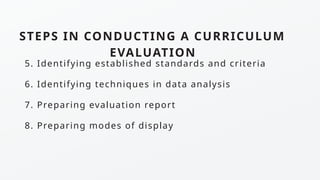
5. Identifying establishedstandards and criteria
6. Identifying techniques in data analysis
7. Preparing evaluation report
8. Preparing modes of display
STEPS IN CONDUCTING A CURRICULUM
EVALUATION
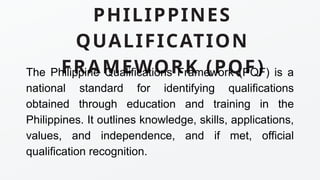
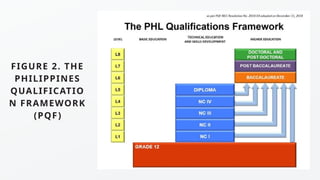
PHILIPPINES
QUALIFICATION
FRAMEWORK (PQF)
The PhilippineQualifications Framework (PQF) is a
national standard for identifying qualifications
obtained through education and training in the
Philippines. It outlines knowledge, skills, applications,
values, and independence, and if met, official
qualification recognition.
PHILIPPINES
QUALIFICATION
FRAMEWORK (PQF)
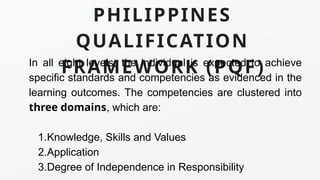
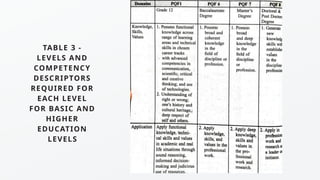
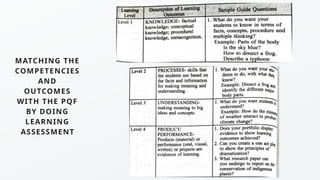
In alleight levels, the individual is expected to achieve
specific standards and competencies as evidenced in the
learning outcomes. The competencies are clustered into
three domains, which are:
1.Knowledge, Skills and Values
2.Application
3.Degree of Independence in Responsibility
40.
TABLE 3 -
LEVELSAND
COMPETENCY
DESCRIPTORS
REQUIRED FOR
EACH LEVEL
FOR BASIC AND
HIGHER
EDUCATION
LEVELS
41.
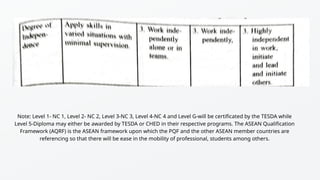
Note: Level 1-NC 1, Level 2- NC 2, Level 3-NC 3, Level 4-NC 4 and Level G-will be certificated by the TESDA while
Level 5-Diploma may either be awarded by TESDA or CHED in their respective programs. The ASEAN Qualification
Framework (AQRF) is the ASEAN framework upon which the PQF and the other ASEAN member countries are
referencing so that there will be ease in the mobility of professional, students among others.
ASSESSMENT TOOLS FOREACH LEVEL OF
LEARNING OUTCOMES
Knowledge, Process, Understanding (KPU) Learning Outcomes
Knowledge, process, and understanding are learning outcomes Students
who can show that they have gained knowledge, can apply such
knowledge and have achieved several meanings on the particular
knowledge have achieved the learning outcomes. The three types of
learning outcomes and on the different levels can be assessed in many
ways with the use of appropriate tools.
44.
THERE ARE TWOGENERAL CATEGORIES OF TEST
ITEMS: (1) OBJECTIVE TEST WHICH REQUIRE
STUDENTS TO
SELECT THE CORRECT RESPONSE FROM SEVERAL
ALTERNATIVES OR TO SUPPLY A WORD OR SHORT
PHRASE TO ANSWER A QUESTION OR COMPLETE
A STATEMENT;
AND (2) SUBJECTIVE TEST WHICH PERMIT THE
TYPES OF TESTS TO MEASURE KNOWLEDGE,
PROCESS AND UNDERSTANDING
45.
THERE ARE TWOGENERAL CATEGORIES OF TEST
ITEMS: (1) OBJECTIVE TEST WHICH REQUIRE
STUDENTS TO
SELECT THE CORRECT RESPONSE FROM SEVERAL
ALTERNATIVES OR TO SUPPLY A WORD OR SHORT
PHRASE TO ANSWER A QUESTION OR COMPLETE
A STATEMENT;
AND (2) SUBJECTIVE TEST WHICH PERMIT THE
TYPES OF TESTS TO MEASURE KNOWLEDGE,
PROCESS AND UNDERSTANDING
46.
TYPES OF TESTSTO MEASURE
KNOWLEDGE, PROCESS AND
UNDERSTANDING
OBJECTIVE TESTS
TESTS THAT REQUIRE ONLY ONE AND ONE CORRECT
ANSWER. IT IS DIFFICULT TO CONSTRUCT BUT EASY TO
CHECK.
1.PENCIL-AND-PAPER TEST
AS THE NAME SUGGESTS, THE TEST IS WRITTEN ON
PAPER AND REQUIRES A PENCIL TO WRITE. HOWEVER, IN
MODERN TIMES, A PENCIL-AND-PAPER TEST CAN ALSO
47.
TYPES OF TESTSTO MEASURE
KNOWLEDGE, PROCESS AND
UNDERSTANDING
SIMPLE RECALL
THIS IS THE MOST COMMON TOOL TO MEASURE
KNOWLEDGE. THERE ARE VARIETIES OF SIMPLE RECALL
TEST, TO INCLUDE:
• FILL-IN-THE-BLANKS
• ENUMERATION
48.
FILL IN THEBLANKS:
STUDENTS COMPLETE SENTENCES
WITH THE CORRECT WORDS.
EXAMPLE: THE CAPITAL OF THE
PHILIPPINES IS _____ (MANILA).
49.
ENUMERATION:
STUDENTS LIST ITEMSRELATED TO
A TOPIC.
Example: Name three types of
curriculum design models
1.SUBJECT CENTERED DESIGN
2.SUBJECT DESIGN
TYPES OF TESTSTO MEASURE
KNOWLEDGE, PROCESS AND
UNDERSTANDING
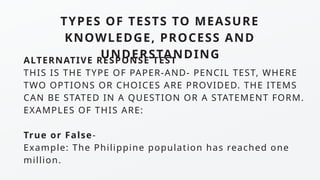
ALTERNATIVE RESPONSE TEST
THIS IS THE TYPE OF PAPER-AND- PENCIL TEST, WHERE
TWO OPTIONS OR CHOICES ARE PROVIDED. THE ITEMS
CAN BE STATED IN A QUESTION OR A STATEMENT FORM.
EXAMPLES OF THIS ARE:
True or False-
Example: The Philippine population has reached one
million.
52.
TYPES OF TESTSTO MEASURE
KNOWLEDGE, PROCESS AND
UNDERSTANDING
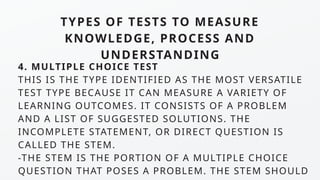
4. MULTIPLE CHOICE TEST
THIS IS THE TYPE IDENTIFIED AS THE MOST VERSATILE
TEST TYPE BECAUSE IT CAN MEASURE A VARIETY OF
LEARNING OUTCOMES. IT CONSISTS OF A PROBLEM
AND A LIST OF SUGGESTED SOLUTIONS. THE
INCOMPLETE STATEMENT, OR DIRECT QUESTION IS
CALLED THE STEM.
-THE STEM IS THE PORTION OF A MULTIPLE CHOICE
QUESTION THAT POSES A PROBLEM. THE STEM SHOULD
53.
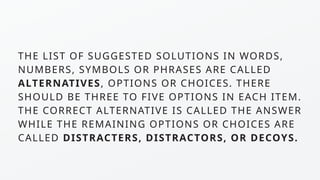
THE LIST OFSUGGESTED SOLUTIONS IN WORDS,
NUMBERS, SYMBOLS OR PHRASES ARE CALLED
ALTERNATIVES, OPTIONS OR CHOICES. THERE
SHOULD BE THREE TO FIVE OPTIONS IN EACH ITEM.
THE CORRECT ALTERNATIVE IS CALLED THE ANSWER
WHILE THE REMAINING OPTIONS OR CHOICES ARE
CALLED DISTRACTERS, DISTRACTORS, OR DECOYS.
54.
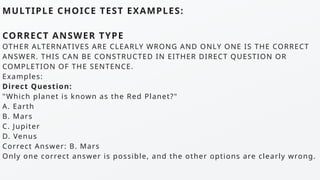
MULTIPLE CHOICE TESTEXAMPLES:
CORRECT ANSWER TYPE
OTHER ALTERNATIVES ARE CLEARLY WRONG AND ONLY ONE IS THE CORRECT
ANSWER. THIS CAN BE CONSTRUCTED IN EITHER DIRECT QUESTION OR
COMPLETION OF THE SENTENCE.
Examples:
Direct Question:
"Which planet is known as the Red Planet?"
A. Earth
B. Mars
C. Jupiter
D. Venus
Correct Answer: B. Mars
Only one correct answer is possible, and the other options are clearly wrong.
55.
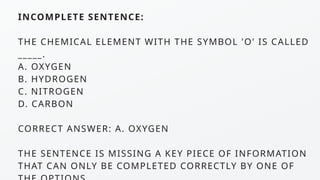
INCOMPLETE SENTENCE:
THE CHEMICALELEMENT WITH THE SYMBOL 'O' IS CALLED
_____.
A. OXYGEN
B. HYDROGEN
C. NITROGEN
D. CARBON
CORRECT ANSWER: A. OXYGEN
THE SENTENCE IS MISSING A KEY PIECE OF INFORMATION
THAT CAN ONLY BE COMPLETED CORRECTLY BY ONE OF
56.
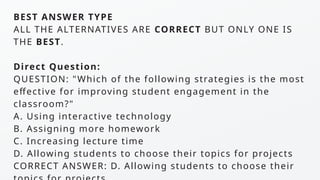
BEST ANSWER TYPE
ALLTHE ALTERNATIVES ARE CORRECT BUT ONLY ONE IS
THE BEST.
Direct Question:
QUESTION: "Which of the following strategies is the most
effective for improving student engagement in the
classroom?"
A. Using interactive technology
B. Assigning more homework
C. Increasing lecture time
D. Allowing students to choose their topics for projects
CORRECT ANSWER: D. Allowing students to choose their
57.
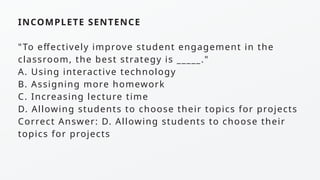
INCOMPLETE SENTENCE
"To effectivelyimprove student engagement in the
classroom, the best strategy is _____."
A. Using interactive technology
B. Assigning more homework
C. Increasing lecture time
D. Allowing students to choose their topics for projects
Correct Answer: D. Allowing students to choose their
topics for projects
58.
5. MATCHING TYPETEST
THE MOST COMMON MATCHING TYPE TEST IS MADE UP
OF TWO PARALLEL COLUMNS, THE FIRST COLUMN (A) IS
THE PREMISE THAT PRESENTS THE PROBLEM, AND THE
SECOND COLUMN (B) PROVIDES THE ANSWER. THERE
ARE MANY MODIFIED MATCHING TYPES AS WELL.
Matching type test is useful in measuring factual
information as well as relationships between two
things, ideas or concepts. It reduces guessing to the
minimum as compared to alternative response test.
Some of the relationships that can be matched are
found in the matrix below:
59.
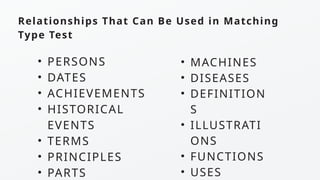
Relationships That CanBe Used in Matching
Type Test
• PERSONS
• DATES
• ACHIEVEMENTS
• HISTORICAL
EVENTS
• TERMS
• PRINCIPLES
• PARTS
• MACHINES
• DISEASES
• DEFINITION
S
• ILLUSTRATI
ONS
• FUNCTIONS
• USES
60.
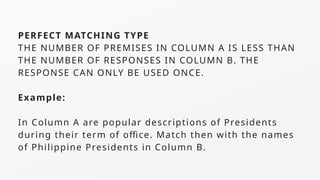
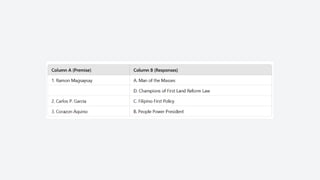
PERFECT MATCHING TYPE
THENUMBER OF PREMISES IN COLUMN A IS LESS THAN
THE NUMBER OF RESPONSES IN COLUMN B. THE
RESPONSE CAN ONLY BE USED ONCE.
Example:
In Column A are popular descriptions of Presidents
during their term of office. Match then with the names
of Philippine Presidents in Column B.
61.
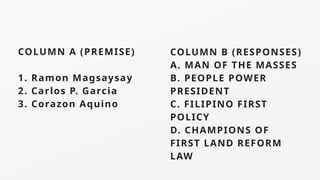
COLUMN A (PREMISE)
1.Ramon Magsaysay
2. Carlos P. Garcia
3. Corazon Aquino
COLUMN B (RESPONSES)
A. MAN OF THE MASSES
B. PEOPLE POWER
PRESIDENT
C. FILIPINO FIRST
POLICY
D. CHAMPIONS OF
FIRST LAND REFORM
LAW
63.
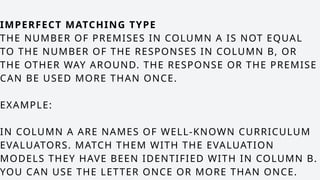
IMPERFECT MATCHING TYPE
THENUMBER OF PREMISES IN COLUMN A IS NOT EQUAL
TO THE NUMBER OF THE RESPONSES IN COLUMN B, OR
THE OTHER WAY AROUND. THE RESPONSE OR THE PREMISE
CAN BE USED MORE THAN ONCE.
EXAMPLE:
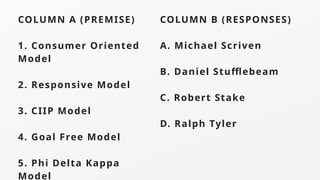
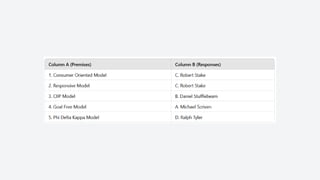
IN COLUMN A ARE NAMES OF WELL-KNOWN CURRICULUM
EVALUATORS. MATCH THEM WITH THE EVALUATION
MODELS THEY HAVE BEEN IDENTIFIED WITH IN COLUMN B.
YOU CAN USE THE LETTER ONCE OR MORE THAN ONCE.
64.
COLUMN A (PREMISE)
1.Consumer Oriented
Model
2. Responsive Model
3. CIIP Model
4. Goal Free Model
5. Phi Delta Kappa
Model
COLUMN B (RESPONSES)
A. Michael Scriven
B. Daniel Stufflebeam
C. Robert Stake
D. Ralph Tyler
66.
TYPES OF TESTSTO MEASURE
KNOWLEDGE, PROCESS AND
UNDERSTANDING
SUBJECTIVE TEST
LEARNING OUTCOMES WHICH INDICATE LEARNER'S
ABILITY TO ORIGINATE AND EXPRESS IDEAS IS
DIFFICULT TO TEST THROUGH OBJECTIVE TYPE TEST.
HENCE IN SUBJECTIVE TYPE TEST, ANSWERS THROUGH
REFLECTIONS, INSIGHTS, AND OPINION CAN BE GIVEN
THROUGH ESSAY.
67.
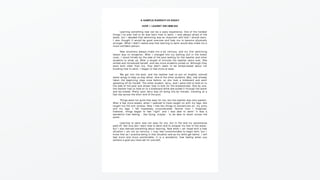
ESSAY
TEST ITEMS ALLOWSTUDENTS FREEDOM OF
RESPONSE. STUDENTS ARE FREE TO SELECT, RELATE
AND PRESENT IDEAS IN THEIR OWN WORDS. THE
TYPE OF ANSWERS WOULD REFLECT THE EXTENT OF
THE LEARNER'S KNOWLEDGE OF THE SUBJECT
MATTER, ABILITY TO USE HIGHER ORDER THINKING
SKILLS AND EXPRESS IDEAS IN AN ACCURATE
CREATIVE AND APPROPRIATE LANGUAGE.
69.
TYPES OF TESTSTO MEASURE
KNOWLEDGE, PROCESS AND
UNDERSTANDING
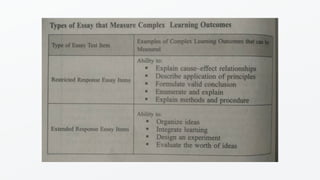
RESTRICTED RESPONSE ITEM
THIS IS LIKE AN EXPANDED FORM OF SHORT ANSWER
TYPE OBJECTIVE TEST. THERE IS A LIMIT ON BOTH THE
CONTENT SCOPE AND THE FORM OF STUDENT
RESPONSE. IT IS MOST USEFUL IN MEASURING
LEARNING OUTCOMES THAT REQUIRE THE
INTERPRETATION AND APPLICATION OF DATA IN A
SPECIFIC AREA.
70.
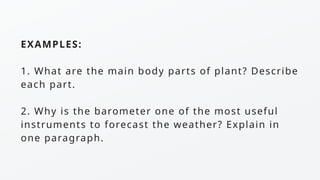
EXAMPLES:
1. What arethe main body parts of plant? Describe
each part.
2. Why is the barometer one of the most useful
instruments to forecast the weather? Explain in
one paragraph.
71.
TYPES OF TESTSTO MEASURE
KNOWLEDGE, PROCESS AND
UNDERSTANDING
EXTENDED RESPONSE ITEM
THE STUDENT IS GENERALLY FREE TO SELECT ANY
FACTUAL INFORMATION THAT CAN HELP IN
ORGANIZING THE RESPONSE. THE CONTENTS OF AN
EXTENDED ESSAY WILL DEPEND ON THE ANALYSIS,
SYNTHESIS, EVALUATION AND OTHER HIGHER ORDER
THINKING SKILLS OF THE TEST TAKERS.
72.
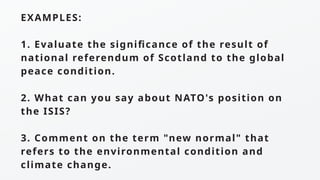
EXAMPLES:
1. Evaluate thesignificance of the result of
national referendum of Scotland to the global
peace condition.
2. What can you say about NATO's position on
the ISIS?
3. Comment on the term "new normal" that
refers to the environmental condition and
climate change.
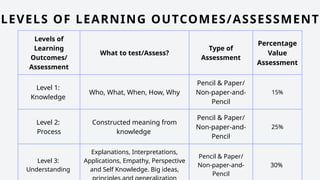
Levels of
Learning
Outcomes/
Assessment
What totest/Assess?
Type of
Assessment
Percentage
Value
Assessment
Level 1:
Knowledge
Who, What, When, How, Why
Pencil & Paper/
Non-paper-and-
Pencil
15%
Level 2:
Process
Constructed meaning from
knowledge
Pencil & Paper/
Non-paper-and-
Pencil
25%
Level 3:
Understanding
Explanations, Interpretations,
Applications, Empathy, Perspective
and Self Knowledge. Big ideas,
Pencil & Paper/
Non-paper-and-
Pencil
30%
LEVELS OF LEARNING OUTCOMES/ASSESSMENT
77.
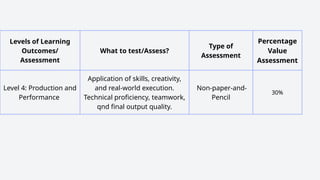
Levels of Learning
Outcomes/
Assessment
Whatto test/Assess?
Type of
Assessment
Percentage
Value
Assessment
Level 4: Production and
Performance
Application of skills, creativity,
and real-world execution.
Technical proficiency, teamwork,
qnd final output quality.
Non-paper-and-
Pencil
30%
78.
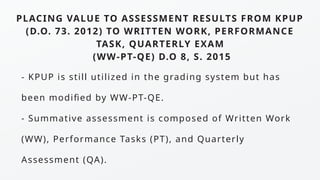
- KPUP isstill utilized in the grading system but has
been modified by WW-PT-QE.
- Summative assessment is composed of Written Work
(WW), Performance Tasks (PT), and Quarterly
Assessment (QA).
PLACING VALUE TO ASSESSMENT RESULTS FROM KPUP
(D.O. 73. 2012) TO WRITTEN WORK, PERFORMANCE
TASK, QUARTERLY EXAM
(WW-PT-QE) D.O 8, S. 2015
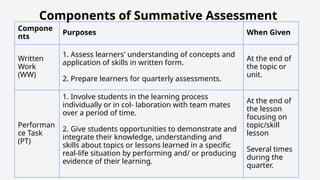
79.
Compone
nts
Purposes When Given
Written
Work
(WW)
1.Assess learners' understanding of concepts and
application of skills in written form.
2. Prepare learners for quarterly assessments.
At the end of
the topic or
unit.
Performan
ce Task
(PT)
1. Involve students in the learning process
individually or in col- laboration with team mates
over a period of time.
2. Give students opportunities to demonstrate and
integrate their knowledge, understanding and
skills about topics or lessons learned in a specific
real-life situation by performing and/ or producing
evidence of their learning.
At the end of
the lesson
focusing on
topic/skill
lesson
Several times
during the
quarter.
Components of Summative Assessment
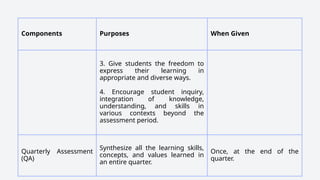
80.
Components Purposes WhenGiven
3. Give students the freedom to
express their learning in
appropriate and diverse ways.
4. Encourage student inquiry,
integration of knowledge,
understanding, and skills in
various contexts beyond the
assessment period.
Quarterly Assessment
(QA)
Synthesize all the learning skills,
concepts, and values learned in
an entire quarter.
Once, at the end of the
quarter.
81.
GRADES AT THEEND
OF THE SCHOOL
YEAR AND HOW
THESE ARE
COMPUTED
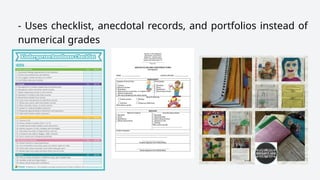
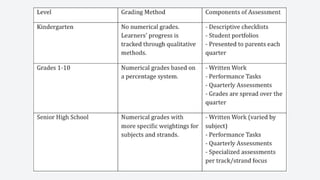
- Uses checklist,anecdotal records, and portfolios instead of
numerical grades
85.
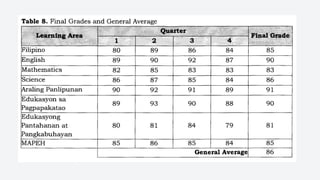
For Grades 1to 12, each grading period includes one
Quarterly Assessment, along with opportunities for students
to complete Written Work and Performance Tasks. While
there's no set number of these tasks, they should be spread
throughout the quarter and used to assess skills after each
unit.
FOR GRADES 1 TO 12
86.
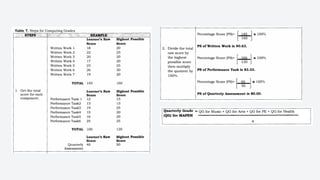
How to Computefor Final Grades and General
Average in DepEd K to 12 Grading System
Step 1: Grades from all student work are added up
• This results in the total score for each component, namely Written
Work, Performance Tasks, and Quarterly Assessment.
•Raw scores from each component have to be converted to a
Percentage Score. This is to ensure that values are parallel to each
other.
87.
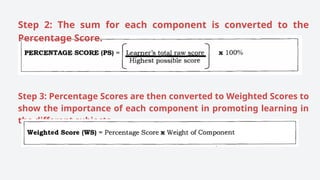
Step 2: Thesum for each component is converted to the
Percentage Score.
Step 3: Percentage Scores are then converted to Weighted Scores to
show the importance of each component in promoting learning in
the different subjects.
88.
Grade 1 to10 (Highschool)
High School Grading Components
89.
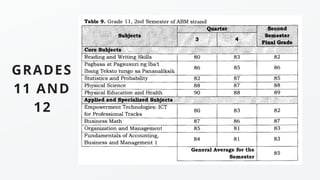
Grade 11 andGrade 12 (Senior High):
Senior High School Grading Components
90.
Step 4: Thesum of the
Weighted Scores in
each component is the
Initial Grade.
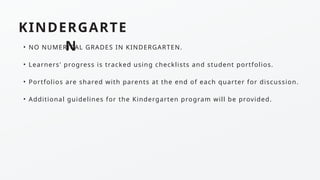
KINDERGARTE
N
• NO NUMERICALGRADES IN KINDERGARTEN.
• Learners' progress is tracked using checklists and student portfolios.
• Portfolios are shared with parents at the end of each quarter for discussion.
• Additional guidelines for the Kindergarten program will be provided.
95.
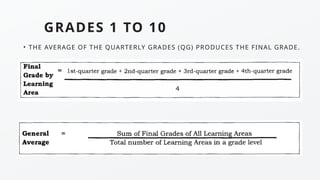
GRADES 1 TO10
• THE AVERAGE OF THE QUARTERLY GRADES (QG) PRODUCES THE FINAL GRADE.
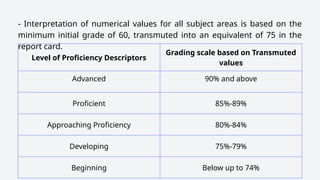
Level of ProficiencyDescriptors
Grading scale based on Transmuted
values
Advanced 90% and above
Proficient 85%-89%
Approaching Proficiency 80%-84%
Developing 75%-79%
Beginning Below up to 74%
- Interpretation of numerical values for all subject areas is based on the
minimum initial grade of 60, transmuted into an equivalent of 75 in the
report card.
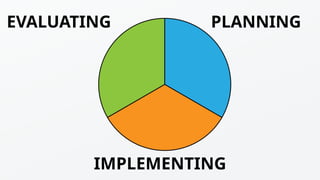
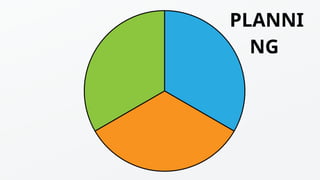
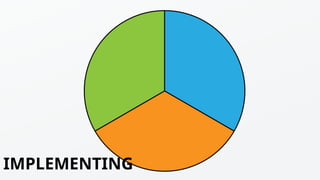
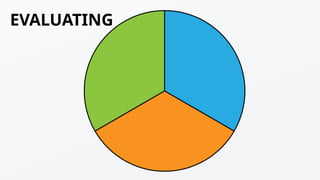
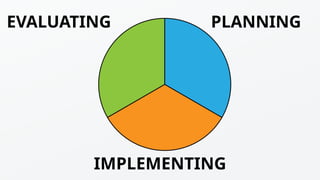
Planning, implementing, andevaluating are three connected
processes in curriculum development. Planning determines
needs through assessment and results in a written curriculum.
Implementation puts the planned curriculum into action
through teaching. Evaluation assesses whether the planned
curriculum was successfully implemented and the desired
learning outcomes achieved. The processes are cyclical -
evaluation informs future planning, which leads again to
implementation and evaluation. Understanding the
connections between planning, implementing, and evaluating
109.
As a curricularist,these guiding ideas
clarify our understanding that one
cannot assess what was not taught,
nor implement what was not
planned. PLAN then IMPLEMENT then
EVALUATE and the next cycle begin.