1. The document discusses various strategies for teaching mathematics, including focusing on knowledge and skill goals, understanding goals, and problem-solving goals.
2. Key strategies discussed are the problem-solving strategy, concept attainment strategy, and concept formation strategy.
3. The problem-solving strategy involves steps like restating the problem, identifying key information, estimating, and checking solutions. The concept attainment strategy helps students identify essential attributes of concepts. The concept formation strategy helps students make connections between elements of a concept.
Introduction to the teaching of mathematics focusing on its logical nature and problem-solving approach.
Discusses the importance of strategies in teaching mathematics based on learning objectives.
Knowledge and skills in mathematics are emphasized through memorization and practice of fundamental concepts.
Understanding goals involve applying knowledge through different teaching strategies.
Various teaching methods including authority teaching, interaction, discovery, laboratory, and teacher-controlled presentations.
Highlights problem solving as a crucial mathematical activity that motivates all students.
Outlines key strategies in teaching mathematics including problem-solving, concept attainment, and formation.
Theoretical foundations for problem-solving strategies based on constructivist and cognitive theories.
Various advanced techniques for problem solving including guided discovery, trial and error, and elimination.Explains the concept attainment strategy focusing on essential attributes and examples.
Outlines successful indicators of the concept attainment strategy for enhancing understanding.
Describes the concept formation strategy to help students connect essential elements within concepts.
Nature of Mathematics
Math is definite, logical and objective. The
rules for determining the truth or falsity of a
statement are accepted by all. If there are
disagreements, it can readily be tested. It is in
contrast with the subjective characteristics of
other subjects like literature, social studies and
the arts.
Math deals with solving problems. Such
problems are similar to all other problems anyone
is confronted with. It consists of: a) defining the
problem, b) entertaining a tentative guess as the
solution c) testing the guess, and d) arriving at
a solution.
3.
.…
Strategies in Teaching
Mathematics
The strategy for teaching Mathematics
depends on the objectives or goals of the
learning process. In general these goals are
classified into three: a) knowledge and skill
goals, b) understanding goals and c) problem
solving goals.
4.
Strategy Based onObjectives
Knowledge and Skill Goals
Knowledge and basic skills compose a large part of
learning in Mathematics. Students may be required to
memorize facts or to become proficient in using
algorithms.
Ex. of facts:
2 X 10= 20 Area of rectangle = B x H
Ex. of skills:
Multiplying two-digit whole numbers
Changing a number to scientific notation
Knowledge and skill goals require automatic
responses which could be achieved through repetition and
practice.
5.
Understanding Goals
The distinguishing characteristics of
understanding goal is that “understanding must be
applied, derived or used to deduce a
consequence”. Some strategies used in
understanding are:
a. authority teaching
b. interaction and discussion
c. discovery
d. laboratory
e. teacher-controlled presentations
6.
a.) Authority teaching
The teacher as an authority simply
states the concept to be learned. The techniques
used are by telling which is defined, stating an
understanding without justification, by
analogy, and by demonstration.
b.) Interaction and discussion
Interaction is created by asking
questions in order to provide means for active
instead of passive participation.
7.
c) Discovery
The elements of a discovery experience
are motivation, a primitive process, an
environment for discovery, an opportunity to make
conjectures and a provision for applying the
generalization.
8.
d) Laboratory
The advantages are:
a) maximizes student participation, b)
provides appropriate level of
difficulty
c) offers novel approaches
d) improves attitudes towards mathematics
This is done through experimental
activities dealing with concrete situations such as
drawing, weighing, averaging and estimating.
Recording, analyzing and checking data enable
students to develop new concepts and
understanding effectively.
9.
e) Teacher-controlled presentations
The teacher uses educational technology
such as films and filmstrips, programmed
materials, and audio materials. Other activities are
listening to resource persons and conducting field
trips. Suitable places for educational trips are
government agencies such as the weather
bureau, post office and community
supermarkets, factories and transportation centers
like the bus depot and airport.
10.
Problem-solving Goals
Problem solving is regarded by mathematics
educators and specialists as the basic
mathematical activity. Other mathematical
activities such as generalization, abstraction, and
concept building are based on problem solving.
Others believe that the more important roleof
problem solving in the school curriculum is to
motivate all students not only those who have a
special interest in mathematics and a special
aptitude for it.
11.
Strategies in Teaching
Mathematics
1. Problem Solving
2. Concept Attainment Strategy
3. Concept Formation Strategy
12.
1. Problem solving
TheoreticalBasis for Problem-solving Strategy
Constructivism – This is based on Brunner’s
theoretical framework that learning is an active process
in which learners construct new ideas or concepts
based upon current/past knowledge.
Cognitive theory – The cognitive theory encourages
students’ creativity with the implementation of
technology such as computer which are used to create
practice situations.
13.
Guided DiscoveryLearning
Tool engages students in a series of higher order
thinking skills to solve problems.
Metacognition Theory
The field of metacognition process holds that students
should develop and explore the problem, extend
solutions, process and develop self-reflection. Problem
solving must challenge students to think.
14.
Cooperative learning
The purpose of cooperative learning group is to make
each member a stronger individual in his/her own right.
Individual accountability is the key to ensuring that all group
members are strengthened by learning cooperatively.
Teachers need to assess how much work each member is
contributing to the group’s work, provide feedback to groups
and individual students, help groups avoid redundant efforts
by members, and make sure that every member is
responsible for the final outcome.
The favorable outcomes in the use of cooperative
learning is that students are taught cooperative skills such
as: a) forming groups, b) working as a group, c) problem
solving as a group and d) managing differences
15.
Steps of theProblem Solving Strategy
1. Restate the problem
2. Select appropriate notation. It can help them recognize a
solution.
3. Prepare a drawing, figure or graph. These can help
understand and visualize the problem.
4. Identify the wanted, given and needed information.
5. Determine the operation to be used.
6. Estimate the answer.
Knowing what the student should get as the answer to the
problem will lead the students to the correct operations to use
and the proper solutions.
16.
7. Solve theproblem.
The student is now ready to work on the problem.
8. Check the solution. Find a way to verify the solutions
in order to experience the process of actually solving the
problem.
17.
Other Techniques inProblem Solving
1. Obtain the answer by trial and error.
It requires the student to make a series of
calculations. In each calculation, an estimate of
some unknown quantity is used to compute the
value of a known quantity.
2. Use an aid, model or sketch.
A problem could be understood by drawing a
sketch, folding a piece of paper, cutting a piece
of string, or making use of some simple aid.
Using an aid could make the situation real to
them.
18.
3. Search fora pattern
This strategy requires the students to examine
sequences of numbers or geometric objects in
search of some rule that will allow them to
extend the sequences indefinitely.
Example: Find the 10th term in a sequence
that begins, 1, 2, 3, 5, 8, 13, . . . . .
This approach is an aspect of
inductive thinking-figuring a rule
from examples.
19.
4. Elimination Strategy
This strategy requires the student to use
logic to reduce the potential list of answers to
a minimum. Through logic, they throw away
some potential estimates as unreasonable
and focus on the reasonable estimates
20.
Concept attainment strategy
This strategy allows the students to discover
the essential attributes of a concept. It can
enhance the students’ skills in (a) separating
important from unimportant information; (b)
searching for patterns and making generalizations;
and (c) defining and explaining concepts.
21.
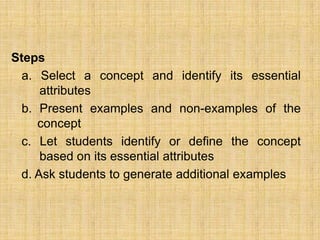
Steps
a.Select a concept and identify its essential
attributes
b. Present examples and non-examples of the
concept
c. Let students identify or define the concept
based on its essential attributes
d. Ask students to generate additional examples
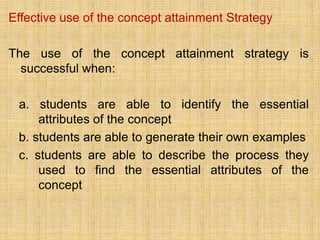
Effective use ofthe concept attainment Strategy
The use of the concept attainment strategy is
successful when:
a. students are able to identify the essential
attributes of the concept
b. students are able to generate their own examples
c. students are able to describe the process they
used to find the essential attributes of the
concept
24.
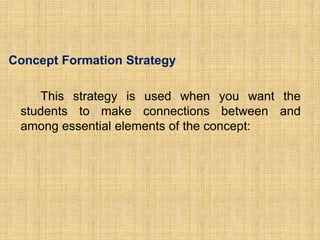
Concept Formation Strategy
This strategy is used when you want the
students to make connections between and
among essential elements of the concept:
25.
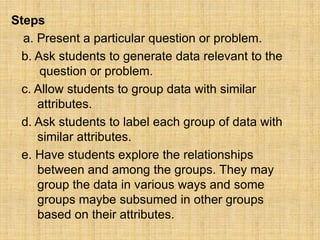
Steps
a.Present a particular question or problem.
b. Ask students to generate data relevant to the
question or problem.
c. Allow students to group data with similar
attributes.
d. Ask students to label each group of data with
similar attributes.
e. Have students explore the relationships
between and among the groups. They may
group the data in various ways and some
groups maybe subsumed in other groups
based on their attributes.