


Welcome
to our presentation
Group Members:
Name ID
Md.Mohit-Ul Alam 131-23-3384
A.N.M. Masum Billah 131-23-3435
Istiaque Mostofa 121-23-2900
Hafeza Islam 131-23-3358
On fabric surface
 Pilling:
 Pilling is formation of little balls of fibers (pills) on the
surface of a fabric which is caused by abrasion in wear.
 Pilling is the tendency of fibers to come loose from a
fabric surface and form balled particles of fiber
 Causes of Pilling:
 Due to wear and abrasion.
 Due to rubbing action of fabric with particular parts of
garments and body.
 Due to soft twisted yarn.
 Due to excess short fibres.
 Due to migration of fibres from constituent yarn in
fabric.
 Due to protruding fibre / yarn hairiness.
 Due to heat in case of thermoplastic fibres.
 Reduction OR Minimizing pilling:
 By using high twisted yarn.
 By brushing and cropping of the fabric surface to remove loose fibre
ends.
 By using singeing process to reduce yarn hairiness, longer fibres.
 By using anti pilling technique.
 By special chemical treatment such as adhesive, anti-rubbing agent.
 By reducing migration of fibres by means of Air Jet spinning
process.
 By increasing inter-fibre friction.
 By increasing linear density of the fibre.
 By using a high number of threads per unit length.

 Pilling test:
 For this test four specimens each 5 inch X 5 inch are
cut from the fabric.
 A seam allowance of 12mm is marked on the back of
each square. In two of the samples the seam is marked
parallel to the warp direction and in the other two
parallel to the weft direction.
 The samples are then folded face to face and a seam is
sewn on the marked line.
 This gives two specimens with the seam parallel to the warp and
two with the seam parallel to the weft.
 Each specimen is turned inside out and 6mm cut off each end of
it thus removing any sewing distortion.
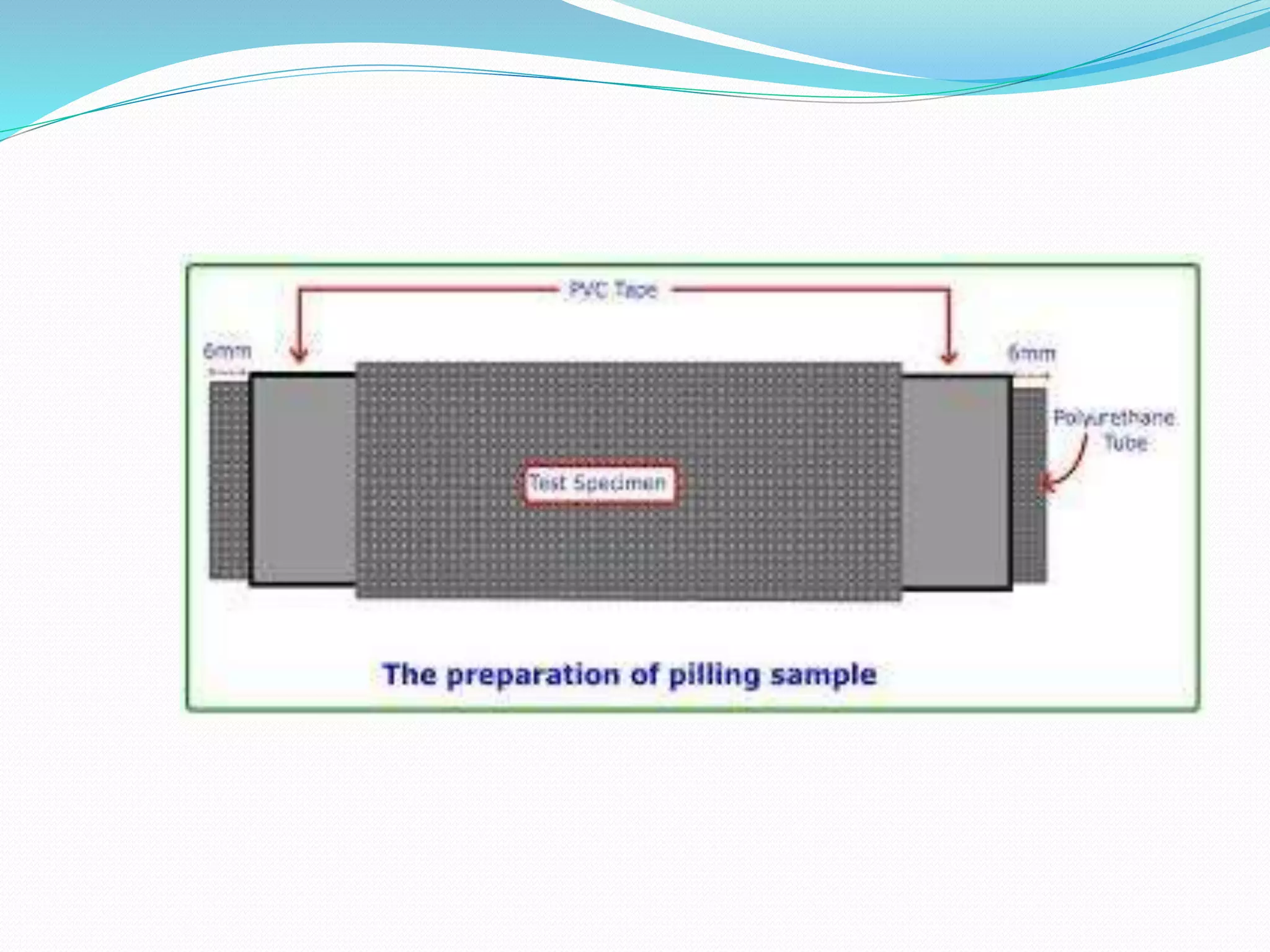
 The fabric tubes made are then mounted on rubber tubes so
that the length of tube showing at each end is the same. Each of
the loose ends is taped with poly (vinyl chloride) (PVC) tape so
that 6mm of the rubber tube is left exposed as shown in Figure.
 All four specimens are then placed in one pilling box.
 The samples are then tumbled together in a cork-lined box as
shown in Figure.
 The usual number of revolutions used in the test is 18,000 which
take 5 hrs
 Assessment
 The specimens are removed from the tubes and viewed
using oblique lighting. The samples are then given a
rating of between 1 and 5 with the help of the
descriptions in Table.
Table :
Rating Description Points to be taken into
consideration
5 No change No visual change
4 Slight change Slight surface fuzzing
3 Moderate change The specimen may be
exhibit one or both of the
following :
a)Moderate fuzzing
b)Isolate d fully form pills
2 Significant change Distinct fuzzing and/ or
pilling
1 Severe change Dense fuzzing and /or
pilling which covers the
specimen
 Rating of pill formation
Thank you

Pilling on fabric surfaces

  • 1.
  • 3.
    Group Members: Name ID Md.Mohit-UlAlam 131-23-3384 A.N.M. Masum Billah 131-23-3435 Istiaque Mostofa 121-23-2900 Hafeza Islam 131-23-3358
  • 4.
  • 5.
     Pilling:  Pillingis formation of little balls of fibers (pills) on the surface of a fabric which is caused by abrasion in wear.  Pilling is the tendency of fibers to come loose from a fabric surface and form balled particles of fiber
  • 6.
     Causes ofPilling:  Due to wear and abrasion.  Due to rubbing action of fabric with particular parts of garments and body.  Due to soft twisted yarn.  Due to excess short fibres.  Due to migration of fibres from constituent yarn in fabric.  Due to protruding fibre / yarn hairiness.  Due to heat in case of thermoplastic fibres.
  • 7.
     Reduction ORMinimizing pilling:  By using high twisted yarn.  By brushing and cropping of the fabric surface to remove loose fibre ends.  By using singeing process to reduce yarn hairiness, longer fibres.  By using anti pilling technique.  By special chemical treatment such as adhesive, anti-rubbing agent.  By reducing migration of fibres by means of Air Jet spinning process.  By increasing inter-fibre friction.  By increasing linear density of the fibre.  By using a high number of threads per unit length. 
  • 8.
     Pilling test: For this test four specimens each 5 inch X 5 inch are cut from the fabric.  A seam allowance of 12mm is marked on the back of each square. In two of the samples the seam is marked parallel to the warp direction and in the other two parallel to the weft direction.  The samples are then folded face to face and a seam is sewn on the marked line.
  • 10.
     This givestwo specimens with the seam parallel to the warp and two with the seam parallel to the weft.  Each specimen is turned inside out and 6mm cut off each end of it thus removing any sewing distortion.  The fabric tubes made are then mounted on rubber tubes so that the length of tube showing at each end is the same. Each of the loose ends is taped with poly (vinyl chloride) (PVC) tape so that 6mm of the rubber tube is left exposed as shown in Figure.  All four specimens are then placed in one pilling box.  The samples are then tumbled together in a cork-lined box as shown in Figure.  The usual number of revolutions used in the test is 18,000 which take 5 hrs
  • 11.
     Assessment  Thespecimens are removed from the tubes and viewed using oblique lighting. The samples are then given a rating of between 1 and 5 with the help of the descriptions in Table.
  • 12.
    Table : Rating DescriptionPoints to be taken into consideration 5 No change No visual change 4 Slight change Slight surface fuzzing 3 Moderate change The specimen may be exhibit one or both of the following : a)Moderate fuzzing b)Isolate d fully form pills 2 Significant change Distinct fuzzing and/ or pilling 1 Severe change Dense fuzzing and /or pilling which covers the specimen
  • 13.
     Rating ofpill formation
  • 15.