1
Unit 6
ORGANIZING
2
Organizing
Organization: collection of people working
together under a division of labor and a
hierarchy of authority to achieve a common
goal
- The second managerial function after planning
process.
- Need large number of workers to require a
supervisor.
- Organizations facilitate greater accomplishment
of work by groups.
- Manager develops order, promotes
cooperation among workers, and fosters
productivity
- Major component: position, task responsibilities,
&Relation ships.
3
Organization involves:
1. Defining the agency’s mission and objectives
2. Establishing policies and plans.
3. Clarifying the activities necessary to meet the
objectives.
4. Organizing for best utilization of available
human and material resources.
5. Delegating the responsibility and authority to
appropriate personnel
6. Grouping personnel vertically & horizontally
through information & authority relationships
4
Organizational structure:
1. Organizational structure furnishes the
formal framework in management
process.
2. Organizational structure should provide
an effective work system, & should
consequently foster job satisfaction
5
Informal & formal organization structures agencies:
1) Informal organization: personal and social
relationships do not appear on the organizational
chart.
- Based on personal relationships rather than
positional authority
- provides social satisfaction, & may gain recognition
- Informal authority is not commanded through
organizational assignment.
- Authority comes from the follower’s natural
respect for a colleague’s knowledge and abilities
- Provides social control of behavior
6
2(Formal organization structures:
Formal organizational structure:
executive decision as a result of planning.
The relationships among people and their
positions can be diagramed.
Describes positions, task responsibilities
and relationships
7
Nursing Department Utilize One Of
The Following Structural Patterns
A- Line organization and line – and – staff
organization, are the most common
structures in large health care facilities:
- Organization’s structure commonly draw in an
organization chart.
- Line positions shown by either horizontal or
vertical unbroken lines.
- Horizontal unbroken lines represent
communication between similar power but
different functions
8
Vertical unbroken lines between positions
means formal paths of communication &
authority.
- Greatest decision making and authority
persons are located at the top, and the least
are at the bottom
*Dotted or broken lines on the organization chart:
- represent staff position.
- (advisory, provides information and assistance
to manager but has limited organizational
authority)
9
- specialization that would be impossible for
any one manager to achieve alone
- Command way indicated by vertical solid
line between individuals.
- One person / one boss. .
- Line Organizations have no advisory
positions.
- Line -and- staff have advisory positions
- In these structures authority and
responsibility are clearly defined with
simplicity of relationships
10
Disadvantages of formal design:
1. Often produce monotony and alienate
workers.‫ونفور‬ ‫ملل‬ ‫عنها‬ ‫ينتج‬
2. Adherence to chain of command
restricts upward communication
(Going outside of the chain of command for upward
communication inappropriate)
11
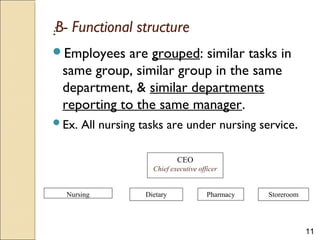
B- Functional structure:
Employees are grouped: similar tasks in
same group, similar group in the same
department, & similar departments
reporting to the same manager.
Ex. All nursing tasks are under nursing service.
CEO
Chief executive officer
Nursing Dietary Pharmacy Storeroom
12
* Advantages of functional organizations:
- They use resource efficiently
- Do not duplicate tasks.
- Simplify training. (common tasks grouped
together for economy of scale)
*Disadvantages of functional organizations
- Poor coordination across functions.
- Response time is slower.
13
C- Dual management:
Separates technical and administrative
responsibilities.
- One hierarchy for technical professionals
make technical decisions, & another
hierarchy for supervisors make decisions
about management issues e.g. personnel and
budget.
- This dual hierarchy gives equal status to
managers and technical professionals. It
provides job description for each hierarchy.
14
D- Self – Contained unit structure:‫القسم‬ ‫هيكلية‬
* Functions needed to produce a service are
grouped together in an autonomous division.
E.g.( large institution)
Strengths:
- Each division has its specialty & high client
satisfaction can be achieved
- High employees coordination across functions
occurs to meet unit goals & reduce conflict.
weaknesses:
- Coordination across product lines is difficult. division
operate independently.
- Each service line has its own nursing staff and
competes with other service lines
15
E- Matrix structure:
Structure has a formal vertical as well as
horizontal chain of command.
separate executives are responsible for each
side of the matrix.
Heads of Departments may receive conflicting
demands from the matrix managers and often
must resolve the conflict themselves.
16
Advantages: (matrix structure):
- Strong contact between staff of different
divisions
Disadvantages:
1. Dual authority frustrating and confusing for
managers and employees in dept.
2. Need excellent interpersonal skills for
involved managers
3. Time-consuming because frequent meetings
are required to resolve conflicts
17
Organizational concepts:
Charts: drawing shows how the parts of
an organization are linked.
- It depicts the formal organizational
relationships
- Areas of responsibility& accountability,
and channels of communication
18
Span of Management (Span Of Control(
Can be determined from the organization
chart.
- It is the number of people (subordinates)
reporting to any manager represents the
manager’s span of control & determines the
number of interactions expected of him .
- Graicunas, a management consultant analyze
potential relationships between a supervisor
and his/her subordinates, and among the
subordinates.
19
- As the number of subordinates increase
arithmetically, number of potential
interactions increased geometrically (single,
direct group, cross RT)
************************************************
Optimal span of management depends on
the following considerations:
1. The manager’s abilities
2. The employee’s maturity.
3. Task complexity
4. Geographic location
20
Decentralization Versus Centralization:
Centralized: decision making done by a
manager at the top of the hierarchy
Decentralized: decision making diffuses
throughout the organization, and allow
problem solving at the level at which they
occur
21
Advantages of decentralization:
1. Increases morale & promotes interpersonal
relationships
2. encourage informality and democracy in
management
3. Facilitate local decision making by Managers &
others
4. Develops managers by allowing them to
manage
5. Increase flexibility.
6. Releases top managers from the routine
administration.
7. Freeing managers for planning, and policy
development, and systems integration
22
Disadvantages of decentralization
1. Divisions may become individualized and
competitive and work against the best
interests of the organization.‫لمصلحة‬ ‫العامة‬ ‫بالهداف‬ ‫تضحية‬
‫ضيقة‬
2. Increase costs, need more manager and large
staffs
3. Division managers may not inform top
manager of their problems.
23
Delegation
Getting work done through others to
accomplish organizational goals
process of assigning work from one organizational
level to another or from superior to subordinate
Delegation Has two legs (Responsibility & Authority)
Delegation increase subordinate's motivation
and commitment to accomplish goals.
The manager concentrates on the
accomplishment of overall goals and objectives
rather than the day-to-day details
- In delegation the manager delegate (authority &
the power)
24
Departmentalization:
 Subdivide of the organizational structures.
 Managers specialize within limited ranges of
activity
1. Departmentalization by function
2. Departmentalization by production
3. Departmentalization by customers
4. Departmentalization by geographical
territories.
5. Departmentalization by project.
25
Authority : The official power to act.
- Given by the organization to direct the
work of others.
- A manager may have the authority to
hire, fire, or discipline others .
• Responsibility: is a duty or an assignment
• Accountability: morally internalizing
responsibility.
- Agreement to accept the consequences of
your actions.
26

Presentation on Organization

  • 1.
  • 2.
    2 Organizing Organization: collection ofpeople working together under a division of labor and a hierarchy of authority to achieve a common goal - The second managerial function after planning process. - Need large number of workers to require a supervisor. - Organizations facilitate greater accomplishment of work by groups. - Manager develops order, promotes cooperation among workers, and fosters productivity - Major component: position, task responsibilities, &Relation ships.
  • 3.
    3 Organization involves: 1. Definingthe agency’s mission and objectives 2. Establishing policies and plans. 3. Clarifying the activities necessary to meet the objectives. 4. Organizing for best utilization of available human and material resources. 5. Delegating the responsibility and authority to appropriate personnel 6. Grouping personnel vertically & horizontally through information & authority relationships
  • 4.
    4 Organizational structure: 1. Organizationalstructure furnishes the formal framework in management process. 2. Organizational structure should provide an effective work system, & should consequently foster job satisfaction
  • 5.
    5 Informal & formalorganization structures agencies: 1) Informal organization: personal and social relationships do not appear on the organizational chart. - Based on personal relationships rather than positional authority - provides social satisfaction, & may gain recognition - Informal authority is not commanded through organizational assignment. - Authority comes from the follower’s natural respect for a colleague’s knowledge and abilities - Provides social control of behavior
  • 6.
    6 2(Formal organization structures: Formalorganizational structure: executive decision as a result of planning. The relationships among people and their positions can be diagramed. Describes positions, task responsibilities and relationships
  • 7.
    7 Nursing Department UtilizeOne Of The Following Structural Patterns A- Line organization and line – and – staff organization, are the most common structures in large health care facilities: - Organization’s structure commonly draw in an organization chart. - Line positions shown by either horizontal or vertical unbroken lines. - Horizontal unbroken lines represent communication between similar power but different functions
  • 8.
    8 Vertical unbroken linesbetween positions means formal paths of communication & authority. - Greatest decision making and authority persons are located at the top, and the least are at the bottom *Dotted or broken lines on the organization chart: - represent staff position. - (advisory, provides information and assistance to manager but has limited organizational authority)
  • 9.
    9 - specialization thatwould be impossible for any one manager to achieve alone - Command way indicated by vertical solid line between individuals. - One person / one boss. . - Line Organizations have no advisory positions. - Line -and- staff have advisory positions - In these structures authority and responsibility are clearly defined with simplicity of relationships
  • 10.
    10 Disadvantages of formaldesign: 1. Often produce monotony and alienate workers.‫ونفور‬ ‫ملل‬ ‫عنها‬ ‫ينتج‬ 2. Adherence to chain of command restricts upward communication (Going outside of the chain of command for upward communication inappropriate)
  • 11.
    11 B- Functional structure: Employeesare grouped: similar tasks in same group, similar group in the same department, & similar departments reporting to the same manager. Ex. All nursing tasks are under nursing service. CEO Chief executive officer Nursing Dietary Pharmacy Storeroom
  • 12.
    12 * Advantages offunctional organizations: - They use resource efficiently - Do not duplicate tasks. - Simplify training. (common tasks grouped together for economy of scale) *Disadvantages of functional organizations - Poor coordination across functions. - Response time is slower.
  • 13.
    13 C- Dual management: Separatestechnical and administrative responsibilities. - One hierarchy for technical professionals make technical decisions, & another hierarchy for supervisors make decisions about management issues e.g. personnel and budget. - This dual hierarchy gives equal status to managers and technical professionals. It provides job description for each hierarchy.
  • 14.
    14 D- Self –Contained unit structure:‫القسم‬ ‫هيكلية‬ * Functions needed to produce a service are grouped together in an autonomous division. E.g.( large institution) Strengths: - Each division has its specialty & high client satisfaction can be achieved - High employees coordination across functions occurs to meet unit goals & reduce conflict. weaknesses: - Coordination across product lines is difficult. division operate independently. - Each service line has its own nursing staff and competes with other service lines
  • 15.
    15 E- Matrix structure: Structurehas a formal vertical as well as horizontal chain of command. separate executives are responsible for each side of the matrix. Heads of Departments may receive conflicting demands from the matrix managers and often must resolve the conflict themselves.
  • 16.
    16 Advantages: (matrix structure): -Strong contact between staff of different divisions Disadvantages: 1. Dual authority frustrating and confusing for managers and employees in dept. 2. Need excellent interpersonal skills for involved managers 3. Time-consuming because frequent meetings are required to resolve conflicts
  • 17.
    17 Organizational concepts: Charts: drawingshows how the parts of an organization are linked. - It depicts the formal organizational relationships - Areas of responsibility& accountability, and channels of communication
  • 18.
    18 Span of Management(Span Of Control( Can be determined from the organization chart. - It is the number of people (subordinates) reporting to any manager represents the manager’s span of control & determines the number of interactions expected of him . - Graicunas, a management consultant analyze potential relationships between a supervisor and his/her subordinates, and among the subordinates.
  • 19.
    19 - As thenumber of subordinates increase arithmetically, number of potential interactions increased geometrically (single, direct group, cross RT) ************************************************ Optimal span of management depends on the following considerations: 1. The manager’s abilities 2. The employee’s maturity. 3. Task complexity 4. Geographic location
  • 20.
    20 Decentralization Versus Centralization: Centralized:decision making done by a manager at the top of the hierarchy Decentralized: decision making diffuses throughout the organization, and allow problem solving at the level at which they occur
  • 21.
    21 Advantages of decentralization: 1.Increases morale & promotes interpersonal relationships 2. encourage informality and democracy in management 3. Facilitate local decision making by Managers & others 4. Develops managers by allowing them to manage 5. Increase flexibility. 6. Releases top managers from the routine administration. 7. Freeing managers for planning, and policy development, and systems integration
  • 22.
    22 Disadvantages of decentralization 1.Divisions may become individualized and competitive and work against the best interests of the organization.‫لمصلحة‬ ‫العامة‬ ‫بالهداف‬ ‫تضحية‬ ‫ضيقة‬ 2. Increase costs, need more manager and large staffs 3. Division managers may not inform top manager of their problems.
  • 23.
    23 Delegation Getting work donethrough others to accomplish organizational goals process of assigning work from one organizational level to another or from superior to subordinate Delegation Has two legs (Responsibility & Authority) Delegation increase subordinate's motivation and commitment to accomplish goals. The manager concentrates on the accomplishment of overall goals and objectives rather than the day-to-day details - In delegation the manager delegate (authority & the power)
  • 24.
    24 Departmentalization:  Subdivide ofthe organizational structures.  Managers specialize within limited ranges of activity 1. Departmentalization by function 2. Departmentalization by production 3. Departmentalization by customers 4. Departmentalization by geographical territories. 5. Departmentalization by project.
  • 25.
    25 Authority : Theofficial power to act. - Given by the organization to direct the work of others. - A manager may have the authority to hire, fire, or discipline others . • Responsibility: is a duty or an assignment • Accountability: morally internalizing responsibility. - Agreement to accept the consequences of your actions.
  • 26.