1/24/2017
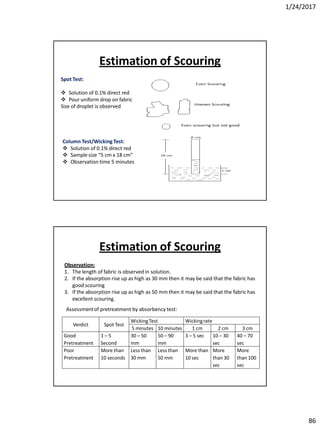
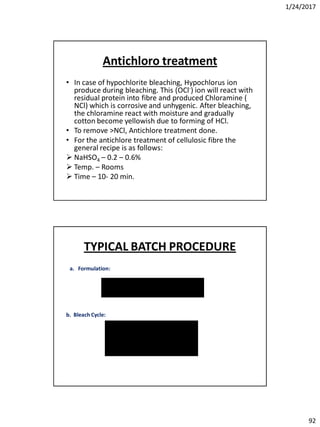
1
MYSELF:SHUVO BRAHMA
Lecturer Wet Processing & engineering department (BUTEX)
• CELL: 01733767475
• EMAIL: shuvobrahma201@gmail.com
EDUCATION & JOB EXPERIENCE
EDUCATION:
BSC: BUTEX 36TH BATCH(W.P.E.)
MSC: BUTEX 5TH BATCH(ON GOING)(W.P.E.)
JOB EXPEIENCE:
COMPANY/UNIVERSITY POSITION
1.EPYLLIONKNITEX LTD
(E.K.L)
EXECUTIVEIN DYEING
PRODUCTION
2. NITER(D.UTech Dept) LECTURER
1/24/2017
2
SYLLABUS
WPE 243: Wet Processing-1
Part-A
• 1.Water
(Waterand its importance in textile , source , concept of hardness , removal
techniques,concepts of WTP in industry its importance and operations)
• 2.Detergentand Auxiliaries
(Various auxiliaries their formation importance and mechanism on textile
surface & uses area , properties and uses of various alkalis and acids in
pretreatment,Detergents ,its type ,importance , use and mechanism)
• 3.Pretreatment
(Chemistryof various impurities in fibre , concepts on singeing, desizing ,
scouring, bleaching, methods of applicationsin knit and oven fabric ,
pretreatmenton cellulose and protein fibre , pretreatmentmachineries , modern
conceptsof pretreatmentand industrial applicationestimationof pretreatment,
damages on textiles due to pretreatmentetc)
CHAP:1
INTRODUCTION
1/24/2017
3
Grey fabric Inspection &
Stitching
Shearing &
Cropping
SingeingDesizingScouringBleachingDrying
Mercerising
Dyeing Printing
Soaping & Drying
Finishing
Folding & Packing
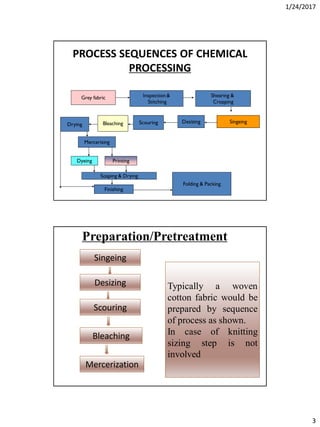
PROCESS SEQUENCES OF CHEMICAL
PROCESSING
Desizing
Scouring
Bleaching
Mercerization
Typically a woven
cotton fabric would be
prepared by sequence
of process as shown.
In case of knitting
sizing step is not
involved
Preparation/Pretreatment
Singeing
1/24/2017
4
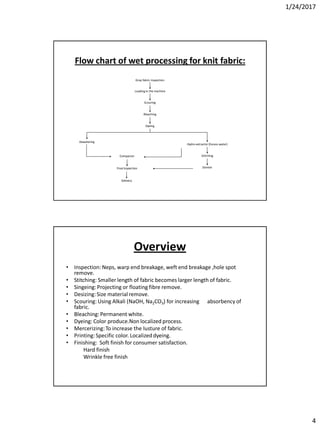
Flow chart of wet processing for knit fabric:
Grey fabric inspection
Loading in the machine
Scouring
Bleaching
Dyeing
Dewatering
Hydro extractor (Excess water)
Stitching
Stenter
Compactor
Final inspection
Delivery
Overview
• Inspection: Neps, warp end breakage, weft end breakage ,hole spot
remove.
• Stitching: Smaller length of fabric becomes larger length of fabric.
• Singeing:Projecting or floating fibre remove.
• Desizing:Size material remove.
• Scouring: Using Alkali (NaOH, Na2CO3) for increasing absorbency of
fabric.
• Bleaching:Permanent white.
• Dyeing: Color produce.Non localized process.
• Mercerizing:To increase the lusture of fabric.
• Printing:Specific color. Localizeddyeing.
• Finishing: Soft finish for consumer satisfaction.
Hard finish
Wrinkle free finish
1/24/2017
5
CHAP:2
WATER AND ITS TREATMENTS
(W.T.P.)
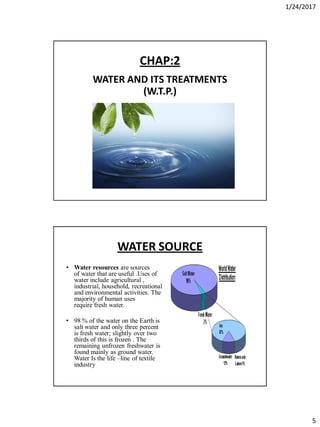
WATER SOURCE
• Water resources are sources
of water that are useful .Uses of
water include agricultural ,
industrial, household, recreational
and environmental activities. The
majority of human uses
require fresh water.
• 98 % of the water on the Earth is
salt water and only three percent
is fresh water; slightly over two
thirds of this is frozen . The
remaining unfrozen freshwater is
found mainly as ground water.
Water Is the life –line of textile
industry
1/24/2017
6
Source of water/type of water
• Rain water
• Surface water
• Subsoil water
• Deep well water
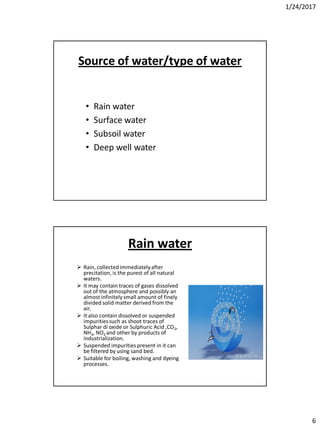
Rain water
 Rain, collected immediatelyafter
precitation, is the purest of all natural
waters.
 It may contain traces of gases dissolved
out of the atmosphere and possibly an
almost infinitely small amount of finely
divided solid matter derived from the
air.
 It also contain dissolved or suspended
impuritiessuch as shoot traces of
Sulphar di oxide or Sulphuric Acid ,CO2,
NH3, NO2 and other by products of
industrialization.
 Suspended impurities present in it can
be filtered by using sand bed.
 Suitable for boiling, washing and dyeing
processes.
1/24/2017
7
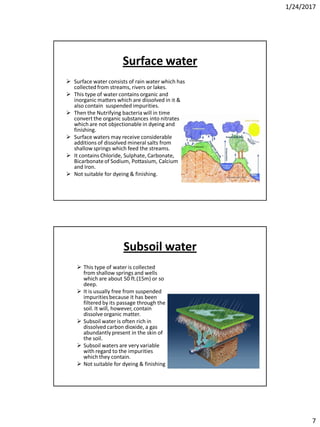
Surface water
 Surface water consists of rain water which has
collectedfrom streams, rivers or lakes.
 This type of water contains organic and
inorganic matters which are dissolved in it &
also contain suspended impurities.
 Then the Nutrifying bacteria will in time
convert the organic substances into nitrates
which are not objectionable in dyeing and
finishing.
 Surface waters may receive considerable
additions of dissolved mineral salts from
shallow springs which feed the streams.
 It contains Chloride, Sulphate, Carbonate,
Bicarbonateof Sodium, Pottasium, Calcium
and Iron.
 Not suitable for dyeing & finishing.
Subsoil water
 This type of water is collected
from shallow springs and wells
which are about 50 ft.(15m) or so
deep.
 It is usually free from suspended
impuritiesbecause it has been
filtered by its passage through the
soil. It will, however, contain
dissolve organic matter.
 Subsoil water is often rich in
dissolved carbon dioxide, a gas
abundantly present in the skin of
the soil.
 Subsoil waters are very variable
with regard to the impurities
which they contain.
 Not suitable for dyeing & finishing
1/24/2017
8
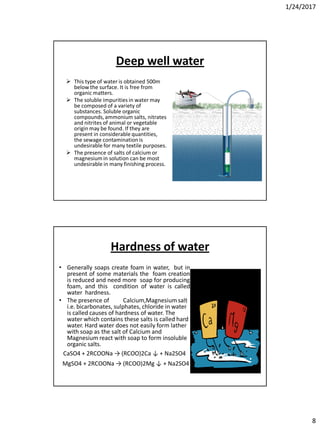
Deep well water
 This type of water is obtained 500m
below the surface. It is free from
organic matters.
 The soluble impurities in water may
be composed of a variety of
substances. Soluble organic
compounds, ammonium salts, nitrates
and nitrites of animal or vegetable
origin may be found. If they are
present in considerable quantities,
the sewage contamination is
undesirable for many textile purposes.
 The presence of salts of calcium or
magnesium in solution can be most
undesirable in many finishing process.
Hardness of water
• Generally soaps create foam in water, but in
present of some materials the foam creation
is reduced and need more soap for producing
foam, and this condition of water is called
water hardness.
• The presence of Calcium,Magnesiumsalt
i.e. bicarbonates, sulphates, chloride in water
is called causes of hardness of water. The
water which contains these salts is called hard
water. Hard water does not easily form lather
with soap as the salt of Calcium and
Magnesium react with soap to form insoluble
organic salts.
CaSO4 + 2RCOONa → (RCOO)2Ca ↓ + Na2SO4
MgSO4 + 2RCOONa → (RCOO)2Mg ↓ + Na2SO4
1/24/2017
9
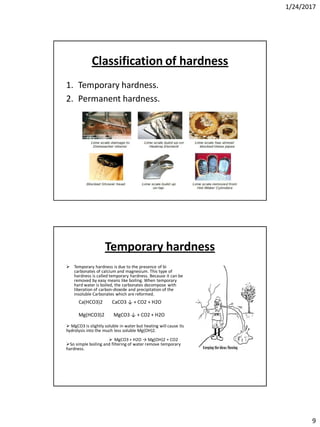
Classification of hardness
1. Temporary hardness.
2. Permanent hardness.
Temporary hardness
 Temporary hardness is due to the presence of bi
carbonates of calcium and magnesium. This type of
hardness is called temporary hardness. Because it can be
removed by easy means like boiling. When temporary
hard water is boiled, the carbonates decompose with
liberation of carbon-dioxide and precipitation of the
insoluble Carbonates which are reformed.
 MgCO3 is slightly soluble in water but heating will cause its
hydrolysis into the much less soluble Mg(OH)2.
 MgCO3 + H2O → Mg(OH)2 + CO2
So simple boiling and filtering of water remove temporary
hardness.
Ca(HCO3)2 CaCO3 ↓ + CO2 + H2O
Mg(HCO3)2 MgCO3 ↓ + CO2 + H2O
1/24/2017
10
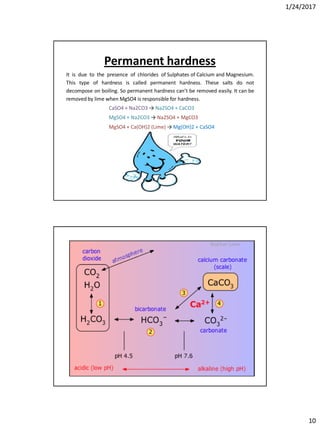
Permanent hardness
It is due to the presence of chlorides of Sulphates of Calcium and Magnesium.
This type of hardness is called permanent hardness. These salts do not
decompose on boiling. So permanent hardness can’t be removed easily. It can be
removed by lime when MgSO4 is responsible for hardness.
CaSO4 + Na2CO3 → Na2SO4 + CaCO3
MgSO4 + Na2CO3 → Na2SO4 + MgCO3
MgSO4 + Ca(OH)2 (Lime) → Mg(OH)2 + CaSO4
1/24/2017
11
UNITS OF HARDNESS
• Hardness is expressed by-
1. PPM(Parts Per Million)
2. In degrees (Grains/ gallon)
1. PPM: The number of grains of calcium carbonateswhich is present in one million
grains of water is called PPM.1 grains of Calcium Carbonate present in 1 million
grains water
2. In degrees: The number of grains of Calcium carbonates which is present in 70,000
grains of water.
Another unit of water hardness-
3. GPG – Grains Per U.S. Gallon
4. PP/ 100000
5. GPG imperial – Grains Per British Gallon
• Here,
» 1 U.S. gallon = 8.33 pounds
» 1 British gallon = 10 pounds (Used in our country)
» 1 grain = 1/7000
» pound;
» i.e. 7000 grains = 1 lb
Hardness Scales
1. German degree
2. French degree
3. American degree
4. British degree
1/24/2017
12
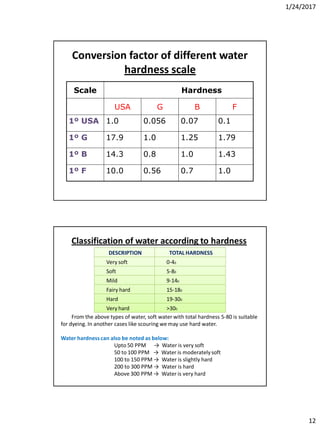
Conversion factor of different water
hardness scale
Scale Hardness
USA G B F
1º USA 1.0 0.056 0.07 0.1
1º G 17.9 1.0 1.25 1.79
1º B 14.3 0.8 1.0 1.43
1º F 10.0 0.56 0.7 1.0
DESCRIPTION TOTAL HARDNESS
Very soft 0-40
Soft 5-80
Mild 9-140
Fairy hard 15-180
Hard 19-300
Very hard >300
From the above types of water, soft water with total hardness 5-80 is suitable
for dyeing. In another cases like scouring we may use hard water.
Water hardnesscan also be noted as below:
Upto 50 PPM → Water is very soft
50 to 100 PPM → Water is moderatelysoft
100 to 150 PPM → Water is slightly hard
200 to 300 PPM → Water is hard
Above 300 PPM → Water is very hard
Classification of water according to hardness
1/24/2017
13
Definition of Different Hardness
1. 1º H (German) Hardness: 10 mg CaO in 1
litre of water
2. 1º H (French) Hardness: 10 mg CaCO3 in 1
litre of water
3. 1º H (English) Hardness: 10 mg CaCO3 in 0.7
litre of water
4. 1º H (American) Hardness: 1 mg CaCO3 in 1
litre of water
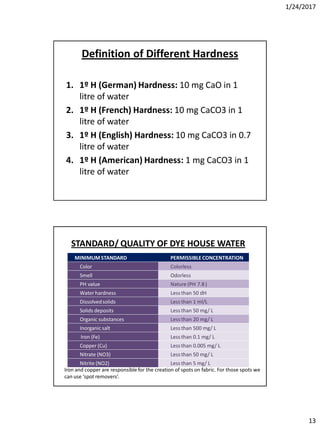
MINIMUMSTANDARD PERMISSIBLECONCENTRATION
Color Colorless
Smell Odorless
PH value Nature (PH 7.8)
Water hardness Less than 50 dH
Dissolvedsolids Less than 1 ml/L
Solids deposits Less than 50 mg/ L
Organic substances Less than 20 mg/ L
Inorganic salt Less than 500 mg/ L
Iron (Fe) Less than 0.1 mg/ L
Copper (Cu) Less than 0.005 mg/ L
Nitrate (NO3) Less than 50 mg/ L
Nitrite (NO2) Less than 5 mg/ L
Iron and copper are responsible for the creation of spots on fabric. For those spots we
can use ‘spot removers’.
STANDARD/ QUALITY OF DYE HOUSE WATER
1/24/2017
14
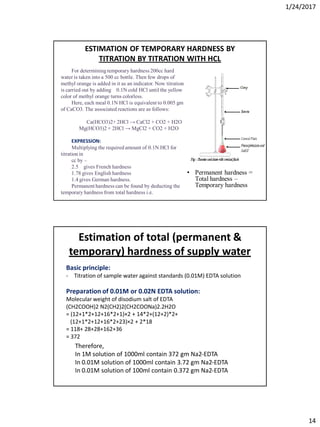
For determining temporary hardness 200cc hard
water is taken into a 500 cc bottle. Then few drops of
methyl orange is added in it as an indicator. Now titration
is carried out by adding 0.1N cold HCl until the yellow
color of methyl orange turns colorless.
Here, each meal 0.1N HCl is equivalent to 0.005 gm
of CaCO3. The associated reactions are as follows:
Ca(HCO3)2+ 2HCl → CaCl2 + CO2 + H2O
Mg(HCO3)2 + 2HCl → MgCl2 + CO2 + H2O
EXPRESSION:
Multiplying the required amount of 0.1N HCl for
titration in
cc by –
2.5 gives French hardness
1.78 gives English hardness
1.4 gives German hardness.
Permanent hardness can be found by deducting the
temporary hardness from total hardness i.e.
ESTIMATION OF TEMPORARY HARDNESS BY
TITRATION BY TITRATION WITH HCL
• Permanent hardness =
Total hardness –
Temporary hardness
Estimation of total (permanent &
temporary) hardness of supply water
Basic principle:
- Titration of sample water against standards (0.01M) EDTA solution
Preparation of 0.01M or 0.02N EDTA solution:
Molecular weight of disodium salt of EDTA
(CH2COOH)2 N2(CH2)2(CH2COONa)2.2H2O
= (12+1*2+12+16*2+1)×2 + 14*2+(12+2)*2+
(12+1*2+12+16*2+23)×2 + 2*18
= 118+ 28+28+162+36
= 372
Therefore,
In 1M solution of 1000ml contain 372 gm Na2-EDTA
In 0.01M solution of 1000ml contain 3.72 gm Na2-EDTA
In 0.01M solution of 100ml contain 0.372 gm Na2-EDTA
1/24/2017
15
• Preparation of ammonia buffer solution:
- 145ml of liquor ammonia (NH4OH) of specific gravity
0.88+15gm NH4Cl + distilled water to make 250ml solution to
give a pH of 10.
Process
Procedure:
- Add 1ml of buffer solution (NH4OH+NH4Cl) to 100ml of the
original water sample. Add 3-4 drops of Eriochrome Black T
indicator (0.2g dye in 15ml of triethanol amine + 5ml of
ethanol)/ 1tablet (making powder) total hardness indicator.
- Titrate against 0.01M prepared EDTA solutions in burette until the
color charges from wine red (or violet) to pure blue (or
turquoise) with no reddish tone; then calculate the total
hardness in terms of ppm of CaCO3.
Calculation
TOTAL HARDNESS =
Volume of 0.01M EDTA solution in ml
------------------------------------------------- × 1000 ppm of
CaCO3.
Volume of sample water in ml
1/24/2017
16
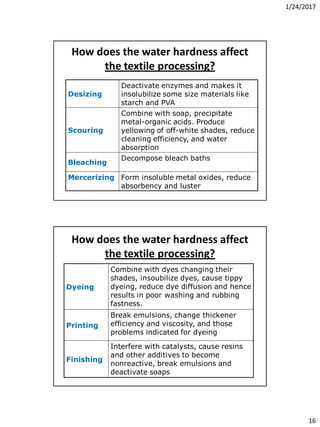
How does the water hardness affect
the textile processing?
Desizing
Deactivate enzymes and makes it
insolubilize some size materials like
starch and PVA
Scouring
Combine with soap, precipitate
metal-organic acids. Produce
yellowing of off-white shades, reduce
cleaning efficiency, and water
absorption
Bleaching
Decompose bleach baths
Mercerizing Form insoluble metal oxides, reduce
absorbency and luster
How does the water hardness affect
the textile processing?
Dyeing
Combine with dyes changing their
shades, insoubilize dyes, cause tippy
dyeing, reduce dye diffusion and hence
results in poor washing and rubbing
fastness.
Printing
Break emulsions, change thickener
efficiency and viscosity, and those
problems indicated for dyeing
Finishing
Interfere with catalysts, cause resins
and other additives to become
nonreactive, break emulsions and
deactivate soaps
1/24/2017
17
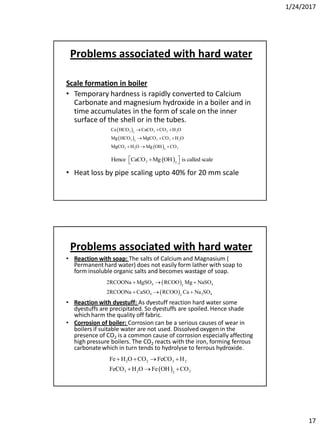
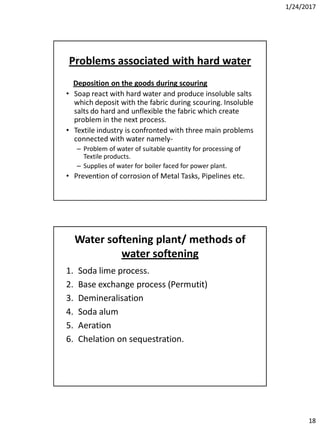
Problems associated with hard water
Scale formation in boiler
• Temporary hardness is rapidly converted to Calcium
Carbonate and magnesium hydroxide in a boiler and in
time accumulates in the form of scale on the inner
surface of the shell or in the tubes.
• Heat loss by pipe scaling upto 40% for 20 mm scale
 
 
 
3 3 2 22
3 3 2 22
3 2 22
Ca HCO CaCO CO H O
Mg HCO MgCO CO H O
MgCO H O Mg OH CO
  
  
  
 3 2
Hence CaCO Mg OH is called scale  
Problems associated with hard water
• Reaction with soap: The salts of Calcium and Magnasium (
Permanent hard water) does not easily form lather with soap to
form insoluble organic salts and becomes wastage of soap.
• Reaction with dyestuff: As dyestuff reaction hard water some
dyestuffs are precipitated. So dyestuffs are spoiled. Hence shade
which harm the quality off fabric.
• Corrosion of boiler: Corrosion can be a serious causes of wear in
boilers if suitable water are not used. Dissolved oxygen in the
presence of CO2 is a common cause of corrosion especially affecting
high pressure boilers. The CO2 reacts with the iron, forming ferrous
carbonate which in turn tends to hydrolyse to ferrous hydroxide.
 
 
4 42
4 2 42
2RCOONa MgSO RCOO Mg NaSO
2RCOONa CaSO RCOO Ca Na SO
  
  
 
2 2 3 2
3 2 22
Fe H O CO FeCO H
FeCO H O Fe OH CO
   
  
1/24/2017
18
Problems associated with hard water
Deposition on the goods during scouring
• Soap react with hard water and produce insoluble salts
which deposit with the fabric during scouring. Insoluble
salts do hard and unflexible the fabric which create
problem in the next process.
• Textile industry is confronted with three main problems
connected with water namely-
– Problem of water of suitable quantity for processing of
Textile products.
– Supplies of water for boiler faced for power plant.
• Prevention of corrosion of Metal Tasks, Pipelines etc.
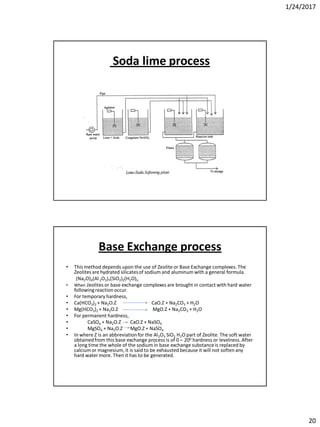
Water softening plant/ methods of
water softening
1. Soda lime process.
2. Base exchange process (Permutit)
3. Demineralisation
4. Soda alum
5. Aeration
6. Chelation on sequestration.
1/24/2017
19
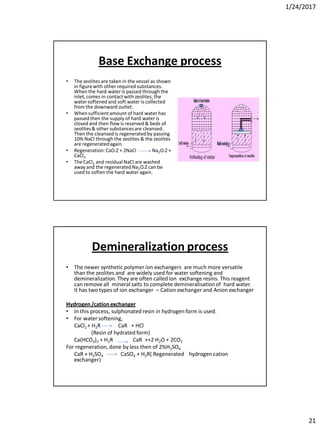
Soda lime process
The main parts of the process are
1. Reagent tanks (Soda lime + Coagulants)
2. Reaction tank
3. Filter
4. Soft water storage tank.
• The soda lime & coagulants are entered in the reagent tanks. Predetermined amount of hard
water is pumped into the reaction at the time of entering of reagents. The agitation is
brought about by a large propeller. The agitation is increased to get more amount of ppm,
steam is passed through the sideway pipe to increase the temp. of the mixer. When the
precipitation is completed, the water is supplied to the filters to remove CaCO3 & then finally
to the soft water storage tank.
• The rate of precipitation may be increased by:
 By increasing of temp. which hasten, crystallization & reduce stability.
 By using an excess of reagent and stirring.
 By bringing the water into contact with preformed particles of precipitate or grains of sand
which can act as nucleus for the precipitation.
 The lime soda [Na2CO3 + Ca(OH)2] and coagulant (NaAlO2) are metered into the reaction
tanks together with a predetermined amount of hard water. Agitation is brought about in
every tank by a large propeller. When sufficient time has elapsed for the precipitation to be
completed the water passes through filters to the soft water storage.
THE RESULT
• By this process we can produce soft water with 50-100 ppm. But if temperature and agitation are
increased water with 5-20 ppm hardness can be obtained
Soda lime process
In this process hydrated lime and sodium carbonate is used to remove
the hardness.
For temporary hardness –
Ca(HCO3)2 + Ca(OH)2  2 CaCO3 + 2 H2O
Mg(HCO3)2 + Ca(OH)2  MgCO3 + CaCO3 + 2 H2O
MgCO3 + Ca(OH)2  Mg(OH)2 + CaCO3
For permanent hardness –
CaSO4 + Na2CO3  CaCO3 + Na2SO4
MgCl2 + Ca(OH)2  CaCl2 + Mg(OH)2
CaCl2 form is removed by –
CaCl2 + Na2CO3  2 NaCl + CaCO3
1/24/2017
20
Soda lime process
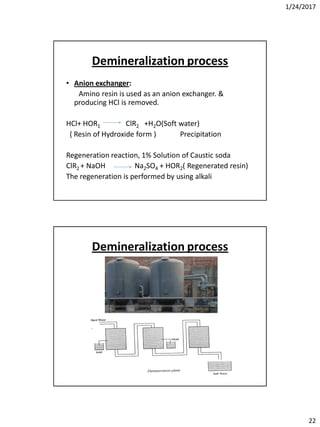
Base Exchange process
• This method depends upon the use of Zeolite or Base Exchange complexes. The
Zeolitesare hydrated silicatesof sodium and aluminum with a general formula.
(Na2O)X(Al2O3)Y(SiO2)Z(H2O)n.
• When Zeolites or base exchange complexes are brought in contact with hard water
followingreaction occur.
• For temporary hardness,
• Ca(HCO3)2 + Na2O.Z CaO.Z + Na2CO3 + H2O
• Mg(HCO3)2 + Na2O.Z MgO.Z + Na2CO3 + H2O
• For permanent hardness,
• CaSO4 + Na2O.Z CaO.Z + NaSO4
• MgSO4 + Na2O.Z MgO.Z + NaSO4
• In where Z is an abbreviationfor the Al2O3 SiO2 H2O part of Zeolite. The soft water
obtainedfrom this base exchange process is of 0 – 200 hardness or levelness.After
a long time the whole of the sodium in base exchange substanceis replaced by
calciumor magnesium, it is said to be exhausted because it will not soften any
hard watermore. Then it has to be generated.
1/24/2017
21
Base Exchange process
• The zeolites are taken in the vessel as shown
in figure with other required substances.
When the hard water is passed through the
inlet,comes in contact with zeolites,the
watersoftened and soft water is collected
from the downward outlet.
• When sufficientamount of hard water has
passed then the supply of hard water is
closed and then flow is reserved & beds of
zeolites& other substancesare cleansed.
Then the cleansed is regeneratedby passing
10% NaCl through the zeolites & the zeolites
are regeneratedagain.
• Regeneration:CaO.Z + 2NaCl Na2O.Z +
CaCl2
• The CaCl2 and residual NaCl are washed
away and the regeneratedNa2O.Z can be
used to soften the hard water again.
Demineralization process
• The newer synthetic polymer ion exchangers are much more versatile
than the zeolites and are widely used for water softening and
demineralization. They are often called ion exchange resins. This reagent
can remove all mineral salts to complete demineralisationof hard water.
It has two types of ion exchanger – Cation exchanger and Anion exchanger
Hydrogen /cation exchanger
• In this process, sulphonated resin in hydrogen form is used.
• For water softening,
CaCl2 + H2R CaR + HCl
(Resin of hydrated form)
Ca(HCO3)2 + H2R CaR ++2 H2O + 2CO2
For regeneration, done by less then of 2%H2SO4
CaR + H2SO4 CaSO4 + H2R( Regenerated hydrogen cation
exchanger)
1/24/2017
22
Demineralization process
• Anion exchanger:
Amino resin is used as an anion exchanger. &
producing HCl is removed.
HCl+ HOR1 ClR2 +H2O(Soft water)
( Resin of Hydroxide form ) Precipitation
Regeneration reaction, 1% Solution of Caustic soda
ClR2 + NaOH Na2SO4 + HOR2( Regenerated resin)
The regeneration is performed by using alkali
Demineralization process
1/24/2017
23
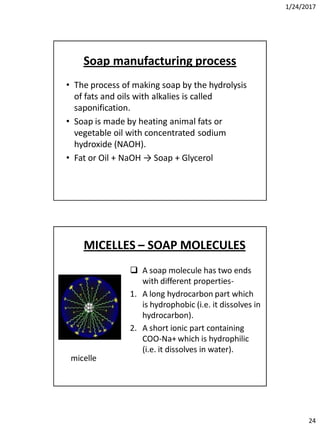
CHAP:3
Soap , Detergent and
Surfactants
Soap
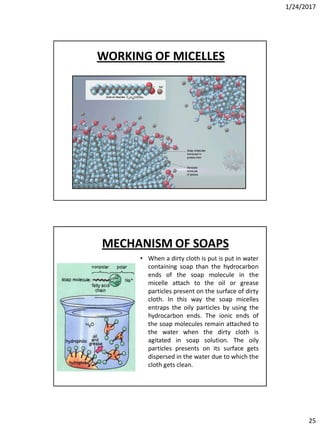
• Soaps are the sodium and potassium salts of the long chain
carboxylic acid.A soap molecule consists of a long hydrocarbon
chain (composed of carbons and hydrogens) with a carboxylic acid
on one end which is ionic bonded to metal ion usually a sodium or
potassium.
• A soap has a large non-ionic hydrocarbon group and an ionic group
COO-Na
• EXAMPLES OF SOAPS
 Sodium stearate (Chemical formula: C17H35COO-Na+)
 Sodium palmitate (Chemical formula: C15H31COO-Na+)
 Sodium oleate (Chemical formula: C17H33COO-Na+)
1/24/2017
24
Soap manufacturing process
• The process of making soap by the hydrolysis
of fats and oils with alkalies is called
saponification.
• Soap is made by heating animal fats or
vegetable oil with concentrated sodium
hydroxide (NAOH).
• Fat or Oil + NaOH → Soap + Glycerol
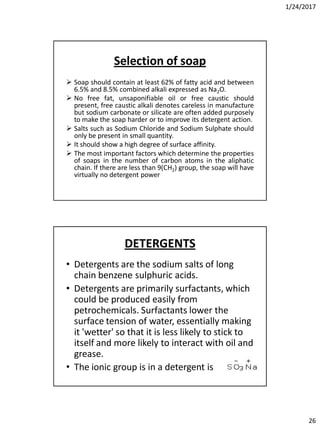
MICELLES – SOAP MOLECULES
 A soap molecule has two ends
with different properties-
1. A long hydrocarbon part which
is hydrophobic (i.e. it dissolves in
hydrocarbon).
2. A short ionic part containing
COO-Na+ which is hydrophilic
(i.e. it dissolves in water).
micelle
1/24/2017
25
WORKING OF MICELLES
MECHANISM OF SOAPS
• When a dirty cloth is put is put in water
containing soap than the hydrocarbon
ends of the soap molecule in the
micelle attach to the oil or grease
particles present on the surface of dirty
cloth. In this way the soap micelles
entraps the oily particles by using the
hydrocarbon ends. The ionic ends of
the soap molecules remain attached to
the water when the dirty cloth is
agitated in soap solution. The oily
particles presents on its surface gets
dispersed in the water due to which the
cloth gets clean.
1/24/2017
26
Selection of soap
 Soap should contain at least 62% of fatty acid and between
6.5% and 8.5% combined alkali expressed as Na2O.
 No free fat, unsaponifiable oil or free caustic should
present, free caustic alkali denotes careless in manufacture
but sodium carbonate or silicate are often added purposely
to make the soap harder or to improve its detergent action.
 Salts such as Sodium Chloride and Sodium Sulphate should
only be present in small quantity.
 It should show a high degree of surface affinity.
 The most important factors which determine the properties
of soaps in the number of carbon atoms in the aliphatic
chain. If there are less than 9(CH2) group, the soap will have
virtually no detergent power
DETERGENTS
• Detergents are the sodium salts of long
chain benzene sulphuric acids.
• Detergents are primarily surfactants, which
could be produced easily from
petrochemicals. Surfactants lower the
surface tension of water, essentially making
it 'wetter' so that it is less likely to stick to
itself and more likely to interact with oil and
grease.
• The ionic group is in a detergent is
1/24/2017
27
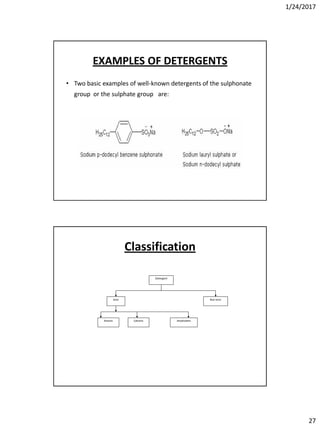
EXAMPLES OF DETERGENTS
• Two basic examples of well-known detergents of the sulphonate
group or the sulphate group are:
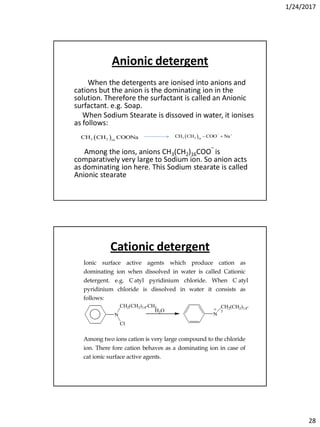
Classification
Detergent
Ionic Nonionic
Anionic Cationic Amphoteric
1/24/2017
28
Anionic detergent
When the detergents are ionised into anions and
cations but the anion is the dominating ion in the
solution. Therefore the surfactant is called an Anionic
surfactant. e.g. Soap.
When Sodium Stearate is dissoved in water, it ionises
as follows:
Among the ions, anions CH3(CH2)16COO‾ is
comparatively very large to Sodium ion. So anion acts
as dominating ion here. This Sodium stearate is called
Anionic stearate
 3 2 16
CH CH COONa  3 2 16
CH CH COO Na 
 
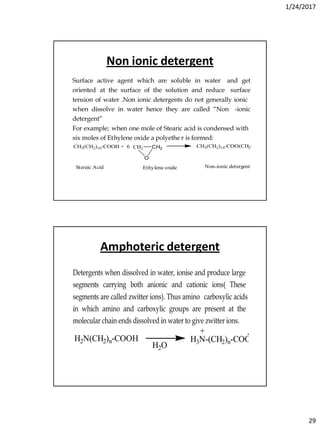
Cationic detergent
Ionic surface active agents which produce cation as
dominating ion when dissolved in water is called Cationic
detergent. e.g. Catyl pyridinium chloride. When C atyl
pyridinium chloride is dissolved in water it consists as
follows:
N
Cl
CH2(CH2)14-CH3
H2O
N
CH2(CH2)14-CH
3
+ Cl-
+ -
Among two ions cation is very large compound to the chloride
ion. There fore cation behaves as a dominating ion in case of
cat ionic surface active agents.
1/24/2017
29
Non ionic detergent
Surface active agent which are soluble in water and get
oriented at the surface of the solution and reduce surface
tension of water .Non ionic detergents do not generally ionic
when dissolve in water hence they are called “Non -ionic
detergent”
For example; when one mole of Stearic acid is condensed with
six moles of Ethylene oxide a polyethe r is formed:
CH3(CH2)16-COOH + 6 CH2 CH2
O
CH3(CH2)16-COO(CH2-CH2-O)6H
Steraic Acid Ethylene oxide Non-ionic detergent
Amphoteric detergent
Detergents when dissolved in water, ionise and produce large
segments carrying both anionic and cationic ions( These
segments are called zwitter ions). Thus amino carboxylic acids
in which amino and carboxylic groups are present at the
molecular chain ends dissolved in water to give zwitter ions.
H2N(CH2)n-COOH
H2O
H3N-(CH2)n-COO
+ -
1/24/2017
30
Special characteristics of Amphoteric
detergents
In alkaline solution: PH>7
They behave like Anionic detergent.
When Acidic solution: PH<7
They behave like Cationic detergent
When Neutral solution: PH=7
They behave like Non ionic detergent
Amphoteric surface active agent possess affinity
towards wool and cellulose fibres
They have lubricating properties
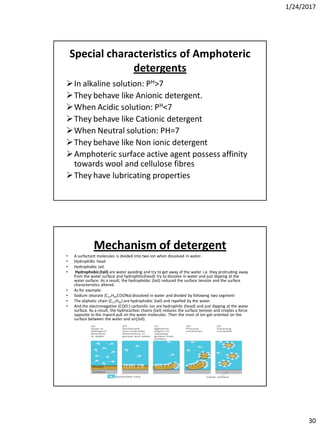
Mechanism of detergent
• A surfactant molecules is divided into two ion when dissolved in water-
• Hydrophillic head
• Hydrophobic tail.
• Hydrophobic(tail) are water avoiding and try to get away of the water. i.e. they protruding away
from the water surface and hydrophilic(head) try to dissolve in water and just dipping at the
water surface. As a result, the hydrophobic (tail) reduced the surface tension and the surface
characteristics altered.
• As for example:
• Sodium stearate (C17H35COONa)dissolved in water and divided by following two segment-
• The aliphatic chain (C17H35) are hydrophobic (tail) and repelled by the water.
• And the electronegative (COO-) carbonilic ion are hydrophilic (head) and just dipping at the water
surface. As a result, the hydrocarbon chains (tail) reduces the surface tension and creates a force
opposite to the inward pull on the water molecules. Then the most of ion get oriented on the
surface between the water and air(/oil).
1/24/2017
31
Mechanism of detergent
• When the fatty acid components of the (soap/detergents) compounds
is of low molecular weight the hydrophilic (head) can pull the
hydrophobic(tail)into the water, but the high number of carbon atoms
prevent this force oppositely.
• A lowest number of carbon atoms necessary to show/manifest surface
activity is of (C9-C19). The lowest series, which can be classified as good
detergentsare the [CH3(CH2)10.COONa]
• When a fibre covered with a layer of oil or wax, is immersed in a warm
aqueous solution of soap and it will be seen that the film bounches up
and ultimately collects itself into spherical globules which are very
easily detached.
Mechanism of detergent
• In a drop of oil, lenticular in foam, adheres to a fibre, its actual shape will be
determined by the inter action of the following three forces-
• TL= The surface tension between the drop and the surround in aqueous phase.
• TLS= The surface tension between the fibre and the oil.
• Ts= The surface tension between the fibre and the water plane any solute
which it may contain.
• In the figure, Any increase in (TLS+TL) in relation to Ts will decrease the area of
contact between the oil and fibre. The result of this is that the shape of the oil
drop will approach more and more to that of a sphere.
• is the contact angle which is drawn at the contact point of solid surface and oil
drop. When the forces are equilibrium their relationship-
• TS = TLS + TLCOS
• COS = (TS – TLS)/TL
• TL = TS – TLS When = 00
• To fulfil this condition, the solid surface must be covered with that phase of the
lowest surface tension. If Ts is greater than TLS,COS will be positive and will be
less than 900. If is greater than 900 the value of COS will be negative and then
TLS will be greater than TS. It indicates that the aqueous phase e will displace
the oil.
1/24/2017
32
DIFFERENCES BETWEEN SOAPS AND DETERGENTS
 SOAPS
 They are metal salts of
long chain higher fatty
acids.
 These are prepared from
vegetable oils and
animal fats.
 They cannot be used
effectively in hard water
as they produce scum
i.e., insoluble
precipitates of Ca2+,
Mg2+, Fe2+ etc.
 DETERGENTS
 These are sodium salts of long
chain hydrocarbons like alkyl
sulphates or alkyl benzene
sulphonates.
 They are prepared from
hydrocarbons of petroleum or
coal.
 These do not produce
insoluble precipitates in hard
water. They are effective in
soft, hard or salt water.
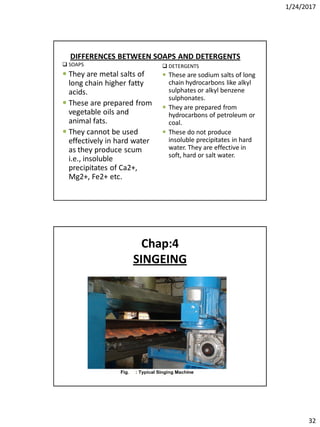
Chap:4
SINGEING
1/24/2017
33
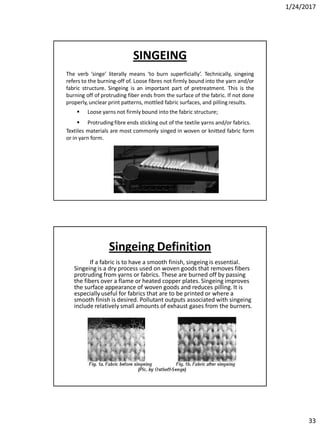
SINGEING
The verb ‘singe’ literally means ‘to burn superficially’. Technically, singeing
refers to the burning-off of. Loose fibres not firmly bound into the yarn and/or
fabric structure. Singeing is an important part of pretreatment. This is the
burning off of protruding fiber ends from the surface of the fabric. If not done
properly, unclear print patterns, mottled fabric surfaces, and pilling results.
 Loose yarns not firmly bound into the fabric structure;
 Protruding fibre ends sticking out of the textile yarns and/or fabrics.
Textiles materials are most commonly singed in woven or knitted fabric form
or in yarn form.
Singeing Definition
If a fabric is to have a smooth finish, singeing is essential.
Singeing is a dry process used on woven goods that removes fibers
protruding from yarns or fabrics. These are burned off by passing
the fibers over a flame or heated copper plates. Singeing improves
the surface appearance of woven goods and reduces pilling. It is
especially useful for fabrics that are to be printed or where a
smooth finish is desired. Pollutant outputs associated with singeing
include relatively small amounts of exhaust gases from the burners.
1/24/2017
34
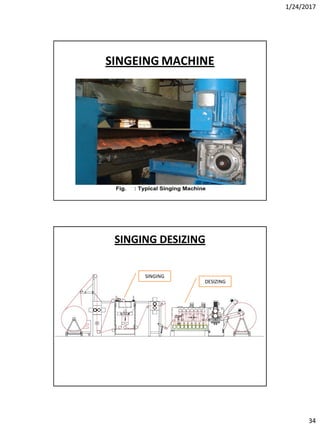
SINGEING MACHINE
SINGING
DESIZING
SINGING DESIZING
1/24/2017
35
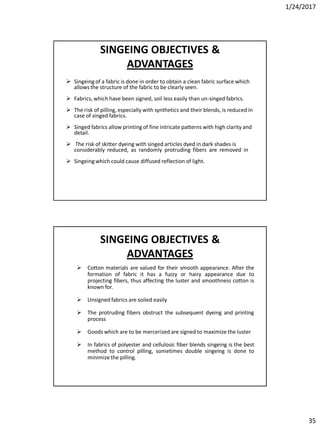
SINGEING OBJECTIVES &
ADVANTAGES
 Singeingof a fabric is done in order to obtain a clean fabric surface which
allows the structure of the fabric to be clearly seen.
 Fabrics, which have been signed, soil less easily than un-singed fabrics.
 The risk of pilling, especially with synthetics and their blends, is reduced in
case of singed fabrics.
 Singed fabrics allow printing of fine intricate patterns with high clarity and
detail.
 The risk of skitter dyeing with singed articles dyed in dark shades is
considerably reduced, as randomly protruding fibers are removed in
 Singeingwhich could cause diffused reflection of light.
SINGEING OBJECTIVES &
ADVANTAGES
 Cotton materials are valued for their smooth appearance. After the
formation of fabric it has a fuzzy or hairy appearance due to
projecting fibers, thus affecting the luster and smoothness cotton is
known for.
 Unsigned fabrics are soiled easily
 The protruding fibers obstruct the subsequent dyeing and printing
process
 Goods which are to be mercerized are signed to maximize the luster
 In fabrics of polyester and cellulosic fiber blends singeing is the best
method to control pilling, sometimes double singeing is done to
minimize the pilling.
1/24/2017
36
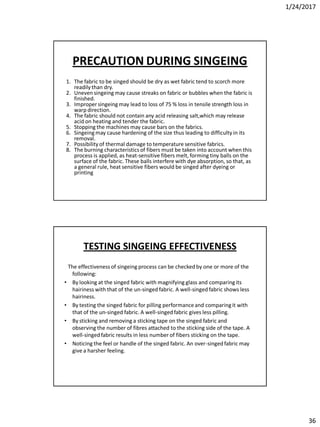
PRECAUTION DURING SINGEING
1. The fabric to be singed should be dry as wet fabric tend to scorch more
readily than dry.
2. Uneven singeing may cause streaks on fabric or bubbles when the fabric is
finished.
3. Impropersingeing may lead to loss of 75 % loss in tensile strength loss in
warp direction.
4. The fabric should not contain any acid releasing salt,which may release
acid on heating and tender the fabric.
5. Stopping the machines may cause bars on the fabrics.
6. Singeingmay cause hardening of the size thus leading to difficulty in its
removal.
7. Possibility of thermal damage to temperature sensitive fabrics.
8. The burning characteristics of fibers must be taken into account when this
process is applied, as heat-sensitive fibers melt, forming tiny balls on the
surface of the fabric. These balls interfere with dye absorption, so that, as
a general rule, heat sensitive fibers would be singed after dyeing or
printing
TESTING SINGEING EFFECTIVENESS
The effectiveness of singeing process can be checked by one or more of the
following:
• By looking at the singed fabric with magnifying glass and comparingits
hairiness with that of the un-singed fabric. A well-singed fabric shows less
hairiness.
• By testing the singed fabric for pilling performanceand comparingit with
that of the un-singed fabric. A well-singedfabric gives less pilling.
• By sticking and removing a sticking tape on the singed fabric and
observing the number of fibres attached to the sticking side of the tape. A
well-singedfabric results in less number of fibers sticking on the tape.
• Noticing the feel or handle of the singed fabric. An over-singedfabric may
give a harsher feeling.
1/24/2017
37
Fabric Singeing
There are three main types of singeing machines:
1. Gas singeing machine,
2. Plate singeing machine,
3. Rotary-cylinder or Roller singeing machine
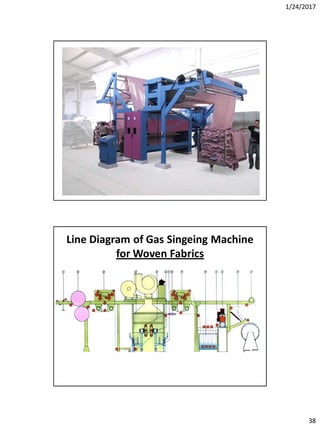
GAS SINGEING MACHINE
In this type of singeing machine, the fabric
passes over a burning gas flame at such a speed
that only the protruding fibres burn and the main
body of the fabric is not damaged by the flame.
This is the most common type of machine used
for singeing fabrics as well yarns
1/24/2017
38
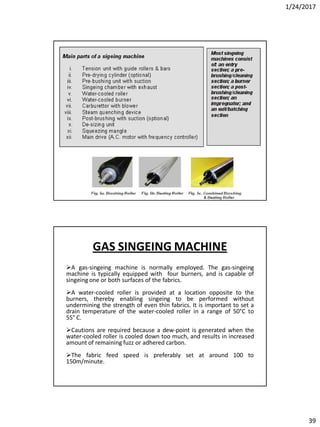
Line Diagram of Gas Singeing Machine
for Woven Fabrics
1/24/2017
39
GAS SINGEING MACHINE
A gas-singeing machine is normally employed. The gas-singeing
machine is typically equipped with four burners, and is capable of
singeing one or both surfaces of the fabrics.
A water-cooled roller is provided at a location opposite to the
burners, thereby enabling singeing to be performed without
undermining the strength of even thin fabrics. It is important to set a
drain temperature of the water-cooled roller in a range of 50°C to
55° C.
Cautions are required because a dew-point is generated when the
water-cooled roller is cooled down too much, and results in increased
amount of remaining fuzz or adhered carbon.
The fabric feed speed is preferably set at around 100 to
150m/minute.
1/24/2017
40
ADVANTAGE/ DISADVANTAGE OF GAS
SINGEING
ADVANTAGE
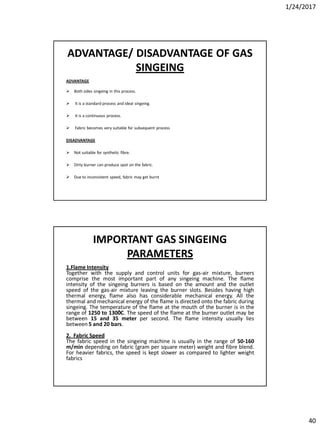
 Both sides singeing in this process.
 It is a standard process and ideal singeing.
 It is a continuous process.
 Fabric becomes very suitable for subsequent process
DISADVANTAGE
 Not suitable for synthetic fibre.
 Dirty burner can produce spot on the fabric.
 Due to inconsistent speed, fabric may get burnt
IMPORTANT GAS SINGEING
PARAMETERS
1.Flame Intensity
Together with the supply and control units for gas-air mixture, burners
comprise the most important part of any singeing machine. The flame
intensity of the singeing burners is based on the amount and the outlet
speed of the gas-air mixture leaving the burner slots. Besides having high
thermal energy, flame also has considerable mechanical energy. All the
thermal and mechanical energy of the flame is directed onto the fabric during
singeing. The temperature of the flame at the mouth of the burner is in the
range of 1250 to 1300̊C. The speed of the flame at the burner outlet may be
between 15 and 35 meter per second. The flame intensity usually lies
between 5 and 20 bars.
2. Fabric Speed
The fabric speed in the singeing machine is usually in the range of 50-160
m/min depending on fabric (gram per square meter) weight and fibre blend.
For heavier fabrics, the speed is kept slower as compared to lighter weight
fabrics
1/24/2017
41
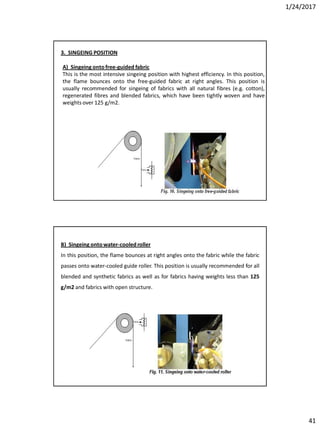
3. SINGEING POSITION
A) Singeing onto free-guided fabric
This is the most intensive singeing position with highest efficiency. In this position,
the flame bounces onto the free-guided fabric at right angles. This position is
usually recommended for singeing of fabrics with all natural fibres (e.g. cotton),
regenerated fibres and blended fabrics, which have been tightly woven and have
weights over 125 g/m2.
B) Singeing onto water-cooled roller
In this position, the flame bounces at right angles onto the fabric while the fabric
passes onto water-cooled guide roller. This position is usually recommended for all
blended and synthetic fabrics as well as for fabrics having weights less than 125
g/m2 and fabrics with open structure.
1/24/2017
42
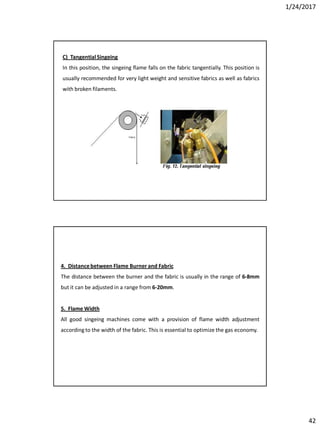
C) TangentialSingeing
In this position, the singeing flame falls on the fabric tangentially. This position is
usually recommended for very light weight and sensitive fabrics as well as fabrics
with broken filaments.
4. Distancebetween Flame Burner and Fabric
The distance between the burner and the fabric is usually in the range of 6-8mm
but it can be adjusted in a range from 6-20mm.
5. Flame Width
All good singeing machines come with a provision of flame width adjustment
according to the width of the fabric. This is essential to optimize the gas economy.
1/24/2017
43
ESSENTIAL CONDITIONS FOR GOOD
GAS SINGEING
1. A flame with high mechanical & thermal energy to
quickly burn thermoplastic protruding fibres (e.g.
polyester) without any molten beads formation.
2. A homogeneous flame with uniform mechanical &
thermal energy to result in uniform singeing
3. An optimal flame/fabric contact time to neither results
in incomplete not over-singeing.
A. Incomplete Singeing
The most common causes of incomplete singeing are as follows:
1. Too low flame intensity
2. Too fast fabric speed
3. Too far distance between the fabric and the burner
4. Inappropriate (i.e. less severe) singeing position
5. Too much moisture in the fabric incoming for singeing.
If the fabric incoming for singeing has too much moisture in it, a significant amount of
thermal energy will be used up in evaporating the fabric moisture rather than burning the
protruding fibres, resulting in incomplete singeing.
B. Uneven Singeing Across the Fabric Width
The most common causes of widthways uneven singeing are as follows:
1. Non-uniform moisture content across the fabric width
2. Non-uniform flame intensity (uneven flame height) across the fabric width
3. Uneven distance between the burner and the fabric
This may be due to misalignment or improper setting of the guide rollers
4.Uneven smoke evacuation over the burners
Common problems in GAS singeing
and their causes
1/24/2017
44
C. Uneven Singeing Along the Fabric Length
1.The most common causes of lengthways uneven singeing are as follows:
2.Non-uniformmoisturecontentalong the fabric length
3.Non-uniformflame intensityalong the fabric length
• Variationin gas-air mixture supply
• Increasingor decreasing thermal energy of the flames during production
4.Change in fabric speed during singeing
5.Change in the distance between the fabric and the burner along the length
D. Horizontal Singeing Stripes
The most common causes of horizontal singeing stripes are as follows:
1.Rollers with an un-centred rolling action
2.Sudden fabric tension increase
E. Vertical Singeing Stripes
This may be caused by:
1.Totalor partial blockage of flame outlet
Common problems in GAS singeing
and their causes
F. Over-singing or Thermal Damage of the Fabric
The most common causes of over-singeing or thermal damage of the fabric are as
follows:
1. Too high flame intensity
2. Too slow fabric speed or too long contact time between fabric and flame
3. Too close distance between the fabric and the burner or too deep
penetrationof the singeing flame into the fabric
4. Inappropriate(i.e. too severe) singeing position
G. Formation of Small Beads of Molten Material
This may be cause by:
1.Insufficient energy supply, when the thermal energy is not supplied quickly
enough to be able to ignite the thermoplastic fibre rather than melting it.
Common problems in GAS singeing
and their causes
1/24/2017
45
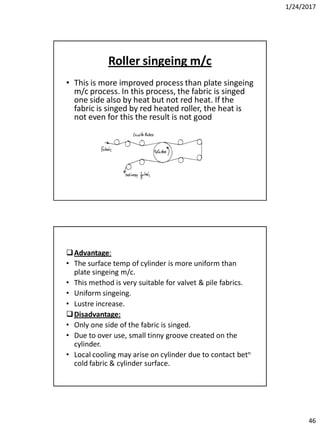
Plate-Singeing m/c
• The main parts of plate singeing m/c :-
• i) Two copper plate &
• ii) Fire clay.
 Copper plates are set up on the fire clay which is heated with farness(gas
and oil or oil jet).
 At first the fabric opening with guide roller is passed over the plate with
drawn roller.
 When the plate was red heated with farness, copper plates drawn with
draw roller which speed 135-225 m/min.
 Projecting fibres is burnt contact with heated plate.
 In this process, one side of fabric is singed
 Advantages:
• Very suitable for back filter in finishing process.
• A certain amount of lusture is produce due to friction betn the fabric
& hot surface of curved plate.
• Improved lusture.
• Uniform singeing.
• More effective in case of valvet & pile fabric.
•
 Disadvantage:
• Very difficult to maintain the proper heat control of the plate.
• Only on side of the fabric is singed.
• Discontinuous process so more time taken.
• More labour cost.
• Not uniform singeing in stitch portion.
• Strength decrease
1/24/2017
46
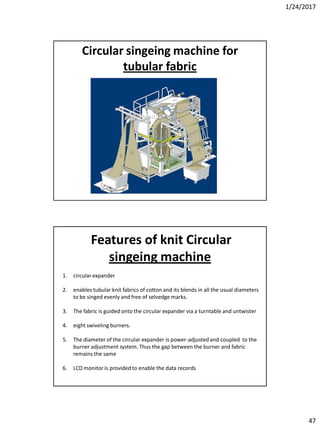
Roller singeing m/c
• This is more improved process than plate singeing
m/c process. In this process, the fabric is singed
one side also by heat but not red heat. If the
fabric is singed by red heated roller, the heat is
not even for this the result is not good
Advantage:
• The surface temp of cylinder is more uniform than
plate singeing m/c.
• This method is very suitable for valvet & pile fabrics.
• Uniform singeing.
• Lustre increase.
Disadvantage:
• Only one side of the fabric is singed.
• Due to over use, small tinny groove created on the
cylinder.
• Local cooling may arise on cylinder due to contact betn
cold fabric & cylinder surface.
1/24/2017
47
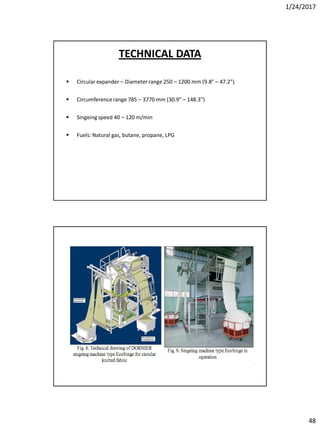
Circular singeing machine for
tubular fabric
1. circular expander
2. enables tubular knit fabrics of cotton and its blends in all the usual diameters
to be singed evenly and free of selvedge marks.
3. The fabric is guided onto the circular expander via a turntable and untwister
4. eight swiveling burners.
5. The diameter of the circular expander is power-adjustedand coupled to the
burner adjustment system. Thus the gap between the burner and fabric
remains the same
6. LCD monitor is provided to enable the data records
Features of knit Circular
singeing machine
1/24/2017
48
 Circular expander – Diameter range 250 – 1200 mm (9.8" – 47.2")
 Circumferencerange 785 – 3770 mm (30.9" – 148.3")
 Singeingspeed 40 – 120 m/min
 Fuels: Natural gas, butane, propane, LPG
TECHNICAL DATA
1/24/2017
49
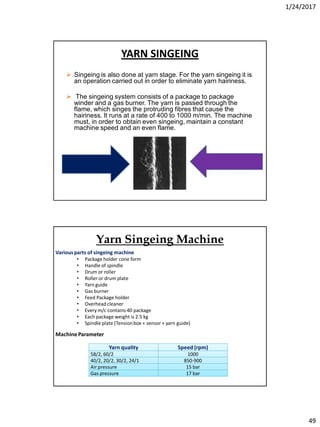
YARN SINGEING
 Singeing is also done at yarn stage. For the yarn singeing it is
an operation carried out in order to eliminate yarn hairiness.
 The singeing system consists of a package to package
winder and a gas burner. The yarn is passed through the
flame, which singes the protruding fibres that cause the
hairiness. It runs at a rate of 400 to 1000 m/min. The machine
must, in order to obtain even singeing, maintain a constant
machine speed and an even flame.
Various parts of singeing machine
• Package holder cone form
• Handle of spindle
• Drum or roller
• Roller or drum plate
• Yarn guide
• Gas burner
• Feed Package holder
• Overhead cleaner
• Every m/c contains40 package
• Each package weight is 2.5 kg
• Spindle plate (Tensionbox + sensor + yarn guide)
MachineParameter
Yarn quality Speed (rpm)
58/2, 60/2 1000
40/2, 20/2, 30/2, 24/1 850-900
Air pressure 15 bar
Gas pressure 17 bar
Yarn Singeing Machine
1/24/2017
50
Bio-polishing
This is a process to remove the protruding fibers from the
surface of a fabric or yarn through the action of an enzyme.
Importance of Bio-polishing:
 Bio-polishing is a finishing process that improves fabric quality
by mainly reducing fuzziness from the fabric surface.
 Bio-polishing is a important process to eliminate micro fibrils
of cotton through the action of enzyme.
 Cleaner surface of fabric is possible to achieve.
Optimum Condition of Bio-polishing
In bio-polishing, pH of the bath is adjusted within 4.5-
5.5. Temperature needs to be maintained between 40-50 C
and process time is maintained between 45-55 minutes.
Tentative Recipe for Bio-polishing
 Cellulase enzyme: 1%
 Acetic acid : 0.5 gm/liter
 pH : 4.5-5.5
 Temperature : 40-50*c
 Time : 45-55 minutes
1/24/2017
51
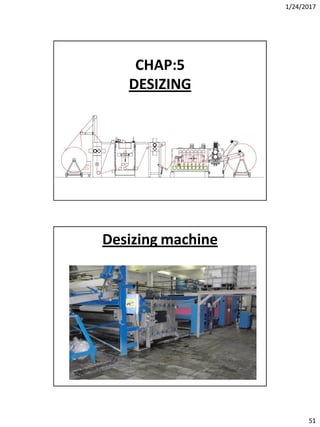
CHAP:5
DESIZING
Desizing machine
1/24/2017
52
Defination
• Desizing is done in order to remove the size from the warp yarns of
the woven fabrics. Warp yarns are coated with sizing agents prior to
weaving in order to reduce their frictional properties, decrease yarn
breakages on the loom and improve weaving productivity by
increasing weft insertion speeds. The sizing material present on the
warp yarns can act as a resist towards dyes and chemicals in textile
wet processing. It must, therefore, be removed before any
subsequent wet processing of the fabric.
• Desizing is the first wet processing textile finishing technology
employed to remove the sizing material from the fabric.
• It depends on
 The solubility of the film forming polymer.
 On the effects of numerous subsequent wet processing steps.
 On the interactions with added chemicals.
1. To remove the starch material from the fabric.
2. To increase the absorbency power of the fabric.
3. To increase the affinity of the fabric to the dry chemicals.
4. To make the fabric suitable for the next process.
5. To increase the luster of the fabric increase of dyeing and printing.
Objects of Desizing
1/24/2017
53
1. The object is to remove from the grey fabric the size that has been applied during
weaving and thus to make the fabric ready for further processes.
2. The main ingredientin size that is not w ater-solubleis usually starch.
3. Chemicallystarch is poly-glucopyranose in w hich straight chain and branched chain
polymers are present.
4. Both the constituentsof starch are insoluble in water but they can be made soluble
by hydrolysis of these long chain compounds to shorter ones.
5. Grey cotton fabric contains both natural impurities as well as ‘added matter’.
6. The added matter is called ‘size’. It is added by man in a process called ‘sizing’, as it
facilitatesweaving.
7. The size containssubstances such as starch, thin boiling starch, CMC, PVA, vegetable
oil, mutton tallow,etc.
Mechanism
 Type and amount of size applied
 Viscosityof the size in solution
 Ease of dissolution of the size film on the yarn
 Nature and the amount of the plasticizers
 Fabric construction
 Method of desizing, and
 Method of washing-off
Factors of Size Removal Efficiency
1/24/2017
54
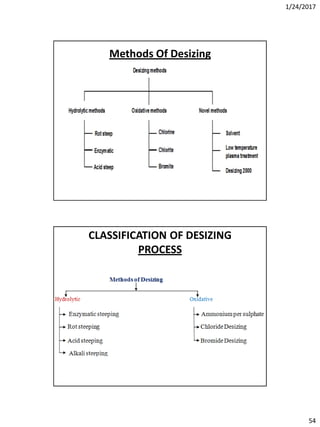
Methods Of Desizing
CLASSIFICATION OF DESIZING
PROCESS
1/24/2017
55
Enzymaticdesizing is the most widely used method for the removal of starch, amylases
being particularly suitable.The advantage in the use of enzymes is that starches are
decomposedwithout damaging cellulose fibre. These are fairly sensitive to temperature
changes from the optimum. Bacterial desizing agents like Rapidase are active over a wider
temperaturerange and have certain other advantages, like tolerance of variation in pH.
Enzymes suffer from one disadvantage that if the conditions of temperature and
pH are not favourable, their desizing activity is destroyed. For example, their activity is
destroyed they are deactivated above 75°C. An outstanding feature of enzyme desizing is
the specific nature of the enzyme action. Thus diastase hydrolyses starch but does not
tender cellulose. Therefore enzyme desizing is safer than acid desizing, where cellulose
may also get hydrolysed if the concentration of the acid is higher than the optimum
value.
ENZYMATIC DESIZING
We use Enzymatic Desizing. Enzyme are complex organic soluble by catalyst
formed by living organisms that catalyze chemical reaction in biological process.
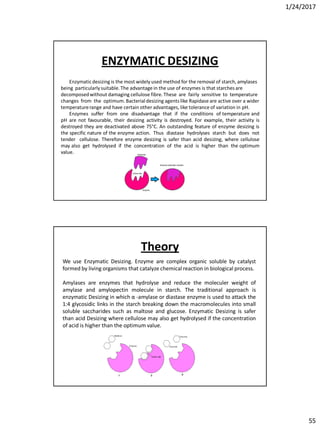
Amylases are enzymes that hydrolyse and reduce the moleculer weight of
amylase and amylopectin molecule in starch. The traditional approach is
enzymatic Desizing in which α -amylase or diastase enzyme is used to attack the
1:4 glycosidic links in the starch breaking down the macromolecules into small
soluble saccharides such as maltose and glucose. Enzymatic Desizing is safer
than acid Desizing where cellulose may also get hydrolysed if the concentration
of acid is higher than the optimum value.
Theory
1/24/2017
56
Mainly two types of enzymes. Such as:
1. Animal enzymes: Example: Viveral, Novofermosol, Degomma, Waste
pancreas, Clotted blood, Liver, etc.
2. Vegetableenzymes:
There are two types vegetable enzymes.
a) Malt extract enzymes: Example: Diastafor, Diastase, Gabahit,
Maltoferment,Maltostase etc.
b) Bacterial enzymes: Example: Rapidase, Biolase, Arcy etc
.
CLASSIFICATION OF ENZYMES
• Other ways to define
• Celluloseenzymes (degrade cellulose and if more time then cellulose damage
and convert glucose)
• Amalysisenzymes: Outstanding features are – only hydrolyse the starch but do
not attack cellulose. So it is used for de sizing
Types of amalysis enzymes
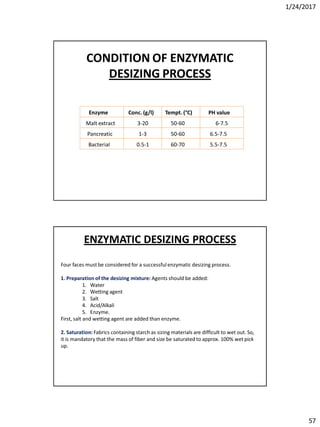
• Malt extracts /malt preparation enzymes:Malt enzymes are obtained by extraction of freshly germinated
barley corns. Concentration, temperature, pH are very important for the efficiency of enzyme. If the
temperature is raised to the upper limit, it become destroyed(not useable)Best result at ---600C and
destroyed at 750C
• Trade name:
• Disastafor.
• Ferment D
• Terhyd MD etc.
• Bacterial extract enzymes: The ferment is obtained from bacillus subtilis which grows on grains of rice and
breaks down the starch into water soluble dextrins.i.e. fermented rice→ produce bacteria→Extract→grow
enlarge→prepared.Best resultat---70-750C and destroyed at ---95-1000C
• Trade name:
– Rapidase.
– Biolase.
– Bactolase.
– Gelatase
– Acry
• Pancreatic analysis enzymes:Pancreatic (animal) enzymes are prepared from the pancrease of
slaughtered animals. A characteristics feature of pancreatic amylases id that they form milky-emulsion in
water and are capable of modifying starch, albumen, pectins and fatts.
• Trade name:
• Fermosol
• Novofermosol DS
• Degomma etc.
• Viveral
1/24/2017
57
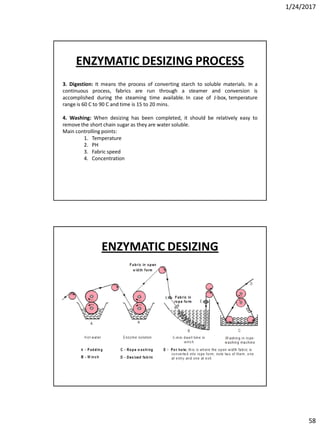
Enzyme Conc. (g/l) Tempt. (°C) PH value
Malt extract 3-20 50-60 6-7.5
Pancreatic 1-3 50-60 6.5-7.5
Bacterial 0.5-1 60-70 5.5-7.5
CONDITION OF ENZYMATIC
DESIZING PROCESS
Four faces must be considered for a successfulenzymatic desizing process.
1. Preparation of the desizing mixture: Agents should be added:
1. Water
2. Wetting agent
3. Salt
4. Acid/Alkali
5. Enzyme.
First, salt and wetting agent are added than enzyme.
2. Saturation: Fabrics containing starch as sizing materials are difficult to wet out. So,
it is mandatory that the mass of fiber and size be saturated to approx. 100% wet pick
up.
ENZYMATIC DESIZING PROCESS
1/24/2017
58
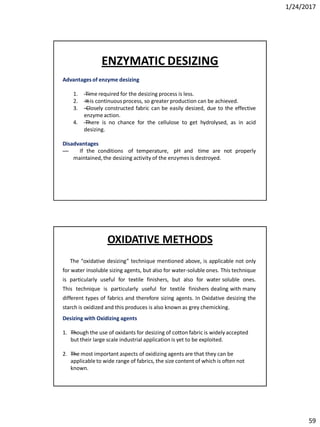
3. Digestion: It means the process of converting starch to soluble materials. In a
continuous process, fabrics are run through a steamer and conversion is
accomplished during the steaming time available. In case of J-box, temperature
range is 60 C to 90 C and time is 15 to 20 mins.
4. Washing: When desizing has been completed, it should be relatively easy to
remove the short chain sugar as they are water soluble.
Main controlling points:
1. Temperature
2. PH
3. Fabric speed
4. Concentration
ENZYMATIC DESIZING PROCESS
ENZYMATIC DESIZING
1/24/2017
59
Advantagesof enzyme desizing
1. —Time required for the desizing process is less.
2. —It is continuous process, so greater production can be achieved.
3. —Closely constructed fabric can be easily desized, due to the effective
enzymeaction.
4. —There is no chance for the cellulose to get hydrolysed, as in acid
desizing.
Disadvantages
— If the conditions of temperature, pH and time are not properly
maintained, the desizing activity of the enzymes is destroyed.
ENZYMATIC DESIZING
The “oxidative desizing” technique mentioned above, is applicable not only
for water insoluble sizing agents, but also for water-soluble ones. This technique
is particularly useful for textile finishers, but also for water soluble ones.
This technique is particularly useful for textile finishers dealing with many
different types of fabrics and therefore sizing agents. In Oxidative desizing the
starch is oxidized and this produces is also known as grey chemicking.
Desizing with Oxidizing agents
1. —Though the use of oxidants for desizing of cotton fabric is widely accepted
but their large scale industrial application is yet to be exploited.
2. —The most important aspects of oxidizing agents are that they can be
applicableto wide range of fabrics, the size content of which is often not
known.
OXIDATIVE METHODS
1/24/2017
60
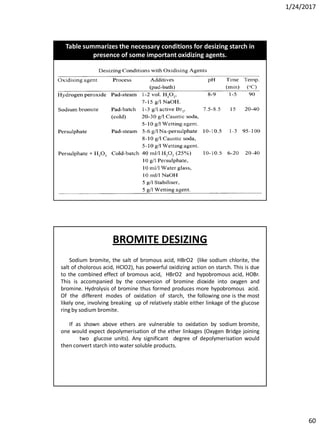
Table summarizes the necessary conditions for desizing starch in
presence of some important oxidizing agents.
Sodium bromite, the salt of bromous acid, HBrO2 (like sodium chlorite, the
salt of cholorous acid, HClO2), has powerful oxidizing action on starch. This is due
to the combined effect of bromous acid, HBrO2 and hypobromous acid, HOBr.
This is accompanied by the conversion of bromine dioxide into oxygen and
bromine. Hydrolysis of bromine thus formed produces more hypobromous acid.
Of the different modes of oxidation of starch, the following one is the most
likely one, involving breaking up of relatively stable either linkage of the glucose
ring by sodium bromite.
If as shown above ethers are vulnerable to oxidation by sodium bromite,
one would expect depolymerisation of the ether linkages (Oxygen Bridge joining
two glucose units). Any significant degree of depolymerisation would
then convert starch into water soluble products.
BROMITE DESIZING
1/24/2017
61
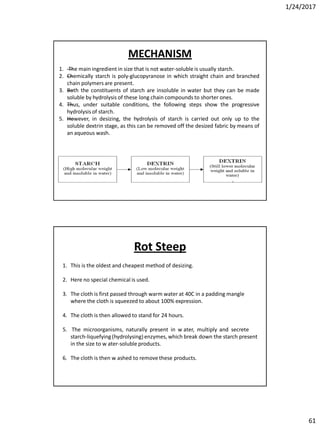
1. —The main ingredient in size that is not water-soluble is usually starch.
2. —Chemically starch is poly-glucopyranose in which straight chain and branched
chain polymers are present.
3. —Both the constituents of starch are insoluble in water but they can be made
soluble by hydrolysis of these long chain compounds to shorter ones.
4. —Thus, under suitable conditions, the following steps show the progressive
hydrolysis of starch.
5. —However, in desizing, the hydrolysis of starch is carried out only up to the
soluble dextrin stage, as this can be removed off the desized fabric by means of
an aqueous wash.
MECHANISM
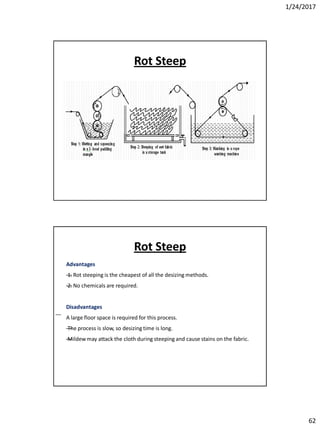
1. This is the oldest and cheapest method of desizing.
2. Here no special chemical is used.
3. The cloth is first passed through warm water at 40C in a padding mangle
where the cloth is squeezed to about 100% expression.
4. The cloth is then allowed to stand for 24 hours.
5. The microorganisms, naturally present in w ater, multiply and secrete
starch-liquefying(hydrolysing)enzymes, which break down the starch present
in the size to w ater-soluble products.
6. The cloth is then w ashed to remove these products.
Rot Steep
1/24/2017
62
Rot Steep
Advantages
—1. Rot steeping is the cheapest of all the desizing methods.
—2. No chemicals are required.
Disadvantages
A large floor space is required for this process.
—The process is slow, so desizing time is long.
—Mildewmay attack the cloth during steeping and cause stains on the fabric.
—
Rot Steep
1/24/2017
63
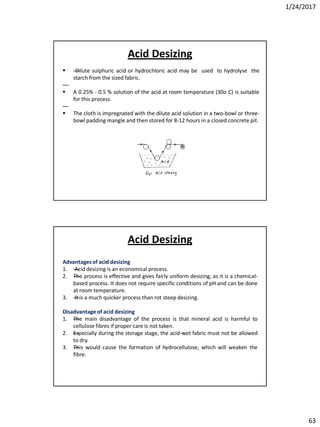
 —Dilute sulphuric acid or hydrochloric acid may be used to hydrolyse the
starch from the sized fabric.
—
 A 0.25% - 0.5 % solution of the acid at room temperature (30o C) is suitable
for this process.
—
 The cloth is impregnated with the dilute acid solution in a two-bowl or three-
bowl padding mangle and then stored for 8-12 hours in a closed concrete pit.
Acid Desizing
Advantages of acid desizing
1. —Acid desizing is an economical process.
2. —The process is effective and gives fairly uniform desizing, as it is a chemical-
based process. It does not require specific conditions of pH and can be done
at room temperature.
3. —It is a much quicker process than rot steep desizing.
Disadvantageof acid desizing
1. —The main disadvantage of the process is that mineral acid is harmful to
cellulose fibres if proper care is not taken.
2. —Especially during the storage stage, the acid-wet fabric must not be allowed
to dry.
3. —This would cause the formation of hydrocellulose, which will weaken the
fibre.
Acid Desizing
1/24/2017
64
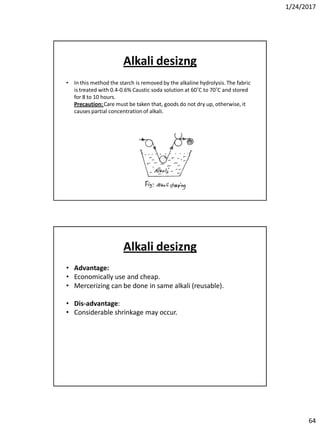
Alkali desizng
• In this method the starch is removed by the alkaline hydrolysis. The fabric
is treated with 0.4-0.6% Caustic soda solution at 60˚C to 70˚C and stored
for 8 to 10 hours.
Precaution: Care must be taken that, goods do not dry up, otherwise, it
causes partial concentrationof alkali.
Alkali desizng
• Advantage:
• Economically use and cheap.
• Mercerizing can be done in same alkali (reusable).
• Dis-advantage:
• Considerable shrinkage may occur.
1/24/2017
65
Desizing Efficiency Test:
Desizingefficiencyis found in two ways conventionaland TEGEWA method.
ConventionalMethod:
In this method we first take the weight of the sized fabric, let it be W1. Then
desize the fabric, dry & take the weight, let it be W2. After that the fabric is
treated with 3gpl (35%) HCl at 700 C for 30 min. dry & take the weight of the
fabric. Let it be W3.
Total size = W1-W3.
Residual size = W2-W3.
Desizing Efficiency = (Total size – Residual size)/Total size X 100.
DESIZING EFFICIENCY TEST
Reagent: potassium iodide (10 gm. Of KI (100%) in 100 ml water, add 0.6358 gm of
iodine (100%) stir and shake; iodine is completely dissolved. Fill up to 800 ml with
water then complete to 1000 ml with ethanol. (Shelf life approx 6 months only).
Method:
 Spot drop wise solution onto fabric.
 Rub in gently.
 Assesschange of color.
Note: the test must be carried on fabric cooled down to room temperature; residual
alkalinity has to be neutralities prior to the test.
Assessment: Grey fabric:
No change of color = no starch size present.
Pale blue to bluish = presence of starch size or blend
Violet =of starch size with synthetic size
Desized fabric:
Pale blue to bluish violet = refer to violet scale TEGEWAThis indicates residual Starch
content.
TEGEWA RATING
1/24/2017
66
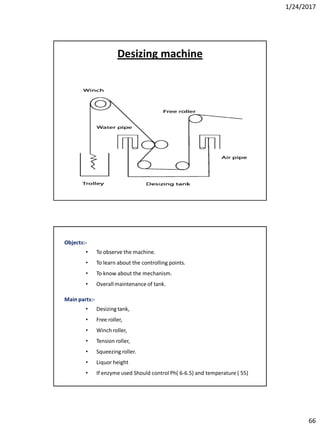
Desizing machine
Objects:-
• To observe the machine.
• To learn about the controlling points.
• To know about the mechanism.
• Overallmaintenance of tank.
Main parts:-
• Desizing tank,
• Free roller,
• Winch roller,
• Tension roller,
• Squeezing roller.
• Liquor height
• If enzyme used Should control Ph( 6-6.5) and temperature ( 55)
1/24/2017
67
The machine should be maintained in several points of view. These points are
mentionedon the next.
Squeezing roller:- The upper roller of the squeezing roller is soft and that of the
lower roller is hard. The speed of the transmission of the cloth through the
squeezing roller should be adjusted according to the quality of the fabric.
Roller movement:-Different free and guide roller should be moved easily. We
have to look about that.
Water, steam line:- proper flow of water and steam should be maintained.
Proper fabric path:- In case of desizing proper path should be followed by the
differentroller.
Speed 80-100 m/min
Proper temperature:- In case of enzymatic agent the proper temperature should
be maintained in the bath. ( 55)
Proper Ph:In case of enzymatic agent the proper Ph should be maintained in the
bath. ( 6-6.5)
Liquorheight: Should keep at standard level
Controlling points of the machine
Machinecondition:
1. Mechanicaldefects
2. Rollers defects.
3. Utility supply pipes condition.
4. Electrical motor condition.
MachineParameter:
1. Capacity of trough: 750 lit.
2. Nip pressure: 0.8 bar
Utilities:
1. Water,
2. Steam,
3. Electricity
4. & Gas :- 1=1.02kg/cm2
Machine Facilities
1/24/2017
68
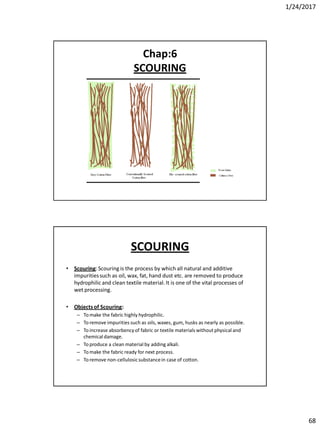
Chap:6
SCOURING
SCOURING
• Scouring:Scouring is the process by which all natural and additive
impuritiessuch as oil, wax, fat, hand dust etc. are removed to produce
hydrophilicand clean textile material. It is one of the vital processes of
wet processing.
• Objectsof Scouring:
– To make the fabric highly hydrophilic.
– To remove impurities such as oils, waxes, gum, husks as nearly as possible.
– To increase absorbency of fabric or textile materials without physical and
chemical damage.
– To produce a clean material by adding alkali.
– To make the fabric ready for next process.
– To remove non-cellulosicsubstancein case of cotton.
1/24/2017
69
Natural fibers contain oils, fats, waxes, minerals, leafy matter and motes as
impurities that interfere with dyeing and finishing. Synthetic fibers contain
producer spin finishes, coning oils and/or knitting oils. Mill grease used t o
lubricate processing equipment mill dirt, temporary fabric markings and the
like may contaminate fabrics as they are being produced. The process of
removing these impurities is called Scouring.
Even though these impurities are not soluble in water, they can be removed by
Extraction, dissolving the impurities in organic solvents, Emulsification, forming
stable suspensions of the impurities in water and Saponification, Converting
the contaminates into water
Theory of Scouring
Mechanism
Saponification:
• The vegetableoil, which is immisciblewith water,is glyceride of fatty acids.
When such oils are heated with a solution of sodium hydroxide in water,the
oil splits up into its constituents-fattyacid and glycerine.Glycerine is miscible
with water easily and the fatty acids reacts with sodium hydroxide present in
the solution forming its sodium salt i.e.soap which is also soluble in water.
Thus oil is removed.
Emulsification:
• Waxand non saponifiableoils are removed by emulsificationas they are
immisciblein water. Normal washing soap is used as a emulsifyingagent
which makes emulsion of them.
1/24/2017
70
1. Saponificationof fats into water-solublesoap and water-miscibleglycerin under alkaline
conditions,
2. Hydrolysisof proteins into water-solubledegradationproducts,
3. Dissolutionof hydrolysis to ammonia of simpler amino compounds,
4. Conversion of pectose and pectin into their soluble salts,
5. Dissolutionof mineral matter,
6. Emulsificationof unsaponifiableoils and waxes, and
7. Removal of dirt particles from the kier liquor by the detergentpresent therein
Procedure of Scouring Process
Scouring agents
1/24/2017
71
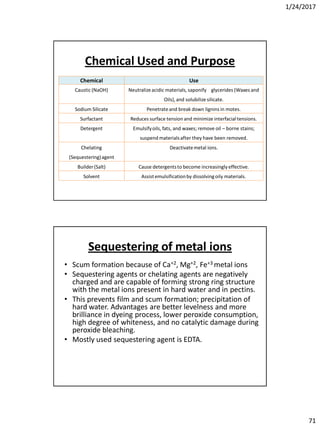
Chemical Use
Caustic (NaOH) Neutralizeacidic materials, saponify glycerides (Waxes and
Oils),and solubilize silicate.
Sodium Silicate Penetrateand break down lignins in motes.
Surfactant Reduces surface tension and minimize interfacialtensions.
Detergent Emulsifyoils, fats, and waxes; remove oil – borne stains;
suspend materialsafter they have been removed.
Chelating
(Sequestering)agent
Deactivatemetal ions.
Builder(Salt) Cause detergentsto become increasingly effective.
Solvent Assistemulsificationby dissolvingoily materials.
Chemical Used and Purpose
Sequestering of metal ions
• Scum formation because of Ca+2, Mg+2, Fe+3 metal ions
• Sequestering agents or chelating agents are negatively
charged and are capable of forming strong ring structure
with the metal ions present in hard water and in pectins.
• This prevents film and scum formation; precipitation of
hard water. Advantages are better levelness and more
brilliance in dyeing process, lower peroxide consumption,
high degree of whiteness, and no catalytic damage during
peroxide bleaching.
• Mostly used sequestering agent is EDTA.
1/24/2017
72
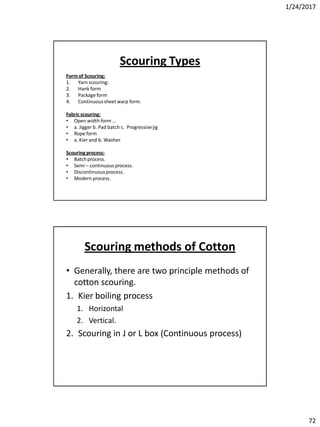
Scouring Types
Form of Scouring:
1. Yarn scouring:
2. Hank form
3. Package form
4. Continuoussheet warp form.
Fabric scouring:
• Open width form …
• a. Jigger b. Pad batch c. Progressivejig
• Rope form
• a. Kier and b. Washer.
Scouring process:
• Batchprocess.
• Semi – continuous process.
• Discontinuousprocess.
• Modern process.
Scouring methods of Cotton
• Generally, there are two principle methods of
cotton scouring.
1. Kier boiling process
1. Horizontal
2. Vertical.
2. Scouring in J or L box (Continuous process)
1/24/2017
73
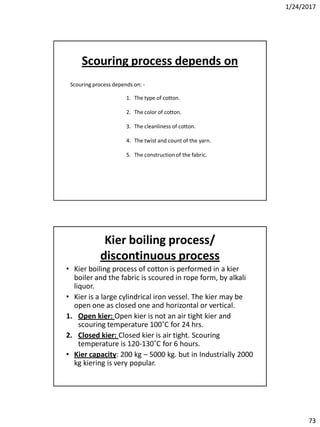
Scouring process depends on: -
1. The type of cotton.
2. The color of cotton.
3. The cleanliness of cotton.
4. The twist and count of the yarn.
5. The construction of the fabric.
Scouring process depends on
Kier boiling process/
discontinuous process
• Kier boiling process of cotton is performed in a kier
boiler and the fabric is scoured in rope form, by alkali
liquor.
• Kier is a large cylindrical iron vessel. The kier may be
open one as closed one and horizontal or vertical.
1. Open kier: Open kier is not an air tight kier and
scouring temperature 100˚C for 24 hrs.
2. Closed kier: Closed kier is air tight. Scouring
temperature is 120-130˚C for 6 hours.
• Kier capacity: 200 kg – 5000 kg. but in Industrially 2000
kg kiering is very popular.
1/24/2017
74
Standard Recipe
The amount of different chemicals used in a kier boiling may vary according to
• Hardness of water.
• Quality / Quantity of cotton.
• Fabric construction/ texture, yarn twist
Recipe
 Caustic Soda (Strong)→ 2-5% owf
 Soda ash (mild)→ 0.5-1.0%
 Sequesteringagent→0.2-0.5%
 Wetting agent+Detergent→0.5-1.0%
 M:L→1:5 to1:7
 Temp→100˚C-120˚C
 Time→8hr(1000C) - 2hr(120˚C)
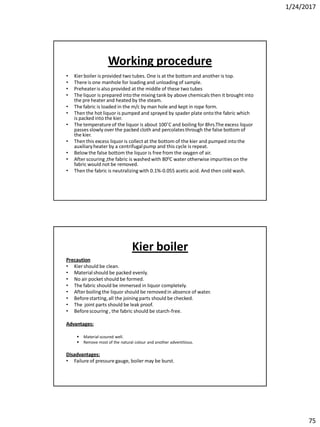
Characteristic of boiler
• Heatingis done by using high pressure steam, generated in an independentboiler
insteadof heating by direct boiler.
• Iron and steel take the place of wood as the mtl of constructionof kier.
• Improvementin the handling of the goods by the use of automatic pilling device.
• Improvementof the circulation of kier liquor through the mtl by the use of
powerfulpump.
• Use of high pressure kier shorten the duration of boiling off and hence saves the
cost of the steam, power etc.
1/24/2017
75
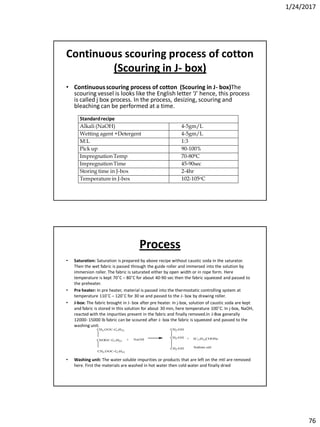
Working procedure
• Kier boiler is provided two tubes. One is at the bottom and another is top.
• There is one manhole for loading and unloading of sample.
• Preheateris also provided at the middle of these two tubes
• The liquor is prepared into the mixing tank by above chemicals then it brought into
the pre heater and heated by the steam.
• The fabric is loaded in the m/c by man hole and kept in rope form.
• Then the hot liquor is pumped and sprayed by spader plate onto the fabric which
is packed into the kier.
• The temperature of the liquor is about 100˚C and boiling for 8hrs.The excess liquor
passes slowly over the packed cloth and percolatesthrough the false bottom of
the kier.
• Then this excess liquor is collect at the bottom of the kier and pumped into the
auxiliaryheater by a centrifugalpump and this cycle is repeat.
• Below the false bottom the liquor is free from the oxygen of air.
• After scouring ,the fabric is washed with 800C water otherwise impurities on the
fabric would not be removed.
• Then the fabric is neutralizing with 0.1%-0.055 acetic acid. And then cold wash.
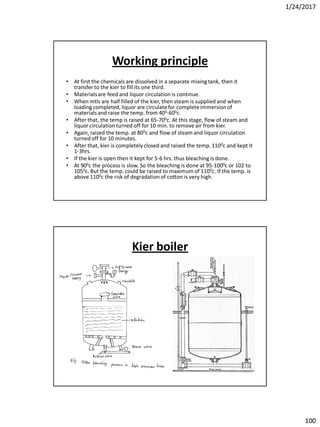
Kier boiler
Precaution
• Kier should be clean.
• Materialshould be packed evenly.
• No air pocket should be formed.
• The fabric should be immersed in liquor completely.
• After boiling the liquor should be removed in absence of water.
• Beforestarting,all the joining parts should be checked.
• The joint parts should be leak proof.
• Beforescouring , the fabric should be starch-free.
Advantages:
 Material scoured well.
 Remove most of the natural colour and another adventitious.
Disadvantages:
• Failure of pressure gauge, boiler may be burst.
1/24/2017
76
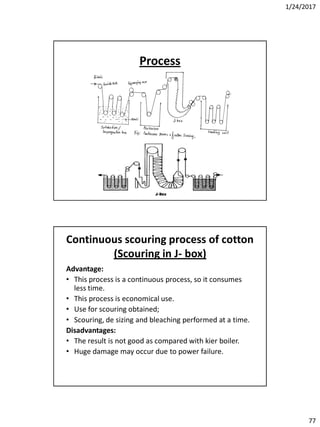
Continuous scouring process of cotton
(Scouring in J- box)
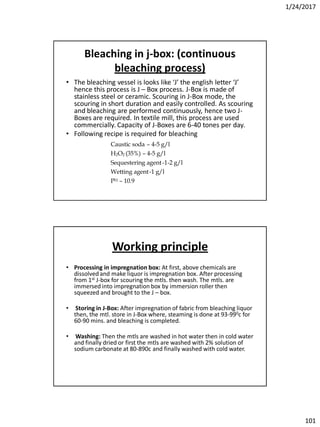
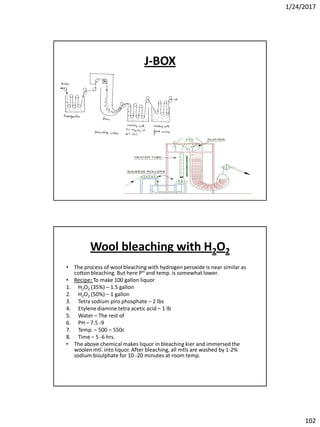
• Continuousscouring process of cotton (Scouring in J- box)The
scouring vessel is looks like the English letter ‘J’ hence, this process
is called j box process. In the process, desizing, scouring and
bleaching can be performed at a time.
Standardrecipe
Alkali (NaOH) 4-5gm/L
Wetting agent +Detergent 4-5gm/L
M:L 1:3
Pick up 90-100%
Impregnation Temp 70-800C
Impregnation Time 45-90sec
Storing time in J-box 2-4hr
Temperature in J-box 102-105oC
Process
• Saturation: Saturation is prepared by above recipe without caustic soda in the saturator.
Then the wet fabric is passed through the guide roller and immersed into the solution by
immersion roller. The fabric is saturated either by open width or in rope form. Here
temperature is kept 70˚C – 80˚C for about 40-90 sec then the fabric squeezed and passed to
the preheater.
• Pre heater: In pre heater, material is passed into the thermostatic controlling system at
temperature 110˚C – 120˚C for 30 se and passed to the J- box by drawing roller.
• J-box: The fabric brought in J- box after pre heater. In j-box, solution of caustic soda are kept
and fabric is stored in this solution for about 30 min, here temperature 100˚C. In j-box, NaOH,
reacted with the impurities present in the fabric and finally removed.In J-Box generally
12000- 15000 lb fabric can be scoured after J- box the fabric is squeezed and passed to the
washing unit.
• Washing unit: The water soluble impurities or products that are left on the mtl are removed
here. First the materials are washed in hot water then cold water and finally dried
CH2-OOC-C17H33
CHOOC-C17H33
CH2-OOC-C17H33
CH2-OH
CH2-OH
CH2-OH
+ + 3C17H33COONa
Sodium salt
NaOH
1/24/2017
77
Process
Continuous scouring process of cotton
(Scouring in J- box)
Advantage:
• This process is a continuous process, so it consumes
less time.
• This process is economical use.
• Use for scouring obtained;
• Scouring, de sizing and bleaching performed at a time.
Disadvantages:
• The result is not good as compared with kier boiler.
• Huge damage may occur due to power failure.
1/24/2017
78
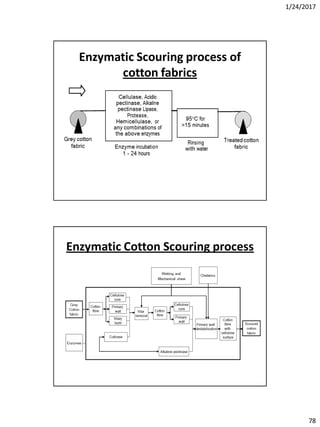
Enzymatic Scouring process of
cotton fabrics
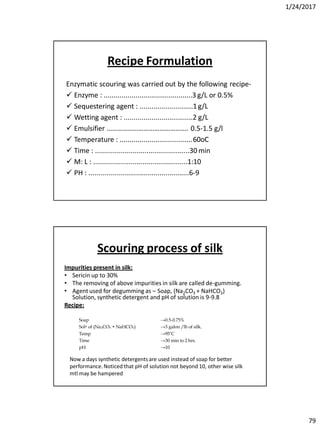
Enzymatic Cotton Scouring process
1/24/2017
79
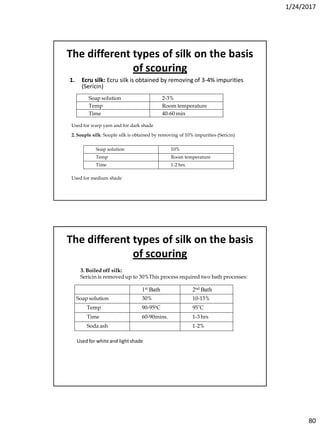
Recipe Formulation
Enzymatic scouring was carried out by the following recipe-
 Enzyme : .............................................3 g/L or 0.5%
 Sequestering agent : ...........................1g/L
 Wetting agent : ...................................2 g/L
 Emulsifier ………………………………………. 0.5-1.5 g/l
 Temperature : .....................................6060oCC
 Time : ................................................30 min
 M: L : ................................................1:10
 PH : ...................................................6-9
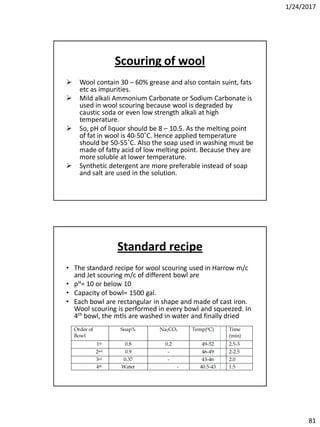
Scouring process of silk
Impurities present in silk:
• Sericin up to 30%
• The removing of above impurities in silk are called de-gumming.
• Agent used for degumming as – Soap, (Na2CO3 + NaHCO3)
Solution, synthetic detergent and pH of solution is 9-9.8
Recipe:
Soap →0.5-0.75%
Soln of (Na2CO3 + NaHCO3) →3 galon /lb of silk.
Temp →95˚C
Time →30 min to 2 hrs.
pH →10
Now a days synthetic detergents are used instead of soap for better
performance. Noticed that pH of solution not beyond 10, other wise silk
mtl may be hampered
1/24/2017
80
The different types of silk on the basis
of scouring
1. Ecru silk: Ecru silk is obtained by removing of 3-4% impurities
(Sericin)
Soap solution 2-3%
Temp Room temperature
Time 40-60 min
Used for warp yarn and for dark shade
2. Souple silk: Souple silk is obtained by removing of 10% impurities (Sericin)
Soap solution 10%
Temp Room temperature
Time 1-2 hrs.
Used for medium shade
The different types of silk on the basis
of scouring
3. Boiled off silk:
Sericin is removed up to 30%This process required two bath processes:
1st Bath 2nd Bath
Soap solution 30% 10-15%
Temp 90-950C 95˚C
Time 60-90mins. 1-3 hrs
Soda ash 1-2%
Used for white and light shade
1/24/2017
81
Scouring of wool
 Wool contain 30 – 60% grease and also contain suint, fats
etc as impurities.
 Mild alkali Ammonium Carbonate or Sodium Carbonate is
used in wool scouring because wool is degraded by
caustic soda or even low strength alkali at high
temperature.
 So, pH of liquor should be 8 – 10.5. As the melting point
of fat in wool is 40-50˚C. Hence applied temperature
should be 50-55˚C. Also the soap used in washing must be
made of fatty acid of low melting point. Because they are
more soluble at lower temperature.
 Synthetic detergent are more preferable instead of soap
and salt are used in the solution.
Standard recipe
• The standard recipe for wool scouring used in Harrow m/c
and Jet scouring m/c of different bowl are
• pH= 10 or below 10
• Capacity of bowl= 1500 gal.
• Each bowl are rectangular in shape and made of cast iron.
Wool scouring is performed in every bowl and squeezed. In
4th bowl, the mtls are washed in water and finally dried
Order of
Bowl
Soap% Na2CO3 Temp(0C) Time
(min)
1st 0.8 0.2 49-52 2.5-3
2nd 0.9 - 46-49 2-2.5
3rd 0.37 - 43-46 2.0
4th Water - 40.5-43 1.5
1/24/2017
82
Scouring of Jute: (Bast fibre)
• Bast fibre, jute, linen etc. are mulicellular fibre,
having polygonal shape. The cells are cemented
with each other by lignin which is non-cellulosic
unit and is about 11-14%.
• If strong alkali is used for jute scouring, its
strength is reduced as lignin is removed and cells
are separated. So, mild alkali is used in jute
scouring at low temp.
• Scouring is not required for Hessian and Sacking
jute
Standard recipe
• Better performance is obtained, if 1% Oxalic acid
solution is used to boil jute fibre before scouring.
• After scouring, jute is treated with CH3COOH or in HCl
Materials Quantity
Na2CO3 4-6gm
Wetting agent + Detergent 0.5-1gm/ltr
Water softening agent 0.5-1.0gm/ltr
M:L 1:15-1:20
Temp Boiling(1000C)
Time 2-4 hrs.
1/24/2017
83
Solvent Scouring Process
There are commercialprocesses where textiles are cleaned with
organic solvents. Fabrics processed this way are said to be "Dry Cleaned".
Although not widely used as a fabric preparation step, it is an important
way of removing certain difficult to remove impurities, where a small
amount of residuals can cause downstream problems. Garment dry-
cleaning is more prevalent.
For fabrics that do not have to be desized, solvent scouring is an effective
way of removing fiber producer finishes, coning and knitting oils. Knitted
fabrics made from nylon, polyester, acetate and acrylics, are particularly
amenable to this method of preparation. Wool grease is effectively
removedby solvent scouring. Solvent
Extractions are particularly useful in the laboratory for determiningthe
amount of processing oils added to man-made fibers and the residual
amounts of oils and waxes left by aqueous scouring. Properly controlled,
fabrics can be produced with very little residual matter.
Scouring fabrics with a blend of fibers requires consideration of the
sensitivities of each fiber to scouring chemicals and to process conditions.
Sensitivities to consider when scouring blends are:
Cotton: Resistant to strong alkali. Degraded by acid.
Rayon: Sensitive to alkali. May be dissolved by hot alkali.
Wool: Degraded by alkali.
Acetate: Hydrolyzedby alkali.
Polyester: Hydrolyses under extreme conditions of alkali and heat.
Blends
1/24/2017
84
Synthetic Scouring
 Synthetic fibers generally do not contain naturally
occurring impurities like natural fibers. However spin
finishes, knitting weaving oils, antistatic agents are
added to improve physical as well as mechanical
properties. Other are dirt etc.
 For polyester weak and low concentration of alkalis are
used at low temperature.
 Special precaution is necessary when polyester is
scoured with strong alkali at higher temperatures and
care has to be taken not to hydrolyze the fiber.
 Nylons are scoured with mild alkali and detergents.
Generally non-ionic detergents are used in scouring of
nylons.
Estimationof Scouring:
1. Determinationof weight loss
2. AbsorbencyTest
• ImmersionTest
• Drop Test
• Spot Test
3. Column Test
AATCC Test Method Number 79
Properly scoured fabric should wet out faster and be more water absorbent.
AATCC Test Method No. 79 is used to measure fabric wetting. A drop of water is
placed on the fabric and the time it takes for the drop to penetrate the fabric is
recorded. The faster the wetting time, the more absorbent the fabric.
Estimation of Scouring
1/24/2017
85
Determinationof Weight Loss:
•Standard weight loss is 4 – 8%
•If weight loss is less than 4%, it can be said that scouring was not well
•If weight loss is above 8% then it can be said that fabric damage has occurred.
Measurement of Weight Loss:
5 gm of dried samples is treated with 200 ml of 1% NaOH for 1 hour at 80ᴼ C after
which sample is well rinsed and run out in hot water. It is then treated in 200 ml of
0.5% HCl at 80ᴼ C for 1 hour, after which sample is once again rinsed, boiled for 1/2
hour in distilled water, dried & weighted.
Estimation of Scouring
ImmersionTest:
 Sample size is “1 cm x 1 cm”
 If the fabric floats on the water, then it may be said that the fabric is unscoured
 If the fabric is immersed within 5 seconds then it may be said that the fabric is
scoured well.
Drop Test:
 Solution 0.1% Direct red
 If dye drop is absorbed within 1 second, then the scouring is of standard level
 If dye drop is absorbed within 0.5 – 0.8 second, then the scouring is of good
level.
A drop is allowed to fall on the fabric by a pipette from 1 or 2 inch above fabric and
time in second is measured until the dye drop is fully absorbed.
Estimation of Scouring
1/24/2017
86
Spot Test:
 Solution of 0.1% direct red
 Pour uniform drop on fabric
Size of droplet is observed
Column Test/Wicking Test:
 Solution of 0.1% direct red
 Sample size “5 cm x 18 cm”
 Observation time 5 minutes
Estimation of Scouring
Observation:
1. The length of fabric is observed in solution.
2. If the absorption rise up as high as 30 mm then it may be said that the fabric has
good scouring
3. If the absorption rise up as high as 50 mm then it may be said that the fabric has
excellent scouring.
Assessmentof pretreatment by absorbency test:
Verdict Spot Test
WickingTest Wickingrate
5 minutes 10 minutes 1 cm 2 cm 3 cm
Good
Pretreatment
1 – 5
Second
30 – 50
mm
50 – 90
mm
3 – 5 sec 10 – 30
sec
40 – 70
sec
Poor
Pretreatment
More than
10 seconds
Less than
30 mm
Less than
50 mm
More than
10 sec
More
than 30
sec
More
than 100
sec
Estimation of Scouring
1/24/2017
87
Souring
The treatment/the process by which the fabric, after processing
with alkali or scouring, is treated with Acetic Acid, Hydrochloric acid or
dilute H2SO4 for removing alkali or neutralizationof alkali is souring.
Scouring Souring
1. To remove oil, waxes gum
soluble impurities.
1. Not to remove any
impurities, only for alkali
neutralization.
2. Scouring is done in alkali
solution.
2. Souring is done dilute
HCl or H2SO4
3. Required heat to boiling. 3. No need of heat.
4. Need of definite time. 4. No need of definite time.
Chap:7
BLEACHING
1/24/2017
88
DEFINATION
Bleaching
The process of decolorize the natural coloring matter present in the
cloth treating with some oxidizing agent and reducing agent and
ensure the permanent whiteness is called bleaching.
Objects
 A high uniform absorbency of fabric to water and dye stuffs.
 Uniform degree of whiteness.
 Fabric should not damage and DP should remain high.
 Destruction of natural coloring matters from the fabric.
 To ensure a level dyeing properties.
 To make the textile materials suitable for subsequent
processing. (Dyeing, printing, etc.)
The mechanism of bleaching is very complicated and not
completely understood. One opinion is that the color producing
agents in natural fibers are often organic compounds containing
conjugated double bonds. Decoloration can occur by breaking
up the chromophore, most likely destroying one or more of the
double bonds within the conjugated system. The bleaching
agents either oxidize or reduce the coloring matter … thus
whiteness obtained is of permanent nature. Primitive bleaching
- expose scoured fabric to the sun - light served as an oxidation
catalyst.
Mechanism of Bleaching
1/24/2017
89
A bleaching agent is a substance that can whiten or decolorize
other substances.
Bleaching Agent
Application of bleaching process to
fiber types
• ++ Process highly soluble,
• +, Process applicable without fiber damage but without achieving and
whiteningeffect.
• (+) , Process applicable only with special precaution.
• _ process unsuitable
Type of fiber Alkal
i
Sodium
chlorid
e
Sodium
hypo
chlorid
e
H2O
2
Reducin
g agent
Cellulose ++ ++ ++ ++ ++
Animal _ _ _ ++ ++
Polyamide + ++ _ (+) ++
Polyester (+) ++ + + +
Polyacrylonitril
e
_ ++ + (+) +
1/24/2017
90
Bleaching auxiliaries
• Wetting agents: Sulphonated oils, fatty alcohol
sulphates, fatty acid condensates
• Activators for bleaching with H2O2 is usually NaOH
which controls the pH
• Stabilizers: Very important for the bleaching with
hydrogen peroxide, suitable products are sodium
silicate ,phosphates, organic complexing agents, etc.
• Sequestering agents: They help to sequester out metal
ions such as EDTA.
• Corrosions inhibitors for sodium chlorite bleaching:
fatty acids condensates, nitrates and phosphates.
Hypochlorite bleaching
 Sodium hypochlorite (NaOCl)or Calcium hypochlorite [Ca(OCl)2] may be used as
hypochloritebleaching agent.
 When Calcium hypochloriteor Sodium hypochloriteis hydrolised, hypochlorus acid
is formed which ionizes under a certain condition any give hypochlorus ions which
are responsiblefor bleaching action. Alkaline condition favours the reaction-
Ca(OCl)2+H2O +CO2→CaCO3+ 2H0Cl
HOCl →H+ + Cl-
 Hypochlorousion (responsiblefor bleaching)&
NaOCl+H20 NaOH + HOCl
HOCl →H+ + Cl-
 Hypochlorousion (responsiblefor bleaching)
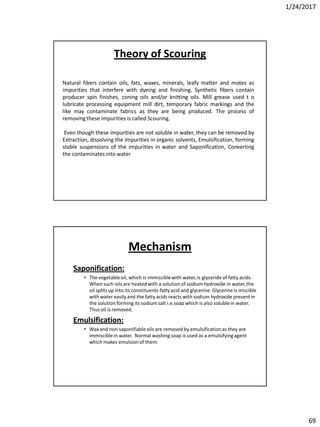
 When calcium hypochlorite is used, it reacts with atmospheric carbon dioxide to
give calcium carbonate as white precipitate.
 Ca(OCl)2+H2O+CO2→CaCO3 ↓+ 2H0Cl
 CaCO3 depositedon the fabric causing harsh handling and uneven dyeing, hence it
have to separate and souring(acid treatment)is done to remove it.
1/24/2017
91
Differences between Ca(OCl)2 and
NaOCl bleaching
181
In textile hypochlorite bleaching sodium hypochlorite [NaOCl] or
calcium hypochlorite [Ca(OCl)2] may be used as hypochlorite bleaching
agent.
Ca(OCl)2 NaOCl
1.It is unstable 1.It is stable
2.It produces CaCO3 precipitate 2. It doesn’t produce any precipitate
3.It makes harsh feeling on the fabric 3.It doesn’t make harsh feeling on the
fabric
4.Comperatively cheaper than NaOCl
bleaching
4.Higher cost than Ca(OCl)2
bleaching
Effect of PH
The effect of PH is very important during hypochlorite bleachig –
 When PH 2 – 4: Produce more chlorine which toxic and corrosive.
 When PH -4: More stable HOCl i.e. HOCl does not divided into H+ and OCl-
 When PH 7 neutral: Decompositionof NaOCl is very high. So it breaks cellulose.
This point is called “Damage point”.
 When PH 7-8: Quick bleaching which tends to degradation of cotton fabric.
 When PH 9.2 – 11: Fabric become neutral and more stable.
 When PH 11 -13: It is the perfect range, but it require more time. If PH =11,
bleachingneeds 130 hrs. and if PH =13, bleaching needs 40 hrs. to be finished
• From the above chart it is clear that, bleaching by hypochlorite should be done in
alkaline medium and not in between the value of PH 2 -7
• Ideal PH for Hypochloritebleaching →9.2-11.0
• PH is maintained at 10. For PH maintain-
• 0.2-0.8% Caustic soda
• 2-3% Soda ash
1/24/2017
92
Antichloro treatment
• In case of hypochlorite bleaching, Hypochlorus ion
produce during bleaching. This (OCl-) ion will react with
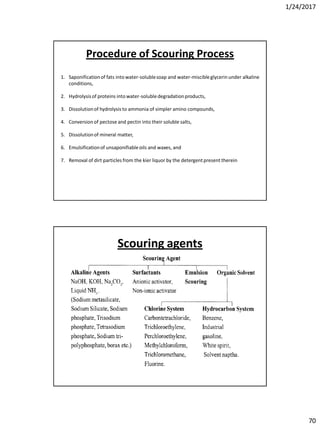
residual protein into fibre and produced Chloramine (
NCl) which is corrosive and unhygenic. After bleaching,
the chloramine react with moisture and gradually
cotton become yellowish due to forming of HCl.
• To remove >NCl, Antichlore treatment done.
• For the antichlore treatment of cellulosic fibre the
general recipe is as follows:
 NaHSO4 – 0.2 – 0.6%
 Temp. – Rooms
 Time – 10- 20 min.
a. Formulation:
b. Bleach Cycle:
TYPICAL BATCH PROCEDURE
1/24/2017
93
1. Hypochlorite is used mainly to bleach cellulosic fabrics. It cannot be used
on wool, polyamides (nylon), acrylics or polyurethanes (spandex).
2. These fibers will yellow from the formation of chloramides.
3. Bleaching with hypochlorite is performed in batch equipment.
4. It is not used in continuous operations because chlorine is liberated into
the atmosphere.
5. Over time, the pad bath decreases in active chlorine causing non-uniform
bleaching from beginning to end of the run.
Uses
Hydrogen Peroxide (H2O2) Bleaching
• Hydrogen peroxide was first used to bleach cotton in the 1920's. By
1940, 65% of all cotton fabrics were bleached with hydrogen
peroxide, largely brought about by the invention of the J-box
which lead to continuous processing.
• Today, it is estimated that 90 to 95 % of all cotton and
cotton/synthetic blends are bleached with hydrogen peroxide.
• It is available commercially as 35, 50 and 70 % solutions.
• It is a corrosive, oxidizing agent which may cause combustion when
allowed to dry out on oxidizable organic matter. Decomposition is
accelerated by metal contamination and is accompanied by the
liberation of heat and oxygen, which will support combustion and
explosions in confined spaces. The material is an irritant to
the skin and mucous membranes and dangerous to the eyes
1/24/2017
94
Hydrogen Peroxide (H2O2) Bleaching
1/24/2017
95
Bleaching action of Hydrogen per
oxide
• Under certain condition,particularly regard to PH , hydrogen peroxide will liberate
hydrogen ion and per hydroxyl ions in the following manner
• Per hydroxyl ions responsible for bleaching.
• Alkalinityfavours the liberation of Per hydroxyl ions because the positivelycharged
hydrogen ion is neutralized but excessive alkalinity cause the peroxide to become
unstable.The hydro – peroxide ion is resposible for bleaching action.
• In presence of catalystsuch as CaCO3, Fe, Cu, Cr, Mg etc. liberated oxygen by
decomposingH2O2 and lower the strength of H2O2.
2H2O2 2H2O + O2
• Hence (20 – 70) or (60 - 80) hardness are suitablefor bleaching.
Difference between H2O2 bleaching
and Hypochlorite bleaching
H2O2 bleaching Hypochlorite
bleaching
1. Per hydroxyl
ions(HO2-) are
responsible for
bleaching.
1. Hypochlorous ions
(OCl-) are responsible
for bleaching.
2. Permanent and white
are obtained
2. Permanent and white
are not obtained as
hydrogen per ox ide
bleaching
3. Temp. near to boiling
i.e. above 900C
3. Room temp.
4. Can be performed i n
scouring.
4. No scouring action is
done.
5. Universal bleaching
agent.
5. Not Universal
bleaching agent.
6. Can be bleached both
cellulosic and protein
fibre.
6. Only cellulosic fibre
can bleach.
7. No need of antichloro
treatment.
7. Need antichloro
treatment.
8. Less possibility of
fabric wastage.
8. More possibility of
fabric wastage.
1/24/2017
96
Standard or general or typical recipe
Chemicals Bleaching Single stage
Scour – bleach
H202 (35%)
OR
H202 (50%)
5-6%
3-4%
5-6%
3-4%
Caustic soda 0.2-0.5% 4%
Soda ash 0.5-1.0% 3%
Wetting agent 0.5-1.0 %
Sodium silicate
(Stabilizer)
0.5-1.5% 2.0-3.0%
PH 9-10.5 Same
M:L ratio 1:10 1:15
Time and temp. 98-1000C-4hrs
102-1050C-3hrs
1100C-1hr
1000C-4.5 hrshrs
102-1050C-3.5 hrs
1100C-1.5hrs
Function of required chemical
• Stabilizer: It makes complex compound with catalyst but not react and
stop the oxygen generation into solution and preserved the strength loss
of H2O2. Generally, Sodium silicate used as Stabilizer.
• Catalyst:The water used in bleaching may present Cu, Zn etc. which acts
as catalyst and destroy H2O2 by generation oxygen but this oxygen have no
bleachingpower.
• Alkali: Without alkali HO2
- producing is slower. On the other hand, huge
alkali present in solution, H2O2 decompose and produce O2. The function
of alkali ( Caustic Soda) is to maintain
PH 9.2 – 11.5.
PH Decomposition of % of
H2O2
10.4 7
11.1 15.5
11.9 19.0
12.2 25.0
12.6 59.0
1/24/2017
97
Function of required chemical
• Soda ash: To also maintain PH and more whiteness.
• Wetting agent: To wet the fabric by lower interfacial tension.
• Water: For better action of sodium silicate, some magnesium salts
are added hence 20 -70 hardness of water are used. If pure soft
water are used, then 0.1 – 0.2 gm/L Magnesium sulphate.
• Temperature: Normally the temperature increase, the stability of
H2O2 reduces.
If temperature is 200c or less than 200c, H2O2 is more stable even
alkaline condition. Not good bleaching below 800C temperature
bleaching.
• Impurities in cotton: Higher the impurities, higher the stability of
H2O2 and higher the bleaching acts as a stabilizer.
As a result, H2O2 do not break and proper leaching is performed.
Advantages of H2O2 bleaching over
other bleaching agent
 H2O2 does not react with residual protein of fibre and hence no need antichloro treatment.
 Permanent white cotton is obtainable and the bleached fabics are highly hydrophilic since
the waxes are solublised and removal by the hot alkaline solution.
 Its reaction products are relatively non toxic and it decomposes to oxygen and water thus
reducing greatly the effluent pollution of the bleaching plant.
 H2O2 bleaching is carried out in alkaline medium and elevated temp. is about 1000c, hence
scouring and bleaching completed together.
 Small amount of impurities present in cotton fibre, give stability of H2O2 in solution and so
needs scouring. For this reason, impurities in cotton acts as stabilizer in H2O2 bleaching.
 Weight of fabric after H2O2 bleaching is higher than that of hypochlorite bleaching.
 Tensile strength is greater after H2O2 bleached fabric than that of hypochlorite bleached.
 Another advantage is degradation possibility of fabric is less due to over bleached.
 Hard water preferable.(20-70C).
 Bleaching and dyeing can be sometimes combined in a single operation.
 The no. of operation and stages in the bleaching can be reduced and continuous one stage
process can be worked.
 It si compatible with the most fibres and can be applied to a wide variety of fabric under a
wide range of bleaching condition and machines.
1/24/2017
98
Disadvantages
Bleaching is slow unless high temperature is
applied energy
Catalytic decomposition of H202 occurs along
with catalytic degradation of cellulose due to
iron, Ne, Cu and Pb hydroxide present in the
bleaching solution or I the fabric.
The above metals and their alloys cannot be
used as material of construction of H202
bleaching containers
H2O2 universal bleaching agent
 Hydrogen peroxide is successfully used to bleach both
cellulosic (vegetable) and protein (animal) fibre.
 In case of cellulosic fibre, H2O2 permanently destroy
the natural color and obtained good result.
 In case of protein fibre H2O2 oxidized the protein mtl.
but if no chloride ion. For this di-appearance, it has no
effect on protein fibre and also destroys the natural
color permanently.
 H2O2 bleaching is done at elevated temperature is
about 1000c in alkali medium and hence scouring and
bleaching can be performed together.
 So, H2O2 is called universal bleaching agent.
1/24/2017
99
Methods of bleaching with Hydrogen
Peroxide
• There are two chief methods for bleaching of
cotton goods with H2O2.
1. Bleaching in kier (Discontinuous)
2. Bleaching in J – Box (Continuous)
Bleaching in kier
• The simplest cotton bleaching method with H2O2 is in kier. When
the conventional kier is used, there is the risk of catalytically
decomposition of the H2O2 by the rest is the kier. So sodium silicate
(Stabilizer) and cement should be used to prevent the wastage of
hydrogen peroxide. The circulation of liquor may be provided either
by centrifugal pump or by a steam injector.
Chemicals Amount
H202 (35%) 2-4%
Caustic soda 0.2-1%
Soda ash 0.5-1.0%
Wetting agent As required
Sodium silicate
(Stabilizer)
2-3%
PH 9-10.5
M:L ratio 1:10-1:20
1/24/2017
100
Working principle
• At first the chemicals are dissolved in a separate mixing tank, then it
transfer to the kier to fill its one third.
• Materialsare feed and liquor circulation is continue.
• When mtls are half filled of the kier, then steam is supplied and when
loading completed, liquor are circulate for completeimmersion of
materialsand raise the temp. from 400-600c.
• After that, the temp is raised at 65-700c. At this stage, flow of steam and
liquor circulation turned off for 10 min. to remove air from kier.
• Again, raised the temp. at 800c and flow of steam and liquor circulation
turned off for 10 minutes.
• After that, kier is completelyclosed and raised the temp. 1100c and kept it
1-3hrs.
• If the kier is open then it kept for 5-6 hrs. thus bleaching is done.
• At 900c the process is slow. So the bleaching is done at 95-1000c or 102 to
1050c. But the temp. could be raised to maximum of 1100c. If the temp. is
above 1100c the risk of degradation of cotton is very high.
Kier boiler
1/24/2017
101
Bleaching in j-box: (continuous
bleaching process)
• The bleaching vessel is looks like ‘J’ the english letter ‘J’
hence this process is J – Box process. J-Box is made of
stainless steel or ceramic. Scouring in J-Box mode, the
scouring in short duration and easily controlled. As scouring
and bleaching are performed continuously, hence two J-
Boxes are required. In textile mill, this process are used
commercially. Capacity of J-Boxes are 6-40 tones per day.
• Following recipe is required for bleaching
Caustic soda – 4-5 g/l
H2O2 (35%) – 4-5 g/l
Sequestering agent-1-2 g/l
Wetting agent-1 g/l
PH – 10.9
Working principle
• Processing in impregnation box: At first, above chemicals are
dissolved and make liquor is impregnation box. After processing
from 1st J-box for scouring the mtls. then wash. The mtls. are
immersed into impregnation box by immersion roller then
squeezed and brought to the J – box.
• Storing in J-Box: After impregnation of fabric from bleaching liquor
then, the mtl. store in J-Box where, steaming is done at 93-990c for
60-90 mins. and bleaching is completed.
• Washing: Then the mtls are washed in hot water then in cold water
and finally dried or first the mtls are washed with 2% solution of
sodium carbonate at 80-890c and finally washed with cold water.
1/24/2017
102
J-BOX
Wool bleaching with H2O2
• The process of wool bleaching with hydrogen peroxide is near similar as
cotton bleaching. But here PH and temp. is somewhat lower.
• Recipe: To make 100 gallon liquor
1. H2O2 (35%) – 1.5 gallon
2. H2O2 (50%) – 1 gallon
3. Tetra sodium piro phosphate – 2 lbs
4. Etylenediamine tetra acetic acid – 1 lb
5. Water – The rest of
6. PH – 7.5 -9
7. Temp. – 500 – 550c
8. Time – 5 -6 hrs.
• The above chemicalmakes liquor in bleaching kier and immersed the
woolen mtl. into liquor. After bleaching, all mtls are washed by 1-2%
sodium bisulphate for 10 -20 minutes at room temp.
1/24/2017
103
Silk bleaching with H2O2
• Near similar to wool bleaching but temp. is little high. In this case,
Silk must be degumed before bleaching.
• Bleaching recipe:
1. H2O2 (35%) – 13 ml/L
2. H2O2 (50%) – 8 ml/L
3. Tetra sodium piro phosphate – 2 gm/L
4. Etylene diamine tetra acetic acid – 1 gm/L
5. PH – 10
6. Temp. – 700c
7. Time – 2 - 4 hrs.
• For Tossar silk – mtls. are immersed in 0.6% H2O2 solution for 6hrs
at 700c. After bleaching the mtls are washed by 1% sodium
bisulphate solution for 15minutes at room temp. and then cold
wash is done and dried.
Jute bleaching with H2O2
• In this case, the wt. of jute decrease 20 -30% of its raw wt.
Strength also lower. At first Sodium Chlorite bleaching and
then hydrogen peroxide bleaching is done.
1. H2O2 (35%) – 0.7-1.4%
2. NaOH – 0.25%
3. Soda ash – 0.5%
4. Sodium silicate – 3% (78 Tw)
5. Magnesium sulphate – 0.1%
6. Temp. – 71-820c
7. Time – At first, circulation of liquor for 20-30 min then, 2-3
hrs.
• After bleaching at first hot wash then cold wash
1/24/2017
104
COMBINED SCOURING BLEACHING
CURVE
RECEIPE
• Fabric: X gm
• H2O2 : 4-5 gm/l
• Caustic soda: 4-5 g/l
• Sequesteringagent: 1-2 g/l
• Peroxide stabelizers:1-2 g/l
• Wettingagent:1-2 g/l
• M:L-1:8
• Time-1 hr
• Temp -800 C
WASHING RECEIPE
• Peroxide killer(PK)-2-3 g/l
• Acetic acid-2-3 g/l
• Temp-500 C
• Time-30-60min
1/24/2017
105
MODERN WINCH DYEING MACHINE

Wet processing-I

  • 1.
    1/24/2017 1 MYSELF:SHUVO BRAHMA Lecturer WetProcessing & engineering department (BUTEX) • CELL: 01733767475 • EMAIL: shuvobrahma201@gmail.com EDUCATION & JOB EXPERIENCE EDUCATION: BSC: BUTEX 36TH BATCH(W.P.E.) MSC: BUTEX 5TH BATCH(ON GOING)(W.P.E.) JOB EXPEIENCE: COMPANY/UNIVERSITY POSITION 1.EPYLLIONKNITEX LTD (E.K.L) EXECUTIVEIN DYEING PRODUCTION 2. NITER(D.UTech Dept) LECTURER
  • 2.
    1/24/2017 2 SYLLABUS WPE 243: WetProcessing-1 Part-A • 1.Water (Waterand its importance in textile , source , concept of hardness , removal techniques,concepts of WTP in industry its importance and operations) • 2.Detergentand Auxiliaries (Various auxiliaries their formation importance and mechanism on textile surface & uses area , properties and uses of various alkalis and acids in pretreatment,Detergents ,its type ,importance , use and mechanism) • 3.Pretreatment (Chemistryof various impurities in fibre , concepts on singeing, desizing , scouring, bleaching, methods of applicationsin knit and oven fabric , pretreatmenton cellulose and protein fibre , pretreatmentmachineries , modern conceptsof pretreatmentand industrial applicationestimationof pretreatment, damages on textiles due to pretreatmentetc) CHAP:1 INTRODUCTION
  • 3.
    1/24/2017 3 Grey fabric Inspection& Stitching Shearing & Cropping SingeingDesizingScouringBleachingDrying Mercerising Dyeing Printing Soaping & Drying Finishing Folding & Packing PROCESS SEQUENCES OF CHEMICAL PROCESSING Desizing Scouring Bleaching Mercerization Typically a woven cotton fabric would be prepared by sequence of process as shown. In case of knitting sizing step is not involved Preparation/Pretreatment Singeing
  • 4.
    1/24/2017 4 Flow chart ofwet processing for knit fabric: Grey fabric inspection Loading in the machine Scouring Bleaching Dyeing Dewatering Hydro extractor (Excess water) Stitching Stenter Compactor Final inspection Delivery Overview • Inspection: Neps, warp end breakage, weft end breakage ,hole spot remove. • Stitching: Smaller length of fabric becomes larger length of fabric. • Singeing:Projecting or floating fibre remove. • Desizing:Size material remove. • Scouring: Using Alkali (NaOH, Na2CO3) for increasing absorbency of fabric. • Bleaching:Permanent white. • Dyeing: Color produce.Non localized process. • Mercerizing:To increase the lusture of fabric. • Printing:Specific color. Localizeddyeing. • Finishing: Soft finish for consumer satisfaction. Hard finish Wrinkle free finish
  • 5.
    1/24/2017 5 CHAP:2 WATER AND ITSTREATMENTS (W.T.P.) WATER SOURCE • Water resources are sources of water that are useful .Uses of water include agricultural , industrial, household, recreational and environmental activities. The majority of human uses require fresh water. • 98 % of the water on the Earth is salt water and only three percent is fresh water; slightly over two thirds of this is frozen . The remaining unfrozen freshwater is found mainly as ground water. Water Is the life –line of textile industry
  • 6.
    1/24/2017 6 Source of water/typeof water • Rain water • Surface water • Subsoil water • Deep well water Rain water  Rain, collected immediatelyafter precitation, is the purest of all natural waters.  It may contain traces of gases dissolved out of the atmosphere and possibly an almost infinitely small amount of finely divided solid matter derived from the air.  It also contain dissolved or suspended impuritiessuch as shoot traces of Sulphar di oxide or Sulphuric Acid ,CO2, NH3, NO2 and other by products of industrialization.  Suspended impurities present in it can be filtered by using sand bed.  Suitable for boiling, washing and dyeing processes.
  • 7.
    1/24/2017 7 Surface water  Surfacewater consists of rain water which has collectedfrom streams, rivers or lakes.  This type of water contains organic and inorganic matters which are dissolved in it & also contain suspended impurities.  Then the Nutrifying bacteria will in time convert the organic substances into nitrates which are not objectionable in dyeing and finishing.  Surface waters may receive considerable additions of dissolved mineral salts from shallow springs which feed the streams.  It contains Chloride, Sulphate, Carbonate, Bicarbonateof Sodium, Pottasium, Calcium and Iron.  Not suitable for dyeing & finishing. Subsoil water  This type of water is collected from shallow springs and wells which are about 50 ft.(15m) or so deep.  It is usually free from suspended impuritiesbecause it has been filtered by its passage through the soil. It will, however, contain dissolve organic matter.  Subsoil water is often rich in dissolved carbon dioxide, a gas abundantly present in the skin of the soil.  Subsoil waters are very variable with regard to the impurities which they contain.  Not suitable for dyeing & finishing
  • 8.
    1/24/2017 8 Deep well water This type of water is obtained 500m below the surface. It is free from organic matters.  The soluble impurities in water may be composed of a variety of substances. Soluble organic compounds, ammonium salts, nitrates and nitrites of animal or vegetable origin may be found. If they are present in considerable quantities, the sewage contamination is undesirable for many textile purposes.  The presence of salts of calcium or magnesium in solution can be most undesirable in many finishing process. Hardness of water • Generally soaps create foam in water, but in present of some materials the foam creation is reduced and need more soap for producing foam, and this condition of water is called water hardness. • The presence of Calcium,Magnesiumsalt i.e. bicarbonates, sulphates, chloride in water is called causes of hardness of water. The water which contains these salts is called hard water. Hard water does not easily form lather with soap as the salt of Calcium and Magnesium react with soap to form insoluble organic salts. CaSO4 + 2RCOONa → (RCOO)2Ca ↓ + Na2SO4 MgSO4 + 2RCOONa → (RCOO)2Mg ↓ + Na2SO4
  • 9.
    1/24/2017 9 Classification of hardness 1.Temporary hardness. 2. Permanent hardness. Temporary hardness  Temporary hardness is due to the presence of bi carbonates of calcium and magnesium. This type of hardness is called temporary hardness. Because it can be removed by easy means like boiling. When temporary hard water is boiled, the carbonates decompose with liberation of carbon-dioxide and precipitation of the insoluble Carbonates which are reformed.  MgCO3 is slightly soluble in water but heating will cause its hydrolysis into the much less soluble Mg(OH)2.  MgCO3 + H2O → Mg(OH)2 + CO2 So simple boiling and filtering of water remove temporary hardness. Ca(HCO3)2 CaCO3 ↓ + CO2 + H2O Mg(HCO3)2 MgCO3 ↓ + CO2 + H2O
  • 10.
    1/24/2017 10 Permanent hardness It isdue to the presence of chlorides of Sulphates of Calcium and Magnesium. This type of hardness is called permanent hardness. These salts do not decompose on boiling. So permanent hardness can’t be removed easily. It can be removed by lime when MgSO4 is responsible for hardness. CaSO4 + Na2CO3 → Na2SO4 + CaCO3 MgSO4 + Na2CO3 → Na2SO4 + MgCO3 MgSO4 + Ca(OH)2 (Lime) → Mg(OH)2 + CaSO4
  • 11.
    1/24/2017 11 UNITS OF HARDNESS •Hardness is expressed by- 1. PPM(Parts Per Million) 2. In degrees (Grains/ gallon) 1. PPM: The number of grains of calcium carbonateswhich is present in one million grains of water is called PPM.1 grains of Calcium Carbonate present in 1 million grains water 2. In degrees: The number of grains of Calcium carbonates which is present in 70,000 grains of water. Another unit of water hardness- 3. GPG – Grains Per U.S. Gallon 4. PP/ 100000 5. GPG imperial – Grains Per British Gallon • Here, » 1 U.S. gallon = 8.33 pounds » 1 British gallon = 10 pounds (Used in our country) » 1 grain = 1/7000 » pound; » i.e. 7000 grains = 1 lb Hardness Scales 1. German degree 2. French degree 3. American degree 4. British degree
  • 12.
    1/24/2017 12 Conversion factor ofdifferent water hardness scale Scale Hardness USA G B F 1º USA 1.0 0.056 0.07 0.1 1º G 17.9 1.0 1.25 1.79 1º B 14.3 0.8 1.0 1.43 1º F 10.0 0.56 0.7 1.0 DESCRIPTION TOTAL HARDNESS Very soft 0-40 Soft 5-80 Mild 9-140 Fairy hard 15-180 Hard 19-300 Very hard >300 From the above types of water, soft water with total hardness 5-80 is suitable for dyeing. In another cases like scouring we may use hard water. Water hardnesscan also be noted as below: Upto 50 PPM → Water is very soft 50 to 100 PPM → Water is moderatelysoft 100 to 150 PPM → Water is slightly hard 200 to 300 PPM → Water is hard Above 300 PPM → Water is very hard Classification of water according to hardness
  • 13.
    1/24/2017 13 Definition of DifferentHardness 1. 1º H (German) Hardness: 10 mg CaO in 1 litre of water 2. 1º H (French) Hardness: 10 mg CaCO3 in 1 litre of water 3. 1º H (English) Hardness: 10 mg CaCO3 in 0.7 litre of water 4. 1º H (American) Hardness: 1 mg CaCO3 in 1 litre of water MINIMUMSTANDARD PERMISSIBLECONCENTRATION Color Colorless Smell Odorless PH value Nature (PH 7.8) Water hardness Less than 50 dH Dissolvedsolids Less than 1 ml/L Solids deposits Less than 50 mg/ L Organic substances Less than 20 mg/ L Inorganic salt Less than 500 mg/ L Iron (Fe) Less than 0.1 mg/ L Copper (Cu) Less than 0.005 mg/ L Nitrate (NO3) Less than 50 mg/ L Nitrite (NO2) Less than 5 mg/ L Iron and copper are responsible for the creation of spots on fabric. For those spots we can use ‘spot removers’. STANDARD/ QUALITY OF DYE HOUSE WATER
  • 14.
    1/24/2017 14 For determining temporaryhardness 200cc hard water is taken into a 500 cc bottle. Then few drops of methyl orange is added in it as an indicator. Now titration is carried out by adding 0.1N cold HCl until the yellow color of methyl orange turns colorless. Here, each meal 0.1N HCl is equivalent to 0.005 gm of CaCO3. The associated reactions are as follows: Ca(HCO3)2+ 2HCl → CaCl2 + CO2 + H2O Mg(HCO3)2 + 2HCl → MgCl2 + CO2 + H2O EXPRESSION: Multiplying the required amount of 0.1N HCl for titration in cc by – 2.5 gives French hardness 1.78 gives English hardness 1.4 gives German hardness. Permanent hardness can be found by deducting the temporary hardness from total hardness i.e. ESTIMATION OF TEMPORARY HARDNESS BY TITRATION BY TITRATION WITH HCL • Permanent hardness = Total hardness – Temporary hardness Estimation of total (permanent & temporary) hardness of supply water Basic principle: - Titration of sample water against standards (0.01M) EDTA solution Preparation of 0.01M or 0.02N EDTA solution: Molecular weight of disodium salt of EDTA (CH2COOH)2 N2(CH2)2(CH2COONa)2.2H2O = (12+1*2+12+16*2+1)×2 + 14*2+(12+2)*2+ (12+1*2+12+16*2+23)×2 + 2*18 = 118+ 28+28+162+36 = 372 Therefore, In 1M solution of 1000ml contain 372 gm Na2-EDTA In 0.01M solution of 1000ml contain 3.72 gm Na2-EDTA In 0.01M solution of 100ml contain 0.372 gm Na2-EDTA
  • 15.
    1/24/2017 15 • Preparation ofammonia buffer solution: - 145ml of liquor ammonia (NH4OH) of specific gravity 0.88+15gm NH4Cl + distilled water to make 250ml solution to give a pH of 10. Process Procedure: - Add 1ml of buffer solution (NH4OH+NH4Cl) to 100ml of the original water sample. Add 3-4 drops of Eriochrome Black T indicator (0.2g dye in 15ml of triethanol amine + 5ml of ethanol)/ 1tablet (making powder) total hardness indicator. - Titrate against 0.01M prepared EDTA solutions in burette until the color charges from wine red (or violet) to pure blue (or turquoise) with no reddish tone; then calculate the total hardness in terms of ppm of CaCO3. Calculation TOTAL HARDNESS = Volume of 0.01M EDTA solution in ml ------------------------------------------------- × 1000 ppm of CaCO3. Volume of sample water in ml
  • 16.
    1/24/2017 16 How does thewater hardness affect the textile processing? Desizing Deactivate enzymes and makes it insolubilize some size materials like starch and PVA Scouring Combine with soap, precipitate metal-organic acids. Produce yellowing of off-white shades, reduce cleaning efficiency, and water absorption Bleaching Decompose bleach baths Mercerizing Form insoluble metal oxides, reduce absorbency and luster How does the water hardness affect the textile processing? Dyeing Combine with dyes changing their shades, insoubilize dyes, cause tippy dyeing, reduce dye diffusion and hence results in poor washing and rubbing fastness. Printing Break emulsions, change thickener efficiency and viscosity, and those problems indicated for dyeing Finishing Interfere with catalysts, cause resins and other additives to become nonreactive, break emulsions and deactivate soaps
  • 17.
    1/24/2017 17 Problems associated withhard water Scale formation in boiler • Temporary hardness is rapidly converted to Calcium Carbonate and magnesium hydroxide in a boiler and in time accumulates in the form of scale on the inner surface of the shell or in the tubes. • Heat loss by pipe scaling upto 40% for 20 mm scale       3 3 2 22 3 3 2 22 3 2 22 Ca HCO CaCO CO H O Mg HCO MgCO CO H O MgCO H O Mg OH CO           3 2 Hence CaCO Mg OH is called scale   Problems associated with hard water • Reaction with soap: The salts of Calcium and Magnasium ( Permanent hard water) does not easily form lather with soap to form insoluble organic salts and becomes wastage of soap. • Reaction with dyestuff: As dyestuff reaction hard water some dyestuffs are precipitated. So dyestuffs are spoiled. Hence shade which harm the quality off fabric. • Corrosion of boiler: Corrosion can be a serious causes of wear in boilers if suitable water are not used. Dissolved oxygen in the presence of CO2 is a common cause of corrosion especially affecting high pressure boilers. The CO2 reacts with the iron, forming ferrous carbonate which in turn tends to hydrolyse to ferrous hydroxide.     4 42 4 2 42 2RCOONa MgSO RCOO Mg NaSO 2RCOONa CaSO RCOO Ca Na SO         2 2 3 2 3 2 22 Fe H O CO FeCO H FeCO H O Fe OH CO       
  • 18.
    1/24/2017 18 Problems associated withhard water Deposition on the goods during scouring • Soap react with hard water and produce insoluble salts which deposit with the fabric during scouring. Insoluble salts do hard and unflexible the fabric which create problem in the next process. • Textile industry is confronted with three main problems connected with water namely- – Problem of water of suitable quantity for processing of Textile products. – Supplies of water for boiler faced for power plant. • Prevention of corrosion of Metal Tasks, Pipelines etc. Water softening plant/ methods of water softening 1. Soda lime process. 2. Base exchange process (Permutit) 3. Demineralisation 4. Soda alum 5. Aeration 6. Chelation on sequestration.
  • 19.
    1/24/2017 19 Soda lime process Themain parts of the process are 1. Reagent tanks (Soda lime + Coagulants) 2. Reaction tank 3. Filter 4. Soft water storage tank. • The soda lime & coagulants are entered in the reagent tanks. Predetermined amount of hard water is pumped into the reaction at the time of entering of reagents. The agitation is brought about by a large propeller. The agitation is increased to get more amount of ppm, steam is passed through the sideway pipe to increase the temp. of the mixer. When the precipitation is completed, the water is supplied to the filters to remove CaCO3 & then finally to the soft water storage tank. • The rate of precipitation may be increased by:  By increasing of temp. which hasten, crystallization & reduce stability.  By using an excess of reagent and stirring.  By bringing the water into contact with preformed particles of precipitate or grains of sand which can act as nucleus for the precipitation.  The lime soda [Na2CO3 + Ca(OH)2] and coagulant (NaAlO2) are metered into the reaction tanks together with a predetermined amount of hard water. Agitation is brought about in every tank by a large propeller. When sufficient time has elapsed for the precipitation to be completed the water passes through filters to the soft water storage. THE RESULT • By this process we can produce soft water with 50-100 ppm. But if temperature and agitation are increased water with 5-20 ppm hardness can be obtained Soda lime process In this process hydrated lime and sodium carbonate is used to remove the hardness. For temporary hardness – Ca(HCO3)2 + Ca(OH)2  2 CaCO3 + 2 H2O Mg(HCO3)2 + Ca(OH)2  MgCO3 + CaCO3 + 2 H2O MgCO3 + Ca(OH)2  Mg(OH)2 + CaCO3 For permanent hardness – CaSO4 + Na2CO3  CaCO3 + Na2SO4 MgCl2 + Ca(OH)2  CaCl2 + Mg(OH)2 CaCl2 form is removed by – CaCl2 + Na2CO3  2 NaCl + CaCO3
  • 20.
    1/24/2017 20 Soda lime process BaseExchange process • This method depends upon the use of Zeolite or Base Exchange complexes. The Zeolitesare hydrated silicatesof sodium and aluminum with a general formula. (Na2O)X(Al2O3)Y(SiO2)Z(H2O)n. • When Zeolites or base exchange complexes are brought in contact with hard water followingreaction occur. • For temporary hardness, • Ca(HCO3)2 + Na2O.Z CaO.Z + Na2CO3 + H2O • Mg(HCO3)2 + Na2O.Z MgO.Z + Na2CO3 + H2O • For permanent hardness, • CaSO4 + Na2O.Z CaO.Z + NaSO4 • MgSO4 + Na2O.Z MgO.Z + NaSO4 • In where Z is an abbreviationfor the Al2O3 SiO2 H2O part of Zeolite. The soft water obtainedfrom this base exchange process is of 0 – 200 hardness or levelness.After a long time the whole of the sodium in base exchange substanceis replaced by calciumor magnesium, it is said to be exhausted because it will not soften any hard watermore. Then it has to be generated.
  • 21.
    1/24/2017 21 Base Exchange process •The zeolites are taken in the vessel as shown in figure with other required substances. When the hard water is passed through the inlet,comes in contact with zeolites,the watersoftened and soft water is collected from the downward outlet. • When sufficientamount of hard water has passed then the supply of hard water is closed and then flow is reserved & beds of zeolites& other substancesare cleansed. Then the cleansed is regeneratedby passing 10% NaCl through the zeolites & the zeolites are regeneratedagain. • Regeneration:CaO.Z + 2NaCl Na2O.Z + CaCl2 • The CaCl2 and residual NaCl are washed away and the regeneratedNa2O.Z can be used to soften the hard water again. Demineralization process • The newer synthetic polymer ion exchangers are much more versatile than the zeolites and are widely used for water softening and demineralization. They are often called ion exchange resins. This reagent can remove all mineral salts to complete demineralisationof hard water. It has two types of ion exchanger – Cation exchanger and Anion exchanger Hydrogen /cation exchanger • In this process, sulphonated resin in hydrogen form is used. • For water softening, CaCl2 + H2R CaR + HCl (Resin of hydrated form) Ca(HCO3)2 + H2R CaR ++2 H2O + 2CO2 For regeneration, done by less then of 2%H2SO4 CaR + H2SO4 CaSO4 + H2R( Regenerated hydrogen cation exchanger)
  • 22.
    1/24/2017 22 Demineralization process • Anionexchanger: Amino resin is used as an anion exchanger. & producing HCl is removed. HCl+ HOR1 ClR2 +H2O(Soft water) ( Resin of Hydroxide form ) Precipitation Regeneration reaction, 1% Solution of Caustic soda ClR2 + NaOH Na2SO4 + HOR2( Regenerated resin) The regeneration is performed by using alkali Demineralization process
  • 23.
    1/24/2017 23 CHAP:3 Soap , Detergentand Surfactants Soap • Soaps are the sodium and potassium salts of the long chain carboxylic acid.A soap molecule consists of a long hydrocarbon chain (composed of carbons and hydrogens) with a carboxylic acid on one end which is ionic bonded to metal ion usually a sodium or potassium. • A soap has a large non-ionic hydrocarbon group and an ionic group COO-Na • EXAMPLES OF SOAPS  Sodium stearate (Chemical formula: C17H35COO-Na+)  Sodium palmitate (Chemical formula: C15H31COO-Na+)  Sodium oleate (Chemical formula: C17H33COO-Na+)
  • 24.
    1/24/2017 24 Soap manufacturing process •The process of making soap by the hydrolysis of fats and oils with alkalies is called saponification. • Soap is made by heating animal fats or vegetable oil with concentrated sodium hydroxide (NAOH). • Fat or Oil + NaOH → Soap + Glycerol MICELLES – SOAP MOLECULES  A soap molecule has two ends with different properties- 1. A long hydrocarbon part which is hydrophobic (i.e. it dissolves in hydrocarbon). 2. A short ionic part containing COO-Na+ which is hydrophilic (i.e. it dissolves in water). micelle
  • 25.
    1/24/2017 25 WORKING OF MICELLES MECHANISMOF SOAPS • When a dirty cloth is put is put in water containing soap than the hydrocarbon ends of the soap molecule in the micelle attach to the oil or grease particles present on the surface of dirty cloth. In this way the soap micelles entraps the oily particles by using the hydrocarbon ends. The ionic ends of the soap molecules remain attached to the water when the dirty cloth is agitated in soap solution. The oily particles presents on its surface gets dispersed in the water due to which the cloth gets clean.
  • 26.
    1/24/2017 26 Selection of soap Soap should contain at least 62% of fatty acid and between 6.5% and 8.5% combined alkali expressed as Na2O.  No free fat, unsaponifiable oil or free caustic should present, free caustic alkali denotes careless in manufacture but sodium carbonate or silicate are often added purposely to make the soap harder or to improve its detergent action.  Salts such as Sodium Chloride and Sodium Sulphate should only be present in small quantity.  It should show a high degree of surface affinity.  The most important factors which determine the properties of soaps in the number of carbon atoms in the aliphatic chain. If there are less than 9(CH2) group, the soap will have virtually no detergent power DETERGENTS • Detergents are the sodium salts of long chain benzene sulphuric acids. • Detergents are primarily surfactants, which could be produced easily from petrochemicals. Surfactants lower the surface tension of water, essentially making it 'wetter' so that it is less likely to stick to itself and more likely to interact with oil and grease. • The ionic group is in a detergent is
  • 27.
    1/24/2017 27 EXAMPLES OF DETERGENTS •Two basic examples of well-known detergents of the sulphonate group or the sulphate group are: Classification Detergent Ionic Nonionic Anionic Cationic Amphoteric
  • 28.
    1/24/2017 28 Anionic detergent When thedetergents are ionised into anions and cations but the anion is the dominating ion in the solution. Therefore the surfactant is called an Anionic surfactant. e.g. Soap. When Sodium Stearate is dissoved in water, it ionises as follows: Among the ions, anions CH3(CH2)16COO‾ is comparatively very large to Sodium ion. So anion acts as dominating ion here. This Sodium stearate is called Anionic stearate  3 2 16 CH CH COONa  3 2 16 CH CH COO Na    Cationic detergent Ionic surface active agents which produce cation as dominating ion when dissolved in water is called Cationic detergent. e.g. Catyl pyridinium chloride. When C atyl pyridinium chloride is dissolved in water it consists as follows: N Cl CH2(CH2)14-CH3 H2O N CH2(CH2)14-CH 3 + Cl- + - Among two ions cation is very large compound to the chloride ion. There fore cation behaves as a dominating ion in case of cat ionic surface active agents.
  • 29.
    1/24/2017 29 Non ionic detergent Surfaceactive agent which are soluble in water and get oriented at the surface of the solution and reduce surface tension of water .Non ionic detergents do not generally ionic when dissolve in water hence they are called “Non -ionic detergent” For example; when one mole of Stearic acid is condensed with six moles of Ethylene oxide a polyethe r is formed: CH3(CH2)16-COOH + 6 CH2 CH2 O CH3(CH2)16-COO(CH2-CH2-O)6H Steraic Acid Ethylene oxide Non-ionic detergent Amphoteric detergent Detergents when dissolved in water, ionise and produce large segments carrying both anionic and cationic ions( These segments are called zwitter ions). Thus amino carboxylic acids in which amino and carboxylic groups are present at the molecular chain ends dissolved in water to give zwitter ions. H2N(CH2)n-COOH H2O H3N-(CH2)n-COO + -
  • 30.
    1/24/2017 30 Special characteristics ofAmphoteric detergents In alkaline solution: PH>7 They behave like Anionic detergent. When Acidic solution: PH<7 They behave like Cationic detergent When Neutral solution: PH=7 They behave like Non ionic detergent Amphoteric surface active agent possess affinity towards wool and cellulose fibres They have lubricating properties Mechanism of detergent • A surfactant molecules is divided into two ion when dissolved in water- • Hydrophillic head • Hydrophobic tail. • Hydrophobic(tail) are water avoiding and try to get away of the water. i.e. they protruding away from the water surface and hydrophilic(head) try to dissolve in water and just dipping at the water surface. As a result, the hydrophobic (tail) reduced the surface tension and the surface characteristics altered. • As for example: • Sodium stearate (C17H35COONa)dissolved in water and divided by following two segment- • The aliphatic chain (C17H35) are hydrophobic (tail) and repelled by the water. • And the electronegative (COO-) carbonilic ion are hydrophilic (head) and just dipping at the water surface. As a result, the hydrocarbon chains (tail) reduces the surface tension and creates a force opposite to the inward pull on the water molecules. Then the most of ion get oriented on the surface between the water and air(/oil).
  • 31.
    1/24/2017 31 Mechanism of detergent •When the fatty acid components of the (soap/detergents) compounds is of low molecular weight the hydrophilic (head) can pull the hydrophobic(tail)into the water, but the high number of carbon atoms prevent this force oppositely. • A lowest number of carbon atoms necessary to show/manifest surface activity is of (C9-C19). The lowest series, which can be classified as good detergentsare the [CH3(CH2)10.COONa] • When a fibre covered with a layer of oil or wax, is immersed in a warm aqueous solution of soap and it will be seen that the film bounches up and ultimately collects itself into spherical globules which are very easily detached. Mechanism of detergent • In a drop of oil, lenticular in foam, adheres to a fibre, its actual shape will be determined by the inter action of the following three forces- • TL= The surface tension between the drop and the surround in aqueous phase. • TLS= The surface tension between the fibre and the oil. • Ts= The surface tension between the fibre and the water plane any solute which it may contain. • In the figure, Any increase in (TLS+TL) in relation to Ts will decrease the area of contact between the oil and fibre. The result of this is that the shape of the oil drop will approach more and more to that of a sphere. • is the contact angle which is drawn at the contact point of solid surface and oil drop. When the forces are equilibrium their relationship- • TS = TLS + TLCOS • COS = (TS – TLS)/TL • TL = TS – TLS When = 00 • To fulfil this condition, the solid surface must be covered with that phase of the lowest surface tension. If Ts is greater than TLS,COS will be positive and will be less than 900. If is greater than 900 the value of COS will be negative and then TLS will be greater than TS. It indicates that the aqueous phase e will displace the oil.
  • 32.
    1/24/2017 32 DIFFERENCES BETWEEN SOAPSAND DETERGENTS  SOAPS  They are metal salts of long chain higher fatty acids.  These are prepared from vegetable oils and animal fats.  They cannot be used effectively in hard water as they produce scum i.e., insoluble precipitates of Ca2+, Mg2+, Fe2+ etc.  DETERGENTS  These are sodium salts of long chain hydrocarbons like alkyl sulphates or alkyl benzene sulphonates.  They are prepared from hydrocarbons of petroleum or coal.  These do not produce insoluble precipitates in hard water. They are effective in soft, hard or salt water. Chap:4 SINGEING
  • 33.
    1/24/2017 33 SINGEING The verb ‘singe’literally means ‘to burn superficially’. Technically, singeing refers to the burning-off of. Loose fibres not firmly bound into the yarn and/or fabric structure. Singeing is an important part of pretreatment. This is the burning off of protruding fiber ends from the surface of the fabric. If not done properly, unclear print patterns, mottled fabric surfaces, and pilling results.  Loose yarns not firmly bound into the fabric structure;  Protruding fibre ends sticking out of the textile yarns and/or fabrics. Textiles materials are most commonly singed in woven or knitted fabric form or in yarn form. Singeing Definition If a fabric is to have a smooth finish, singeing is essential. Singeing is a dry process used on woven goods that removes fibers protruding from yarns or fabrics. These are burned off by passing the fibers over a flame or heated copper plates. Singeing improves the surface appearance of woven goods and reduces pilling. It is especially useful for fabrics that are to be printed or where a smooth finish is desired. Pollutant outputs associated with singeing include relatively small amounts of exhaust gases from the burners.
  • 34.
  • 35.
    1/24/2017 35 SINGEING OBJECTIVES & ADVANTAGES Singeingof a fabric is done in order to obtain a clean fabric surface which allows the structure of the fabric to be clearly seen.  Fabrics, which have been signed, soil less easily than un-singed fabrics.  The risk of pilling, especially with synthetics and their blends, is reduced in case of singed fabrics.  Singed fabrics allow printing of fine intricate patterns with high clarity and detail.  The risk of skitter dyeing with singed articles dyed in dark shades is considerably reduced, as randomly protruding fibers are removed in  Singeingwhich could cause diffused reflection of light. SINGEING OBJECTIVES & ADVANTAGES  Cotton materials are valued for their smooth appearance. After the formation of fabric it has a fuzzy or hairy appearance due to projecting fibers, thus affecting the luster and smoothness cotton is known for.  Unsigned fabrics are soiled easily  The protruding fibers obstruct the subsequent dyeing and printing process  Goods which are to be mercerized are signed to maximize the luster  In fabrics of polyester and cellulosic fiber blends singeing is the best method to control pilling, sometimes double singeing is done to minimize the pilling.
  • 36.
    1/24/2017 36 PRECAUTION DURING SINGEING 1.The fabric to be singed should be dry as wet fabric tend to scorch more readily than dry. 2. Uneven singeing may cause streaks on fabric or bubbles when the fabric is finished. 3. Impropersingeing may lead to loss of 75 % loss in tensile strength loss in warp direction. 4. The fabric should not contain any acid releasing salt,which may release acid on heating and tender the fabric. 5. Stopping the machines may cause bars on the fabrics. 6. Singeingmay cause hardening of the size thus leading to difficulty in its removal. 7. Possibility of thermal damage to temperature sensitive fabrics. 8. The burning characteristics of fibers must be taken into account when this process is applied, as heat-sensitive fibers melt, forming tiny balls on the surface of the fabric. These balls interfere with dye absorption, so that, as a general rule, heat sensitive fibers would be singed after dyeing or printing TESTING SINGEING EFFECTIVENESS The effectiveness of singeing process can be checked by one or more of the following: • By looking at the singed fabric with magnifying glass and comparingits hairiness with that of the un-singed fabric. A well-singed fabric shows less hairiness. • By testing the singed fabric for pilling performanceand comparingit with that of the un-singed fabric. A well-singedfabric gives less pilling. • By sticking and removing a sticking tape on the singed fabric and observing the number of fibres attached to the sticking side of the tape. A well-singedfabric results in less number of fibers sticking on the tape. • Noticing the feel or handle of the singed fabric. An over-singedfabric may give a harsher feeling.
  • 37.
    1/24/2017 37 Fabric Singeing There arethree main types of singeing machines: 1. Gas singeing machine, 2. Plate singeing machine, 3. Rotary-cylinder or Roller singeing machine GAS SINGEING MACHINE In this type of singeing machine, the fabric passes over a burning gas flame at such a speed that only the protruding fibres burn and the main body of the fabric is not damaged by the flame. This is the most common type of machine used for singeing fabrics as well yarns
  • 38.
    1/24/2017 38 Line Diagram ofGas Singeing Machine for Woven Fabrics
  • 39.
    1/24/2017 39 GAS SINGEING MACHINE Agas-singeing machine is normally employed. The gas-singeing machine is typically equipped with four burners, and is capable of singeing one or both surfaces of the fabrics. A water-cooled roller is provided at a location opposite to the burners, thereby enabling singeing to be performed without undermining the strength of even thin fabrics. It is important to set a drain temperature of the water-cooled roller in a range of 50°C to 55° C. Cautions are required because a dew-point is generated when the water-cooled roller is cooled down too much, and results in increased amount of remaining fuzz or adhered carbon. The fabric feed speed is preferably set at around 100 to 150m/minute.
  • 40.
    1/24/2017 40 ADVANTAGE/ DISADVANTAGE OFGAS SINGEING ADVANTAGE  Both sides singeing in this process.  It is a standard process and ideal singeing.  It is a continuous process.  Fabric becomes very suitable for subsequent process DISADVANTAGE  Not suitable for synthetic fibre.  Dirty burner can produce spot on the fabric.  Due to inconsistent speed, fabric may get burnt IMPORTANT GAS SINGEING PARAMETERS 1.Flame Intensity Together with the supply and control units for gas-air mixture, burners comprise the most important part of any singeing machine. The flame intensity of the singeing burners is based on the amount and the outlet speed of the gas-air mixture leaving the burner slots. Besides having high thermal energy, flame also has considerable mechanical energy. All the thermal and mechanical energy of the flame is directed onto the fabric during singeing. The temperature of the flame at the mouth of the burner is in the range of 1250 to 1300̊C. The speed of the flame at the burner outlet may be between 15 and 35 meter per second. The flame intensity usually lies between 5 and 20 bars. 2. Fabric Speed The fabric speed in the singeing machine is usually in the range of 50-160 m/min depending on fabric (gram per square meter) weight and fibre blend. For heavier fabrics, the speed is kept slower as compared to lighter weight fabrics
  • 41.
    1/24/2017 41 3. SINGEING POSITION A)Singeing onto free-guided fabric This is the most intensive singeing position with highest efficiency. In this position, the flame bounces onto the free-guided fabric at right angles. This position is usually recommended for singeing of fabrics with all natural fibres (e.g. cotton), regenerated fibres and blended fabrics, which have been tightly woven and have weights over 125 g/m2. B) Singeing onto water-cooled roller In this position, the flame bounces at right angles onto the fabric while the fabric passes onto water-cooled guide roller. This position is usually recommended for all blended and synthetic fabrics as well as for fabrics having weights less than 125 g/m2 and fabrics with open structure.
  • 42.
    1/24/2017 42 C) TangentialSingeing In thisposition, the singeing flame falls on the fabric tangentially. This position is usually recommended for very light weight and sensitive fabrics as well as fabrics with broken filaments. 4. Distancebetween Flame Burner and Fabric The distance between the burner and the fabric is usually in the range of 6-8mm but it can be adjusted in a range from 6-20mm. 5. Flame Width All good singeing machines come with a provision of flame width adjustment according to the width of the fabric. This is essential to optimize the gas economy.
  • 43.
    1/24/2017 43 ESSENTIAL CONDITIONS FORGOOD GAS SINGEING 1. A flame with high mechanical & thermal energy to quickly burn thermoplastic protruding fibres (e.g. polyester) without any molten beads formation. 2. A homogeneous flame with uniform mechanical & thermal energy to result in uniform singeing 3. An optimal flame/fabric contact time to neither results in incomplete not over-singeing. A. Incomplete Singeing The most common causes of incomplete singeing are as follows: 1. Too low flame intensity 2. Too fast fabric speed 3. Too far distance between the fabric and the burner 4. Inappropriate (i.e. less severe) singeing position 5. Too much moisture in the fabric incoming for singeing. If the fabric incoming for singeing has too much moisture in it, a significant amount of thermal energy will be used up in evaporating the fabric moisture rather than burning the protruding fibres, resulting in incomplete singeing. B. Uneven Singeing Across the Fabric Width The most common causes of widthways uneven singeing are as follows: 1. Non-uniform moisture content across the fabric width 2. Non-uniform flame intensity (uneven flame height) across the fabric width 3. Uneven distance between the burner and the fabric This may be due to misalignment or improper setting of the guide rollers 4.Uneven smoke evacuation over the burners Common problems in GAS singeing and their causes
  • 44.
    1/24/2017 44 C. Uneven SingeingAlong the Fabric Length 1.The most common causes of lengthways uneven singeing are as follows: 2.Non-uniformmoisturecontentalong the fabric length 3.Non-uniformflame intensityalong the fabric length • Variationin gas-air mixture supply • Increasingor decreasing thermal energy of the flames during production 4.Change in fabric speed during singeing 5.Change in the distance between the fabric and the burner along the length D. Horizontal Singeing Stripes The most common causes of horizontal singeing stripes are as follows: 1.Rollers with an un-centred rolling action 2.Sudden fabric tension increase E. Vertical Singeing Stripes This may be caused by: 1.Totalor partial blockage of flame outlet Common problems in GAS singeing and their causes F. Over-singing or Thermal Damage of the Fabric The most common causes of over-singeing or thermal damage of the fabric are as follows: 1. Too high flame intensity 2. Too slow fabric speed or too long contact time between fabric and flame 3. Too close distance between the fabric and the burner or too deep penetrationof the singeing flame into the fabric 4. Inappropriate(i.e. too severe) singeing position G. Formation of Small Beads of Molten Material This may be cause by: 1.Insufficient energy supply, when the thermal energy is not supplied quickly enough to be able to ignite the thermoplastic fibre rather than melting it. Common problems in GAS singeing and their causes
  • 45.
    1/24/2017 45 Plate-Singeing m/c • Themain parts of plate singeing m/c :- • i) Two copper plate & • ii) Fire clay.  Copper plates are set up on the fire clay which is heated with farness(gas and oil or oil jet).  At first the fabric opening with guide roller is passed over the plate with drawn roller.  When the plate was red heated with farness, copper plates drawn with draw roller which speed 135-225 m/min.  Projecting fibres is burnt contact with heated plate.  In this process, one side of fabric is singed  Advantages: • Very suitable for back filter in finishing process. • A certain amount of lusture is produce due to friction betn the fabric & hot surface of curved plate. • Improved lusture. • Uniform singeing. • More effective in case of valvet & pile fabric. •  Disadvantage: • Very difficult to maintain the proper heat control of the plate. • Only on side of the fabric is singed. • Discontinuous process so more time taken. • More labour cost. • Not uniform singeing in stitch portion. • Strength decrease
  • 46.
    1/24/2017 46 Roller singeing m/c •This is more improved process than plate singeing m/c process. In this process, the fabric is singed one side also by heat but not red heat. If the fabric is singed by red heated roller, the heat is not even for this the result is not good Advantage: • The surface temp of cylinder is more uniform than plate singeing m/c. • This method is very suitable for valvet & pile fabrics. • Uniform singeing. • Lustre increase. Disadvantage: • Only one side of the fabric is singed. • Due to over use, small tinny groove created on the cylinder. • Local cooling may arise on cylinder due to contact betn cold fabric & cylinder surface.
  • 47.
    1/24/2017 47 Circular singeing machinefor tubular fabric 1. circular expander 2. enables tubular knit fabrics of cotton and its blends in all the usual diameters to be singed evenly and free of selvedge marks. 3. The fabric is guided onto the circular expander via a turntable and untwister 4. eight swiveling burners. 5. The diameter of the circular expander is power-adjustedand coupled to the burner adjustment system. Thus the gap between the burner and fabric remains the same 6. LCD monitor is provided to enable the data records Features of knit Circular singeing machine
  • 48.
    1/24/2017 48  Circular expander– Diameter range 250 – 1200 mm (9.8" – 47.2")  Circumferencerange 785 – 3770 mm (30.9" – 148.3")  Singeingspeed 40 – 120 m/min  Fuels: Natural gas, butane, propane, LPG TECHNICAL DATA
  • 49.
    1/24/2017 49 YARN SINGEING  Singeingis also done at yarn stage. For the yarn singeing it is an operation carried out in order to eliminate yarn hairiness.  The singeing system consists of a package to package winder and a gas burner. The yarn is passed through the flame, which singes the protruding fibres that cause the hairiness. It runs at a rate of 400 to 1000 m/min. The machine must, in order to obtain even singeing, maintain a constant machine speed and an even flame. Various parts of singeing machine • Package holder cone form • Handle of spindle • Drum or roller • Roller or drum plate • Yarn guide • Gas burner • Feed Package holder • Overhead cleaner • Every m/c contains40 package • Each package weight is 2.5 kg • Spindle plate (Tensionbox + sensor + yarn guide) MachineParameter Yarn quality Speed (rpm) 58/2, 60/2 1000 40/2, 20/2, 30/2, 24/1 850-900 Air pressure 15 bar Gas pressure 17 bar Yarn Singeing Machine
  • 50.
    1/24/2017 50 Bio-polishing This is aprocess to remove the protruding fibers from the surface of a fabric or yarn through the action of an enzyme. Importance of Bio-polishing:  Bio-polishing is a finishing process that improves fabric quality by mainly reducing fuzziness from the fabric surface.  Bio-polishing is a important process to eliminate micro fibrils of cotton through the action of enzyme.  Cleaner surface of fabric is possible to achieve. Optimum Condition of Bio-polishing In bio-polishing, pH of the bath is adjusted within 4.5- 5.5. Temperature needs to be maintained between 40-50 C and process time is maintained between 45-55 minutes. Tentative Recipe for Bio-polishing  Cellulase enzyme: 1%  Acetic acid : 0.5 gm/liter  pH : 4.5-5.5  Temperature : 40-50*c  Time : 45-55 minutes
  • 51.
  • 52.
    1/24/2017 52 Defination • Desizing isdone in order to remove the size from the warp yarns of the woven fabrics. Warp yarns are coated with sizing agents prior to weaving in order to reduce their frictional properties, decrease yarn breakages on the loom and improve weaving productivity by increasing weft insertion speeds. The sizing material present on the warp yarns can act as a resist towards dyes and chemicals in textile wet processing. It must, therefore, be removed before any subsequent wet processing of the fabric. • Desizing is the first wet processing textile finishing technology employed to remove the sizing material from the fabric. • It depends on  The solubility of the film forming polymer.  On the effects of numerous subsequent wet processing steps.  On the interactions with added chemicals. 1. To remove the starch material from the fabric. 2. To increase the absorbency power of the fabric. 3. To increase the affinity of the fabric to the dry chemicals. 4. To make the fabric suitable for the next process. 5. To increase the luster of the fabric increase of dyeing and printing. Objects of Desizing
  • 53.
    1/24/2017 53 1. The objectis to remove from the grey fabric the size that has been applied during weaving and thus to make the fabric ready for further processes. 2. The main ingredientin size that is not w ater-solubleis usually starch. 3. Chemicallystarch is poly-glucopyranose in w hich straight chain and branched chain polymers are present. 4. Both the constituentsof starch are insoluble in water but they can be made soluble by hydrolysis of these long chain compounds to shorter ones. 5. Grey cotton fabric contains both natural impurities as well as ‘added matter’. 6. The added matter is called ‘size’. It is added by man in a process called ‘sizing’, as it facilitatesweaving. 7. The size containssubstances such as starch, thin boiling starch, CMC, PVA, vegetable oil, mutton tallow,etc. Mechanism  Type and amount of size applied  Viscosityof the size in solution  Ease of dissolution of the size film on the yarn  Nature and the amount of the plasticizers  Fabric construction  Method of desizing, and  Method of washing-off Factors of Size Removal Efficiency
  • 54.
  • 55.
    1/24/2017 55 Enzymaticdesizing is themost widely used method for the removal of starch, amylases being particularly suitable.The advantage in the use of enzymes is that starches are decomposedwithout damaging cellulose fibre. These are fairly sensitive to temperature changes from the optimum. Bacterial desizing agents like Rapidase are active over a wider temperaturerange and have certain other advantages, like tolerance of variation in pH. Enzymes suffer from one disadvantage that if the conditions of temperature and pH are not favourable, their desizing activity is destroyed. For example, their activity is destroyed they are deactivated above 75°C. An outstanding feature of enzyme desizing is the specific nature of the enzyme action. Thus diastase hydrolyses starch but does not tender cellulose. Therefore enzyme desizing is safer than acid desizing, where cellulose may also get hydrolysed if the concentration of the acid is higher than the optimum value. ENZYMATIC DESIZING We use Enzymatic Desizing. Enzyme are complex organic soluble by catalyst formed by living organisms that catalyze chemical reaction in biological process. Amylases are enzymes that hydrolyse and reduce the moleculer weight of amylase and amylopectin molecule in starch. The traditional approach is enzymatic Desizing in which α -amylase or diastase enzyme is used to attack the 1:4 glycosidic links in the starch breaking down the macromolecules into small soluble saccharides such as maltose and glucose. Enzymatic Desizing is safer than acid Desizing where cellulose may also get hydrolysed if the concentration of acid is higher than the optimum value. Theory
  • 56.
    1/24/2017 56 Mainly two typesof enzymes. Such as: 1. Animal enzymes: Example: Viveral, Novofermosol, Degomma, Waste pancreas, Clotted blood, Liver, etc. 2. Vegetableenzymes: There are two types vegetable enzymes. a) Malt extract enzymes: Example: Diastafor, Diastase, Gabahit, Maltoferment,Maltostase etc. b) Bacterial enzymes: Example: Rapidase, Biolase, Arcy etc . CLASSIFICATION OF ENZYMES • Other ways to define • Celluloseenzymes (degrade cellulose and if more time then cellulose damage and convert glucose) • Amalysisenzymes: Outstanding features are – only hydrolyse the starch but do not attack cellulose. So it is used for de sizing Types of amalysis enzymes • Malt extracts /malt preparation enzymes:Malt enzymes are obtained by extraction of freshly germinated barley corns. Concentration, temperature, pH are very important for the efficiency of enzyme. If the temperature is raised to the upper limit, it become destroyed(not useable)Best result at ---600C and destroyed at 750C • Trade name: • Disastafor. • Ferment D • Terhyd MD etc. • Bacterial extract enzymes: The ferment is obtained from bacillus subtilis which grows on grains of rice and breaks down the starch into water soluble dextrins.i.e. fermented rice→ produce bacteria→Extract→grow enlarge→prepared.Best resultat---70-750C and destroyed at ---95-1000C • Trade name: – Rapidase. – Biolase. – Bactolase. – Gelatase – Acry • Pancreatic analysis enzymes:Pancreatic (animal) enzymes are prepared from the pancrease of slaughtered animals. A characteristics feature of pancreatic amylases id that they form milky-emulsion in water and are capable of modifying starch, albumen, pectins and fatts. • Trade name: • Fermosol • Novofermosol DS • Degomma etc. • Viveral
  • 57.
    1/24/2017 57 Enzyme Conc. (g/l)Tempt. (°C) PH value Malt extract 3-20 50-60 6-7.5 Pancreatic 1-3 50-60 6.5-7.5 Bacterial 0.5-1 60-70 5.5-7.5 CONDITION OF ENZYMATIC DESIZING PROCESS Four faces must be considered for a successfulenzymatic desizing process. 1. Preparation of the desizing mixture: Agents should be added: 1. Water 2. Wetting agent 3. Salt 4. Acid/Alkali 5. Enzyme. First, salt and wetting agent are added than enzyme. 2. Saturation: Fabrics containing starch as sizing materials are difficult to wet out. So, it is mandatory that the mass of fiber and size be saturated to approx. 100% wet pick up. ENZYMATIC DESIZING PROCESS
  • 58.
    1/24/2017 58 3. Digestion: Itmeans the process of converting starch to soluble materials. In a continuous process, fabrics are run through a steamer and conversion is accomplished during the steaming time available. In case of J-box, temperature range is 60 C to 90 C and time is 15 to 20 mins. 4. Washing: When desizing has been completed, it should be relatively easy to remove the short chain sugar as they are water soluble. Main controlling points: 1. Temperature 2. PH 3. Fabric speed 4. Concentration ENZYMATIC DESIZING PROCESS ENZYMATIC DESIZING
  • 59.
    1/24/2017 59 Advantagesof enzyme desizing 1.—Time required for the desizing process is less. 2. —It is continuous process, so greater production can be achieved. 3. —Closely constructed fabric can be easily desized, due to the effective enzymeaction. 4. —There is no chance for the cellulose to get hydrolysed, as in acid desizing. Disadvantages — If the conditions of temperature, pH and time are not properly maintained, the desizing activity of the enzymes is destroyed. ENZYMATIC DESIZING The “oxidative desizing” technique mentioned above, is applicable not only for water insoluble sizing agents, but also for water-soluble ones. This technique is particularly useful for textile finishers, but also for water soluble ones. This technique is particularly useful for textile finishers dealing with many different types of fabrics and therefore sizing agents. In Oxidative desizing the starch is oxidized and this produces is also known as grey chemicking. Desizing with Oxidizing agents 1. —Though the use of oxidants for desizing of cotton fabric is widely accepted but their large scale industrial application is yet to be exploited. 2. —The most important aspects of oxidizing agents are that they can be applicableto wide range of fabrics, the size content of which is often not known. OXIDATIVE METHODS
  • 60.
    1/24/2017 60 Table summarizes thenecessary conditions for desizing starch in presence of some important oxidizing agents. Sodium bromite, the salt of bromous acid, HBrO2 (like sodium chlorite, the salt of cholorous acid, HClO2), has powerful oxidizing action on starch. This is due to the combined effect of bromous acid, HBrO2 and hypobromous acid, HOBr. This is accompanied by the conversion of bromine dioxide into oxygen and bromine. Hydrolysis of bromine thus formed produces more hypobromous acid. Of the different modes of oxidation of starch, the following one is the most likely one, involving breaking up of relatively stable either linkage of the glucose ring by sodium bromite. If as shown above ethers are vulnerable to oxidation by sodium bromite, one would expect depolymerisation of the ether linkages (Oxygen Bridge joining two glucose units). Any significant degree of depolymerisation would then convert starch into water soluble products. BROMITE DESIZING
  • 61.
    1/24/2017 61 1. —The mainingredient in size that is not water-soluble is usually starch. 2. —Chemically starch is poly-glucopyranose in which straight chain and branched chain polymers are present. 3. —Both the constituents of starch are insoluble in water but they can be made soluble by hydrolysis of these long chain compounds to shorter ones. 4. —Thus, under suitable conditions, the following steps show the progressive hydrolysis of starch. 5. —However, in desizing, the hydrolysis of starch is carried out only up to the soluble dextrin stage, as this can be removed off the desized fabric by means of an aqueous wash. MECHANISM 1. This is the oldest and cheapest method of desizing. 2. Here no special chemical is used. 3. The cloth is first passed through warm water at 40C in a padding mangle where the cloth is squeezed to about 100% expression. 4. The cloth is then allowed to stand for 24 hours. 5. The microorganisms, naturally present in w ater, multiply and secrete starch-liquefying(hydrolysing)enzymes, which break down the starch present in the size to w ater-soluble products. 6. The cloth is then w ashed to remove these products. Rot Steep
  • 62.
    1/24/2017 62 Rot Steep Advantages —1. Rotsteeping is the cheapest of all the desizing methods. —2. No chemicals are required. Disadvantages A large floor space is required for this process. —The process is slow, so desizing time is long. —Mildewmay attack the cloth during steeping and cause stains on the fabric. — Rot Steep
  • 63.
    1/24/2017 63  —Dilute sulphuricacid or hydrochloric acid may be used to hydrolyse the starch from the sized fabric. —  A 0.25% - 0.5 % solution of the acid at room temperature (30o C) is suitable for this process. —  The cloth is impregnated with the dilute acid solution in a two-bowl or three- bowl padding mangle and then stored for 8-12 hours in a closed concrete pit. Acid Desizing Advantages of acid desizing 1. —Acid desizing is an economical process. 2. —The process is effective and gives fairly uniform desizing, as it is a chemical- based process. It does not require specific conditions of pH and can be done at room temperature. 3. —It is a much quicker process than rot steep desizing. Disadvantageof acid desizing 1. —The main disadvantage of the process is that mineral acid is harmful to cellulose fibres if proper care is not taken. 2. —Especially during the storage stage, the acid-wet fabric must not be allowed to dry. 3. —This would cause the formation of hydrocellulose, which will weaken the fibre. Acid Desizing
  • 64.
    1/24/2017 64 Alkali desizng • Inthis method the starch is removed by the alkaline hydrolysis. The fabric is treated with 0.4-0.6% Caustic soda solution at 60˚C to 70˚C and stored for 8 to 10 hours. Precaution: Care must be taken that, goods do not dry up, otherwise, it causes partial concentrationof alkali. Alkali desizng • Advantage: • Economically use and cheap. • Mercerizing can be done in same alkali (reusable). • Dis-advantage: • Considerable shrinkage may occur.
  • 65.
    1/24/2017 65 Desizing Efficiency Test: Desizingefficiencyisfound in two ways conventionaland TEGEWA method. ConventionalMethod: In this method we first take the weight of the sized fabric, let it be W1. Then desize the fabric, dry & take the weight, let it be W2. After that the fabric is treated with 3gpl (35%) HCl at 700 C for 30 min. dry & take the weight of the fabric. Let it be W3. Total size = W1-W3. Residual size = W2-W3. Desizing Efficiency = (Total size – Residual size)/Total size X 100. DESIZING EFFICIENCY TEST Reagent: potassium iodide (10 gm. Of KI (100%) in 100 ml water, add 0.6358 gm of iodine (100%) stir and shake; iodine is completely dissolved. Fill up to 800 ml with water then complete to 1000 ml with ethanol. (Shelf life approx 6 months only). Method:  Spot drop wise solution onto fabric.  Rub in gently.  Assesschange of color. Note: the test must be carried on fabric cooled down to room temperature; residual alkalinity has to be neutralities prior to the test. Assessment: Grey fabric: No change of color = no starch size present. Pale blue to bluish = presence of starch size or blend Violet =of starch size with synthetic size Desized fabric: Pale blue to bluish violet = refer to violet scale TEGEWAThis indicates residual Starch content. TEGEWA RATING
  • 66.
    1/24/2017 66 Desizing machine Objects:- • Toobserve the machine. • To learn about the controlling points. • To know about the mechanism. • Overallmaintenance of tank. Main parts:- • Desizing tank, • Free roller, • Winch roller, • Tension roller, • Squeezing roller. • Liquor height • If enzyme used Should control Ph( 6-6.5) and temperature ( 55)
  • 67.
    1/24/2017 67 The machine shouldbe maintained in several points of view. These points are mentionedon the next. Squeezing roller:- The upper roller of the squeezing roller is soft and that of the lower roller is hard. The speed of the transmission of the cloth through the squeezing roller should be adjusted according to the quality of the fabric. Roller movement:-Different free and guide roller should be moved easily. We have to look about that. Water, steam line:- proper flow of water and steam should be maintained. Proper fabric path:- In case of desizing proper path should be followed by the differentroller. Speed 80-100 m/min Proper temperature:- In case of enzymatic agent the proper temperature should be maintained in the bath. ( 55) Proper Ph:In case of enzymatic agent the proper Ph should be maintained in the bath. ( 6-6.5) Liquorheight: Should keep at standard level Controlling points of the machine Machinecondition: 1. Mechanicaldefects 2. Rollers defects. 3. Utility supply pipes condition. 4. Electrical motor condition. MachineParameter: 1. Capacity of trough: 750 lit. 2. Nip pressure: 0.8 bar Utilities: 1. Water, 2. Steam, 3. Electricity 4. & Gas :- 1=1.02kg/cm2 Machine Facilities
  • 68.
    1/24/2017 68 Chap:6 SCOURING SCOURING • Scouring:Scouring isthe process by which all natural and additive impuritiessuch as oil, wax, fat, hand dust etc. are removed to produce hydrophilicand clean textile material. It is one of the vital processes of wet processing. • Objectsof Scouring: – To make the fabric highly hydrophilic. – To remove impurities such as oils, waxes, gum, husks as nearly as possible. – To increase absorbency of fabric or textile materials without physical and chemical damage. – To produce a clean material by adding alkali. – To make the fabric ready for next process. – To remove non-cellulosicsubstancein case of cotton.
  • 69.
    1/24/2017 69 Natural fibers containoils, fats, waxes, minerals, leafy matter and motes as impurities that interfere with dyeing and finishing. Synthetic fibers contain producer spin finishes, coning oils and/or knitting oils. Mill grease used t o lubricate processing equipment mill dirt, temporary fabric markings and the like may contaminate fabrics as they are being produced. The process of removing these impurities is called Scouring. Even though these impurities are not soluble in water, they can be removed by Extraction, dissolving the impurities in organic solvents, Emulsification, forming stable suspensions of the impurities in water and Saponification, Converting the contaminates into water Theory of Scouring Mechanism Saponification: • The vegetableoil, which is immisciblewith water,is glyceride of fatty acids. When such oils are heated with a solution of sodium hydroxide in water,the oil splits up into its constituents-fattyacid and glycerine.Glycerine is miscible with water easily and the fatty acids reacts with sodium hydroxide present in the solution forming its sodium salt i.e.soap which is also soluble in water. Thus oil is removed. Emulsification: • Waxand non saponifiableoils are removed by emulsificationas they are immisciblein water. Normal washing soap is used as a emulsifyingagent which makes emulsion of them.
  • 70.
    1/24/2017 70 1. Saponificationof fatsinto water-solublesoap and water-miscibleglycerin under alkaline conditions, 2. Hydrolysisof proteins into water-solubledegradationproducts, 3. Dissolutionof hydrolysis to ammonia of simpler amino compounds, 4. Conversion of pectose and pectin into their soluble salts, 5. Dissolutionof mineral matter, 6. Emulsificationof unsaponifiableoils and waxes, and 7. Removal of dirt particles from the kier liquor by the detergentpresent therein Procedure of Scouring Process Scouring agents
  • 71.
    1/24/2017 71 Chemical Use Caustic (NaOH)Neutralizeacidic materials, saponify glycerides (Waxes and Oils),and solubilize silicate. Sodium Silicate Penetrateand break down lignins in motes. Surfactant Reduces surface tension and minimize interfacialtensions. Detergent Emulsifyoils, fats, and waxes; remove oil – borne stains; suspend materialsafter they have been removed. Chelating (Sequestering)agent Deactivatemetal ions. Builder(Salt) Cause detergentsto become increasingly effective. Solvent Assistemulsificationby dissolvingoily materials. Chemical Used and Purpose Sequestering of metal ions • Scum formation because of Ca+2, Mg+2, Fe+3 metal ions • Sequestering agents or chelating agents are negatively charged and are capable of forming strong ring structure with the metal ions present in hard water and in pectins. • This prevents film and scum formation; precipitation of hard water. Advantages are better levelness and more brilliance in dyeing process, lower peroxide consumption, high degree of whiteness, and no catalytic damage during peroxide bleaching. • Mostly used sequestering agent is EDTA.
  • 72.
    1/24/2017 72 Scouring Types Form ofScouring: 1. Yarn scouring: 2. Hank form 3. Package form 4. Continuoussheet warp form. Fabric scouring: • Open width form … • a. Jigger b. Pad batch c. Progressivejig • Rope form • a. Kier and b. Washer. Scouring process: • Batchprocess. • Semi – continuous process. • Discontinuousprocess. • Modern process. Scouring methods of Cotton • Generally, there are two principle methods of cotton scouring. 1. Kier boiling process 1. Horizontal 2. Vertical. 2. Scouring in J or L box (Continuous process)
  • 73.
    1/24/2017 73 Scouring process dependson: - 1. The type of cotton. 2. The color of cotton. 3. The cleanliness of cotton. 4. The twist and count of the yarn. 5. The construction of the fabric. Scouring process depends on Kier boiling process/ discontinuous process • Kier boiling process of cotton is performed in a kier boiler and the fabric is scoured in rope form, by alkali liquor. • Kier is a large cylindrical iron vessel. The kier may be open one as closed one and horizontal or vertical. 1. Open kier: Open kier is not an air tight kier and scouring temperature 100˚C for 24 hrs. 2. Closed kier: Closed kier is air tight. Scouring temperature is 120-130˚C for 6 hours. • Kier capacity: 200 kg – 5000 kg. but in Industrially 2000 kg kiering is very popular.
  • 74.
    1/24/2017 74 Standard Recipe The amountof different chemicals used in a kier boiling may vary according to • Hardness of water. • Quality / Quantity of cotton. • Fabric construction/ texture, yarn twist Recipe  Caustic Soda (Strong)→ 2-5% owf  Soda ash (mild)→ 0.5-1.0%  Sequesteringagent→0.2-0.5%  Wetting agent+Detergent→0.5-1.0%  M:L→1:5 to1:7  Temp→100˚C-120˚C  Time→8hr(1000C) - 2hr(120˚C) Characteristic of boiler • Heatingis done by using high pressure steam, generated in an independentboiler insteadof heating by direct boiler. • Iron and steel take the place of wood as the mtl of constructionof kier. • Improvementin the handling of the goods by the use of automatic pilling device. • Improvementof the circulation of kier liquor through the mtl by the use of powerfulpump. • Use of high pressure kier shorten the duration of boiling off and hence saves the cost of the steam, power etc.
  • 75.
    1/24/2017 75 Working procedure • Kierboiler is provided two tubes. One is at the bottom and another is top. • There is one manhole for loading and unloading of sample. • Preheateris also provided at the middle of these two tubes • The liquor is prepared into the mixing tank by above chemicals then it brought into the pre heater and heated by the steam. • The fabric is loaded in the m/c by man hole and kept in rope form. • Then the hot liquor is pumped and sprayed by spader plate onto the fabric which is packed into the kier. • The temperature of the liquor is about 100˚C and boiling for 8hrs.The excess liquor passes slowly over the packed cloth and percolatesthrough the false bottom of the kier. • Then this excess liquor is collect at the bottom of the kier and pumped into the auxiliaryheater by a centrifugalpump and this cycle is repeat. • Below the false bottom the liquor is free from the oxygen of air. • After scouring ,the fabric is washed with 800C water otherwise impurities on the fabric would not be removed. • Then the fabric is neutralizing with 0.1%-0.055 acetic acid. And then cold wash. Kier boiler Precaution • Kier should be clean. • Materialshould be packed evenly. • No air pocket should be formed. • The fabric should be immersed in liquor completely. • After boiling the liquor should be removed in absence of water. • Beforestarting,all the joining parts should be checked. • The joint parts should be leak proof. • Beforescouring , the fabric should be starch-free. Advantages:  Material scoured well.  Remove most of the natural colour and another adventitious. Disadvantages: • Failure of pressure gauge, boiler may be burst.
  • 76.
    1/24/2017 76 Continuous scouring processof cotton (Scouring in J- box) • Continuousscouring process of cotton (Scouring in J- box)The scouring vessel is looks like the English letter ‘J’ hence, this process is called j box process. In the process, desizing, scouring and bleaching can be performed at a time. Standardrecipe Alkali (NaOH) 4-5gm/L Wetting agent +Detergent 4-5gm/L M:L 1:3 Pick up 90-100% Impregnation Temp 70-800C Impregnation Time 45-90sec Storing time in J-box 2-4hr Temperature in J-box 102-105oC Process • Saturation: Saturation is prepared by above recipe without caustic soda in the saturator. Then the wet fabric is passed through the guide roller and immersed into the solution by immersion roller. The fabric is saturated either by open width or in rope form. Here temperature is kept 70˚C – 80˚C for about 40-90 sec then the fabric squeezed and passed to the preheater. • Pre heater: In pre heater, material is passed into the thermostatic controlling system at temperature 110˚C – 120˚C for 30 se and passed to the J- box by drawing roller. • J-box: The fabric brought in J- box after pre heater. In j-box, solution of caustic soda are kept and fabric is stored in this solution for about 30 min, here temperature 100˚C. In j-box, NaOH, reacted with the impurities present in the fabric and finally removed.In J-Box generally 12000- 15000 lb fabric can be scoured after J- box the fabric is squeezed and passed to the washing unit. • Washing unit: The water soluble impurities or products that are left on the mtl are removed here. First the materials are washed in hot water then cold water and finally dried CH2-OOC-C17H33 CHOOC-C17H33 CH2-OOC-C17H33 CH2-OH CH2-OH CH2-OH + + 3C17H33COONa Sodium salt NaOH
  • 77.
    1/24/2017 77 Process Continuous scouring processof cotton (Scouring in J- box) Advantage: • This process is a continuous process, so it consumes less time. • This process is economical use. • Use for scouring obtained; • Scouring, de sizing and bleaching performed at a time. Disadvantages: • The result is not good as compared with kier boiler. • Huge damage may occur due to power failure.
  • 78.
    1/24/2017 78 Enzymatic Scouring processof cotton fabrics Enzymatic Cotton Scouring process
  • 79.
    1/24/2017 79 Recipe Formulation Enzymatic scouringwas carried out by the following recipe-  Enzyme : .............................................3 g/L or 0.5%  Sequestering agent : ...........................1g/L  Wetting agent : ...................................2 g/L  Emulsifier ………………………………………. 0.5-1.5 g/l  Temperature : .....................................6060oCC  Time : ................................................30 min  M: L : ................................................1:10  PH : ...................................................6-9 Scouring process of silk Impurities present in silk: • Sericin up to 30% • The removing of above impurities in silk are called de-gumming. • Agent used for degumming as – Soap, (Na2CO3 + NaHCO3) Solution, synthetic detergent and pH of solution is 9-9.8 Recipe: Soap →0.5-0.75% Soln of (Na2CO3 + NaHCO3) →3 galon /lb of silk. Temp →95˚C Time →30 min to 2 hrs. pH →10 Now a days synthetic detergents are used instead of soap for better performance. Noticed that pH of solution not beyond 10, other wise silk mtl may be hampered
  • 80.
    1/24/2017 80 The different typesof silk on the basis of scouring 1. Ecru silk: Ecru silk is obtained by removing of 3-4% impurities (Sericin) Soap solution 2-3% Temp Room temperature Time 40-60 min Used for warp yarn and for dark shade 2. Souple silk: Souple silk is obtained by removing of 10% impurities (Sericin) Soap solution 10% Temp Room temperature Time 1-2 hrs. Used for medium shade The different types of silk on the basis of scouring 3. Boiled off silk: Sericin is removed up to 30%This process required two bath processes: 1st Bath 2nd Bath Soap solution 30% 10-15% Temp 90-950C 95˚C Time 60-90mins. 1-3 hrs Soda ash 1-2% Used for white and light shade
  • 81.
    1/24/2017 81 Scouring of wool Wool contain 30 – 60% grease and also contain suint, fats etc as impurities.  Mild alkali Ammonium Carbonate or Sodium Carbonate is used in wool scouring because wool is degraded by caustic soda or even low strength alkali at high temperature.  So, pH of liquor should be 8 – 10.5. As the melting point of fat in wool is 40-50˚C. Hence applied temperature should be 50-55˚C. Also the soap used in washing must be made of fatty acid of low melting point. Because they are more soluble at lower temperature.  Synthetic detergent are more preferable instead of soap and salt are used in the solution. Standard recipe • The standard recipe for wool scouring used in Harrow m/c and Jet scouring m/c of different bowl are • pH= 10 or below 10 • Capacity of bowl= 1500 gal. • Each bowl are rectangular in shape and made of cast iron. Wool scouring is performed in every bowl and squeezed. In 4th bowl, the mtls are washed in water and finally dried Order of Bowl Soap% Na2CO3 Temp(0C) Time (min) 1st 0.8 0.2 49-52 2.5-3 2nd 0.9 - 46-49 2-2.5 3rd 0.37 - 43-46 2.0 4th Water - 40.5-43 1.5
  • 82.
    1/24/2017 82 Scouring of Jute:(Bast fibre) • Bast fibre, jute, linen etc. are mulicellular fibre, having polygonal shape. The cells are cemented with each other by lignin which is non-cellulosic unit and is about 11-14%. • If strong alkali is used for jute scouring, its strength is reduced as lignin is removed and cells are separated. So, mild alkali is used in jute scouring at low temp. • Scouring is not required for Hessian and Sacking jute Standard recipe • Better performance is obtained, if 1% Oxalic acid solution is used to boil jute fibre before scouring. • After scouring, jute is treated with CH3COOH or in HCl Materials Quantity Na2CO3 4-6gm Wetting agent + Detergent 0.5-1gm/ltr Water softening agent 0.5-1.0gm/ltr M:L 1:15-1:20 Temp Boiling(1000C) Time 2-4 hrs.
  • 83.
    1/24/2017 83 Solvent Scouring Process Thereare commercialprocesses where textiles are cleaned with organic solvents. Fabrics processed this way are said to be "Dry Cleaned". Although not widely used as a fabric preparation step, it is an important way of removing certain difficult to remove impurities, where a small amount of residuals can cause downstream problems. Garment dry- cleaning is more prevalent. For fabrics that do not have to be desized, solvent scouring is an effective way of removing fiber producer finishes, coning and knitting oils. Knitted fabrics made from nylon, polyester, acetate and acrylics, are particularly amenable to this method of preparation. Wool grease is effectively removedby solvent scouring. Solvent Extractions are particularly useful in the laboratory for determiningthe amount of processing oils added to man-made fibers and the residual amounts of oils and waxes left by aqueous scouring. Properly controlled, fabrics can be produced with very little residual matter. Scouring fabrics with a blend of fibers requires consideration of the sensitivities of each fiber to scouring chemicals and to process conditions. Sensitivities to consider when scouring blends are: Cotton: Resistant to strong alkali. Degraded by acid. Rayon: Sensitive to alkali. May be dissolved by hot alkali. Wool: Degraded by alkali. Acetate: Hydrolyzedby alkali. Polyester: Hydrolyses under extreme conditions of alkali and heat. Blends
  • 84.
    1/24/2017 84 Synthetic Scouring  Syntheticfibers generally do not contain naturally occurring impurities like natural fibers. However spin finishes, knitting weaving oils, antistatic agents are added to improve physical as well as mechanical properties. Other are dirt etc.  For polyester weak and low concentration of alkalis are used at low temperature.  Special precaution is necessary when polyester is scoured with strong alkali at higher temperatures and care has to be taken not to hydrolyze the fiber.  Nylons are scoured with mild alkali and detergents. Generally non-ionic detergents are used in scouring of nylons. Estimationof Scouring: 1. Determinationof weight loss 2. AbsorbencyTest • ImmersionTest • Drop Test • Spot Test 3. Column Test AATCC Test Method Number 79 Properly scoured fabric should wet out faster and be more water absorbent. AATCC Test Method No. 79 is used to measure fabric wetting. A drop of water is placed on the fabric and the time it takes for the drop to penetrate the fabric is recorded. The faster the wetting time, the more absorbent the fabric. Estimation of Scouring
  • 85.
    1/24/2017 85 Determinationof Weight Loss: •Standardweight loss is 4 – 8% •If weight loss is less than 4%, it can be said that scouring was not well •If weight loss is above 8% then it can be said that fabric damage has occurred. Measurement of Weight Loss: 5 gm of dried samples is treated with 200 ml of 1% NaOH for 1 hour at 80ᴼ C after which sample is well rinsed and run out in hot water. It is then treated in 200 ml of 0.5% HCl at 80ᴼ C for 1 hour, after which sample is once again rinsed, boiled for 1/2 hour in distilled water, dried & weighted. Estimation of Scouring ImmersionTest:  Sample size is “1 cm x 1 cm”  If the fabric floats on the water, then it may be said that the fabric is unscoured  If the fabric is immersed within 5 seconds then it may be said that the fabric is scoured well. Drop Test:  Solution 0.1% Direct red  If dye drop is absorbed within 1 second, then the scouring is of standard level  If dye drop is absorbed within 0.5 – 0.8 second, then the scouring is of good level. A drop is allowed to fall on the fabric by a pipette from 1 or 2 inch above fabric and time in second is measured until the dye drop is fully absorbed. Estimation of Scouring
  • 86.
    1/24/2017 86 Spot Test:  Solutionof 0.1% direct red  Pour uniform drop on fabric Size of droplet is observed Column Test/Wicking Test:  Solution of 0.1% direct red  Sample size “5 cm x 18 cm”  Observation time 5 minutes Estimation of Scouring Observation: 1. The length of fabric is observed in solution. 2. If the absorption rise up as high as 30 mm then it may be said that the fabric has good scouring 3. If the absorption rise up as high as 50 mm then it may be said that the fabric has excellent scouring. Assessmentof pretreatment by absorbency test: Verdict Spot Test WickingTest Wickingrate 5 minutes 10 minutes 1 cm 2 cm 3 cm Good Pretreatment 1 – 5 Second 30 – 50 mm 50 – 90 mm 3 – 5 sec 10 – 30 sec 40 – 70 sec Poor Pretreatment More than 10 seconds Less than 30 mm Less than 50 mm More than 10 sec More than 30 sec More than 100 sec Estimation of Scouring
  • 87.
    1/24/2017 87 Souring The treatment/the processby which the fabric, after processing with alkali or scouring, is treated with Acetic Acid, Hydrochloric acid or dilute H2SO4 for removing alkali or neutralizationof alkali is souring. Scouring Souring 1. To remove oil, waxes gum soluble impurities. 1. Not to remove any impurities, only for alkali neutralization. 2. Scouring is done in alkali solution. 2. Souring is done dilute HCl or H2SO4 3. Required heat to boiling. 3. No need of heat. 4. Need of definite time. 4. No need of definite time. Chap:7 BLEACHING
  • 88.
    1/24/2017 88 DEFINATION Bleaching The process ofdecolorize the natural coloring matter present in the cloth treating with some oxidizing agent and reducing agent and ensure the permanent whiteness is called bleaching. Objects  A high uniform absorbency of fabric to water and dye stuffs.  Uniform degree of whiteness.  Fabric should not damage and DP should remain high.  Destruction of natural coloring matters from the fabric.  To ensure a level dyeing properties.  To make the textile materials suitable for subsequent processing. (Dyeing, printing, etc.) The mechanism of bleaching is very complicated and not completely understood. One opinion is that the color producing agents in natural fibers are often organic compounds containing conjugated double bonds. Decoloration can occur by breaking up the chromophore, most likely destroying one or more of the double bonds within the conjugated system. The bleaching agents either oxidize or reduce the coloring matter … thus whiteness obtained is of permanent nature. Primitive bleaching - expose scoured fabric to the sun - light served as an oxidation catalyst. Mechanism of Bleaching
  • 89.
    1/24/2017 89 A bleaching agentis a substance that can whiten or decolorize other substances. Bleaching Agent Application of bleaching process to fiber types • ++ Process highly soluble, • +, Process applicable without fiber damage but without achieving and whiteningeffect. • (+) , Process applicable only with special precaution. • _ process unsuitable Type of fiber Alkal i Sodium chlorid e Sodium hypo chlorid e H2O 2 Reducin g agent Cellulose ++ ++ ++ ++ ++ Animal _ _ _ ++ ++ Polyamide + ++ _ (+) ++ Polyester (+) ++ + + + Polyacrylonitril e _ ++ + (+) +
  • 90.
    1/24/2017 90 Bleaching auxiliaries • Wettingagents: Sulphonated oils, fatty alcohol sulphates, fatty acid condensates • Activators for bleaching with H2O2 is usually NaOH which controls the pH • Stabilizers: Very important for the bleaching with hydrogen peroxide, suitable products are sodium silicate ,phosphates, organic complexing agents, etc. • Sequestering agents: They help to sequester out metal ions such as EDTA. • Corrosions inhibitors for sodium chlorite bleaching: fatty acids condensates, nitrates and phosphates. Hypochlorite bleaching  Sodium hypochlorite (NaOCl)or Calcium hypochlorite [Ca(OCl)2] may be used as hypochloritebleaching agent.  When Calcium hypochloriteor Sodium hypochloriteis hydrolised, hypochlorus acid is formed which ionizes under a certain condition any give hypochlorus ions which are responsiblefor bleaching action. Alkaline condition favours the reaction- Ca(OCl)2+H2O +CO2→CaCO3+ 2H0Cl HOCl →H+ + Cl-  Hypochlorousion (responsiblefor bleaching)& NaOCl+H20 NaOH + HOCl HOCl →H+ + Cl-  Hypochlorousion (responsiblefor bleaching)  When calcium hypochlorite is used, it reacts with atmospheric carbon dioxide to give calcium carbonate as white precipitate.  Ca(OCl)2+H2O+CO2→CaCO3 ↓+ 2H0Cl  CaCO3 depositedon the fabric causing harsh handling and uneven dyeing, hence it have to separate and souring(acid treatment)is done to remove it.
  • 91.
    1/24/2017 91 Differences between Ca(OCl)2and NaOCl bleaching 181 In textile hypochlorite bleaching sodium hypochlorite [NaOCl] or calcium hypochlorite [Ca(OCl)2] may be used as hypochlorite bleaching agent. Ca(OCl)2 NaOCl 1.It is unstable 1.It is stable 2.It produces CaCO3 precipitate 2. It doesn’t produce any precipitate 3.It makes harsh feeling on the fabric 3.It doesn’t make harsh feeling on the fabric 4.Comperatively cheaper than NaOCl bleaching 4.Higher cost than Ca(OCl)2 bleaching Effect of PH The effect of PH is very important during hypochlorite bleachig –  When PH 2 – 4: Produce more chlorine which toxic and corrosive.  When PH -4: More stable HOCl i.e. HOCl does not divided into H+ and OCl-  When PH 7 neutral: Decompositionof NaOCl is very high. So it breaks cellulose. This point is called “Damage point”.  When PH 7-8: Quick bleaching which tends to degradation of cotton fabric.  When PH 9.2 – 11: Fabric become neutral and more stable.  When PH 11 -13: It is the perfect range, but it require more time. If PH =11, bleachingneeds 130 hrs. and if PH =13, bleaching needs 40 hrs. to be finished • From the above chart it is clear that, bleaching by hypochlorite should be done in alkaline medium and not in between the value of PH 2 -7 • Ideal PH for Hypochloritebleaching →9.2-11.0 • PH is maintained at 10. For PH maintain- • 0.2-0.8% Caustic soda • 2-3% Soda ash
  • 92.
    1/24/2017 92 Antichloro treatment • Incase of hypochlorite bleaching, Hypochlorus ion produce during bleaching. This (OCl-) ion will react with residual protein into fibre and produced Chloramine ( NCl) which is corrosive and unhygenic. After bleaching, the chloramine react with moisture and gradually cotton become yellowish due to forming of HCl. • To remove >NCl, Antichlore treatment done. • For the antichlore treatment of cellulosic fibre the general recipe is as follows:  NaHSO4 – 0.2 – 0.6%  Temp. – Rooms  Time – 10- 20 min. a. Formulation: b. Bleach Cycle: TYPICAL BATCH PROCEDURE
  • 93.
    1/24/2017 93 1. Hypochlorite isused mainly to bleach cellulosic fabrics. It cannot be used on wool, polyamides (nylon), acrylics or polyurethanes (spandex). 2. These fibers will yellow from the formation of chloramides. 3. Bleaching with hypochlorite is performed in batch equipment. 4. It is not used in continuous operations because chlorine is liberated into the atmosphere. 5. Over time, the pad bath decreases in active chlorine causing non-uniform bleaching from beginning to end of the run. Uses Hydrogen Peroxide (H2O2) Bleaching • Hydrogen peroxide was first used to bleach cotton in the 1920's. By 1940, 65% of all cotton fabrics were bleached with hydrogen peroxide, largely brought about by the invention of the J-box which lead to continuous processing. • Today, it is estimated that 90 to 95 % of all cotton and cotton/synthetic blends are bleached with hydrogen peroxide. • It is available commercially as 35, 50 and 70 % solutions. • It is a corrosive, oxidizing agent which may cause combustion when allowed to dry out on oxidizable organic matter. Decomposition is accelerated by metal contamination and is accompanied by the liberation of heat and oxygen, which will support combustion and explosions in confined spaces. The material is an irritant to the skin and mucous membranes and dangerous to the eyes
  • 94.
  • 95.
    1/24/2017 95 Bleaching action ofHydrogen per oxide • Under certain condition,particularly regard to PH , hydrogen peroxide will liberate hydrogen ion and per hydroxyl ions in the following manner • Per hydroxyl ions responsible for bleaching. • Alkalinityfavours the liberation of Per hydroxyl ions because the positivelycharged hydrogen ion is neutralized but excessive alkalinity cause the peroxide to become unstable.The hydro – peroxide ion is resposible for bleaching action. • In presence of catalystsuch as CaCO3, Fe, Cu, Cr, Mg etc. liberated oxygen by decomposingH2O2 and lower the strength of H2O2. 2H2O2 2H2O + O2 • Hence (20 – 70) or (60 - 80) hardness are suitablefor bleaching. Difference between H2O2 bleaching and Hypochlorite bleaching H2O2 bleaching Hypochlorite bleaching 1. Per hydroxyl ions(HO2-) are responsible for bleaching. 1. Hypochlorous ions (OCl-) are responsible for bleaching. 2. Permanent and white are obtained 2. Permanent and white are not obtained as hydrogen per ox ide bleaching 3. Temp. near to boiling i.e. above 900C 3. Room temp. 4. Can be performed i n scouring. 4. No scouring action is done. 5. Universal bleaching agent. 5. Not Universal bleaching agent. 6. Can be bleached both cellulosic and protein fibre. 6. Only cellulosic fibre can bleach. 7. No need of antichloro treatment. 7. Need antichloro treatment. 8. Less possibility of fabric wastage. 8. More possibility of fabric wastage.
  • 96.
    1/24/2017 96 Standard or generalor typical recipe Chemicals Bleaching Single stage Scour – bleach H202 (35%) OR H202 (50%) 5-6% 3-4% 5-6% 3-4% Caustic soda 0.2-0.5% 4% Soda ash 0.5-1.0% 3% Wetting agent 0.5-1.0 % Sodium silicate (Stabilizer) 0.5-1.5% 2.0-3.0% PH 9-10.5 Same M:L ratio 1:10 1:15 Time and temp. 98-1000C-4hrs 102-1050C-3hrs 1100C-1hr 1000C-4.5 hrshrs 102-1050C-3.5 hrs 1100C-1.5hrs Function of required chemical • Stabilizer: It makes complex compound with catalyst but not react and stop the oxygen generation into solution and preserved the strength loss of H2O2. Generally, Sodium silicate used as Stabilizer. • Catalyst:The water used in bleaching may present Cu, Zn etc. which acts as catalyst and destroy H2O2 by generation oxygen but this oxygen have no bleachingpower. • Alkali: Without alkali HO2 - producing is slower. On the other hand, huge alkali present in solution, H2O2 decompose and produce O2. The function of alkali ( Caustic Soda) is to maintain PH 9.2 – 11.5. PH Decomposition of % of H2O2 10.4 7 11.1 15.5 11.9 19.0 12.2 25.0 12.6 59.0
  • 97.
    1/24/2017 97 Function of requiredchemical • Soda ash: To also maintain PH and more whiteness. • Wetting agent: To wet the fabric by lower interfacial tension. • Water: For better action of sodium silicate, some magnesium salts are added hence 20 -70 hardness of water are used. If pure soft water are used, then 0.1 – 0.2 gm/L Magnesium sulphate. • Temperature: Normally the temperature increase, the stability of H2O2 reduces. If temperature is 200c or less than 200c, H2O2 is more stable even alkaline condition. Not good bleaching below 800C temperature bleaching. • Impurities in cotton: Higher the impurities, higher the stability of H2O2 and higher the bleaching acts as a stabilizer. As a result, H2O2 do not break and proper leaching is performed. Advantages of H2O2 bleaching over other bleaching agent  H2O2 does not react with residual protein of fibre and hence no need antichloro treatment.  Permanent white cotton is obtainable and the bleached fabics are highly hydrophilic since the waxes are solublised and removal by the hot alkaline solution.  Its reaction products are relatively non toxic and it decomposes to oxygen and water thus reducing greatly the effluent pollution of the bleaching plant.  H2O2 bleaching is carried out in alkaline medium and elevated temp. is about 1000c, hence scouring and bleaching completed together.  Small amount of impurities present in cotton fibre, give stability of H2O2 in solution and so needs scouring. For this reason, impurities in cotton acts as stabilizer in H2O2 bleaching.  Weight of fabric after H2O2 bleaching is higher than that of hypochlorite bleaching.  Tensile strength is greater after H2O2 bleached fabric than that of hypochlorite bleached.  Another advantage is degradation possibility of fabric is less due to over bleached.  Hard water preferable.(20-70C).  Bleaching and dyeing can be sometimes combined in a single operation.  The no. of operation and stages in the bleaching can be reduced and continuous one stage process can be worked.  It si compatible with the most fibres and can be applied to a wide variety of fabric under a wide range of bleaching condition and machines.
  • 98.
    1/24/2017 98 Disadvantages Bleaching is slowunless high temperature is applied energy Catalytic decomposition of H202 occurs along with catalytic degradation of cellulose due to iron, Ne, Cu and Pb hydroxide present in the bleaching solution or I the fabric. The above metals and their alloys cannot be used as material of construction of H202 bleaching containers H2O2 universal bleaching agent  Hydrogen peroxide is successfully used to bleach both cellulosic (vegetable) and protein (animal) fibre.  In case of cellulosic fibre, H2O2 permanently destroy the natural color and obtained good result.  In case of protein fibre H2O2 oxidized the protein mtl. but if no chloride ion. For this di-appearance, it has no effect on protein fibre and also destroys the natural color permanently.  H2O2 bleaching is done at elevated temperature is about 1000c in alkali medium and hence scouring and bleaching can be performed together.  So, H2O2 is called universal bleaching agent.
  • 99.
    1/24/2017 99 Methods of bleachingwith Hydrogen Peroxide • There are two chief methods for bleaching of cotton goods with H2O2. 1. Bleaching in kier (Discontinuous) 2. Bleaching in J – Box (Continuous) Bleaching in kier • The simplest cotton bleaching method with H2O2 is in kier. When the conventional kier is used, there is the risk of catalytically decomposition of the H2O2 by the rest is the kier. So sodium silicate (Stabilizer) and cement should be used to prevent the wastage of hydrogen peroxide. The circulation of liquor may be provided either by centrifugal pump or by a steam injector. Chemicals Amount H202 (35%) 2-4% Caustic soda 0.2-1% Soda ash 0.5-1.0% Wetting agent As required Sodium silicate (Stabilizer) 2-3% PH 9-10.5 M:L ratio 1:10-1:20
  • 100.
    1/24/2017 100 Working principle • Atfirst the chemicals are dissolved in a separate mixing tank, then it transfer to the kier to fill its one third. • Materialsare feed and liquor circulation is continue. • When mtls are half filled of the kier, then steam is supplied and when loading completed, liquor are circulate for completeimmersion of materialsand raise the temp. from 400-600c. • After that, the temp is raised at 65-700c. At this stage, flow of steam and liquor circulation turned off for 10 min. to remove air from kier. • Again, raised the temp. at 800c and flow of steam and liquor circulation turned off for 10 minutes. • After that, kier is completelyclosed and raised the temp. 1100c and kept it 1-3hrs. • If the kier is open then it kept for 5-6 hrs. thus bleaching is done. • At 900c the process is slow. So the bleaching is done at 95-1000c or 102 to 1050c. But the temp. could be raised to maximum of 1100c. If the temp. is above 1100c the risk of degradation of cotton is very high. Kier boiler
  • 101.
    1/24/2017 101 Bleaching in j-box:(continuous bleaching process) • The bleaching vessel is looks like ‘J’ the english letter ‘J’ hence this process is J – Box process. J-Box is made of stainless steel or ceramic. Scouring in J-Box mode, the scouring in short duration and easily controlled. As scouring and bleaching are performed continuously, hence two J- Boxes are required. In textile mill, this process are used commercially. Capacity of J-Boxes are 6-40 tones per day. • Following recipe is required for bleaching Caustic soda – 4-5 g/l H2O2 (35%) – 4-5 g/l Sequestering agent-1-2 g/l Wetting agent-1 g/l PH – 10.9 Working principle • Processing in impregnation box: At first, above chemicals are dissolved and make liquor is impregnation box. After processing from 1st J-box for scouring the mtls. then wash. The mtls. are immersed into impregnation box by immersion roller then squeezed and brought to the J – box. • Storing in J-Box: After impregnation of fabric from bleaching liquor then, the mtl. store in J-Box where, steaming is done at 93-990c for 60-90 mins. and bleaching is completed. • Washing: Then the mtls are washed in hot water then in cold water and finally dried or first the mtls are washed with 2% solution of sodium carbonate at 80-890c and finally washed with cold water.
  • 102.
    1/24/2017 102 J-BOX Wool bleaching withH2O2 • The process of wool bleaching with hydrogen peroxide is near similar as cotton bleaching. But here PH and temp. is somewhat lower. • Recipe: To make 100 gallon liquor 1. H2O2 (35%) – 1.5 gallon 2. H2O2 (50%) – 1 gallon 3. Tetra sodium piro phosphate – 2 lbs 4. Etylenediamine tetra acetic acid – 1 lb 5. Water – The rest of 6. PH – 7.5 -9 7. Temp. – 500 – 550c 8. Time – 5 -6 hrs. • The above chemicalmakes liquor in bleaching kier and immersed the woolen mtl. into liquor. After bleaching, all mtls are washed by 1-2% sodium bisulphate for 10 -20 minutes at room temp.
  • 103.
    1/24/2017 103 Silk bleaching withH2O2 • Near similar to wool bleaching but temp. is little high. In this case, Silk must be degumed before bleaching. • Bleaching recipe: 1. H2O2 (35%) – 13 ml/L 2. H2O2 (50%) – 8 ml/L 3. Tetra sodium piro phosphate – 2 gm/L 4. Etylene diamine tetra acetic acid – 1 gm/L 5. PH – 10 6. Temp. – 700c 7. Time – 2 - 4 hrs. • For Tossar silk – mtls. are immersed in 0.6% H2O2 solution for 6hrs at 700c. After bleaching the mtls are washed by 1% sodium bisulphate solution for 15minutes at room temp. and then cold wash is done and dried. Jute bleaching with H2O2 • In this case, the wt. of jute decrease 20 -30% of its raw wt. Strength also lower. At first Sodium Chlorite bleaching and then hydrogen peroxide bleaching is done. 1. H2O2 (35%) – 0.7-1.4% 2. NaOH – 0.25% 3. Soda ash – 0.5% 4. Sodium silicate – 3% (78 Tw) 5. Magnesium sulphate – 0.1% 6. Temp. – 71-820c 7. Time – At first, circulation of liquor for 20-30 min then, 2-3 hrs. • After bleaching at first hot wash then cold wash
  • 104.
    1/24/2017 104 COMBINED SCOURING BLEACHING CURVE RECEIPE •Fabric: X gm • H2O2 : 4-5 gm/l • Caustic soda: 4-5 g/l • Sequesteringagent: 1-2 g/l • Peroxide stabelizers:1-2 g/l • Wettingagent:1-2 g/l • M:L-1:8 • Time-1 hr • Temp -800 C WASHING RECEIPE • Peroxide killer(PK)-2-3 g/l • Acetic acid-2-3 g/l • Temp-500 C • Time-30-60min
  • 105.