LEARNING OUTCOMES
• Touse equilibrium data and differentiate between
Langmuir and BET isotherm
• To compare the structure of adsorbents and select the
suitable adsorption equipment
• To explain the principles of adsorption
• To describe the operations of adsorption units
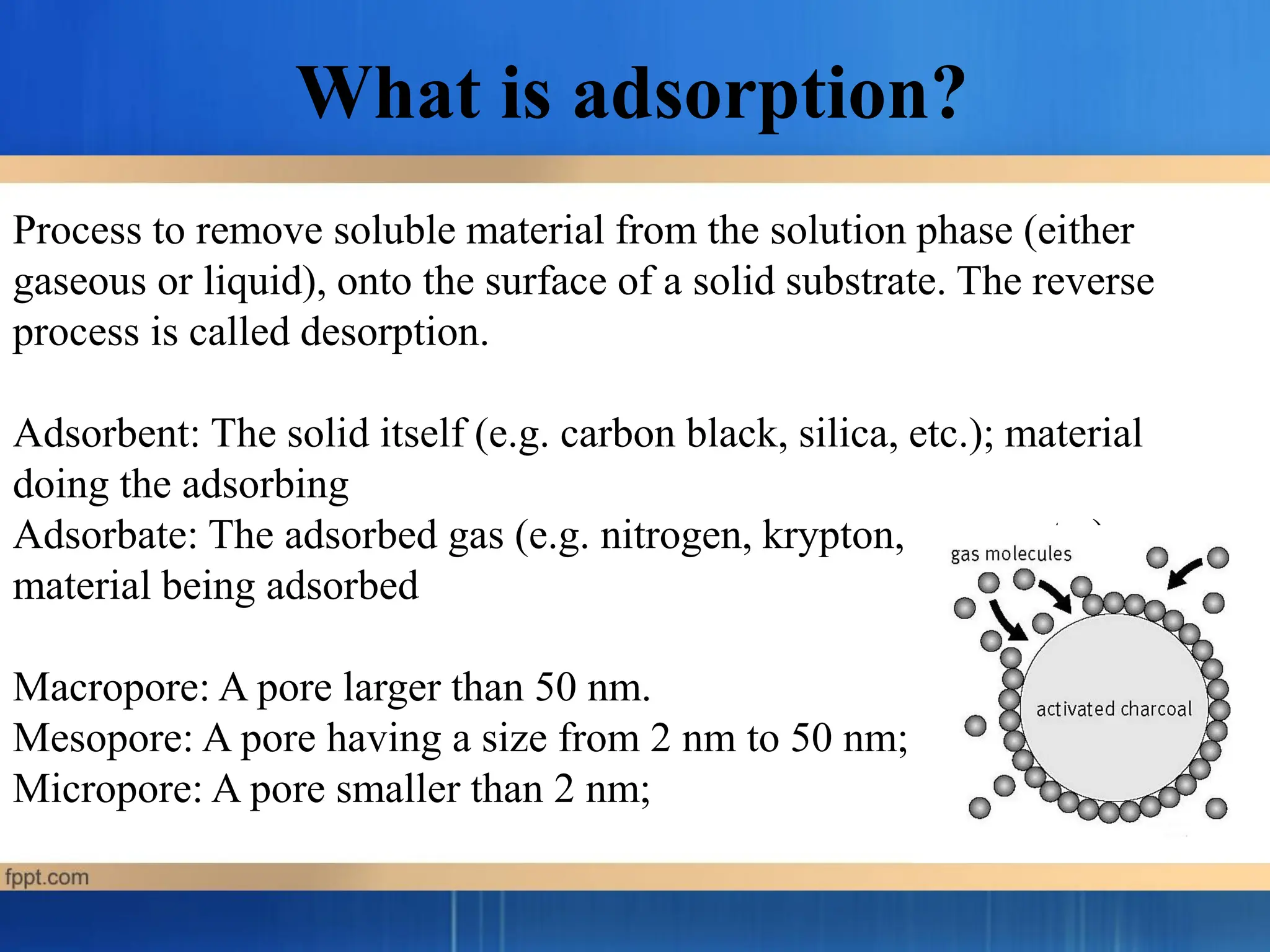
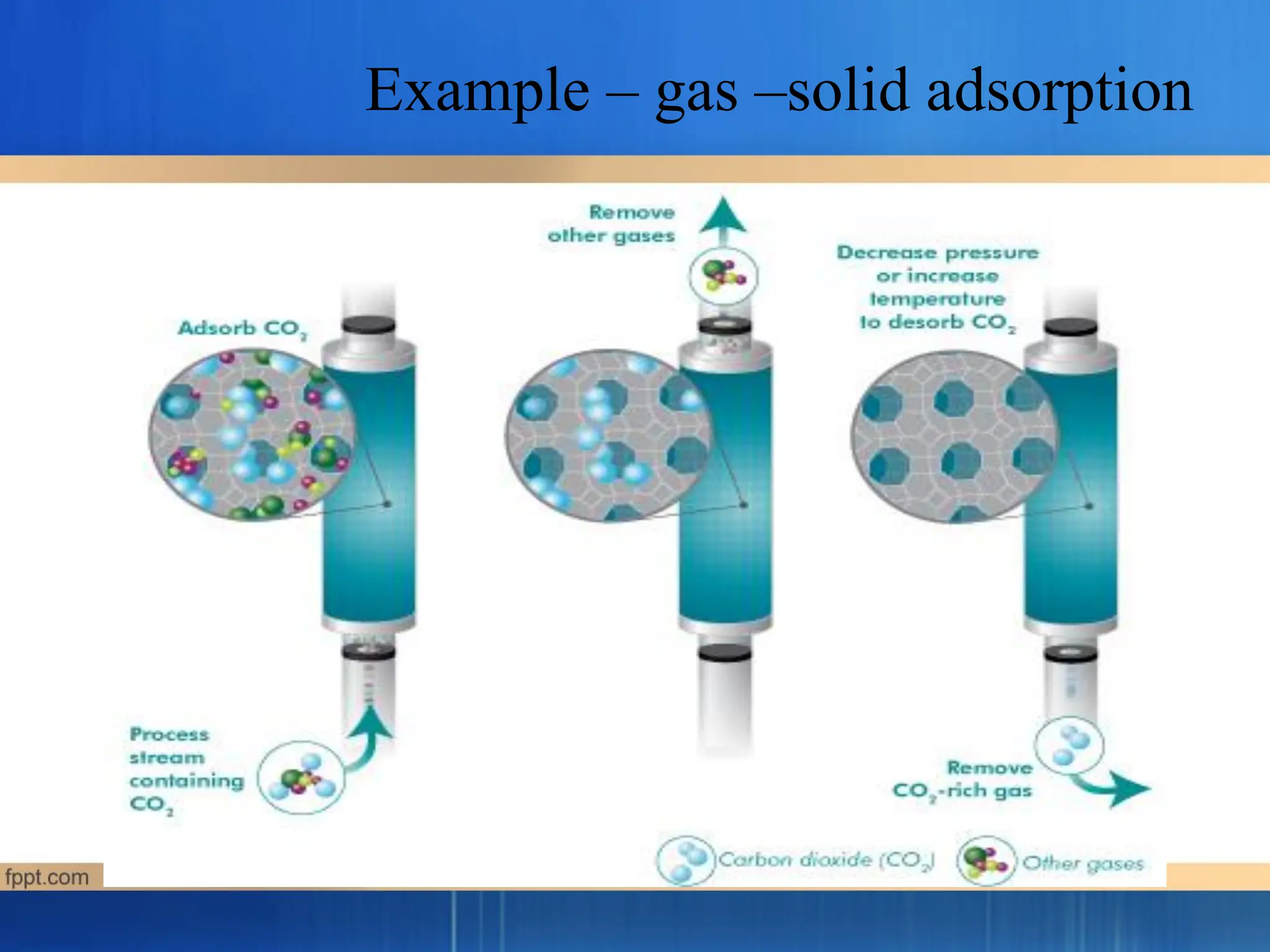
Process to removesoluble material from the solution phase (either
gaseous or liquid), onto the surface of a solid substrate. The reverse
process is called desorption.
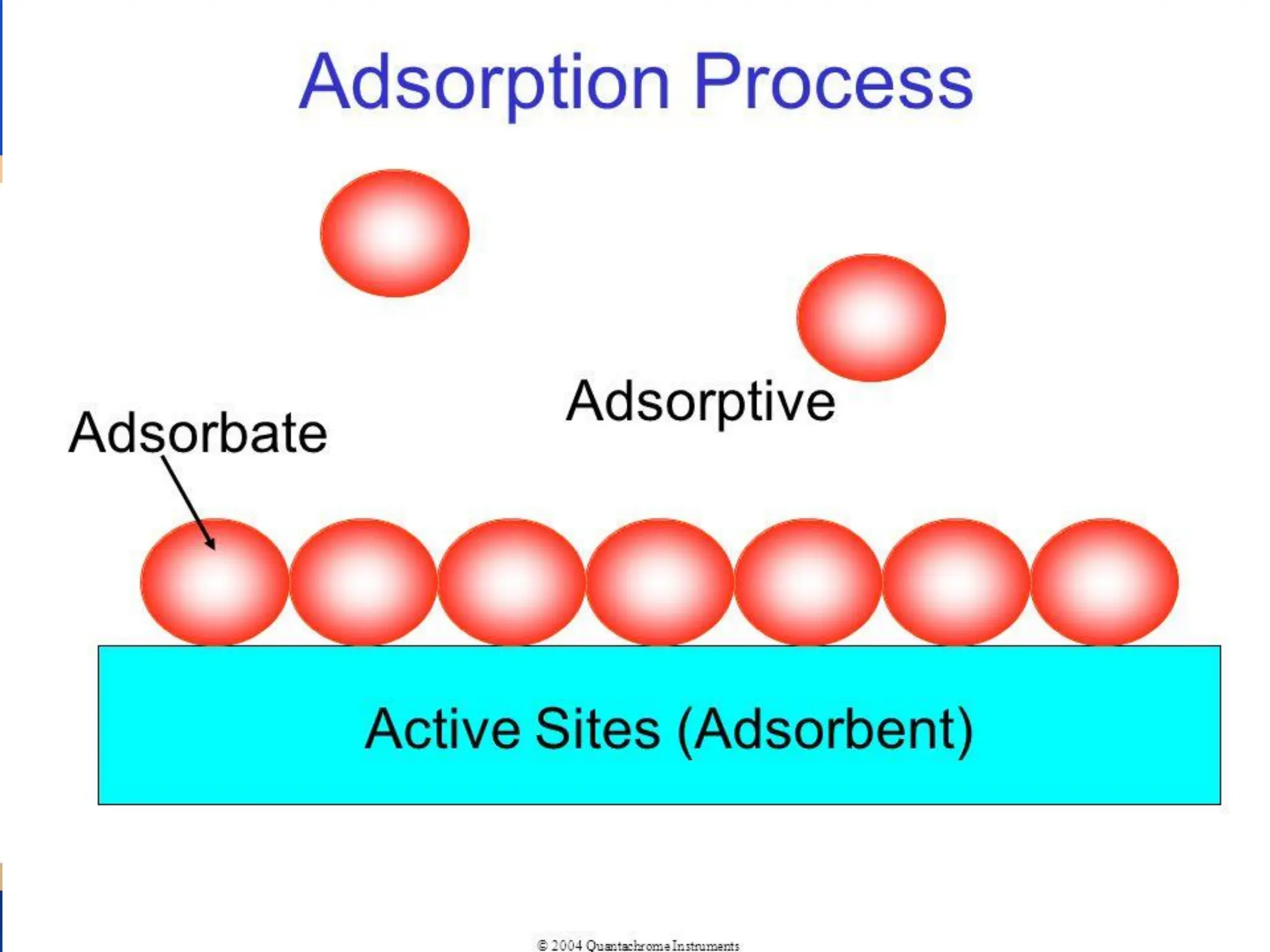
Adsorbent: The solid itself (e.g. carbon black, silica, etc.); material
doing the adsorbing
Adsorbate: The adsorbed gas (e.g. nitrogen, krypton, argon, etc.);
material being adsorbed
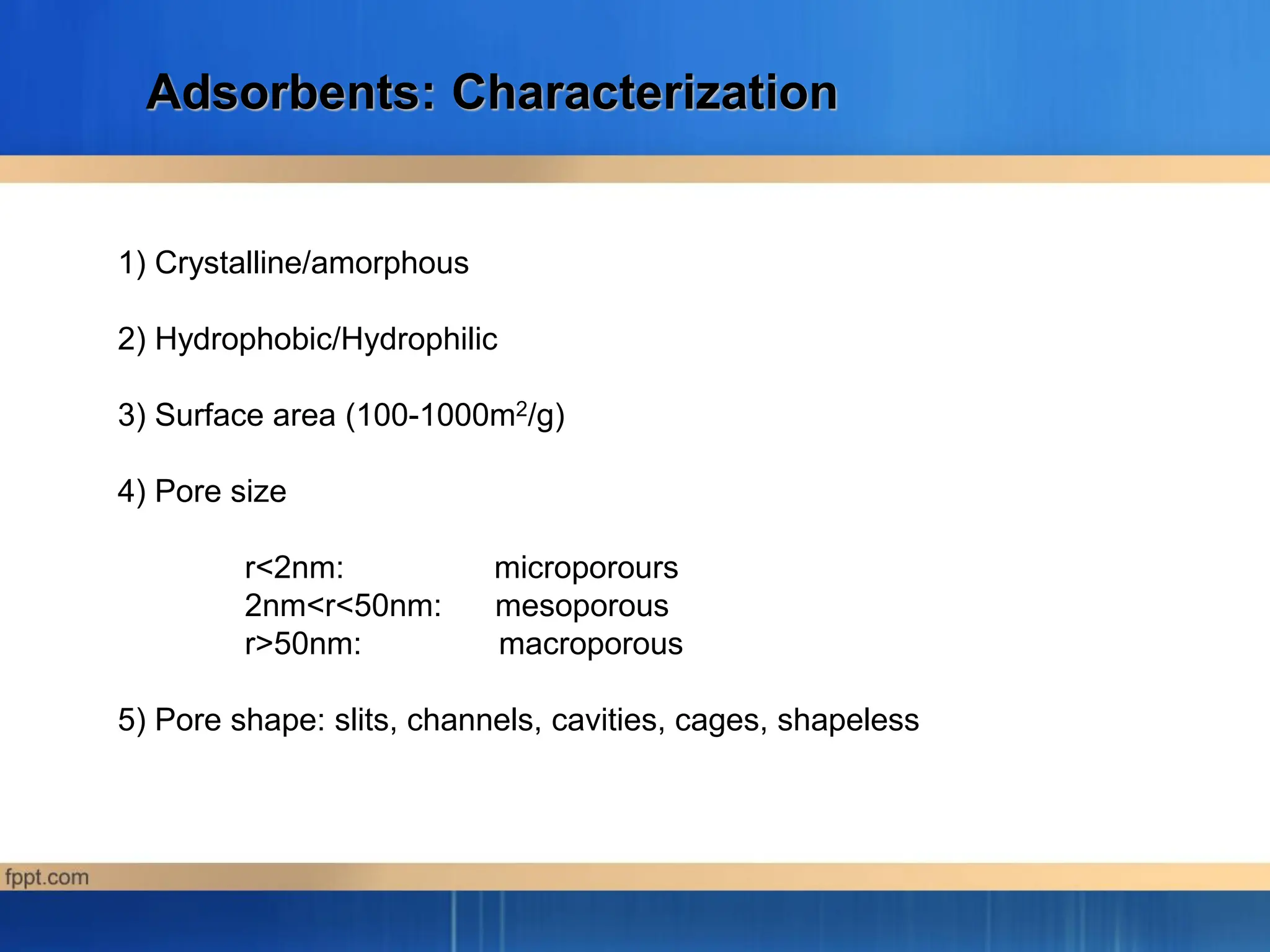
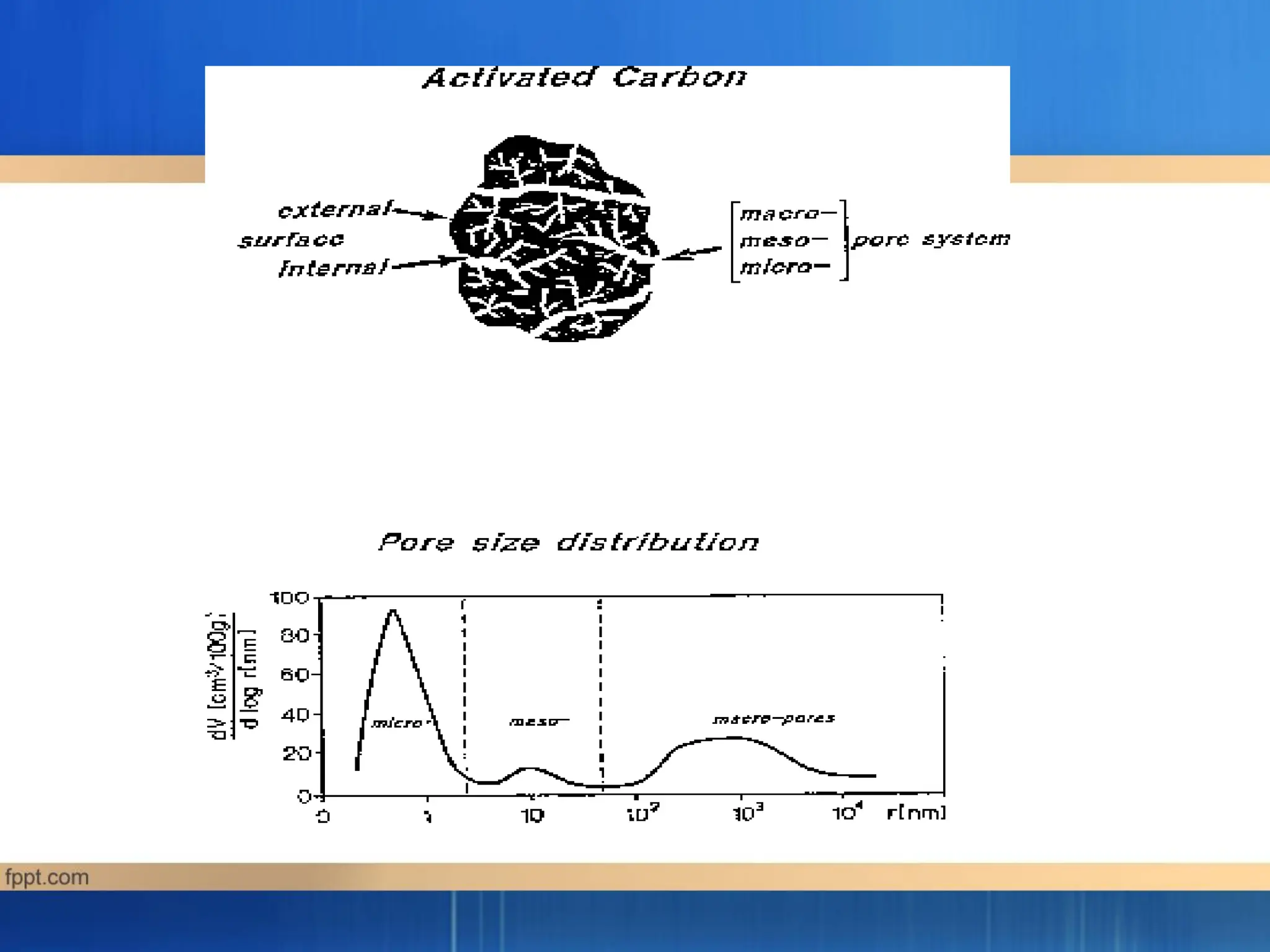
Macropore: A pore larger than 50 nm.
Mesopore: A pore having a size from 2 nm to 50 nm;
Micropore: A pore smaller than 2 nm;
What is adsorption?
6.
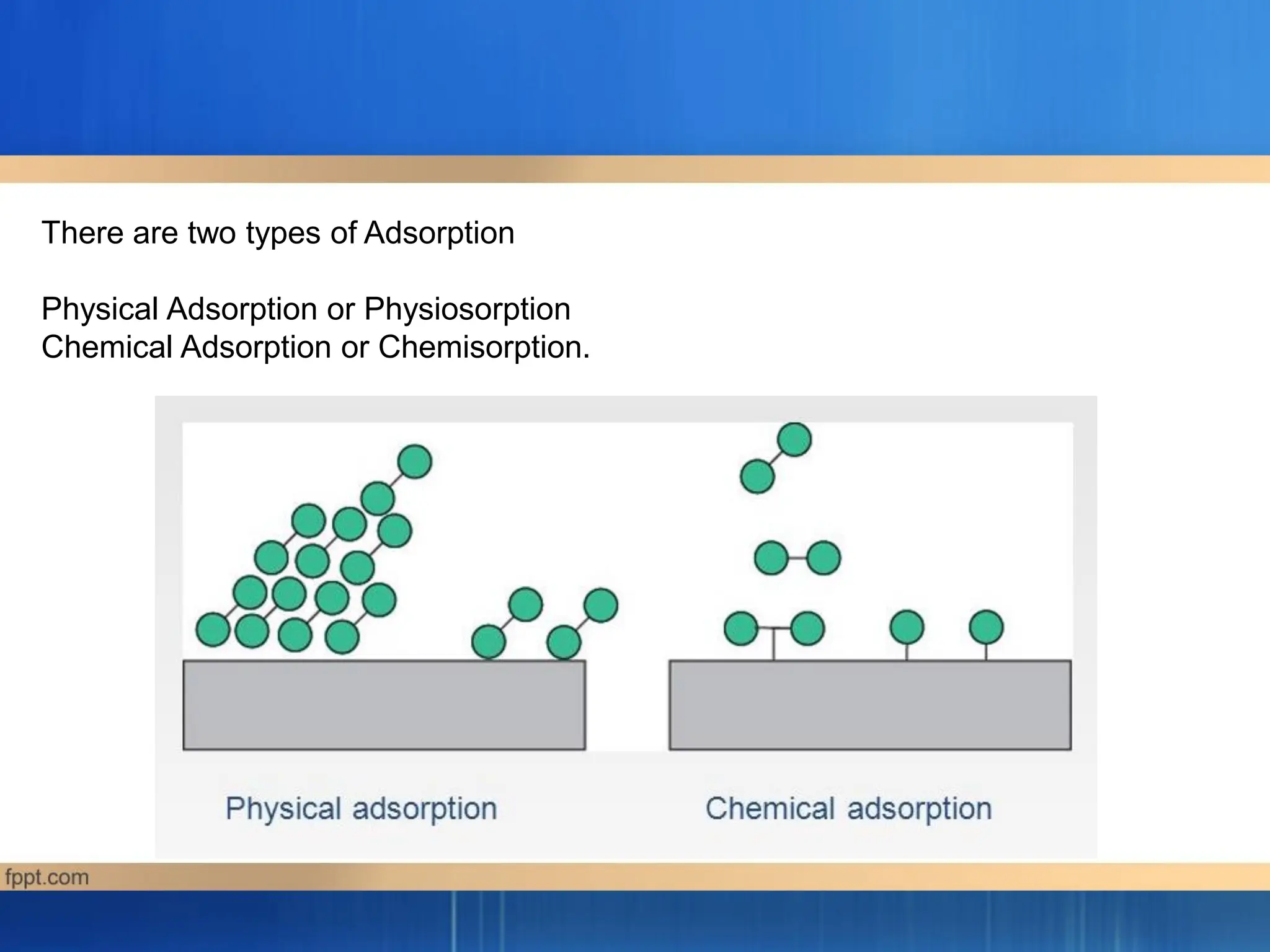
There are twotypes of Adsorption
Physical Adsorption or Physiosorption
Chemical Adsorption or Chemisorption.
7.
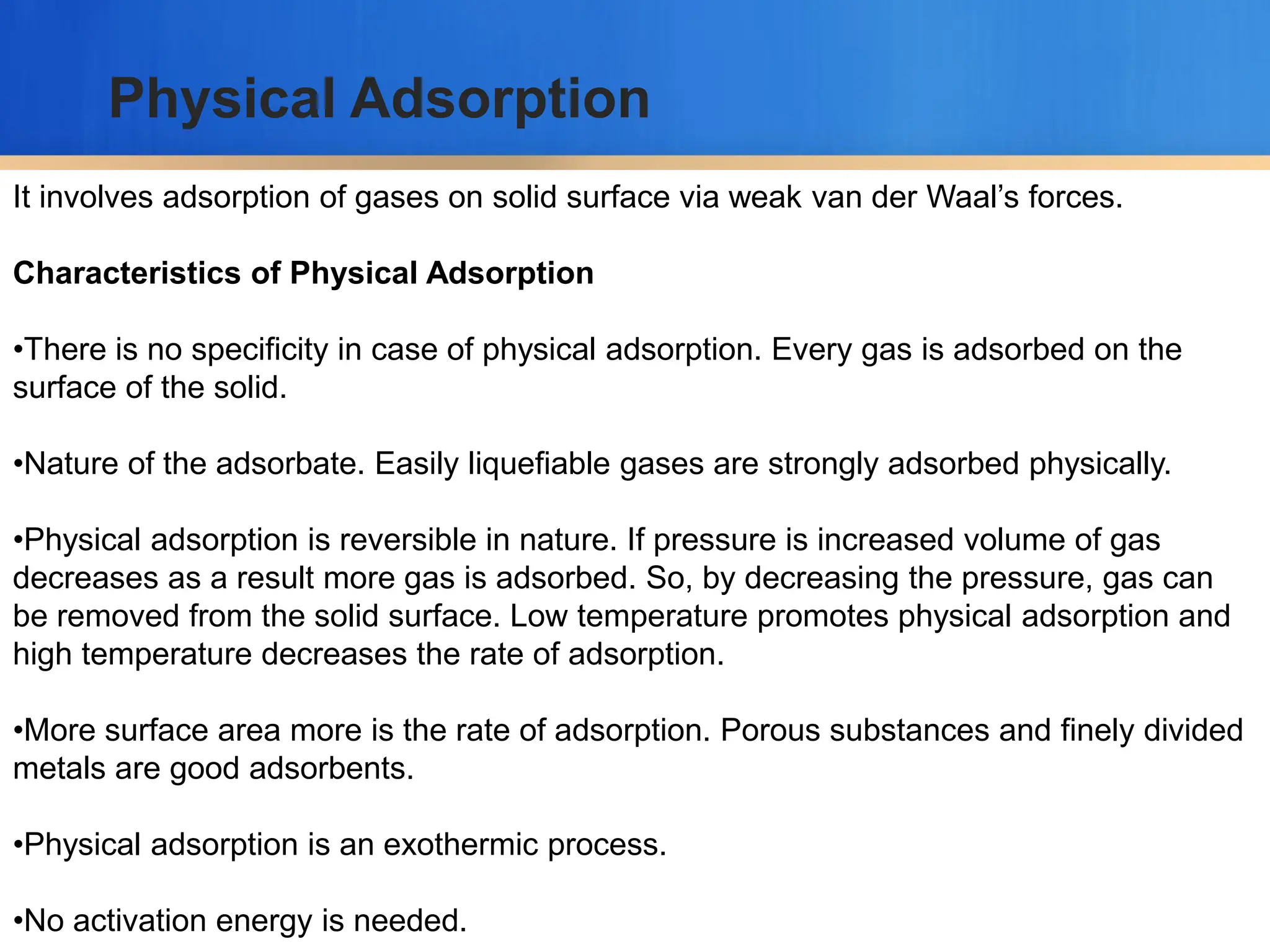
It involves adsorptionof gases on solid surface via weak van der Waal’s forces.
Characteristics of Physical Adsorption
•There is no specificity in case of physical adsorption. Every gas is adsorbed on the
surface of the solid.
•Nature of the adsorbate. Easily liquefiable gases are strongly adsorbed physically.
•Physical adsorption is reversible in nature. If pressure is increased volume of gas
decreases as a result more gas is adsorbed. So, by decreasing the pressure, gas can
be removed from the solid surface. Low temperature promotes physical adsorption and
high temperature decreases the rate of adsorption.
•More surface area more is the rate of adsorption. Porous substances and finely divided
metals are good adsorbents.
•Physical adsorption is an exothermic process.
•No activation energy is needed.
Physical Adsorption
8.
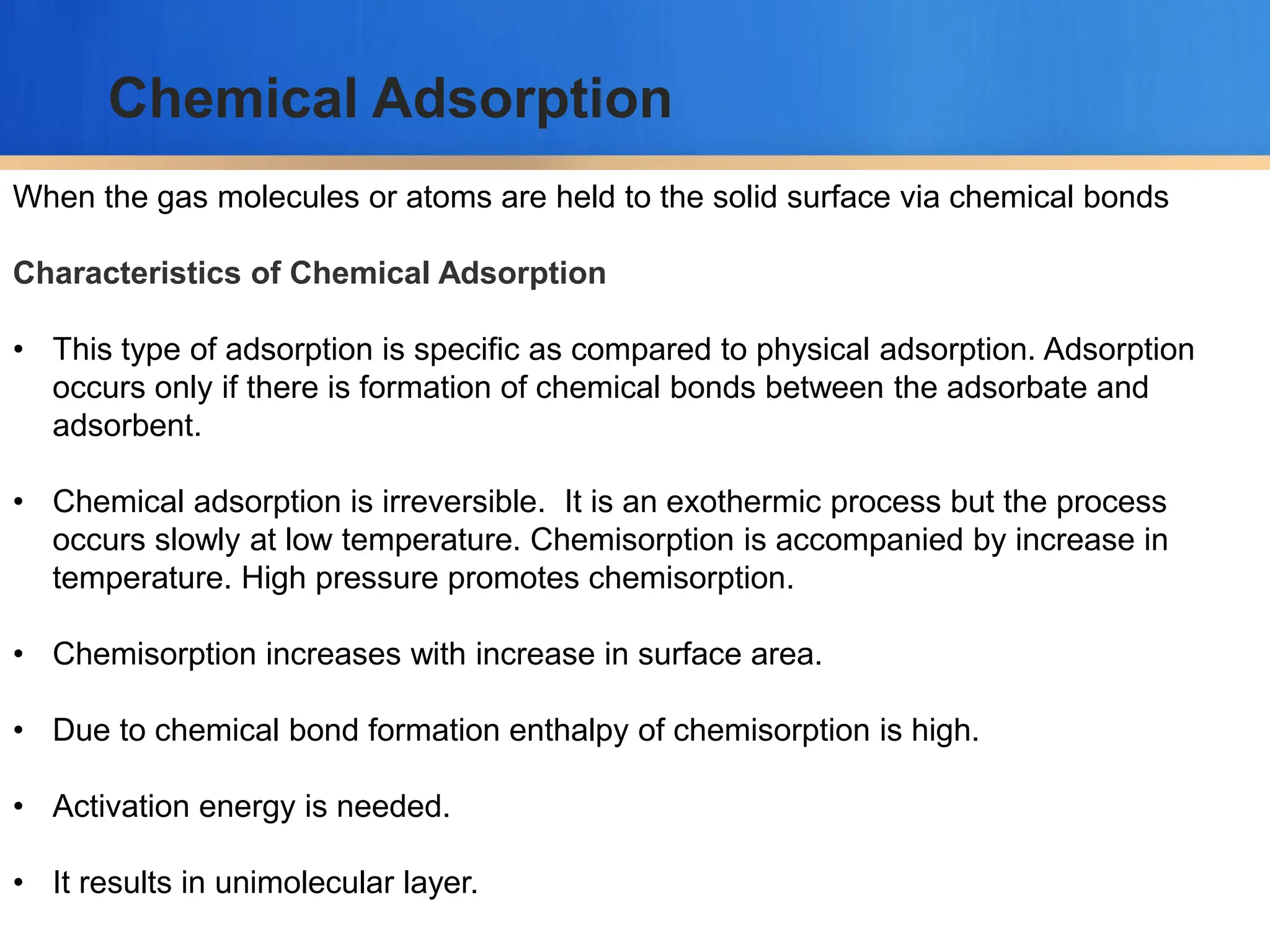
When the gasmolecules or atoms are held to the solid surface via chemical bonds
Characteristics of Chemical Adsorption
• This type of adsorption is specific as compared to physical adsorption. Adsorption
occurs only if there is formation of chemical bonds between the adsorbate and
adsorbent.
• Chemical adsorption is irreversible. It is an exothermic process but the process
occurs slowly at low temperature. Chemisorption is accompanied by increase in
temperature. High pressure promotes chemisorption.
• Chemisorption increases with increase in surface area.
• Due to chemical bond formation enthalpy of chemisorption is high.
• Activation energy is needed.
• It results in unimolecular layer.
Chemical Adsorption
9.
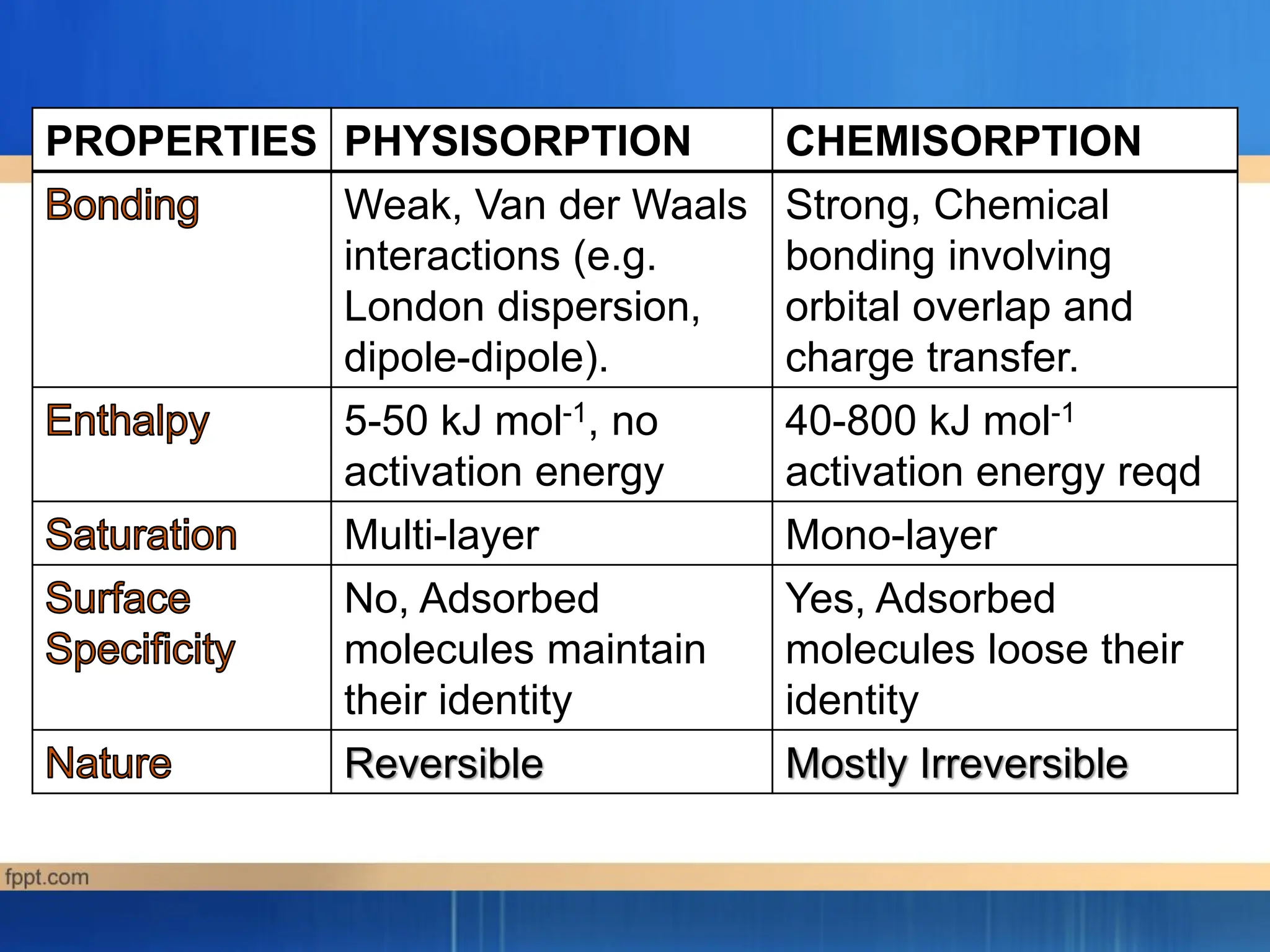
PROPERTIES PHYSISORPTION CHEMISORPTION
Weak,Van der Waals
interactions (e.g.
London dispersion,
dipole-dipole).
Strong, Chemical
bonding involving
orbital overlap and
charge transfer.
5-50 kJ mol-1, no
activation energy
40-800 kJ mol-1
activation energy reqd
Multi-layer Mono-layer
No, Adsorbed
molecules maintain
their identity
Yes, Adsorbed
molecules loose their
identity
Reversible Mostly Irreversible
10.
10
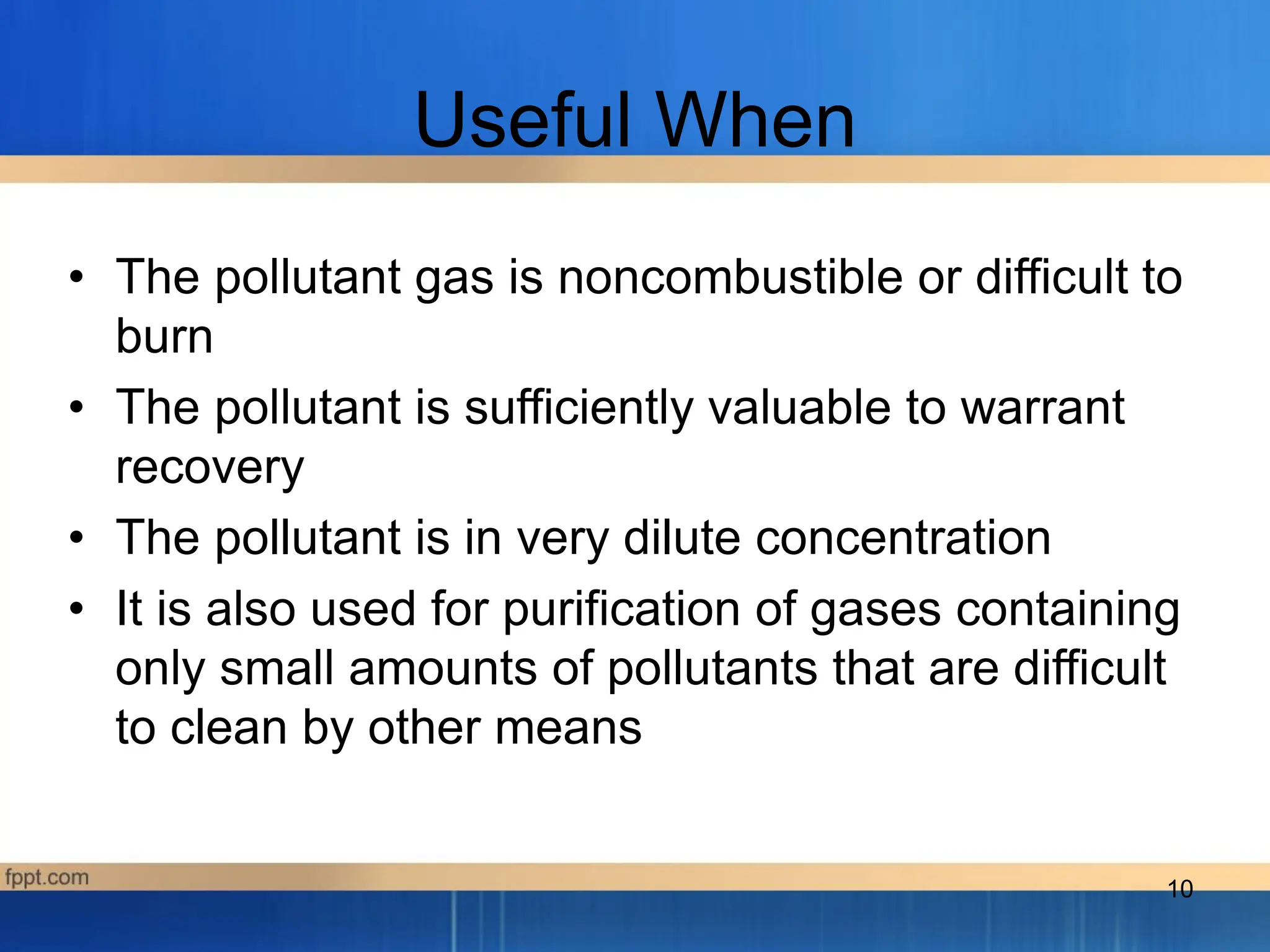
Useful When
• Thepollutant gas is noncombustible or difficult to
burn
• The pollutant is sufficiently valuable to warrant
recovery
• The pollutant is in very dilute concentration
• It is also used for purification of gases containing
only small amounts of pollutants that are difficult
to clean by other means
11.
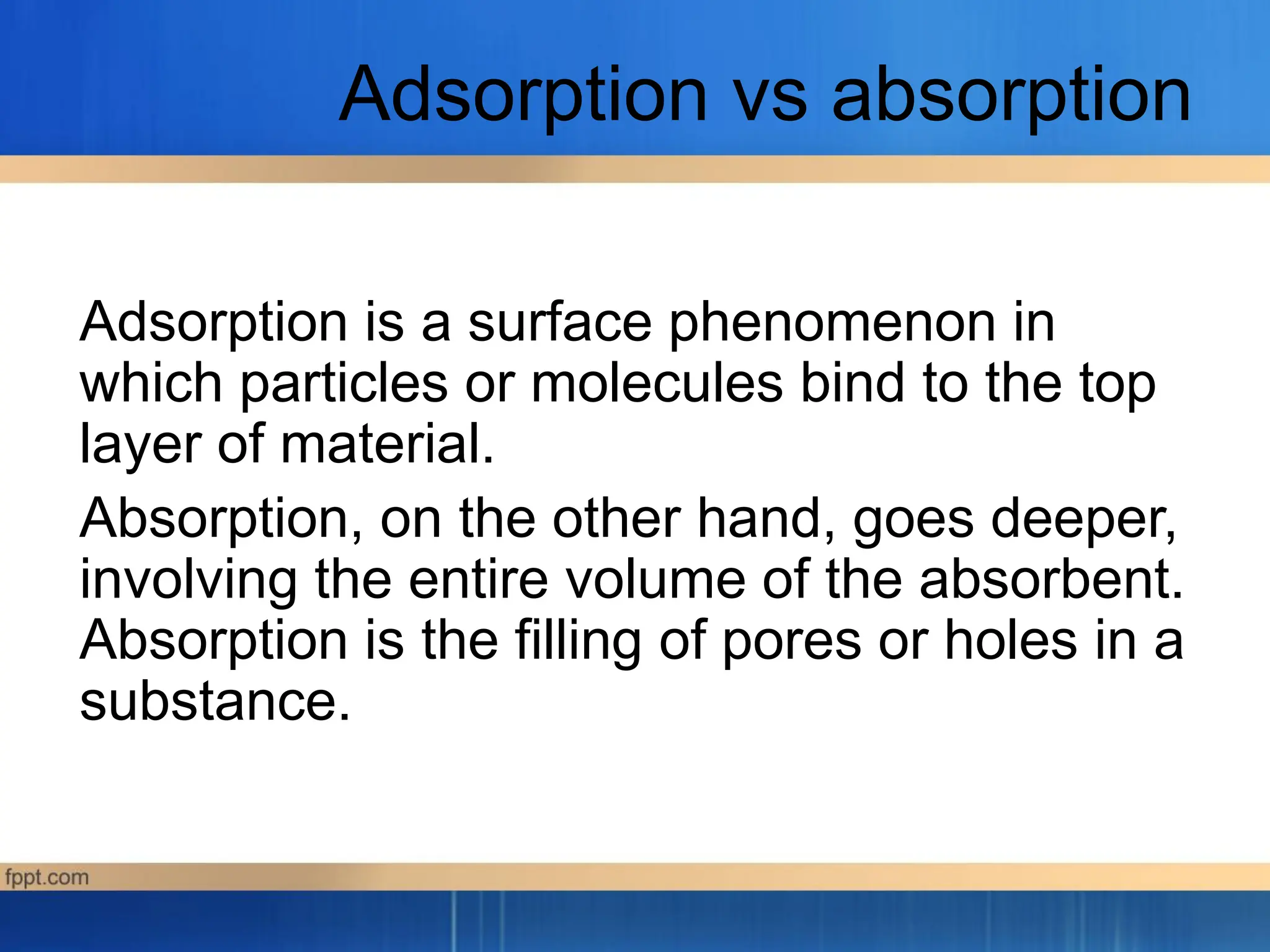
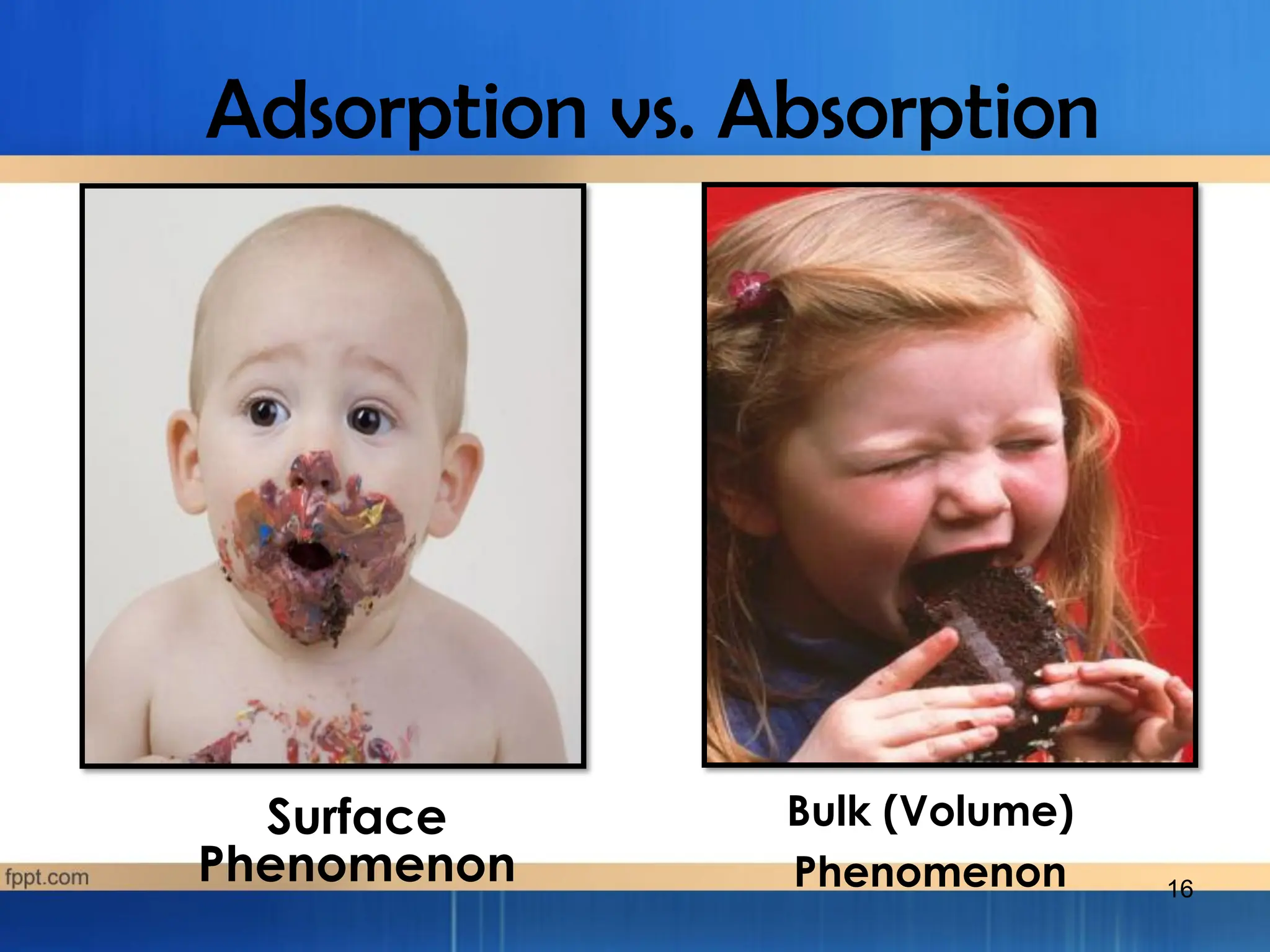
Adsorption vs absorption
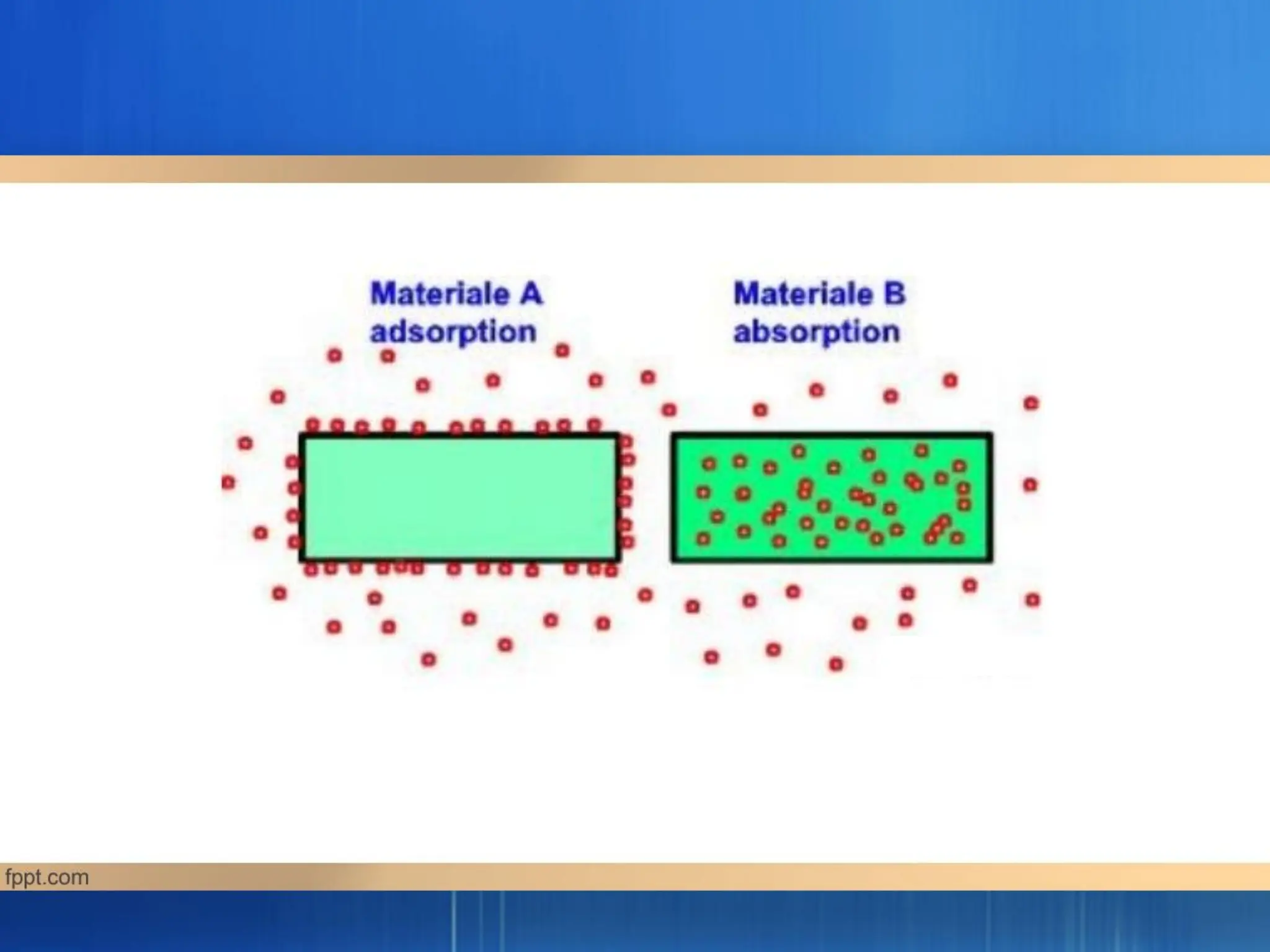
Adsorptionis a surface phenomenon in
which particles or molecules bind to the top
layer of material.
Absorption, on the other hand, goes deeper,
involving the entire volume of the absorbent.
Absorption is the filling of pores or holes in a
substance.
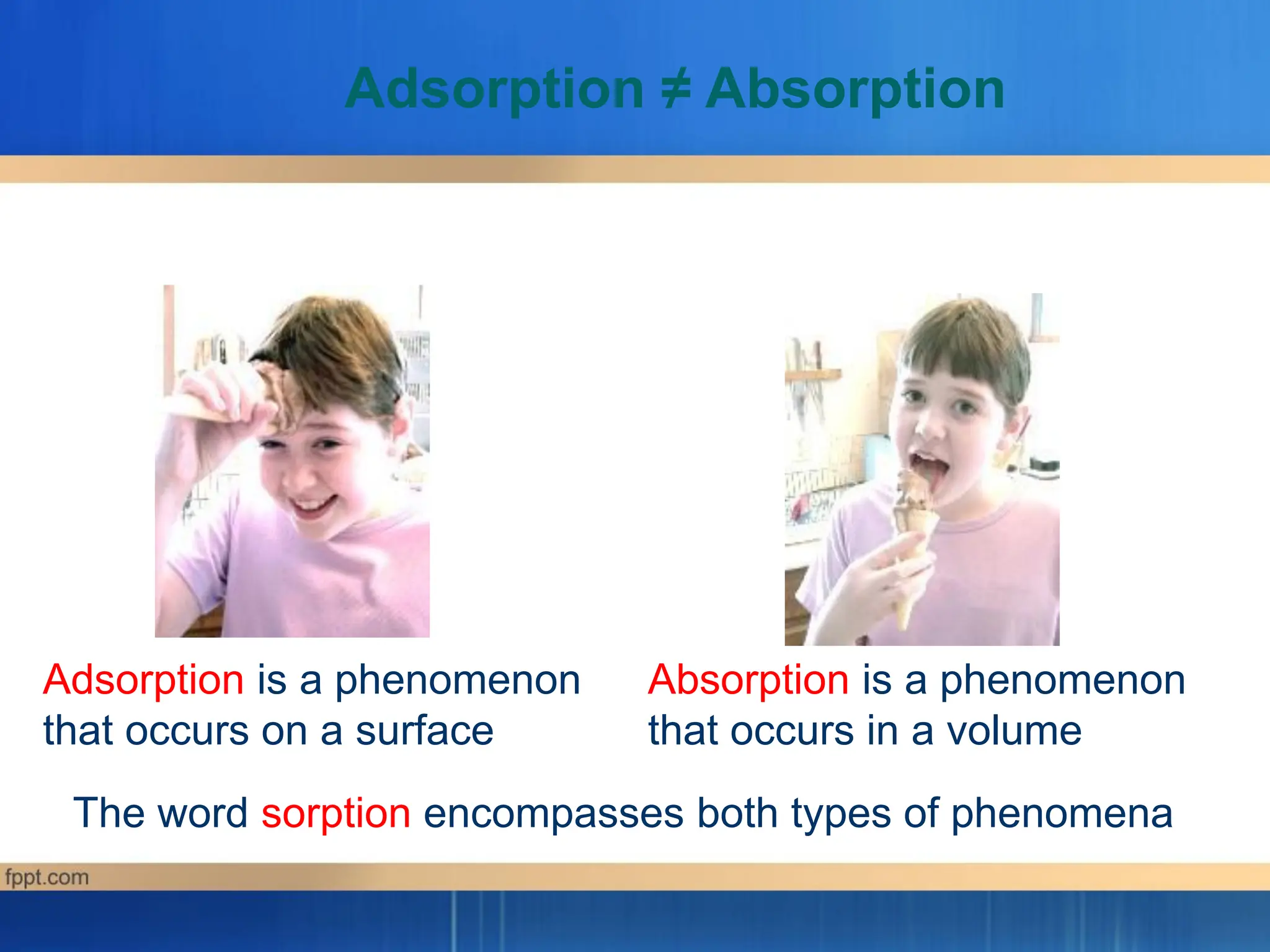
The word sorptionencompasses both types of phenomena
Adsorption ≠ Absorption
Adsorption is a phenomenon
that occurs on a surface
Absorption is a phenomenon
that occurs in a volume
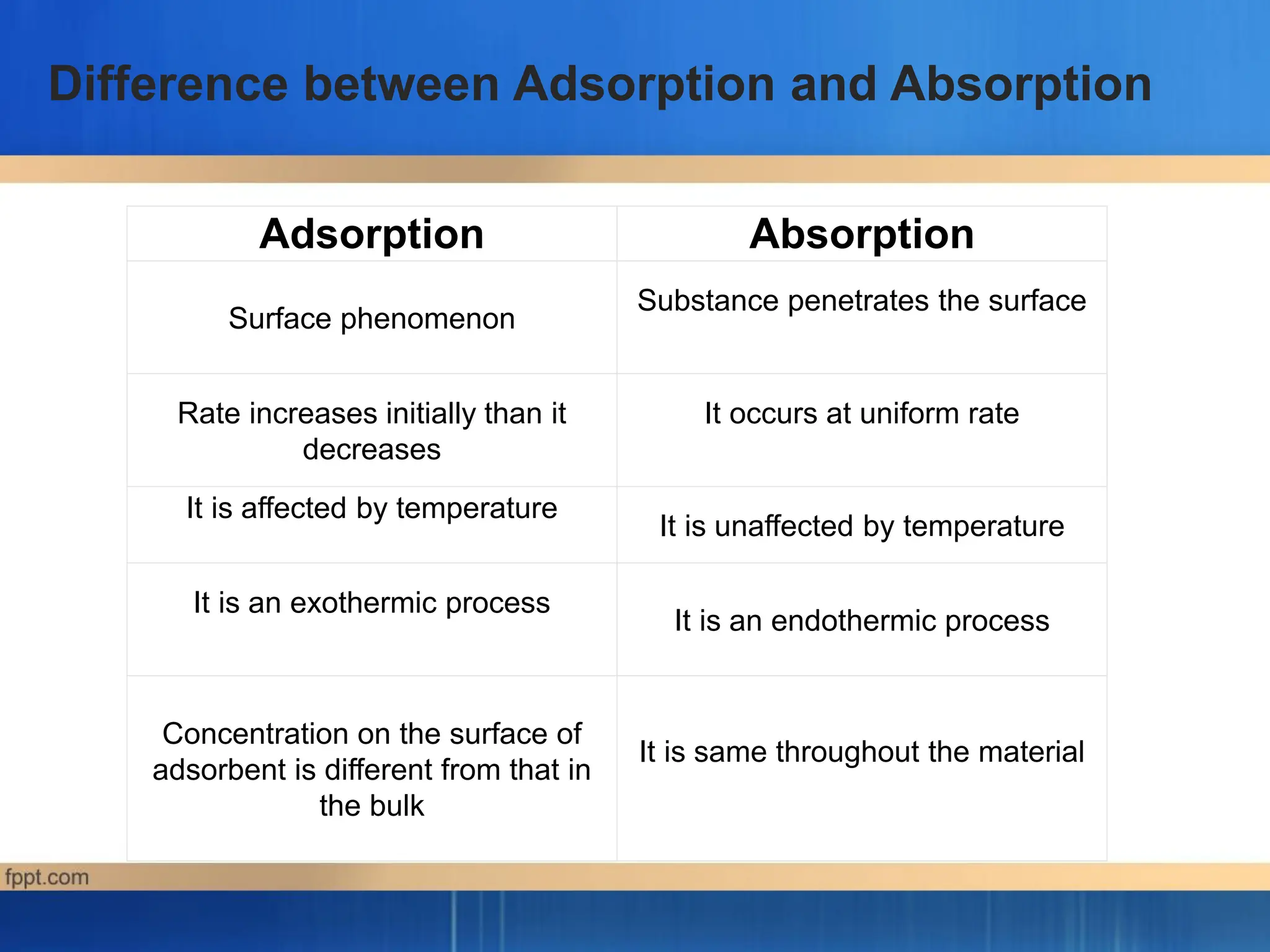
Adsorption Absorption
Surface phenomenon
Substancepenetrates the surface
Rate increases initially than it
decreases
It occurs at uniform rate
It is affected by temperature
It is unaffected by temperature
It is an exothermic process
It is an endothermic process
Concentration on the surface of
adsorbent is different from that in
the bulk
It is same throughout the material
Difference between Adsorption and Absorption
18.
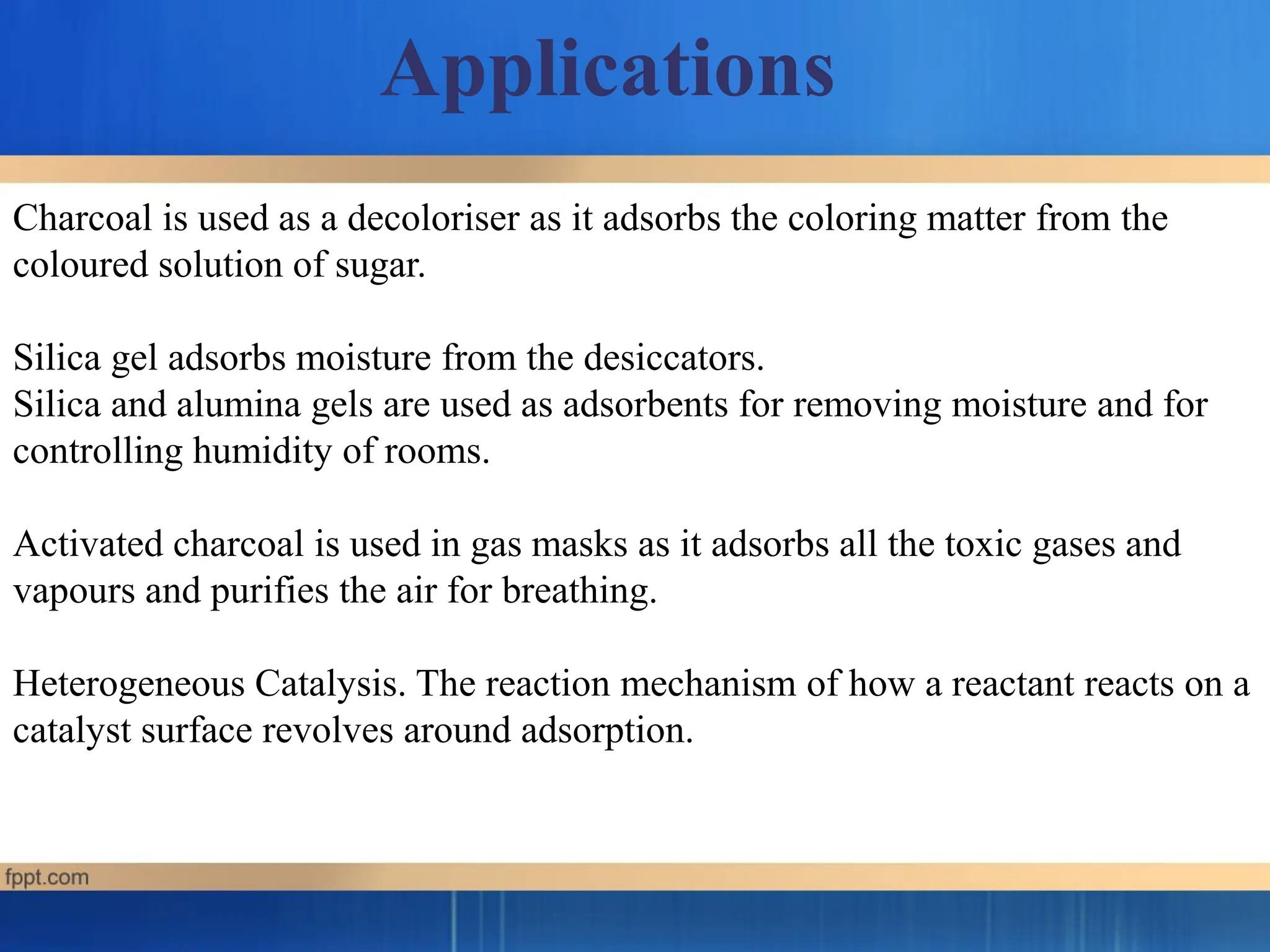
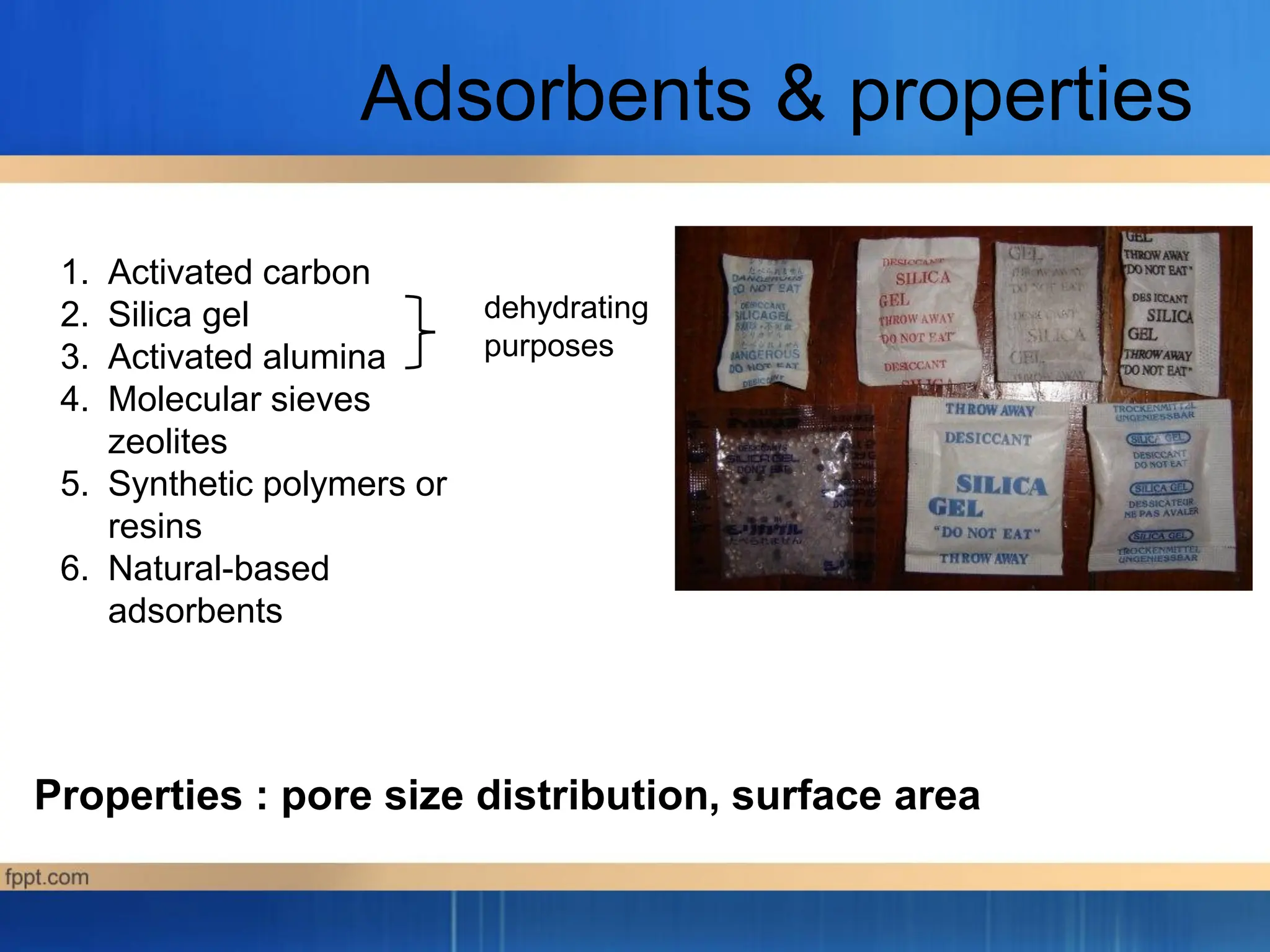
Charcoal is usedas a decoloriser as it adsorbs the coloring matter from the
coloured solution of sugar.
Silica gel adsorbs moisture from the desiccators.
Silica and alumina gels are used as adsorbents for removing moisture and for
controlling humidity of rooms.
Activated charcoal is used in gas masks as it adsorbs all the toxic gases and
vapours and purifies the air for breathing.
Heterogeneous Catalysis. The reaction mechanism of how a reactant reacts on a
catalyst surface revolves around adsorption.
Applications
19.
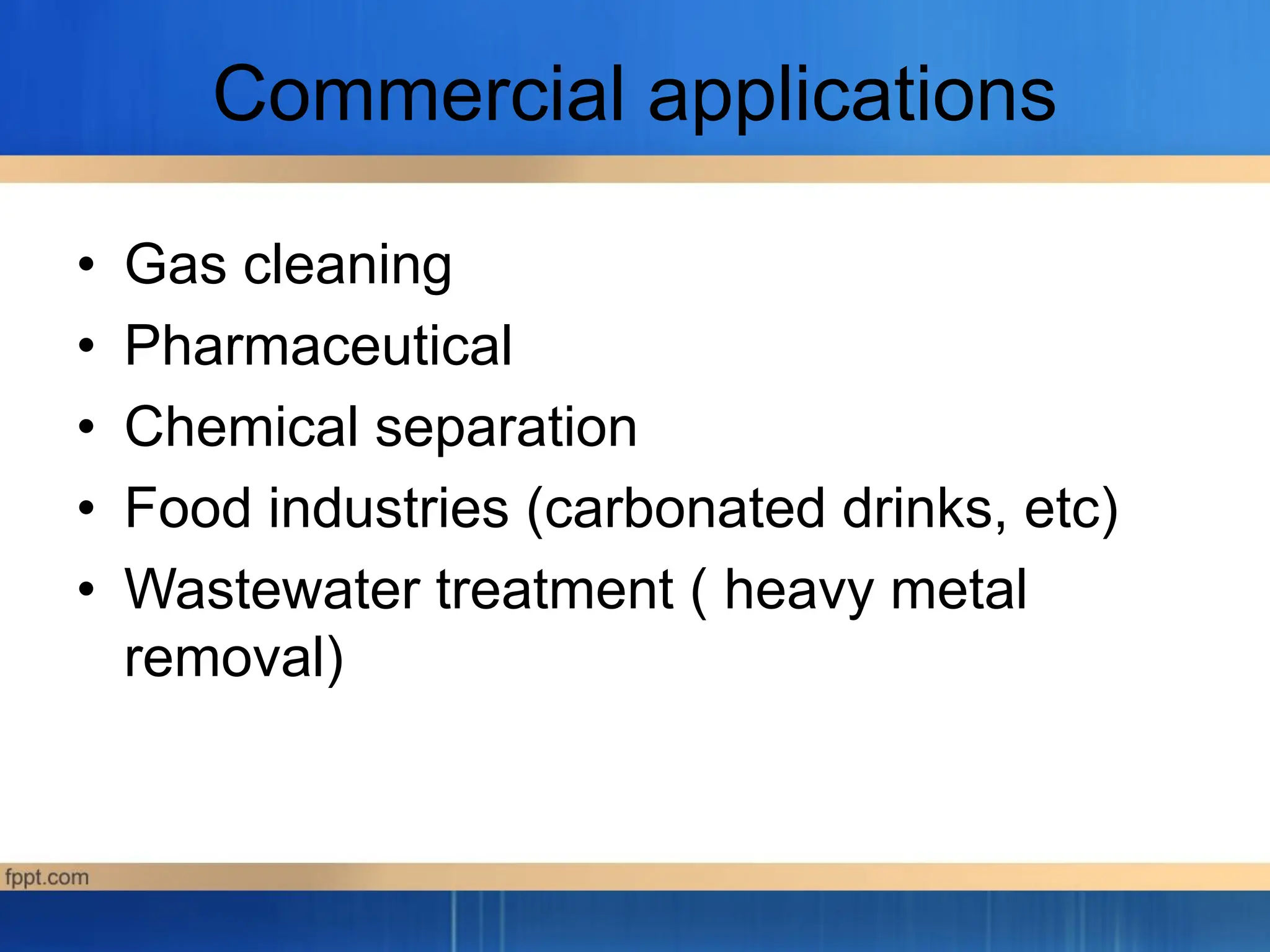
Commercial applications
• Gascleaning
• Pharmaceutical
• Chemical separation
• Food industries (carbonated drinks, etc)
• Wastewater treatment ( heavy metal
removal)
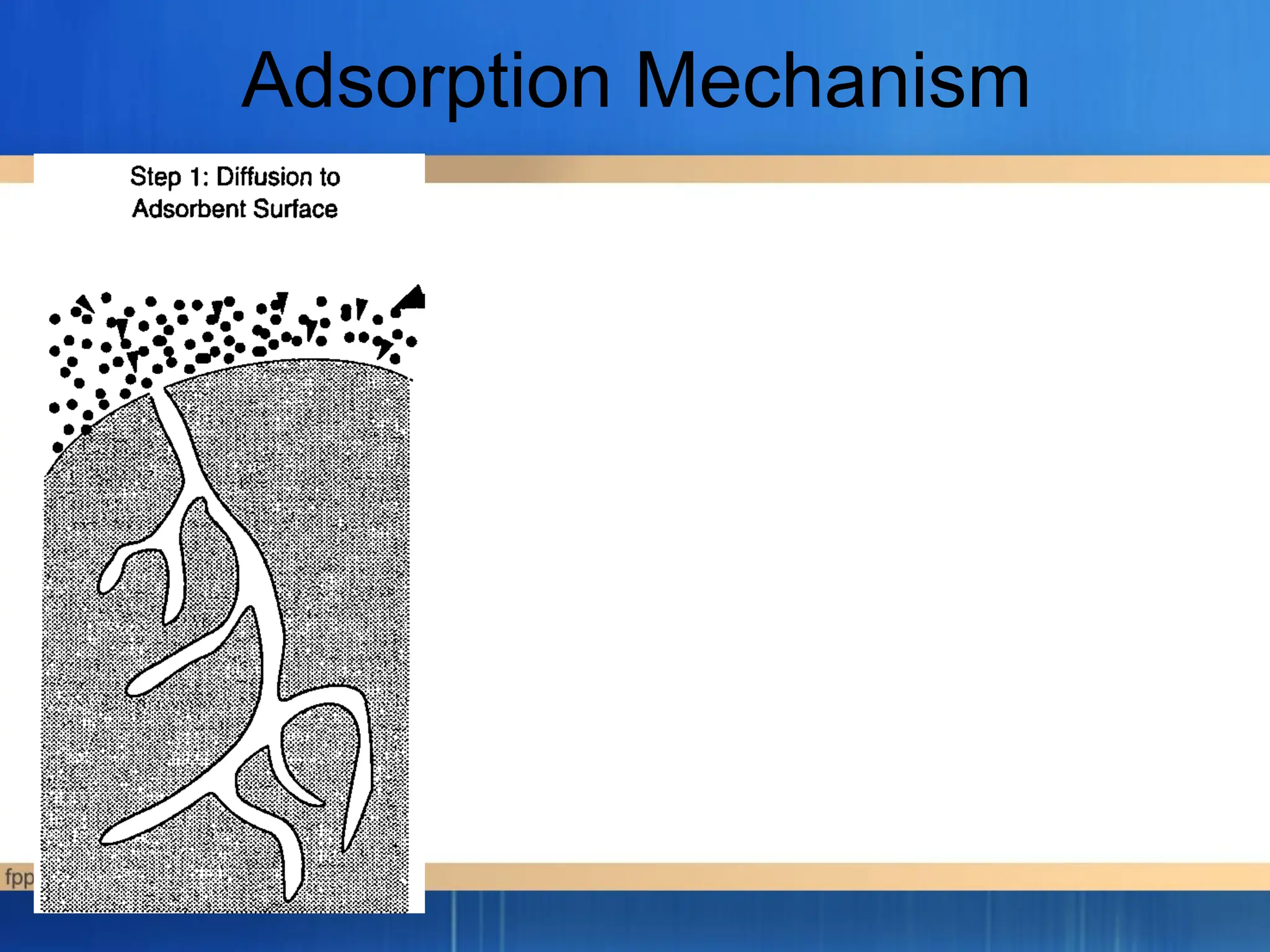
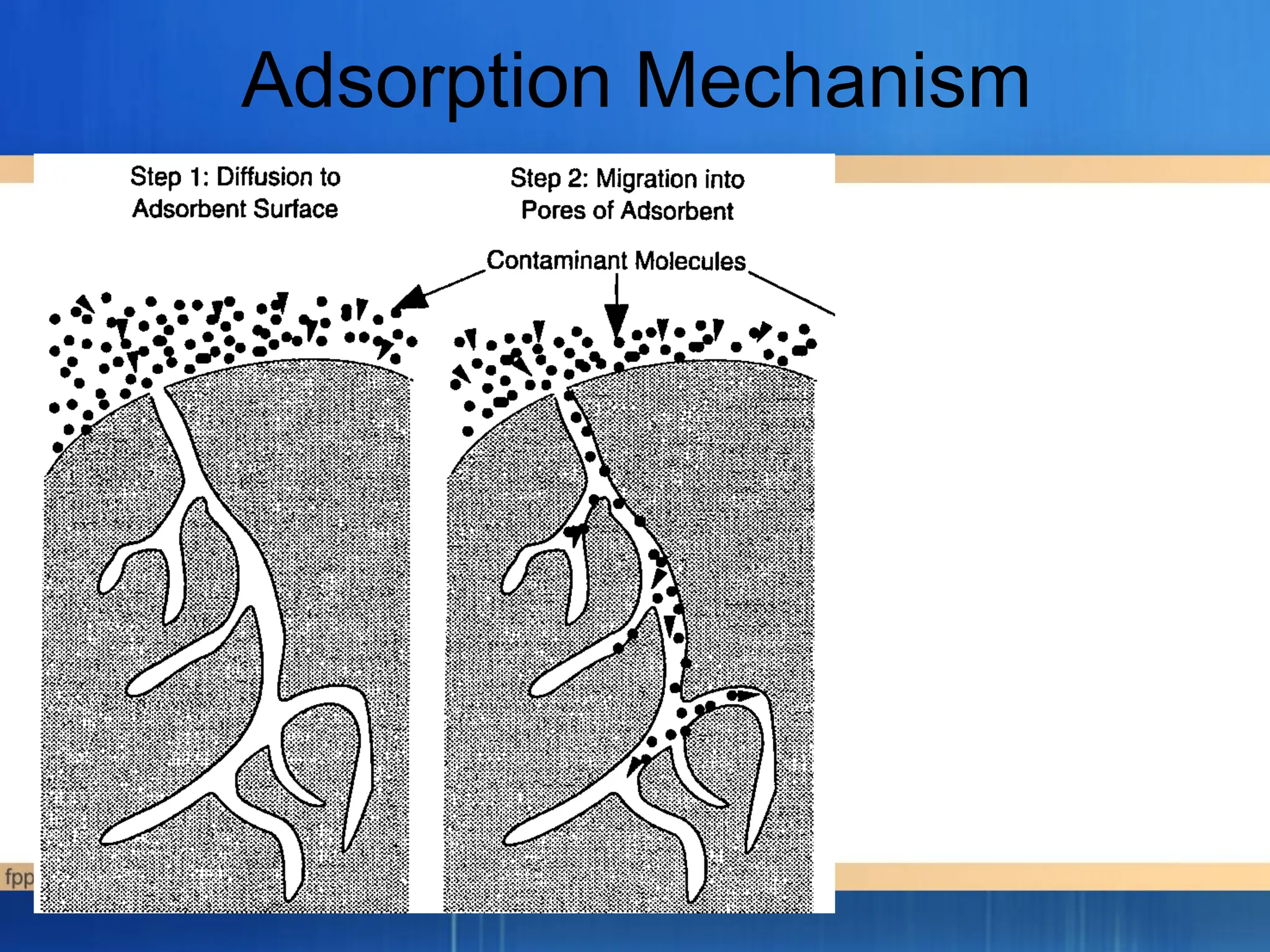
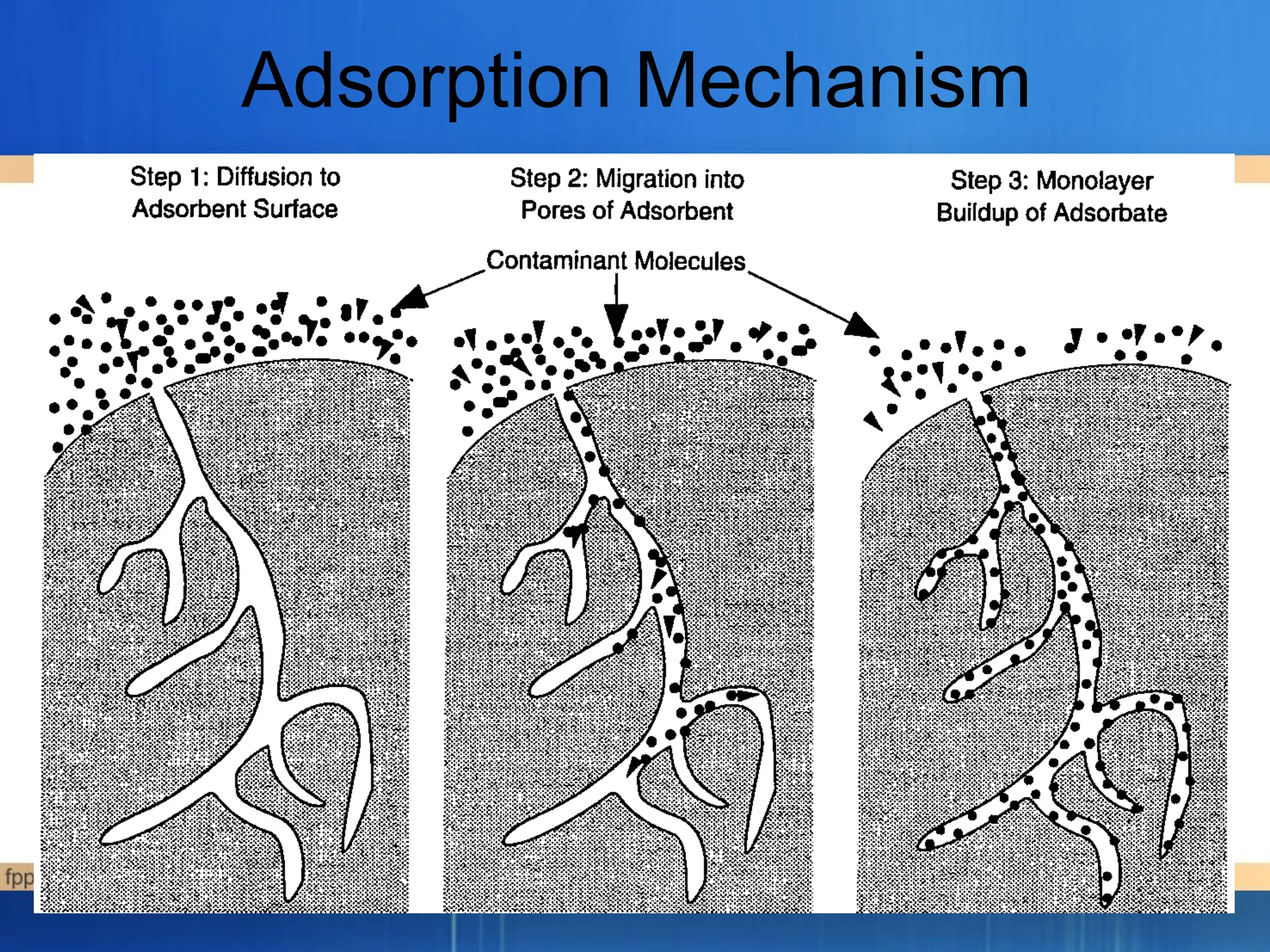
Adsorption Mechanism
– 2)Chemical adsorption
• Results from a chemical interaction between the
adsorbate and adsorbent. Therefore formed bond
is much stronger than that for physical adsorption
• Heat liberated during chemisorption is in the range
of 20-400 kj/g mole
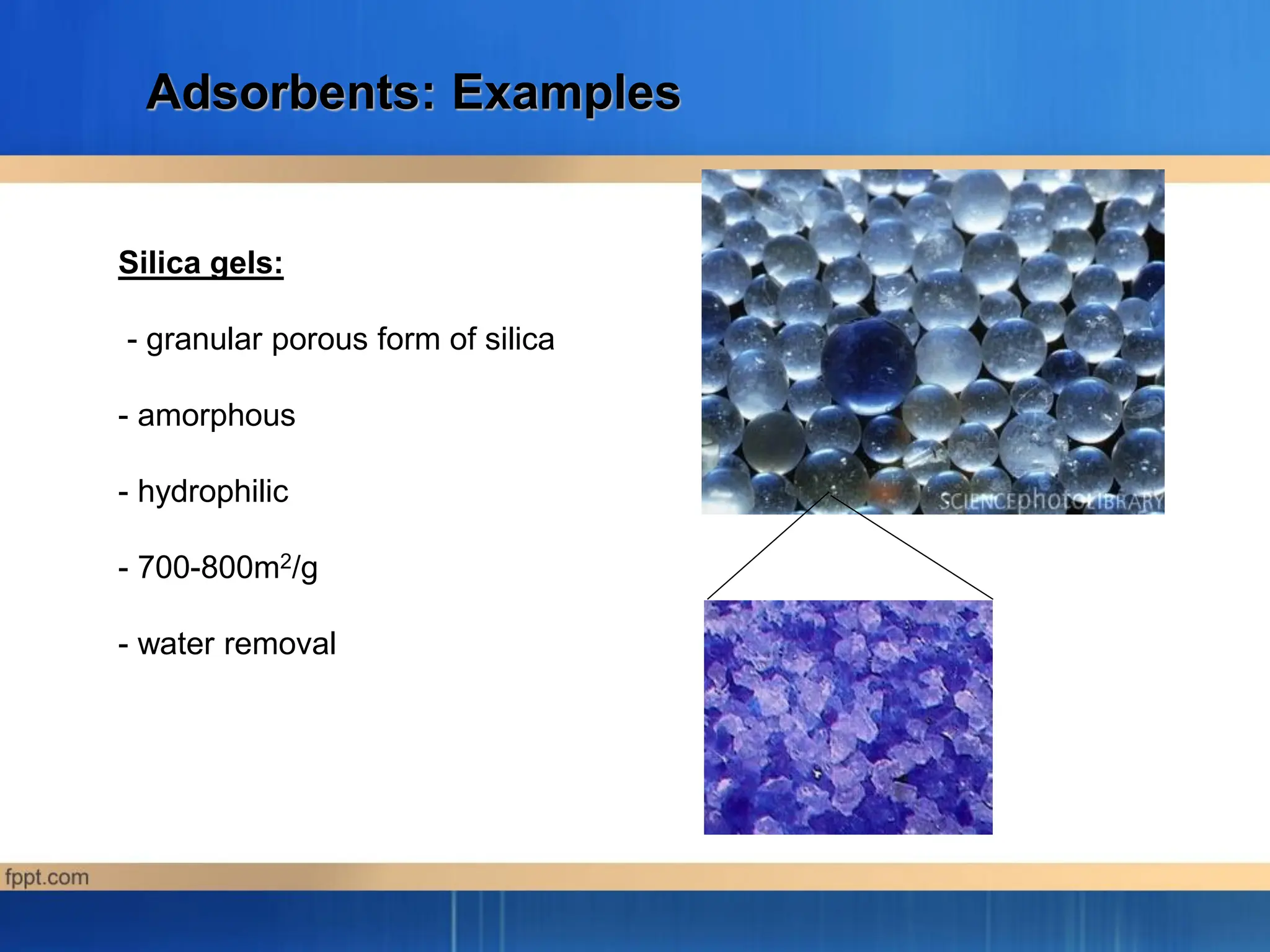
Adsorbents: Examples
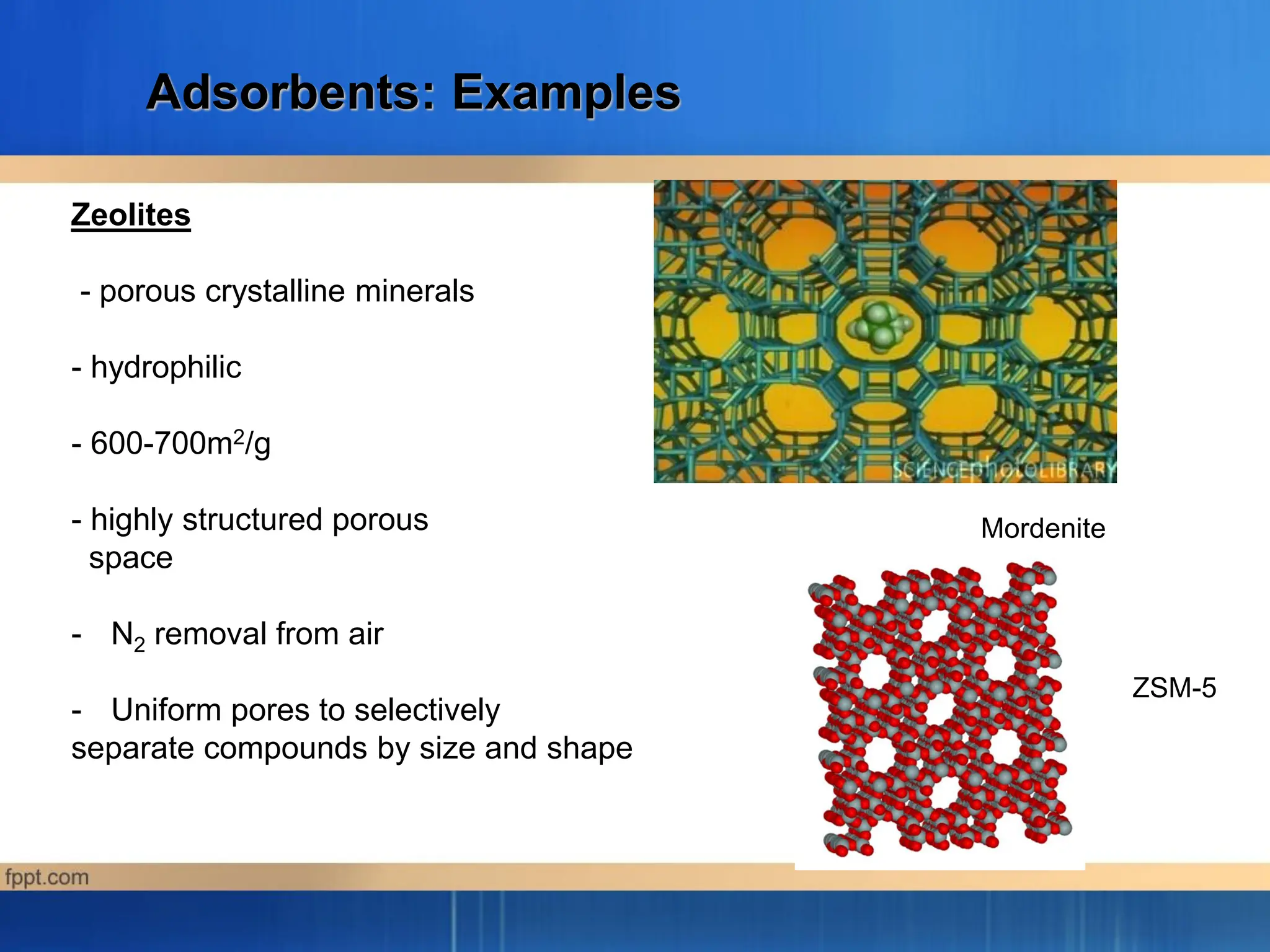
Zeolites
- porouscrystalline minerals
- hydrophilic
- 600-700m2/g
- highly structured porous
space
- N2 removal from air
- Uniform pores to selectively
separate compounds by size and shape
Mordenite
ZSM-5
29.
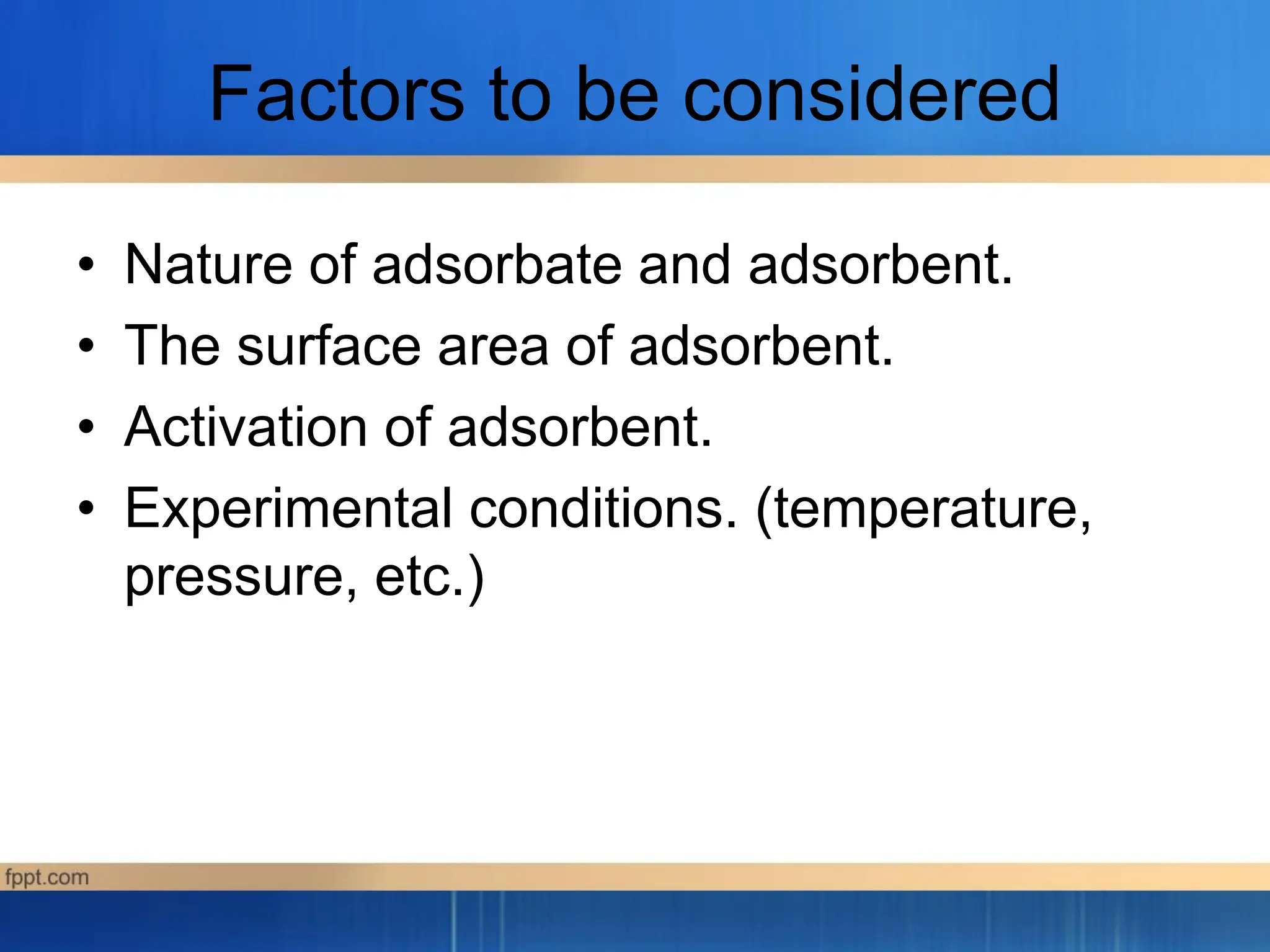
Factors to beconsidered
• Nature of adsorbate and adsorbent.
• The surface area of adsorbent.
• Activation of adsorbent.
• Experimental conditions. (temperature,
pressure, etc.)
30.
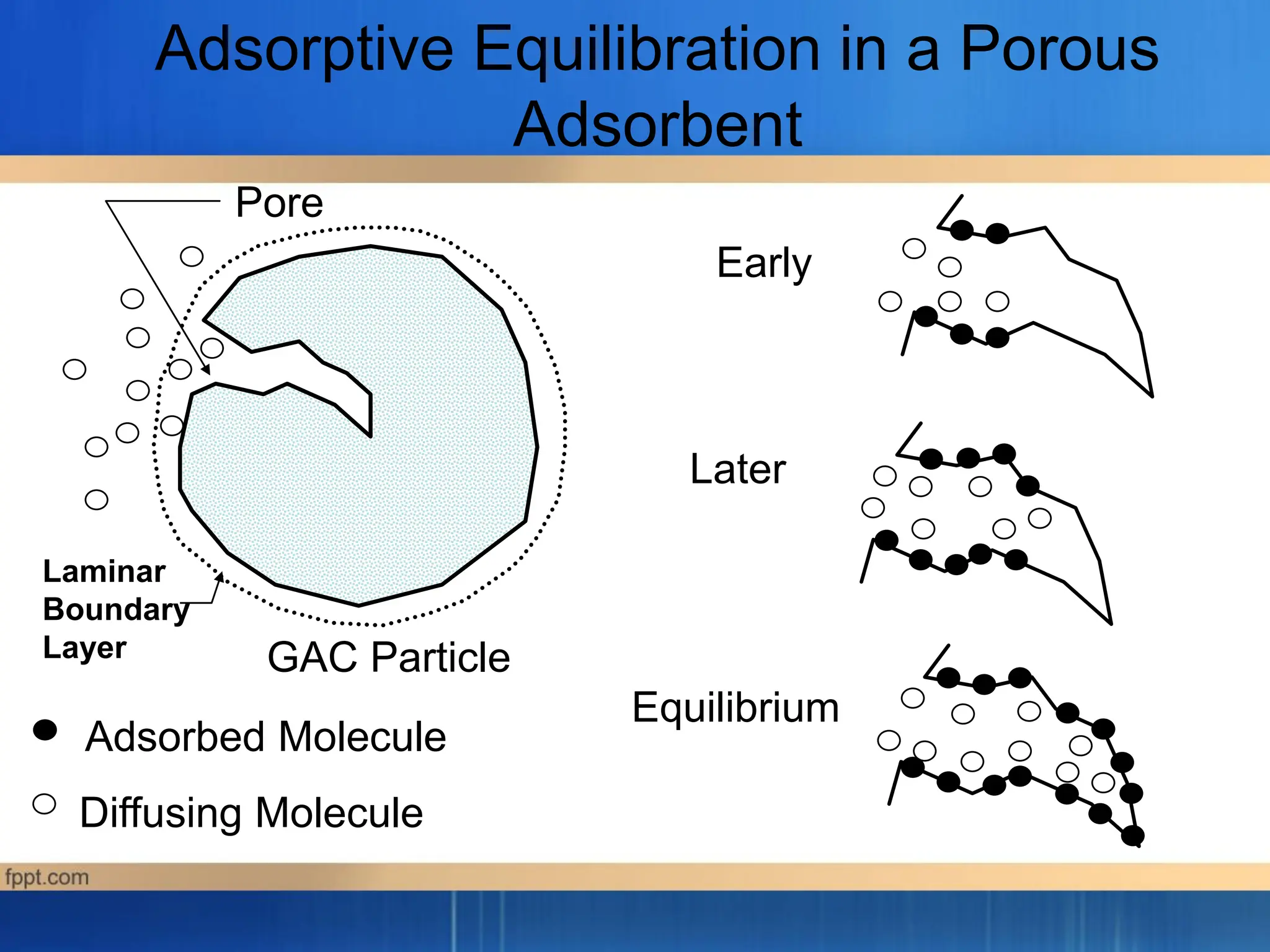
Adsorptive Equilibration ina Porous
Adsorbent
Adsorbed Molecule
Diffusing Molecule
Equilibrium
Pore
GAC Particle
Early
Later
Laminar
Boundary
Layer
31.
If the adsorbentand adsorbate are contacted long enough
an equilibrium will be established between the amount of
adsorbate adsorbed and the amount of adsorbate in solution.
The equilibrium relationship is described by isotherms.
ADSORPTION EQUILIBRIA
32.
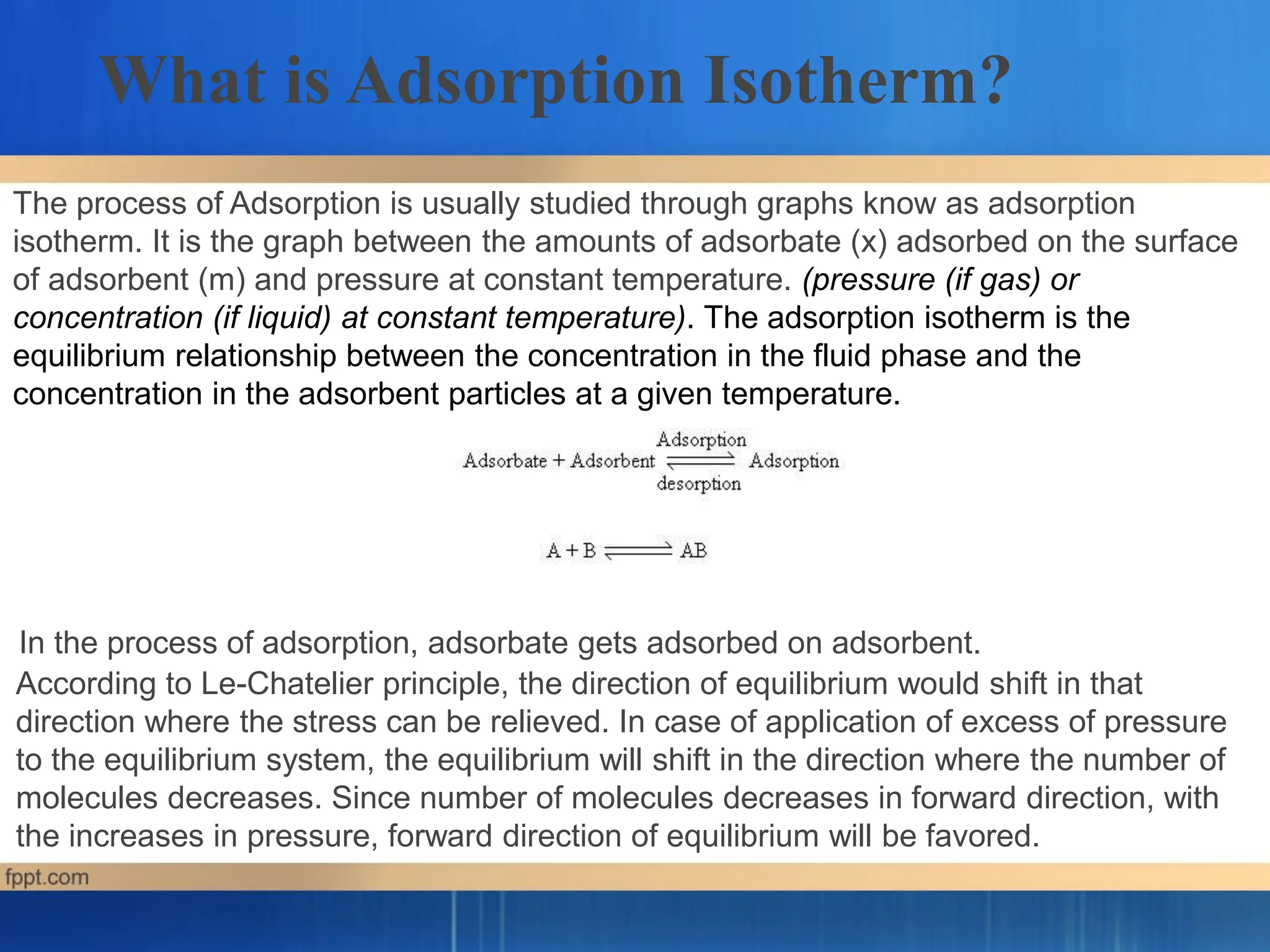
In the processof adsorption, adsorbate gets adsorbed on adsorbent.
According to Le-Chatelier principle, the direction of equilibrium would shift in that
direction where the stress can be relieved. In case of application of excess of pressure
to the equilibrium system, the equilibrium will shift in the direction where the number of
molecules decreases. Since number of molecules decreases in forward direction, with
the increases in pressure, forward direction of equilibrium will be favored.
What is Adsorption Isotherm?
The process of Adsorption is usually studied through graphs know as adsorption
isotherm. It is the graph between the amounts of adsorbate (x) adsorbed on the surface
of adsorbent (m) and pressure at constant temperature. (pressure (if gas) or
concentration (if liquid) at constant temperature). The adsorption isotherm is the
equilibrium relationship between the concentration in the fluid phase and the
concentration in the adsorbent particles at a given temperature.
33.
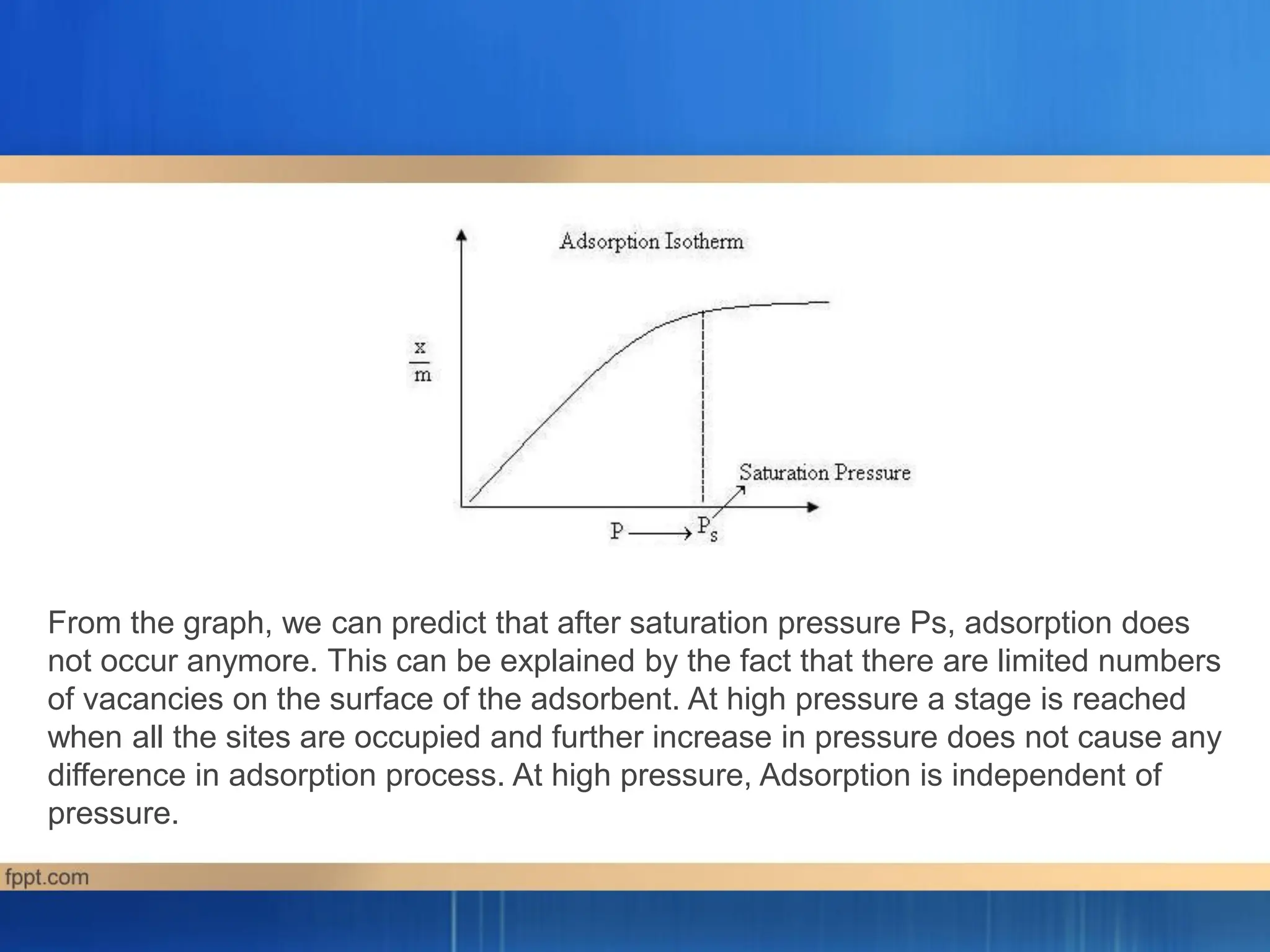
From the graph,we can predict that after saturation pressure Ps, adsorption does
not occur anymore. This can be explained by the fact that there are limited numbers
of vacancies on the surface of the adsorbent. At high pressure a stage is reached
when all the sites are occupied and further increase in pressure does not cause any
difference in adsorption process. At high pressure, Adsorption is independent of
pressure.
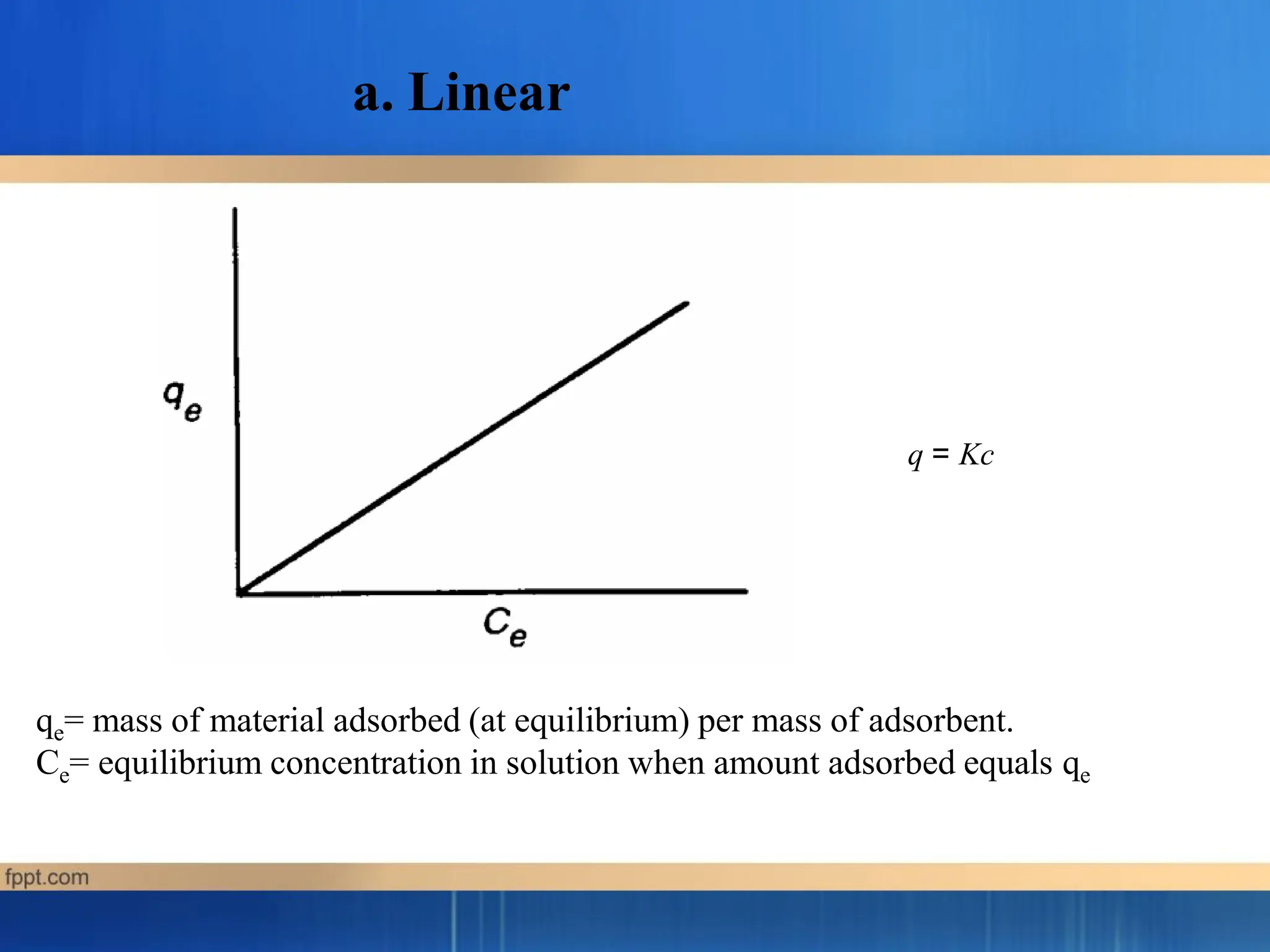
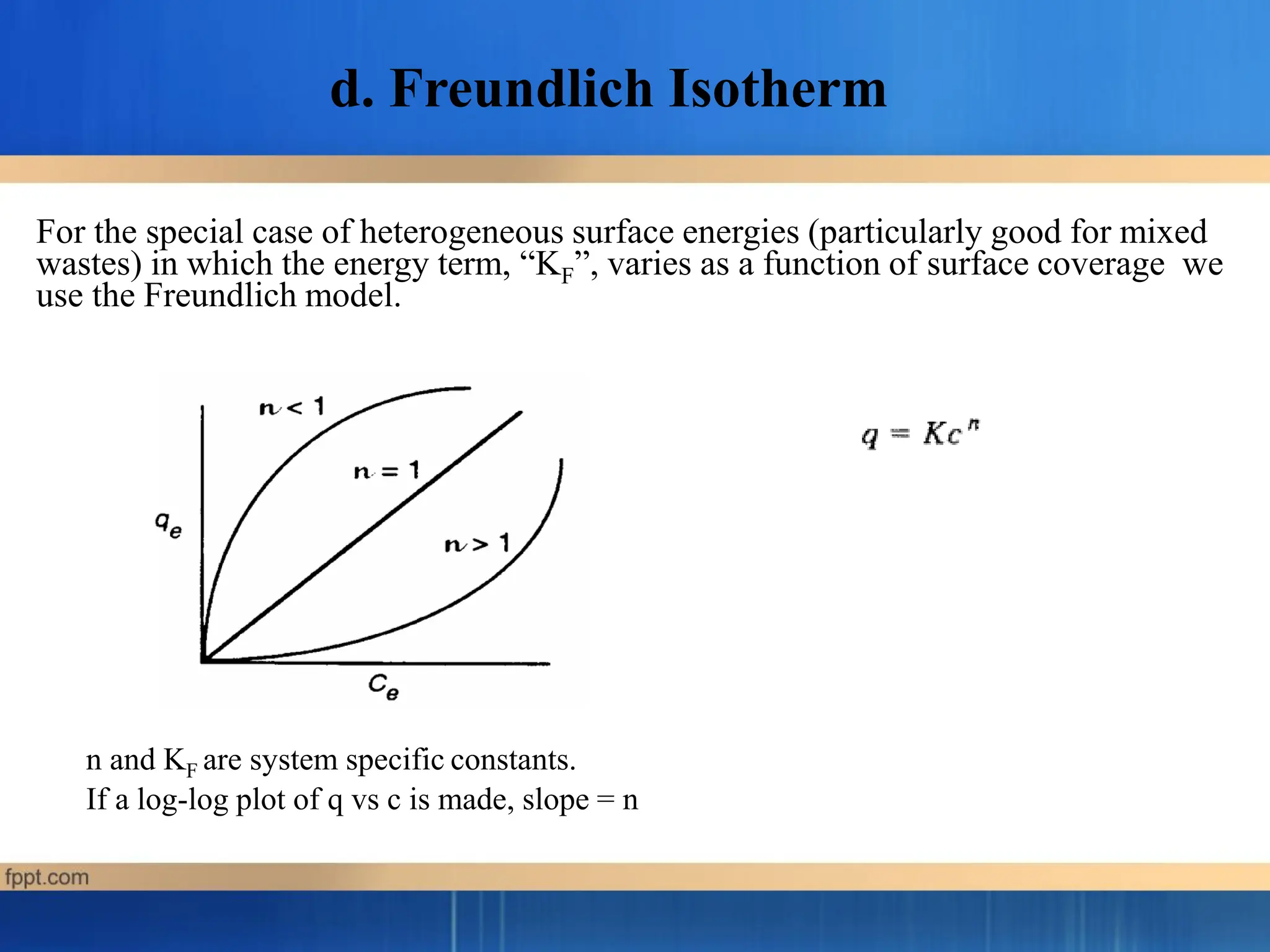
a. Linear
qe= massof material adsorbed (at equilibrium) per mass of adsorbent.
Ce= equilibrium concentration in solution when amount adsorbed equals qe
q = Kc
36.
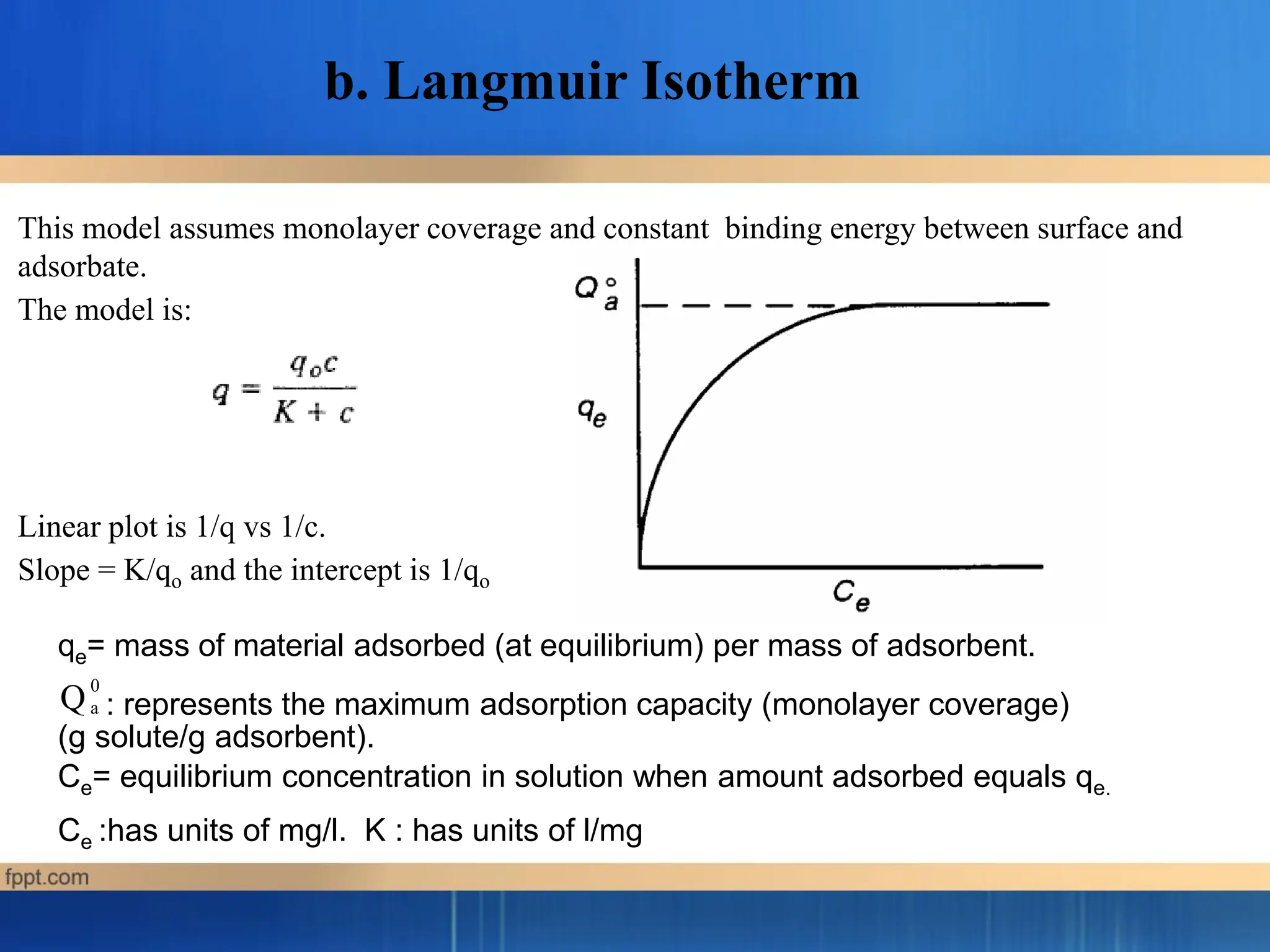
This model assumesmonolayer coverage and constant binding energy between surface and
adsorbate.
The model is:
Linear plot is 1/q vs 1/c.
Slope = K/qo and the intercept is 1/qo
qe= mass of material adsorbed (at equilibrium) per mass of adsorbent.
: represents the maximum adsorption capacity (monolayer coverage)
0
a
Q
(g solute/g adsorbent).
Ce= equilibrium concentration in solution when amount adsorbed equals qe.
Ce :has units of mg/l. K : has units of l/mg
b. Langmuir Isotherm
37.
c. BET (Brunauer,Emmett and Teller) isotherm
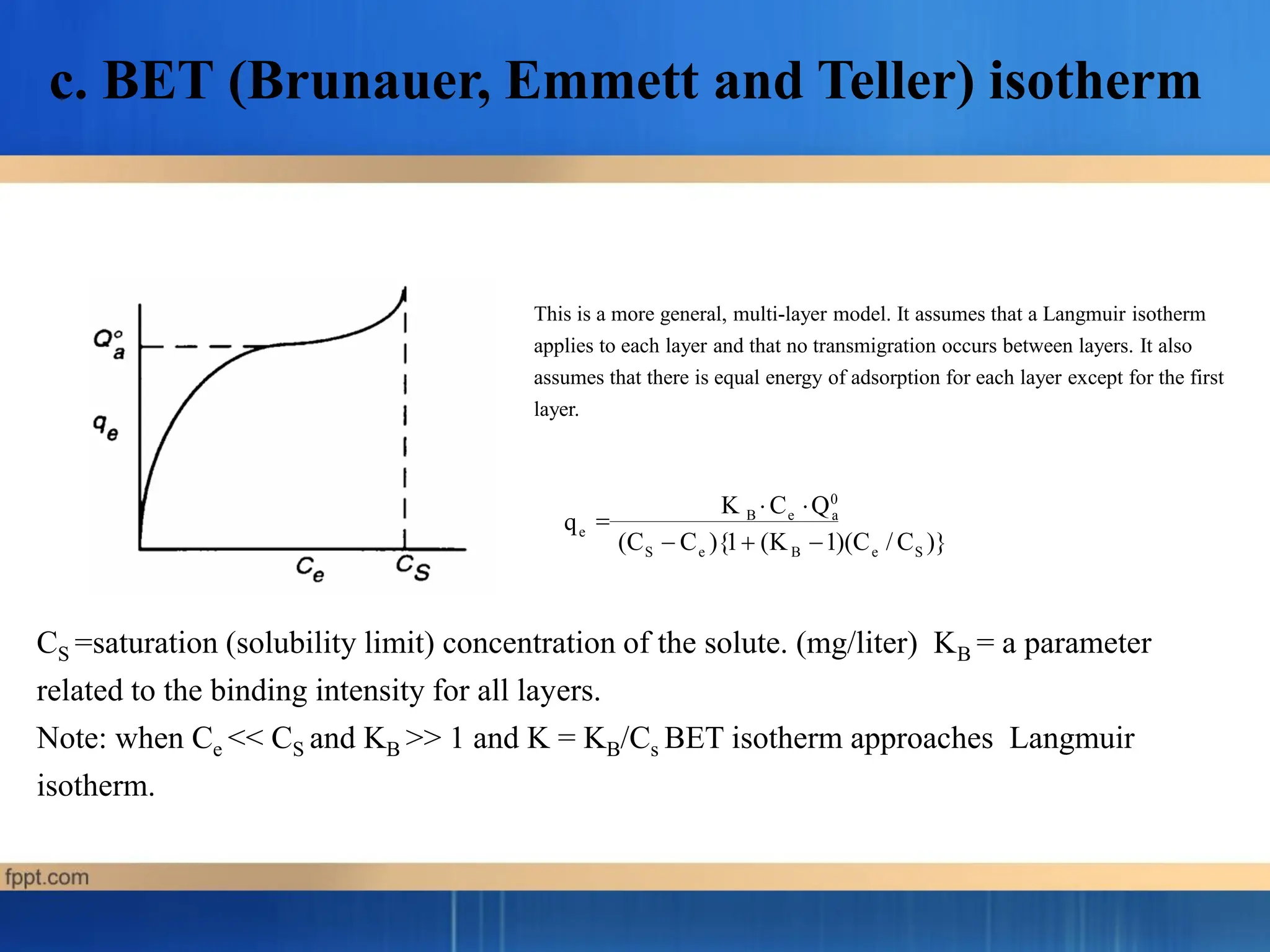
This is a more general, multi-layer model. It assumes that a Langmuir isotherm
applies to each layer and that no transmigration occurs between layers. It also
assumes that there is equal energy of adsorption for each layer except for the first
layer.
CS =saturation (solubility limit) concentration of the solute. (mg/liter) KB = a parameter
related to the binding intensity for all layers.
Note: when Ce << CS and KB >> 1 and K = KB/Cs BET isotherm approaches Langmuir
isotherm.
q
S e B e S
e
(C C ){1 (K 1)(C / C )}
K C Q0
B e a
38.
For the specialcase of heterogeneous surface energies (particularly good for mixed
wastes) in which the energy term, “KF”, varies as a function of surface coverage we
use the Freundlich model.
n and KF are system specific constants.
If a log-log plot of q vs c is made, slope = n
d. Freundlich Isotherm
39.
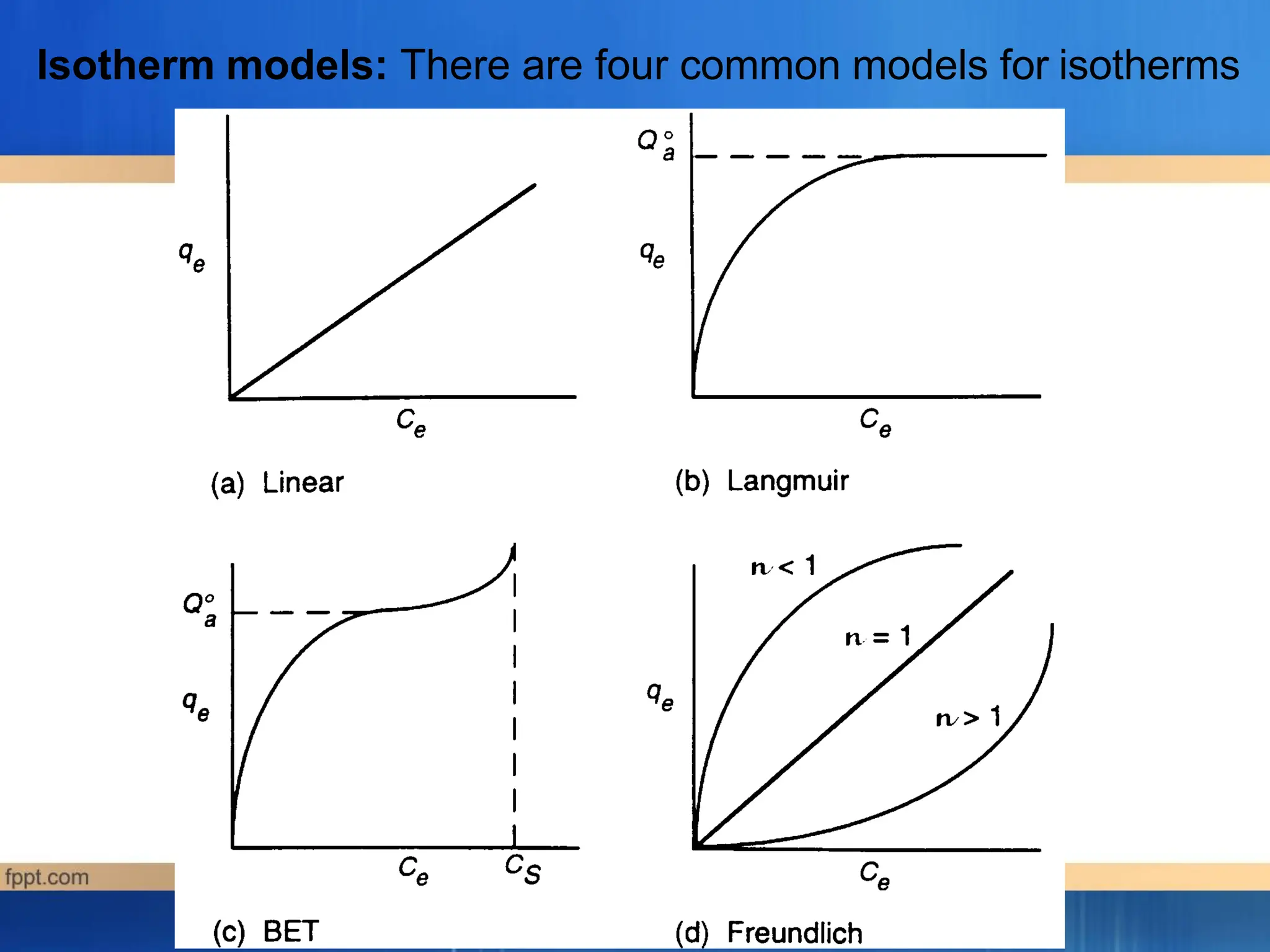
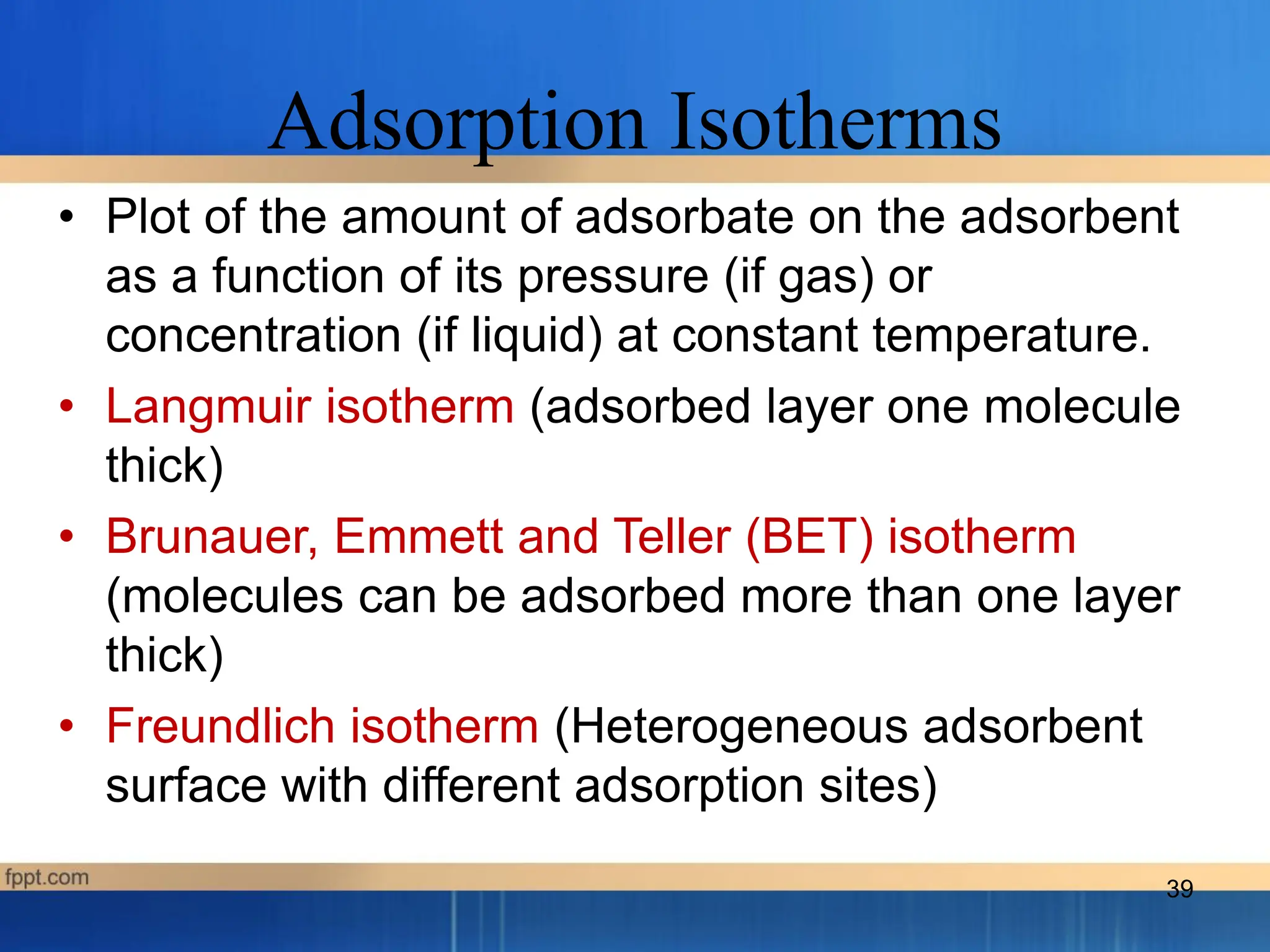
Adsorption Isotherms
• Plotof the amount of adsorbate on the adsorbent
as a function of its pressure (if gas) or
concentration (if liquid) at constant temperature.
• Langmuir isotherm (adsorbed layer one molecule
thick)
• Brunauer, Emmett and Teller (BET) isotherm
(molecules can be adsorbed more than one layer
thick)
• Freundlich isotherm (Heterogeneous adsorbent
surface with different adsorption sites)
39
40.
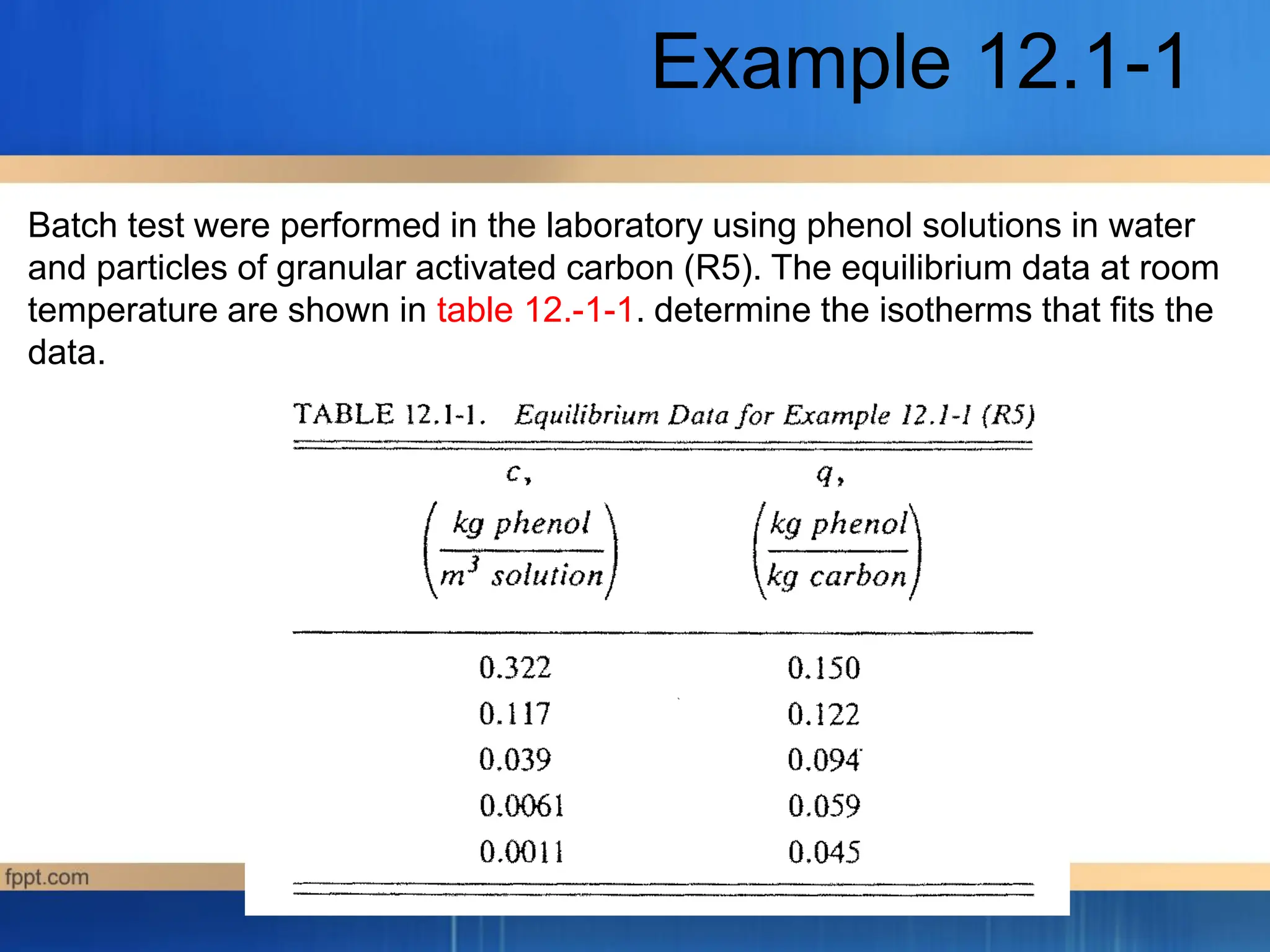
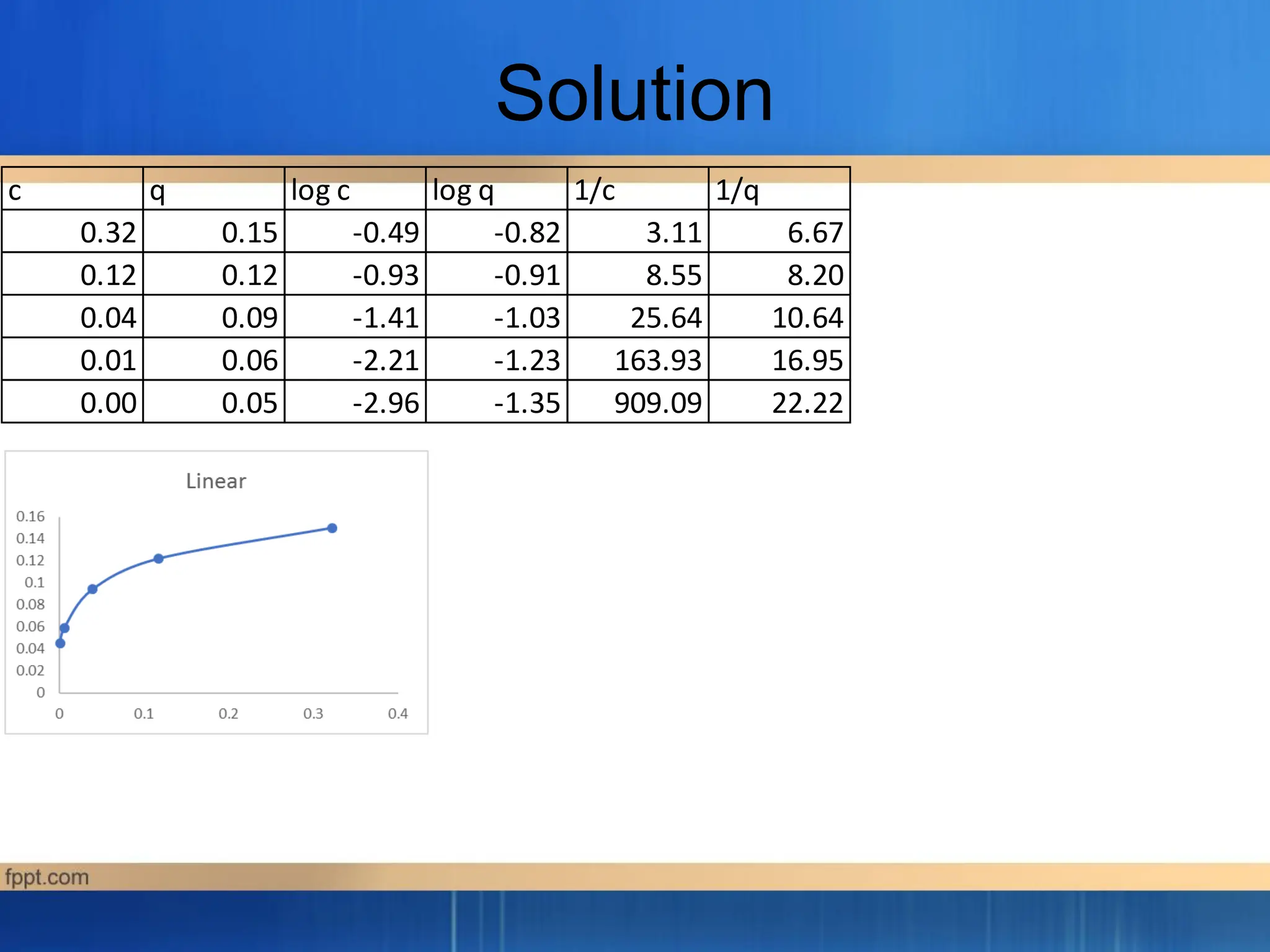
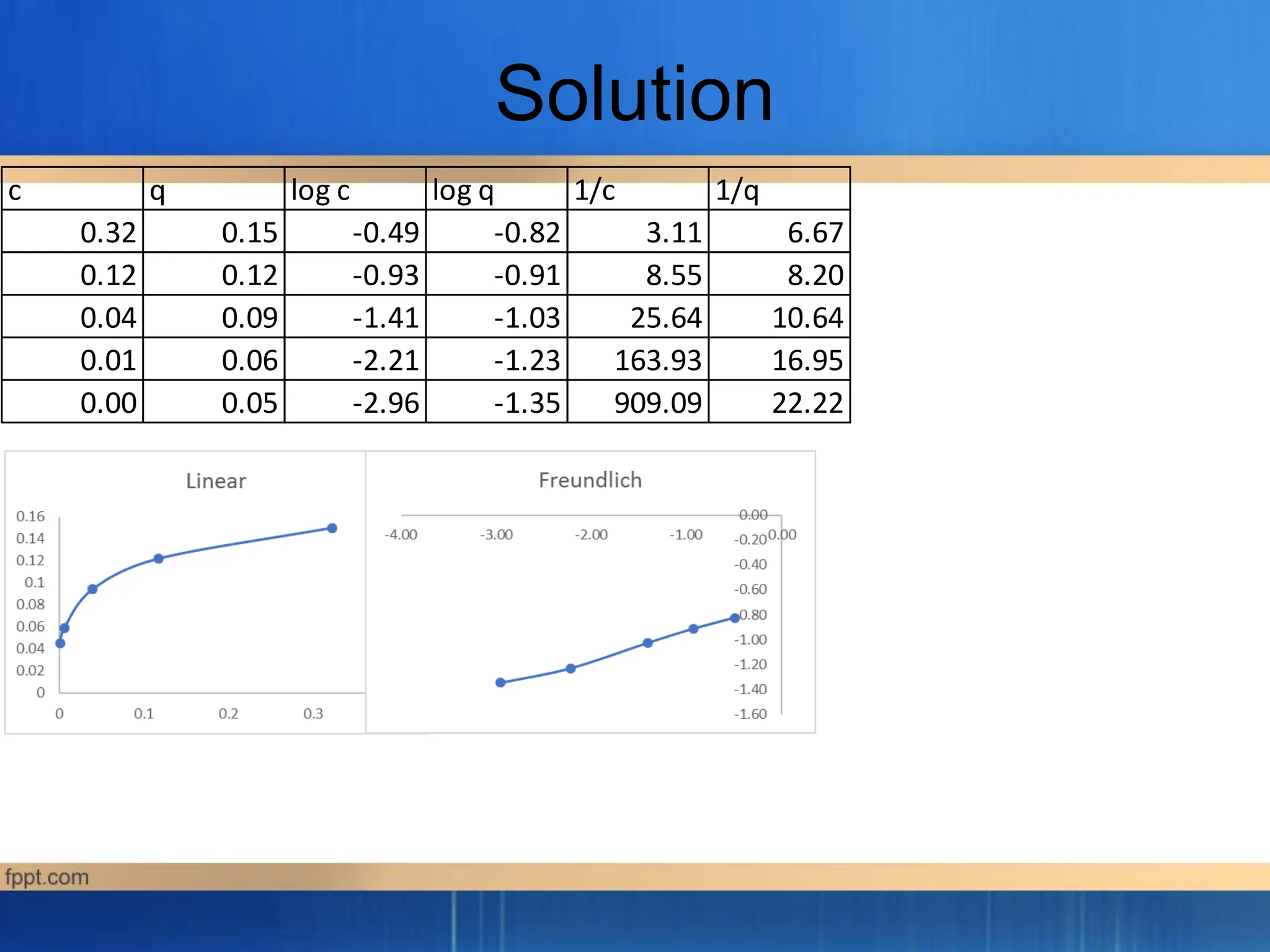
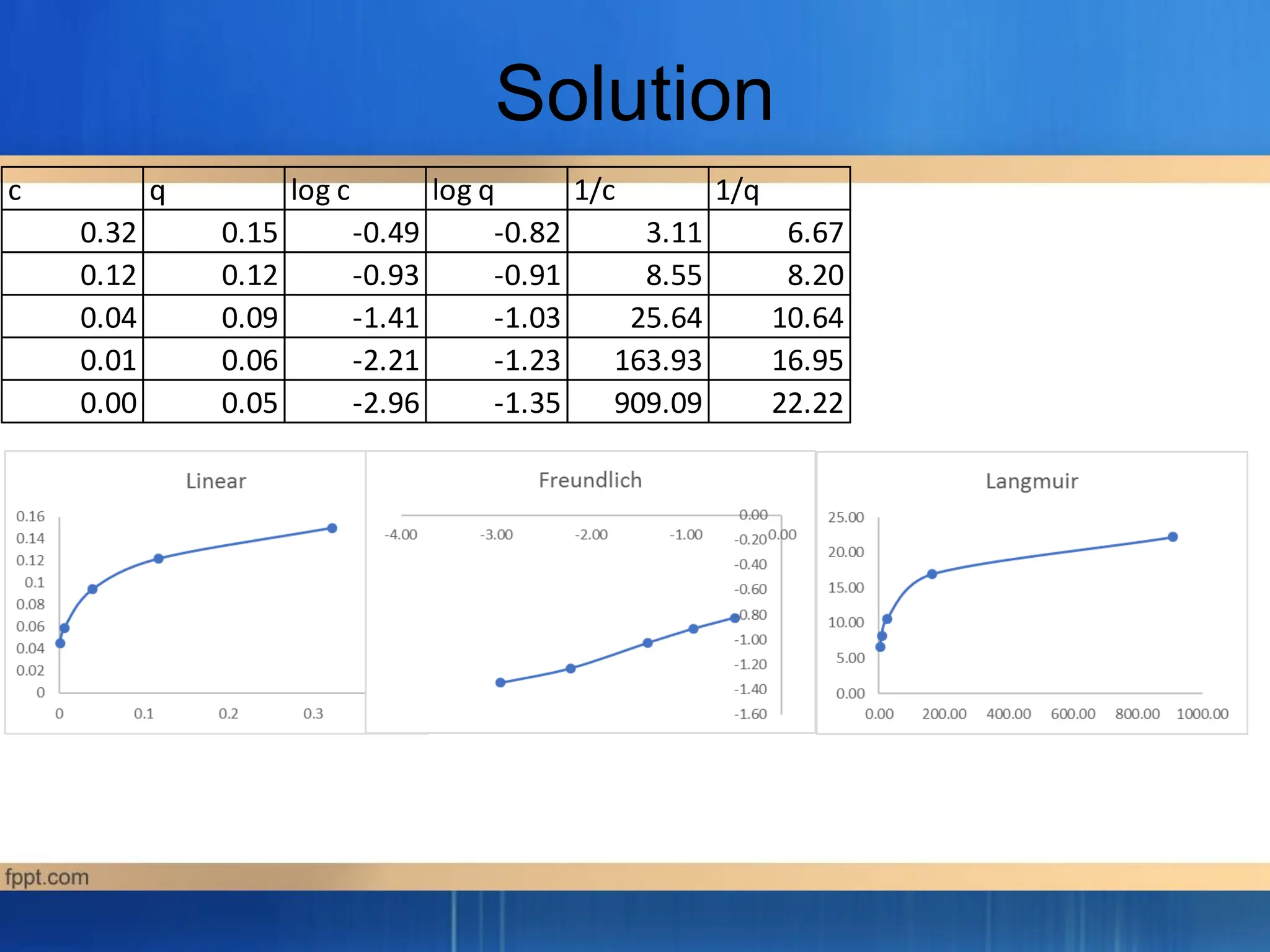
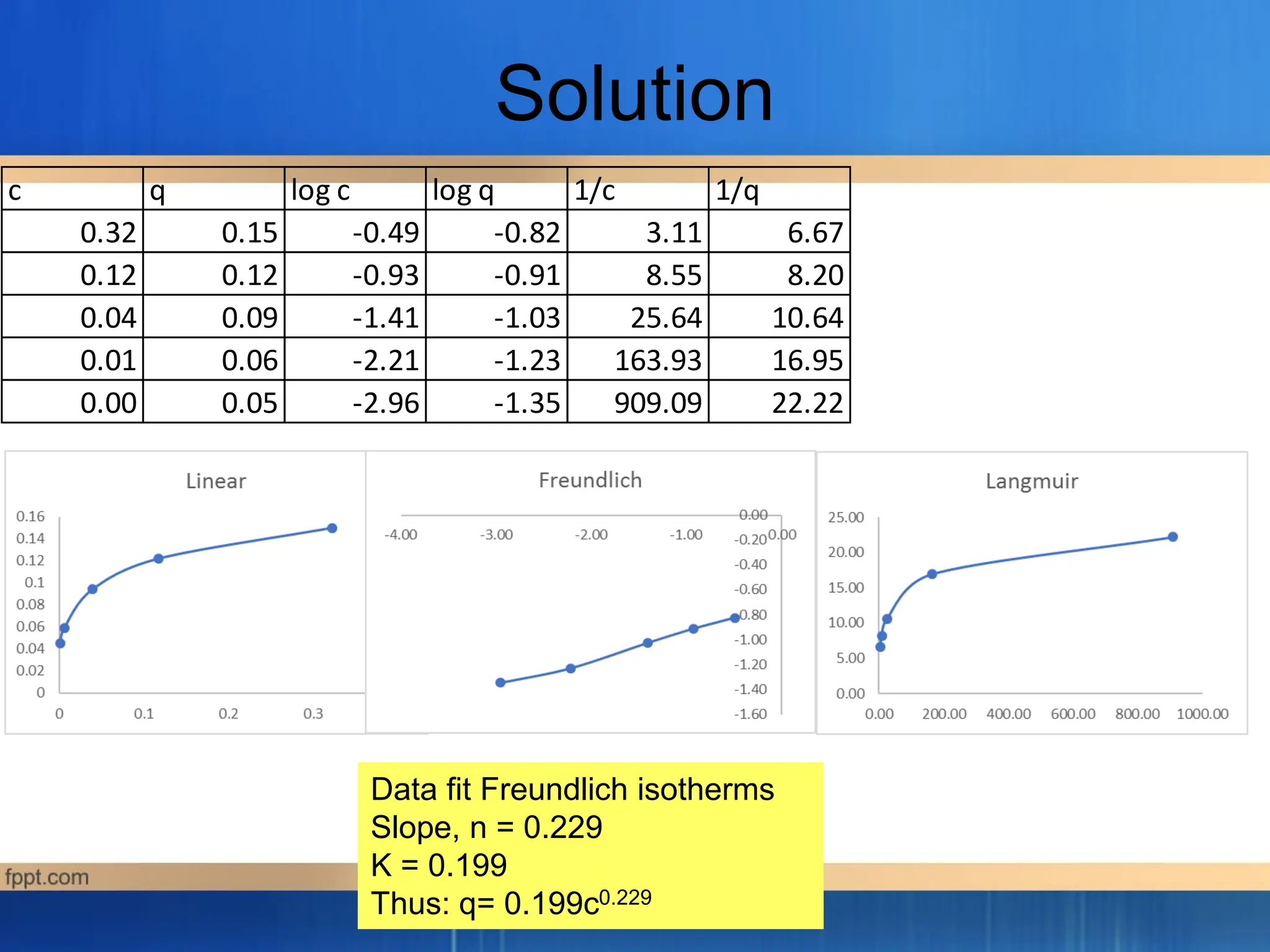
Example 12.1-1
Batch testwere performed in the laboratory using phenol solutions in water
and particles of granular activated carbon (R5). The equilibrium data at room
temperature are shown in table 12.-1-1. determine the isotherms that fits the
data.
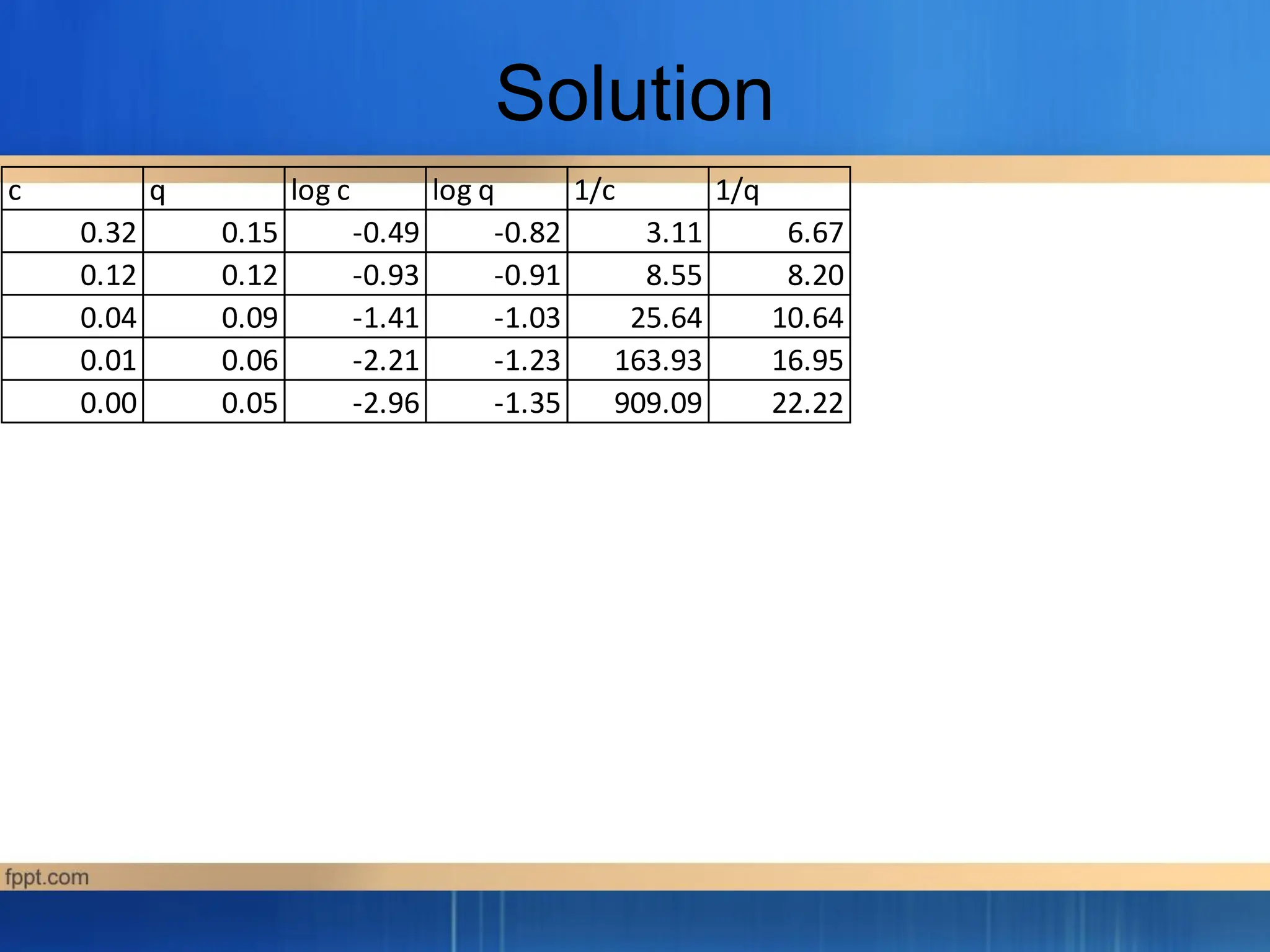
Solution
Data fit Freundlichisotherms
Slope, n = 0.229
K = 0.199
Thus: q= 0.199c0.229
c q log c log q 1/c 1/q
0.32 0.15 -0.49 -0.82 3.11 6.67
0.12 0.12 -0.93 -0.91 8.55 8.20
0.04 0.09 -1.41 -1.03 25.64 10.64
0.01 0.06 -2.21 -1.23 163.93 16.95
0.00 0.05 -2.96 -1.35 909.09 22.22
46.
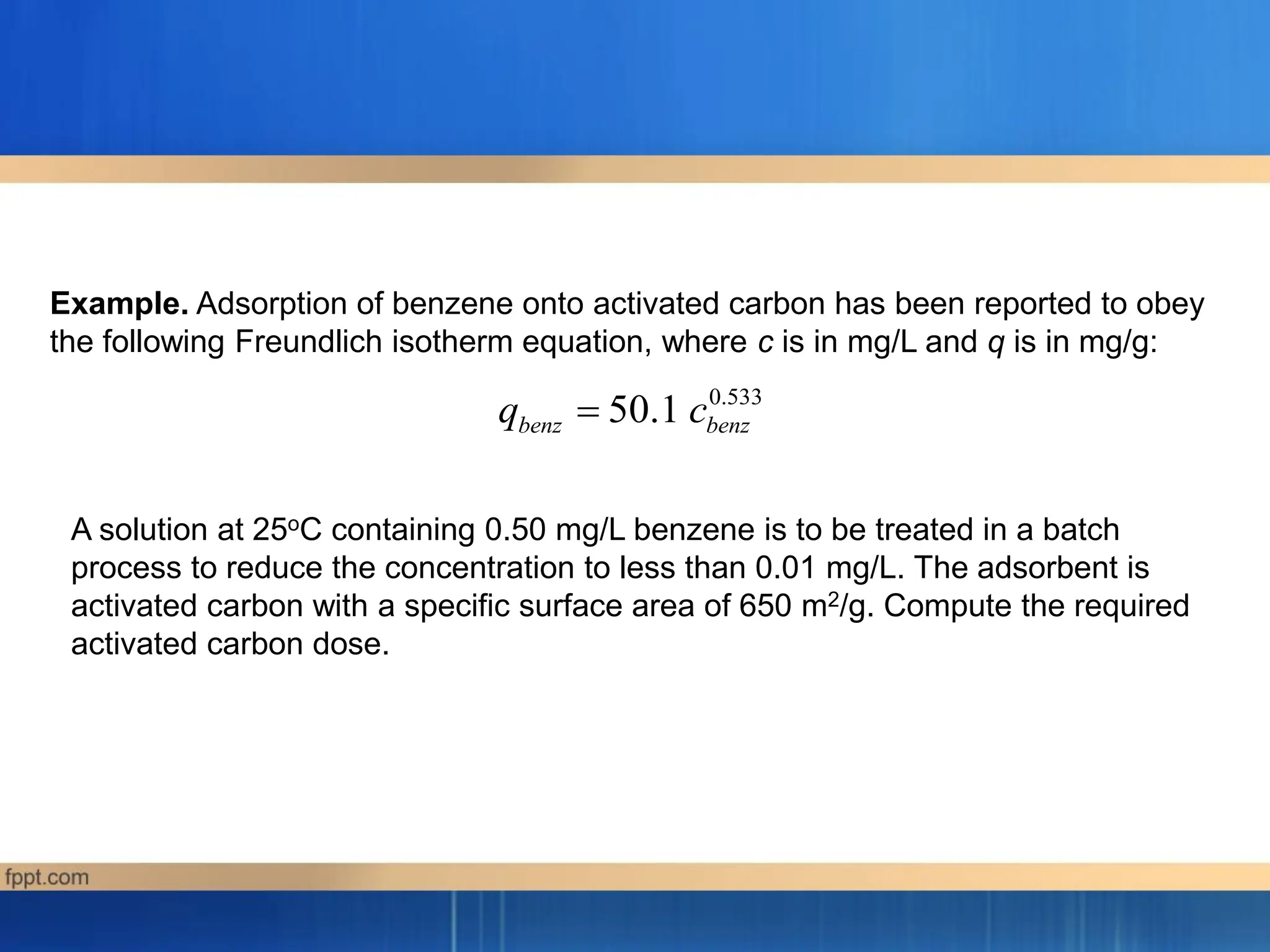
0.533
50.1
benz benz
q c
Example.Adsorption of benzene onto activated carbon has been reported to obey
the following Freundlich isotherm equation, where c is in mg/L and q is in mg/g:
A solution at 25oC containing 0.50 mg/L benzene is to be treated in a batch
process to reduce the concentration to less than 0.01 mg/L. The adsorbent is
activated carbon with a specific surface area of 650 m2/g. Compute the required
activated carbon dose.
47.
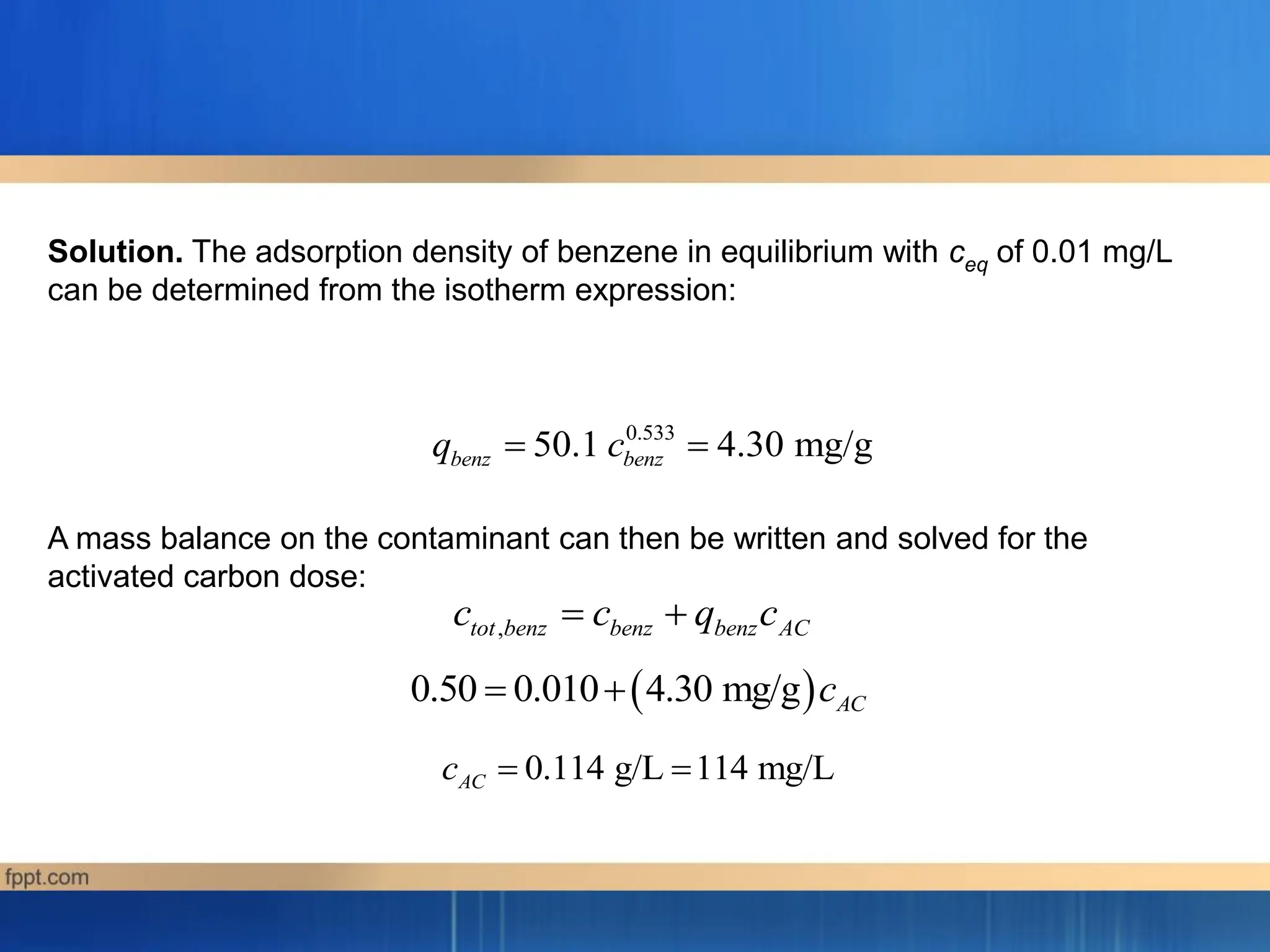
0.533
50.1 4.30 mg/g
benzbenz
q c
,
tot benz benz benz AC
c c q c
0.50 0.010 4.30 mg/g AC
c
0.114 g/L 114 mg/L
AC
c
Solution. The adsorption density of benzene in equilibrium with ceq of 0.01 mg/L
can be determined from the isotherm expression:
A mass balance on the contaminant can then be written and solved for the
activated carbon dose:
48.
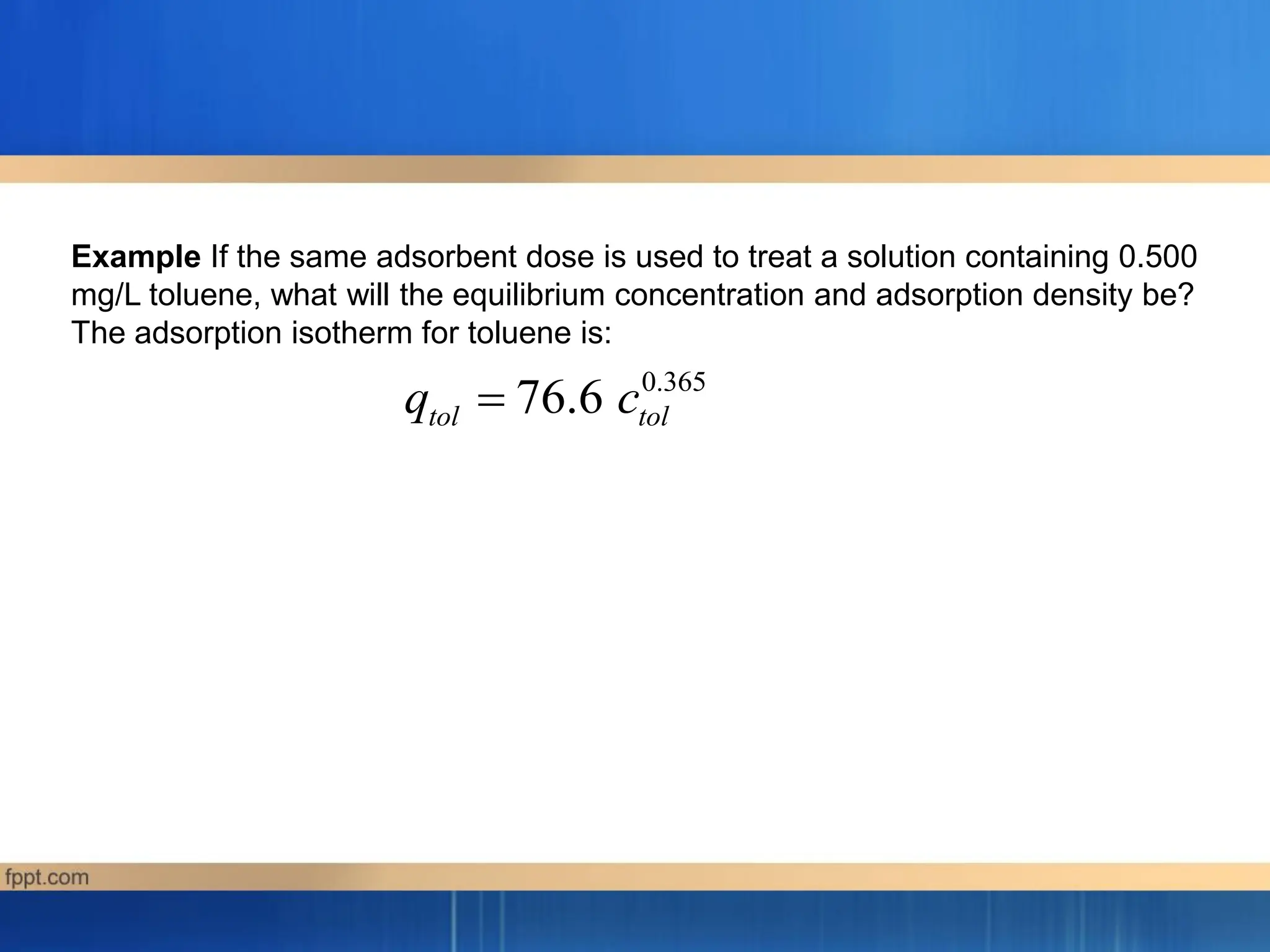
0.365
76.6
tol tol
q c
ExampleIf the same adsorbent dose is used to treat a solution containing 0.500
mg/L toluene, what will the equilibrium concentration and adsorption density be?
The adsorption isotherm for toluene is:
49.
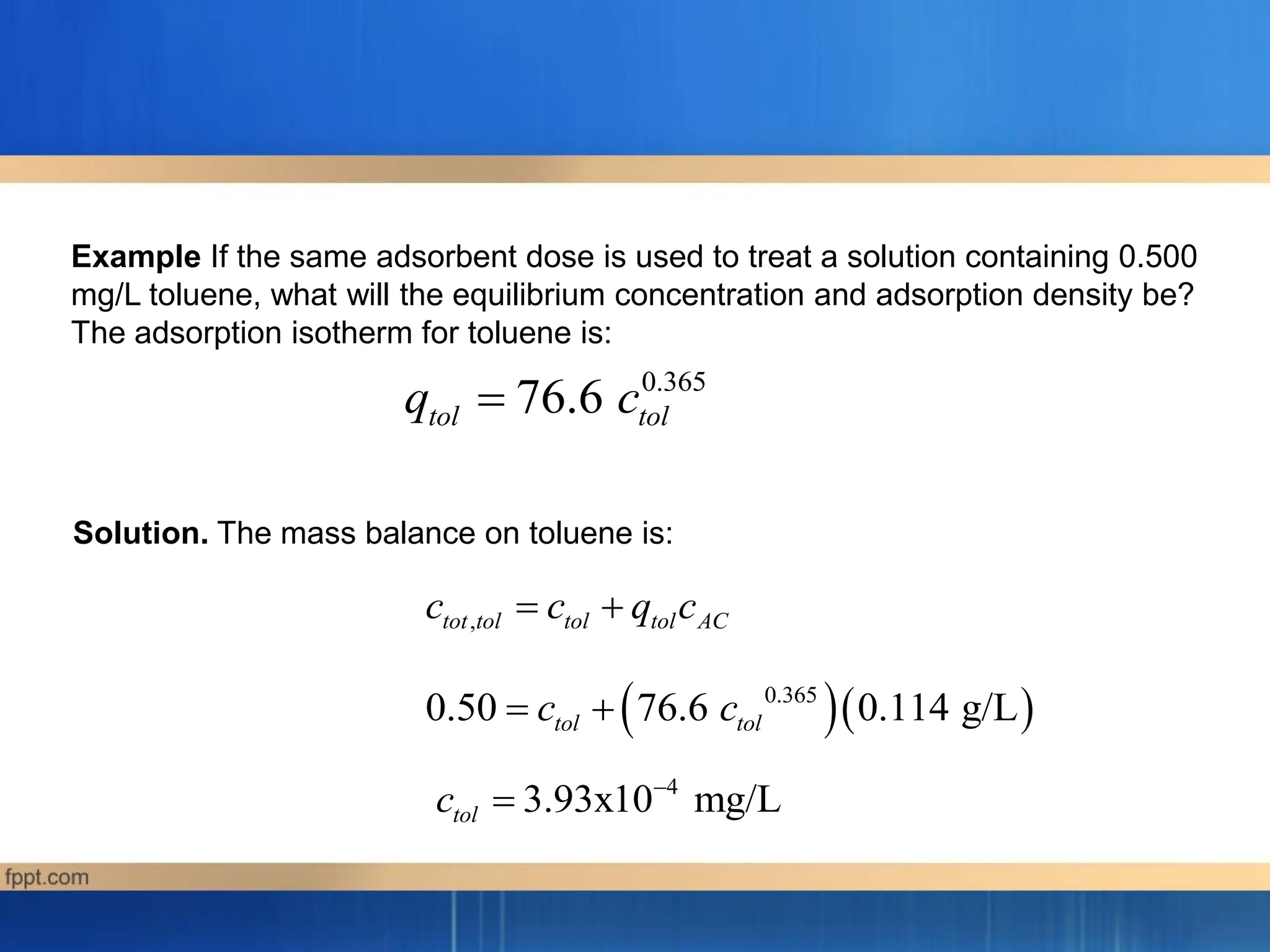
0.365
76.6
tol tol
q c
ExampleIf the same adsorbent dose is used to treat a solution containing 0.500
mg/L toluene, what will the equilibrium concentration and adsorption density be?
The adsorption isotherm for toluene is:
,
tot tol tol tol AC
c c q c
0.365
0.50 76.6 0.114 g/L
tol tol
c c
4
3.93x10 mg/L
tol
c
Solution. The mass balance on toluene is:
50.
Test yourself
• Awastewater solution having a volume of 1.0m3
contains 0.21 kg phenol/m3 of solution (0.21 g/L). A
total of 1.40 kg of fresh granular activated carbon is
added to the solution, which is then mixed to reach
equilibrium. Using the isotherms, what are the final
equilibrium values, and what are percent of phenol is
extracted?
51.
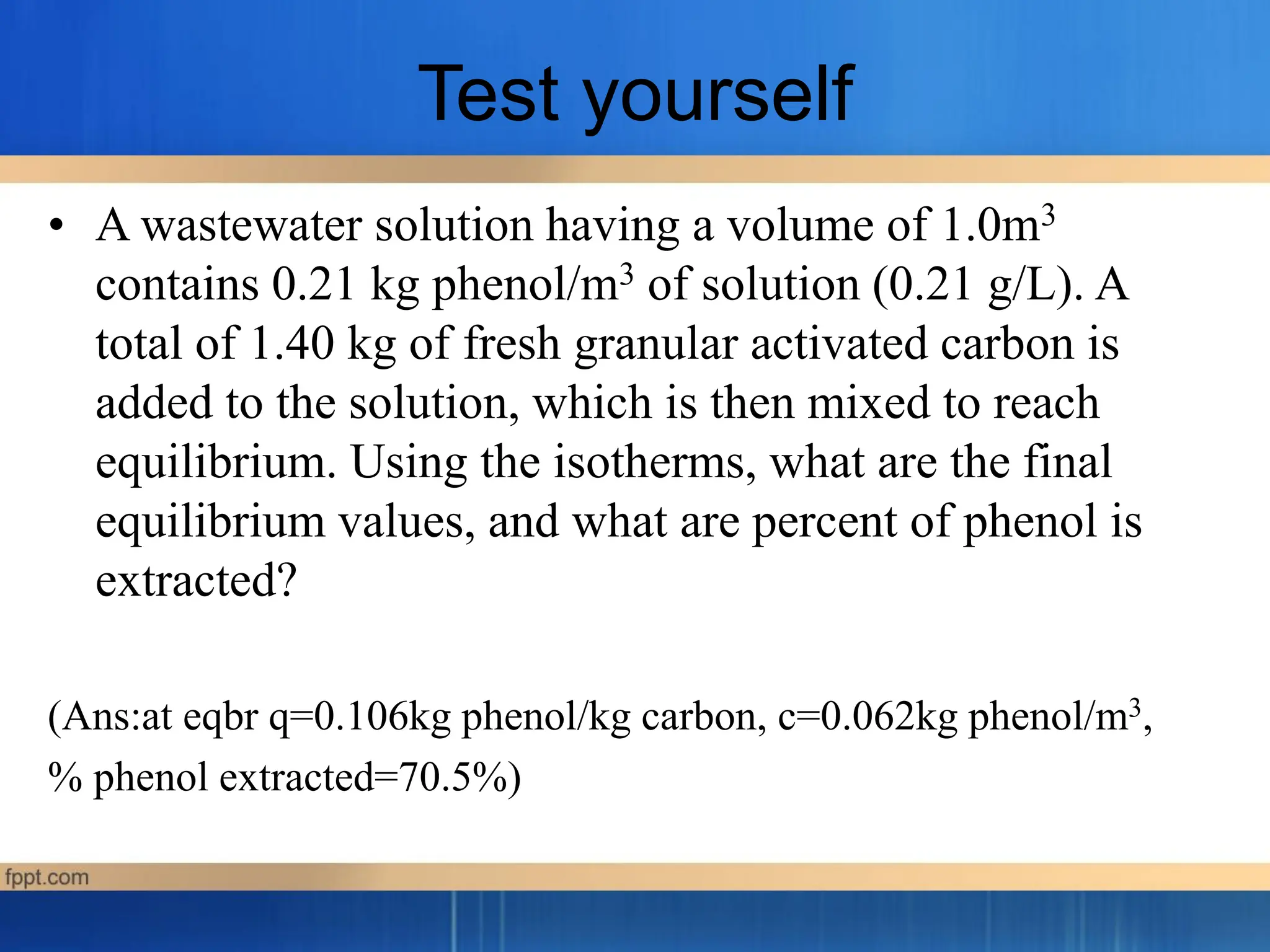
Test yourself
• Awastewater solution having a volume of 1.0m3
contains 0.21 kg phenol/m3 of solution (0.21 g/L). A
total of 1.40 kg of fresh granular activated carbon is
added to the solution, which is then mixed to reach
equilibrium. Using the isotherms, what are the final
equilibrium values, and what are percent of phenol is
extracted?
(Ans:at eqbr q=0.106kg phenol/kg carbon, c=0.062kg phenol/m3,
% phenol extracted=70.5%)
52.
Adsorbate:
Solubility
In general, assolubility of solute increases the extent of adsorption
decreases.
Factors which affect solubility include:
molecular size (high MW- low solubility),
Ionization (solubility is minimum when compounds are uncharged),
polarity (as polarity increases, higher solubility because water is a
polar solvent).
Factors which affect adsorption extent
53.
pH
pH often affectsthe surface charge on the adsorbent as well as the
charge on the solute. Generally, for organic material as pH goes down
adsorption goes up.
Temperature
Adsorption reactions are typically exothermic. Here heat is given off
by the reaction therefore as T increases extent of adsorption
decreases.
Presence of other solutes
In general, get competition for a limited number of sites therefore get
reduced extent of adsorption or a specific material.
54.
Adsorbent:
Virtually every solidsurface has the capacity to adsorb solutes. From the
wastewater/water treatment point of view, activated carbon (AC) is the
adsorbent of choice. AC prepared from many sources: Wood- Lignite,
Coal- Nutshells- Bone
These raw materials are prepared at high temperature under low oxygen
conditions (so we don’t get complete combustion). This forms a “char”.
The char is then activated by heating to 300 – 1000 oC in the presence of
steam, oxygen or CO2.
This process result in “Activated carbon” which is highly porous, micro-
crystalline material which resembles graphite plates with some specific
functional groups (e.g. COOH, OH)
55.
Most of thesurface area is in pores of molecular sized dimensions.
This results in slower mass transfer during the adsorption process
but also results in greater binding capacity of the adsorbate.
Adsorption behavior is related in part to the nature of the functional
groups on the carbon surface. In general, carbon manufactured at:
<500 oC is weakly acidic
> 500 oC is weakly basic
Spent AC can be regenerated at high temperatures (roughly a
maximum of fifteen times).
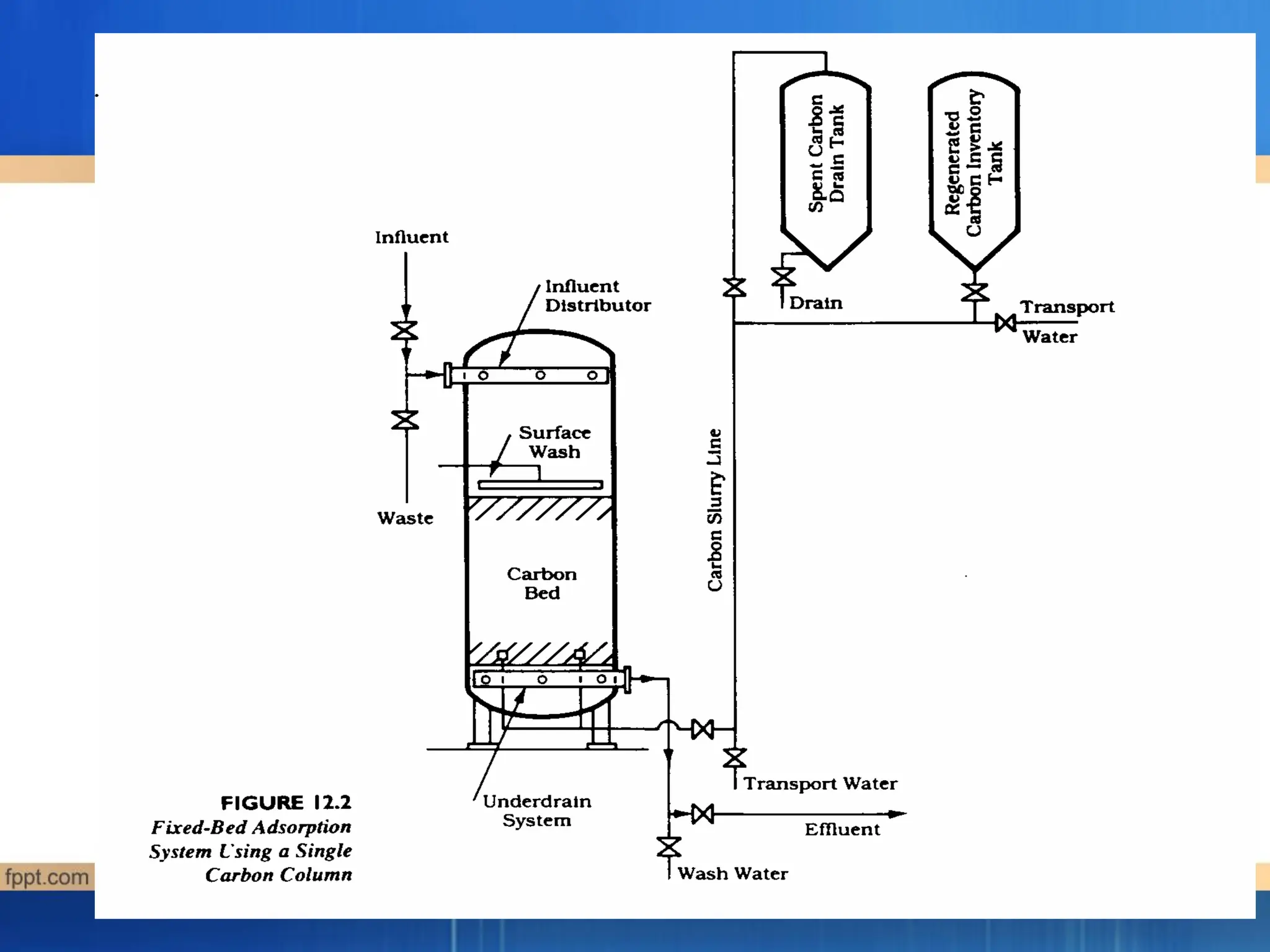
57.
Activated carbon reactorsare usually called carbon contactors because the
waste stream is “contacted” with the carbon. Many times the contactor is
of the columnar fluidized or fixed-bed type. Sometimes (less often) the
contactor is in a slurry form.
Fixed or fluidized beds have the advantage of not having to separate the
carbon from the liquid stream after the contact period.
Slurry systems need some sort of activated carbon removal process to
separate the AC from the liquid stream.
CARBON CONTACTORS
58.
contactors provide filtrationas well as adsorption so they have to be
periodically backwashed or cleaned.
This is one reason why we only want to run soluble material through a
contactor.
Packed bed (fixed carbon bed)
60.
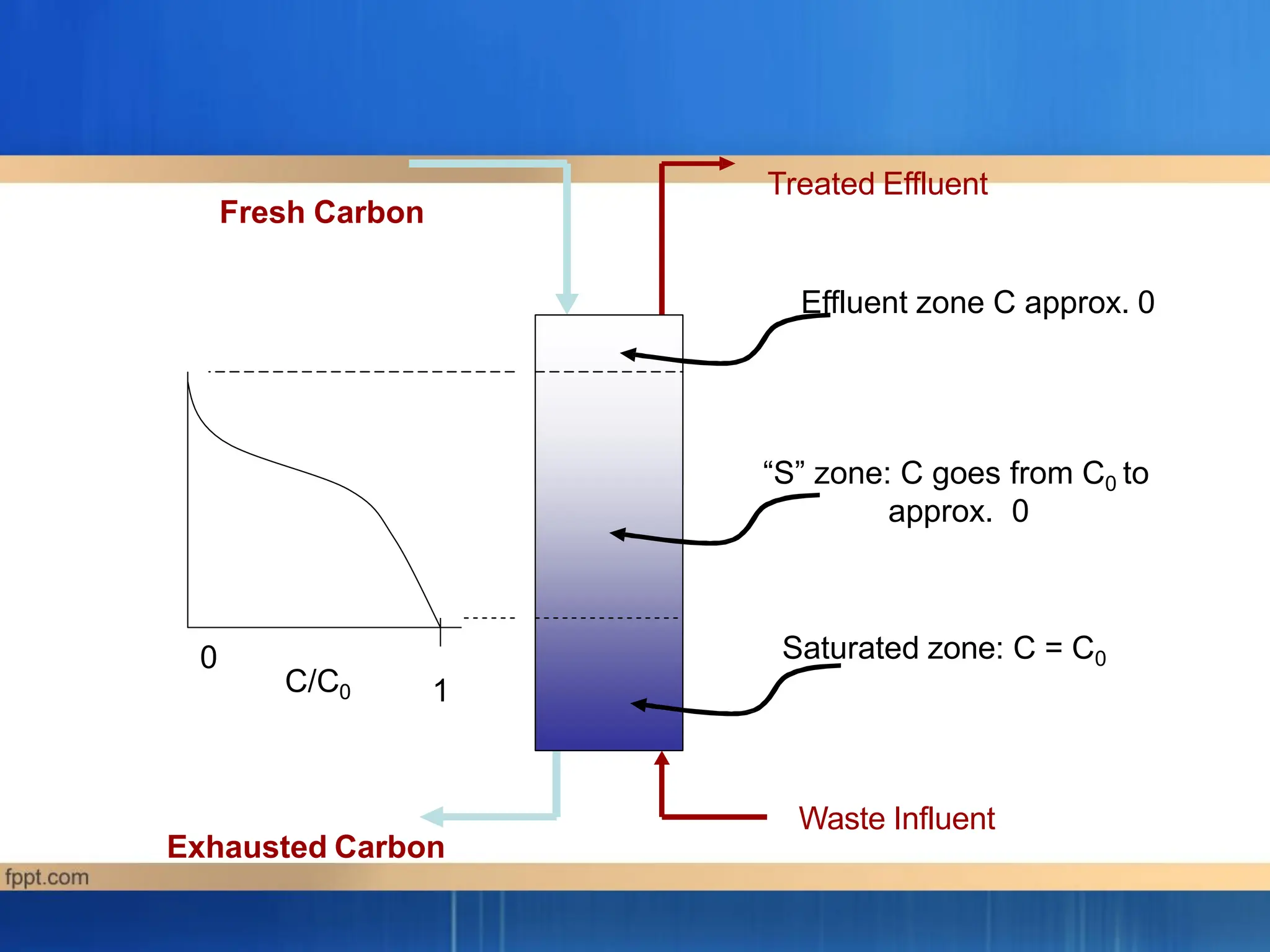
Fluidized Bed Contactors:
Ina fluidized bed mode (upflow) carbon can be continuously
removed from the bottom of the contactor as it ’s exhausted.
Fresh make-up carbon can than be added to the top of
contactor at the same rate.
Upflow fluidized beds also minimize clogging and
unintentional filtration.
61.
Fresh Carbon
Exhausted Carbon
WasteInfluent
Treated Effluent
Saturated zone: C = C0
“S” zone: C goes from C0 to
approx. 0
Effluent zone C approx. 0
C/C0 1
0
62.
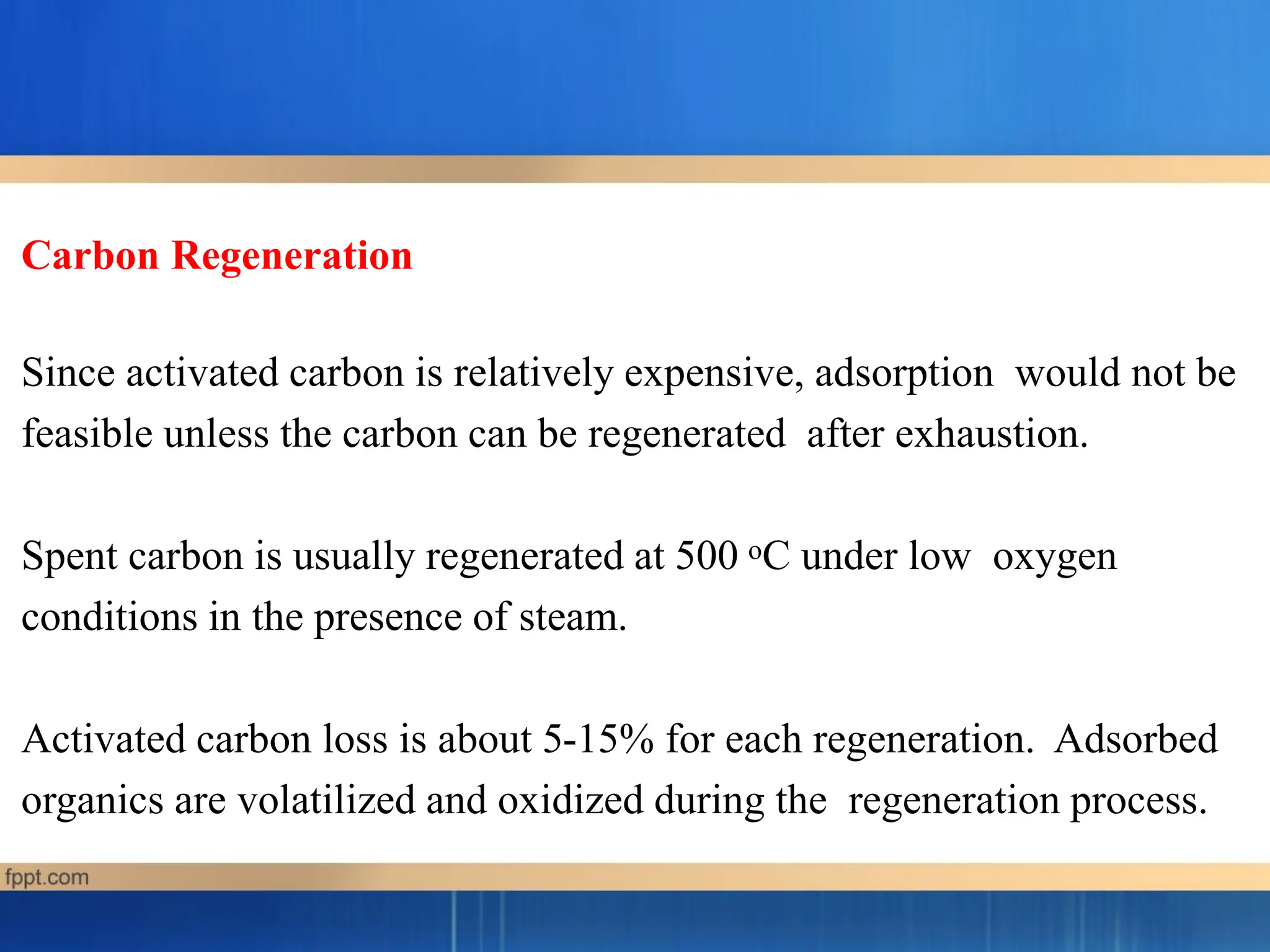
Carbon Regeneration
Since activatedcarbon is relatively expensive, adsorption would not be
feasible unless the carbon can be regenerated after exhaustion.
Spent carbon is usually regenerated at 500 oC under low oxygen
conditions in the presence of steam.
Activated carbon loss is about 5-15% for each regeneration. Adsorbed
organics are volatilized and oxidized during the regeneration process.
63.
Activated carbon ismostly applied in water treatment for:
-The removal of taste and odor producing compounds
-the elimination of inconvenient or toxic often-non polar compounds.
-additional efforts are the removal of heavy metals, if present.
The application of AC in powder form is specially suitable in cases low
dosage are needed or intermittent use (removal of taste originated from an
algae-bloom)
Common apparent contact times are in dependence of the goal between 5
and 30 minutes; bed thickness up to 2-3 m are applied in water treatment.
Proper application of activated carbon needs experiments to decide
for the proper type (adsorption isotherm) and the proper dose.
64.
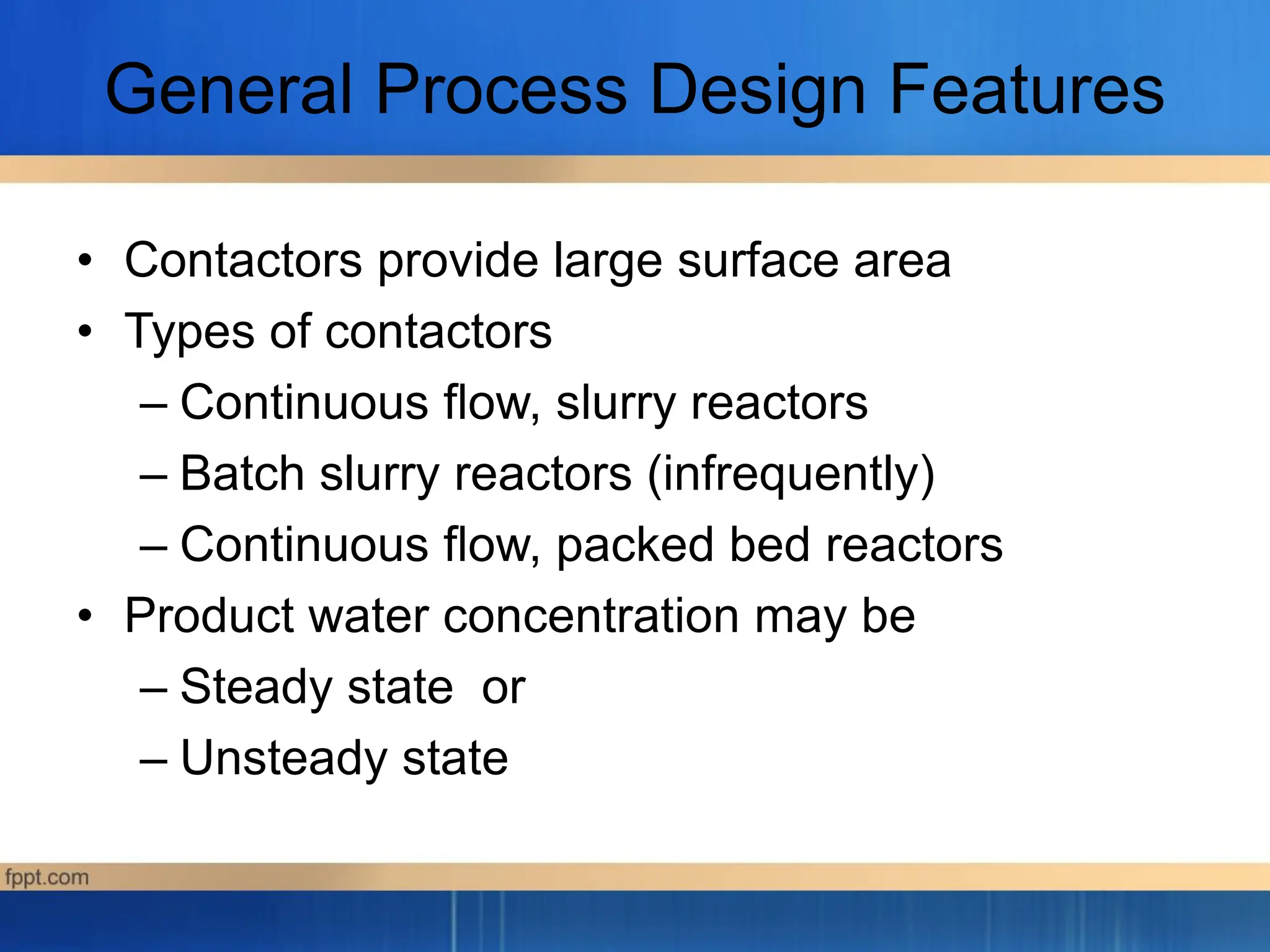
General Process DesignFeatures
• Contactors provide large surface area
• Types of contactors
– Continuous flow, slurry reactors
– Batch slurry reactors (infrequently)
– Continuous flow, packed bed reactors
• Product water concentration may be
– Steady state or
– Unsteady state
65.
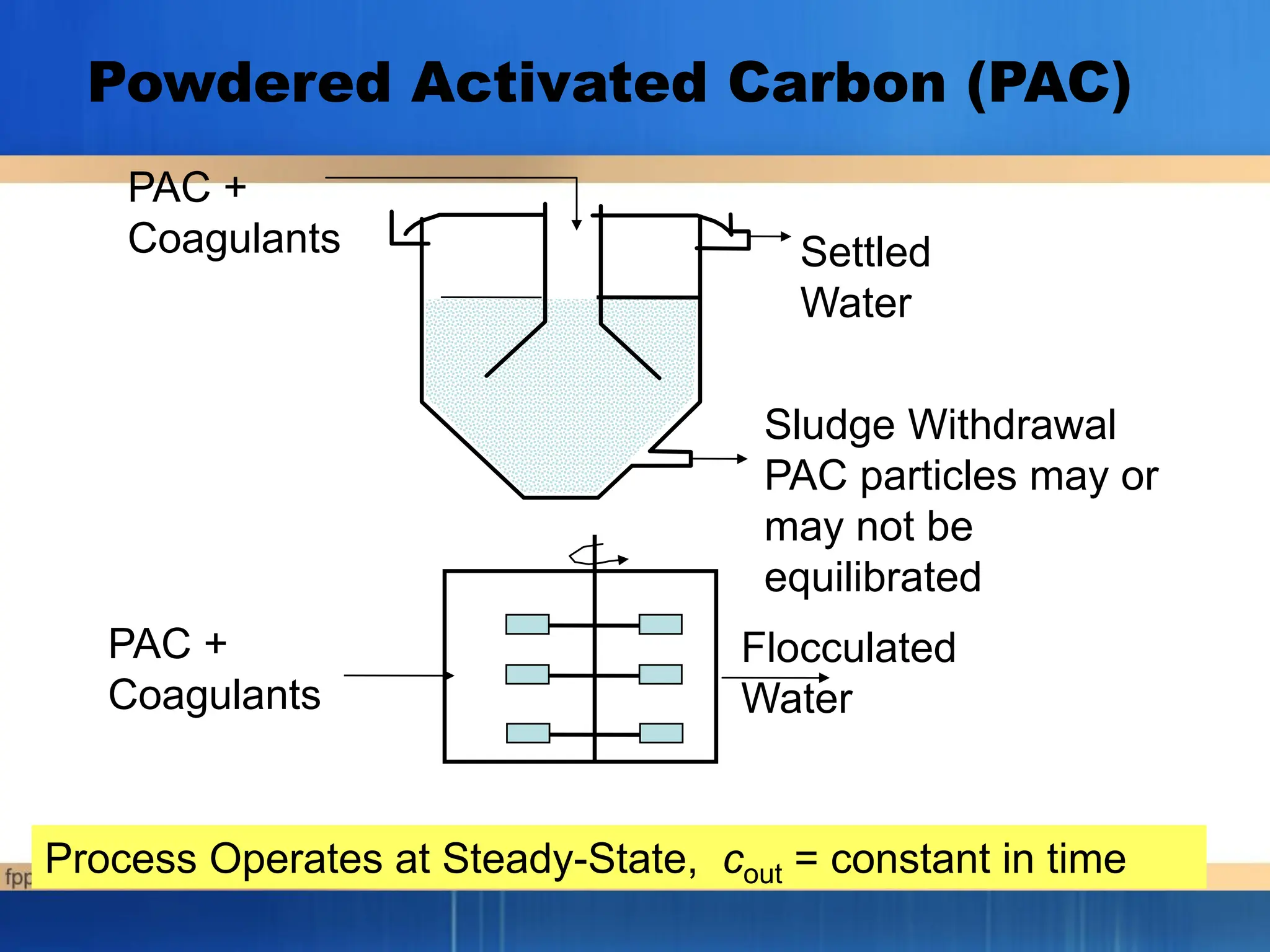
PAC +
Coagulants
Sludge Withdrawal
PACparticles may or
may not be
equilibrated
Settled
Water
PAC +
Coagulants
Flocculated
Water
Powdered Activated Carbon (PAC)
Process Operates at Steady-State, cout = constant in time
66.
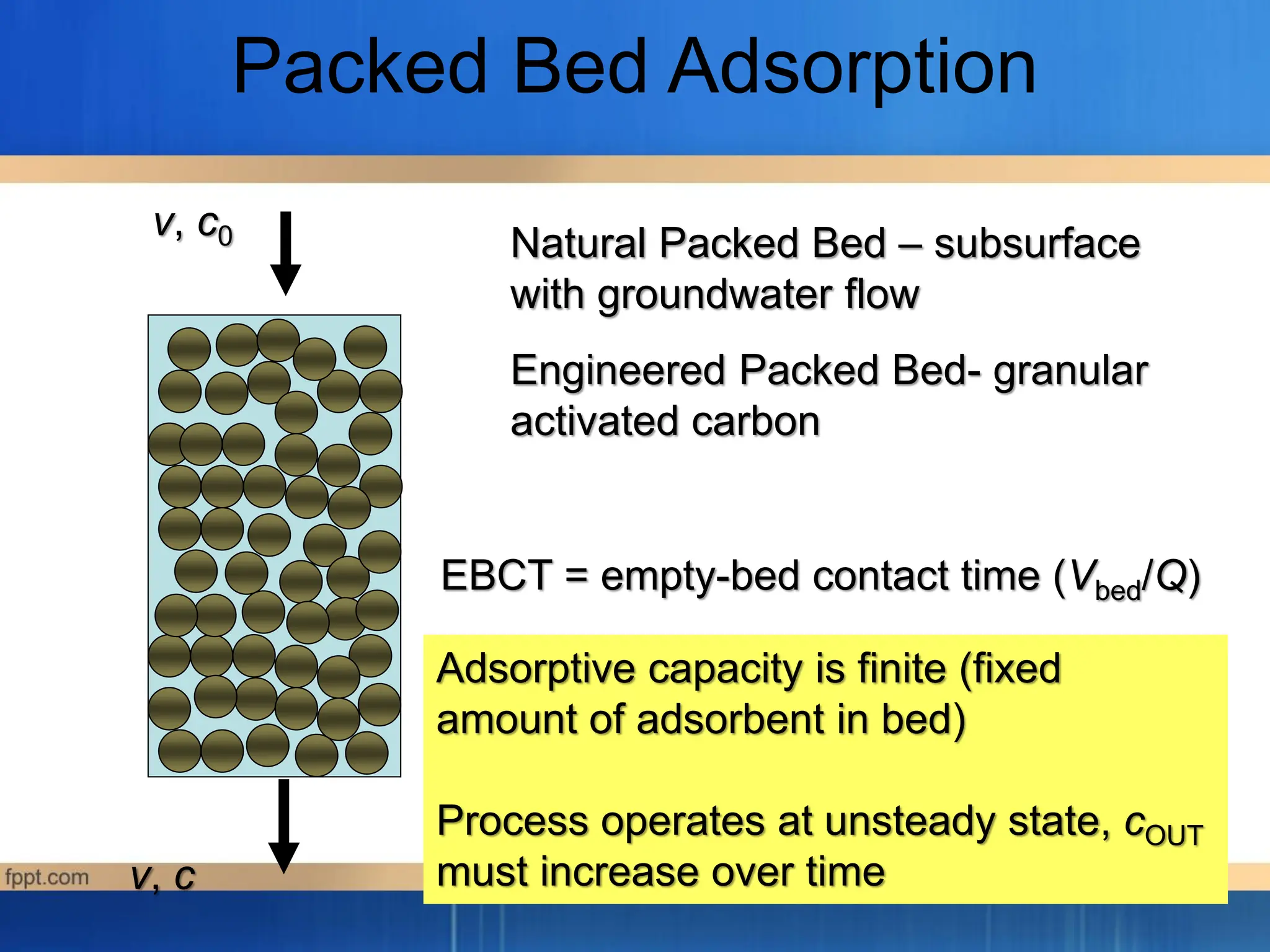
Packed Bed Adsorption
v,c0 Natural Packed Bed – subsurface
with groundwater flow
Engineered Packed Bed- granular
activated carbon
EBCT = empty-bed contact time (Vbed/Q)
v, c
Adsorptive capacity is finite (fixed
amount of adsorbent in bed)
Process operates at unsteady state, cOUT
must increase over time
67.
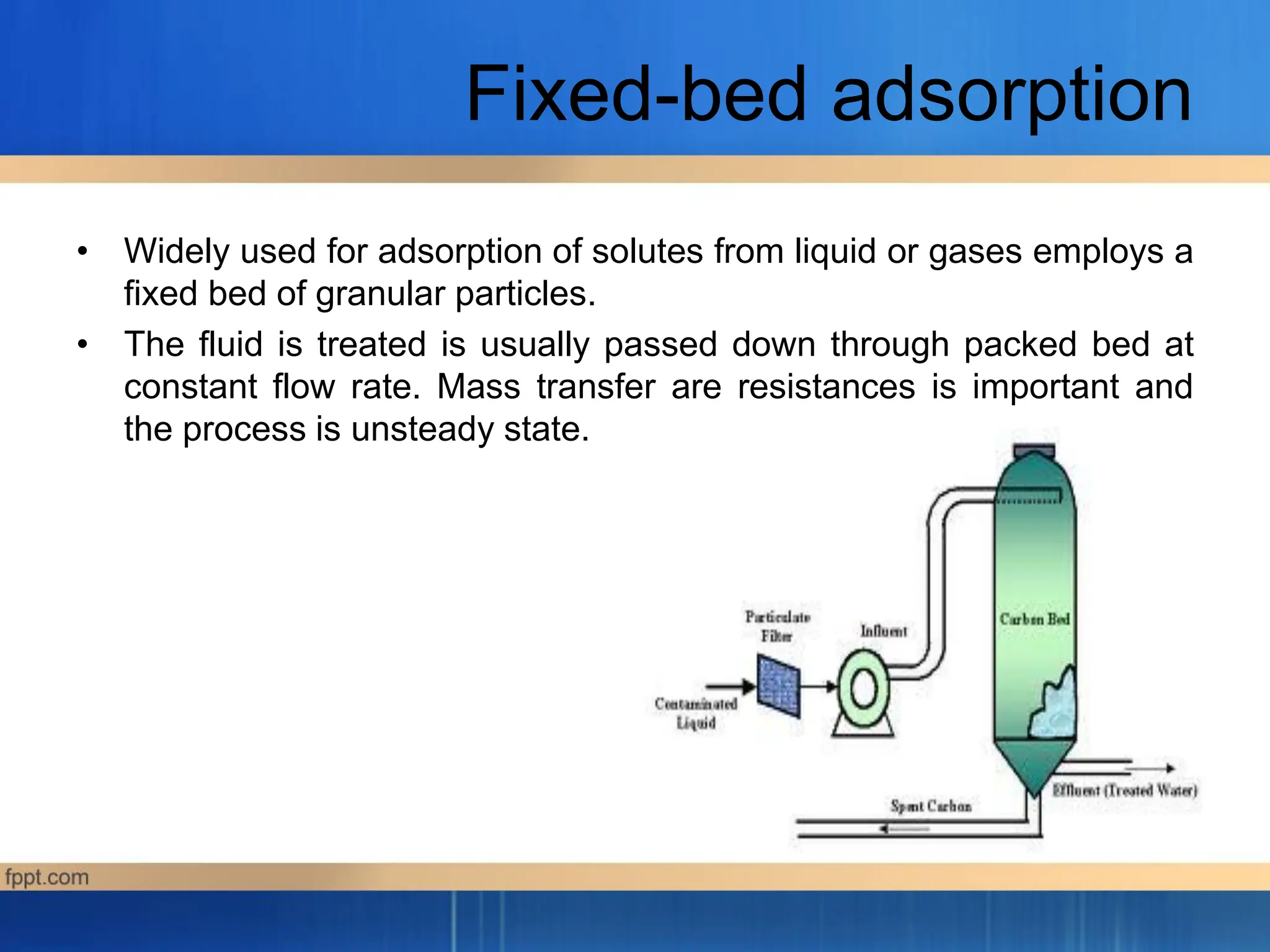
Fixed-bed adsorption
• Widelyused for adsorption of solutes from liquid or gases employs a
fixed bed of granular particles.
• The fluid is treated is usually passed down through packed bed at
constant flow rate. Mass transfer are resistances is important and
the process is unsteady state.