Surface chemistry
Adsorption
 The phenomenon of attracting and retaining the
  molecules of a substance on the surface of a liquid or
  solid resulting in to higher concentration of the
  molecules on the surface is called adsorption
 Causes of adsorption : Unbalanced forces of attraction
  or free valencies which is present at the solid or liquid
  surface, have the property to attract and retain the
  molecules of a gas or a dissolved substance on to their
  surfaces with which they come in contact.
 Example : Ammonia gas placed in contact with charcoal
  gets adsorbed on the charcoal
Some basic terms used in adsorption
 Adsorbate : The substance which gets adsorbed on any
    surface is called adsorbate for example, if a gas gets
    adsorbed on to the surface of a solid, then the gas is termed
    as the adsorbate.
   The substance on the surface of which adsorption takes
    place is called adsorbent.
   Absorption : When the molecules of a substance are
    uniformly distributed throughout the body of a solid or
    liquid. This phenomenon is called absorption.
   Desorption : The removal of the adsorbed substance from
    a surface is called desorption
   Sorption : The phenomenon in which adsorption and
    absorption occur simultaneously is called sorption.
Characteristics of adsorption
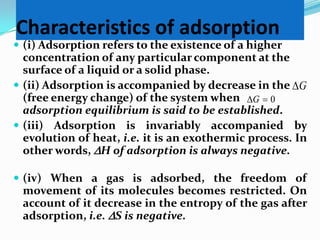
 (i) Adsorption refers to the existence of a higher
  concentration of any particular component at the
  surface of a liquid or a solid phase.
 (ii) Adsorption is accompanied by decrease in the G
  (free energy change) of the system when G  0
  adsorption equilibrium is said to be established.
 (iii) Adsorption is invariably accompanied by
  evolution of heat, i.e. it is an exothermic process. In
  other words, H of adsorption is always negative.

 (iv) When a gas is adsorbed, the freedom of
 movement of its molecules becomes restricted. On
 account of it decrease in the entropy of the gas after
 adsorption, i.e. S is negative.
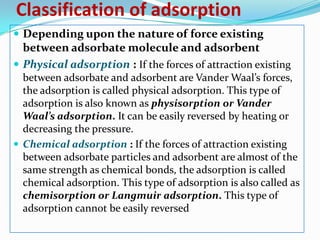
Classification of adsorption
 Depending upon the nature of force existing
  between adsorbate molecule and adsorbent
 Physical adsorption : If the forces of attraction existing
  between adsorbate and adsorbent are Vander Waal’s forces,
  the adsorption is called physical adsorption. This type of
  adsorption is also known as physisorption or Vander
  Waal’s adsorption. It can be easily reversed by heating or
  decreasing the pressure.
 Chemical adsorption : If the forces of attraction existing
  between adsorbate particles and adsorbent are almost of the
  same strength as chemical bonds, the adsorption is called
  chemical adsorption. This type of adsorption is also called as
  chemisorption or Langmuir adsorption. This type of
  adsorption cannot be easily reversed
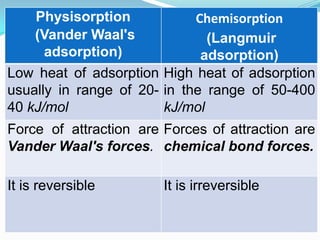
Physisorption            Chemisorption
    (Vander Waal's             (Langmuir
      adsorption)             adsorption)
Low heat of adsorption High heat of adsorption
usually in range of 20- in the range of 50-400
40 kJ/mol               kJ/mol
Force of attraction are Forces of attraction are
Vander Waal's forces. chemical bond forces.

It is reversible        It is irreversible
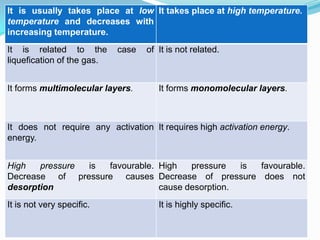
It is usually takes place at low It takes place at high temperature.
temperature and decreases with
increasing temperature.
It is related to the        case   of It is not related.
liquefication of the gas.


It forms multimolecular layers.       It forms monomolecular layers.


It does not require any activation It requires high activation energy.
energy.


High   pressure is favourable. High   pressure   is favourable.
Decrease of pressure causes Decrease of pressure does not
desorption                     cause desorption.
It is not very specific.              It is highly specific.
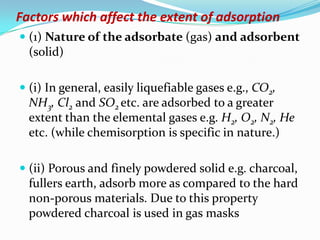
Factors which affect the extent of adsorption
 (1) Nature of the adsorbate (gas) and adsorbent
  (solid)

 (i) In general, easily liquefiable gases e.g., CO2,
  NH3, Cl2 and SO2 etc. are adsorbed to a greater
  extent than the elemental gases e.g. H2, O2, N2, He
  etc. (while chemisorption is specific in nature.)

 (ii) Porous and finely powdered solid e.g. charcoal,
  fullers earth, adsorb more as compared to the hard
  non-porous materials. Due to this property
  powdered charcoal is used in gas masks
 2) Surface area of the solid adsorbent
 (i) The extent of adsorption depends
  directly upon the surface area of the
  adsorbent, i.e. larger the surface area of the
  adsorbent, greater is the extent of
  adsorption.
 (ii) Surface area of a powdered solid
  adsorbent depends upon its particle size.
  Smaller the particle size, greater is its
  surface area
(3) Effect of temperature
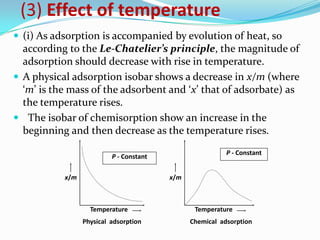
 (i) As adsorption is accompanied by evolution of heat, so
  according to the Le-Chatelier’s principle, the magnitude of
  adsorption should decrease with rise in temperature.
 A physical adsorption isobar shows a decrease in x/m (where
  ‘m’ is the mass of the adsorbent and ‘x’ that of adsorbate) as
  the temperature rises.
 The isobar of chemisorption show an increase in the
  beginning and then decrease as the temperature rises.
                                                          P - Constant
                          P - Constant

           x/m                           x/m


                   Temperature                  Temperature
                 Physical adsorption           Chemical adsorption
Adsorption isotherms
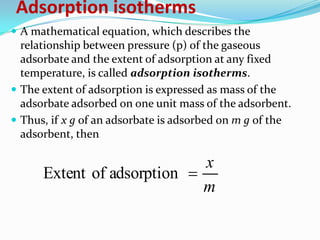
 A mathematical equation, which describes the
  relationship between pressure (p) of the gaseous
  adsorbate and the extent of adsorption at any fixed
  temperature, is called adsorption isotherms.
 The extent of adsorption is expressed as mass of the
  adsorbate adsorbed on one unit mass of the adsorbent.
 Thus, if x g of an adsorbate is adsorbed on m g of the
  adsorbent, then

                             x
      Extent of adsorption 
                             m
Freundlich adsorption isotherm
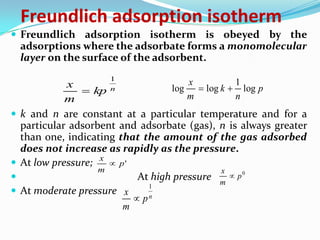
 Freundlich adsorption isotherm is obeyed by the
    adsorptions where the adsorbate forms a monomolecular
    layer on the surface of the adsorbent.
                       1
              x                          x        1
                  kp  n             log  log k  log p
              m                          m        n
   k and n are constant at a particular temperature and for a
    particular adsorbent and adsorbate (gas), n is always greater
    than one, indicating that the amount of the gas adsorbed
    does not increase as rapidly as the pressure.
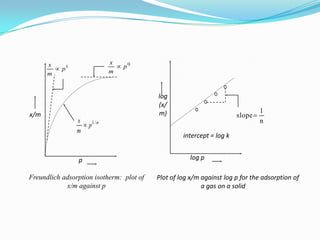
   At low pressure; x  p '
                     m                         x
                             At high pressure m  p 0
                                1
   At moderate pressure x
                              pn
                          m
x
      x
         p1                    p0
      m                      m


                                          log
                                          (x/
                                          m)                                     1
x/m                                                                    slope 
                x                                                                n
                   p1 / n
                m
                                                   intercept = log k


                p                                     log p

Freundlich adsorption isotherm: plot of   Plot of log x/m against log p for the adsorption of
            x/m against p                                 a gas on a solid
Application of adsorption
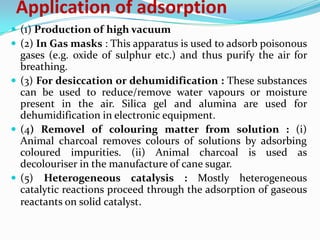
 (1) Production of high vacuum
 (2) In Gas masks : This apparatus is used to adsorb poisonous
  gases (e.g. oxide of sulphur etc.) and thus purify the air for
  breathing.
 (3) For desiccation or dehumidification : These substances
  can be used to reduce/remove water vapours or moisture
  present in the air. Silica gel and alumina are used for
  dehumidification in electronic equipment.
 (4) Removel of colouring matter from solution : (i)
  Animal charcoal removes colours of solutions by adsorbing
  coloured impurities. (ii) Animal charcoal is used as
  decolouriser in the manufacture of cane sugar.
 (5) Heterogeneous catalysis : Mostly heterogeneous
  catalytic reactions proceed through the adsorption of gaseous
  reactants on solid catalyst.
 (6) Separation of inert gases : Due to the difference
  in degree of adsorption of gases by charcoal, a mixture
  of inert gases can be separated by adsorption on
  coconut charcoal at different low temperatures.
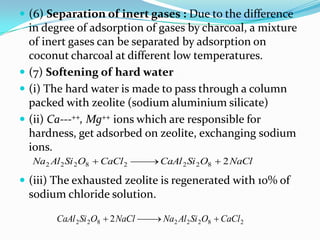
 (7) Softening of hard water
 (i) The hard water is made to pass through a column
  packed with zeolite (sodium aluminium silicate)
 (ii) Ca---++, Mg++ ions which are responsible for
  hardness, get adsorbed on zeolite, exchanging sodium
  ions.
  Na2 Al 2 Si 2 O8  CaCl 2  CaAl 2 Si 2 O8  2 NaCl

 (iii) The exhausted zeolite is regenerated with 10% of
 sodium chloride solution.

       CaAl 2 Si 2O8  2 NaCl  Na2 Al 2 Si 2O8  CaCl 2
 (8) In curing diseases : A number of drugs are adsorbed on
  the germs and kill them or these are adsorbed on the tissues
  and heat them
 (9) Froth floatation process
 A low grade sulphide ore is concentrated by separating it from
  silica and other earthy matter by this method
 (10) In dyeing : Many dyes get adsorbed on the cloth either
  directly or by the use of mordants

Surface chemistry

  • 1.
  • 2.
    Adsorption  The phenomenonof attracting and retaining the molecules of a substance on the surface of a liquid or solid resulting in to higher concentration of the molecules on the surface is called adsorption  Causes of adsorption : Unbalanced forces of attraction or free valencies which is present at the solid or liquid surface, have the property to attract and retain the molecules of a gas or a dissolved substance on to their surfaces with which they come in contact.  Example : Ammonia gas placed in contact with charcoal gets adsorbed on the charcoal
  • 3.
    Some basic termsused in adsorption  Adsorbate : The substance which gets adsorbed on any surface is called adsorbate for example, if a gas gets adsorbed on to the surface of a solid, then the gas is termed as the adsorbate.  The substance on the surface of which adsorption takes place is called adsorbent.  Absorption : When the molecules of a substance are uniformly distributed throughout the body of a solid or liquid. This phenomenon is called absorption.  Desorption : The removal of the adsorbed substance from a surface is called desorption  Sorption : The phenomenon in which adsorption and absorption occur simultaneously is called sorption.
  • 4.
    Characteristics of adsorption (i) Adsorption refers to the existence of a higher concentration of any particular component at the surface of a liquid or a solid phase.  (ii) Adsorption is accompanied by decrease in the G (free energy change) of the system when G  0 adsorption equilibrium is said to be established.  (iii) Adsorption is invariably accompanied by evolution of heat, i.e. it is an exothermic process. In other words, H of adsorption is always negative.  (iv) When a gas is adsorbed, the freedom of movement of its molecules becomes restricted. On account of it decrease in the entropy of the gas after adsorption, i.e. S is negative.
  • 5.
    Classification of adsorption Depending upon the nature of force existing between adsorbate molecule and adsorbent  Physical adsorption : If the forces of attraction existing between adsorbate and adsorbent are Vander Waal’s forces, the adsorption is called physical adsorption. This type of adsorption is also known as physisorption or Vander Waal’s adsorption. It can be easily reversed by heating or decreasing the pressure.  Chemical adsorption : If the forces of attraction existing between adsorbate particles and adsorbent are almost of the same strength as chemical bonds, the adsorption is called chemical adsorption. This type of adsorption is also called as chemisorption or Langmuir adsorption. This type of adsorption cannot be easily reversed
  • 6.
    Physisorption Chemisorption (Vander Waal's (Langmuir adsorption) adsorption) Low heat of adsorption High heat of adsorption usually in range of 20- in the range of 50-400 40 kJ/mol kJ/mol Force of attraction are Forces of attraction are Vander Waal's forces. chemical bond forces. It is reversible It is irreversible
  • 7.
    It is usuallytakes place at low It takes place at high temperature. temperature and decreases with increasing temperature. It is related to the case of It is not related. liquefication of the gas. It forms multimolecular layers. It forms monomolecular layers. It does not require any activation It requires high activation energy. energy. High pressure is favourable. High pressure is favourable. Decrease of pressure causes Decrease of pressure does not desorption cause desorption. It is not very specific. It is highly specific.
  • 8.
    Factors which affectthe extent of adsorption  (1) Nature of the adsorbate (gas) and adsorbent (solid)  (i) In general, easily liquefiable gases e.g., CO2, NH3, Cl2 and SO2 etc. are adsorbed to a greater extent than the elemental gases e.g. H2, O2, N2, He etc. (while chemisorption is specific in nature.)  (ii) Porous and finely powdered solid e.g. charcoal, fullers earth, adsorb more as compared to the hard non-porous materials. Due to this property powdered charcoal is used in gas masks
  • 9.
     2) Surfacearea of the solid adsorbent  (i) The extent of adsorption depends directly upon the surface area of the adsorbent, i.e. larger the surface area of the adsorbent, greater is the extent of adsorption.  (ii) Surface area of a powdered solid adsorbent depends upon its particle size. Smaller the particle size, greater is its surface area
  • 10.
    (3) Effect oftemperature  (i) As adsorption is accompanied by evolution of heat, so according to the Le-Chatelier’s principle, the magnitude of adsorption should decrease with rise in temperature.  A physical adsorption isobar shows a decrease in x/m (where ‘m’ is the mass of the adsorbent and ‘x’ that of adsorbate) as the temperature rises.  The isobar of chemisorption show an increase in the beginning and then decrease as the temperature rises. P - Constant P - Constant x/m x/m Temperature Temperature Physical adsorption Chemical adsorption
  • 11.
    Adsorption isotherms  Amathematical equation, which describes the relationship between pressure (p) of the gaseous adsorbate and the extent of adsorption at any fixed temperature, is called adsorption isotherms.  The extent of adsorption is expressed as mass of the adsorbate adsorbed on one unit mass of the adsorbent.  Thus, if x g of an adsorbate is adsorbed on m g of the adsorbent, then x Extent of adsorption  m
  • 12.
    Freundlich adsorption isotherm Freundlich adsorption isotherm is obeyed by the adsorptions where the adsorbate forms a monomolecular layer on the surface of the adsorbent. 1 x x 1  kp n log  log k  log p m m n  k and n are constant at a particular temperature and for a particular adsorbent and adsorbate (gas), n is always greater than one, indicating that the amount of the gas adsorbed does not increase as rapidly as the pressure.  At low pressure; x  p ' m x  At high pressure m  p 0 1  At moderate pressure x  pn m
  • 13.
    x x  p1  p0 m m log (x/ m) 1 x/m slope  x n  p1 / n m intercept = log k p log p Freundlich adsorption isotherm: plot of Plot of log x/m against log p for the adsorption of x/m against p a gas on a solid
  • 14.
    Application of adsorption (1) Production of high vacuum  (2) In Gas masks : This apparatus is used to adsorb poisonous gases (e.g. oxide of sulphur etc.) and thus purify the air for breathing.  (3) For desiccation or dehumidification : These substances can be used to reduce/remove water vapours or moisture present in the air. Silica gel and alumina are used for dehumidification in electronic equipment.  (4) Removel of colouring matter from solution : (i) Animal charcoal removes colours of solutions by adsorbing coloured impurities. (ii) Animal charcoal is used as decolouriser in the manufacture of cane sugar.  (5) Heterogeneous catalysis : Mostly heterogeneous catalytic reactions proceed through the adsorption of gaseous reactants on solid catalyst.
  • 15.
     (6) Separationof inert gases : Due to the difference in degree of adsorption of gases by charcoal, a mixture of inert gases can be separated by adsorption on coconut charcoal at different low temperatures.  (7) Softening of hard water  (i) The hard water is made to pass through a column packed with zeolite (sodium aluminium silicate)  (ii) Ca---++, Mg++ ions which are responsible for hardness, get adsorbed on zeolite, exchanging sodium ions. Na2 Al 2 Si 2 O8  CaCl 2  CaAl 2 Si 2 O8  2 NaCl  (iii) The exhausted zeolite is regenerated with 10% of sodium chloride solution. CaAl 2 Si 2O8  2 NaCl  Na2 Al 2 Si 2O8  CaCl 2
  • 16.
     (8) Incuring diseases : A number of drugs are adsorbed on the germs and kill them or these are adsorbed on the tissues and heat them  (9) Froth floatation process  A low grade sulphide ore is concentrated by separating it from silica and other earthy matter by this method  (10) In dyeing : Many dyes get adsorbed on the cloth either directly or by the use of mordants