LIGHT
What is
Light?
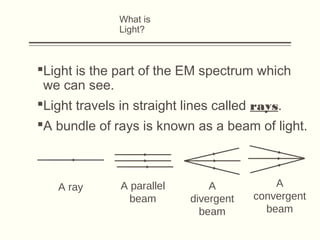
Light is the part of the EM spectrum which
we can see.
Light travels in straight lines called rays.
A bundle of rays is known as a beam of light.
A ray A parallel
beam
A
divergent
beam
A
convergent
beam
Luminous and Non-
Luminous
Luminous objects are those that give off light
on its own.
Example: Light bulb, SunExample: Light bulb, Sun
Non-luminous objects are objects that do not
give off light on its own.
Example: table, board, MoonExample: table, board, Moon
Reflection
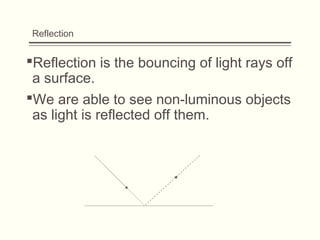
Reflection is the bouncing of light rays off
a surface.
We are able to see non-luminous objects
as light is reflected off them.
Laws of Reflection
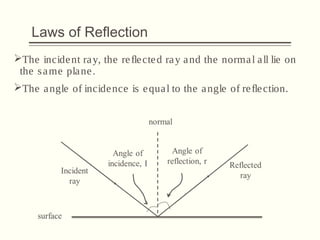
The incident ray, the reflected ray and the normal all lie on
the same plane.
The angle of incidence is equal to the angle of reflection.
Reflection for Different
Surfaces
Regular reflection
•On smooth
surfaces
Diffused reflection
•On rough
surfaces
Properties of Image Formed by Plane
Mirror
Same size as the object
Laterally inverted (left-to-right inversion)
Upright
Virtual (image cannot be caught on a screen)
Object distance is equal to image distance
Ray Diagram for Reflection
Object, O
observer
Image, I
observer
Object, O
observer
Ray Diagram (Extended object)
observer
Refractio
n
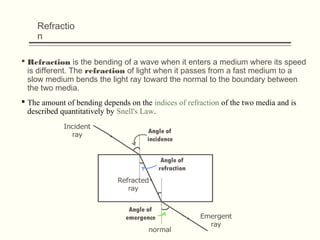
 Refraction is the bending of a wave when it enters a medium where its speed
is different. The refraction of light when it passes from a fast medium to a
slow medium bends the light ray toward the normal to the boundary between
the two media.
 The amount of bending depends on the indices of refraction of the two media and is
described quantitatively by Snell's Law.
Laws of Refraction
first law of reflectionfirst law of reflection
The incident ray, the refracted ray and the normal all lie in the same
plane.
Second law of reflectionSecond law of reflection
For two particular media, the ratio of the sine of the angle of incidence
to the sine of the angle of refraction is a constant.
Refractive
Index
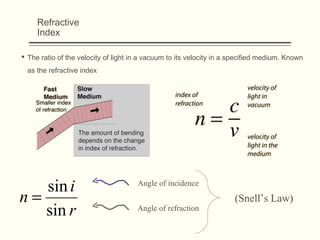
 The ratio of the velocity of light in a vacuum to its velocity in a specified medium. Known
as the refractive index
r
i
n
sin
sin
=
Angle of incidence
Angle of refraction
(Snell’s Law)
Speed and Refractive
Index
Speed of light in vacuum = 3 x 10⁸
ms-1
Light is found to move slower in optically denser
mediums. (e.g. glass and water)
Material n Material n
Vacuum 1.000 Ethyl alcohol 1.362
Air 1.000277 Glycerin 1.473
Water 4/3 Ice 1.31
Carbon disulfide 1.63 Polystyrene 1.59
Methylene
iodide
1.74 Crown glass 1.50-1.62
Diamond 2.417 Flint glass 1.57-1.75
There are two different types of
lenses.
Convex
Lens
Concave
Lens
SPHERICAL LENS
Start with the convex lens.
Convex lenses are also known as
converging lenses
Concave lenses are also known as
diverging lenses
Convex
lenses
Concave
lensesAND
Principal focus
Incident rays of light are parallel
Convex lenses
Incident rays are parallel
Rays leaving the lens are diverging
Concavelenses
Forming Images
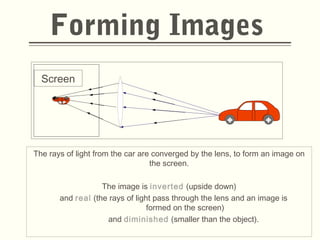
The rays of light from the car are converged by the lens, to form an image on
the screen.
The image is inverted (upside down)
and real (the rays of light pass through the lens and an image is
formed on the screen)
and diminished (smaller than the object).
Screen
Film/screen
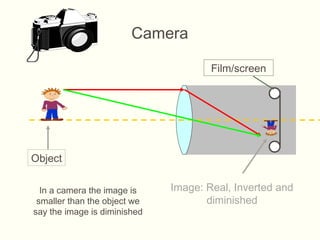
Image: Real, Inverted and
diminished
Object
In a camera the image is
smaller than the object we
say the image is diminished
Camera

light

  • 1.
  • 2.
    What is Light? Light isthe part of the EM spectrum which we can see. Light travels in straight lines called rays. A bundle of rays is known as a beam of light. A ray A parallel beam A divergent beam A convergent beam
  • 3.
    Luminous and Non- Luminous Luminousobjects are those that give off light on its own. Example: Light bulb, SunExample: Light bulb, Sun Non-luminous objects are objects that do not give off light on its own. Example: table, board, MoonExample: table, board, Moon
  • 4.
    Reflection Reflection is thebouncing of light rays off a surface. We are able to see non-luminous objects as light is reflected off them.
  • 5.
    Laws of Reflection Theincident ray, the reflected ray and the normal all lie on the same plane. The angle of incidence is equal to the angle of reflection.
  • 6.
    Reflection for Different Surfaces Regularreflection •On smooth surfaces Diffused reflection •On rough surfaces
  • 7.
    Properties of ImageFormed by Plane Mirror Same size as the object Laterally inverted (left-to-right inversion) Upright Virtual (image cannot be caught on a screen) Object distance is equal to image distance
  • 8.
    Ray Diagram forReflection Object, O observer
  • 9.
  • 10.
  • 11.
  • 12.
    Refractio n  Refraction is thebending of a wave when it enters a medium where its speed is different. The refraction of light when it passes from a fast medium to a slow medium bends the light ray toward the normal to the boundary between the two media.  The amount of bending depends on the indices of refraction of the two media and is described quantitatively by Snell's Law.
  • 13.
    Laws of Refraction firstlaw of reflectionfirst law of reflection The incident ray, the refracted ray and the normal all lie in the same plane. Second law of reflectionSecond law of reflection For two particular media, the ratio of the sine of the angle of incidence to the sine of the angle of refraction is a constant.
  • 14.
    Refractive Index  The ratioof the velocity of light in a vacuum to its velocity in a specified medium. Known as the refractive index r i n sin sin = Angle of incidence Angle of refraction (Snell’s Law)
  • 15.
    Speed and Refractive Index Speedof light in vacuum = 3 x 10⁸ ms-1 Light is found to move slower in optically denser mediums. (e.g. glass and water) Material n Material n Vacuum 1.000 Ethyl alcohol 1.362 Air 1.000277 Glycerin 1.473 Water 4/3 Ice 1.31 Carbon disulfide 1.63 Polystyrene 1.59 Methylene iodide 1.74 Crown glass 1.50-1.62 Diamond 2.417 Flint glass 1.57-1.75
  • 16.
    There are twodifferent types of lenses. Convex Lens Concave Lens SPHERICAL LENS
  • 17.
    Start with theconvex lens. Convex lenses are also known as converging lenses Concave lenses are also known as diverging lenses Convex lenses Concave lensesAND
  • 18.
    Principal focus Incident raysof light are parallel Convex lenses
  • 19.
    Incident rays areparallel Rays leaving the lens are diverging Concavelenses
  • 20.
    Forming Images The raysof light from the car are converged by the lens, to form an image on the screen. The image is inverted (upside down) and real (the rays of light pass through the lens and an image is formed on the screen) and diminished (smaller than the object). Screen
  • 21.
    Film/screen Image: Real, Invertedand diminished Object In a camera the image is smaller than the object we say the image is diminished Camera