Physical Media
PHYSICAL MEDIA
Physical Media
Physical Media
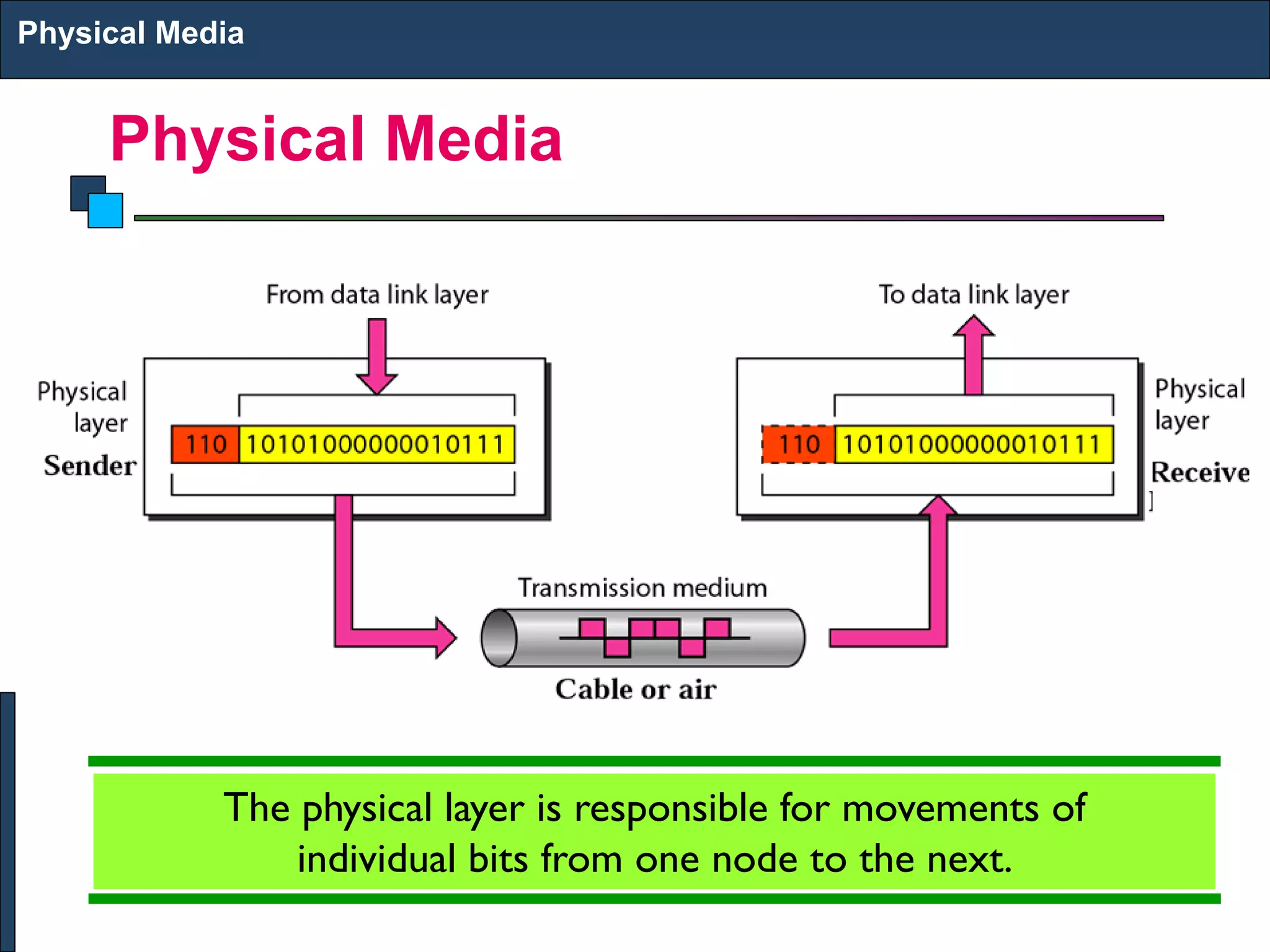
The physical layer is responsible for movements of
individual bits from one node to the next.
Physical Links
How to make computers talk across a wire?
How to share the wire?
Physical Media
From Signals to Packets
Physical Media
Analog Signal
“Digital” Signal
Bit Stream 0 0 1 0 1 1 1 0 0 0 1
Packets
0100010101011100101010101011101110000001111010101110101010101101011010111001
Header/Body Header/Body Header/Body
Receiver
Sender
Packet
Transmission
Analog Signals
Physical Media
➢ An Analog signal is any continuous signal for which the
time varying feature is a representation of some other time
varying quantity.
➢ E.g.,
in sound recording, fluctuations in air pressure (sound) strike the
diaphragm of a microphone which induces corresponding fluctuations in
the current produced by a coil in an electromagnetic microphone, or the
voltage produced by a condenser microphone. The voltage or the
current is said to be an "analog" of the sound.
Digital Signals
Physical Media
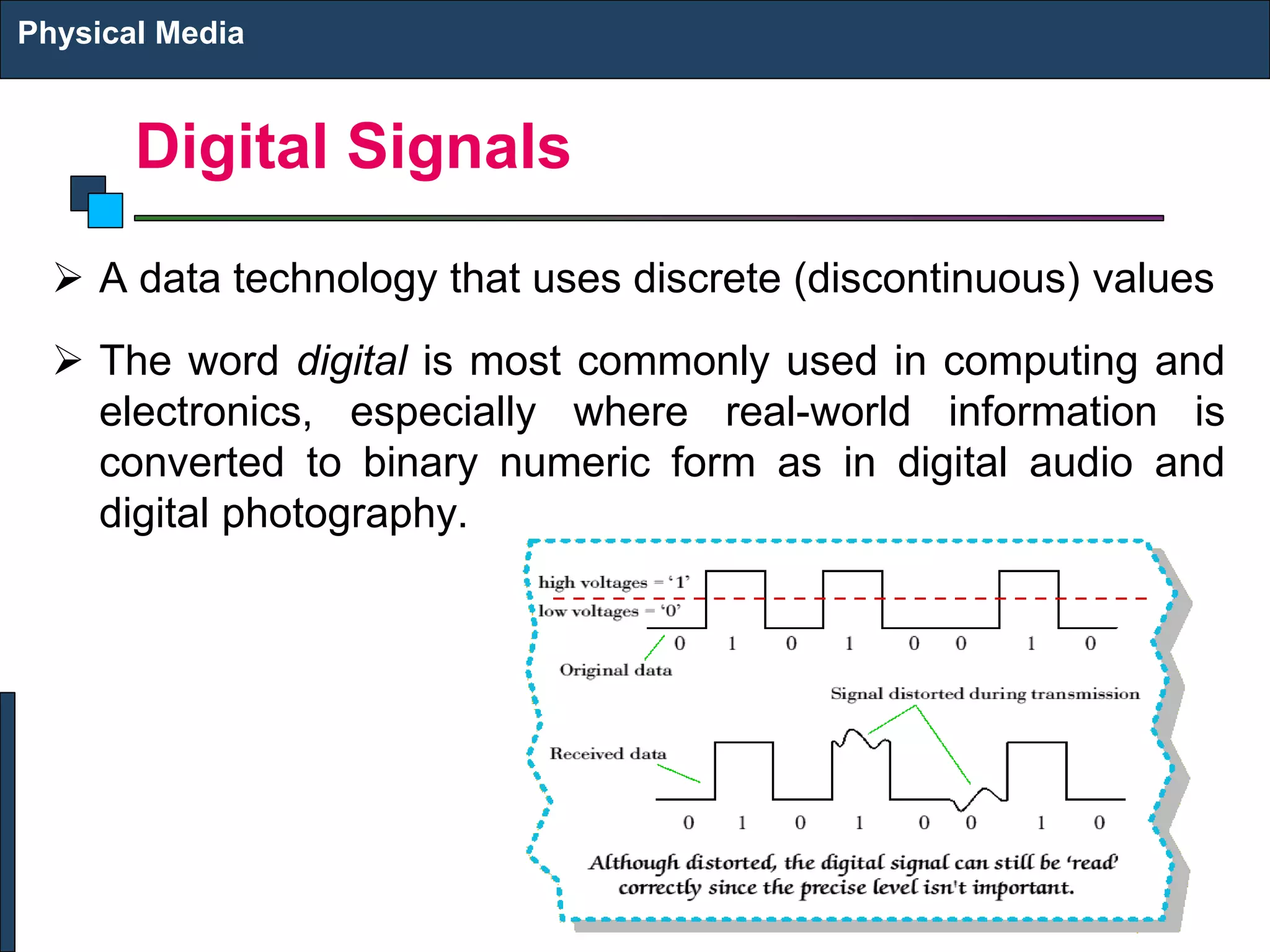
➢ A data technology that uses discrete (discontinuous) values
➢ The word digital is most commonly used in computing and
electronics, especially where real-world information is
converted to binary numeric form as in digital audio and
digital photography.
Transmission Media
Physical Media
Transmission Media
Physical Media
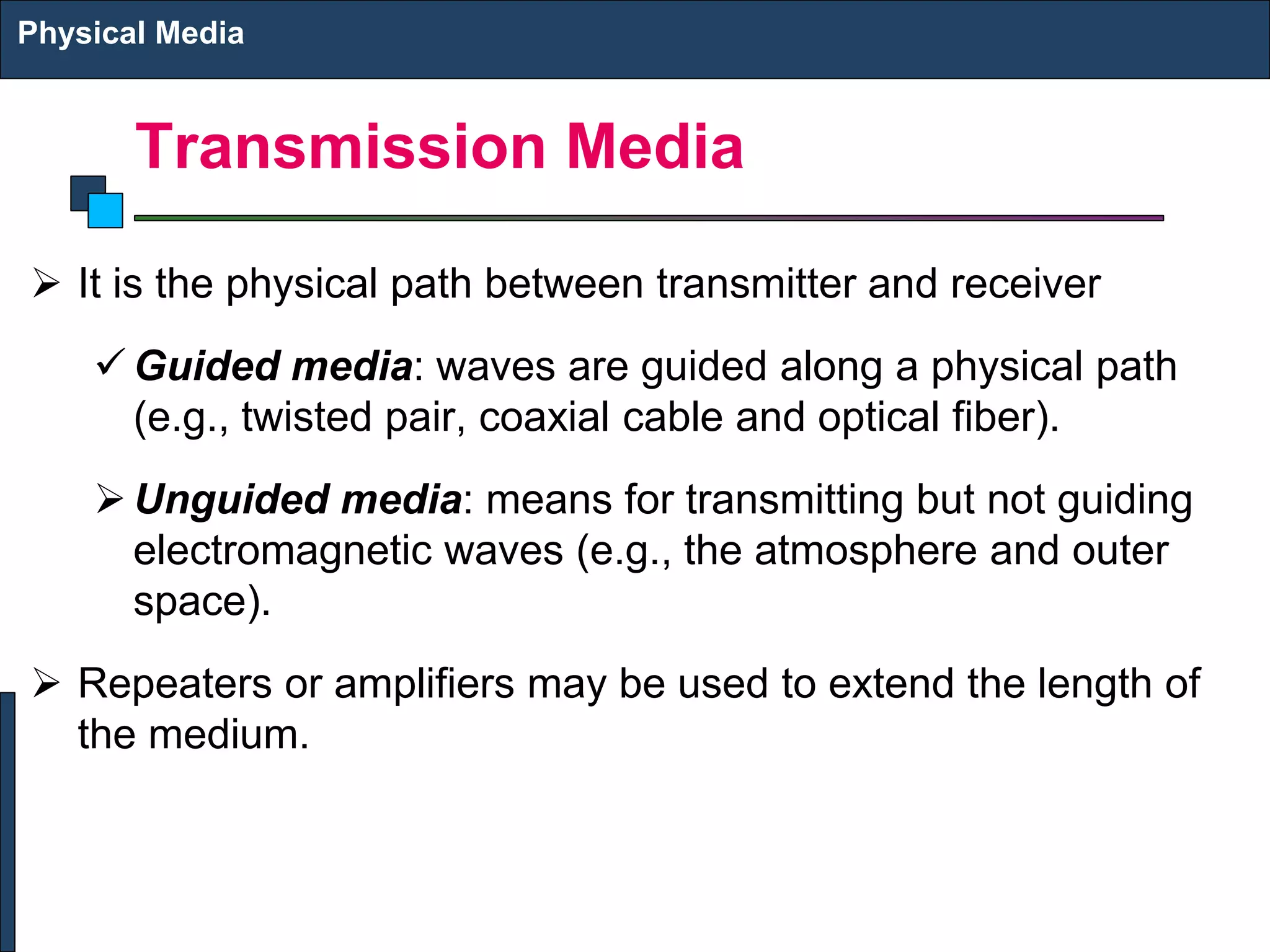
➢ It is the physical path between transmitter and receiver
✓ Guided media: waves are guided along a physical path
(e.g., twisted pair, coaxial cable and optical fiber).
➢Unguided media: means for transmitting but not guiding
electromagnetic waves (e.g., the atmosphere and outer
space).
➢ Repeaters or amplifiers may be used to extend the length of
the medium.
Transmission Media Choices
Physical Media
➢ Twisted pair
➢ Coaxial cable
➢ Optical fiber
➢ Wireless communications
Physical Media
Copper
Thick Coaxial Cable
Thin Coaxial Cable
Twisted Pair
Shielded Twisted pair (STP)
Unshielded Twisted Pair (UTS)
Optical Fiber
Multi-mode
Single-mode
Wireless
Short Range
Medium Range (Line of Sight)
Satellite
Physical Media
1) Coaxial Cable
Coaxial cable is a copper-cored
cable surrounded by a heavy
shielding and is used to
connect computers in a
network.
Outer conductor shields the
inner conductor from picking up
stray signal from the air
High bandwidth but lossy
channel.
Repeater is used to regenerate
the weakened signals.
Physical Media
Cont’d
Physical Media
Cont’d
Divided into two basic categories
for coax used in LANs.
– 50-ohm cable [baseband]
– 75-ohm cable [broadband or
single channel baseband]
In general, coax has better noise
immunity for higher frequencies
than twisted pair.
Coaxial cable provides much
higher bandwidth than twisted
pair.
However, cable is ‘bulky’.
Physical Media
Category Impedance Use
RG-59 75 W Cable TV
RG-58 50 W
Thin
Ethernet
RG-11 50 W
Thick
Ethernet
Cont’d
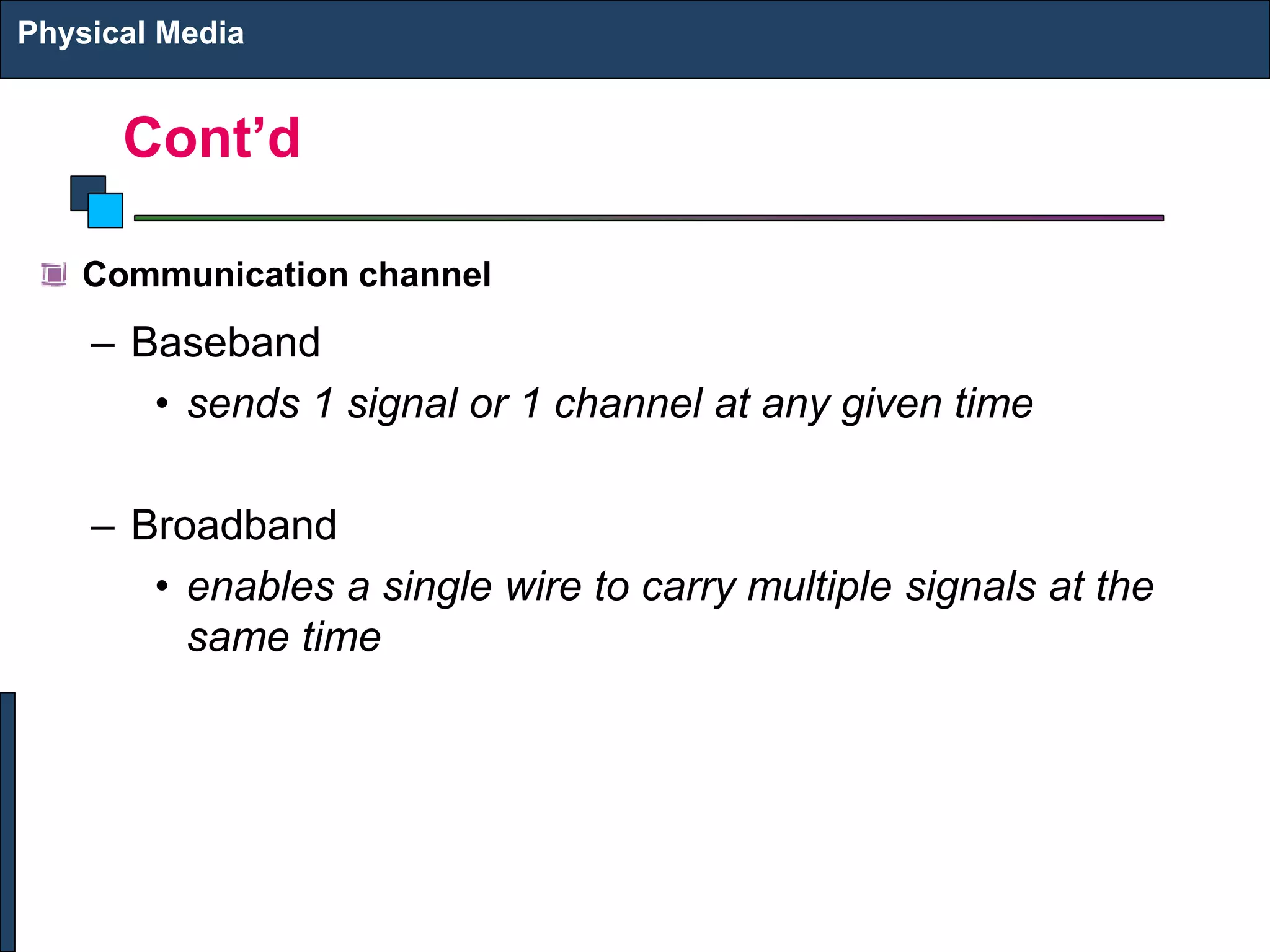
Communication channel
– Baseband
• sends 1 signal or 1 channel at any given time
– Broadband
• enables a single wire to carry multiple signals at the
same time
Physical Media
2) Twisted Pair
Twisted-pair is a type of cabling that is used for telephone
communications and most modern Ethernet networks.
A pair of wires (copper or steel coated with copper) forms a circuit that
can transmit data.
The pairs are twisted to provide protection against crosstalk, the noise
generated by adjacent pairs.
The signal is transmitted through one wire and a ground reference is
transmitted in the other wire.
Physical Media
Cont’d
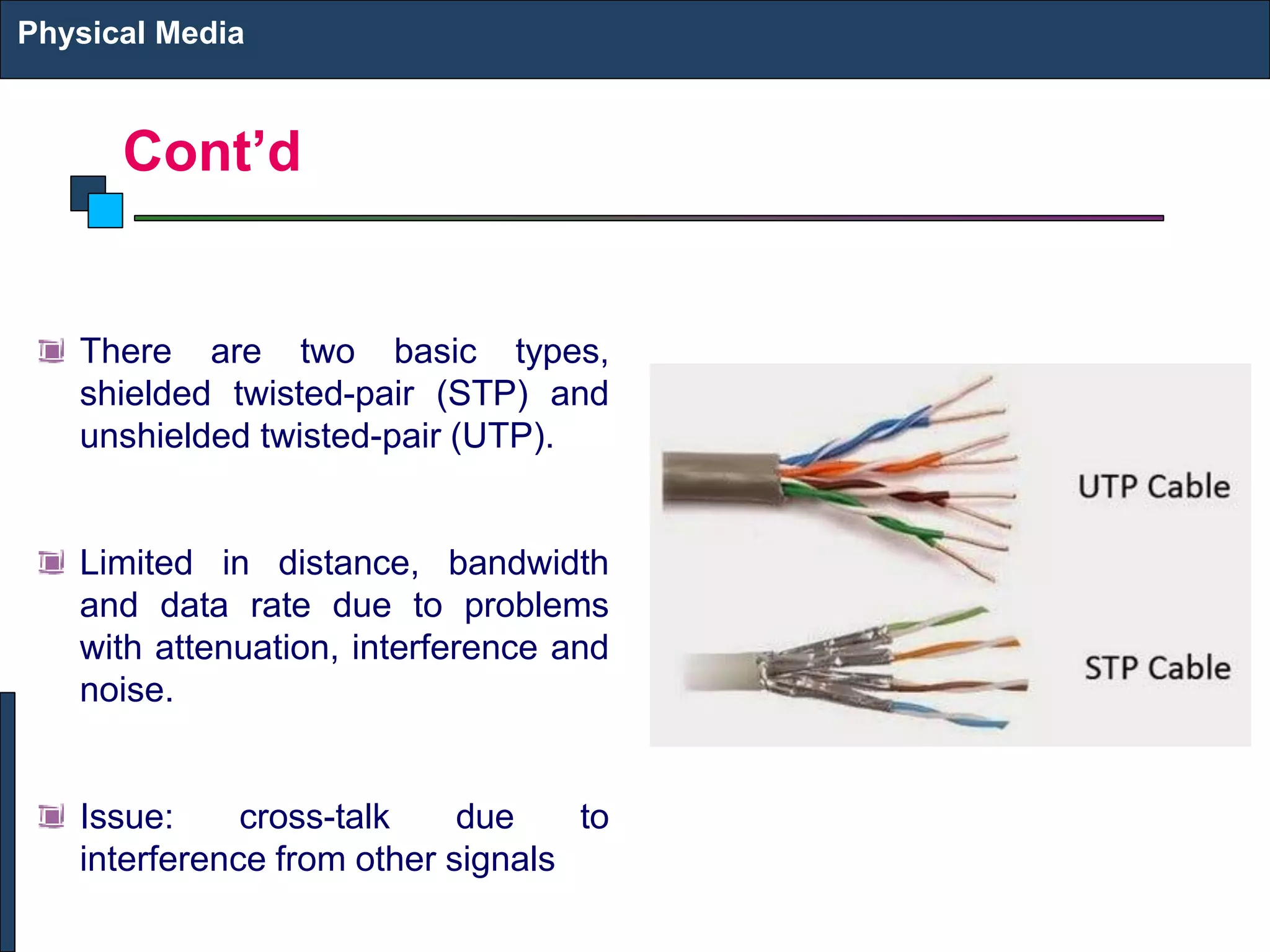
There are two basic types,
shielded twisted-pair (STP) and
unshielded twisted-pair (UTP).
Limited in distance, bandwidth
and data rate due to problems
with attenuation, interference and
noise.
Issue: cross-talk due to
interference from other signals
Physical Media
a) Unshielded Twisted Pair (UTP)
Physical Media
 Typically wrapped inside a plastic cover (for mechanical protection)
 Here below a sample UTP cable with 4 unshielded twisted pairs of wires
Cont’d
Consists of 4 pairs (8 wires) of
insulated copper wires typically
about 1 mm thick.
The wires are twisted together in
a helical form.
Twisting reduces the interference
between pairs of wires.
High bandwidth and High
attenuation channel.
Flexible and cheap cable.
Physical Media
Cont’d
UTP comes in several categories that are
➢ based on the number of twists in the wires,
➢ the diameter of the wires and
➢ the material used in the wires.
The categories are
➢ CAT 3,
➢ CAT 4,
➢ CAT 5, and enhanced CAT 5
➢ CAT 6 (latest)
Category 3 is the wiring used primarily for telephone
connections.
Category 5e and Category 6 are currently the most common
Ethernet cables used.
Physical Media
Cont’d
UTP comes in several categories that are
➢ based on the number of twists in the wires, the diameter of the
wires and the material used in the wires.
The categories are
Physical Media
Categories Description
CAT 1 - The lowest quality, and only good for voice,
- Mainly found in very old buildings, not recommended now
CAT 2 - Good for voice and low data rates
- Up to 4Mbps for low-speed token ring networks)
CAT 3 - At least 3 twists per foot,
- Up to 10 Mbps (common in phone networks in residential buildings)
CAT 4 - Up to 16 Mbps (mainly for token rings)
CAT 5/5e - Up to 100 Mbps (common for networks targeted for high-speed data
communications
CAT 6 Latest and more twists than Cat 5, up to 1 Gbps
Cont’d
Physical Media
Categories
Bandwidth Attenuation Impedance Application
CAT 3 16 MHz 11.5 dB 100 ohms
- Voice applications
- 10baseT (10Mbps) Ethernet
CAT 4 20 MHz 7.5 dB 100 ohms 10baseT (10Mbps) Ethernet
CAT 5 100 MHz 24.0 dB 100 ohms
- High-speed data transmission
- 10BaseT (10 Mbps) Ethernet
- Fast Ethernet (100 Mbps)
CAT 5e 150 MHz 24.0 dB 100 ohms
- Transmits high-speed data
- Fast Ethernet (100 Mbps),
- Gigabit Ethernet (1000 Mbps)
- 155 Mbps ATM
CAT 6 250 MHz 19.8 dB 100 ohms
- Transmits high-speed data
Gigabit Ethernet (1000 Mbps)
- 10 Gig Ethernet (10000 Mbps)
Cont’d
Baseband
➢ Bidirectional
➢ Bandwidth
➢ attenuation ,
➢ Repeaters
Broadband
➢ Analog,
➢ unidirectional ,
➢ dual-cable,
➢ mid-split
➢ amplifiers
Physical Media
b) Shielded Twisted Pair (STP)
Physical Media
 STP cables are similar to UTP cables, except there is a metal foil or
braided-metal-mesh cover that encases each pair of insulated wires
3) Fiber Media
Optical fibers use light to send information through the
optical medium.
It uses the principal of total internal reflection.
Modulated light transmissions are used to transmit the
signal.
Physical Media
Cont’d
Physical Media
Fiber Media
Light travels through the optical media by the way of total
internal reflection.
Modulation scheme used is intensity modulation.
Two types of Fiber media :
➢ Multimode
➢ Single mode
Physical Media
Single and Multimode Fiber
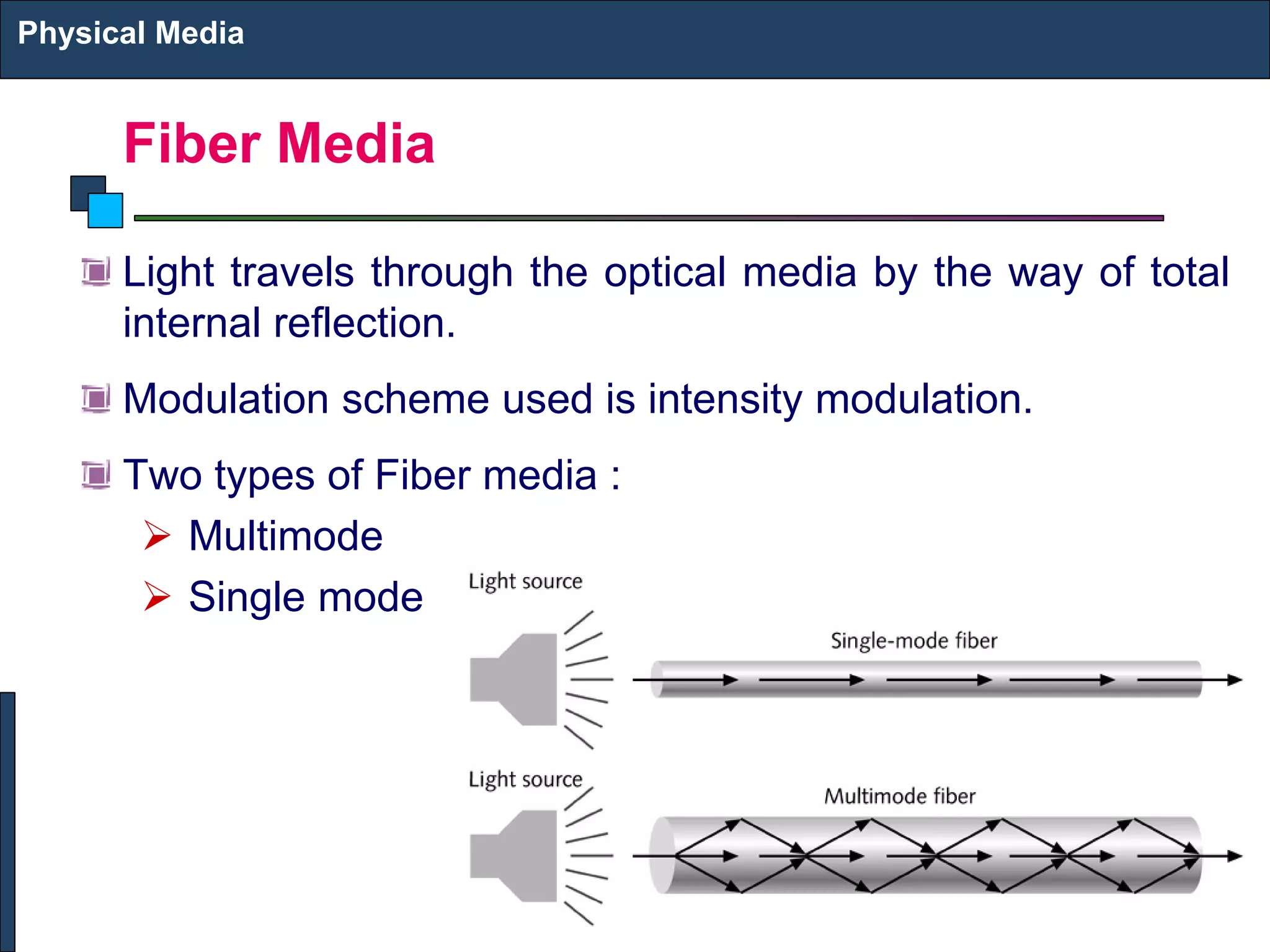
Single-mode fiber
Carries light pulses along single path
Uses Laser Light Source
Has a very small core and carry only one beam of light.
It can support Gbps data rates over > 100 Km without using
repeaters.
Multimode fiber
➢ Many pulses of light generated by LED travel at different
angles
➢ Can support less bandwidth than Single-mode Fiber.
Physical Media
Fiber Media
The bandwidth of the fiber is
limited due to the dispersion effect.
Distance Bandwidth product of a
fiber is almost a constant.
Fiber optic cables consist of
multiple fibers packed inside
protective covering.
Contains one or several glass
fibers at its core
Surrounding the fibers is a layer
called cladding
Physical Media
Fiber Optic Cable
FO Cable may have 1 to
over 1000 fibers
Physical Media
Fiber Optic Cable
Physical Media
core
cladding jacket
light
c
(a) Geometry of optical fiber
(b) Reflection in optical fiber
Total Internal Reflection
Physical Media
Wireless Media
Very useful in difficult terrain where cable laying is not
possible.
Provides mobility to communication nodes.
Right of way and cable laying costs can be reduced.
Susceptible to rain, atmospheric variations and Objects in
transmission path.
Physical Media
Wireless Media
Infrared
➢ Infrared radiation (IR) is electromagnetic radiation with a wavelength
between 0.7 and 300 micrometers
Microwave
➢ Microwaves are electromagnetic waves with wavelengths ranging
from as long as one meter to as short as one millimeter
Radio
➢ Radio waves transmit music, conversations, pictures and data
invisibly through the air, often over millions of miles wavelengths in
the electromagnetic spectrum longer than microwave
Physical Media
Wireless Media
Indoor : 10 – 50m : Bluetooth, WLAN
Short range Outdoor : 50 – 200m: WLAN
➢ Mid Range Outdoor : 200m – 5 Km : Global
➢ System for Mobile Communications GSM, Code
➢ Division Multiple Access CDMA, WLAN Point-to-Point, Wi-Max
Long Range Outdoor :
➢ 5 Km – 100 Km : Microwave Point-to-Point
Long Distance Communication :
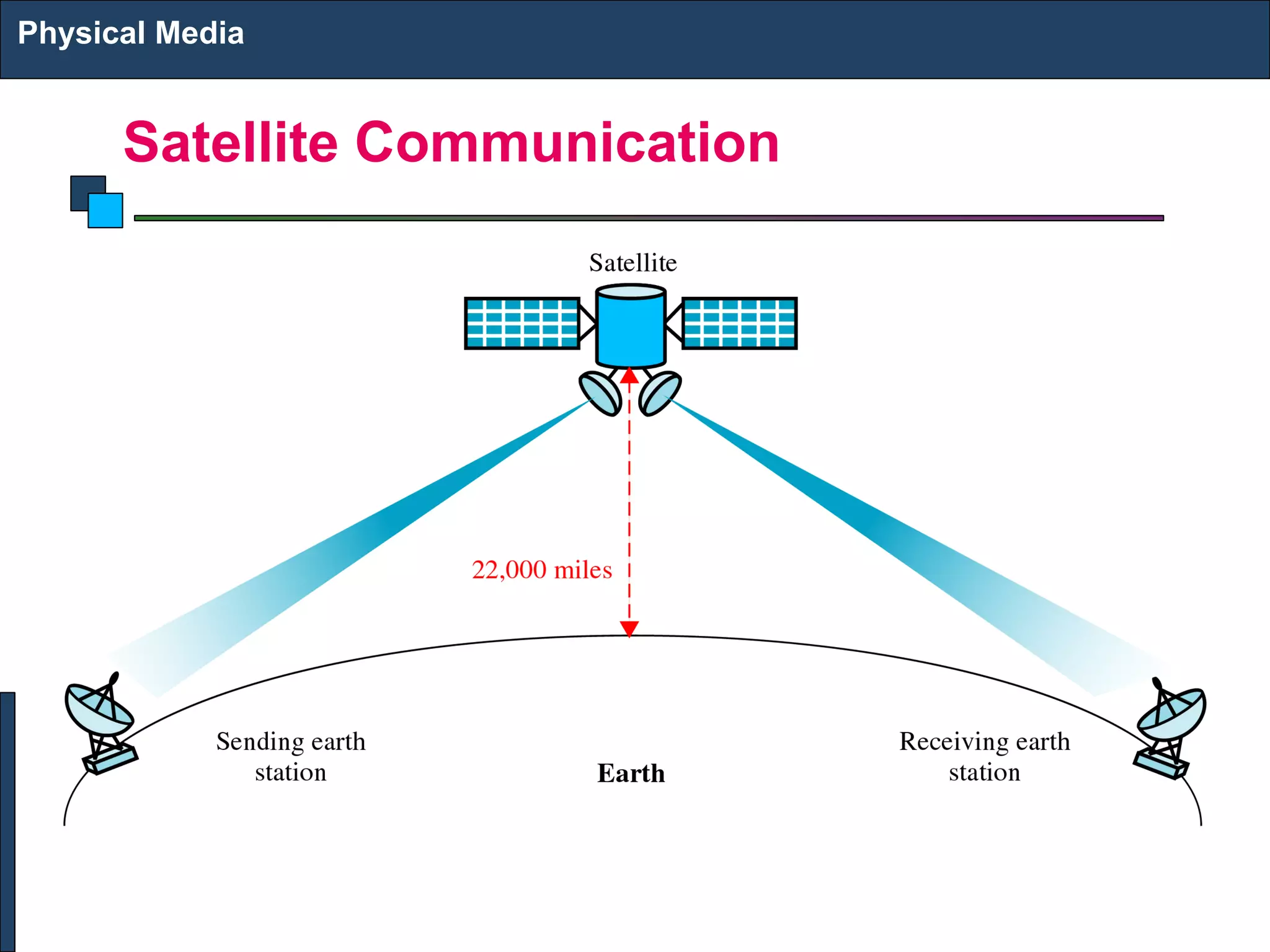
➢ Across Continents : Satellite Communication
Physical Media
Electromagnetic spectrum
Physical Media
Wireless LAN
Physical Media
Internet
Router
Switch
Access Point
Access Point
PC
PC
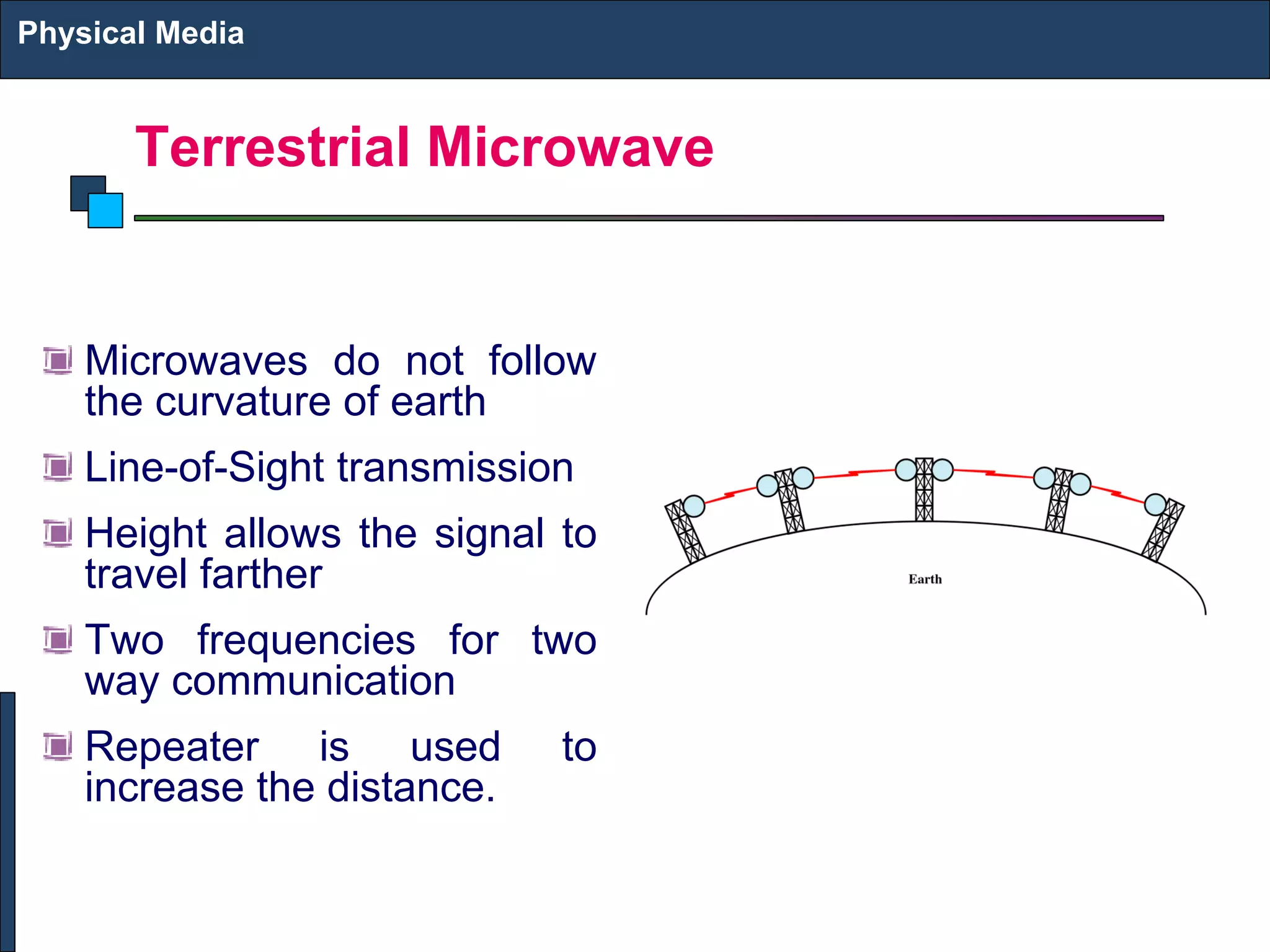
Terrestrial Microwave
Microwaves do not follow
the curvature of earth
Line-of-Sight transmission
Height allows the signal to
travel farther
Two frequencies for two
way communication
Repeater is used to
increase the distance.
Physical Media
Satellite Communication
Physical Media

Physical Layer- Transmission Media.pdf

  • 1.
  • 2.
    Physical Media Physical Media Thephysical layer is responsible for movements of individual bits from one node to the next.
  • 3.
    Physical Links How tomake computers talk across a wire? How to share the wire? Physical Media
  • 4.
    From Signals toPackets Physical Media Analog Signal “Digital” Signal Bit Stream 0 0 1 0 1 1 1 0 0 0 1 Packets 0100010101011100101010101011101110000001111010101110101010101101011010111001 Header/Body Header/Body Header/Body Receiver Sender Packet Transmission
  • 5.
    Analog Signals Physical Media ➢An Analog signal is any continuous signal for which the time varying feature is a representation of some other time varying quantity. ➢ E.g., in sound recording, fluctuations in air pressure (sound) strike the diaphragm of a microphone which induces corresponding fluctuations in the current produced by a coil in an electromagnetic microphone, or the voltage produced by a condenser microphone. The voltage or the current is said to be an "analog" of the sound.
  • 6.
    Digital Signals Physical Media ➢A data technology that uses discrete (discontinuous) values ➢ The word digital is most commonly used in computing and electronics, especially where real-world information is converted to binary numeric form as in digital audio and digital photography.
  • 7.
  • 8.
    Transmission Media Physical Media ➢It is the physical path between transmitter and receiver ✓ Guided media: waves are guided along a physical path (e.g., twisted pair, coaxial cable and optical fiber). ➢Unguided media: means for transmitting but not guiding electromagnetic waves (e.g., the atmosphere and outer space). ➢ Repeaters or amplifiers may be used to extend the length of the medium.
  • 9.
    Transmission Media Choices PhysicalMedia ➢ Twisted pair ➢ Coaxial cable ➢ Optical fiber ➢ Wireless communications
  • 10.
    Physical Media Copper Thick CoaxialCable Thin Coaxial Cable Twisted Pair Shielded Twisted pair (STP) Unshielded Twisted Pair (UTS) Optical Fiber Multi-mode Single-mode Wireless Short Range Medium Range (Line of Sight) Satellite Physical Media
  • 11.
    1) Coaxial Cable Coaxialcable is a copper-cored cable surrounded by a heavy shielding and is used to connect computers in a network. Outer conductor shields the inner conductor from picking up stray signal from the air High bandwidth but lossy channel. Repeater is used to regenerate the weakened signals. Physical Media
  • 12.
  • 13.
    Cont’d Divided into twobasic categories for coax used in LANs. – 50-ohm cable [baseband] – 75-ohm cable [broadband or single channel baseband] In general, coax has better noise immunity for higher frequencies than twisted pair. Coaxial cable provides much higher bandwidth than twisted pair. However, cable is ‘bulky’. Physical Media Category Impedance Use RG-59 75 W Cable TV RG-58 50 W Thin Ethernet RG-11 50 W Thick Ethernet
  • 14.
    Cont’d Communication channel – Baseband •sends 1 signal or 1 channel at any given time – Broadband • enables a single wire to carry multiple signals at the same time Physical Media
  • 15.
    2) Twisted Pair Twisted-pairis a type of cabling that is used for telephone communications and most modern Ethernet networks. A pair of wires (copper or steel coated with copper) forms a circuit that can transmit data. The pairs are twisted to provide protection against crosstalk, the noise generated by adjacent pairs. The signal is transmitted through one wire and a ground reference is transmitted in the other wire. Physical Media
  • 16.
    Cont’d There are twobasic types, shielded twisted-pair (STP) and unshielded twisted-pair (UTP). Limited in distance, bandwidth and data rate due to problems with attenuation, interference and noise. Issue: cross-talk due to interference from other signals Physical Media
  • 17.
    a) Unshielded TwistedPair (UTP) Physical Media  Typically wrapped inside a plastic cover (for mechanical protection)  Here below a sample UTP cable with 4 unshielded twisted pairs of wires
  • 18.
    Cont’d Consists of 4pairs (8 wires) of insulated copper wires typically about 1 mm thick. The wires are twisted together in a helical form. Twisting reduces the interference between pairs of wires. High bandwidth and High attenuation channel. Flexible and cheap cable. Physical Media
  • 19.
    Cont’d UTP comes inseveral categories that are ➢ based on the number of twists in the wires, ➢ the diameter of the wires and ➢ the material used in the wires. The categories are ➢ CAT 3, ➢ CAT 4, ➢ CAT 5, and enhanced CAT 5 ➢ CAT 6 (latest) Category 3 is the wiring used primarily for telephone connections. Category 5e and Category 6 are currently the most common Ethernet cables used. Physical Media
  • 20.
    Cont’d UTP comes inseveral categories that are ➢ based on the number of twists in the wires, the diameter of the wires and the material used in the wires. The categories are Physical Media Categories Description CAT 1 - The lowest quality, and only good for voice, - Mainly found in very old buildings, not recommended now CAT 2 - Good for voice and low data rates - Up to 4Mbps for low-speed token ring networks) CAT 3 - At least 3 twists per foot, - Up to 10 Mbps (common in phone networks in residential buildings) CAT 4 - Up to 16 Mbps (mainly for token rings) CAT 5/5e - Up to 100 Mbps (common for networks targeted for high-speed data communications CAT 6 Latest and more twists than Cat 5, up to 1 Gbps
  • 21.
    Cont’d Physical Media Categories Bandwidth AttenuationImpedance Application CAT 3 16 MHz 11.5 dB 100 ohms - Voice applications - 10baseT (10Mbps) Ethernet CAT 4 20 MHz 7.5 dB 100 ohms 10baseT (10Mbps) Ethernet CAT 5 100 MHz 24.0 dB 100 ohms - High-speed data transmission - 10BaseT (10 Mbps) Ethernet - Fast Ethernet (100 Mbps) CAT 5e 150 MHz 24.0 dB 100 ohms - Transmits high-speed data - Fast Ethernet (100 Mbps), - Gigabit Ethernet (1000 Mbps) - 155 Mbps ATM CAT 6 250 MHz 19.8 dB 100 ohms - Transmits high-speed data Gigabit Ethernet (1000 Mbps) - 10 Gig Ethernet (10000 Mbps)
  • 22.
    Cont’d Baseband ➢ Bidirectional ➢ Bandwidth ➢attenuation , ➢ Repeaters Broadband ➢ Analog, ➢ unidirectional , ➢ dual-cable, ➢ mid-split ➢ amplifiers Physical Media
  • 23.
    b) Shielded TwistedPair (STP) Physical Media  STP cables are similar to UTP cables, except there is a metal foil or braided-metal-mesh cover that encases each pair of insulated wires
  • 24.
    3) Fiber Media Opticalfibers use light to send information through the optical medium. It uses the principal of total internal reflection. Modulated light transmissions are used to transmit the signal. Physical Media
  • 25.
  • 26.
    Fiber Media Light travelsthrough the optical media by the way of total internal reflection. Modulation scheme used is intensity modulation. Two types of Fiber media : ➢ Multimode ➢ Single mode Physical Media
  • 27.
    Single and MultimodeFiber Single-mode fiber Carries light pulses along single path Uses Laser Light Source Has a very small core and carry only one beam of light. It can support Gbps data rates over > 100 Km without using repeaters. Multimode fiber ➢ Many pulses of light generated by LED travel at different angles ➢ Can support less bandwidth than Single-mode Fiber. Physical Media
  • 28.
    Fiber Media The bandwidthof the fiber is limited due to the dispersion effect. Distance Bandwidth product of a fiber is almost a constant. Fiber optic cables consist of multiple fibers packed inside protective covering. Contains one or several glass fibers at its core Surrounding the fibers is a layer called cladding Physical Media
  • 29.
    Fiber Optic Cable FOCable may have 1 to over 1000 fibers Physical Media
  • 30.
    Fiber Optic Cable PhysicalMedia core cladding jacket light c (a) Geometry of optical fiber (b) Reflection in optical fiber
  • 31.
  • 32.
    Wireless Media Very usefulin difficult terrain where cable laying is not possible. Provides mobility to communication nodes. Right of way and cable laying costs can be reduced. Susceptible to rain, atmospheric variations and Objects in transmission path. Physical Media
  • 33.
    Wireless Media Infrared ➢ Infraredradiation (IR) is electromagnetic radiation with a wavelength between 0.7 and 300 micrometers Microwave ➢ Microwaves are electromagnetic waves with wavelengths ranging from as long as one meter to as short as one millimeter Radio ➢ Radio waves transmit music, conversations, pictures and data invisibly through the air, often over millions of miles wavelengths in the electromagnetic spectrum longer than microwave Physical Media
  • 34.
    Wireless Media Indoor :10 – 50m : Bluetooth, WLAN Short range Outdoor : 50 – 200m: WLAN ➢ Mid Range Outdoor : 200m – 5 Km : Global ➢ System for Mobile Communications GSM, Code ➢ Division Multiple Access CDMA, WLAN Point-to-Point, Wi-Max Long Range Outdoor : ➢ 5 Km – 100 Km : Microwave Point-to-Point Long Distance Communication : ➢ Across Continents : Satellite Communication Physical Media
  • 35.
  • 36.
  • 37.
    Terrestrial Microwave Microwaves donot follow the curvature of earth Line-of-Sight transmission Height allows the signal to travel farther Two frequencies for two way communication Repeater is used to increase the distance. Physical Media
  • 38.