Network Media Types
Network Media
 is the actual path over which an electrical signal travels as it moves from one
component to another.
 The Communication Medium/Network Media plays an important role in Networks.
If the medium works well and properly, then the speed of transferring data is good
but if the medium is not working properly, then your data would be delayed or
would not be sent or even can be lost during transmission. In Computer Networks,
we call this speed of transmitting data, as DATA RATE.
Two Types of networks that can be set-up
1. Wired Network
2. Wireless Network
WIRED NETWORK
is mostly set-up using an Ethernet Cable.
This can be done using 3 technologies:
1. Twisted Pair Wires(UTP cable, STP cable)
2. Coaxial Cables
3. Fibre Optics
WIRED NETWORK
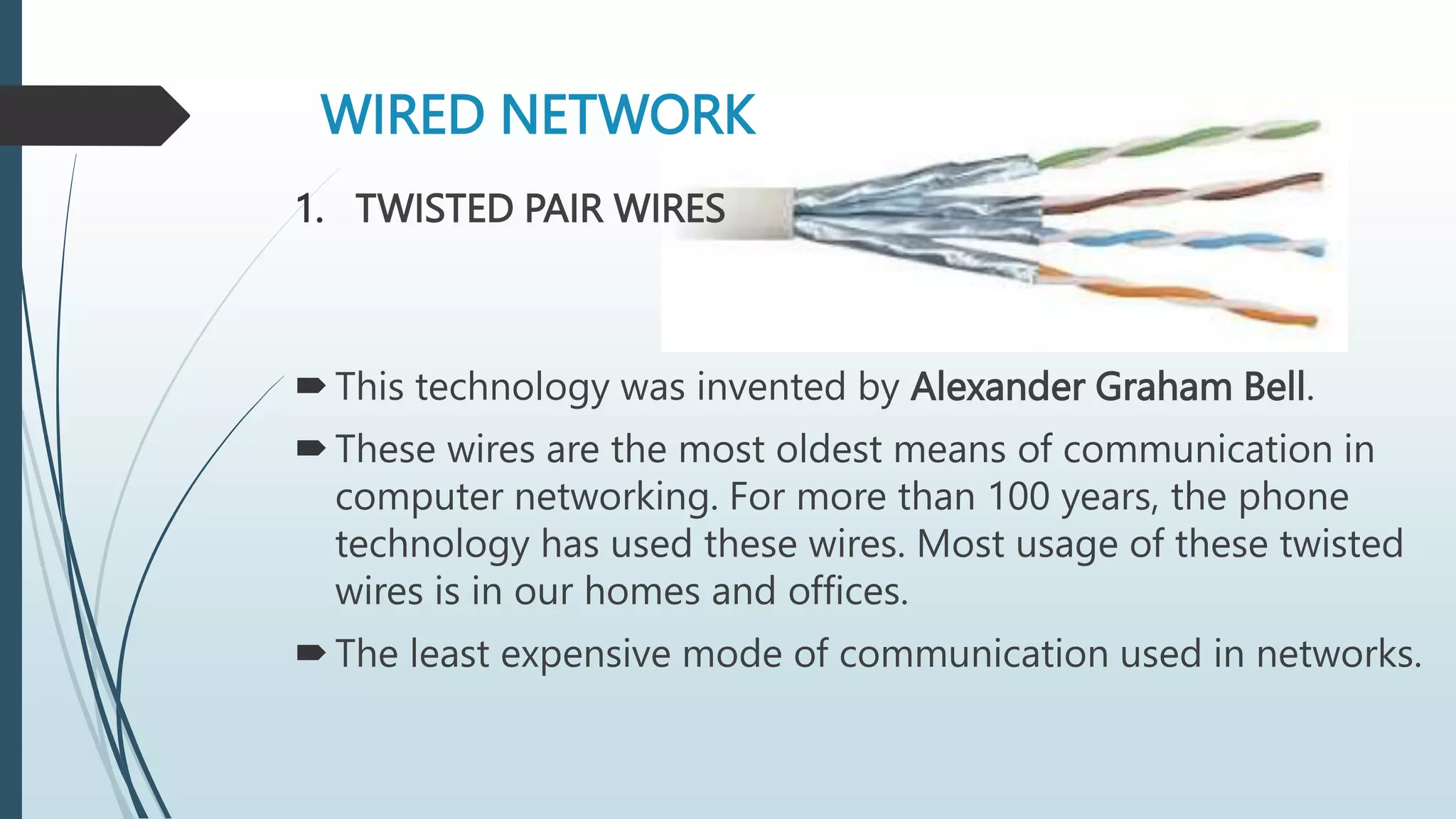
1. TWISTED PAIR WIRES
This technology was invented by Alexander Graham Bell.
These wires are the most oldest means of communication in
computer networking. For more than 100 years, the phone
technology has used these wires. Most usage of these twisted
wires is in our homes and offices.
The least expensive mode of communication used in networks.
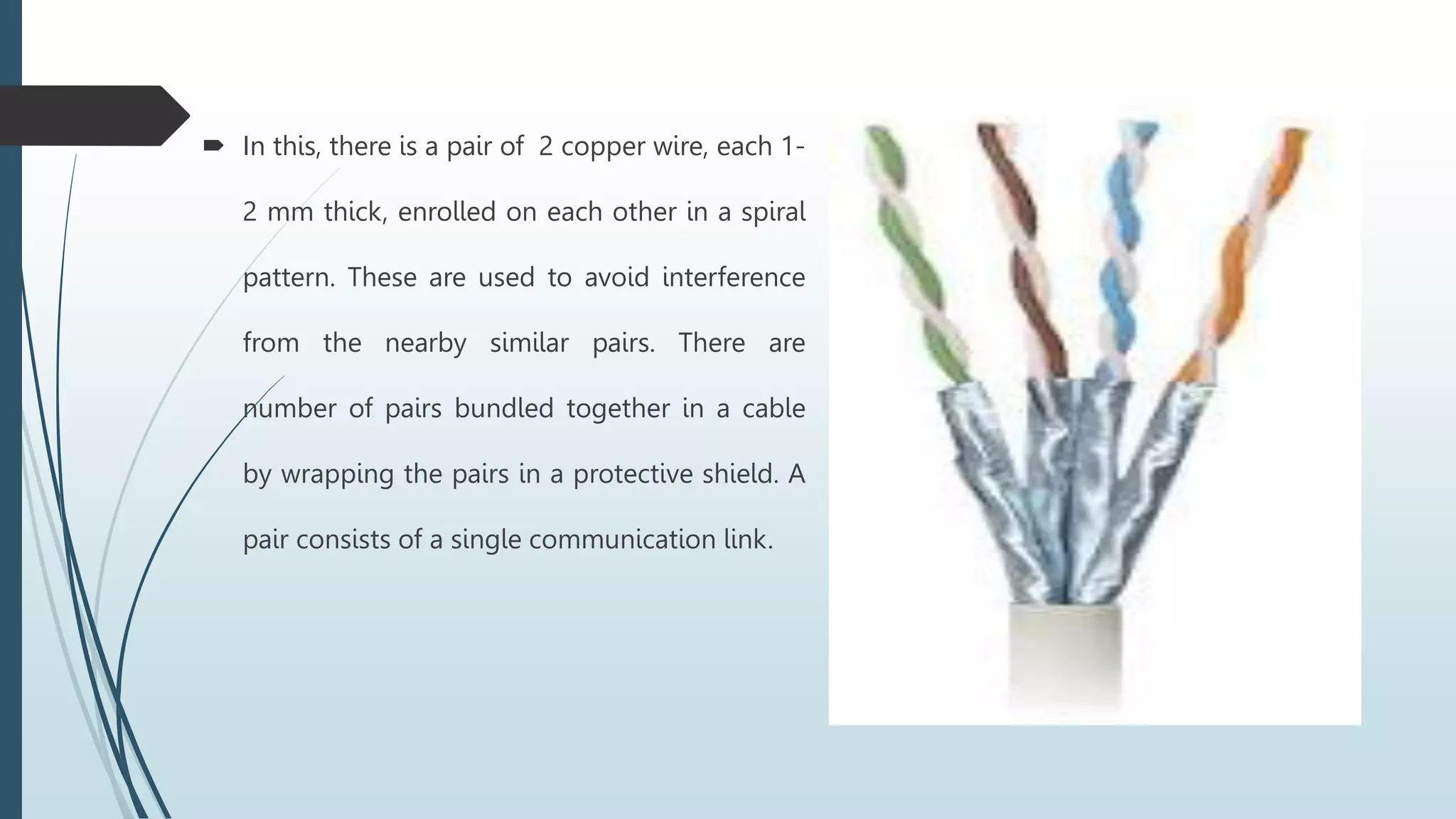
 In this, there is a pair of 2 copper wire, each 1-
2 mm thick, enrolled on each other in a spiral
pattern. These are used to avoid interference
from the nearby similar pairs. There are
number of pairs bundled together in a cable
by wrapping the pairs in a protective shield. A
pair consists of a single communication link.
UNSHIELDED TWISTED PAIR
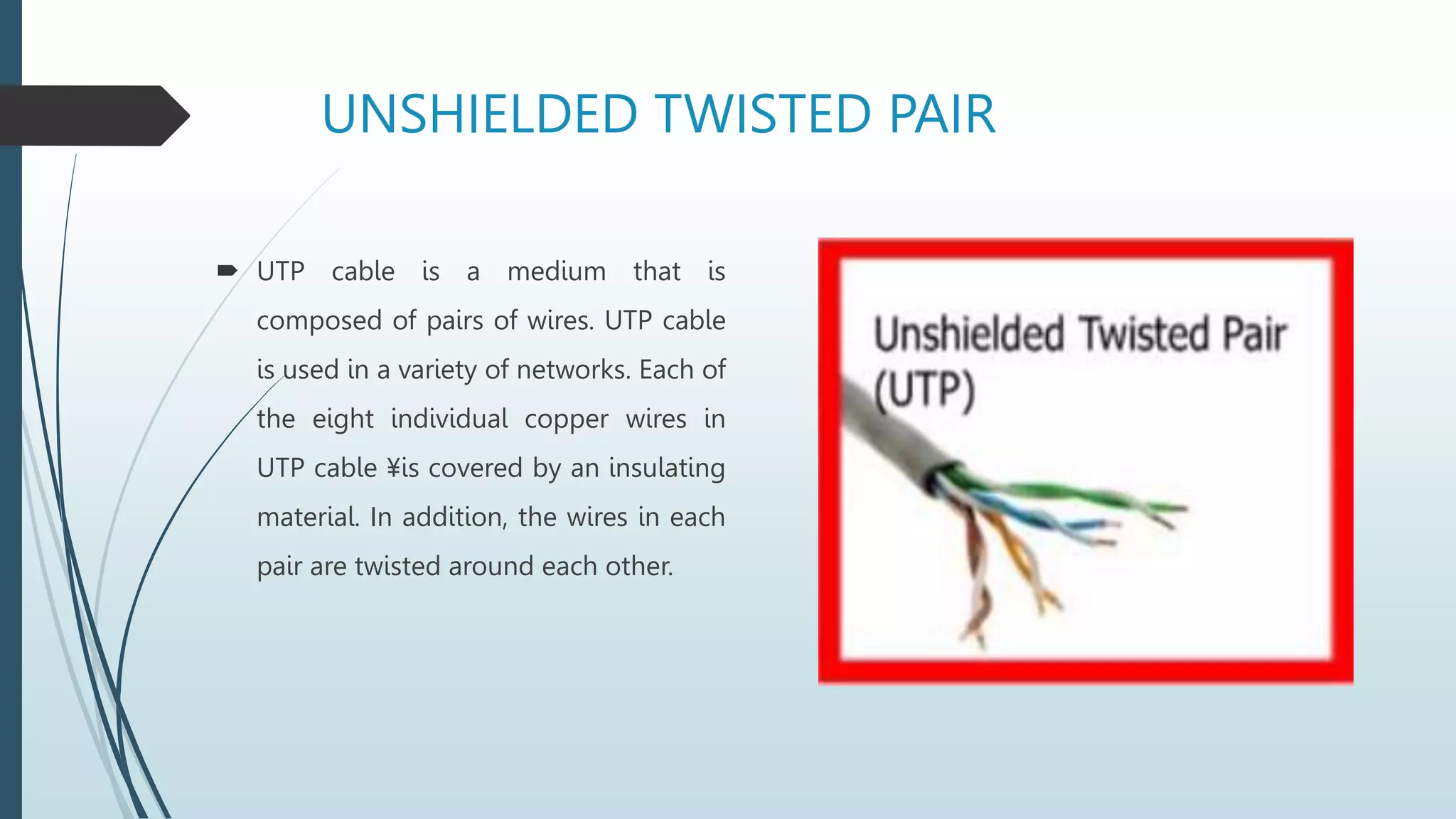
 UTP cable is a medium that is
composed of pairs of wires. UTP cable
is used in a variety of networks. Each of
the eight individual copper wires in
UTP cable ¥is covered by an insulating
material. In addition, the wires in each
pair are twisted around each other.
SHIELDED TWISTED PAIR
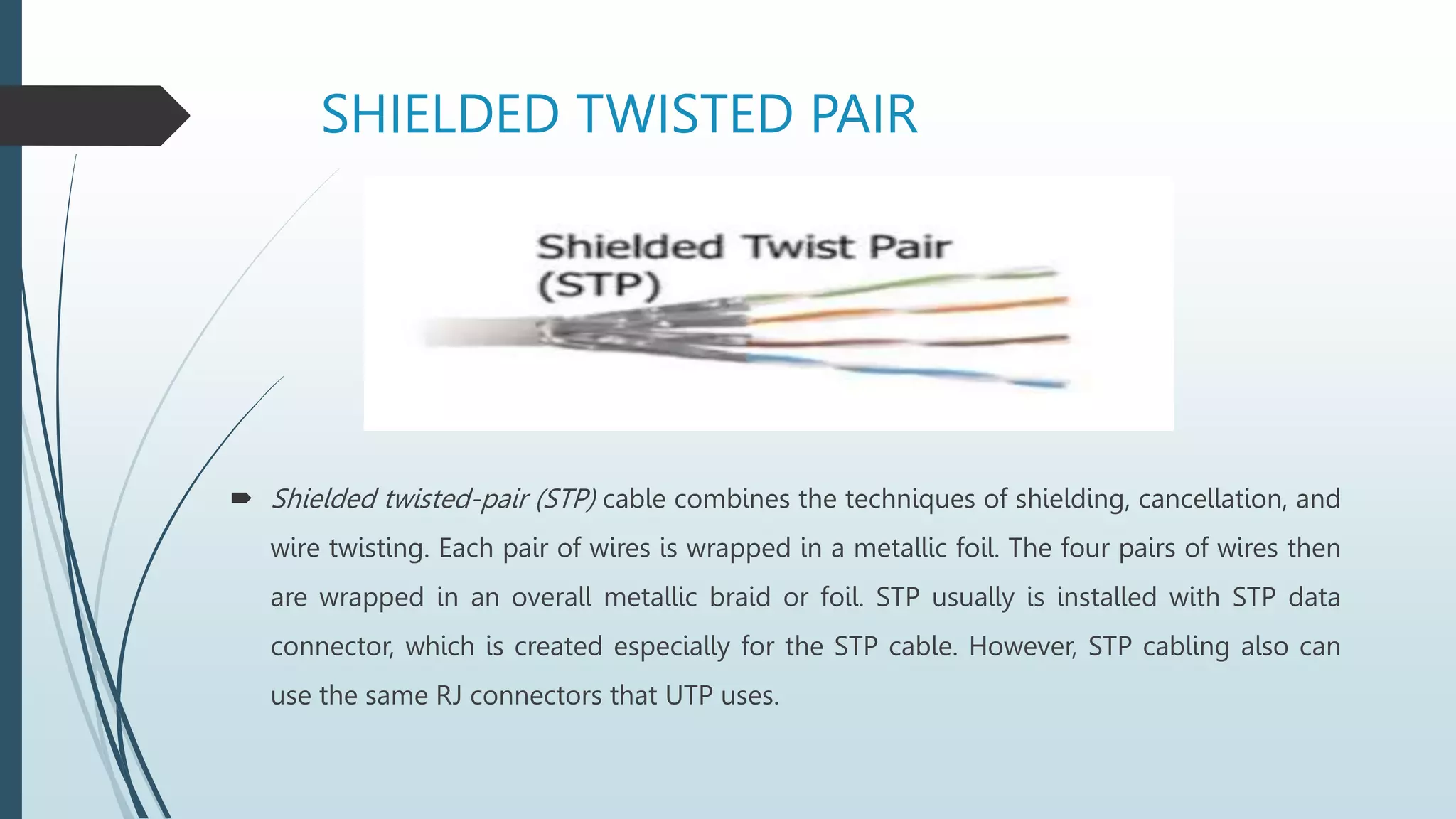
 Shielded twisted-pair (STP) cable combines the techniques of shielding, cancellation, and
wire twisting. Each pair of wires is wrapped in a metallic foil. The four pairs of wires then
are wrapped in an overall metallic braid or foil. STP usually is installed with STP data
connector, which is created especially for the STP cable. However, STP cabling also can
use the same RJ connectors that UTP uses.
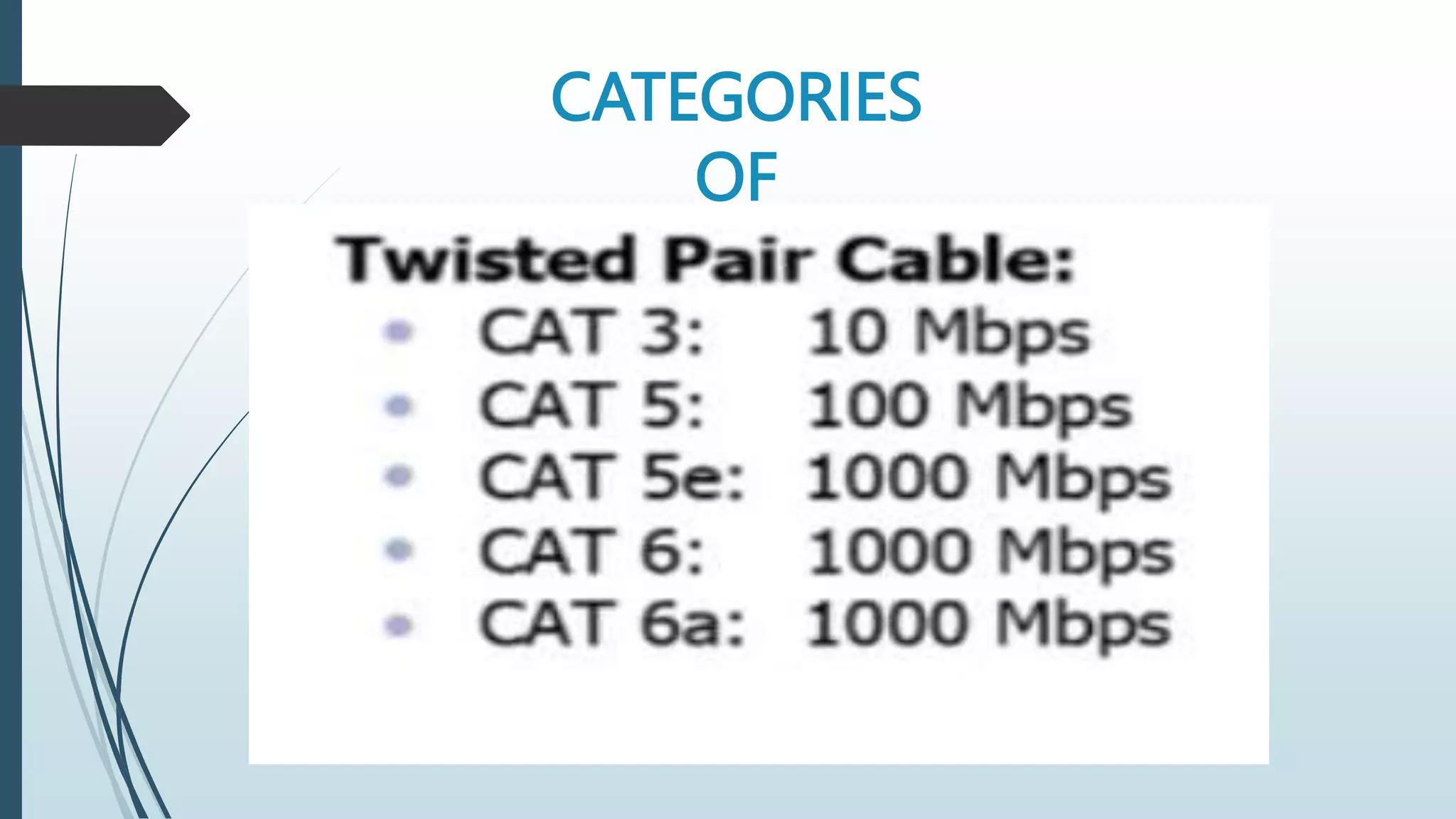
CATEGORIES
OF
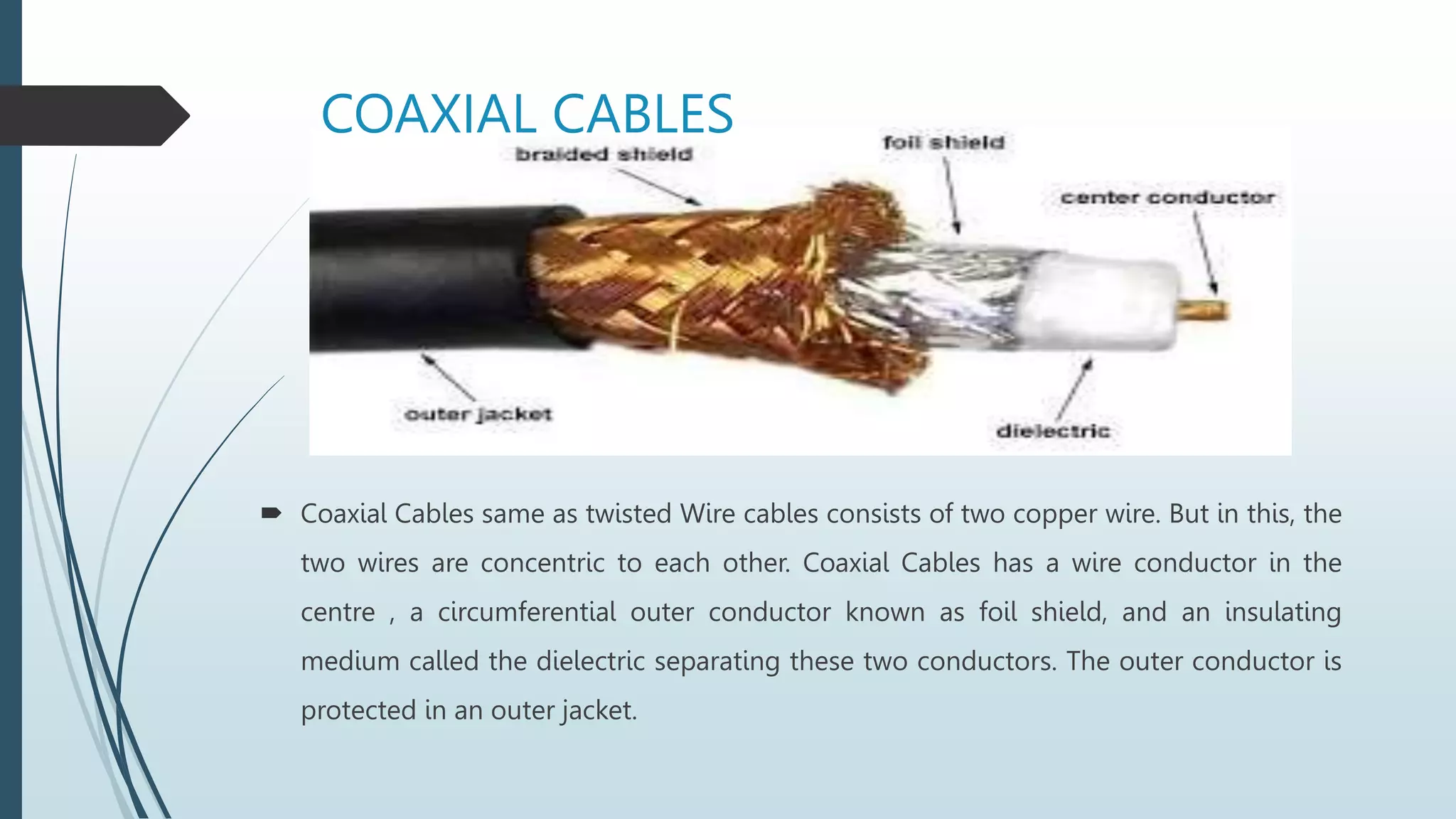
COAXIAL CABLES
 Coaxial Cables same as twisted Wire cables consists of two copper wire. But in this, the
two wires are concentric to each other. Coaxial Cables has a wire conductor in the
centre , a circumferential outer conductor known as foil shield, and an insulating
medium called the dielectric separating these two conductors. The outer conductor is
protected in an outer jacket.
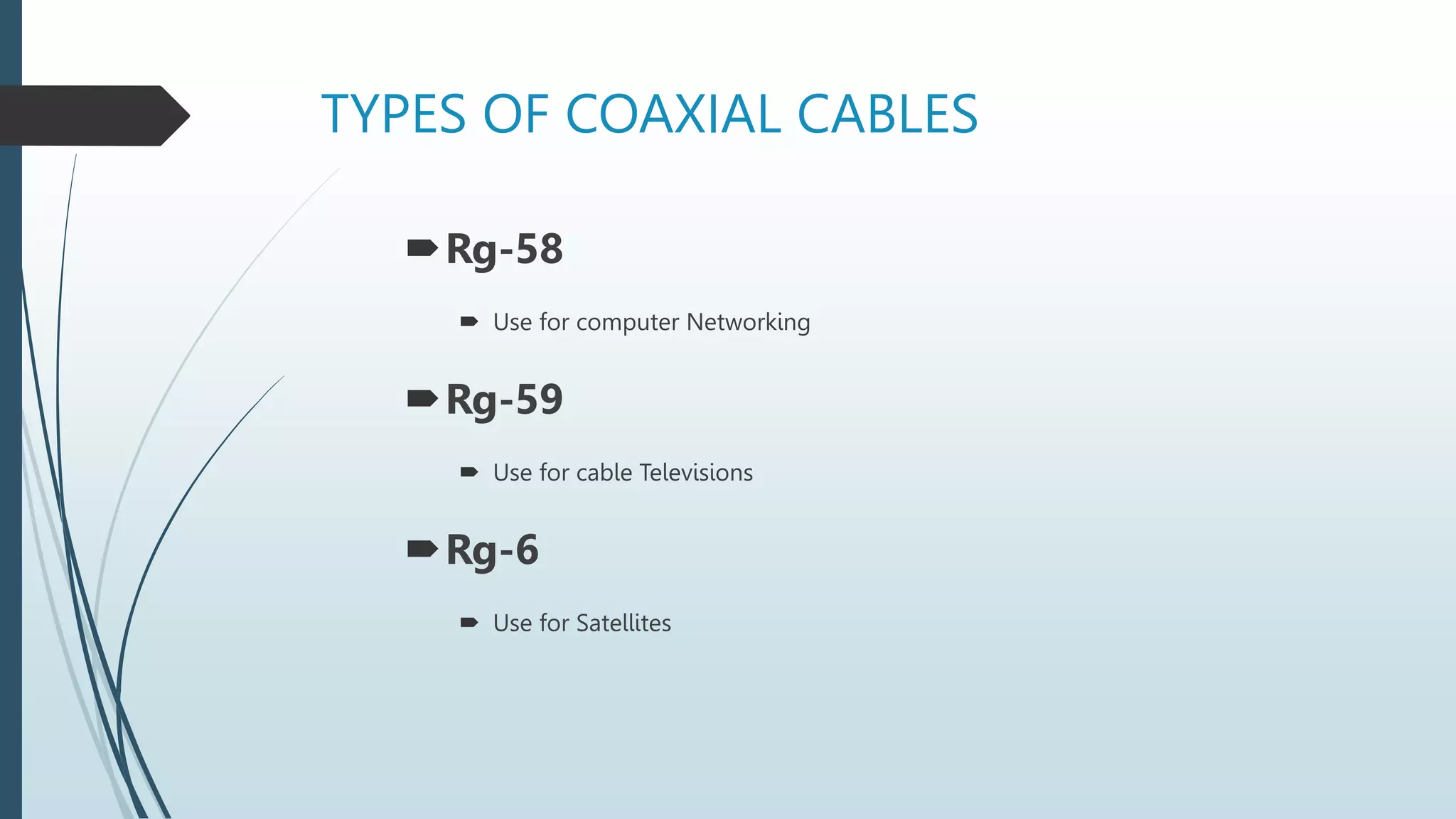
TYPES OF COAXIAL CABLES
Rg-58
 Use for computer Networking
Rg-59
 Use for cable Televisions
Rg-6
 Use for Satellites
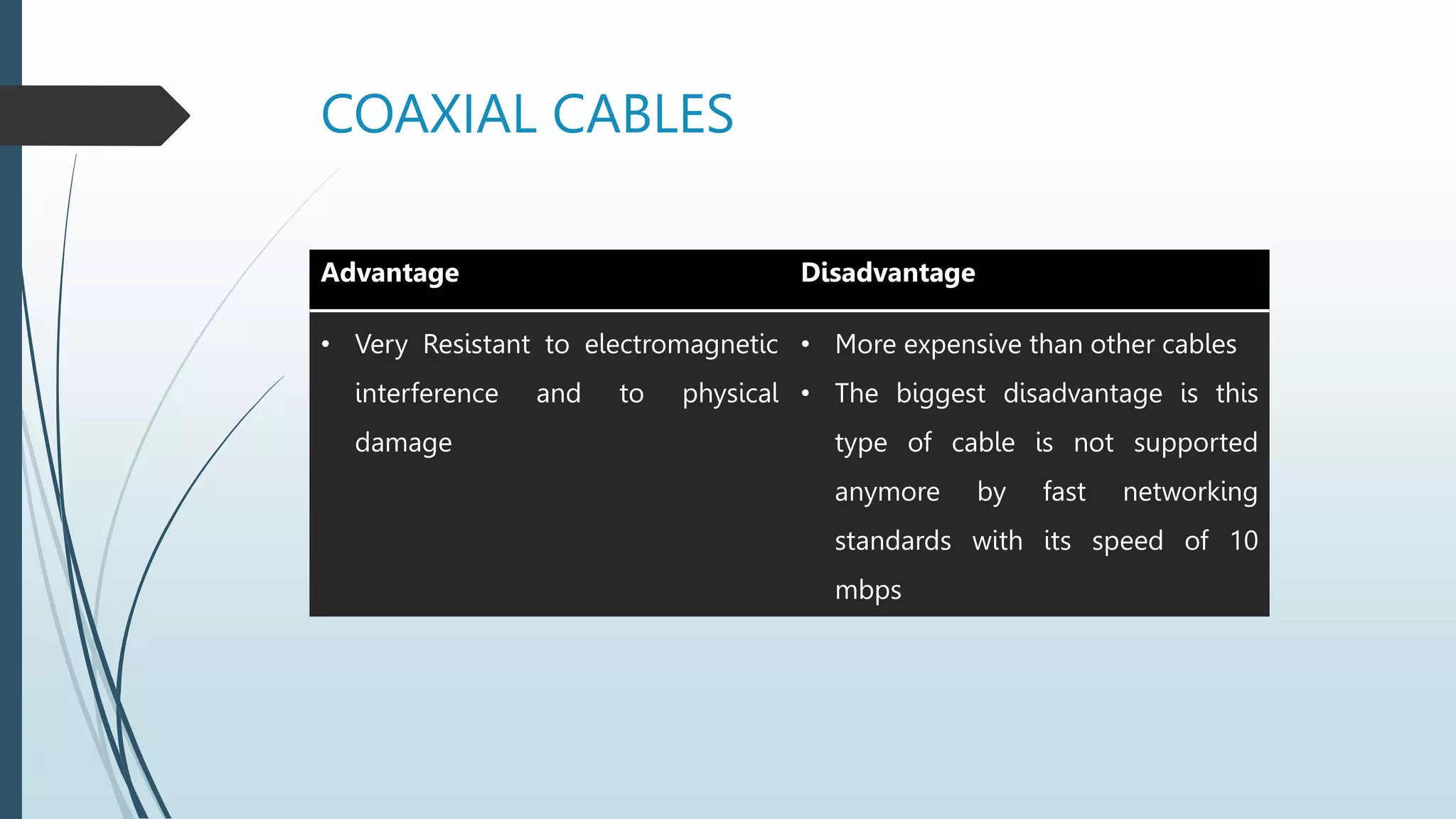
COAXIAL CABLES
Advantage Disadvantage
• Very Resistant to electromagnetic
interference and to physical
damage
• More expensive than other cables
• The biggest disadvantage is this
type of cable is not supported
anymore by fast networking
standards with its speed of 10
mbps
FIBRE OPTICS
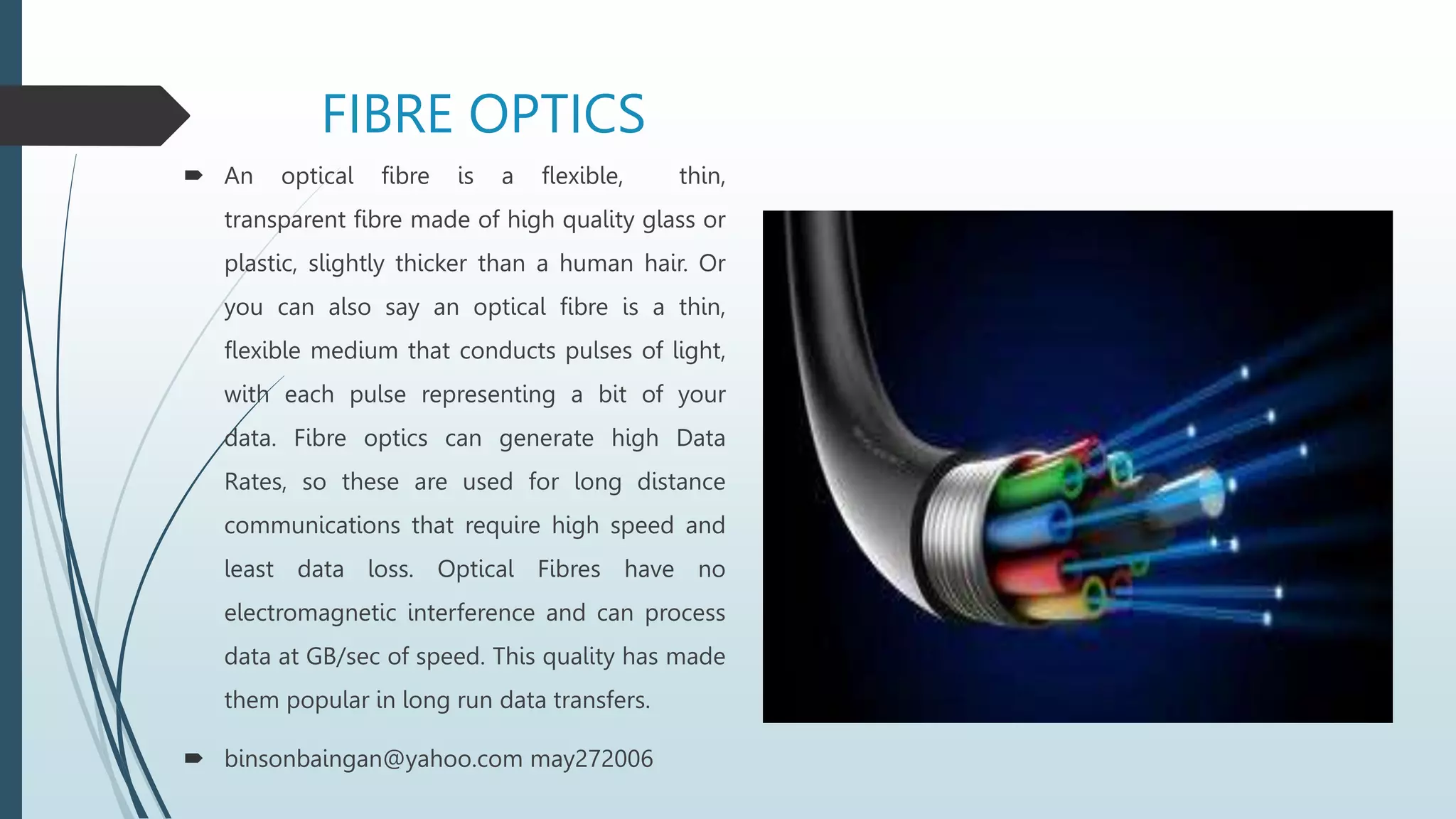
 An optical fibre is a flexible, thin,
transparent fibre made of high quality glass or
plastic, slightly thicker than a human hair. Or
you can also say an optical fibre is a thin,
flexible medium that conducts pulses of light,
with each pulse representing a bit of your
data. Fibre optics can generate high Data
Rates, so these are used for long distance
communications that require high speed and
least data loss. Optical Fibres have no
electromagnetic interference and can process
data at GB/sec of speed. This quality has made
them popular in long run data transfers.
 binsonbaingan@yahoo.com may272006
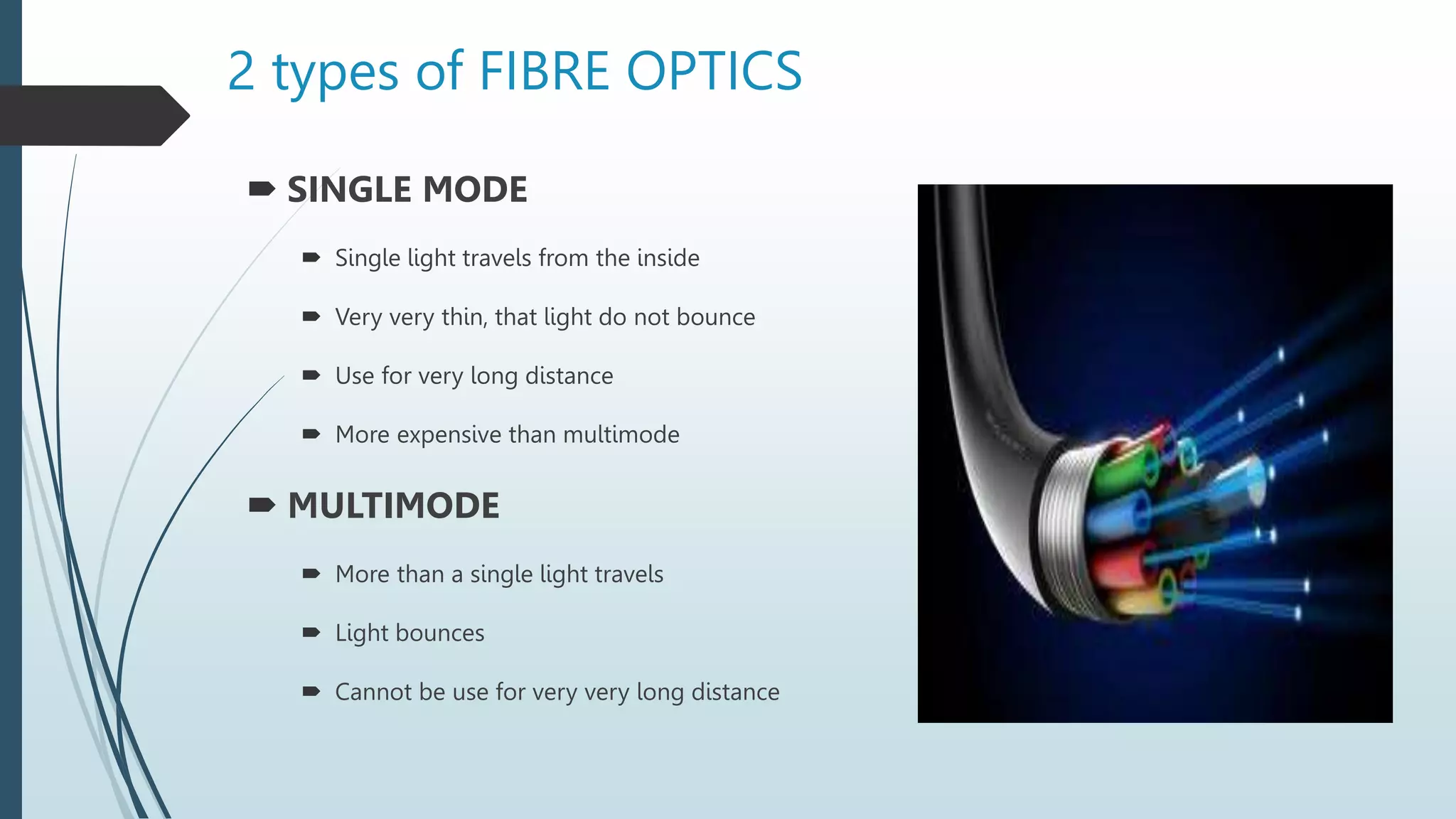
2 types of FIBRE OPTICS
 SINGLE MODE
 Single light travels from the inside
 Very very thin, that light do not bounce
 Use for very long distance
 More expensive than multimode
 MULTIMODE
 More than a single light travels
 Light bounces
 Cannot be use for very very long distance
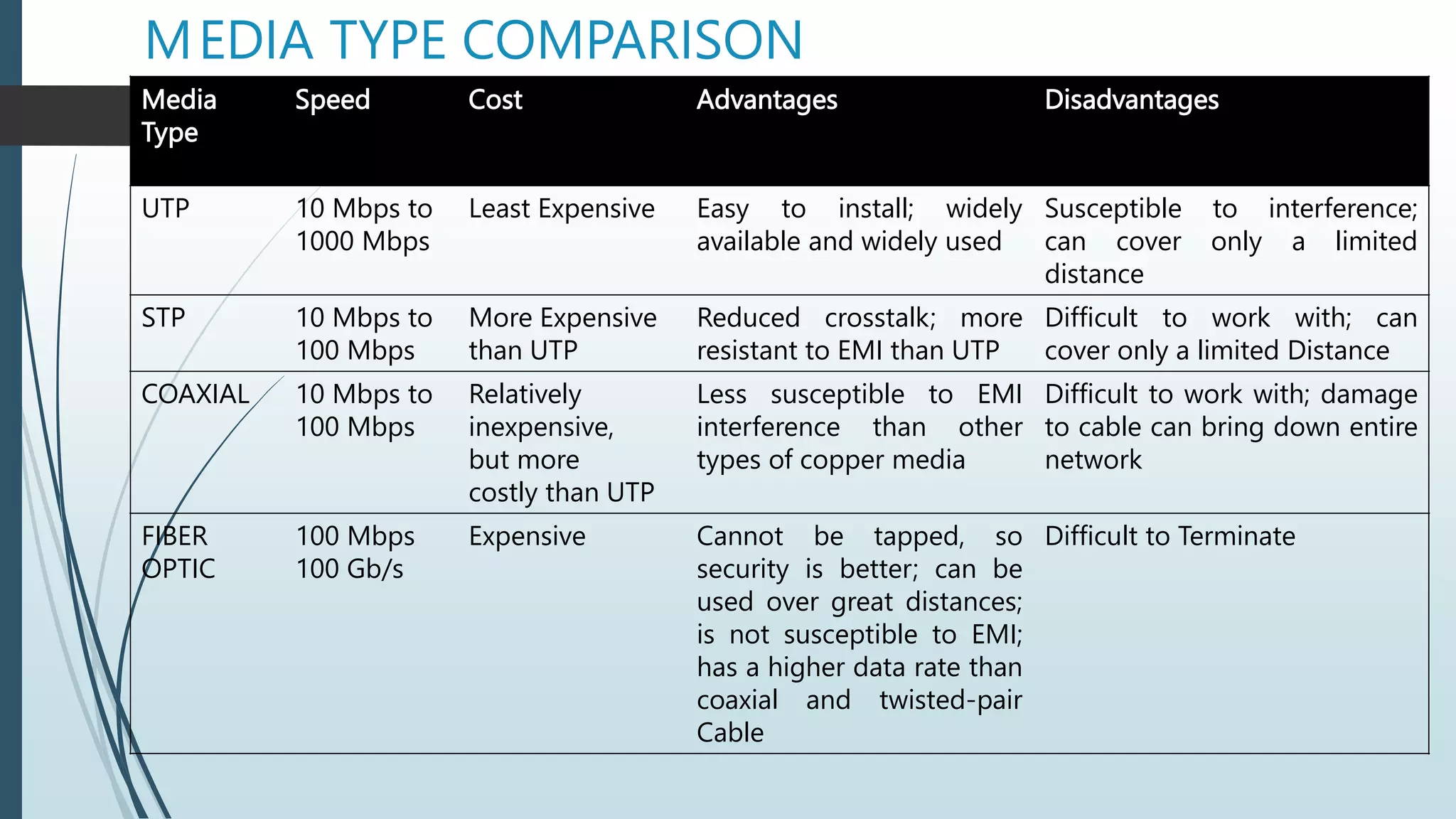
Media
Type
Speed Cost Advantages Disadvantages
UTP 10 Mbps to
1000 Mbps
Least Expensive Easy to install; widely
available and widely used
Susceptible to interference;
can cover only a limited
distance
STP 10 Mbps to
100 Mbps
More Expensive
than UTP
Reduced crosstalk; more
resistant to EMI than UTP
Difficult to work with; can
cover only a limited Distance
COAXIAL 10 Mbps to
100 Mbps
Relatively
inexpensive,
but more
costly than UTP
Less susceptible to EMI
interference than other
types of copper media
Difficult to work with; damage
to cable can bring down entire
network
FIBER
OPTIC
100 Mbps
100 Gb/s
Expensive Cannot be tapped, so
security is better; can be
used over great distances;
is not susceptible to EMI;
has a higher data rate than
coaxial and twisted-pair
Cable
Difficult to Terminate
MEDIA TYPE COMPARISON
WIRELESS NETWORK
 Wireless communication uses radio frequencies (RF) or infrared (IR) waves to
transmit data between devices on a LAN. For wireless LANs, a key component is
the wireless hub, or access point, used for signal distribution.
 To receive the signals from the access point, a PC or laptop must install a wireless
adapter card (wireless NIC).
 Wireless signals are electromagnetic waves that can travel through the vacuum of
outer space and through a medium such as air. Therefore, no physical medium is
necessary for wireless signals, making them a very versatile way to build a network.
Some common applications of wireless data
communication:
 • Accessing the Internet using a cellular phone
 • Establishing a home or business Internet connection over satellite
 • Beaming data between two hand-held computing devices
 • Using a wireless keyboard and mouse for the PC
WIRELESS NETWORK
Radio waves
are electromagnetic waves with wavelengths greater than infra-red radiations. There
frequency varies from as high as 300 GHz to as low as 3 KHz . They travel by speed of light.
Radio Waves can be natural and artificial also.
Radio Waves doesn't need any physical wire to travel. They can penetrate through air,
through walls and windows and can be used to deliver long distances messages.
Natural Radio Waves occur due to lighting
Artificial Radio waves are used in mobile, radio communication, radar systems
etc.
WIRELESS NETWORK
Infrared
 The wireless remote controls used with appliances such as televisions and stereos
communicate with infrared transmissions. Infrared is limited to a small area (e.g. a
single room), and usually requires that the transmitter be pointed towards the
receiver.
 Infrared hardware is inexpensive compared to other mechanism, and does into
require and antenna.
 Computer networks can use infrared technology for data communication. For
example, it is possible to equip a large room with single infrared connection that
provide network access to all computer in the room.
WIRELESS NETWORK
Bluetooth
Bluetooth technology that enables short-range wireless connections between
desktop and notebook computer, handhelds, personal digital assistants, mobile
phones, camera phones, printers, digital cameras, headsets, keyboards and even a
computer mouse.
Bluetooth wireless technology uses a globally available frequency band 2.4 GHz
for worldwide compatibility with the 10 meter range.
 Communication Satellites
A communication satellite links two or more transmitter or receiver that
are situated on Earth, called as Ground Stations. The satellite receives the
message or transmission on one frequency band, reproduce the signal using
a repeater and transmits the signal or the message on another frequency.
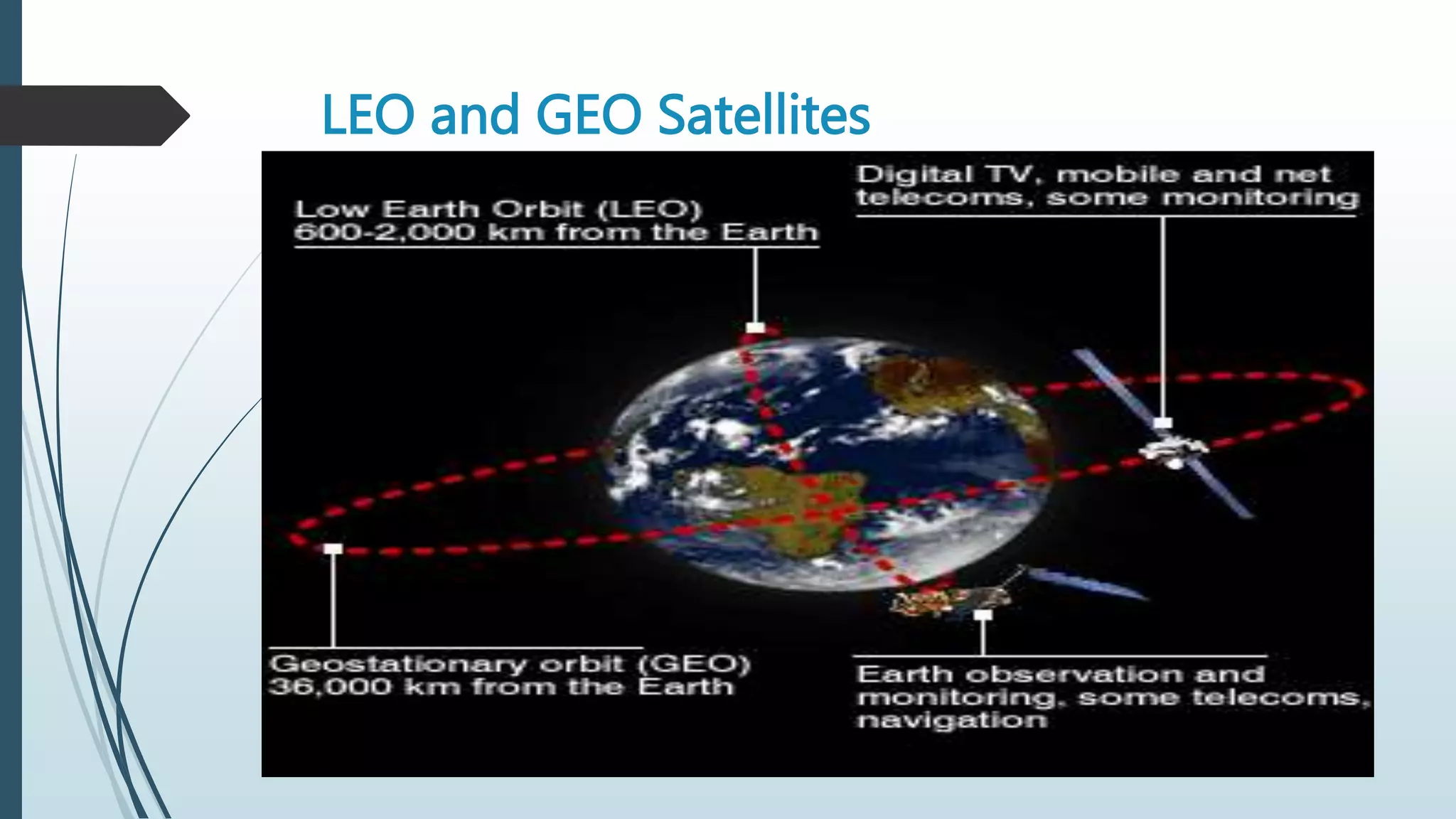
There are basically two types of satellites are used in communications. These
are:
(a) Geostationary Satellites
(b) Low Earth Orbiting satellites (LEO satellites)
WIRELESS NETWORK
LEO and GEO Satellites
Thank You!

Network Media Types.pptx

  • 1.
  • 2.
    Network Media  isthe actual path over which an electrical signal travels as it moves from one component to another.  The Communication Medium/Network Media plays an important role in Networks. If the medium works well and properly, then the speed of transferring data is good but if the medium is not working properly, then your data would be delayed or would not be sent or even can be lost during transmission. In Computer Networks, we call this speed of transmitting data, as DATA RATE.
  • 3.
    Two Types ofnetworks that can be set-up 1. Wired Network 2. Wireless Network
  • 4.
    WIRED NETWORK is mostlyset-up using an Ethernet Cable. This can be done using 3 technologies: 1. Twisted Pair Wires(UTP cable, STP cable) 2. Coaxial Cables 3. Fibre Optics
  • 5.
    WIRED NETWORK 1. TWISTEDPAIR WIRES This technology was invented by Alexander Graham Bell. These wires are the most oldest means of communication in computer networking. For more than 100 years, the phone technology has used these wires. Most usage of these twisted wires is in our homes and offices. The least expensive mode of communication used in networks.
  • 6.
     In this,there is a pair of 2 copper wire, each 1- 2 mm thick, enrolled on each other in a spiral pattern. These are used to avoid interference from the nearby similar pairs. There are number of pairs bundled together in a cable by wrapping the pairs in a protective shield. A pair consists of a single communication link.
  • 7.
    UNSHIELDED TWISTED PAIR UTP cable is a medium that is composed of pairs of wires. UTP cable is used in a variety of networks. Each of the eight individual copper wires in UTP cable ¥is covered by an insulating material. In addition, the wires in each pair are twisted around each other.
  • 8.
    SHIELDED TWISTED PAIR Shielded twisted-pair (STP) cable combines the techniques of shielding, cancellation, and wire twisting. Each pair of wires is wrapped in a metallic foil. The four pairs of wires then are wrapped in an overall metallic braid or foil. STP usually is installed with STP data connector, which is created especially for the STP cable. However, STP cabling also can use the same RJ connectors that UTP uses.
  • 9.
  • 10.
    COAXIAL CABLES  CoaxialCables same as twisted Wire cables consists of two copper wire. But in this, the two wires are concentric to each other. Coaxial Cables has a wire conductor in the centre , a circumferential outer conductor known as foil shield, and an insulating medium called the dielectric separating these two conductors. The outer conductor is protected in an outer jacket.
  • 11.
    TYPES OF COAXIALCABLES Rg-58  Use for computer Networking Rg-59  Use for cable Televisions Rg-6  Use for Satellites
  • 12.
    COAXIAL CABLES Advantage Disadvantage •Very Resistant to electromagnetic interference and to physical damage • More expensive than other cables • The biggest disadvantage is this type of cable is not supported anymore by fast networking standards with its speed of 10 mbps
  • 13.
    FIBRE OPTICS  Anoptical fibre is a flexible, thin, transparent fibre made of high quality glass or plastic, slightly thicker than a human hair. Or you can also say an optical fibre is a thin, flexible medium that conducts pulses of light, with each pulse representing a bit of your data. Fibre optics can generate high Data Rates, so these are used for long distance communications that require high speed and least data loss. Optical Fibres have no electromagnetic interference and can process data at GB/sec of speed. This quality has made them popular in long run data transfers.  binsonbaingan@yahoo.com may272006
  • 14.
    2 types ofFIBRE OPTICS  SINGLE MODE  Single light travels from the inside  Very very thin, that light do not bounce  Use for very long distance  More expensive than multimode  MULTIMODE  More than a single light travels  Light bounces  Cannot be use for very very long distance
  • 15.
    Media Type Speed Cost AdvantagesDisadvantages UTP 10 Mbps to 1000 Mbps Least Expensive Easy to install; widely available and widely used Susceptible to interference; can cover only a limited distance STP 10 Mbps to 100 Mbps More Expensive than UTP Reduced crosstalk; more resistant to EMI than UTP Difficult to work with; can cover only a limited Distance COAXIAL 10 Mbps to 100 Mbps Relatively inexpensive, but more costly than UTP Less susceptible to EMI interference than other types of copper media Difficult to work with; damage to cable can bring down entire network FIBER OPTIC 100 Mbps 100 Gb/s Expensive Cannot be tapped, so security is better; can be used over great distances; is not susceptible to EMI; has a higher data rate than coaxial and twisted-pair Cable Difficult to Terminate MEDIA TYPE COMPARISON
  • 16.
    WIRELESS NETWORK  Wirelesscommunication uses radio frequencies (RF) or infrared (IR) waves to transmit data between devices on a LAN. For wireless LANs, a key component is the wireless hub, or access point, used for signal distribution.  To receive the signals from the access point, a PC or laptop must install a wireless adapter card (wireless NIC).  Wireless signals are electromagnetic waves that can travel through the vacuum of outer space and through a medium such as air. Therefore, no physical medium is necessary for wireless signals, making them a very versatile way to build a network.
  • 17.
    Some common applicationsof wireless data communication:  • Accessing the Internet using a cellular phone  • Establishing a home or business Internet connection over satellite  • Beaming data between two hand-held computing devices  • Using a wireless keyboard and mouse for the PC
  • 18.
    WIRELESS NETWORK Radio waves areelectromagnetic waves with wavelengths greater than infra-red radiations. There frequency varies from as high as 300 GHz to as low as 3 KHz . They travel by speed of light. Radio Waves can be natural and artificial also. Radio Waves doesn't need any physical wire to travel. They can penetrate through air, through walls and windows and can be used to deliver long distances messages. Natural Radio Waves occur due to lighting Artificial Radio waves are used in mobile, radio communication, radar systems etc.
  • 19.
    WIRELESS NETWORK Infrared  Thewireless remote controls used with appliances such as televisions and stereos communicate with infrared transmissions. Infrared is limited to a small area (e.g. a single room), and usually requires that the transmitter be pointed towards the receiver.  Infrared hardware is inexpensive compared to other mechanism, and does into require and antenna.  Computer networks can use infrared technology for data communication. For example, it is possible to equip a large room with single infrared connection that provide network access to all computer in the room.
  • 20.
    WIRELESS NETWORK Bluetooth Bluetooth technologythat enables short-range wireless connections between desktop and notebook computer, handhelds, personal digital assistants, mobile phones, camera phones, printers, digital cameras, headsets, keyboards and even a computer mouse. Bluetooth wireless technology uses a globally available frequency band 2.4 GHz for worldwide compatibility with the 10 meter range.
  • 21.
     Communication Satellites Acommunication satellite links two or more transmitter or receiver that are situated on Earth, called as Ground Stations. The satellite receives the message or transmission on one frequency band, reproduce the signal using a repeater and transmits the signal or the message on another frequency. There are basically two types of satellites are used in communications. These are: (a) Geostationary Satellites (b) Low Earth Orbiting satellites (LEO satellites) WIRELESS NETWORK
  • 22.
    LEO and GEOSatellites
  • 23.