On Chip
Variation (OCV)
Amr Adel Mohammady
/amradelm
/amradelm
Introduction
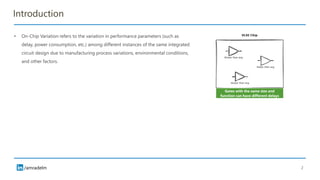
• On-Chip Variation refers to the variation in performance parameters (such as
delay, power consumption, etc.) among different instances of the same integrated
circuit design due to manufacturing process variations, environmental conditions,
and other factors.
Gates with the same size and
function can have different delays
2
/amradelm
Variations in interconnect
Temperature variations
on chip [2]
Sources of OCV
• Process Variations: Variations in the manufacturing process can lead to
differences in transistor characteristics (such as threshold voltage, oxide
thickness, doping concentration, etc.)
• Temperature Variations: Temperature fluctuations across the chip during
operation can cause variations in transistor behaviour and interconnect delays.
• Supply Voltage Variations: Fluctuations in the supply voltage, due to factors like
power supply noise or voltage drop, can affect the performance of transistors
and circuits.
• Interconnect Variations: Variations in interconnect resistance, capacitance, and
parasitic effects can lead to differences in signal propagation delay and power
consumption
MOSFET under microscope [1]
3
/amradelm
On Chip Variation (OCV) vs Process Voltage Temperature (PVT)
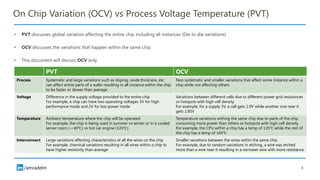
• PVT discusses global variation affecting the entire chip including all instances (Die to die variations)
• OCV discusses the variations that happen within the same chip
• This document will discuss OCV only
PVT OCV
Process Systematic and large variations such as doping, oxide thickness, etc
can affect entire parts of a wafer resulting in all instance within the chip
to be faster or slower than average
Non systematic and smaller variations that affect some instance within a
chip while not affecting others
Voltage Difference in the supply voltage provided to the entire chip
For example, a chip can have two operating voltages 3V for high
performance mode and 2V for low power mode
Variations between different cells due to different power grid resistances
or hotspots with high cell density
For example, for a supply 3V, a cell gets 2.9V while another one near it
gets 2.85V
Temperature Ambient temperature where the chip will be operated
For example, the chip is being used in summer vs winter or in a cooled
server room ( −40℃) vs hot car engine (120℃)
Temperature variations withing the same chip due to parts of the chip
consuming more power than others or hotspots with high cell density.
For example, the CPU within a chip has a temp of 125℃ while the rest of
the chip has a temp of 100℃
Interconnect Large variations affecting characteristics of all the wires on the chip
For example, chemical variations resulting in all wires within a chip to
have higher resistivity than average
Smaller variations between the wires within the same chip
For example, due to random variations in etching, a wire was etched
more than a wire near it resulting in a narrower wire with more resistance
4
/amradelm
Worst Case Analysis
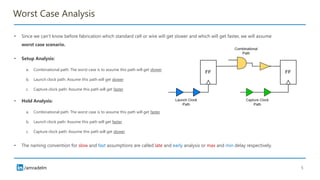
• Since we can’t know before fabrication which standard cell or wire will get slower and which will get faster, we will assume
worst case scenario.
• Setup Analysis:
a. Combinational path: The worst case is to assume this path will get slower
b. Launch clock path: Assume this path will get slower
c. Capture clock path: Assume this path will get faster
• Hold Analysis:
a. Combinational path: The worst case is to assume this path will get faster
b. Launch clock path: Assume this path will get faster
c. Capture clock path: Assume this path will get slower
• The naming convention for slow and fast assumptions are called late and early analysis or max and min delay respectively.
5
/amradelm
Pessimism and Optimism
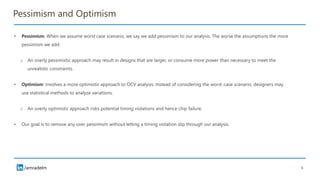
• Pessimism: When we assume worst case scenario, we say we add pessimism to our analysis. The worse the assumptions the more
pessimism we add.
o An overly pessimistic approach may result in designs that are larger, or consume more power than necessary to meet the
unrealistic constraints.
• Optimism: Involves a more optimistic approach to OCV analysis. Instead of considering the worst-case scenario, designers may
use statistical methods to analyze variations.
o An overly optimistic approach risks potential timing violations and hence chip failure.
• Our goal is to remove any over pessimism without letting a timing violation slip through our analysis.
6
/amradelm
Cell Delay OCV
7
/amradelm
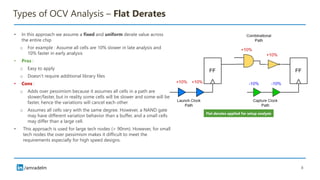
Types of OCV Analysis – Flat Derates
• In this approach we assume a fixed and uniform derate value across
the entire chip
o For example : Assume all cells are 10% slower in late analysis and
10% faster in early analysis
• Pros :
o Easy to apply
o Doesn’t require additional library files
• Cons :
o Adds over pessimism because it assumes all cells in a path are
slower/faster, but in reality some cells will be slower and some will be
faster, hence the variations will cancel each other
o Assumes all cells vary with the same degree. However, a NAND gate
may have different variation behavior than a buffer, and a small cells
may differ than a large cell.
• This approach is used for large tech nodes (> 90nm). However, for small
tech nodes the over pessimism makes it difficult to meet the
requirements especially for high speed designs.
Flat derates applied for setup analysis
8
/amradelm
Types of OCV Analysis – Advanced On-chip Variation (AOCV)
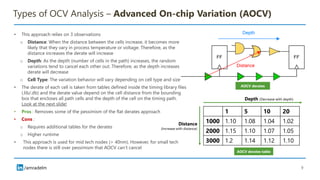
• This approach relies on 3 observations
o Distance: When the distance between the cells increase, it becomes more
likely that they vary in process temperature or voltage. Therefore, as the
distance increases the derate will increase
o Depth: As the depth (number of cells in the path) increases, the random
variations tend to cancel each other out. Therefore, as the depth increases the
derate will decrease
o Cell Type: The variation behavior will vary depending on cell type and size
• The derate of each cell is taken from tables defined inside the timing library files
(.lib/.db) and the derate value depend on the cell distance from the bounding
box that encloses all path cells and the depth of the cell on the timing path.
Look at the next slide!
• Pros : Removes some of the pessimism of the flat derates approach
• Cons :
o Requires additional tables for the derates
o Higher runtime
• This approach is used for mid tech nodes (> 40nm). However, for small tech
nodes there is still over pessimism that AOCV can’t cancel
AOCV derates
1 5 10 20
1000 1.10 1.08 1.04 1.02
2000 1.15 1.10 1.07 1.05
3000 1.2 1.14 1.12 1.10
Depth (Decrease with depth)
Distance
(Increase with distance)
AOCV derates table
9
/amradelm
Advanced On-chip Variation (AOCV) - Calculations
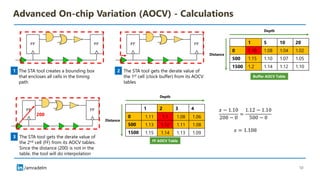
The STA tool creates a bounding box
that encloses all cells in the timing
path
The STA tool gets the derate value of
the 1st cell (clock buffer) from its AOCV
tables
1 5 10 20
0 1.10 1.08 1.04 1.02
500 1.15 1.10 1.07 1.05
1500 1.2 1.14 1.12 1.10
Depth
Distance
1 2
The STA tool gets the derate value of
the 2nd cell (FF) from its AOCV tables.
Since the distance (200) is not in the
table, the tool will do interpolation
1 2 3 4
0 1.11 1.1 1.08 1.06
500 1.13 1.12 1.11 1.08
1500 1.15 1.14 1.13 1.09
Depth
Distance
3
Buffer AOCV Table
FF AOCV Table
𝑥 − 1.10
200 − 0
=
1.12 − 1.10
500 − 0
𝑥 = 1.108
200
10
/amradelm
Types of OCV Analysis – Parametric On-chip Variation (POCV)
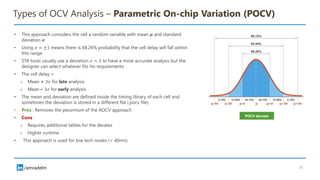
• This approach considers the cell a random variable with mean 𝝁 and standard
deviation 𝝈
• Using 𝜎 = ±1 means there is 68.26% probability that the cell delay will fall within
this range
• STA tools usually use a deviation 𝜎 = 3 to have a more accurate analysis but the
designer can select whatever fits his requirements
• The cell delay =
o Mean + 3𝜎 for late analysis
o Mean – 3𝜎 for early analysis
• The mean and deviation are defined inside the timing library of each cell and
sometimes the deviation is stored in a different file (.pocv file)
• Pros : Removes the pessimism of the AOCV approach
• Cons :
o Requires additional tables for the derates
o Higher runtime
• This approach is used for low tech nodes (< 40nm).
POCV derates
11
/amradelm
Parametric On-chip Variation (POCV) - Calculations
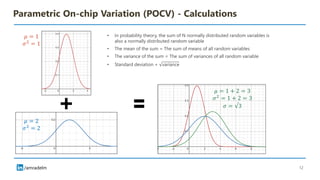
• In probability theory, the sum of N normally distributed random variables is
also a normally distributed random variable
• The mean of the sum = The sum of means of all random variables
• The variance of the sum = The sum of variances of all random variable
• Standard deviation = variance
𝜇 = 1
𝜎2
= 1
𝜇 = 2
𝜎2 = 2
𝜇 = 1 + 2 = 3
𝜎2 = 1 + 2 = 3
𝜎 = √3
12
/amradelm
Parametric On-chip Variation (POCV) - Calculations
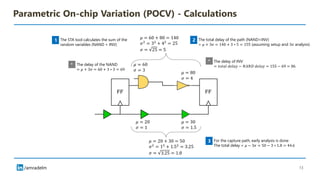
𝜇 = 60 + 80 = 140
𝜎2
= 32
+ 42
= 25
𝜎 = 25 = 5
𝜇 = 80
𝜎 = 4
𝜇 = 60
𝜎 = 3
The STA tool calculates the sum of the
random variables (NAND + INV)
1 The total delay of the path (NAND+INV)
= 𝜇 + 3𝜎 = 140 + 3 ∗ 5 = 155 (assuming setup and 3𝜎 analysis)
2
The delay of INV
= 𝑡𝑜𝑡𝑎𝑙 𝑑𝑒𝑙𝑎𝑦 − 𝑁𝐴𝑁𝐷 𝑑𝑒𝑙𝑎𝑦 = 155 − 69 = 86
The delay of the NAND
= 𝜇 + 3𝜎 = 60 + 3 ∗ 3 = 69
*
*
For the capture path, early analysis is done
The total delay = 𝜇 − 3𝜎 = 50 − 3 ∗ 1.8 = 44.6
3
𝜇 = 30
𝜎 = 1.5
𝜇 = 20
𝜎 = 1
𝜇 = 20 + 30 = 50
𝜎2
= 12
+ 1.52
= 3.25
𝜎 = 3.25 = 1.8
13
/amradelm
POCV vs LVF (Library Variation Format)
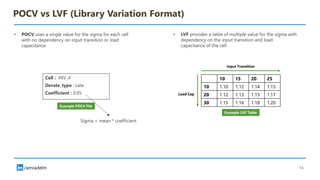
• POCV uses a single value for the sigma for each cell
with no dependency on input transition or load
capacitance
10 15 20 25
10 1.10 1.12 1.14 1.15
20 1.12 1.13 1.15 1.17
30 1.15 1.16 1.18 1.20
Input Transition
Example LVF Table
• LVF provides a table of multiple value for the sigma with
dependency on the input transition and load
capacitance of the cell
Load Cap
Example POCV File
Cell : INV_4
Derate_type : Late
Coefficient : 0.05
Sigma = mean * coefficient
14
/amradelm
Temp and Voltage OCV
15
/amradelm
Temp and Voltage OCV – Flat Derates
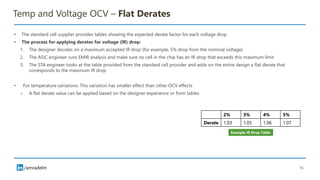
• The standard cell supplier provides tables showing the expected derate factor for each voltage drop
• The process for applying derates for voltage (IR) drop:
1. The designer decides on a maximum accepted IR drop (for example, 5% drop from the nominal voltage)
2. The ASIC engineer runs EMIR analysis and make sure no cell in the chip has an IR drop that exceeds this maximum limit
3. The STA engineer looks at the table provided from the standard cell provider and adds on the entire design a flat derate that
corresponds to the maximum IR drop
• For temperature variations: This variation has smaller effect than other OCV effects
o A flat derate value can be applied based on the designer experience or from tables
2% 3% 4% 5%
Derate 1.03 1.05 1.06 1.07
Example IR Drop Table
16
/amradelm
Wire Delay OCV
17
/amradelm
Wire Delay Analysis – Flat Derates
• The OCV effect on wire delay is small compared to the effect on cell delays
• The approach used for wire OCV is applying a flat derate
• The derate could be applied in two ways:
o Derate applied to the propagation delay of the wire
o Scaling factor applied on the resistance and capacitance of the wire and hence the propagation delay. This approach also affects the
load capacitance that the cells see and therefore, the cell propagation delay and transition time
18
/amradelm
Additional Topics
19
/amradelm
Clock Reconvergence Pessimism Removal (CRPR)
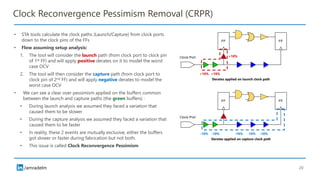
• STA tools calculate the clock paths (Launch/Capture) from clock ports
down to the clock pins of the FFs
• Flow assuming setup analysis:
1. The tool will consider the launch path (from clock port to clock pin
of 1st FF) and will apply positive derates on it to model the worst
case OCV
2. The tool will then consider the capture path (from clock port to
clock pin of 2nd FF) and will apply negative derates to model the
worst case OCV
• We can see a clear over pessimism applied on the buffers common
between the launch and capture paths (the green buffers) :
• During launch analysis we assumed they faced a variation that
caused them to be slower
• During the capture analysis we assumed they faced a variation that
caused them to be faster
• In reality, these 2 events are mutually exclusive, either the buffers
got slower or faster during fabrication but not both.
• This issue is called Clock Reconvergence Pessimism
20
+10% +10%
+10%
Derates applied on launch clock path
-10% -10%
Derates applied on capture clock path
-10% -10% -10%
/amradelm
Clock Reconvergence Pessimism Removal (CRPR)
Path Incr Total
BUF_1 11 11
BUF_2 12 23
BUF_3 10.5 33.5
FF_TCQ 2 35.5
Combinational path 18 53.5
Clock Period 5 5
BUF_1 9 14
BUF_2 10.5 24.5
BUF_4 9 33.5
BUF_5 9 42.5
BUF_6 9 51.5
FF_Setup -1 50.5
Setup (Required – Arrival) -3
21
11ns 12ns
10.5ns
9ns 10.5ns 9ns 9ns 9ns
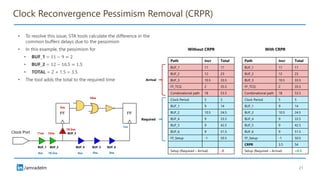
• To resolve this issue, STA tools calculate the difference in the
common buffers delays due to the pessimism
• In this example, the pessimism for
• BUF_1 = 11 − 9 = 2
• BUF_2 = 12 − 10.5 = 1.5
• TOTAL = 2 + 1.5 = 3.5
• The tool adds the total to the required time Arrival
Required
Path Incr Total
BUF_1 11 11
BUF_2 12 23
BUF_3 10.5 33.5
FF_TCQ 2 35.5
Combinational path 18 53.5
Clock Period 5 5
BUF_1 9 14
BUF_2 10.5 24.5
BUF_4 9 33.5
BUF_5 9 42.5
BUF_6 9 51.5
FF_Setup -1 50.5
CRPR 3.5 54
Setup (Required – Arrival) +0.5
2ns
18ns
1ns
BUF_1 BUF_2 BUF_4 BUF_5 BUF_6
BUF_3
Without CRPR With CRPR
/amradelm
Citations
• [1] https://www.bbvaopenmind.com/en/technology/innovation/mini-transistors-technological-revolution-20th-century/
• [2] L. Chen, W. Jin and S. X. . -D. Tan, "Fast Thermal Analysis for Chiplet Design based on Graph Convolution Networks," 2022 27th
Asia and South Pacific Design Automation Conference (ASP-DAC), Taipei, Taiwan, 2022, pp. 485-492, doi: 10.1109/ASP-
DAC52403.2022.9712583.
/amradelm
Thank You!
23

VLSI Static Timing Analysis Timing Checks Part 5 - On Chip Variation

  • 1.
    On Chip Variation (OCV) AmrAdel Mohammady /amradelm
  • 2.
    /amradelm Introduction • On-Chip Variationrefers to the variation in performance parameters (such as delay, power consumption, etc.) among different instances of the same integrated circuit design due to manufacturing process variations, environmental conditions, and other factors. Gates with the same size and function can have different delays 2
  • 3.
    /amradelm Variations in interconnect Temperaturevariations on chip [2] Sources of OCV • Process Variations: Variations in the manufacturing process can lead to differences in transistor characteristics (such as threshold voltage, oxide thickness, doping concentration, etc.) • Temperature Variations: Temperature fluctuations across the chip during operation can cause variations in transistor behaviour and interconnect delays. • Supply Voltage Variations: Fluctuations in the supply voltage, due to factors like power supply noise or voltage drop, can affect the performance of transistors and circuits. • Interconnect Variations: Variations in interconnect resistance, capacitance, and parasitic effects can lead to differences in signal propagation delay and power consumption MOSFET under microscope [1] 3
  • 4.
    /amradelm On Chip Variation(OCV) vs Process Voltage Temperature (PVT) • PVT discusses global variation affecting the entire chip including all instances (Die to die variations) • OCV discusses the variations that happen within the same chip • This document will discuss OCV only PVT OCV Process Systematic and large variations such as doping, oxide thickness, etc can affect entire parts of a wafer resulting in all instance within the chip to be faster or slower than average Non systematic and smaller variations that affect some instance within a chip while not affecting others Voltage Difference in the supply voltage provided to the entire chip For example, a chip can have two operating voltages 3V for high performance mode and 2V for low power mode Variations between different cells due to different power grid resistances or hotspots with high cell density For example, for a supply 3V, a cell gets 2.9V while another one near it gets 2.85V Temperature Ambient temperature where the chip will be operated For example, the chip is being used in summer vs winter or in a cooled server room ( −40℃) vs hot car engine (120℃) Temperature variations withing the same chip due to parts of the chip consuming more power than others or hotspots with high cell density. For example, the CPU within a chip has a temp of 125℃ while the rest of the chip has a temp of 100℃ Interconnect Large variations affecting characteristics of all the wires on the chip For example, chemical variations resulting in all wires within a chip to have higher resistivity than average Smaller variations between the wires within the same chip For example, due to random variations in etching, a wire was etched more than a wire near it resulting in a narrower wire with more resistance 4
  • 5.
    /amradelm Worst Case Analysis •Since we can’t know before fabrication which standard cell or wire will get slower and which will get faster, we will assume worst case scenario. • Setup Analysis: a. Combinational path: The worst case is to assume this path will get slower b. Launch clock path: Assume this path will get slower c. Capture clock path: Assume this path will get faster • Hold Analysis: a. Combinational path: The worst case is to assume this path will get faster b. Launch clock path: Assume this path will get faster c. Capture clock path: Assume this path will get slower • The naming convention for slow and fast assumptions are called late and early analysis or max and min delay respectively. 5
  • 6.
    /amradelm Pessimism and Optimism •Pessimism: When we assume worst case scenario, we say we add pessimism to our analysis. The worse the assumptions the more pessimism we add. o An overly pessimistic approach may result in designs that are larger, or consume more power than necessary to meet the unrealistic constraints. • Optimism: Involves a more optimistic approach to OCV analysis. Instead of considering the worst-case scenario, designers may use statistical methods to analyze variations. o An overly optimistic approach risks potential timing violations and hence chip failure. • Our goal is to remove any over pessimism without letting a timing violation slip through our analysis. 6
  • 7.
  • 8.
    /amradelm Types of OCVAnalysis – Flat Derates • In this approach we assume a fixed and uniform derate value across the entire chip o For example : Assume all cells are 10% slower in late analysis and 10% faster in early analysis • Pros : o Easy to apply o Doesn’t require additional library files • Cons : o Adds over pessimism because it assumes all cells in a path are slower/faster, but in reality some cells will be slower and some will be faster, hence the variations will cancel each other o Assumes all cells vary with the same degree. However, a NAND gate may have different variation behavior than a buffer, and a small cells may differ than a large cell. • This approach is used for large tech nodes (> 90nm). However, for small tech nodes the over pessimism makes it difficult to meet the requirements especially for high speed designs. Flat derates applied for setup analysis 8
  • 9.
    /amradelm Types of OCVAnalysis – Advanced On-chip Variation (AOCV) • This approach relies on 3 observations o Distance: When the distance between the cells increase, it becomes more likely that they vary in process temperature or voltage. Therefore, as the distance increases the derate will increase o Depth: As the depth (number of cells in the path) increases, the random variations tend to cancel each other out. Therefore, as the depth increases the derate will decrease o Cell Type: The variation behavior will vary depending on cell type and size • The derate of each cell is taken from tables defined inside the timing library files (.lib/.db) and the derate value depend on the cell distance from the bounding box that encloses all path cells and the depth of the cell on the timing path. Look at the next slide! • Pros : Removes some of the pessimism of the flat derates approach • Cons : o Requires additional tables for the derates o Higher runtime • This approach is used for mid tech nodes (> 40nm). However, for small tech nodes there is still over pessimism that AOCV can’t cancel AOCV derates 1 5 10 20 1000 1.10 1.08 1.04 1.02 2000 1.15 1.10 1.07 1.05 3000 1.2 1.14 1.12 1.10 Depth (Decrease with depth) Distance (Increase with distance) AOCV derates table 9
  • 10.
    /amradelm Advanced On-chip Variation(AOCV) - Calculations The STA tool creates a bounding box that encloses all cells in the timing path The STA tool gets the derate value of the 1st cell (clock buffer) from its AOCV tables 1 5 10 20 0 1.10 1.08 1.04 1.02 500 1.15 1.10 1.07 1.05 1500 1.2 1.14 1.12 1.10 Depth Distance 1 2 The STA tool gets the derate value of the 2nd cell (FF) from its AOCV tables. Since the distance (200) is not in the table, the tool will do interpolation 1 2 3 4 0 1.11 1.1 1.08 1.06 500 1.13 1.12 1.11 1.08 1500 1.15 1.14 1.13 1.09 Depth Distance 3 Buffer AOCV Table FF AOCV Table 𝑥 − 1.10 200 − 0 = 1.12 − 1.10 500 − 0 𝑥 = 1.108 200 10
  • 11.
    /amradelm Types of OCVAnalysis – Parametric On-chip Variation (POCV) • This approach considers the cell a random variable with mean 𝝁 and standard deviation 𝝈 • Using 𝜎 = ±1 means there is 68.26% probability that the cell delay will fall within this range • STA tools usually use a deviation 𝜎 = 3 to have a more accurate analysis but the designer can select whatever fits his requirements • The cell delay = o Mean + 3𝜎 for late analysis o Mean – 3𝜎 for early analysis • The mean and deviation are defined inside the timing library of each cell and sometimes the deviation is stored in a different file (.pocv file) • Pros : Removes the pessimism of the AOCV approach • Cons : o Requires additional tables for the derates o Higher runtime • This approach is used for low tech nodes (< 40nm). POCV derates 11
  • 12.
    /amradelm Parametric On-chip Variation(POCV) - Calculations • In probability theory, the sum of N normally distributed random variables is also a normally distributed random variable • The mean of the sum = The sum of means of all random variables • The variance of the sum = The sum of variances of all random variable • Standard deviation = variance 𝜇 = 1 𝜎2 = 1 𝜇 = 2 𝜎2 = 2 𝜇 = 1 + 2 = 3 𝜎2 = 1 + 2 = 3 𝜎 = √3 12
  • 13.
    /amradelm Parametric On-chip Variation(POCV) - Calculations 𝜇 = 60 + 80 = 140 𝜎2 = 32 + 42 = 25 𝜎 = 25 = 5 𝜇 = 80 𝜎 = 4 𝜇 = 60 𝜎 = 3 The STA tool calculates the sum of the random variables (NAND + INV) 1 The total delay of the path (NAND+INV) = 𝜇 + 3𝜎 = 140 + 3 ∗ 5 = 155 (assuming setup and 3𝜎 analysis) 2 The delay of INV = 𝑡𝑜𝑡𝑎𝑙 𝑑𝑒𝑙𝑎𝑦 − 𝑁𝐴𝑁𝐷 𝑑𝑒𝑙𝑎𝑦 = 155 − 69 = 86 The delay of the NAND = 𝜇 + 3𝜎 = 60 + 3 ∗ 3 = 69 * * For the capture path, early analysis is done The total delay = 𝜇 − 3𝜎 = 50 − 3 ∗ 1.8 = 44.6 3 𝜇 = 30 𝜎 = 1.5 𝜇 = 20 𝜎 = 1 𝜇 = 20 + 30 = 50 𝜎2 = 12 + 1.52 = 3.25 𝜎 = 3.25 = 1.8 13
  • 14.
    /amradelm POCV vs LVF(Library Variation Format) • POCV uses a single value for the sigma for each cell with no dependency on input transition or load capacitance 10 15 20 25 10 1.10 1.12 1.14 1.15 20 1.12 1.13 1.15 1.17 30 1.15 1.16 1.18 1.20 Input Transition Example LVF Table • LVF provides a table of multiple value for the sigma with dependency on the input transition and load capacitance of the cell Load Cap Example POCV File Cell : INV_4 Derate_type : Late Coefficient : 0.05 Sigma = mean * coefficient 14
  • 15.
  • 16.
    /amradelm Temp and VoltageOCV – Flat Derates • The standard cell supplier provides tables showing the expected derate factor for each voltage drop • The process for applying derates for voltage (IR) drop: 1. The designer decides on a maximum accepted IR drop (for example, 5% drop from the nominal voltage) 2. The ASIC engineer runs EMIR analysis and make sure no cell in the chip has an IR drop that exceeds this maximum limit 3. The STA engineer looks at the table provided from the standard cell provider and adds on the entire design a flat derate that corresponds to the maximum IR drop • For temperature variations: This variation has smaller effect than other OCV effects o A flat derate value can be applied based on the designer experience or from tables 2% 3% 4% 5% Derate 1.03 1.05 1.06 1.07 Example IR Drop Table 16
  • 17.
  • 18.
    /amradelm Wire Delay Analysis– Flat Derates • The OCV effect on wire delay is small compared to the effect on cell delays • The approach used for wire OCV is applying a flat derate • The derate could be applied in two ways: o Derate applied to the propagation delay of the wire o Scaling factor applied on the resistance and capacitance of the wire and hence the propagation delay. This approach also affects the load capacitance that the cells see and therefore, the cell propagation delay and transition time 18
  • 19.
  • 20.
    /amradelm Clock Reconvergence PessimismRemoval (CRPR) • STA tools calculate the clock paths (Launch/Capture) from clock ports down to the clock pins of the FFs • Flow assuming setup analysis: 1. The tool will consider the launch path (from clock port to clock pin of 1st FF) and will apply positive derates on it to model the worst case OCV 2. The tool will then consider the capture path (from clock port to clock pin of 2nd FF) and will apply negative derates to model the worst case OCV • We can see a clear over pessimism applied on the buffers common between the launch and capture paths (the green buffers) : • During launch analysis we assumed they faced a variation that caused them to be slower • During the capture analysis we assumed they faced a variation that caused them to be faster • In reality, these 2 events are mutually exclusive, either the buffers got slower or faster during fabrication but not both. • This issue is called Clock Reconvergence Pessimism 20 +10% +10% +10% Derates applied on launch clock path -10% -10% Derates applied on capture clock path -10% -10% -10%
  • 21.
    /amradelm Clock Reconvergence PessimismRemoval (CRPR) Path Incr Total BUF_1 11 11 BUF_2 12 23 BUF_3 10.5 33.5 FF_TCQ 2 35.5 Combinational path 18 53.5 Clock Period 5 5 BUF_1 9 14 BUF_2 10.5 24.5 BUF_4 9 33.5 BUF_5 9 42.5 BUF_6 9 51.5 FF_Setup -1 50.5 Setup (Required – Arrival) -3 21 11ns 12ns 10.5ns 9ns 10.5ns 9ns 9ns 9ns • To resolve this issue, STA tools calculate the difference in the common buffers delays due to the pessimism • In this example, the pessimism for • BUF_1 = 11 − 9 = 2 • BUF_2 = 12 − 10.5 = 1.5 • TOTAL = 2 + 1.5 = 3.5 • The tool adds the total to the required time Arrival Required Path Incr Total BUF_1 11 11 BUF_2 12 23 BUF_3 10.5 33.5 FF_TCQ 2 35.5 Combinational path 18 53.5 Clock Period 5 5 BUF_1 9 14 BUF_2 10.5 24.5 BUF_4 9 33.5 BUF_5 9 42.5 BUF_6 9 51.5 FF_Setup -1 50.5 CRPR 3.5 54 Setup (Required – Arrival) +0.5 2ns 18ns 1ns BUF_1 BUF_2 BUF_4 BUF_5 BUF_6 BUF_3 Without CRPR With CRPR
  • 22.
    /amradelm Citations • [1] https://www.bbvaopenmind.com/en/technology/innovation/mini-transistors-technological-revolution-20th-century/ •[2] L. Chen, W. Jin and S. X. . -D. Tan, "Fast Thermal Analysis for Chiplet Design based on Graph Convolution Networks," 2022 27th Asia and South Pacific Design Automation Conference (ASP-DAC), Taipei, Taiwan, 2022, pp. 485-492, doi: 10.1109/ASP- DAC52403.2022.9712583.
  • 23.