‫الرحمن‬ ‫ا‬ ‫بسم‬
‫الرحيم‬
Restrain
Dr. Safaa Hussein Ali
Lecturer of geriatric medicine
Ain Shams university
Cairo – Egypt
Senior registrar of geriatric medicine
Prince Mansour military hospital
Taif-KSA
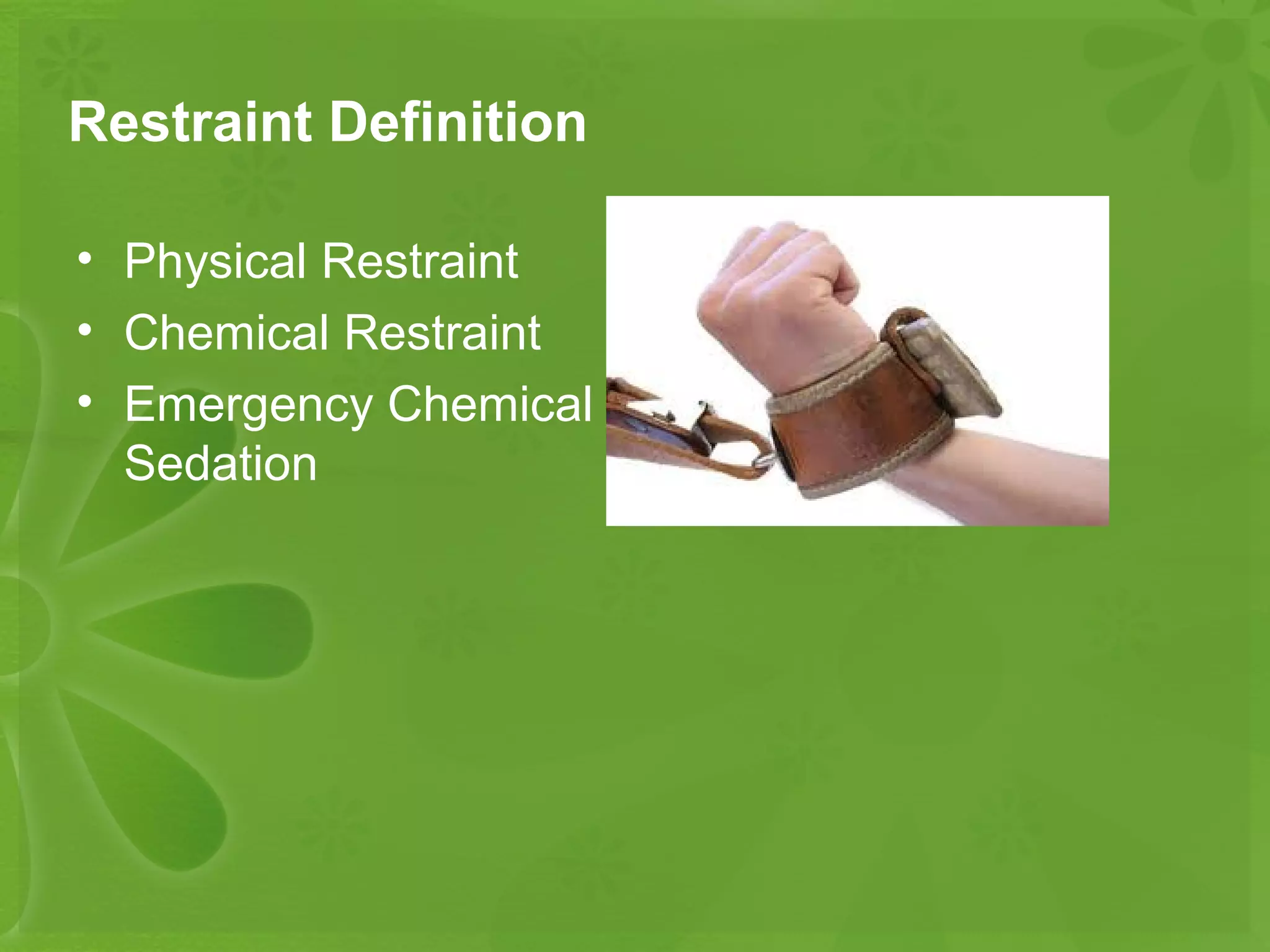
Restraint Definition
• Physical Restraint
• Chemical Restraint
• Emergency Chemical
Sedation
Medico-Legal Questions
• Does the patient need to be restrained?
• Which is safer, chemical or physical restraint?
• How do I minimize my medical and legal risk in
these cases?
Restraint Definition
• More subtle restraints may also be employed, for
example removing walking aids from an individuals
reach, or ensuring that the environmental temperature in
certain areas within care settings discourages loitering.
The application of electronic tagging devices can alert
staff to the movement of an individual out of a desired
area and thus enables their apprehension. Chemical
restraint of individuals may be achieved by the use of
sedative medications, on either a short or long term
basis.•
Definition Seclusion
• Involuntary confinement of the patient alone in a room or
an area where the patient is physically prevented from
leaving. Does not include confinement on a locked unit
where the patient is with others. May only be used for
the management of violent or self destructive behavior.
INDIVIDUAL AUTONOMY
• While the foregoing measures breach individual
autonomy, that is; the right to make ones own decisions,
then the justification in health and social care settings is
usually that restraint is in the service users best interest
(the ethical principle of beneficence) and/or is carried out
in order to prevent the individual coming to harm (the
principle of non-maleficence). If a further rationale is
provided, it may be that, while autonomy is a prima facie
principle (that is, at first sight appears to be one that
should be upheld), it is predicated upon an individual
having insight into the consequences of their actions.
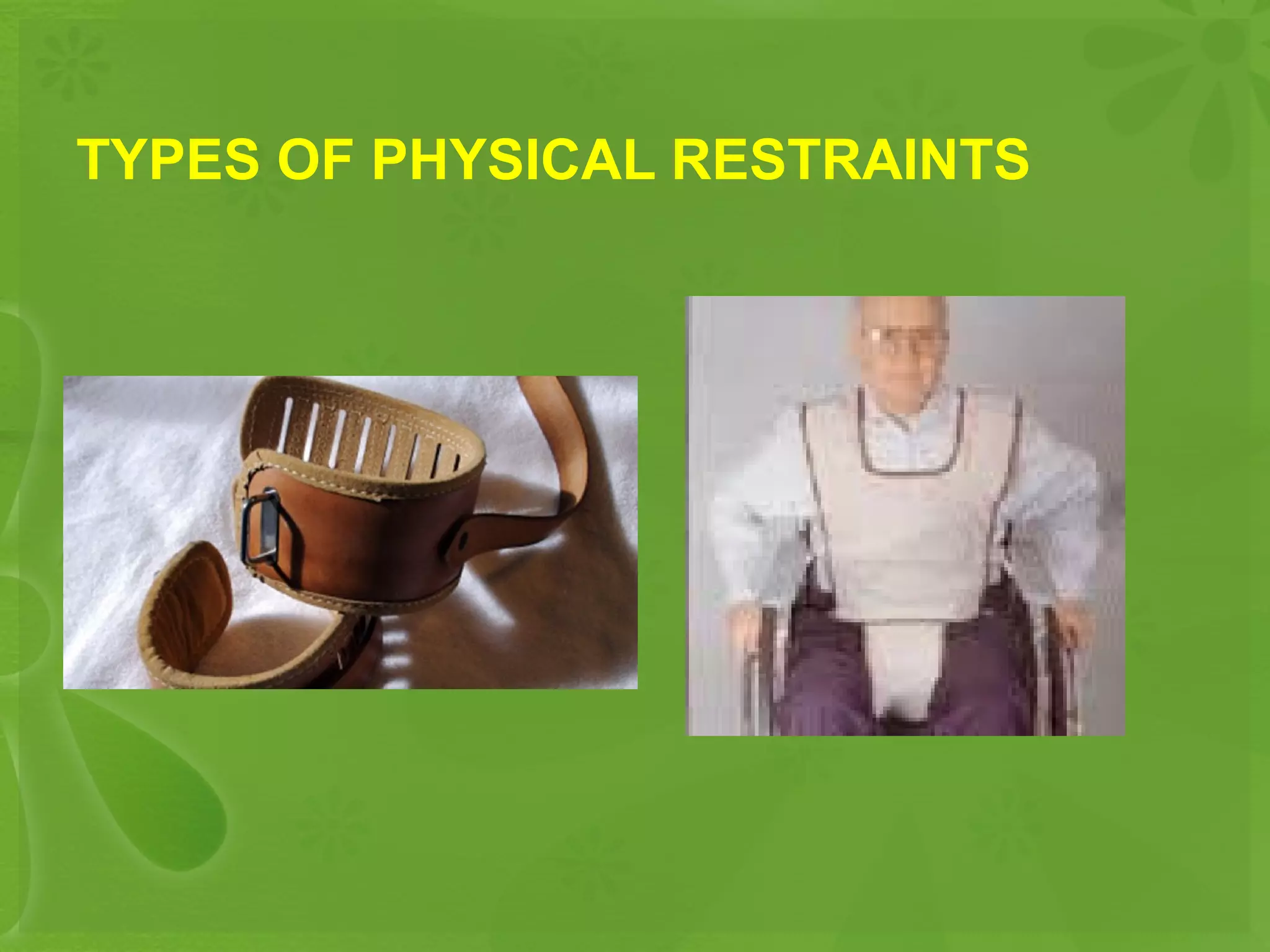
TYPES OF PHYSICAL RESTRAINTS
• Physical restraints
include: Straps, Vests,
Mitts, seat belts, side
rails, and beds with high
padded walls usually
used for seizure
patients.•• Restraints also
include casts, range of
motion machines and any
medical device where the
patient’s movement is
restricted if the patient
can’t free themselves
from the device.
TYPES OF PHYSICAL RESTRAINTS
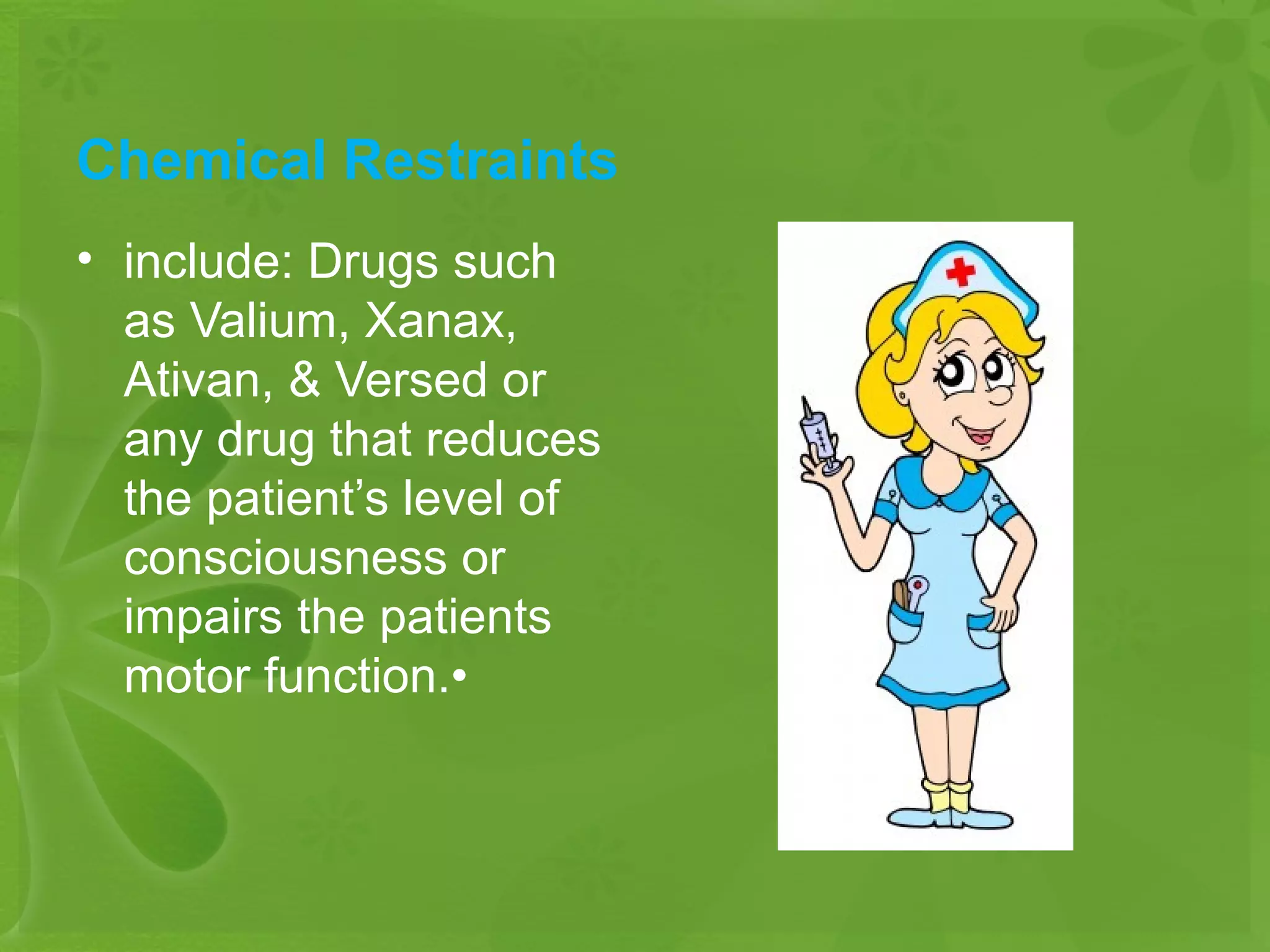
Chemical Restraints
• include: Drugs such
as Valium, Xanax,
Ativan, & Versed or
any drug that reduces
the patient’s level of
consciousness or
impairs the patients
motor function.•
ENVIORNMENTAL RESTRAINTS
• An environmental restraint is anything that prevents a
patient from obtaining clothing, car keys, walkers, canes
and other devices used for mobility. Confining a patient
in a locked room. Certain behavior modifications, for
example refusing the patient access to something or
preventing the patient from leaving their room or facility
because of anger issues or displaying “clinical” behavior.
An angry outburst could be construed as “clinical” thus
restricting the patient for a day outing or even leaving
their room.
THE PROBLEM WITH RESTRAINTS
• Restraints just cause more problems than they prevent
and is also a major legal risk as well. Both physical an
chemical restraints lead to falls, soft tissue skin injuries,
problems with circulation, neurologic and orthopedic
impairment from nerve damage and fractures.
Environmental restraints can cause patient injury when
the patient tries to remove themselves from the restraint.
For example, if a patient with post-op knee surgery is
using a range of motion machine and tries to remove the
device, they may fall when trying to use the bathroom.
They may not call for assistance for fear inadequacy or
they may feel a loss of dignity.•
The Legal Risks of Restraints•
• The patient may be harmed physically and emotionally.
The problem with using restraints is that it opens up a
whole plethora of legal issues in a way that violates the
patients rights, and can also lead to charges of false
imprisonment, at the same time failure to use restraints
when they are indicated may violate the nurse practice
act as well. When using restraints you need to
understand how to document properly and accurately as
it shows that you have followed the correct procedure
when using restraints on patients.
How to Document for Restraints•
• First off, you should do a head to toe assessment of the
patient and do a cognitive assessment as well, this will
show that you are aware of the patients current
condition-if changes occur after restraints it will show
that you took the appropriate steps in documentation and
will give a clear “before and after” picture.
• • Restraints should only be used as a last resort, not just
because a patient is ventilated or combative there are
other measures that can be used instead of restraints.
Alternatives to Restraints
• When restraining a patient it is always a good idea to
consult with another colleague in this matter. For
instance a consult with a physical therapist may yield
alternatives such as:• Using a different or special bed,
keeping the call light easily within reach, using an alarm
bed that sound when the patient tries to leave
unsupervised and frequent physical and cognitive
assessments. If restraints are your only alternative you
should discuss it with the family or guardian and know
your facilities policy and procedures. EXCEPT in an
extreme emergency-you must get a physician’s order
and informed consent to apply restraints
The Physician’s Restraint Order
• Hospitals and Facilities have orders that must comply
with the Joint Commission Guidelines on restraint use.
The order states the type of restraint to use such as a
vest, soft wrist, or leather.
• The order should also include when to apply it, duration,
and frequency of assessment during restraint.
• Restrained patients should be kept close to a nurses
station with the door open so you can see and hear
what’s happening.
• Although facilities vary in protocol the usual is to check
every 15 minutes. Circulation, skin integrity, motion and
sensation need to be assessed and documented. You
should check your previous shifts documentation to
make sure they are following protocol.
Assessment During Restraints
• This case demonstrates if you restrain a patient in an
emergency, your documentation should show the same
detailed attention.
• Always document why such an intervention took place,
the name of the physician you spoke with, the orders you
received, and your reflected actins.
• Your documentation must show that your patient received
competent care.
• You must also obtain informed consent, this reduces your
legal exposure but know that informed consent can be
revoked at any time either in writing or verbally.
Document that you provided both patient and family
about the use of restraints, their purpose, and duration of
time. Be thorough as possible.
A Checklist for Restraints Charting
• Follow your facilities P&P for restraint use. If you don’t
have one a good rule is to check the patient and
document these things every hour: type of restraint,
reason for restraint, patient and family education with
documentation, patient position, skin condition in
pressure areas, circulation of extremities, re-application
of restraints if needed, other safety precautions in effect,
BR assistance, help with eating and drinking, reevaluate
the need for restraints, observation there are no
breathing restrictions.
Chemical restraints
• Chemical restraints
include "any drug
that is used for
discipline or
convenience and
not required to
treat medical
symptoms."'
Psychotropic Medications
• Antidepressant Medications
• Antipsychotic Medications
• Mood Stabilizers
• Anxiolytic Medications
(counteract or diminish anxiety)
• Sedative-Hypnotic Medications**
(sleep inducers)
Consequences of Chemical Restraint
• Increased Fall Risk
• Orthostatic/Postural
Hypotension
• Memory Impairment
• Functional Decline
• Agitation
• Withdrawal
• Sedation
• Movement Disorders
Gradual Dose Reduction
• For drugs in the
sedative-hypnotic
• class, a gradual dose
reduction is
recommended at
• least three times
within six months
before concluding that
a gradual dose
reduction is clinically
contraindicated
• Antipsychotic and
antidepressant
• medications require
gradual dose
reduction, but no time
period is suggested
Case One
• 26 year old male in booking. Drunk and
probably intoxicated on other substances. He is
running his head into the wall.
Medical and Legal Risk
1. Do nothing!
2. Tie him into a restraint chair for several hours
3. Emergency Chemical Sedation
• Chemical Sedation is safer than
Prolonged Physical Restraint
• Chemical Sedation does carry risk.
• Do the benefits outweigh the risks?
• How do the risks compare to physical
restraint?
Chemical Sedation is safer than
Prolonged Physical Restraint
• Injuries Common in Physical Restrain, both to the patient
and staff.
• Death has occurred.
• Injuries uncommon in Chemical sedation.
• Deaths very rare.
Minimizing Legal Risk
• Right Patient
• Right Medication
• Right Documentation
• Conforms to established protocol
• Physician Order
Right Patient
• Acute Danger to self or others
• The danger is immediate and apparent
• Other treatment modalities did not work
• The patient should refuse voluntary
sedation
• NOT to be used as a disciplinary measure
Right Agent--Antipsychotics
• Haloperidol 5-20mg IM.
Overall Best Agent
• Other Possibilities
• Droperidol.
• Ziprosidone (Geodon)
• Olanzapine (Zyprexa)
Antipsychotics Advantages
• No Respiratory depression.
• Safe, safe, safe.
• “How much Haldol can you safely give IV push?”
Antipsychotic Potential Adverse Event
• QT prolongation
• Dysrhythmia exceedingly rare
• Seizure threshold
• Controversial
• Neuroleptic Malignant Syndrome
• Exceedingly rare
• Dystonia.
• Common but trivial
Right Agent
• Benzodiazepines
• Lorazepam 2-4mg IM. Best Agent.
• Other possibilities:
• Midazolam
• Diazepam
Lorazepam--Advantages
• “Antidote” to stimulant overdose
• Works well in concert with Haldol
• Recommended for use in children
Lorazepam--Disadvantages
• Respiratory depression
• Hypotension
Documentation
• Need for Emergency
Sedation
• No reversible medical
conditions
• Refusal of less
invasive alternatives
• Physician order
• Medication(s) given
• Safe Onset of
sedation
• Retrospective review
RETHINK RESTRAINTS
• “ HEY! I THINK HE
JUST MOVED! ADD
ONE MORE!”
Rethink Restraints
• Patients who are restrained do fall and may
sustain more serious injury because part of their
body is tied to the bed or because they fall from
a greater height after climbing up and over a
side rail.
• Patients have died as a result of being
suspended from beds or chairs by straps or vest
restraints, and by being entrapped in side rails.
Rethink Restraints
• The risk of patients injuring themselves,
sometimes fatally while becoming agitated
and trying to escape from their restraints,
is real.
Rethink Restraints
• Restrained individuals often feel humiliated.
They may become depressed, withdrawn or
agitated when freedom of movement is taken
away from them.
Rethink Restraints
• Restraints pose special risks for people who are
agitated, or who may fall while attempting to
escape their restraints.
Identify alternatives
• Physiologic cares, such as attention to comfort,
pain relief, positioning, oral feedings in lieu of
intravenous or enteral nutrition.
• Close observation by staff (i.e. moving them to a
room by the nurse’s station).
• Environmental manipulation, such as increased
light or presence of accessible call light or other
means of communication.
Identify alternatives
• Personal strengthening and rehabilitation
program.
• Use of “personal assistance” devices such as
hearing aids, visual aids and mobility device.
Use of positioning devices such as geri-chair,
body and seat cushion.
Identify alternatives
• Efforts to design a safer physical environment,
including the removal of obstacles that impede
movement, placement of objects and furniture in
familiar places, lower beds, use of bed alarms
and adequate lighting.
Conclusion
• Determine that there is a valid need to restrain
the patient.
• Consider your legal and ethical obligations, and
realize that an individual shouldn't have his or her
movement restricted simply for the caregivers
convenience.
• Contact the patients physician, and get an order
for the use of restraints.
• Decide which type of restraint is most appropriate
for the situation. Use the least-restrictive device
you can.
Conclusion
• Check on restrained patients at least every 15
minutes. Remove the restraint at least every two
hours to check for skin irritation and proper
blood circulation.
• Get a new order from a physician if the patient
needs to be restrained the following day.
• By law, a doctors order for restraints expires
after 24 hours.
Safe restrain
Nursing How To : Tie A Half-Bow Knot

PHYSICAL AND CHEMICAL RESTRAIN

  • 1.
  • 2.
    Restrain Dr. Safaa HusseinAli Lecturer of geriatric medicine Ain Shams university Cairo – Egypt Senior registrar of geriatric medicine Prince Mansour military hospital Taif-KSA
  • 3.
    Restraint Definition • PhysicalRestraint • Chemical Restraint • Emergency Chemical Sedation
  • 4.
    Medico-Legal Questions • Doesthe patient need to be restrained? • Which is safer, chemical or physical restraint? • How do I minimize my medical and legal risk in these cases?
  • 5.
    Restraint Definition • Moresubtle restraints may also be employed, for example removing walking aids from an individuals reach, or ensuring that the environmental temperature in certain areas within care settings discourages loitering. The application of electronic tagging devices can alert staff to the movement of an individual out of a desired area and thus enables their apprehension. Chemical restraint of individuals may be achieved by the use of sedative medications, on either a short or long term basis.•
  • 6.
    Definition Seclusion • Involuntaryconfinement of the patient alone in a room or an area where the patient is physically prevented from leaving. Does not include confinement on a locked unit where the patient is with others. May only be used for the management of violent or self destructive behavior.
  • 7.
    INDIVIDUAL AUTONOMY • Whilethe foregoing measures breach individual autonomy, that is; the right to make ones own decisions, then the justification in health and social care settings is usually that restraint is in the service users best interest (the ethical principle of beneficence) and/or is carried out in order to prevent the individual coming to harm (the principle of non-maleficence). If a further rationale is provided, it may be that, while autonomy is a prima facie principle (that is, at first sight appears to be one that should be upheld), it is predicated upon an individual having insight into the consequences of their actions.
  • 8.
    TYPES OF PHYSICALRESTRAINTS • Physical restraints include: Straps, Vests, Mitts, seat belts, side rails, and beds with high padded walls usually used for seizure patients.•• Restraints also include casts, range of motion machines and any medical device where the patient’s movement is restricted if the patient can’t free themselves from the device.
  • 9.
  • 10.
  • 11.
    Chemical Restraints • include:Drugs such as Valium, Xanax, Ativan, & Versed or any drug that reduces the patient’s level of consciousness or impairs the patients motor function.•
  • 12.
    ENVIORNMENTAL RESTRAINTS • Anenvironmental restraint is anything that prevents a patient from obtaining clothing, car keys, walkers, canes and other devices used for mobility. Confining a patient in a locked room. Certain behavior modifications, for example refusing the patient access to something or preventing the patient from leaving their room or facility because of anger issues or displaying “clinical” behavior. An angry outburst could be construed as “clinical” thus restricting the patient for a day outing or even leaving their room.
  • 13.
    THE PROBLEM WITHRESTRAINTS • Restraints just cause more problems than they prevent and is also a major legal risk as well. Both physical an chemical restraints lead to falls, soft tissue skin injuries, problems with circulation, neurologic and orthopedic impairment from nerve damage and fractures. Environmental restraints can cause patient injury when the patient tries to remove themselves from the restraint. For example, if a patient with post-op knee surgery is using a range of motion machine and tries to remove the device, they may fall when trying to use the bathroom. They may not call for assistance for fear inadequacy or they may feel a loss of dignity.•
  • 14.
    The Legal Risksof Restraints• • The patient may be harmed physically and emotionally. The problem with using restraints is that it opens up a whole plethora of legal issues in a way that violates the patients rights, and can also lead to charges of false imprisonment, at the same time failure to use restraints when they are indicated may violate the nurse practice act as well. When using restraints you need to understand how to document properly and accurately as it shows that you have followed the correct procedure when using restraints on patients.
  • 15.
    How to Documentfor Restraints•
  • 16.
    How to Documentfor Restraints• • First off, you should do a head to toe assessment of the patient and do a cognitive assessment as well, this will show that you are aware of the patients current condition-if changes occur after restraints it will show that you took the appropriate steps in documentation and will give a clear “before and after” picture. • • Restraints should only be used as a last resort, not just because a patient is ventilated or combative there are other measures that can be used instead of restraints.
  • 17.
    Alternatives to Restraints •When restraining a patient it is always a good idea to consult with another colleague in this matter. For instance a consult with a physical therapist may yield alternatives such as:• Using a different or special bed, keeping the call light easily within reach, using an alarm bed that sound when the patient tries to leave unsupervised and frequent physical and cognitive assessments. If restraints are your only alternative you should discuss it with the family or guardian and know your facilities policy and procedures. EXCEPT in an extreme emergency-you must get a physician’s order and informed consent to apply restraints
  • 18.
    The Physician’s RestraintOrder • Hospitals and Facilities have orders that must comply with the Joint Commission Guidelines on restraint use. The order states the type of restraint to use such as a vest, soft wrist, or leather. • The order should also include when to apply it, duration, and frequency of assessment during restraint. • Restrained patients should be kept close to a nurses station with the door open so you can see and hear what’s happening. • Although facilities vary in protocol the usual is to check every 15 minutes. Circulation, skin integrity, motion and sensation need to be assessed and documented. You should check your previous shifts documentation to make sure they are following protocol.
  • 19.
  • 20.
    Assessment During Restraints •This case demonstrates if you restrain a patient in an emergency, your documentation should show the same detailed attention. • Always document why such an intervention took place, the name of the physician you spoke with, the orders you received, and your reflected actins. • Your documentation must show that your patient received competent care. • You must also obtain informed consent, this reduces your legal exposure but know that informed consent can be revoked at any time either in writing or verbally. Document that you provided both patient and family about the use of restraints, their purpose, and duration of time. Be thorough as possible.
  • 21.
    A Checklist forRestraints Charting • Follow your facilities P&P for restraint use. If you don’t have one a good rule is to check the patient and document these things every hour: type of restraint, reason for restraint, patient and family education with documentation, patient position, skin condition in pressure areas, circulation of extremities, re-application of restraints if needed, other safety precautions in effect, BR assistance, help with eating and drinking, reevaluate the need for restraints, observation there are no breathing restrictions.
  • 22.
    Chemical restraints • Chemicalrestraints include "any drug that is used for discipline or convenience and not required to treat medical symptoms."'
  • 23.
    Psychotropic Medications • AntidepressantMedications • Antipsychotic Medications • Mood Stabilizers • Anxiolytic Medications (counteract or diminish anxiety) • Sedative-Hypnotic Medications** (sleep inducers)
  • 24.
    Consequences of ChemicalRestraint • Increased Fall Risk • Orthostatic/Postural Hypotension • Memory Impairment • Functional Decline • Agitation • Withdrawal • Sedation • Movement Disorders
  • 25.
    Gradual Dose Reduction •For drugs in the sedative-hypnotic • class, a gradual dose reduction is recommended at • least three times within six months before concluding that a gradual dose reduction is clinically contraindicated • Antipsychotic and antidepressant • medications require gradual dose reduction, but no time period is suggested
  • 26.
    Case One • 26year old male in booking. Drunk and probably intoxicated on other substances. He is running his head into the wall.
  • 27.
    Medical and LegalRisk 1. Do nothing! 2. Tie him into a restraint chair for several hours 3. Emergency Chemical Sedation
  • 28.
    • Chemical Sedationis safer than Prolonged Physical Restraint • Chemical Sedation does carry risk. • Do the benefits outweigh the risks? • How do the risks compare to physical restraint?
  • 29.
    Chemical Sedation issafer than Prolonged Physical Restraint • Injuries Common in Physical Restrain, both to the patient and staff. • Death has occurred. • Injuries uncommon in Chemical sedation. • Deaths very rare.
  • 30.
    Minimizing Legal Risk •Right Patient • Right Medication • Right Documentation • Conforms to established protocol • Physician Order
  • 31.
    Right Patient • AcuteDanger to self or others • The danger is immediate and apparent • Other treatment modalities did not work • The patient should refuse voluntary sedation • NOT to be used as a disciplinary measure
  • 32.
    Right Agent--Antipsychotics • Haloperidol5-20mg IM. Overall Best Agent • Other Possibilities • Droperidol. • Ziprosidone (Geodon) • Olanzapine (Zyprexa)
  • 33.
    Antipsychotics Advantages • NoRespiratory depression. • Safe, safe, safe. • “How much Haldol can you safely give IV push?”
  • 34.
    Antipsychotic Potential AdverseEvent • QT prolongation • Dysrhythmia exceedingly rare • Seizure threshold • Controversial • Neuroleptic Malignant Syndrome • Exceedingly rare • Dystonia. • Common but trivial
  • 35.
    Right Agent • Benzodiazepines •Lorazepam 2-4mg IM. Best Agent. • Other possibilities: • Midazolam • Diazepam
  • 36.
    Lorazepam--Advantages • “Antidote” tostimulant overdose • Works well in concert with Haldol • Recommended for use in children
  • 37.
  • 38.
    Documentation • Need forEmergency Sedation • No reversible medical conditions • Refusal of less invasive alternatives • Physician order • Medication(s) given • Safe Onset of sedation • Retrospective review
  • 39.
    RETHINK RESTRAINTS • “HEY! I THINK HE JUST MOVED! ADD ONE MORE!”
  • 40.
    Rethink Restraints • Patientswho are restrained do fall and may sustain more serious injury because part of their body is tied to the bed or because they fall from a greater height after climbing up and over a side rail. • Patients have died as a result of being suspended from beds or chairs by straps or vest restraints, and by being entrapped in side rails.
  • 41.
    Rethink Restraints • Therisk of patients injuring themselves, sometimes fatally while becoming agitated and trying to escape from their restraints, is real.
  • 42.
    Rethink Restraints • Restrainedindividuals often feel humiliated. They may become depressed, withdrawn or agitated when freedom of movement is taken away from them.
  • 43.
    Rethink Restraints • Restraintspose special risks for people who are agitated, or who may fall while attempting to escape their restraints.
  • 44.
    Identify alternatives • Physiologiccares, such as attention to comfort, pain relief, positioning, oral feedings in lieu of intravenous or enteral nutrition. • Close observation by staff (i.e. moving them to a room by the nurse’s station). • Environmental manipulation, such as increased light or presence of accessible call light or other means of communication.
  • 45.
    Identify alternatives • Personalstrengthening and rehabilitation program. • Use of “personal assistance” devices such as hearing aids, visual aids and mobility device. Use of positioning devices such as geri-chair, body and seat cushion.
  • 46.
    Identify alternatives • Effortsto design a safer physical environment, including the removal of obstacles that impede movement, placement of objects and furniture in familiar places, lower beds, use of bed alarms and adequate lighting.
  • 47.
    Conclusion • Determine thatthere is a valid need to restrain the patient. • Consider your legal and ethical obligations, and realize that an individual shouldn't have his or her movement restricted simply for the caregivers convenience. • Contact the patients physician, and get an order for the use of restraints. • Decide which type of restraint is most appropriate for the situation. Use the least-restrictive device you can.
  • 48.
    Conclusion • Check onrestrained patients at least every 15 minutes. Remove the restraint at least every two hours to check for skin irritation and proper blood circulation. • Get a new order from a physician if the patient needs to be restrained the following day. • By law, a doctors order for restraints expires after 24 hours.
  • 49.
  • 50.
    Nursing How To: Tie A Half-Bow Knot