Prepared by:
Sojiya Jose
Clinical instructor in MCH, Alhasa, KSA
A fall is an unexpected
change in position that
causes a person to land
on an object on the
floor or other lower
level (witnessed), or is
reported to have landed
on the ground
(unwitnessed).
Classification of falls:
* Accidental
* Anticipated physiologic
* Unanticipated physiologic
* Assisted fall
* Provides guidelines for preventing, managing,
reporting fall occurrence
* To identify patient at risk of falling
* Determine actions to minimize risk factors
 all the patients should be assessed on admissions, and
patients in OPD and day surgery units, for risk for all using
Morse fall scale and Humpty Dumpty scale
Reassessment should be performed as the following:
• Beginning of the shift
• A change in patient's clinical status
• Post-operative and other procedure
• Whenever a fall occurs
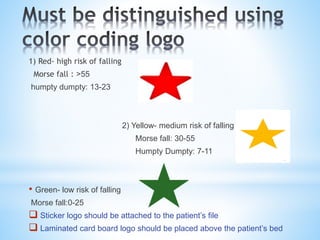
1) Red- high risk of falling
Morse fall : ˃55
humpty dumpty: 13-23
2) Yellow- medium risk of falling
Morse fall: 30-55
Humpty Dumpty: 7-11
• Green- low risk of falling
Morse fall:0-25
 Sticker logo should be attached to the patient’s file
 Laminated card board logo should be placed above the patient’s bed
 Safety precautions should be applied to all patients
 Do not leave at risk patient unattended in diagnostic or
treatment areas
 All the patient in recovery room of OR and ER observation
bed are at risk of fall and then the fall preventions should
be applied
 Patient having same risk of fall can be confined together in
one room if possible
 Patient status at risk should be communicated
 Fall risk incident rport should be submitted following any
fall to nursing office as apart of Quality Improvement
monitoring
 Preventive measures must be applied through health
education, periodic or regular environmental monitoring and
educational activities
 social worker can be contacted in case patient need
watcher
 Assessment tool: Morse fall and Humpty
Dumpty scale
 logo
 fall incident assessment form
 OVR
Pre-fall
 Assess and reassess patient with appropriate tool
 Educate family regarding family prevention
 Take actions to reduce risk for fall
 Correct potential risk in the patient fall
 Check the patient at least 2hourly and risk patients
every 30 minutes
 Encourage the patient to perform active range of
motion
Post-fall
 Guide the patient to remain supine and
support him
 Provide the psychological support
 Assess the patient and ABC’S
 Provide necessary care
 Observe the patient
 Inform supervisor
 Write OVR, fall incident report
 orient patient to surroundings and hospital routines
 patient and family education
 communicate the patient risk status
 place the patent's personnel belonging assistive device
aids with reach
 position call light accessible to patient
 instruct the patient slowly for supine position
 lower the bed to its lowest position, lock the bed
wheels, raise the side rails and observe patient
frequently
 keep bedside curtains open when nursing staff are not
in attendance
 call bell should be reachable to patient
 orient the patient and sitter to the surroundings
 instruct on use of bed controls, nurse call bell
 lower the bed to its lowest position, lock the bed wheels,
raise the side rails and observe patient frequently
 sitters will be encouraged not to sleep in the cribs
 maintain adequate lighting
 keep bedside curtains open when nursing staff are not in
attendance
 instruct patient and family to call for help when needed

Fall prevention and mangemnet

  • 1.
    Prepared by: Sojiya Jose Clinicalinstructor in MCH, Alhasa, KSA
  • 3.
    A fall isan unexpected change in position that causes a person to land on an object on the floor or other lower level (witnessed), or is reported to have landed on the ground (unwitnessed). Classification of falls: * Accidental * Anticipated physiologic * Unanticipated physiologic * Assisted fall
  • 4.
    * Provides guidelinesfor preventing, managing, reporting fall occurrence * To identify patient at risk of falling * Determine actions to minimize risk factors
  • 6.
     all thepatients should be assessed on admissions, and patients in OPD and day surgery units, for risk for all using Morse fall scale and Humpty Dumpty scale Reassessment should be performed as the following: • Beginning of the shift • A change in patient's clinical status • Post-operative and other procedure • Whenever a fall occurs
  • 7.
    1) Red- highrisk of falling Morse fall : ˃55 humpty dumpty: 13-23 2) Yellow- medium risk of falling Morse fall: 30-55 Humpty Dumpty: 7-11 • Green- low risk of falling Morse fall:0-25  Sticker logo should be attached to the patient’s file  Laminated card board logo should be placed above the patient’s bed
  • 8.
     Safety precautionsshould be applied to all patients  Do not leave at risk patient unattended in diagnostic or treatment areas  All the patient in recovery room of OR and ER observation bed are at risk of fall and then the fall preventions should be applied  Patient having same risk of fall can be confined together in one room if possible  Patient status at risk should be communicated  Fall risk incident rport should be submitted following any fall to nursing office as apart of Quality Improvement monitoring  Preventive measures must be applied through health education, periodic or regular environmental monitoring and educational activities  social worker can be contacted in case patient need watcher
  • 9.
     Assessment tool:Morse fall and Humpty Dumpty scale  logo  fall incident assessment form  OVR
  • 10.
    Pre-fall  Assess andreassess patient with appropriate tool  Educate family regarding family prevention  Take actions to reduce risk for fall  Correct potential risk in the patient fall  Check the patient at least 2hourly and risk patients every 30 minutes  Encourage the patient to perform active range of motion
  • 11.
    Post-fall  Guide thepatient to remain supine and support him  Provide the psychological support  Assess the patient and ABC’S  Provide necessary care  Observe the patient  Inform supervisor  Write OVR, fall incident report
  • 12.
     orient patientto surroundings and hospital routines  patient and family education  communicate the patient risk status  place the patent's personnel belonging assistive device aids with reach  position call light accessible to patient  instruct the patient slowly for supine position  lower the bed to its lowest position, lock the bed wheels, raise the side rails and observe patient frequently  keep bedside curtains open when nursing staff are not in attendance  call bell should be reachable to patient
  • 13.
     orient thepatient and sitter to the surroundings  instruct on use of bed controls, nurse call bell  lower the bed to its lowest position, lock the bed wheels, raise the side rails and observe patient frequently  sitters will be encouraged not to sleep in the cribs  maintain adequate lighting  keep bedside curtains open when nursing staff are not in attendance  instruct patient and family to call for help when needed