Door County Memorial Hospital
       Restraints & Safety
                  Staff Education
Purpose: The purpose of this presentation is to provide nursing
staff with information on how to care for patients in need of
restraints


• Goal: The goal of this self-directed presentation
  is to educate staff to use restraints as a last
  resort and, when used, to provide a safe
  environment for the patient in restraints.
• Objectives: After completing this presentation,
  the participant will be able to:
    – Explain what measures to try before putting a patient
      in restraints.
    – Describe the type of order that must be written for
      restraints.
    – Describe methods to safely care for a patient in
      restraints.
Restraint Safety Information

• A physical restraint is any manual method, physical or
  mechanical device, material, or equipment that immobilizes or
  reduces the ability of a patient to move his or her arms, legs,
  body, or head freely.
• A chemical restraint is a drug or medication that is used as a
  restriction to manage the patient’s behavior or restrict the
  patient’s freedom of movement and is not a standard treatment
  or dosage for the patient’s condition.
• Seclusion is the involuntary confinement of a patient alone in a
  room or area from which the patient is physically prevented
  from leaving.
• The use of seclusion or medication as a
  restrictive intervention, restraint and/or
  chemical restraint is not employed at
  DCMH .
There are many potential risks
and side effects of restraint use:
•   Psychological/Emotional:
•           Increased agitation, hostility, aggression and combativeness
•           Feelings of humiliation, loss of dignity
•           Increased confusion
•           Fear
•   Physical:
•           Pressure ulcers, skin trauma (tears, cuts, bruises)
•           Bone loss (demineralization) from decreased weight bearing activity
•           Decreased muscle mass, tone, strength, endurance
•           Deconditioning leads to stiffness, contractures, loss of balance, increased risk of
                        falls
•           Reduced heart and lung capacity, increased risk of orthostatic hypotension and
    respiratory infection
•           Physical discomfort, increased pain
•           Increased constipation, increased risk of fecal impaction
•           Increased incontinence and risk of urinary tract infection due to urinary stasis
•           Obstructed and restricted circulation
•           Reduced appetite
•           Dehydration
•           Death
All alternatives must be tried before
restraints are to be used. This includes:
• Offer bedpan or bathroom every 2 hours
• Offer fluids and nourishment frequently, keep water within
  reach
• Provide diversional activity
• Decrease stimuli and noise
• Provide change of position, up to chair, ambulation
• Have patient wear glasses and/or hearing aides
• Activate bed alarm
• Increase observation
    – Ask family to sit with patient
    – Alert other staff to be observant
    – Move patient to a room near the nurse’s station
• If the patient is interfering with his medical equipment
    – Educate frequently not to touch the treatment device
    – Place the device out of site if possible
    – Cover the device (i.e. wrap I.V. site with Coban or Kerlex)
Important Reminders

• Document all alternatives that were tried
  before restraint use. The decision to use
  restraints must include the full awareness of
  the patient’s rights, dignity, modesty and well
  being. Patients and families must be
  provided with information on restraints to
  allow for an informed decision. This should
  include providing them with “Information
  Sheet: Using Restraints Safely.”
Patient and Family Education:

•    Discuss with patient and family
  safety concerns, i.e. risks of pulling
  out IV.
•    Explain the behavior that initiated
  restrain use
•    Explain the alternatives tried
•    Assure that safety/comfort will be
  met
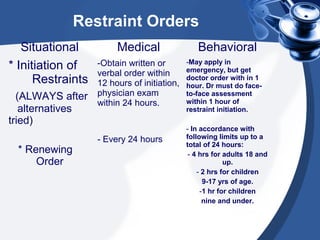
Restraint Orders
   Situational          Medical                 Behavioral
                                             -May apply in
* Initiation of    -Obtain written or
                                             emergency, but get
                   verbal order within
      Restraints   12 hours of initiation,
                                             doctor order with in 1
                                             hour. Dr must do face-
  (ALWAYS after    physician exam            to-face assessment
                   within 24 hours.          within 1 hour of
   alternatives                              restraint initiation.
tried)
                                             - In accordance with
                   - Every 24 hours          following limits up to a
                                             total of 24 hours:
 * Renewing                                   - 4 hrs for adults 18 and
     Order                                                up.
                                                 - 2 hrs for children
                                                   9-17 yrs of age.
                                                  -1 hr for children
                                                   nine and under.
Safe application of wrist/ankle
restraints:
• Always use quick release knots
• DON’T tie to side rails or cross behind patient
• Keep side rails up at all times
• Have call light in reach
• Keep sharp objects away from patient
• Never use a draw sheet tied around the patient’s
  waist as a restraint
• Use only hospital approved soft restraints on wrists
  and ankles
• If leather restraints are required: keep padding under
  leather, keep key behind headboard or taped to the
  wall above headboard at all times
Monitor a patient in restraint every
15 minutes for:

• Signs of injury

• Circulation and range of motion

• Comfort

• Readiness for discontinuation of
  restraint
Documentation (on the restraint
management flow sheet) every 2 hours for:

• Release the patient, turn and position
• Institute a trial of restraint release
• Hydration and nutrition needs
• Elimination needs
• Comfort and repositioning needs
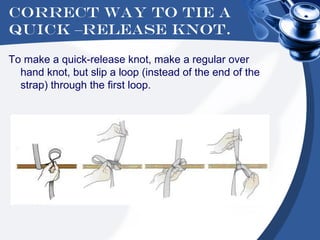
Correct way to tie a
quick –release knot.

To make a quick-release knot, make a regular over
  hand knot, but slip a loop (instead of the end of the
  strap) through the first loop.
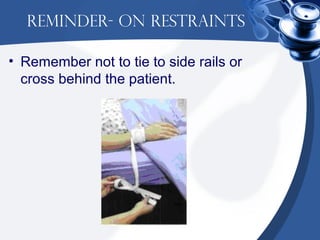
Reminder- on restraints

• Remember not to tie to side rails or
  cross behind the patient.
Additional Information

• For additional information on restraints
  refer to:
      - Restraints policy, found on the J
      drive in the Administrative Policies
      under Patients Rights &
  Organizational Ethics.

     - MedFilms, Educational Video:
     “Patient Restraints and Seclusion”
     located in Nursing Education Office.
References:

• Door County Memorial Hospital. (2008,
  July). Policy and Procedures:
  Administrative Policies, Patient Rights
  & Organizational Ethics. Restraints.
  Sturgeon Bay, WI
• Carter, Pamela J., (2007) Lippincott's
  Essentials for Nursing Assistants: A
  Humanistic Approach to Caregiving
  (pp 279-286). Lippincott Williams &
  Wilkins.

Patient Restraints

  • 1.
    Door County MemorialHospital Restraints & Safety Staff Education
  • 2.
    Purpose: The purposeof this presentation is to provide nursing staff with information on how to care for patients in need of restraints • Goal: The goal of this self-directed presentation is to educate staff to use restraints as a last resort and, when used, to provide a safe environment for the patient in restraints. • Objectives: After completing this presentation, the participant will be able to: – Explain what measures to try before putting a patient in restraints. – Describe the type of order that must be written for restraints. – Describe methods to safely care for a patient in restraints.
  • 3.
    Restraint Safety Information •A physical restraint is any manual method, physical or mechanical device, material, or equipment that immobilizes or reduces the ability of a patient to move his or her arms, legs, body, or head freely. • A chemical restraint is a drug or medication that is used as a restriction to manage the patient’s behavior or restrict the patient’s freedom of movement and is not a standard treatment or dosage for the patient’s condition. • Seclusion is the involuntary confinement of a patient alone in a room or area from which the patient is physically prevented from leaving. • The use of seclusion or medication as a restrictive intervention, restraint and/or chemical restraint is not employed at DCMH .
  • 4.
    There are manypotential risks and side effects of restraint use: • Psychological/Emotional: • Increased agitation, hostility, aggression and combativeness • Feelings of humiliation, loss of dignity • Increased confusion • Fear • Physical: • Pressure ulcers, skin trauma (tears, cuts, bruises) • Bone loss (demineralization) from decreased weight bearing activity • Decreased muscle mass, tone, strength, endurance • Deconditioning leads to stiffness, contractures, loss of balance, increased risk of falls • Reduced heart and lung capacity, increased risk of orthostatic hypotension and respiratory infection • Physical discomfort, increased pain • Increased constipation, increased risk of fecal impaction • Increased incontinence and risk of urinary tract infection due to urinary stasis • Obstructed and restricted circulation • Reduced appetite • Dehydration • Death
  • 5.
    All alternatives mustbe tried before restraints are to be used. This includes: • Offer bedpan or bathroom every 2 hours • Offer fluids and nourishment frequently, keep water within reach • Provide diversional activity • Decrease stimuli and noise • Provide change of position, up to chair, ambulation • Have patient wear glasses and/or hearing aides • Activate bed alarm • Increase observation – Ask family to sit with patient – Alert other staff to be observant – Move patient to a room near the nurse’s station • If the patient is interfering with his medical equipment – Educate frequently not to touch the treatment device – Place the device out of site if possible – Cover the device (i.e. wrap I.V. site with Coban or Kerlex)
  • 6.
    Important Reminders • Documentall alternatives that were tried before restraint use. The decision to use restraints must include the full awareness of the patient’s rights, dignity, modesty and well being. Patients and families must be provided with information on restraints to allow for an informed decision. This should include providing them with “Information Sheet: Using Restraints Safely.”
  • 7.
    Patient and FamilyEducation: • Discuss with patient and family safety concerns, i.e. risks of pulling out IV. • Explain the behavior that initiated restrain use • Explain the alternatives tried • Assure that safety/comfort will be met
  • 8.
    Restraint Orders Situational Medical Behavioral -May apply in * Initiation of -Obtain written or emergency, but get verbal order within Restraints 12 hours of initiation, doctor order with in 1 hour. Dr must do face- (ALWAYS after physician exam to-face assessment within 24 hours. within 1 hour of alternatives restraint initiation. tried) - In accordance with - Every 24 hours following limits up to a total of 24 hours: * Renewing - 4 hrs for adults 18 and Order up. - 2 hrs for children 9-17 yrs of age. -1 hr for children nine and under.
  • 9.
    Safe application ofwrist/ankle restraints: • Always use quick release knots • DON’T tie to side rails or cross behind patient • Keep side rails up at all times • Have call light in reach • Keep sharp objects away from patient • Never use a draw sheet tied around the patient’s waist as a restraint • Use only hospital approved soft restraints on wrists and ankles • If leather restraints are required: keep padding under leather, keep key behind headboard or taped to the wall above headboard at all times
  • 10.
    Monitor a patientin restraint every 15 minutes for: • Signs of injury • Circulation and range of motion • Comfort • Readiness for discontinuation of restraint
  • 11.
    Documentation (on therestraint management flow sheet) every 2 hours for: • Release the patient, turn and position • Institute a trial of restraint release • Hydration and nutrition needs • Elimination needs • Comfort and repositioning needs
  • 12.
    Correct way totie a quick –release knot. To make a quick-release knot, make a regular over hand knot, but slip a loop (instead of the end of the strap) through the first loop.
  • 13.
    Reminder- on restraints •Remember not to tie to side rails or cross behind the patient.
  • 14.
    Additional Information • Foradditional information on restraints refer to: - Restraints policy, found on the J drive in the Administrative Policies under Patients Rights & Organizational Ethics. - MedFilms, Educational Video: “Patient Restraints and Seclusion” located in Nursing Education Office.
  • 15.
    References: • Door CountyMemorial Hospital. (2008, July). Policy and Procedures: Administrative Policies, Patient Rights & Organizational Ethics. Restraints. Sturgeon Bay, WI • Carter, Pamela J., (2007) Lippincott's Essentials for Nursing Assistants: A Humanistic Approach to Caregiving (pp 279-286). Lippincott Williams & Wilkins.