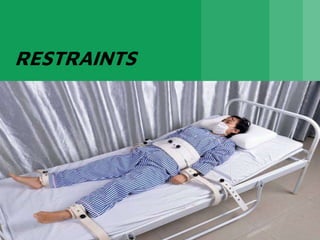
RESTRAINTS
● A physical restraint is a human, mechanical or
physical device that is used with or without the
patient’s permission to restrict his or her
freedom of movement or normal access to a
person’s body & is not a usual part of treatment
plans indicated by the person’s conditions or
symptoms.
1
2
3
GUIDELINES
FOR USING
RESTRAINTS
ONLY TO ENSURE THE PHYSICAL
SAFETY OF THE PATIENT OR OTHER
RESIDENTS
WHEN LESS RESTRICTIVE
INTERVENTIONS ARE NOT
SUCCESSFUL
ONLY ON THE WRITTEN ORDER OF
A PHYSICIAN
TYPES OF RESTRAINTS
1. Physical restraints
2. Chemical restraints
PHYSICAL RESTRAINTS
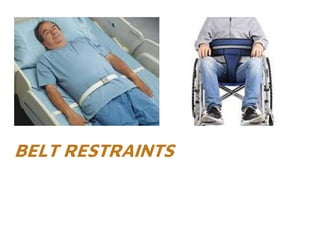
● Belt restraints : device that secures the client to
bed or stretcher. Apply over the clothes or
gown. Avoid placing belt across the chest or too
tightly across the abdomen
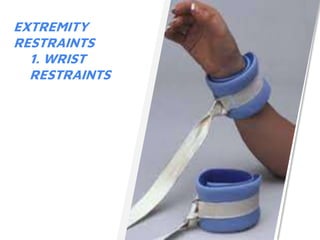
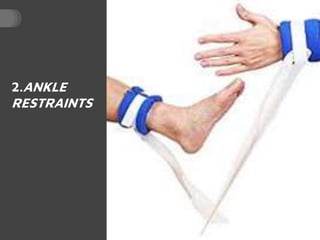
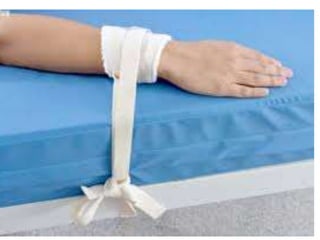
● Extremity restraints (ankle or wrist ) : restraint
designed to immobilize one or all extremities. a
simple wrist restraint is called as a CLOVE
HITCH.
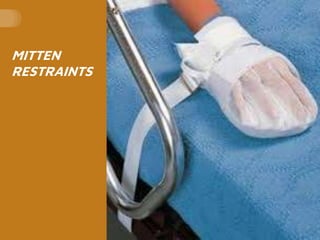
● Mitten restraints : thumbless mitten device to
restrain patient’s hands. Place hands , being
sure to bring end all the way up over the wrist.
● Elbow restraint : piece of fabric
with slots in which tongue blades
are placed so that elbow joints
remains rigid
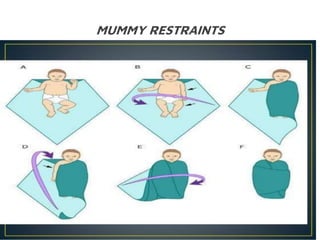
● Mummy restraint: open blanket or
sheet on bed or crib with one
corner folded toward centre. Place
child on blanket shoulders at fold
and feet toward opposite corner.
Controls movement of torso &
extremities.
EXTREMITY
RESTRAINTS
1. WRIST
RESTRAINTS
2.ANKLE
RESTRAINTS
BELT RESTRAINTS
MITTEN
RESTRAINTS
MUMMY RESTRAINTS
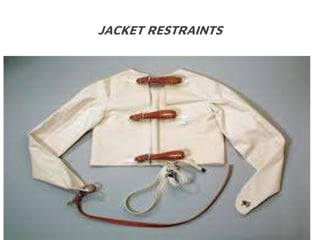
JACKET RESTRAINTS
CHEMICAL
RESTRAINTS
● It is a form of medical restraint in which a drug is used to
restrict the freedom or movement of a patient or in some
cases to sedate the patient.
● used in emergency, acute & psychiatric settings
● commonly used drugs are benzodiazipines, antipsychotic &
dissociative anesthetics.
● also termed as PSYCHOPHARMACOLOGIC AGENT,
PSYCHOTROPIC DRUG or THERAPEUTIC RESTRAINTS.
COMPLICATIONS………
1. Pressure ulcer
2. Constipation
3. Pneumonia
4. Urinary & fecal
incontinence
5. Urinary retention
6. Contractures
7. Nerve damage
8. Circulatory impairment
9. Impaired skin integrity
10. Danger of suffocation
11. Diminished muscle & bone tone
12. Fractures
13. Altered nutrition & hydration
14. Changes in mental status
15. Aspiration
CARE OF
PATIENT ON
RESTRAINTS
● Get informed consent from the
relatives before applying restraints.
● Restraint order is valid only for 24 hrs
● Reassess the patient for continued use
of restraints with the intent of
discontinuing restraint at the earliest
possible time
● Inspect patient for any injury, including
hazards of immobility
● Observe IV catheters, urinary catheters
& drainage tubing are in correct
position
● Provide appropriate sensory
stimulation & frequently re orient the
patient
● Assess the consciousness & orientation,
oxygenation, skin integrity(redness, skin
irritation), circulation (pulse) , parasthesia
& change position of the patient every 2
hrs
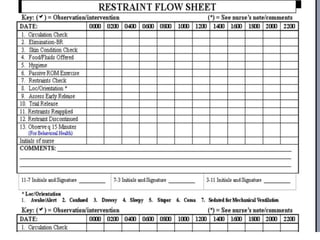
● Remove restraints every 2 hrs & assess the
patient
● Record the time & date of assessments &
releases
● Record type & location of restraint & time
applied
● apply restraints smoothly & snugly
without obstructing blood circulation
● tie the restraints on the bed not to the side
rails
RESTRAINTS.pptx
RESTRAINTS.pptx
RESTRAINTS.pptx

RESTRAINTS.pptx

  • 1.
  • 2.
    ● A physicalrestraint is a human, mechanical or physical device that is used with or without the patient’s permission to restrict his or her freedom of movement or normal access to a person’s body & is not a usual part of treatment plans indicated by the person’s conditions or symptoms.
  • 3.
    1 2 3 GUIDELINES FOR USING RESTRAINTS ONLY TOENSURE THE PHYSICAL SAFETY OF THE PATIENT OR OTHER RESIDENTS WHEN LESS RESTRICTIVE INTERVENTIONS ARE NOT SUCCESSFUL ONLY ON THE WRITTEN ORDER OF A PHYSICIAN
  • 4.
    TYPES OF RESTRAINTS 1.Physical restraints 2. Chemical restraints PHYSICAL RESTRAINTS ● Belt restraints : device that secures the client to bed or stretcher. Apply over the clothes or gown. Avoid placing belt across the chest or too tightly across the abdomen ● Extremity restraints (ankle or wrist ) : restraint designed to immobilize one or all extremities. a simple wrist restraint is called as a CLOVE HITCH. ● Mitten restraints : thumbless mitten device to restrain patient’s hands. Place hands , being sure to bring end all the way up over the wrist.
  • 5.
    ● Elbow restraint: piece of fabric with slots in which tongue blades are placed so that elbow joints remains rigid ● Mummy restraint: open blanket or sheet on bed or crib with one corner folded toward centre. Place child on blanket shoulders at fold and feet toward opposite corner. Controls movement of torso & extremities.
  • 6.
  • 7.
  • 9.
  • 10.
  • 11.
  • 12.
  • 13.
    CHEMICAL RESTRAINTS ● It isa form of medical restraint in which a drug is used to restrict the freedom or movement of a patient or in some cases to sedate the patient. ● used in emergency, acute & psychiatric settings ● commonly used drugs are benzodiazipines, antipsychotic & dissociative anesthetics. ● also termed as PSYCHOPHARMACOLOGIC AGENT, PSYCHOTROPIC DRUG or THERAPEUTIC RESTRAINTS.
  • 14.
    COMPLICATIONS……… 1. Pressure ulcer 2.Constipation 3. Pneumonia 4. Urinary & fecal incontinence 5. Urinary retention 6. Contractures 7. Nerve damage 8. Circulatory impairment 9. Impaired skin integrity 10. Danger of suffocation
  • 15.
    11. Diminished muscle& bone tone 12. Fractures 13. Altered nutrition & hydration 14. Changes in mental status 15. Aspiration
  • 16.
    CARE OF PATIENT ON RESTRAINTS ●Get informed consent from the relatives before applying restraints. ● Restraint order is valid only for 24 hrs ● Reassess the patient for continued use of restraints with the intent of discontinuing restraint at the earliest possible time ● Inspect patient for any injury, including hazards of immobility ● Observe IV catheters, urinary catheters & drainage tubing are in correct position ● Provide appropriate sensory stimulation & frequently re orient the patient
  • 17.
    ● Assess theconsciousness & orientation, oxygenation, skin integrity(redness, skin irritation), circulation (pulse) , parasthesia & change position of the patient every 2 hrs ● Remove restraints every 2 hrs & assess the patient ● Record the time & date of assessments & releases ● Record type & location of restraint & time applied ● apply restraints smoothly & snugly without obstructing blood circulation ● tie the restraints on the bed not to the side rails