Mr.Ramprasad.S
Asst.Professor
Dept.Neurosciences Nursing
Introduction
Essentials required for OT
1. Location with in the hospital
2. Quantity
3. Size
4. Design
5. Equipment required
Parameters for OT
1. Avoid unrelated hospital traffic
2. Avoid outdoor noise
3. Keep a provision for future
expansion
4. Sliding doors
5. Smooth non slippery floors
6. Easy access to departments
• Provision for high efficiency
autoclave
• Radiology film illuminators
• Emergency communication system
Location with in the hospital
1. Centralization
2. Help in optimum man power
3. Avoid crowding
4. Easy team training
5. Minimization of issues related to
surgical supplies
6. Effective supervision
Should be easy accessible to
1. Surgical wards
2. Location of blood bank
3. CSSD
4. Proximity of diagnostic such as
radiology, pathology,ICU.
Size of OT
1. QUANTITY
based on
1. Cost benefit consideration
2. Patient load and disease occurrence
3. Availability of space
4. Number of surgical beds
5. Average length of stay of surgical
patients.
Design
Major operating room
Recovery room
Sub sterilizing area
Sterile instruments supply and storage
Scrub area
Clean up area
Male dressing room
Female dressing room
Nurse station
Wheeled stretcher area
Operation theater zones
Zone 1
Zone 2
Zone 3
Zone 1
Also called as outer zone and
unsterile zone or non restricted zone
or interchange area.
This zone avoids the exposure to
contaminated areas after changing to
surgical attire.
Zone 2
Also called as middle intermediate
zone or semi restricted area and should
be in-between two zones.
This should be large to receive the
supplies for surgery.
Zone 3
Also called as inner most or most
sterile area or restricted zone.
Classification of OT
classification is based on,
1. Extent of surgery involved
2. Type of service provided
3. Sharing of OT
4. Urgency Situation
1.Extent of surgery involved
a. Minor OT
b. Major OT
2. Type of service provided
a. Out patient OT
b. Inpatient OT
3. Sharing of OT
A. Decentralized
 Neurosurgery
 Orthopedic
 CTVS
 ENT
 Eye
 General surgery
 Gynec
 Renal
B. Centralized
4. Urgency Situation
A. Emergency OT
B. Elective OT
Staffing Of OT
The staffing can be measured in many
ways,
1. Number of hours worked
2. Hours associated with direct patient
care
3. Workload calculation
Benefits of good staffing
1. Improves patient outcome
2. Lowers mortality rate
3. Increase OT efficiency
4. Reduce patient waiting time for
surgery
5. Balance workload
OT staffing is based on
1. Total number of hours of cases
2. Number of cases operated per day
3. Type of cases
4. Nature of cases
5. Prescribed norms and policies and
procedures
Policies of OT
1. Functions of OT
2. Duties and responsibilities of
doctors and nurses and technicians
3. Checklist for preparing OT for
surgeries
4. Maintenance of records of surgeries
5. Methods of aseptic techniques
should be followed
6. Maintenance of sterility in different
zones.
7. Disposal of Medical Waste
Staffing Pattern Of OT
OT in charge
Nursing StaffSupport StaffOperating staff
Chief
surgeon
Supportin
g surgeon
perfutionist
anesthetist
Technicians
Helpers
Scrub
Nurse
Circulati
ng
Nurse
Procurement Nurse
Members of OT Team
1. OT in Charge
2. Operating consultant
3. Collaborating surgeons
4. Scrub nurse
5. Circuiting nurse
6. Anaesthetists
7. Percussionist
8. OT technicians
9. Pre recovery staffs
10.Post recovery staffs
11. Sterilization staffs
12. Store keeper
13. Helping staffs
Role of Nurse in OT
1. Pre operative check for the
availability of the materials for
surgery
2. Psychological preparation of the
patient
3. Follow correct aseptic techniques
4. Positioning of the patient
Proper administration of medications
as per policies.
Delivering of high quality patient
care.
 Nursing care based on EBP.
 Participate in risk assessment and
reporting.
 Assess, plan , implement and
evaluate care.
Maintaining of resources
Organize and prioritize the workload
Support other staffs in maintaining
health
Principles of OT Attire
General Principles
Aware of the dress
policy
No one should go out after
change into OT attire
All staffs must
change to OT
attire
Must change
the attire if
any soiling
occur
Focuses on
maintaining
Asepsis
Safety spectacles should be worn when required
Air conditioning unit 1
Anaesthesia machine 1
C/S set 1
Instrument table 1
Laparotomy set 1
Laryngoscope 1
OR light 1
OR table 1
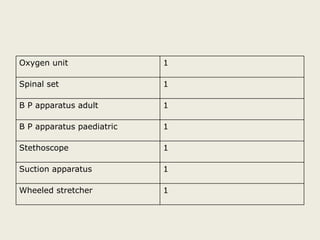
Oxygen unit 1
Spinal set 1
B P apparatus adult 1
B P apparatus paediatric 1
Stethoscope 1
Suction apparatus 1
Wheeled stretcher 1
Criteria for selection of suture
Tissue contamination
Surgeon
preference
Speed of
healing
Cost &
availability
Aesthetic concern
Tension desired in wound healing
Absorption Material structure
Material origin
Absorbable
Non
Absorbable
Monofilament
Multifilame
nt
Natural Synthetic
1. Polyglycotic
acid
2. Catgut
3. Polydiaxone
1. Silk
2. Catgut
3. Nylon
4. Polyster
1. Catgut
2. Nylon
3. Stainless steel
4. polypropylene
1. polygly
cactin
2. polyest
er silk
1. silk
2. catgut
1. all other
available
sutures
Types of suture
Interrupting Sutures Continuous
Sutures
Mattress
Suture
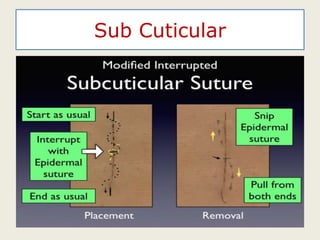
Simple Sub cuticular
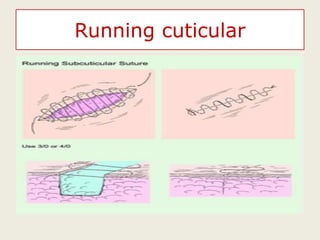
Running
intra dermal
pull out
Running
cuticular
Suture Techniques
Simple Interrupted
Sub Cuticular
Continuous Sutures
Running cuticular
Mattress Suture
DEFINITION
Waste generated in the diagnosis, treatment
and immunization of human beings or
animals, in research or in the production and
testing of biological products.
CLASSIFICATIONS OF HOSPITAL
WASTE
CATEGORIES OF BIO-MEDICAL
WASTE
Option Waste Category
Cat 1
Human anatomical waste (human
tissues, organs, body parts)
Cat 2
Animal waste animal tissues,
organs, body parts carcasses,
bleeding parts, fluid, blood and
experimental animals used in
research, waste generated by
veterinary hospitals/ colleges,
discharge from hospitals, animal
houses)
Option Waste Category
Cat 3
Microbiology & Biotechnology waste
(wastes from laboratory cultures,
stocks or specimens of micro-
organisms live or attenuated vaccines,
human and animal cell culture used
in research and infectious agents from
research and industrial laboratories,
wastes from production of biological,
toxins, dishes and devices used for
transfer of cultures)
Cat 4
Waste Sharps (needles, syringes, scalpels
blades, glass etc. that may cause puncture
and cuts. This includes both used &
unused sharps)
Cat 5
Discarded Medicines and Cytotoxic drugs
(wastes comprising of outdated,
contaminated and discarded medicines)
Cat 6
Solid Waste (Items contaminated with
blood and body fluids including cotton,
dressings, soiled plaster casts, line
beddings, other material contaminated
with blood)
Cat 7
Solid Waste (waste generated from
disposable items other than the waste
sharps such as tubing, catheters,
intravenous sets etc.)
Cat 8
Liquid Waste (waste generated from
laboratory & washing, cleaning , house-
keeping and disinfecting activities)
Cat 9
Incineration Ash (ash from incineration of
any bio-medical waste)
Cat 10
Chemical Waste (chemicals used in
production of biological, chemicals, used in
disinfect ion, as insecticides, etc)
COLOR CODING & TYPE OF
CONTAINER
Colour
Coding
Type of
Containers
Category Treatment Options
as per Schedule 1
Yellow Plastic bag 1,2,3,6 Incineration/deep burial
Red
Disinfected
Container/
Plastic bag
3,6,7 Autoclaving/Microwaving
/Chemical Treatment
Blue/
White
transluc
ent
Plastic
bag/puncture
proof
container
4,7 Autoclaving/Microwaving
/ chemical treatment and
destruction/shredding
Black Plastic bag 5,9,10
(Solid)
Disposal in secured
landfill
Waste
Managemen
t
Why waste has to
be treated?
STEPS IN WASTE
MANAGEMENT
SURVEY
SEGREGATI
ON
STORAGE
TRANSPORTA
TION
TREATMEN
T
DISPOSAL
MINIMIZA
TION
Personal Protective
Equipment
Ot nursing
Ot nursing
Ot nursing
Ot nursing

Ot nursing

  • 1.
  • 2.
  • 3.
    Essentials required forOT 1. Location with in the hospital 2. Quantity 3. Size 4. Design 5. Equipment required
  • 4.
    Parameters for OT 1.Avoid unrelated hospital traffic 2. Avoid outdoor noise 3. Keep a provision for future expansion 4. Sliding doors 5. Smooth non slippery floors 6. Easy access to departments
  • 5.
    • Provision forhigh efficiency autoclave • Radiology film illuminators • Emergency communication system
  • 6.
    Location with inthe hospital 1. Centralization 2. Help in optimum man power 3. Avoid crowding 4. Easy team training 5. Minimization of issues related to surgical supplies 6. Effective supervision
  • 7.
    Should be easyaccessible to 1. Surgical wards 2. Location of blood bank 3. CSSD 4. Proximity of diagnostic such as radiology, pathology,ICU.
  • 8.
    Size of OT 1.QUANTITY based on 1. Cost benefit consideration 2. Patient load and disease occurrence 3. Availability of space 4. Number of surgical beds 5. Average length of stay of surgical patients.
  • 9.
    Design Major operating room Recoveryroom Sub sterilizing area Sterile instruments supply and storage
  • 10.
    Scrub area Clean uparea Male dressing room Female dressing room Nurse station Wheeled stretcher area
  • 11.
  • 12.
    Zone 1 Also calledas outer zone and unsterile zone or non restricted zone or interchange area. This zone avoids the exposure to contaminated areas after changing to surgical attire.
  • 13.
    Zone 2 Also calledas middle intermediate zone or semi restricted area and should be in-between two zones. This should be large to receive the supplies for surgery.
  • 14.
    Zone 3 Also calledas inner most or most sterile area or restricted zone.
  • 15.
  • 16.
    classification is basedon, 1. Extent of surgery involved 2. Type of service provided 3. Sharing of OT 4. Urgency Situation
  • 17.
    1.Extent of surgeryinvolved a. Minor OT b. Major OT
  • 18.
    2. Type ofservice provided a. Out patient OT b. Inpatient OT
  • 19.
    3. Sharing ofOT A. Decentralized  Neurosurgery  Orthopedic  CTVS  ENT  Eye  General surgery  Gynec  Renal B. Centralized
  • 20.
    4. Urgency Situation A.Emergency OT B. Elective OT
  • 21.
  • 22.
    The staffing canbe measured in many ways, 1. Number of hours worked 2. Hours associated with direct patient care 3. Workload calculation
  • 23.
    Benefits of goodstaffing 1. Improves patient outcome 2. Lowers mortality rate 3. Increase OT efficiency 4. Reduce patient waiting time for surgery 5. Balance workload
  • 24.
    OT staffing isbased on 1. Total number of hours of cases 2. Number of cases operated per day 3. Type of cases 4. Nature of cases 5. Prescribed norms and policies and procedures
  • 25.
  • 26.
    1. Functions ofOT 2. Duties and responsibilities of doctors and nurses and technicians 3. Checklist for preparing OT for surgeries 4. Maintenance of records of surgeries
  • 27.
    5. Methods ofaseptic techniques should be followed 6. Maintenance of sterility in different zones. 7. Disposal of Medical Waste
  • 28.
  • 29.
    OT in charge NursingStaffSupport StaffOperating staff Chief surgeon Supportin g surgeon perfutionist anesthetist Technicians Helpers Scrub Nurse Circulati ng Nurse Procurement Nurse
  • 30.
  • 31.
    1. OT inCharge 2. Operating consultant 3. Collaborating surgeons 4. Scrub nurse 5. Circuiting nurse 6. Anaesthetists
  • 32.
    7. Percussionist 8. OTtechnicians 9. Pre recovery staffs 10.Post recovery staffs 11. Sterilization staffs 12. Store keeper 13. Helping staffs
  • 33.
  • 34.
    1. Pre operativecheck for the availability of the materials for surgery 2. Psychological preparation of the patient 3. Follow correct aseptic techniques 4. Positioning of the patient
  • 35.
    Proper administration ofmedications as per policies. Delivering of high quality patient care.  Nursing care based on EBP.  Participate in risk assessment and reporting.
  • 36.
     Assess, plan, implement and evaluate care. Maintaining of resources Organize and prioritize the workload Support other staffs in maintaining health
  • 37.
  • 41.
    General Principles Aware ofthe dress policy No one should go out after change into OT attire All staffs must change to OT attire Must change the attire if any soiling occur Focuses on maintaining Asepsis Safety spectacles should be worn when required
  • 49.
    Air conditioning unit1 Anaesthesia machine 1 C/S set 1 Instrument table 1 Laparotomy set 1 Laryngoscope 1 OR light 1 OR table 1
  • 50.
    Oxygen unit 1 Spinalset 1 B P apparatus adult 1 B P apparatus paediatric 1 Stethoscope 1 Suction apparatus 1 Wheeled stretcher 1
  • 52.
    Criteria for selectionof suture Tissue contamination Surgeon preference Speed of healing Cost & availability Aesthetic concern Tension desired in wound healing
  • 53.
    Absorption Material structure Materialorigin Absorbable Non Absorbable Monofilament Multifilame nt Natural Synthetic 1. Polyglycotic acid 2. Catgut 3. Polydiaxone 1. Silk 2. Catgut 3. Nylon 4. Polyster 1. Catgut 2. Nylon 3. Stainless steel 4. polypropylene 1. polygly cactin 2. polyest er silk 1. silk 2. catgut 1. all other available sutures Types of suture
  • 54.
    Interrupting Sutures Continuous Sutures Mattress Suture SimpleSub cuticular Running intra dermal pull out Running cuticular Suture Techniques
  • 55.
  • 56.
  • 57.
  • 58.
  • 59.
  • 61.
    DEFINITION Waste generated inthe diagnosis, treatment and immunization of human beings or animals, in research or in the production and testing of biological products.
  • 62.
  • 64.
  • 65.
    Option Waste Category Cat1 Human anatomical waste (human tissues, organs, body parts) Cat 2 Animal waste animal tissues, organs, body parts carcasses, bleeding parts, fluid, blood and experimental animals used in research, waste generated by veterinary hospitals/ colleges, discharge from hospitals, animal houses)
  • 66.
    Option Waste Category Cat3 Microbiology & Biotechnology waste (wastes from laboratory cultures, stocks or specimens of micro- organisms live or attenuated vaccines, human and animal cell culture used in research and infectious agents from research and industrial laboratories, wastes from production of biological, toxins, dishes and devices used for transfer of cultures)
  • 67.
    Cat 4 Waste Sharps(needles, syringes, scalpels blades, glass etc. that may cause puncture and cuts. This includes both used & unused sharps) Cat 5 Discarded Medicines and Cytotoxic drugs (wastes comprising of outdated, contaminated and discarded medicines) Cat 6 Solid Waste (Items contaminated with blood and body fluids including cotton, dressings, soiled plaster casts, line beddings, other material contaminated with blood)
  • 68.
    Cat 7 Solid Waste(waste generated from disposable items other than the waste sharps such as tubing, catheters, intravenous sets etc.) Cat 8 Liquid Waste (waste generated from laboratory & washing, cleaning , house- keeping and disinfecting activities) Cat 9 Incineration Ash (ash from incineration of any bio-medical waste) Cat 10 Chemical Waste (chemicals used in production of biological, chemicals, used in disinfect ion, as insecticides, etc)
  • 69.
    COLOR CODING &TYPE OF CONTAINER
  • 70.
    Colour Coding Type of Containers Category TreatmentOptions as per Schedule 1 Yellow Plastic bag 1,2,3,6 Incineration/deep burial Red Disinfected Container/ Plastic bag 3,6,7 Autoclaving/Microwaving /Chemical Treatment Blue/ White transluc ent Plastic bag/puncture proof container 4,7 Autoclaving/Microwaving / chemical treatment and destruction/shredding Black Plastic bag 5,9,10 (Solid) Disposal in secured landfill
  • 73.
  • 74.
    Why waste hasto be treated?
  • 76.
  • 77.
  • 79.