Restraint and seclusion
Dr :Nora abdallah
2022
Second year
:
Outlines
• Definition of Restraint .
• Definition of seclusion.
• Indication of restraint and seclusion.
• The Least restrictive methods are.
• a) Reducing stimuli . b) Verbal intervention.
• c) Offering patients' needs .
Symptoms indicate potential violence .
• Contraindication of restraint and seclusion.
• Types of restraints 1-Mechanical 2- Chemical
Cont :
• Types Mechanical restraint:
• 1-Straitjackets. 2-Wheelchair.
• 3-Safety vests. 4-Straps.
• 5-Mittens
• Technique of mechanical restraint and nursing intervention
• 2- Chemical restraints
• Preparation for chemical restraint .
• lines of pharmacological restraints .
• Seclusion room:
• Characteristics of seclusion room
Restraint and seclusion:
Definition of Restraint:
An intervention of placing the patient involuntarily under control by
the use of chemical or mechanical devices for the reasons of
preventing exited patient from harming self or others.
Definition of seclusion:
It is the involuntary confinement of a person in a hazard-free room or
area that is often locked and where the person can be directly
observed.
Indication of restraint and seclusion
1-When the patient's behavior is physically harmful to
self or others e.g. agitated or aggressive behavior.
2-When alternative or less restrictive measures are
insufficient in protecting the patient or others from.
3-When a decrease in sensory overstimulation
(seclusion only) is needed.
TheLeastrestrictivemethods“ shouldbeemployedwhendealingwiththe
potentiallyviolentpatient.
Symptoms indicate potential violence include
-
-Restlessness . -Tapping of finger.
-Irritability . - Anxiety.
-Tremors and muscles tension.
Change in voice quality.
 This means that
A patient should be provided by alternatives to correct inappropriate
behavior in order to maintain a good working relationship and to
maintain the dignity of the patient.
These methods are.
a) Reducing stimuli such as:
1-Reduce noise as possible. 2- Avoid eye contact with patient.
3- Maintain distance from agitated patient; do not invade the
patient's“ space".
b) Verbal intervention such as:
4- Avoid provocative remarks. 5- Talking softly rather than shouting,
6- Ask patient to be calm and allow patient to ventilate his/ her
feelings:
c) Offering patients' needs
7-Inquiring about what specific needs the patient may have
8- Provide needed medication.
Contraindicationofrestraintandseclusion:
-Any medical or psychiatric condition that could be exacerbated by its
use
Example:
 Broken or burned extremities
 Claustrophobia
 Bronchial asthma
 Delirium or dementia leading to inability to tolerate decreased
 stimulation
 Close supervision and direct observation can‟t provided
Types of restraints
1-Mechanical/physical restraint:
Are any manual method or mechanical device attached to the
patient's body that the patient cannot easily remove and that
restricts freedom of movement or normal access to one's body,
material, or equipment.
Types of mechanical restraint:
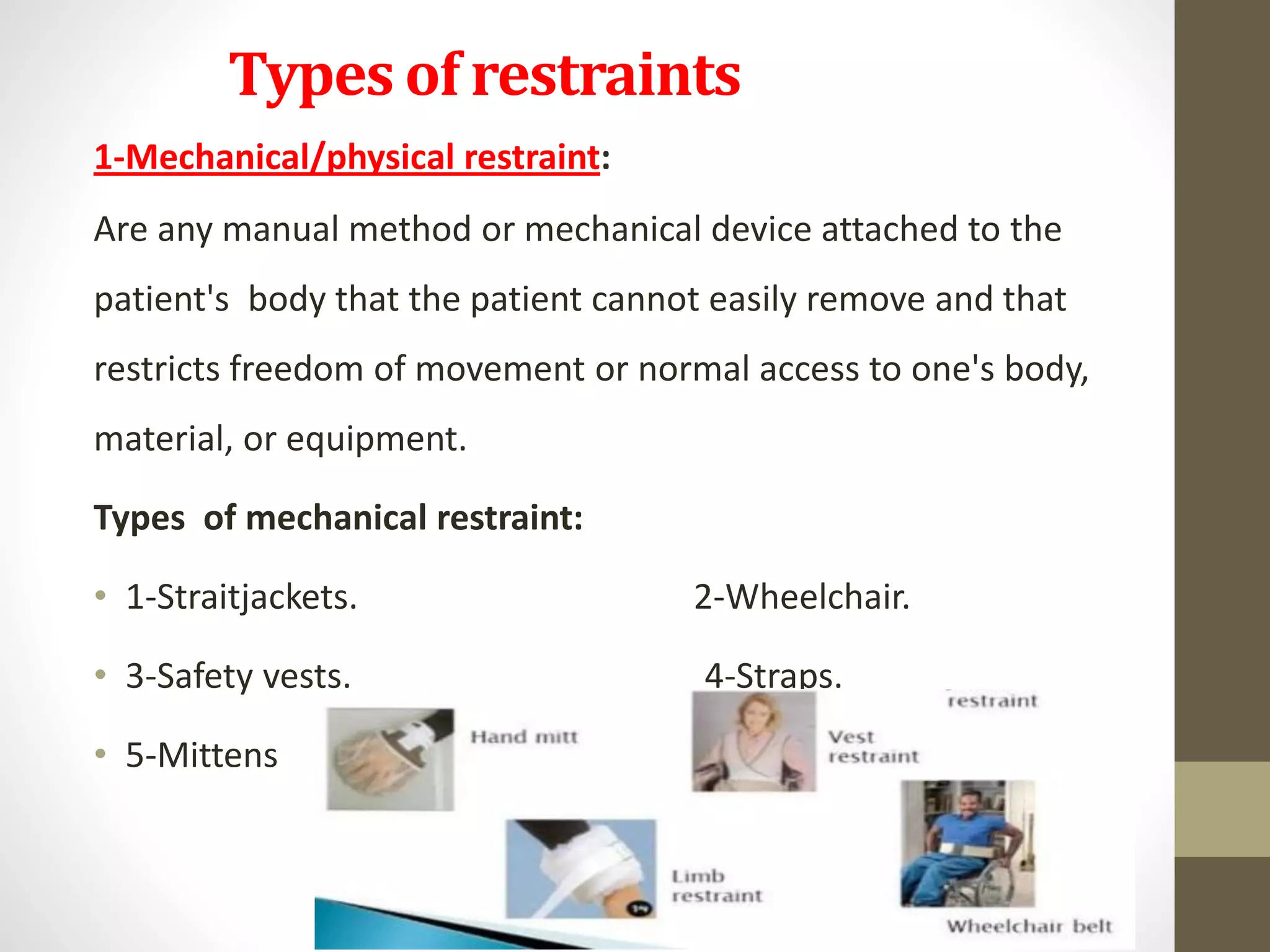
• 1-Straitjackets. 2-Wheelchair.
• 3-Safety vests. 4-Straps.
• 5-Mittens
Cont.
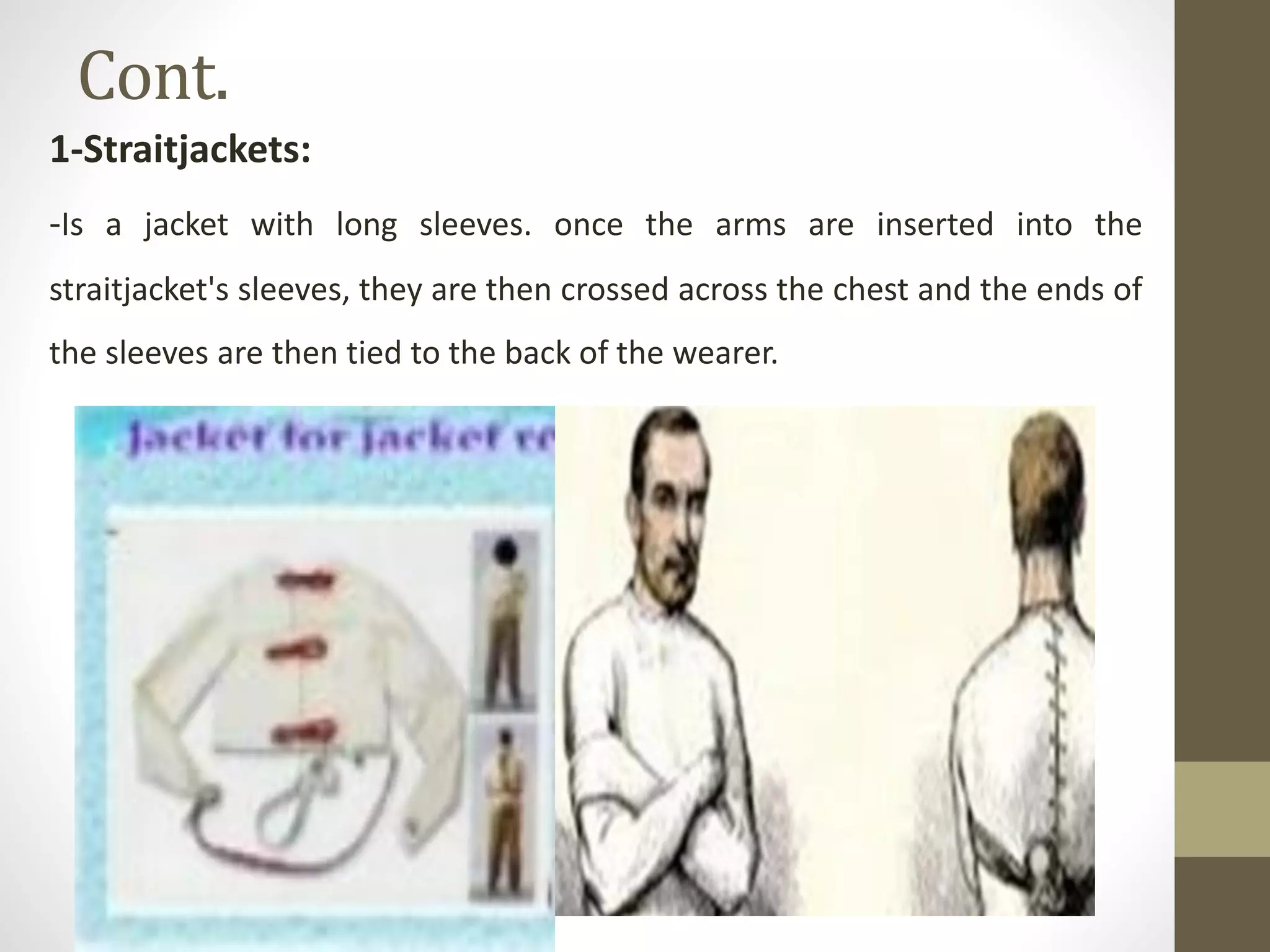
1-Straitjackets:
-Is a jacket with long sleeves. once the arms are inserted into the
straitjacket's sleeves, they are then crossed across the chest and the ends of
the sleeves are then tied to the back of the wearer.
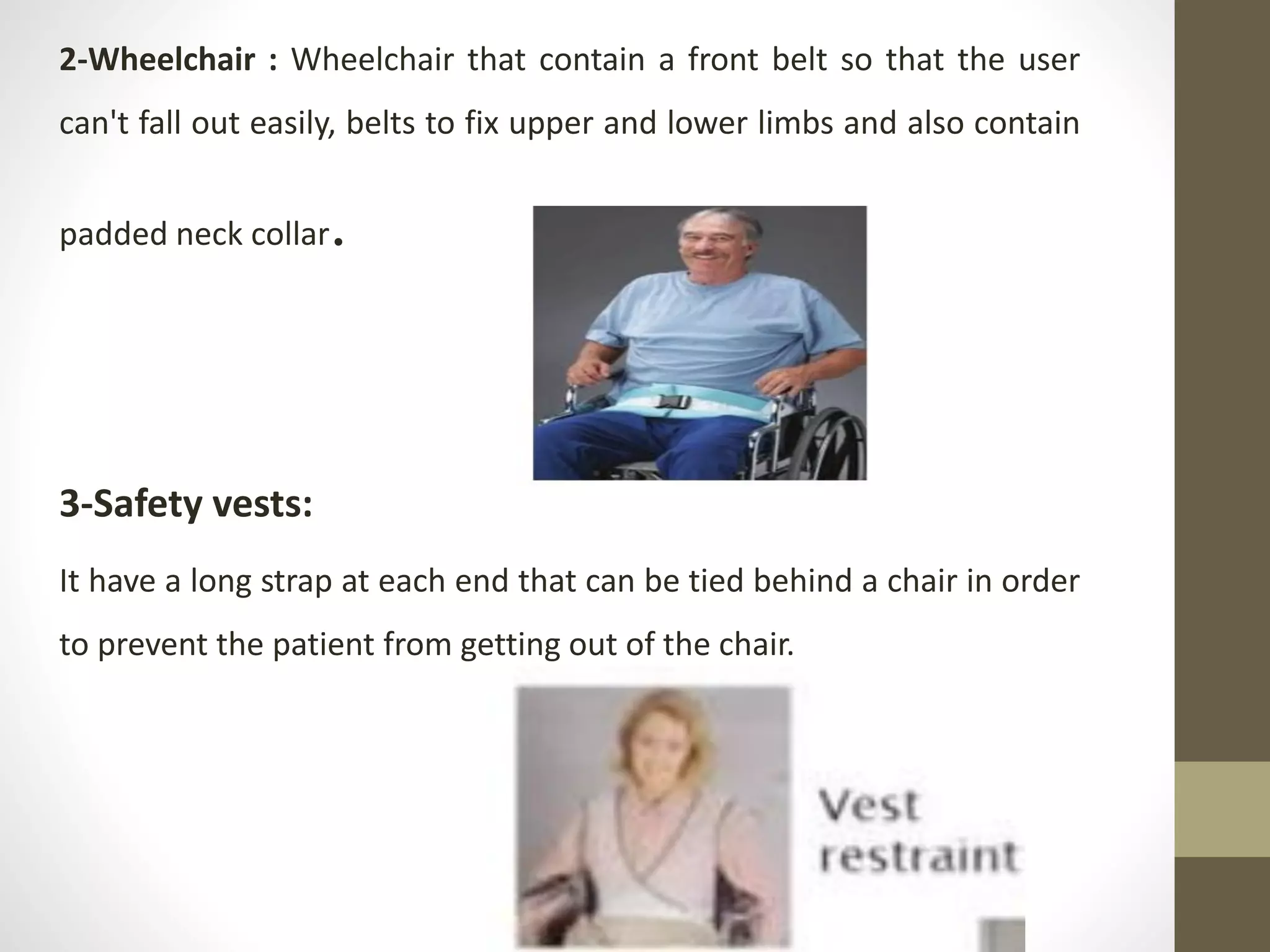
2-Wheelchair : Wheelchair that contain a front belt so that the user
can't fall out easily, belts to fix upper and lower limbs and also contain
padded neck collar.
3-Safety vests:
It have a long strap at each end that can be tied behind a chair in order
to prevent the patient from getting out of the chair.
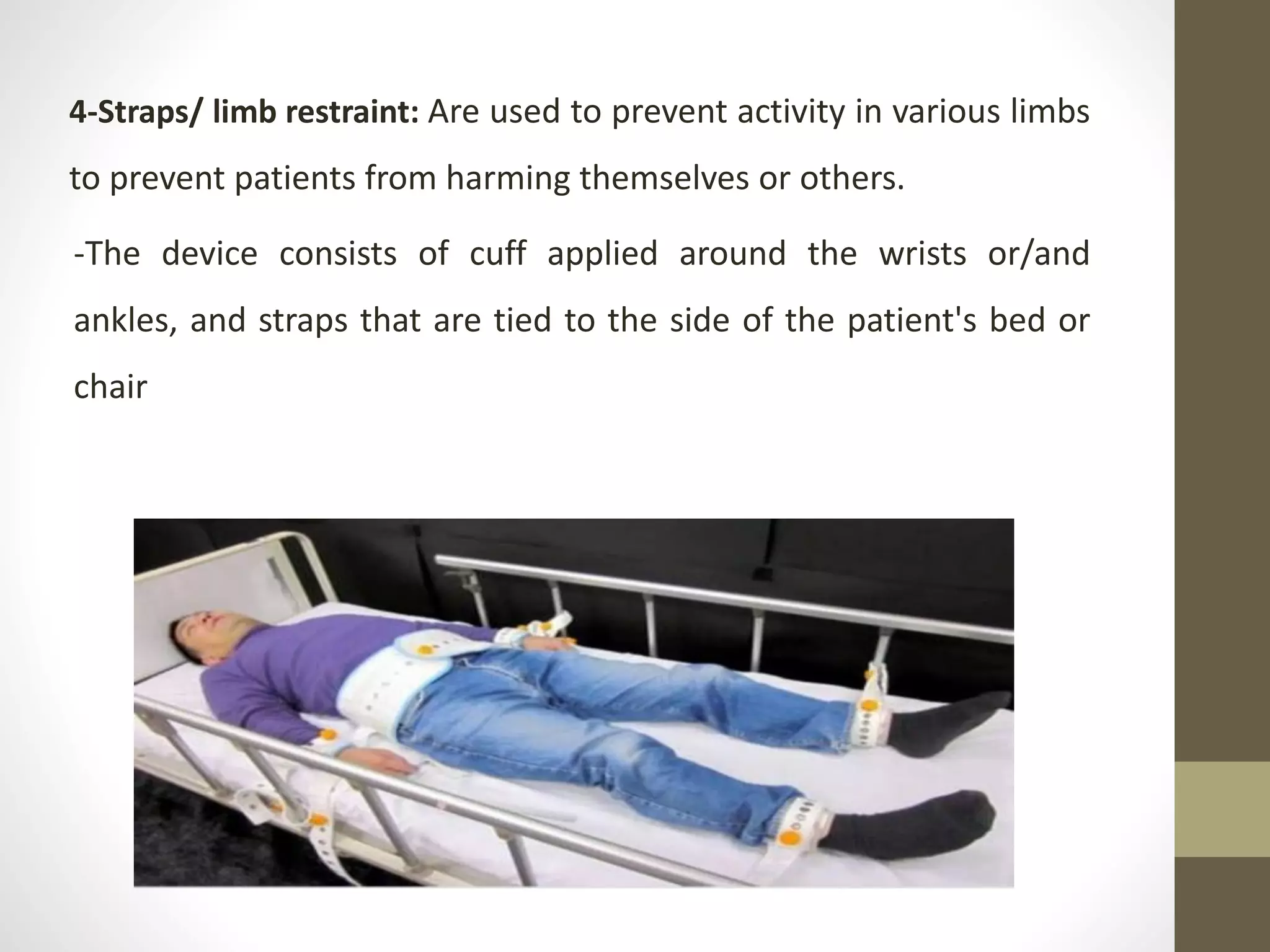
4-Straps/ limb restraint: Are used to prevent activity in various limbs
to prevent patients from harming themselves or others.
-The device consists of cuff applied around the wrists or/and
ankles, and straps that are tied to the side of the patient's bed or
chair
Cont.
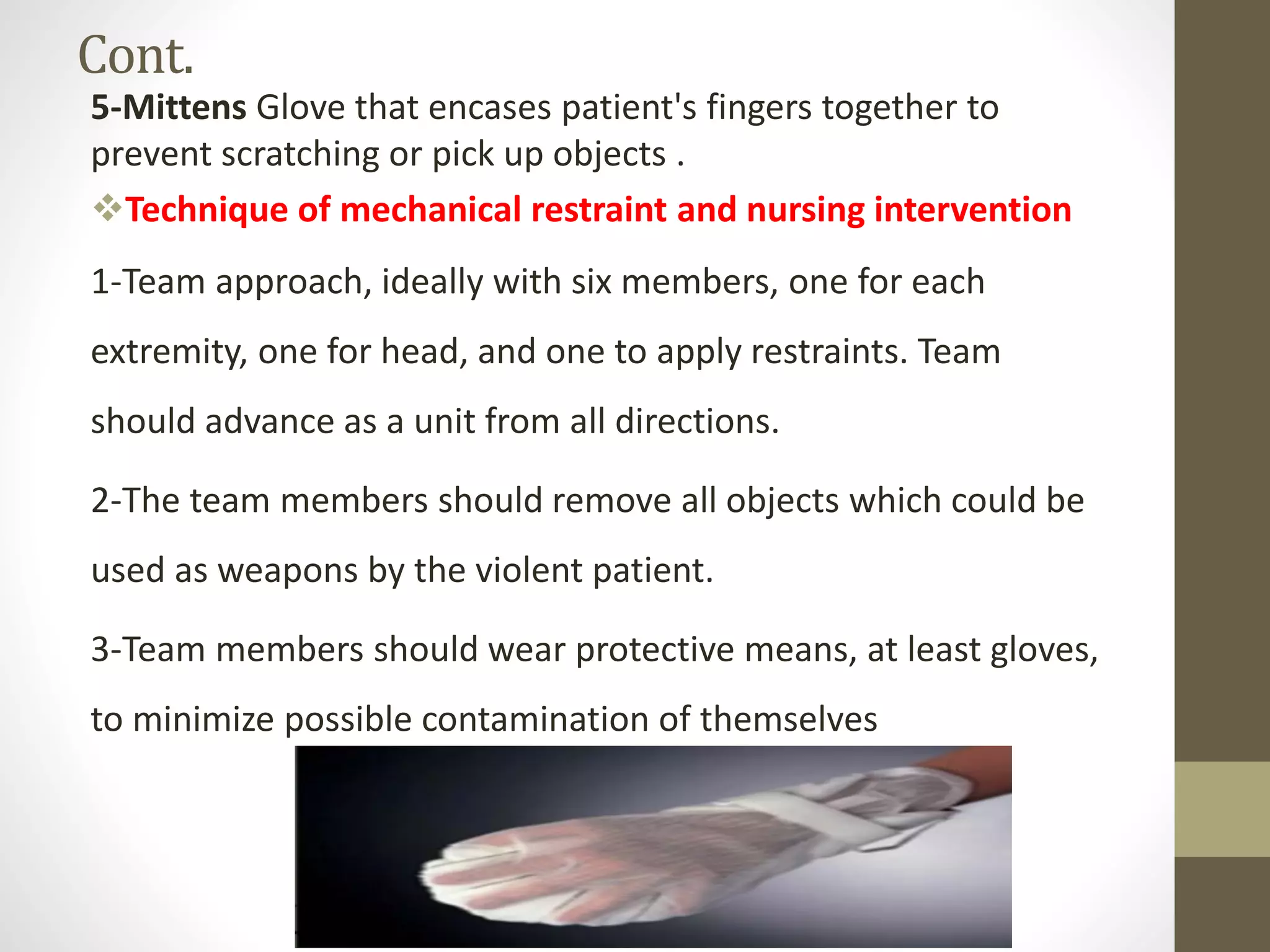
5-Mittens Glove that encases patient's fingers together to
prevent scratching or pick up objects .
Technique of mechanical restraint and nursing intervention
1-Team approach, ideally with six members, one for each
extremity, one for head, and one to apply restraints. Team
should advance as a unit from all directions.
2-The team members should remove all objects which could be
used as weapons by the violent patient.
3-Team members should wear protective means, at least gloves,
to minimize possible contamination of themselves
Cont.:
4- Explain to patient that the restraints are being applied for reasons of
protection. (emphasize the therapeutic reasons for the restraints, not
the punitive).
5-A surgical mask can be placed over the patient's face to prevent
spitting
6- Can apply soft cervical collar that may also restrict patient's range of
motion and minimize head banging and biting
7- Patient should be kept in open area where he can be observed and
monitored.
8- Patient's condition is reviewed and documented regularly every 15
minutes and provide all physiological needs
Cont.
9- Change position of restrained extremities often and check for
vascular function.
10-Undress patient and search for concealed weapons or
chemicals after the restraints are applied.
11- The psychiatrist must document full reasons make restraints
necessary.
12- Restraint device should be removed as soon as possible (as
patient behavior being controlled).
:
(2) Chemicalrestraints
• Are medications used to restrict the patient's freedom of
movement or for emergency control of behavior but that are
not standard treatments for the patient's medical or
psychiatric condition.
• Chemical restraints can also be used after physical restraints if
the patient continues to struggle against the restraints and
shows a persistence of uncontrolled behavior
-Intervention should change the patient's behavior without
reaching the point of amnesia or altering the patient's level of
consciousness .
Cont.
• Preparation for chemical restraint :
1- Take P.T history.
2 -Laboratory information as possible before chemical restraints,
as medications may alter patient's behavior, make diagnosis
difficult.
3-Consider contacting the psychiatric consultant before
chemically restraining the patient, as the consultant may wish to
see and examine the patient before medications are given.
Cont.
There are three lines of pharmacological restraints
1-Benzodiazepines:
-Diazepam ( Valium) - Lorazepam ( Ativan)
2-Atypical antipsychotics:
-Respiridone ( Respiridal) . -Fluphena Zina ( Prolixin) .
3-Combination of benzodiazepines and atypical antipsychotic .
Seclusion room:
• Characteristics of seclusion room :
The seclusion room for violent patients composed of four walls
and floor are covered with a padded lining that is
- Abrasion resistant
- - Fire retardant
- Shock absorbent.
-Ventilation and lighting are provided through the ceiling of the
room that is made of fine metal mesh Door is provided in one
wall to provide access to the room that is externally closed.
Cont.
• Ventilation and lighting are provided through the ceiling of the
room that is made of fine metal mesh
• Door is provided in one wall to provide access to the room
that is externally closed.
• A window may be positioned in the door to permit viewing of
the interior room.
• Its need to be monitored usually by video surveillance.
• The specific room in which a patient is secluded most be
devoid of any potentially harmful objects

Restraint and seclusion 2022-١.pdf

  • 1.
    Restraint and seclusion Dr:Nora abdallah 2022 Second year
  • 2.
    : Outlines • Definition ofRestraint . • Definition of seclusion. • Indication of restraint and seclusion. • The Least restrictive methods are. • a) Reducing stimuli . b) Verbal intervention. • c) Offering patients' needs . Symptoms indicate potential violence . • Contraindication of restraint and seclusion. • Types of restraints 1-Mechanical 2- Chemical
  • 3.
    Cont : • TypesMechanical restraint: • 1-Straitjackets. 2-Wheelchair. • 3-Safety vests. 4-Straps. • 5-Mittens • Technique of mechanical restraint and nursing intervention • 2- Chemical restraints • Preparation for chemical restraint . • lines of pharmacological restraints . • Seclusion room: • Characteristics of seclusion room
  • 4.
    Restraint and seclusion: Definitionof Restraint: An intervention of placing the patient involuntarily under control by the use of chemical or mechanical devices for the reasons of preventing exited patient from harming self or others. Definition of seclusion: It is the involuntary confinement of a person in a hazard-free room or area that is often locked and where the person can be directly observed.
  • 5.
    Indication of restraintand seclusion 1-When the patient's behavior is physically harmful to self or others e.g. agitated or aggressive behavior. 2-When alternative or less restrictive measures are insufficient in protecting the patient or others from. 3-When a decrease in sensory overstimulation (seclusion only) is needed.
  • 6.
    TheLeastrestrictivemethods“ shouldbeemployedwhendealingwiththe potentiallyviolentpatient. Symptoms indicatepotential violence include - -Restlessness . -Tapping of finger. -Irritability . - Anxiety. -Tremors and muscles tension. Change in voice quality.  This means that A patient should be provided by alternatives to correct inappropriate behavior in order to maintain a good working relationship and to maintain the dignity of the patient.
  • 7.
    These methods are. a)Reducing stimuli such as: 1-Reduce noise as possible. 2- Avoid eye contact with patient. 3- Maintain distance from agitated patient; do not invade the patient's“ space". b) Verbal intervention such as: 4- Avoid provocative remarks. 5- Talking softly rather than shouting, 6- Ask patient to be calm and allow patient to ventilate his/ her feelings: c) Offering patients' needs 7-Inquiring about what specific needs the patient may have 8- Provide needed medication.
  • 8.
    Contraindicationofrestraintandseclusion: -Any medical orpsychiatric condition that could be exacerbated by its use Example:  Broken or burned extremities  Claustrophobia  Bronchial asthma  Delirium or dementia leading to inability to tolerate decreased  stimulation  Close supervision and direct observation can‟t provided
  • 9.
    Types of restraints 1-Mechanical/physicalrestraint: Are any manual method or mechanical device attached to the patient's body that the patient cannot easily remove and that restricts freedom of movement or normal access to one's body, material, or equipment. Types of mechanical restraint: • 1-Straitjackets. 2-Wheelchair. • 3-Safety vests. 4-Straps. • 5-Mittens
  • 10.
    Cont. 1-Straitjackets: -Is a jacketwith long sleeves. once the arms are inserted into the straitjacket's sleeves, they are then crossed across the chest and the ends of the sleeves are then tied to the back of the wearer.
  • 11.
    2-Wheelchair : Wheelchairthat contain a front belt so that the user can't fall out easily, belts to fix upper and lower limbs and also contain padded neck collar. 3-Safety vests: It have a long strap at each end that can be tied behind a chair in order to prevent the patient from getting out of the chair.
  • 12.
    4-Straps/ limb restraint:Are used to prevent activity in various limbs to prevent patients from harming themselves or others. -The device consists of cuff applied around the wrists or/and ankles, and straps that are tied to the side of the patient's bed or chair
  • 13.
    Cont. 5-Mittens Glove thatencases patient's fingers together to prevent scratching or pick up objects . Technique of mechanical restraint and nursing intervention 1-Team approach, ideally with six members, one for each extremity, one for head, and one to apply restraints. Team should advance as a unit from all directions. 2-The team members should remove all objects which could be used as weapons by the violent patient. 3-Team members should wear protective means, at least gloves, to minimize possible contamination of themselves
  • 14.
    Cont.: 4- Explain topatient that the restraints are being applied for reasons of protection. (emphasize the therapeutic reasons for the restraints, not the punitive). 5-A surgical mask can be placed over the patient's face to prevent spitting 6- Can apply soft cervical collar that may also restrict patient's range of motion and minimize head banging and biting 7- Patient should be kept in open area where he can be observed and monitored. 8- Patient's condition is reviewed and documented regularly every 15 minutes and provide all physiological needs
  • 15.
    Cont. 9- Change positionof restrained extremities often and check for vascular function. 10-Undress patient and search for concealed weapons or chemicals after the restraints are applied. 11- The psychiatrist must document full reasons make restraints necessary. 12- Restraint device should be removed as soon as possible (as patient behavior being controlled).
  • 16.
    : (2) Chemicalrestraints • Aremedications used to restrict the patient's freedom of movement or for emergency control of behavior but that are not standard treatments for the patient's medical or psychiatric condition. • Chemical restraints can also be used after physical restraints if the patient continues to struggle against the restraints and shows a persistence of uncontrolled behavior -Intervention should change the patient's behavior without reaching the point of amnesia or altering the patient's level of consciousness .
  • 17.
    Cont. • Preparation forchemical restraint : 1- Take P.T history. 2 -Laboratory information as possible before chemical restraints, as medications may alter patient's behavior, make diagnosis difficult. 3-Consider contacting the psychiatric consultant before chemically restraining the patient, as the consultant may wish to see and examine the patient before medications are given.
  • 18.
    Cont. There are threelines of pharmacological restraints 1-Benzodiazepines: -Diazepam ( Valium) - Lorazepam ( Ativan) 2-Atypical antipsychotics: -Respiridone ( Respiridal) . -Fluphena Zina ( Prolixin) . 3-Combination of benzodiazepines and atypical antipsychotic .
  • 19.
    Seclusion room: • Characteristicsof seclusion room : The seclusion room for violent patients composed of four walls and floor are covered with a padded lining that is - Abrasion resistant - - Fire retardant - Shock absorbent. -Ventilation and lighting are provided through the ceiling of the room that is made of fine metal mesh Door is provided in one wall to provide access to the room that is externally closed.
  • 20.
    Cont. • Ventilation andlighting are provided through the ceiling of the room that is made of fine metal mesh • Door is provided in one wall to provide access to the room that is externally closed. • A window may be positioned in the door to permit viewing of the interior room. • Its need to be monitored usually by video surveillance. • The specific room in which a patient is secluded most be devoid of any potentially harmful objects