Restpadd PHF
Seclusion and Restraint
Training Module
Definition
Seclusion - Involuntary confinement of the patient
alone in a room or an area where the patient is physically
prevented from leaving; a situation where a patient is
restricted to a room or area alone and staff physically
intervenes to prevent the patient from leaving is also
considered seclusion.
Restraint - Any manual method, physical or
mechanical device, material, or equipment that
immobilizes or reduces the ability of a patient to move
his or her arms, legs, body, or head freely; or a drug or
medication when it is used as a restriction to manage the
patient's behavior or restrict the patient's freedom of
movement and is not a standard treatment or dosage for
the patient's condition.
Definition
At Restpadd PHF, we strive to minimize the use of seclusion
and restraint, and if possible to eliminate itโ€™s use through
proper staff training, thorough assessment, effective
treatment planning and by using least-restrictive methods.
Seclusion and /or restraints are to be used only as a last resort
when a patient poses a threat to himself, staff or other
patients. An RN or LVN may initiate an emergency seclusion
or restraint prior to obtaining a physicians order, but the
physician must be contacted and an order obtained within
minutes.
The following slides are examples of less restrictive methods
in order from least to most restrictive.
Redirection
Example:
๏‚— Change the subject of conversation.
๏‚— Direct patient to a different room.
๏‚— Offer patient an activity.
๏‚— Draw attention away from cause of anxiety.
Sensory / Stimulus Reduction
Examples:
๏‚— Offering ear plugs to reduce noise level.
๏‚— Inviting patient to walk to the end of a hall, away from
noise.
๏‚— Reducing overall noise of the unit.
๏‚— Asking patient to step into their room.
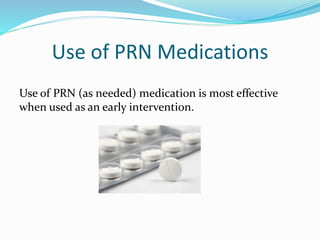
Use of PRN Medications
Use of PRN (as needed) medication is most effective
when used as an early intervention.
One-on-one processing
A one-on-one conversation with a staff member can often
deescalate an anxious patient.
๏‚— Nurse
๏‚— Provider
๏‚— Therapist
๏‚— Mental Health Technician
Time out
Less restrictive than seclusion but still removes patient
from the milieu.
May include time alone in room or in the quiet room but
exit is not restricted.
Gives the patient time to process and โ€œresetโ€ before
entering the milieu again.
Seclusion
Patient may be secluded in the quiet room or his/her
own room.
If the door to the room is closed or egress is prevented by
a staff member, the patient is considered to be in
seclusion.
Secluded patients must be assessed every 15 minutes by a
nurse and remain in line of sight for the duration of
seclusion.
Chemical Restraint
Chemical restraint is using a drug or medication to
manage a patient's behavior or restrict the patient's
freedom of movement when the medication is not a
standard treatment or dosage for the patient's condition.
Patient must be assessed by a nurse every 15 minutes for
the first 60 minutes after administration of meds.
Physical restraint
Physical restraint is laying hands on a patient to prevent
them from harming themselves, other patients, or staff
members.
CPI techniques should always be used.
Common physical interaction that is brief and focused
on redirection, or hands-on intervention to break up
fights or escort patients away from the scene of
disruption is not considered restraint.
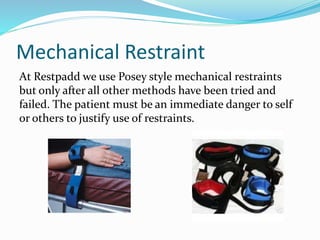
Mechanical Restraint
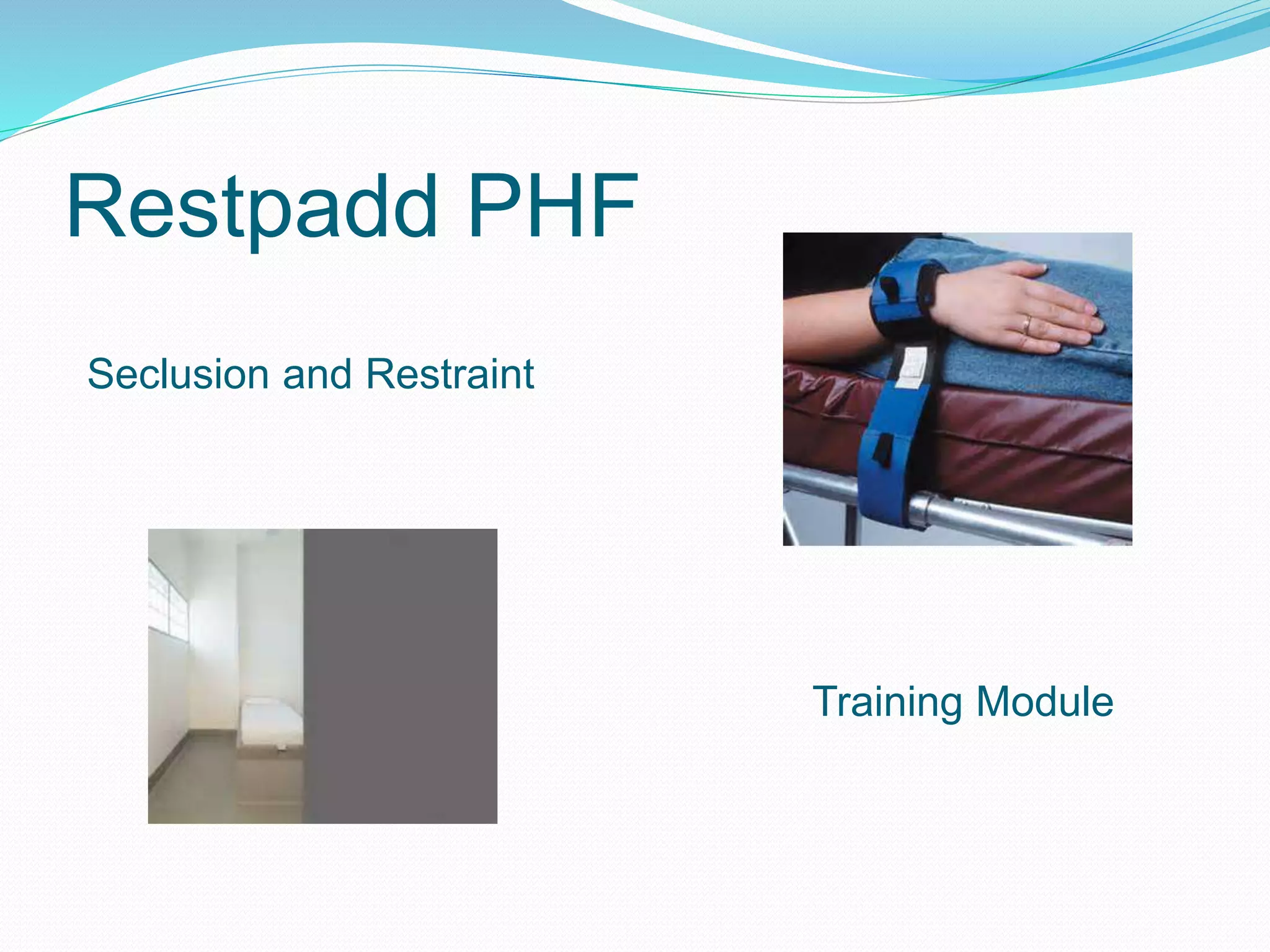
At Restpadd we use Posey style mechanical restraints
but only after all other methods have been tried and
failed. The patient must be an immediate danger to self
or others to justify use of restraints.
WARNING
Patients placed in mechanical restraints are at risk of
death.
Patients placed in mechanical restraints should never be
placed prone (face down).
While in restraint, the patient shall be continually monitored
and re-assessed. The monitoring must be in person and face
to face, for the duration of the restraint episode. Staff will
monitor for minor injuries, signs of physical distress,
comfort, hydration and toileting needs.
WARNING
Restraint shall require the order of a physician and may
have a maximum duration of 4 hours for adult patients.
When a physician gives an order for seclusion or
restraint it must specify the conditions or criteria for
discontinuation of the order. For example, criteria may
include a โ€œdecrease in psychomotor agitationโ€, โ€œnon-
threatening behavior or language is displayedโ€ and โ€œself
control is demonstratedโ€.
Medical Risks for Death in Restraint
๏‚— Respiratory problems, including asthma, bronchitis,
emphysema, chronic pulmonary disease, or other
breathing difficulties
๏‚— Unknown Cardiac conditions, history of arrhythmias
under stress
๏‚— Obesity, pregnancy, or other conditions of enlarged
abdomens
๏‚— Recent ingestion of food and/or fluids
16
(NAPHS, 2003; Morrison, 2002; Tracy, Donnelly & Stultz, 2002)
Debriefing
Debriefing and review are the last steps in the seclusion and
restraint process.
Once the patient is calm, a debriefing is to be completed within 24
hours of intervention.
๏‚— Debriefing allows the patient to gain insight into the event and
what led up to it.
๏‚— Debriefing should be used to establish interventions which may
present future need for seclusion and restraint.
๏‚— Debriefing should be used to assess the possible need for
modification of the treatment plan.
Try to see restraint and seclusion from the
patients perspective
"The restraint made me feel even more angry
because it hurt me and made me worse. I would
like staff to respond in a different way such as
give you more options during the step before they
act too quickly."
Samantha Jones, age 41
(LeBel, J., Stromberg, N., (2004) Experiences of S/R. Unpublished Papers)
18
The End

Seclusion and restraint training module

  • 1.
    Restpadd PHF Seclusion andRestraint Training Module
  • 2.
    Definition Seclusion - Involuntaryconfinement of the patient alone in a room or an area where the patient is physically prevented from leaving; a situation where a patient is restricted to a room or area alone and staff physically intervenes to prevent the patient from leaving is also considered seclusion.
  • 3.
    Restraint - Anymanual method, physical or mechanical device, material, or equipment that immobilizes or reduces the ability of a patient to move his or her arms, legs, body, or head freely; or a drug or medication when it is used as a restriction to manage the patient's behavior or restrict the patient's freedom of movement and is not a standard treatment or dosage for the patient's condition. Definition
  • 4.
    At Restpadd PHF,we strive to minimize the use of seclusion and restraint, and if possible to eliminate itโ€™s use through proper staff training, thorough assessment, effective treatment planning and by using least-restrictive methods. Seclusion and /or restraints are to be used only as a last resort when a patient poses a threat to himself, staff or other patients. An RN or LVN may initiate an emergency seclusion or restraint prior to obtaining a physicians order, but the physician must be contacted and an order obtained within minutes. The following slides are examples of less restrictive methods in order from least to most restrictive.
  • 5.
    Redirection Example: ๏‚— Change thesubject of conversation. ๏‚— Direct patient to a different room. ๏‚— Offer patient an activity. ๏‚— Draw attention away from cause of anxiety.
  • 6.
    Sensory / StimulusReduction Examples: ๏‚— Offering ear plugs to reduce noise level. ๏‚— Inviting patient to walk to the end of a hall, away from noise. ๏‚— Reducing overall noise of the unit. ๏‚— Asking patient to step into their room.
  • 7.
    Use of PRNMedications Use of PRN (as needed) medication is most effective when used as an early intervention.
  • 8.
    One-on-one processing A one-on-oneconversation with a staff member can often deescalate an anxious patient. ๏‚— Nurse ๏‚— Provider ๏‚— Therapist ๏‚— Mental Health Technician
  • 9.
    Time out Less restrictivethan seclusion but still removes patient from the milieu. May include time alone in room or in the quiet room but exit is not restricted. Gives the patient time to process and โ€œresetโ€ before entering the milieu again.
  • 10.
    Seclusion Patient may besecluded in the quiet room or his/her own room. If the door to the room is closed or egress is prevented by a staff member, the patient is considered to be in seclusion. Secluded patients must be assessed every 15 minutes by a nurse and remain in line of sight for the duration of seclusion.
  • 11.
    Chemical Restraint Chemical restraintis using a drug or medication to manage a patient's behavior or restrict the patient's freedom of movement when the medication is not a standard treatment or dosage for the patient's condition. Patient must be assessed by a nurse every 15 minutes for the first 60 minutes after administration of meds.
  • 12.
    Physical restraint Physical restraintis laying hands on a patient to prevent them from harming themselves, other patients, or staff members. CPI techniques should always be used. Common physical interaction that is brief and focused on redirection, or hands-on intervention to break up fights or escort patients away from the scene of disruption is not considered restraint.
  • 13.
    Mechanical Restraint At Restpaddwe use Posey style mechanical restraints but only after all other methods have been tried and failed. The patient must be an immediate danger to self or others to justify use of restraints.
  • 14.
    WARNING Patients placed inmechanical restraints are at risk of death. Patients placed in mechanical restraints should never be placed prone (face down). While in restraint, the patient shall be continually monitored and re-assessed. The monitoring must be in person and face to face, for the duration of the restraint episode. Staff will monitor for minor injuries, signs of physical distress, comfort, hydration and toileting needs.
  • 15.
    WARNING Restraint shall requirethe order of a physician and may have a maximum duration of 4 hours for adult patients. When a physician gives an order for seclusion or restraint it must specify the conditions or criteria for discontinuation of the order. For example, criteria may include a โ€œdecrease in psychomotor agitationโ€, โ€œnon- threatening behavior or language is displayedโ€ and โ€œself control is demonstratedโ€.
  • 16.
    Medical Risks forDeath in Restraint ๏‚— Respiratory problems, including asthma, bronchitis, emphysema, chronic pulmonary disease, or other breathing difficulties ๏‚— Unknown Cardiac conditions, history of arrhythmias under stress ๏‚— Obesity, pregnancy, or other conditions of enlarged abdomens ๏‚— Recent ingestion of food and/or fluids 16 (NAPHS, 2003; Morrison, 2002; Tracy, Donnelly & Stultz, 2002)
  • 17.
    Debriefing Debriefing and revieware the last steps in the seclusion and restraint process. Once the patient is calm, a debriefing is to be completed within 24 hours of intervention. ๏‚— Debriefing allows the patient to gain insight into the event and what led up to it. ๏‚— Debriefing should be used to establish interventions which may present future need for seclusion and restraint. ๏‚— Debriefing should be used to assess the possible need for modification of the treatment plan.
  • 18.
    Try to seerestraint and seclusion from the patients perspective "The restraint made me feel even more angry because it hurt me and made me worse. I would like staff to respond in a different way such as give you more options during the step before they act too quickly." Samantha Jones, age 41 (LeBel, J., Stromberg, N., (2004) Experiences of S/R. Unpublished Papers) 18
  • 19.