By-Kshirabdhi Tanaya
Tutor,Dept.of psychiatric
nursing
SUM Nursing college, S‘O’A
DTU Bhubaneswar
Definitions:-
• Restraint is defined as ‘the intentional
restriction of a person’s voluntary movement or
behavior. (Counsel and Care UK, 2002)
• Restraints are physical, chemical or
environmental measures used to control the
physical or behavioral activity of person or a
portion of his/ her body
PURPOSE
• To carry out the physical examination
• To provide the safety to child
• To protect the child from injury
• To complete the diagnostic and therapeutic
procedures
• To maintain the child in prescribed position
• To reduce the discomfort of child during some
tests and procedure like specimen collection
INDICATIONS
• Displaying behavior that is putting themselves
at risk of harm
• Displaying behavior that is putting others at risk
of harm
• Requiring treatment by a legal order, for
example , under the Mental Health Act 2007
• Requiring urgent life-saving treatment
• Needing to be maintained in secure settings
GENERAL PRINCPILES FOR USE OF
RESTRAINTS
• Should be selected to reduce clients movement
only as much as necessary
• Nurse should carefully explain type of restraint
and reason for its use
• Should not interfere with treatment
• Bony prominences should be padded before
applying it
Principles Contd..
• Always select the safe and appropriate restraint
• Restraint should not be too tight; it should not
interfere with the normal circulation
• Restraint should demonstrate to the child, on
the child doll to gain the cooperation and
reduce the anxiety
• Always maintain comfort to the child and
maintain body alignment
• Should be changed when they become soiled or
damp
Principles Contd..
• Don’t give too much tight knot. Should be able
to quickly release the device
• Should be secure away from a clients reach
• Should be attached to bed frame not to side
rails
• Change the side of child to prevent pressure
sore
• Observe the restraint every 20-30 minutes to
prevent any complications
• Should be removed a minimum of every 2 hrs
• Do the recording and reporting properly
PHYSICAL RESTRAINT
Physical restraint is anything near or on the body
which limits a clients movement. This may be
attached to a person’s body or create physical
barriers.
E.g. table fixed to a chair or a bed rail that cannot be
opened by a client
ENVIORNMENTAL RESTRAINTS
Environmental restraints that change or modify a
person’s surroundings to restrict or control a clients
mobility
E.g. A secure unit or garden, seclusion
CHEMICAL RESTRAINT
Chemical restraint are any form of psychoactive
medication used not to treat illness, but to
intentionally inhibit a particular behavior or
movement
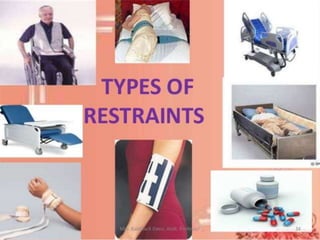
TYPES OF PHYSICAL RESTRAINT
1. Mummy restraint
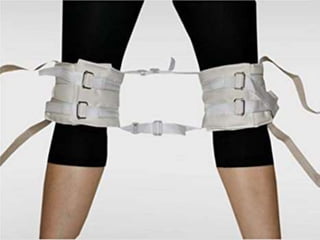
2. Elbow and knee restraint
3. Extremity restraint
4. Abdominal restraint
5. Jacket restraint
6. Mitten or finger restraint
7. Crib net restraint
8. Safety belt
9. Slide rails and splints
POTENTIAL RISKS AND SIDE EFFECTS
OF RESTRAINT USE:
Psychological /Emotional
• Increased agitation & hostility
• Feelings of humiliation, loss of dignity
• Increased confusion
• Fear
Physical:
•Pressure ulcers, skin trauma
•Decreased muscle tone, strength, endurance
•Contractures, loss of balance & Dislocations/ fracture
•Reduced heart and lung capacity
•Physical discomfort, increased pain
•Increased constipation, increased risk of fecal impaction
•Increased incontinence and urinary stasis
•Obstructed and restricted circulation
•Reduced appetite, Dehydration
•Impaired Circulation
•Death
RESTRAINT GUIDELINES
• Doctors order
• Informed consent
• Follow proper technique
• Least restrictive
• Pad boney prominence
• Maintain good body alignment
ORDER FOR RESTRAINT
• Use only after written order by the physician,
unless emergency situation occurs
• Patient is reassessed every 24 hours for continued
need for restraint
• New order is required after 24 hours
• No standing order allowed
• Physician and nurse must document in their notes
the indication for restraint
• Type of restraint to be used
• The projected time restraint is to be employed
ASSESSMENT
•Check for circulation, condition of limbs
•Attention should be given to patient’s
need including hydration, elimination
and nutrition
•Vital signs
BEHAVIOUR REQUIRED FOR RELEASE
• Follows instructions, directions
• Calm, in control
• Verbal contact
• Asks for assistance
Monitor a patient in restraint every 15 minutes for:
• Signs for injury
• Circulation and range of motion
• Comfort
• Readiness for discontinuation of restraint
Documentation in every 2 hours for:
• Release the patient, turn and position
• Institute a trial of restraint release
• Hydration and nutrition needs
• Elimination needs
• Comfort and repositioning needs
THANK YOU

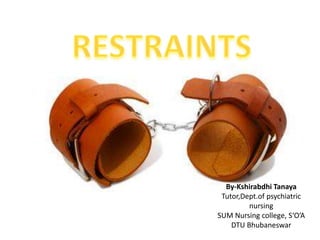
Restraints

  • 1.
    By-Kshirabdhi Tanaya Tutor,Dept.of psychiatric nursing SUMNursing college, S‘O’A DTU Bhubaneswar
  • 2.
    Definitions:- • Restraint isdefined as ‘the intentional restriction of a person’s voluntary movement or behavior. (Counsel and Care UK, 2002) • Restraints are physical, chemical or environmental measures used to control the physical or behavioral activity of person or a portion of his/ her body
  • 3.
    PURPOSE • To carryout the physical examination • To provide the safety to child • To protect the child from injury • To complete the diagnostic and therapeutic procedures • To maintain the child in prescribed position • To reduce the discomfort of child during some tests and procedure like specimen collection
  • 4.
    INDICATIONS • Displaying behaviorthat is putting themselves at risk of harm • Displaying behavior that is putting others at risk of harm • Requiring treatment by a legal order, for example , under the Mental Health Act 2007 • Requiring urgent life-saving treatment • Needing to be maintained in secure settings
  • 5.
    GENERAL PRINCPILES FORUSE OF RESTRAINTS • Should be selected to reduce clients movement only as much as necessary • Nurse should carefully explain type of restraint and reason for its use • Should not interfere with treatment • Bony prominences should be padded before applying it
  • 6.
    Principles Contd.. • Alwaysselect the safe and appropriate restraint • Restraint should not be too tight; it should not interfere with the normal circulation • Restraint should demonstrate to the child, on the child doll to gain the cooperation and reduce the anxiety • Always maintain comfort to the child and maintain body alignment • Should be changed when they become soiled or damp
  • 7.
    Principles Contd.. • Don’tgive too much tight knot. Should be able to quickly release the device • Should be secure away from a clients reach • Should be attached to bed frame not to side rails • Change the side of child to prevent pressure sore • Observe the restraint every 20-30 minutes to prevent any complications • Should be removed a minimum of every 2 hrs • Do the recording and reporting properly
  • 9.
    PHYSICAL RESTRAINT Physical restraintis anything near or on the body which limits a clients movement. This may be attached to a person’s body or create physical barriers. E.g. table fixed to a chair or a bed rail that cannot be opened by a client
  • 10.
    ENVIORNMENTAL RESTRAINTS Environmental restraintsthat change or modify a person’s surroundings to restrict or control a clients mobility E.g. A secure unit or garden, seclusion
  • 12.
    CHEMICAL RESTRAINT Chemical restraintare any form of psychoactive medication used not to treat illness, but to intentionally inhibit a particular behavior or movement
  • 14.
    TYPES OF PHYSICALRESTRAINT 1. Mummy restraint 2. Elbow and knee restraint 3. Extremity restraint 4. Abdominal restraint 5. Jacket restraint 6. Mitten or finger restraint 7. Crib net restraint 8. Safety belt 9. Slide rails and splints
  • 26.
    POTENTIAL RISKS ANDSIDE EFFECTS OF RESTRAINT USE: Psychological /Emotional • Increased agitation & hostility • Feelings of humiliation, loss of dignity • Increased confusion • Fear
  • 29.
    Physical: •Pressure ulcers, skintrauma •Decreased muscle tone, strength, endurance •Contractures, loss of balance & Dislocations/ fracture •Reduced heart and lung capacity •Physical discomfort, increased pain •Increased constipation, increased risk of fecal impaction •Increased incontinence and urinary stasis •Obstructed and restricted circulation •Reduced appetite, Dehydration •Impaired Circulation •Death
  • 30.
    RESTRAINT GUIDELINES • Doctorsorder • Informed consent • Follow proper technique • Least restrictive • Pad boney prominence • Maintain good body alignment
  • 31.
    ORDER FOR RESTRAINT •Use only after written order by the physician, unless emergency situation occurs • Patient is reassessed every 24 hours for continued need for restraint • New order is required after 24 hours • No standing order allowed • Physician and nurse must document in their notes the indication for restraint • Type of restraint to be used • The projected time restraint is to be employed
  • 32.
    ASSESSMENT •Check for circulation,condition of limbs •Attention should be given to patient’s need including hydration, elimination and nutrition •Vital signs
  • 33.
    BEHAVIOUR REQUIRED FORRELEASE • Follows instructions, directions • Calm, in control • Verbal contact • Asks for assistance
  • 35.
    Monitor a patientin restraint every 15 minutes for: • Signs for injury • Circulation and range of motion • Comfort • Readiness for discontinuation of restraint
  • 36.
    Documentation in every2 hours for: • Release the patient, turn and position • Institute a trial of restraint release • Hydration and nutrition needs • Elimination needs • Comfort and repositioning needs
  • 37.