SITI MARIAM BINTI MOHD HAMZAH
Emergency Psychiatry
[Part 3] Evaluation & treatment
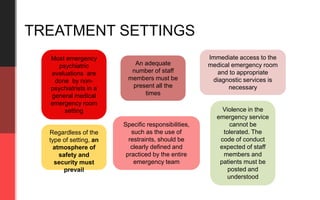
TREATMENT SETTINGS
Most emergency
psychiatric
evaluations are
done by non-
psychiatrists in a
general medical
emergency room
setting
Regardless of the
type of setting, an
atmosphere of
safety and
security must
prevail
An adequate
number of staff
members must be
present all the
times
Specific responsibilities,
such as the use of
restraints, should be
clearly defined and
practiced by the entire
emergency team
Immediate access to the
medical emergency room
and to appropriate
diagnostic services is
necessary
Violence in the
emergency service
cannot be
tolerated. The
code of conduct
expected of staff
members and
patients must be
posted and
understood
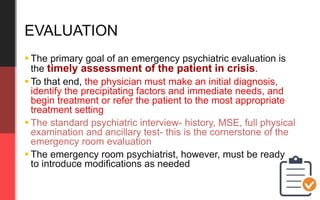
 The primary goal of an emergency psychiatric evaluation is
the timely assessment of the patient in crisis.
 To that end, the physician must make an initial diagnosis,
identify the precipitating factors and immediate needs, and
begin treatment or refer the patient to the most appropriate
treatment setting
 The standard psychiatric interview- history, MSE, full physical
examination and ancillary test- this is the cornerstone of the
emergency room evaluation
 The emergency room psychiatrist, however, must be ready
to introduce modifications as needed
EVALUATION
 The emergency psychiatrists must rapidly assess and distinguish
the truly emergency psychiatric patients from those who are less
acutely ill and from non-psychiatric emergencies
 A triage system is an efficient and effective way to identify
emergency, urgent, and non-urgent patients, who can then be
prioritized for care
TREATMENT OF EMERGENCIES
PSYCHOTHERAPY
 Adjustment disorder in all age groups may result in tantrum-
like outbursts of rage
 These outbursts are particularly common in marital quarrels,
and police are often summoned by neighbors distressed by
the sounds of a violent altercation
 Such family quarrels should be approached with caution,
because they may be complicated by alcohol use and the
presence of dangerous weapons
 clinicians must avoid patronizing or contemptuous attitudes
and try to communicate an attitude of respect and an
authentic peacemaking concern

TREATMENT OF EMERGENCIES
PHARMACOTHERAPY
Major indications for the
use of psychotropic
medication in an
emergency room include
• Violent or assaultive
behavior
• Massive anxiety or
panic
• Extrapyramidal
reactions; dystonia
and akathisia
Episodic of outburst
respond to haloperidol,
carbamazepine, lithium
and beta-adrenergic
receptor antagonists
Persons who are paranoid
or in catatonic excitement,
they require
tranquilization
If hx suggest of seizure
disorder, confirm the
diagnosis and ascertain
the cause first.
• If positive,
anticonvulsant
therapy is initiated or
appropriate surgery is
provided (in the case
of cerebral mass)
Conservative measures
may be suffice for
intoxication from drug of
abuse
• Sometimes, drug
such as haloperidol
are needed until a
patient is stabilized;
5-10 mg every half-
hour to an hour
• Benzodiazepines
may be used instead
of, or in addition to
antipsychotics; to
reduce antipsychotics
dosage
for violent and struggling patients..
they are subdued most
effectively with an
appropriate sedative or
antipsychotics
Diazepam; 5-10mg or
lorazepam; 2-4mg may
be given slowly IV over
2 minutes
• IV medication must
be given with great
care to avoid
respiratory arrest
Patient who require IM
medication, can be
sedated with haloperidol
 are used when patients are so dangerous to
themselves or others, that they pose a severe threat that
cant be controlled in any other way
 may be for temporarily to receive medication or for long
periods if medication cant be used
 Usually, patients in restraints quiet down after a time
TREATMENT OF EMERGENCIES
RESTRAINTS
TREATMENT OF EMERGENCIES
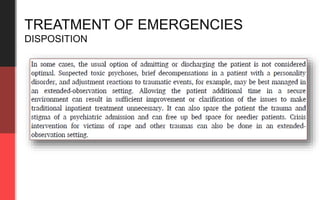
DISPOSITION
TREATMENT OF EMERGENCIES
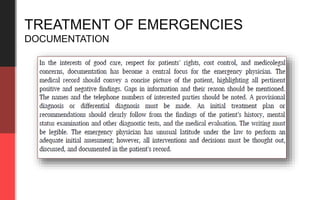
DOCUMENTATION
THANK YOU

2. emergency psychiatry

  • 1.
    SITI MARIAM BINTIMOHD HAMZAH Emergency Psychiatry [Part 3] Evaluation & treatment
  • 2.
    TREATMENT SETTINGS Most emergency psychiatric evaluationsare done by non- psychiatrists in a general medical emergency room setting Regardless of the type of setting, an atmosphere of safety and security must prevail An adequate number of staff members must be present all the times Specific responsibilities, such as the use of restraints, should be clearly defined and practiced by the entire emergency team Immediate access to the medical emergency room and to appropriate diagnostic services is necessary Violence in the emergency service cannot be tolerated. The code of conduct expected of staff members and patients must be posted and understood
  • 3.
     The primarygoal of an emergency psychiatric evaluation is the timely assessment of the patient in crisis.  To that end, the physician must make an initial diagnosis, identify the precipitating factors and immediate needs, and begin treatment or refer the patient to the most appropriate treatment setting  The standard psychiatric interview- history, MSE, full physical examination and ancillary test- this is the cornerstone of the emergency room evaluation  The emergency room psychiatrist, however, must be ready to introduce modifications as needed EVALUATION
  • 4.
     The emergencypsychiatrists must rapidly assess and distinguish the truly emergency psychiatric patients from those who are less acutely ill and from non-psychiatric emergencies  A triage system is an efficient and effective way to identify emergency, urgent, and non-urgent patients, who can then be prioritized for care
  • 7.
    TREATMENT OF EMERGENCIES PSYCHOTHERAPY Adjustment disorder in all age groups may result in tantrum- like outbursts of rage  These outbursts are particularly common in marital quarrels, and police are often summoned by neighbors distressed by the sounds of a violent altercation  Such family quarrels should be approached with caution, because they may be complicated by alcohol use and the presence of dangerous weapons  clinicians must avoid patronizing or contemptuous attitudes and try to communicate an attitude of respect and an authentic peacemaking concern
  • 8.
  • 9.
    TREATMENT OF EMERGENCIES PHARMACOTHERAPY Majorindications for the use of psychotropic medication in an emergency room include • Violent or assaultive behavior • Massive anxiety or panic • Extrapyramidal reactions; dystonia and akathisia Episodic of outburst respond to haloperidol, carbamazepine, lithium and beta-adrenergic receptor antagonists Persons who are paranoid or in catatonic excitement, they require tranquilization If hx suggest of seizure disorder, confirm the diagnosis and ascertain the cause first. • If positive, anticonvulsant therapy is initiated or appropriate surgery is provided (in the case of cerebral mass) Conservative measures may be suffice for intoxication from drug of abuse • Sometimes, drug such as haloperidol are needed until a patient is stabilized; 5-10 mg every half- hour to an hour • Benzodiazepines may be used instead of, or in addition to antipsychotics; to reduce antipsychotics dosage
  • 10.
    for violent andstruggling patients.. they are subdued most effectively with an appropriate sedative or antipsychotics Diazepam; 5-10mg or lorazepam; 2-4mg may be given slowly IV over 2 minutes • IV medication must be given with great care to avoid respiratory arrest Patient who require IM medication, can be sedated with haloperidol
  • 11.
     are usedwhen patients are so dangerous to themselves or others, that they pose a severe threat that cant be controlled in any other way  may be for temporarily to receive medication or for long periods if medication cant be used  Usually, patients in restraints quiet down after a time TREATMENT OF EMERGENCIES RESTRAINTS
  • 13.
  • 14.
  • 15.