Objective:  Food stores chemical energy Procedure:  1. Go over homework   2. Lecture   3. Concept check questions Homework:  Write a paragraph comparing and contrasting energy conversion in a car vs. energy conversion   in your cells Bell-work:  Define food for me in chemical terms.  What  was in your lunch today?  Now describe it in  terms of the classes of organic molecules it  contains.  Go back to chapter 5 (honors – 3)  for help. October 24, 2006
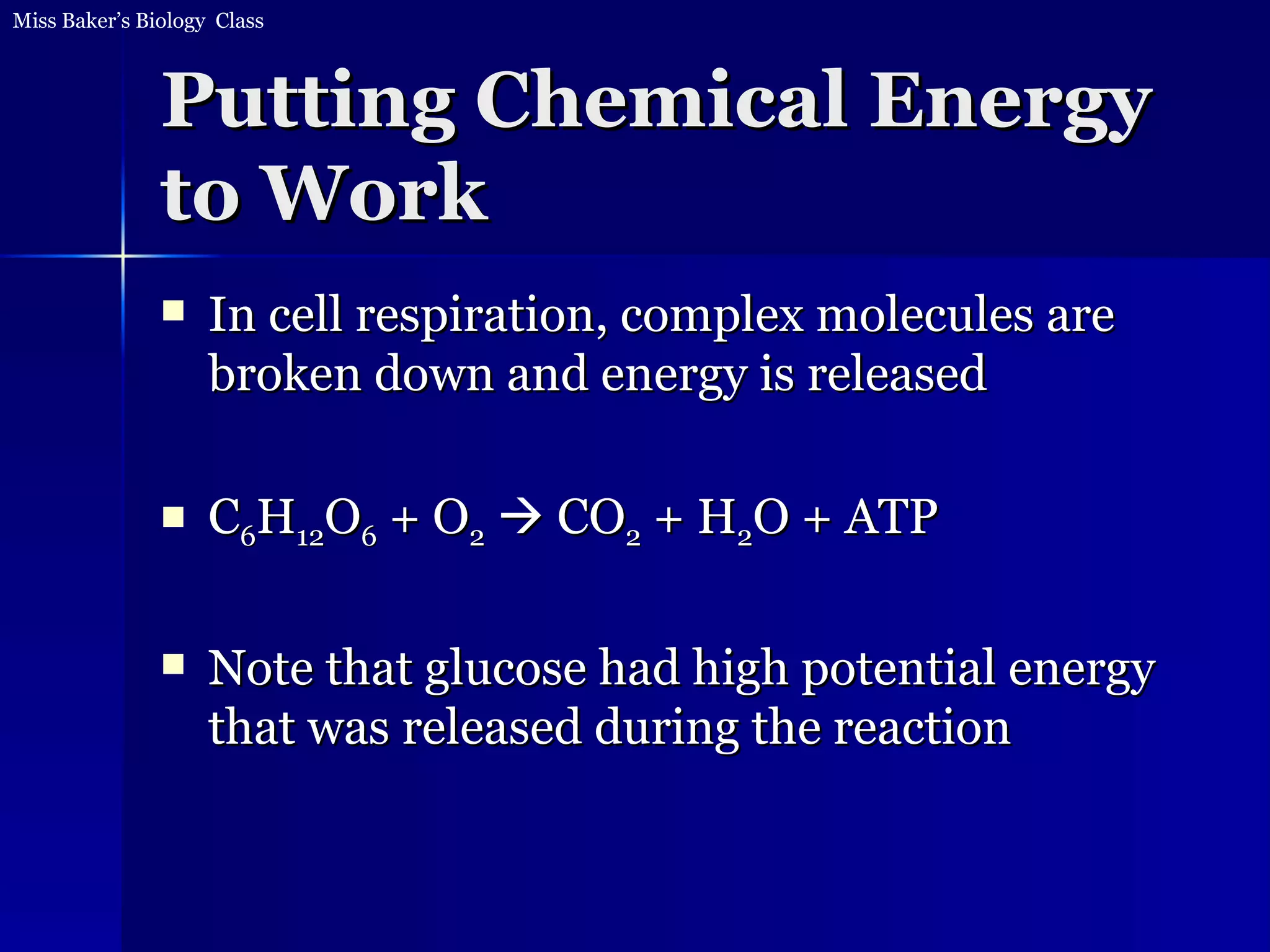
Putting Chemical Energy to Work In cell respiration, complex molecules are broken down and energy is released C 6 H 12 O 6  + O 2     CO 2  + H 2 O + ATP Note that glucose had high potential energy that was released during the reaction
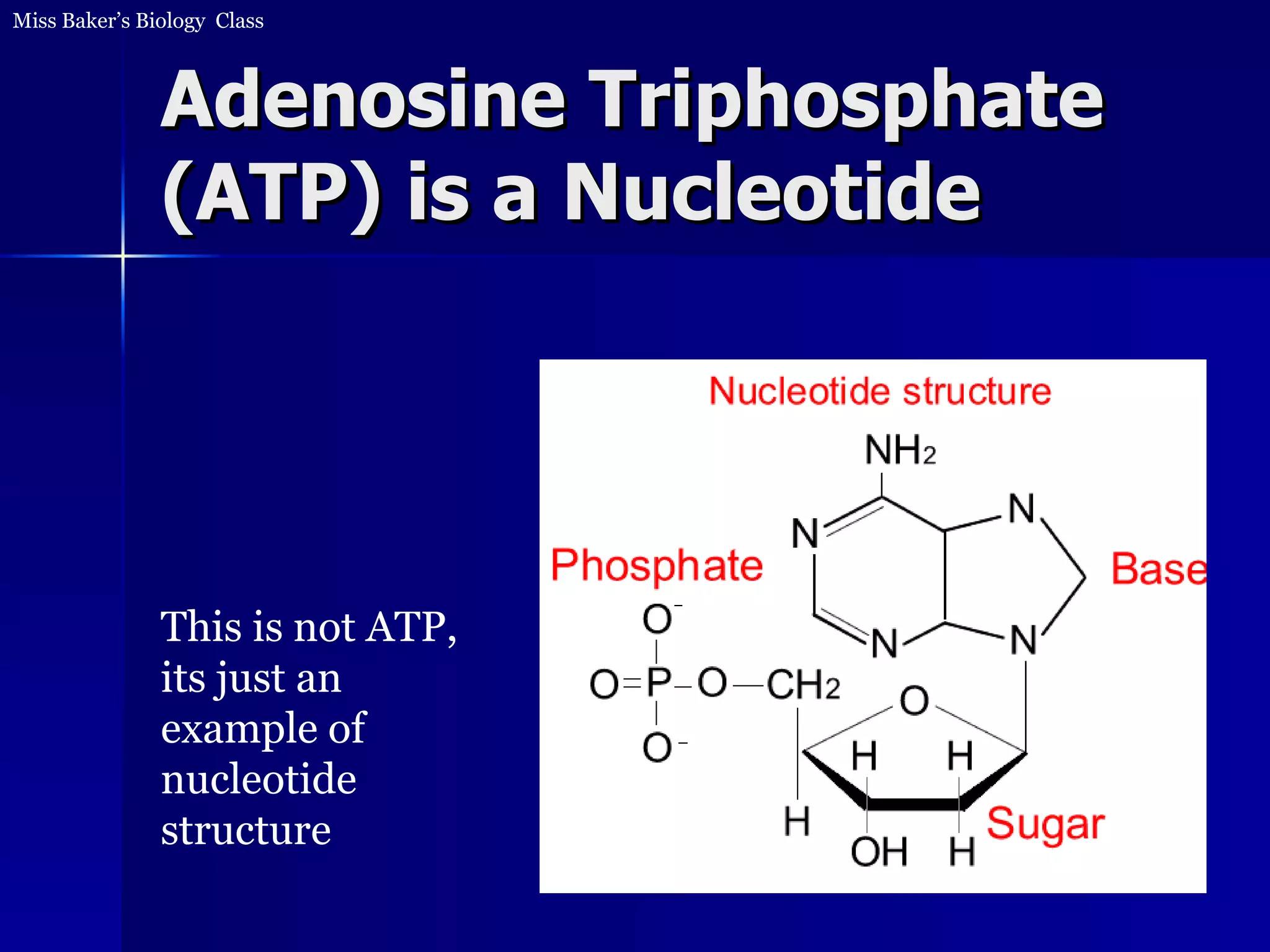
Adenosine Triphosphate (ATP) is a Nucleotide This is not ATP, its just an example of nucleotide structure
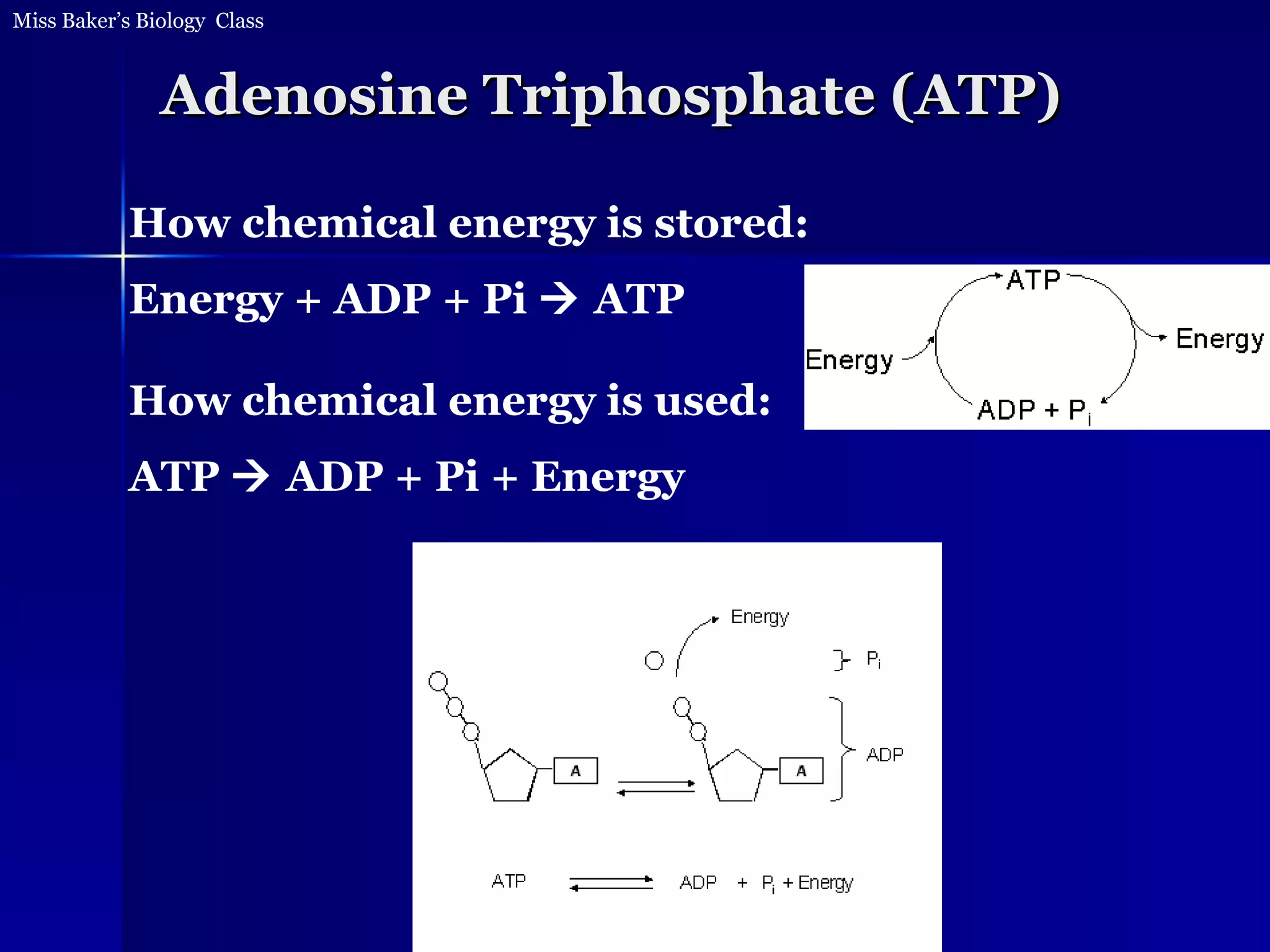
Adenosine Triphosphate (ATP) How chemical energy is stored: Energy + ADP + Pi    ATP How chemical energy is used: ATP    ADP + Pi + Energy
Energy Conversion Remember, whenever energy is converted, some of the energy becomes unusable (heat) Heat can keep your body warm, but it can no longer be used in the chemical reactions important to your metabolism
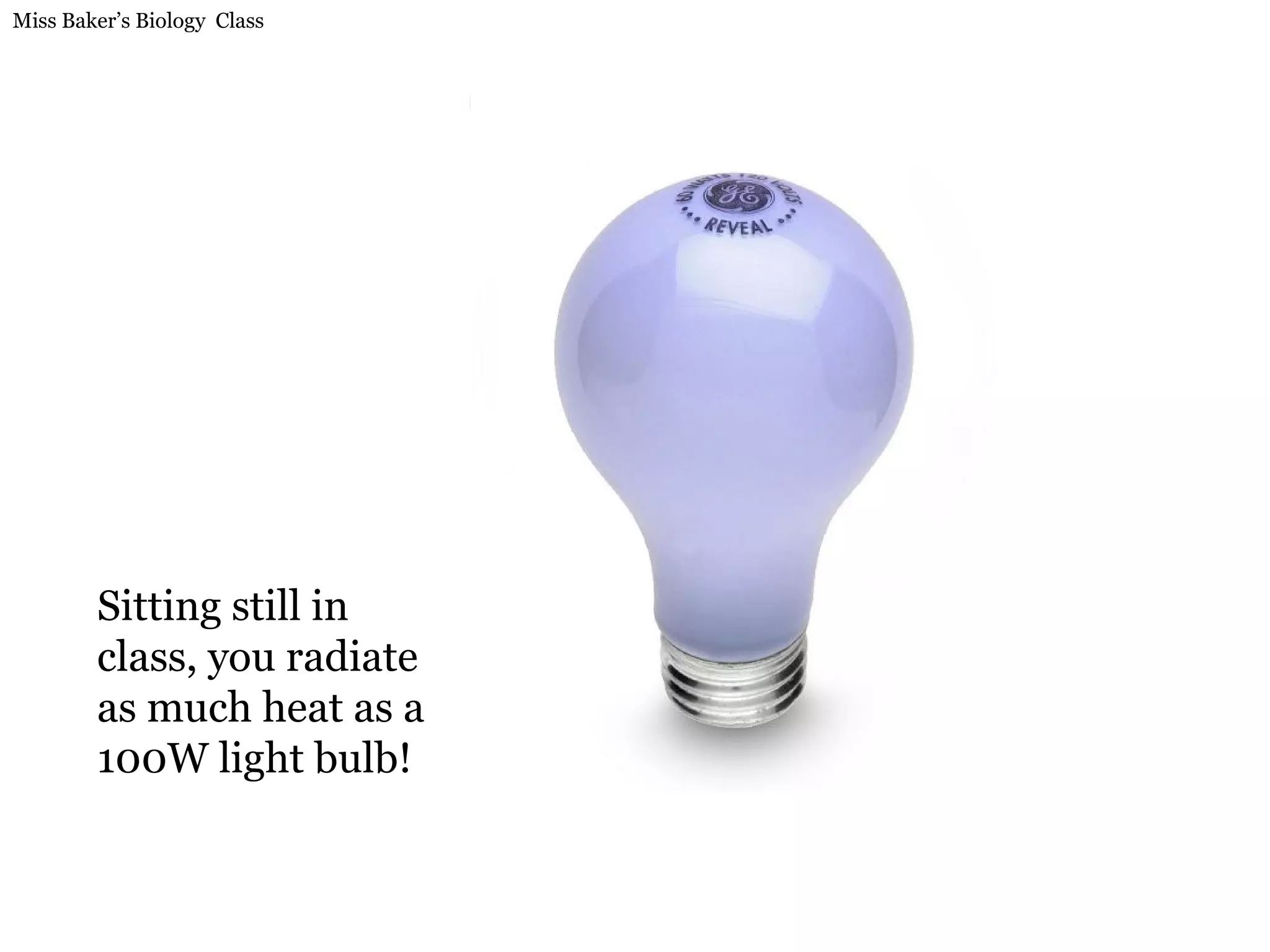
Sitting still in class, you radiate as much heat as a 100W light bulb!
A  calorie  is the amount of energy required to raise the temperture of 1g of water by 1 degree C By measuring the increase in water temperature, you can calculate the number of calories in any food 1,000 calories = 1 kilocalorie Because most food contains a lot of calories, kilocalories are the measurement you find on a nutritional label Units of Energy in Food

Cell Respiration (part 1)

  • 1.
    Objective: Foodstores chemical energy Procedure: 1. Go over homework 2. Lecture 3. Concept check questions Homework: Write a paragraph comparing and contrasting energy conversion in a car vs. energy conversion in your cells Bell-work: Define food for me in chemical terms. What was in your lunch today? Now describe it in terms of the classes of organic molecules it contains. Go back to chapter 5 (honors – 3) for help. October 24, 2006
  • 2.
    Putting Chemical Energyto Work In cell respiration, complex molecules are broken down and energy is released C 6 H 12 O 6 + O 2  CO 2 + H 2 O + ATP Note that glucose had high potential energy that was released during the reaction
  • 3.
    Adenosine Triphosphate (ATP)is a Nucleotide This is not ATP, its just an example of nucleotide structure
  • 4.
    Adenosine Triphosphate (ATP)How chemical energy is stored: Energy + ADP + Pi  ATP How chemical energy is used: ATP  ADP + Pi + Energy
  • 5.
    Energy Conversion Remember,whenever energy is converted, some of the energy becomes unusable (heat) Heat can keep your body warm, but it can no longer be used in the chemical reactions important to your metabolism
  • 6.
    Sitting still inclass, you radiate as much heat as a 100W light bulb!
  • 7.
    A calorie is the amount of energy required to raise the temperture of 1g of water by 1 degree C By measuring the increase in water temperature, you can calculate the number of calories in any food 1,000 calories = 1 kilocalorie Because most food contains a lot of calories, kilocalories are the measurement you find on a nutritional label Units of Energy in Food