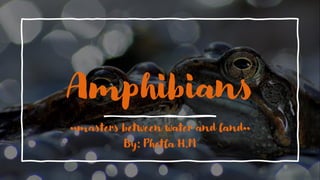
Amphibians
••masters between water and land••
By: Phetla H.M
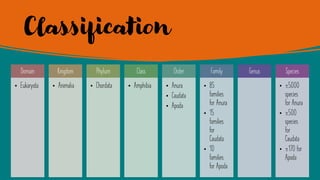
Classification
Domain
• Eukaryota
Kingdom
• Animalia
Phylum
• Chordata
Class
• Amphibia
Order
• Anura
• Caudata
• Apoda
Family
• 85
families
for Anura
• 15
families
for
Caudata
• 10
families
for Apoda
Genus Species
• ±5000
species
for Anura
• ±500
species
for
Caudata
• ±170 for
Apoda
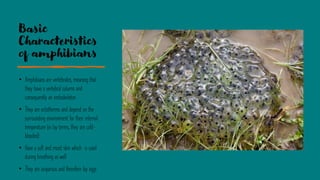
Basic
Characteristics
of amphibians
• Amphibians are vertebrates, meaning that
they have a vertebral column and
consequently an endoskeleton
• They are ectotherms and depend on the
surrounding environment for their internal
temperature (in lay terms, they are cold-
blooded)
• Have a soft and moist skin which is used
during breathing as well
• They are oviparous and therefore lay eggs
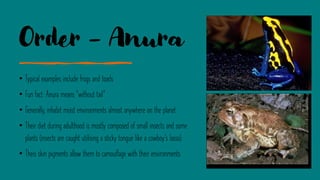
Order - Anura
• Typical examples include frogs and toads
• Fun fact: Anura means “without tail”
• Generally, inhabit moist environments almost anywhere on the planet
• Their diet during adulthood is mostly composed of small insects and some
plants (insects are caught utilising a sticky tongue like a cowboy’s lasso).
• Theis skin pigments allow them to camouflage with their environments
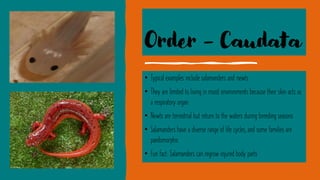
Order - Caudata
• Typical examples include salamanders and newts
• They are limited to living in moist environments because their skin acts as
a respiratory organ
• Newts are terrestrial but return to the waters during breeding seasons
• Salamanders have a diverse range of life cycles, and some families are
paedomorphic
• Fun fact: Salamanders can regrow injured body parts
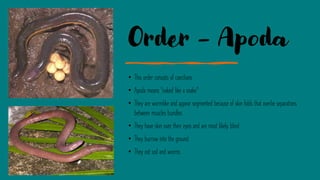
Order - Apoda
• This order consists of caecilians
• Apoda means “naked like a snake”
• They are wormlike and appear segmented because of skin folds that overlie separations
between muscles bundles
• They have skin over their eyes and are most likely blind
• They burrow into the ground
• They eat soil and worms
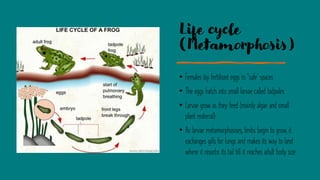
Life cycle
(Metamorphosis)
• Females lay fertilised eggs in “safe’ spaces
• The eggs hatch into small larvae called tadpoles
• Larvae grow as they feed (mainly algae and small
plant material)
• As larvae metamorphosises, limbs begin to grow, it
exchanges gills for lungs and makes its way to land
where it resorbs its tail till it reaches adult body size
References

Amphibians

  • 1.
    Amphibians ••masters between waterand land•• By: Phetla H.M
  • 2.
    Classification Domain • Eukaryota Kingdom • Animalia Phylum •Chordata Class • Amphibia Order • Anura • Caudata • Apoda Family • 85 families for Anura • 15 families for Caudata • 10 families for Apoda Genus Species • ±5000 species for Anura • ±500 species for Caudata • ±170 for Apoda
  • 3.
    Basic Characteristics of amphibians • Amphibiansare vertebrates, meaning that they have a vertebral column and consequently an endoskeleton • They are ectotherms and depend on the surrounding environment for their internal temperature (in lay terms, they are cold- blooded) • Have a soft and moist skin which is used during breathing as well • They are oviparous and therefore lay eggs
  • 4.
    Order - Anura •Typical examples include frogs and toads • Fun fact: Anura means “without tail” • Generally, inhabit moist environments almost anywhere on the planet • Their diet during adulthood is mostly composed of small insects and some plants (insects are caught utilising a sticky tongue like a cowboy’s lasso). • Theis skin pigments allow them to camouflage with their environments
  • 5.
    Order - Caudata •Typical examples include salamanders and newts • They are limited to living in moist environments because their skin acts as a respiratory organ • Newts are terrestrial but return to the waters during breeding seasons • Salamanders have a diverse range of life cycles, and some families are paedomorphic • Fun fact: Salamanders can regrow injured body parts
  • 6.
    Order - Apoda •This order consists of caecilians • Apoda means “naked like a snake” • They are wormlike and appear segmented because of skin folds that overlie separations between muscles bundles • They have skin over their eyes and are most likely blind • They burrow into the ground • They eat soil and worms
  • 7.
    Life cycle (Metamorphosis) • Femaleslay fertilised eggs in “safe’ spaces • The eggs hatch into small larvae called tadpoles • Larvae grow as they feed (mainly algae and small plant material) • As larvae metamorphosises, limbs begin to grow, it exchanges gills for lungs and makes its way to land where it resorbs its tail till it reaches adult body size
  • 8.