Background of group, Other organisms
                                         found in group, Extinct or Endangered, and
                                         What is their importance to our lives


      frogs and toads
                                         	 Amphibians
are
one
of
the
oldest
living
classes
of

                                         vertebrates.
They
evolved
during
the
Devonian
Period,
but
many

        Amphibians
                                         of
the
types
of
amphibians
went
extinct
over
time.
The

                                         amphibians
that
live
today
include
frogs,
toads,
salamanders,

                                         newts,
and
caecilians.
Caecilians
resemble
earthworms
or

                                         snakes,
they
live
underground
and
are
widely
unknown

                                         amphibians.
The
frogs
are
used
as
laboratory
specimens
for
the

                                         study
of
anatomy,
behavior,
ecology,
and
evolution.
They
are
also

                                         food
for
several
human
cultures.
Amphibians
are
no
longer

                                         present
in
some
areas,
but
in
other
regions
the
population
is

                                         stable
and
growing.
They
are
found
all
over
the
world
except
in

                                         Antarctica
and
Greenland.

                                         Nutrition, Reproduction, Response to stimuli,
                                         Adaptation, Regulation, and Place in food
                                         chain
                                         
  Frogs
reproduction
is
sexually.
The
eggs
are
fertilized
outside
the

                                         mother’s
body.
She
lays
the
eggs,
which
are
jellylike
and
the
father

                                         comes
and
fertilizes
them.
They
adapt
from
living
in
water
to
living

                                         on
land.
When
they
lived
in
water
they
were
known
as
tadpoles
and

                                         they
had
tales
and
no
legs.
After
half
of
their
life
was
lived
in
water

                                         now
they
become
adults
and
live
on
land,
but
still
go
in
the
water.

                                         When
they
become
adults
they
lose
their
tails
and
grow
legs.
They
do

                                         not
have
their
gills
anymore
and
they
now
have
lungs.
Their

                                         response
to
stimuli
is
they
hear
through
the
tympanic
membrane
or

                                         eardrum.
The
external
stimulus
of
sound,
the
tympanic
membrane

                                         vibrates
and
sends
sound
waves
deeper
within
the
skull.
In
the
food

    Shayla Brink                         chain
they
are
secondary
consumers.
Frogs
and
toads
are
carnivores;

                                         they
eat
crickets,
flies,
and
mostly
insects.
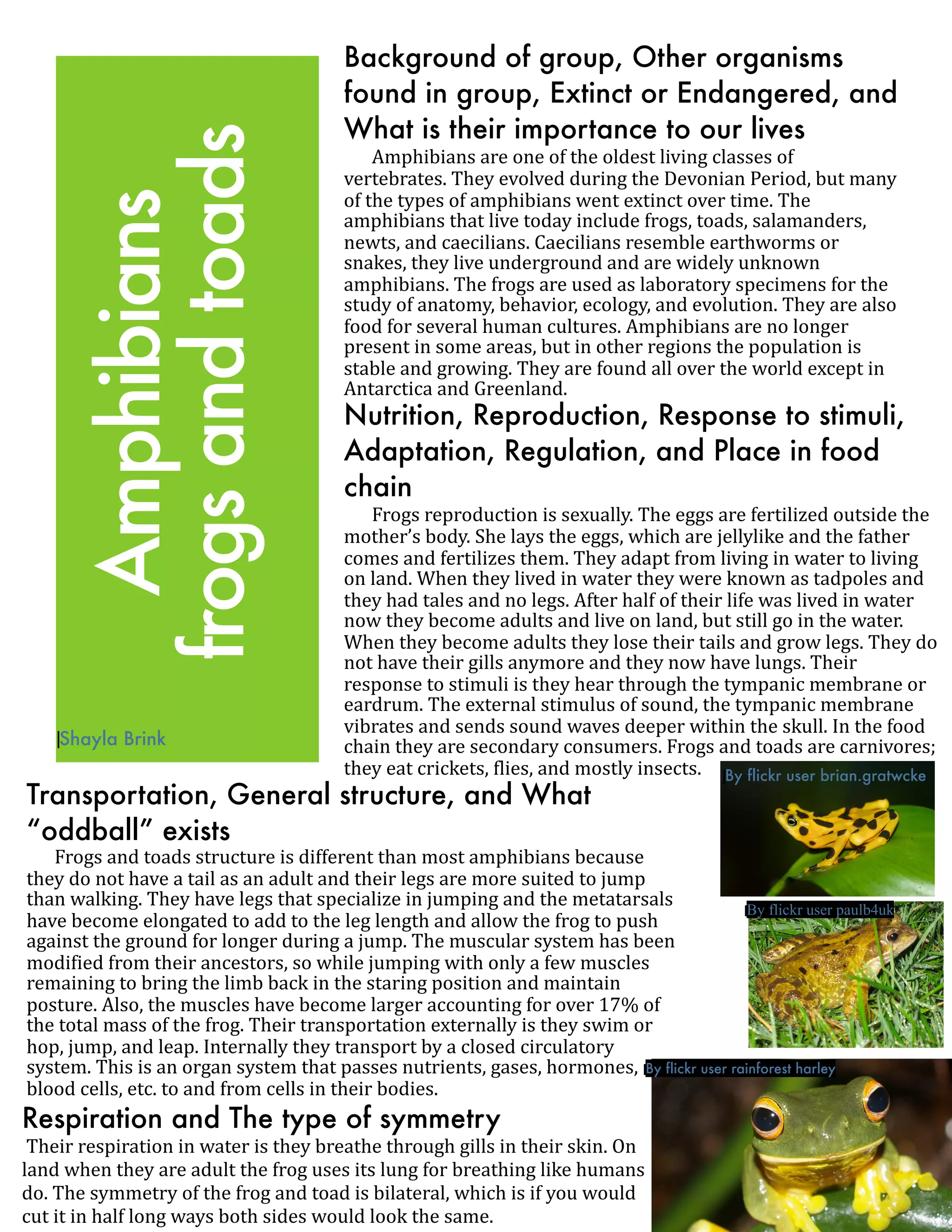
 By flickr user brian.gratwcke
Transportation, General structure, and What
“oddball” exists

 Frogs
and
toads
structure
is
different
than
most
amphibians
because

they
do
not
have
a
tail
as
an
adult
and
their
legs
are
more
suited
to
jump

than
walking.
They
have
legs
that
specialize
in
jumping
and
the
metatarsals
               By flickr user paulb4uk
have
become
elongated
to
add
to
the
leg
length
and
allow
the
frog
to
push

against
the
ground
for
longer
during
a
jump.
The
muscular
system
has
been

modified
from
their
ancestors,
so
while
jumping
with
only
a
few
muscles

remaining
to
bring
the
limb
back
in
the
staring
position
and
maintain

posture.
Also,
the
muscles
have
become
larger
accounting
for
over
17%
of

the
total
mass
of
the
frog.
Their
transportation
externally
is
they
swim
or

hop,
jump,
and
leap.
Internally
they
transport
by
a
closed
circulatory

system.
This
is
an
organ
system
that
passes
nutrients,
gases,
hormones,
 By flickr user rainforest harley
blood
cells,
etc.
to
and
from
cells
in
their
bodies.
Respiration and The type of symmetry

Their
respiration
in
water
is
they
breathe
through
gills
in
their
skin.
On

land
when
they
are
adult
the
frog
uses
its
lung
for
breathing
like
humans

do.
The
symmetry
of
the
frog
and
toad
is
bilateral,
which
is
if
you
would

cut
it
in
half
long
ways
both
sides
would
look
the
same.

Froggys

  • 1.
    Background of group,Other organisms found in group, Extinct or Endangered, and What is their importance to our lives frogs and toads Amphibians
are
one
of
the
oldest
living
classes
of
 vertebrates.
They
evolved
during
the
Devonian
Period,
but
many
 Amphibians of
the
types
of
amphibians
went
extinct
over
time.
The
 amphibians
that
live
today
include
frogs,
toads,
salamanders,
 newts,
and
caecilians.
Caecilians
resemble
earthworms
or
 snakes,
they
live
underground
and
are
widely
unknown
 amphibians.
The
frogs
are
used
as
laboratory
specimens
for
the
 study
of
anatomy,
behavior,
ecology,
and
evolution.
They
are
also
 food
for
several
human
cultures.
Amphibians
are
no
longer
 present
in
some
areas,
but
in
other
regions
the
population
is
 stable
and
growing.
They
are
found
all
over
the
world
except
in
 Antarctica
and
Greenland.
 Nutrition, Reproduction, Response to stimuli, Adaptation, Regulation, and Place in food chain Frogs
reproduction
is
sexually.
The
eggs
are
fertilized
outside
the
 mother’s
body.
She
lays
the
eggs,
which
are
jellylike
and
the
father
 comes
and
fertilizes
them.
They
adapt
from
living
in
water
to
living
 on
land.
When
they
lived
in
water
they
were
known
as
tadpoles
and
 they
had
tales
and
no
legs.
After
half
of
their
life
was
lived
in
water
 now
they
become
adults
and
live
on
land,
but
still
go
in
the
water.
 When
they
become
adults
they
lose
their
tails
and
grow
legs.
They
do
 not
have
their
gills
anymore
and
they
now
have
lungs.
Their
 response
to
stimuli
is
they
hear
through
the
tympanic
membrane
or
 eardrum.
The
external
stimulus
of
sound,
the
tympanic
membrane
 vibrates
and
sends
sound
waves
deeper
within
the
skull.
In
the
food
 Shayla Brink chain
they
are
secondary
consumers.
Frogs
and
toads
are
carnivores;
 they
eat
crickets,
flies,
and
mostly
insects.
 By flickr user brian.gratwcke Transportation, General structure, and What “oddball” exists 
 Frogs
and
toads
structure
is
different
than
most
amphibians
because
 they
do
not
have
a
tail
as
an
adult
and
their
legs
are
more
suited
to
jump
 than
walking.
They
have
legs
that
specialize
in
jumping
and
the
metatarsals
 By flickr user paulb4uk have
become
elongated
to
add
to
the
leg
length
and
allow
the
frog
to
push
 against
the
ground
for
longer
during
a
jump.
The
muscular
system
has
been
 modified
from
their
ancestors,
so
while
jumping
with
only
a
few
muscles
 remaining
to
bring
the
limb
back
in
the
staring
position
and
maintain
 posture.
Also,
the
muscles
have
become
larger
accounting
for
over
17%
of
 the
total
mass
of
the
frog.
Their
transportation
externally
is
they
swim
or
 hop,
jump,
and
leap.
Internally
they
transport
by
a
closed
circulatory
 system.
This
is
an
organ
system
that
passes
nutrients,
gases,
hormones,
 By flickr user rainforest harley blood
cells,
etc.
to
and
from
cells
in
their
bodies. Respiration and The type of symmetry 
Their
respiration
in
water
is
they
breathe
through
gills
in
their
skin.
On
 land
when
they
are
adult
the
frog
uses
its
lung
for
breathing
like
humans
 do.
The
symmetry
of
the
frog
and
toad
is
bilateral,
which
is
if
you
would
 cut
it
in
half
long
ways
both
sides
would
look
the
same.