Emulsion Polymerization
• Mohammad Shahidul
• Department of Textile
Engineering
• ID: BTE 00905507
Emulsion Polymerization
The most common type of emulsion polymerization is an
oil-in-water emulsion, in which droplets of monomer
(the oil) are emulsified (with surfactants) in a continuous
phase of water. Water-soluble polymers, such as certain
polyvinyl alcohols or hydroxyethyl celluloses, can also be
used to act as emulsifiers/stabilizers.
Emulsion Polymerization :
Typical ingredient
100 part (by wt.) monomer (water insoluble)
180 part water
2-5 parts acid soap
0.1-0.5 part water-soluble initiator
0-1 part CTA (monomer soluble)
-growing polymer particle
-Monomers inside the micelle decrease
Unreacted monomers in other
micelles and in droplets diffuse
through water to the growing particles
Reaction terminates when 2nd radical gets in
reaction starts again for the 2nd chain when 3rd particle gets in.
Steps in Emulsion Polymeriztion
Water-soluble initiator
Polymer born in water
Monomer swollen micelle
Polymer moves to micelle
Applications
Polymers produced by emulsion polymerization can be divided into three
rough categories.
•Synthetic rubber
Some grades of styrene-butadiene (SBR)
Some grades of Polybutadiene
Polychloroprene (Neoprene)
Nitrile rubber
Acrylic rubber
Fluoroelastomer (FKM)
•Plastics
Some grades of PVC
Some grades of polystyrene
Some grades of PMMA
Acrylonitrile-butadiene-styrene terpolymer (ABS)
Polyvinylidene fluoride
Polyvinyl fluoride
PTFE

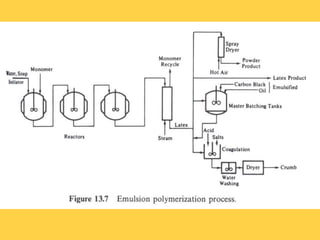
Emulsion polymerization

  • 1.
    Emulsion Polymerization • MohammadShahidul • Department of Textile Engineering • ID: BTE 00905507
  • 2.
    Emulsion Polymerization The mostcommon type of emulsion polymerization is an oil-in-water emulsion, in which droplets of monomer (the oil) are emulsified (with surfactants) in a continuous phase of water. Water-soluble polymers, such as certain polyvinyl alcohols or hydroxyethyl celluloses, can also be used to act as emulsifiers/stabilizers.
  • 3.
    Emulsion Polymerization : Typicalingredient 100 part (by wt.) monomer (water insoluble) 180 part water 2-5 parts acid soap 0.1-0.5 part water-soluble initiator 0-1 part CTA (monomer soluble)
  • 4.
    -growing polymer particle -Monomersinside the micelle decrease Unreacted monomers in other micelles and in droplets diffuse through water to the growing particles Reaction terminates when 2nd radical gets in reaction starts again for the 2nd chain when 3rd particle gets in. Steps in Emulsion Polymeriztion Water-soluble initiator Polymer born in water Monomer swollen micelle Polymer moves to micelle
  • 7.
    Applications Polymers produced byemulsion polymerization can be divided into three rough categories. •Synthetic rubber Some grades of styrene-butadiene (SBR) Some grades of Polybutadiene Polychloroprene (Neoprene) Nitrile rubber Acrylic rubber Fluoroelastomer (FKM) •Plastics Some grades of PVC Some grades of polystyrene Some grades of PMMA Acrylonitrile-butadiene-styrene terpolymer (ABS) Polyvinylidene fluoride Polyvinyl fluoride PTFE