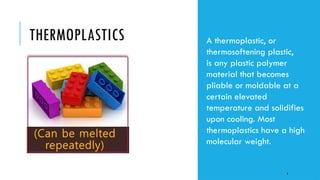
THERMOPLASTICS A thermoplastic,or
thermosoftening plastic,
is any plastic polymer
material that becomes
pliable or moldable at a
certain elevated
temperature and solidifies
upon cooling. Most
thermoplastics have a high
molecular weight.
3
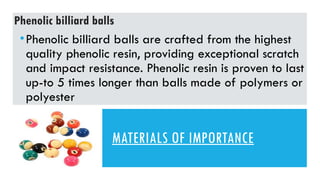
MATERIALS OF IMPORTANCE
•Phenolicbilliard balls are crafted from the highest
quality phenolic resin, providing exceptional scratch
and impact resistance. Phenolic resin is proven to last
up-to 5 times longer than balls made of polymers or
polyester
Phenolic billiard balls
6.
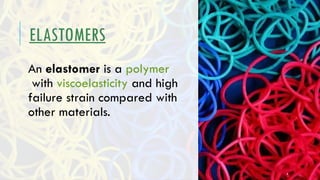
ELASTOMERS
An elastomer isa polymer
with viscoelasticity and high
failure strain compared with
other materials.
6
MISCELLANEOUS
APPLICATIONS
COATINGS: Coatings arefrequently applied to the
surface of materials to serve one or more of the
following functions: (1) to protect the item from the
environment, which may produce corrosive or
deteriorative reactions; (2) to improve the item’s
appearance; and (3) to provide electrical insulation.
9
ADHESIVE: An adhesive is a substance used to bond
together the surfaces of two solid materials (termed
adherends). Adhesive bonding offers some
advantages over other joining technologies (e.g.,
riveting, bolting, and welding), including lighter
weight, the ability to join dissimilar materials and thin
components, better fatigue resistance, and lower
manufacturing costs.
10.
MISCELLANEOUS
APPLICATIONS
FILMS: Polymeric materialshave found widespread use
in the form of thin films. Films having thicknesses
between 0.025 and 0.125 mm (0.001 and 0.005 in.)
are fabricated and used ex tensively as bags for
packaging food products and other merchandise, as
textile products, and in a host of other uses.
10
Foams: are plastic materials that contain a relatively
highvolume percentage of small pores and trapped
gas bubbles. Both thermoplastic and thermosetting
materials are used as foams; these include
polyurethane, rubber, polystyrene, and poly(vinyl chlo
ride).
11.
POLYMERIC
BIOMATERIALS
Polymeric biomaterials arethe
synthetic or natural materials
intended for interfacing with
biological systems to regenerate,
augment/ repair, and treat any
types of tissue of the organs or
function of the human body.
11
12.
ULTRA-HIGH-MOLECULAR-WEIGHT POLYETHYLENE -(Oneof
the advanced polymeric materials discussed in
section 15.20) is used in some important biomedical
applications. When crosslinked (chemically or by
ionizing radiation), UHMWPE materials are
extremely resistant to wear and abrasion, have very
low coefficients of friction, and offer self lubricating
and nonstick surfaces.
POLY(METHYL METHACRYLATE). PMMA is highly
transparent (approximately 92% transmissivity), has
a relatively high index of refraction (1.49), is highly
biocompatible, and is also mechani cally hard (but
also quite brittle). PMMA is the primary constituent
of bone cement (for the secure fixation of hip and
knee prostheses to living bone); furthermore, it is
also used in intraocular lenses and for hard contact
lenses.
12
POLYMERIC
BIOMATERIALS
13.
13
POLYTETRAFLUOROETHYLENE- Polytetrafluoroethylene hasa high degree of chemical
stability in the body environment as a result of its strong carbon–fluorine interatomic
bonds; furthermore, PTFE is not wetted by water (is hydrophobic) and has an extremely
low coefficient of friction.
SILICONES- The silicones have a diverse set of desirable bioproperties and are used in
a wide variety of application types. Depending on degree of crosslinking, silicones can
be prepared to exist as elastomers, gels, and fluids.
BIOAPPLICATIONS OF THE SILICONES ARE MANY AND DIVERSE, TO INCLUDE THE
FOLLOWING:
• Gas-permeable membranes in extended-wear contact lenses and intraocular lenses
• catheters, drains, and shunts
• orthopedic implants—hand and foot joints
• aesthetic implants—breast and facial feature reconstructions (e.G., Nose, chin, and
ear)
• coatings for hypodermic needles, syringes, and blood-collecting devices
• transdermal drug delivery
• dental impression materials
14.
ADVANCED POLYMERIC
MATERIALS
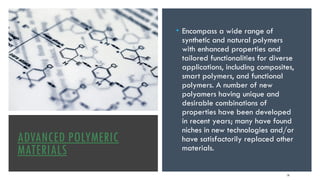
• Encompassa wide range of
synthetic and natural polymers
with enhanced properties and
tailored functionalities for diverse
applications, including composites,
smart polymers, and functional
polymers. A number of new
polyamers having unique and
desirable combinations of
properties have been developed
in recent years; many have found
niches in new technologies and/or
have satisfactorily replaced other
materials.
14
15.
ULTRA-HIGH-MOLECULAR-WEIGHT
POLYETHYLENE (UHMWPE)
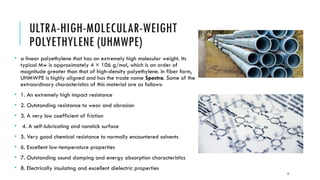
• alinear polyethylene that has an extremely high molecular weight. Its
typical Mw is approximately 4 × 10⁶ g/mol, which is an order of
magnitude greater than that of high-density polyethylene. In fiber form,
UHMWPE is highly aligned and has the trade name Spectra. Some of the
extraordinary characteristics of this material are as follows:
• 1. An extremely high impact resistance
• 2. Outstanding resistance to wear and abrasion
• 3. A very low coefficient of friction
• 4. A self-lubricating and nonstick surface
• 5. Very good chemical resistance to normally encountered solvents
• 6. Excellent low-temperature properties
• 7. Outstanding sound damping and energy absorption characteristics
• 8. Electrically insulating and excellent dielectric properties
15
16.
16
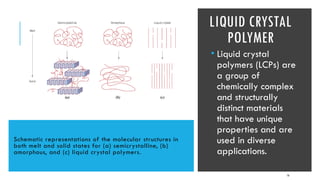
• Liquid crystal
polymers(LCPs) are
a group of
chemically complex
and structurally
distinct materials
that have unique
properties and are
used in diverse
applications.
Schematic representations of the molecular structures in
both melt and solid states for (a) semicrystalline, (b)
amorphous, and (c) liquid crystal polymers.
LIQUID CRYSTAL
POLYMER
17.
• Some ofthe nematic type of liquid crystal polymers are rigid solids at room
temperature and, on the basis of an outstanding combination of properties and
processing characteristics, have found widespread use in a variety of commercial
applications. For example, these materials exhibit the following behaviors:
• 1. Excellent thermal stability; they may be used to temperatures as high as 230°C
(450°F).
• 2. Stiffness and strength; their tensile moduli range between 10 and 24 GPa (1.4
× 106 and 3.5 × 10⁶ psi), and their tensile strengths are from 125 to 255 MPa
(18,000 to 37,000 psi).
• 3. High impact strengths, which are retained upon cooling to relatively low
temperatures.
• 4. Chemical inertness to a wide variety of acids, solvents, bleaches, and so on.
• 5. Inherent flame resistance and combustion products that are relatively nontoxic.
18.
The thermal stabilityand chemical inertness of these materials are explained by
extremely high intermolecular forces. The following may be said about their
processing and fabrication characteristics:
• 1. All conventional processing techniques available for thermoplastic materials
may be used.
• 2. Extremely low shrinkage and warpage take place during molding.
• 3. There is exceptional dimensional repeatability from part to part.
• 4. Melt viscosity is low, which permits molding of thin sections and/or complex
shapes.
• 5. Heats of fusion are low; this results in rapid melting and subsequent cooling,
which shortens molding cycle times.
• 6. They have anisotropic finished-part properties; molecular orientation effects
are produced from melt flow during molding.
19.
THERMOPLASTIC
ELASTOMERS
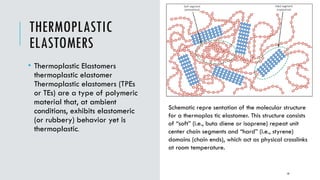
• Thermoplastic Elastomers
thermoplasticelastomer
Thermoplastic elastomers (TPEs
or TEs) are a type of polymeric
material that, at ambient
conditions, exhibits elastomeric
(or rubbery) behavior yet is
thermoplastic.
19
Schematic repre sentation of the molecular structure
for a thermoplas tic elastomer. This structure consists
of “soft” (i.e., buta diene or isoprene) repeat unit
center chain segments and “hard” (i.e., styrene)
domains (chain ends), which act as physical crosslinks
at room temperature.
20.
POLYMER SYNTHESIS AND
PROCESSING
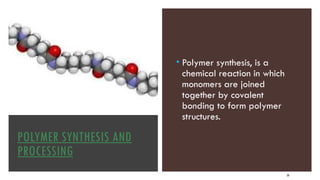
•Polymer synthesis, is a
chemical reaction in which
monomers are joined
together by covalent
bonding to form polymer
structures.
20
21.
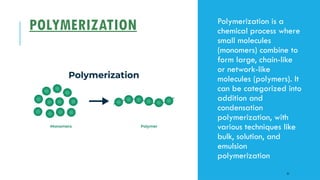
POLYMERIZATION • Polymerizationis a
chemical process where
small molecules
(monomers) combine to
form large, chain-like
or network-like
molecules (polymers). It
can be categorized into
addition and
condensation
polymerization, with
various techniques like
bulk, solution, and
emulsion
polymerization
21
22.
22
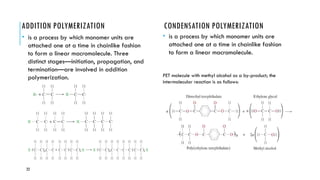
ADDITION POLYMERIZATION
• isa process by which monomer units are
attached one at a time in chainlike fashion
to form a linear macromolecule. Three
distinct stages—initiation, propagation, and
termination—are involved in addition
polymerization.
CONDENSATION POLYMERIZATION
• is a process by which monomer units are
attached one at a time in chainlike fashion
to form a linear macromolecule.
PET molecule with methyl alcohol as a by-product; the
intermolecular reaction is as follows:
23.
23
POLYMER ADDITIVES
• Foreignsubstances called additives are intentionally introduced to enhance or modify many of
these properties and thus render a polymer more serviceable. Typical additives include filler
materials, plasticizers, stabilizers, colorants, and flame retardants.
Fillers
• Filler materials are most often added to polymers to improve tensile and compressive strengths,
abrasion resistance, toughness, dimensional and thermal stability, and other
Plasticizers
• Plasticizers are commonly used in polymers that are intrinsically brittle at room temperature, such as
poly(vinyl chloride) and some of the acetate co polymers.
24.
24
Stabilizers
• Stabilizer (chemistry),a substance added to prevent unwanted change in state of another
substance. Polymer stabilizers are stabilizers used specifically in plastic or other polymers.
Colorants
• Colorants impart a specific color to a polymer; they may be added in the form of dyes or
pigments.
Flame retardants
• Flame retardants are substances added to materials to reduce their flammability, and they are
categorized as halogenated (containing halogens like bromine or chlorine) or non-halogenated,
with the latter gaining attention due to concerns about the toxicity of some halogenated flame
retardant.
25.
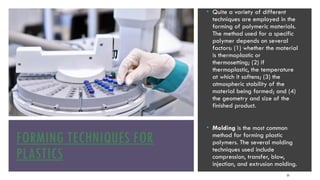
FORMING TECHNIQUES FOR
PLASTICS
25
•Quite a variety of different
techniques are employed in the
forming of polymeric materials.
The method used for a specific
polymer depends on several
factors: (1) whether the material
is thermoplastic or
thermosetting; (2) if
thermoplastic, the temperature
at which it softens; (3) the
atmospheric stability of the
material being formed; and (4)
the geometry and size of the
finished product.
• Molding is the most common
method for forming plastic
polymers. The several molding
techniques used include
compression, transfer, blow,
injection, and extrusion molding.
26.
26
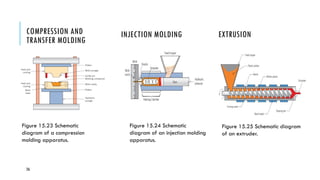
COMPRESSION AND
TRANSFER MOLDING
Figure15.23 Schematic
diagram of a compression
molding apparatus.
INJECTION MOLDING
Figure 15.24 Schematic
diagram of an injection molding
apparatus.
EXTRUSION
Figure 15.25 Schematic diagram
of an extruder.
27.
27
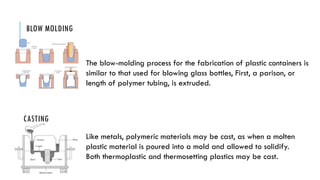
BLOW MOLDING
The blow-moldingprocess for the fabrication of plastic containers is
similar to that used for blowing glass bottles, First, a parison, or
length of polymer tubing, is extruded.
CASTING
Like metals, polymeric materials may be cast, as when a molten
plastic material is poured into a mold and allowed to solidify.
Both thermoplastic and thermosetting plastics may be cast.
28.
28
FABRICATION OF ELASTOMERS
•Techniques used in the actual fabrication of rubber parts are essentially the same as those
discussed for plastics as described previously—compression molding, extrusion, and so on.
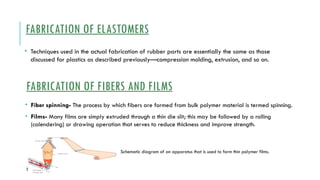
FABRICATION OF FIBERS AND FILMS
• Fiber spinning- The process by which fibers are formed from bulk polymer material is termed spinning.
• Films- Many films are simply extruded through a thin die slit; this may be followed by a rolling
(calendering) or drawing operation that serves to reduce thickness and improve strength.
Schematic diagram of an apparatus that is used to form thin polymer films.
29.
29
3D PRINTING OFPOLYMERS
• Many polymeric materials may be fabricated into useful shapes using 3D printing (additive manufacturing) techniques.
Several novel 3D printing techniques are used for polymeric materials; we will de scribe four of the most common—
fused deposition modeling, stereolithography, polyjet printing, and continuous liquid interface production.
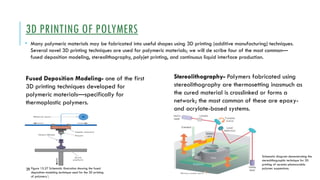
Fused Deposition Modeling- one of the first
3D printing techniques developed for
polymeric materials—specifically for
thermoplastic polymers.
Figure 15.27 Schematic illustration showing the fused
deposition modeling technique used for the 3D printing
of polymers.
Stereolithography- Polymers fabricated using
stereolithography are thermosetting inasmuch as
the cured material is crosslinked or forms a
network; the most common of these are epoxy-
and acrylate-based systems.
Schematic diagram demonstrating the
stereolithographic technique for 3D
printing of ceramic-photocurable
polymer suspensions.
30.
30
Polymer-Derived Ceramics- Theformation of polymer
ceramics is based on thermal curing of functionalized resins
being able to form ceramic-like structures in the result of heat
treatment above 200°C. Polymer-ceramics can be processed
by a broad variety of plastic forming techniques like high
pressure injection molding or extrusion
3D Clay Extrusion- 3D clay extrusion is used in several
different areas including pottery (plates, cups, saucers,
mugs) and ornamental/artisanal (statues, figurines, jewelry,
planters)
32
QUIZ! DIRECTIONS: Listthe correct answers for each question. Write your
answers clearly.
I. Give at least 3
polymer fracture.
01
II. What are the 4
general types of
polymer
molecular
structures?
02
III. List three types
of polymers
based on their
thermal
properties.
03
33.
ANSWER KEY
I. Giveat least 3 polymer fracture.
Ductile fracture
Brittle fracture
Fatigue fracture
Impact fracture
II. What are the 4 general types of polymer
molecular structures?
Linear
Branched
Crosslinked
Network (three dimensional)
III. List three types of polymers based on their
thermal properties
Thermoplastics
Thermosetting Polymer
Elastomers
33
Editor's Notes
#1 This presentation covers polymers, their types, and various applications. We will explore different kinds of polymers such as thermoplastics, thermosetting polymers, elastomers, fibers, and advanced polymeric materials.
#2 Plastics are materials with structural rigidity used in general applications. They are classified into thermoplastics and thermosetting polymers, which differ in their ability to be reshaped when heated.
#3 Thermoplastics become soft and moldable at high temperatures and solidify upon cooling. They have high molecular weight and can be recycled multiple times.
#4 Thermosetting polymers harden permanently upon heating or radiation exposure, forming strong, irreversible cross-linked structures that cannot be reshaped.
#5 Phenolic billiard balls are made from high-quality phenolic resin, which offers superior durability and scratch resistance compared to other polymer-based balls.
#6 Elastomers are polymers with viscoelastic properties, meaning they have high elasticity and return to their original shape after being stretched.
#7 Fiber polymers are synthetic fibers used for reinforcement in various materials. They provide strength and flexibility in applications like textiles and industrial uses.
#8 Polymers are used in coatings to protect surfaces from environmental damage, enhance appearance, and provide insulation. Adhesives are used to bond materials, offering lightweight and durable joining solutions.
#9 Films made of polymers are used in packaging, textiles, and other applications. Foams, which contain trapped gas bubbles, are used for insulation and cushioning.
#10 Polymeric biomaterials interact with biological systems for medical applications like tissue regeneration, prosthetics, and implants.
#11 Ultra-high-molecular-weight polyethylene (UHMWPE) is used in biomedical applications due to its resistance to wear, self-lubricating properties, and chemical stability.
#12 Polytetrafluoroethylene (PTFE) and silicones have medical applications, including coatings for medical devices, implants, and drug delivery systems.
#13 Advanced polymeric materials have enhanced properties for specialized applications. They include UHMWPE, liquid crystal polymers, and thermoplastic elastomers, offering superior strength and chemical resistance.
#14 Liquid crystal polymers (LCPs) are used in high-temperature environments due to their thermal stability, high strength, and chemical resistance.
#15 Thermoplastic elastomers (TPEs) combine rubber-like properties with the ability to be reshaped under heat, making them versatile for various applications.
#16 Polymer synthesis involves chemical reactions that form polymers from monomers through polymerization. This can be done via addition or condensation polymerization.
#17 Addition polymerization builds polymers step by step, forming linear macromolecules. Condensation polymerization releases small by-products, such as water, during polymer formation.
#18 Polymer additives enhance properties like strength, flexibility, and flame resistance. Common additives include fillers, plasticizers, stabilizers, colorants, and flame retardants.
#19 Plastic forming techniques vary depending on polymer type. Molding techniques include compression, injection, blow, and extrusion molding.
#20 Elastomers are processed using molding and extrusion techniques similar to plastics. Fiber spinning is used to create synthetic fibers.
#21 3D printing allows polymers to be shaped into complex designs. Techniques include fused deposition modeling, stereolithography, and polyjet printing.
#22 Polymer-derived ceramics are created through high-temperature treatment, forming ceramic-like structures. They are used in various applications, including pottery and medical implants.
#23 This concludes the presentation on polymers. Thank you for your attention! Feel free to ask any questions.