POLYMERS
AND
POLYMERIZATION
PRESENTATION BY:
A G H A A B D U L A Z I Z
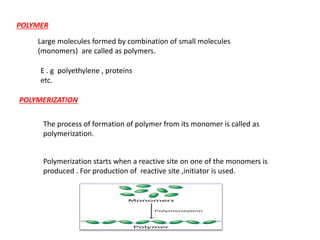
POLYMER
Large molecules formed by combination of small molecules
(monomers) are called as polymers.
E . g polyethylene , proteins
etc.
POLYMERIZATION
The process of formation of polymer from its monomer is called as
polymerization.
Polymerization starts when a reactive site on one of the monomers is
produced . For production of reactive site ,initiator is used.
CLASSIFICATION
OF POLYMERS
BASIS OF CLASSIFICATION
Polymers are classified on the basis
of;
Sources of polymers
Thermal behavior
Mechanism of polymerization
Structure of polymer
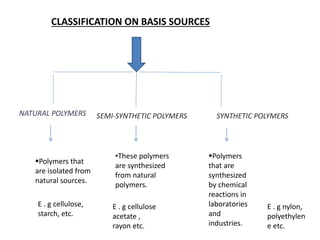
CLASSIFICATION ON BASIS SOURCES
NATURAL POLYMERS SEMI-SYNTHETIC POLYMERS SYNTHETIC POLYMERS
Polymers that
are isolated from
natural sources.
•These polymers
are synthesized
from natural
polymers.
Polymers
that are
synthesized
by chemical
reactions in
laboratories
and
industries.
E . g cellulose,
starch, etc.
E . g cellulose
acetate ,
rayon etc.
E . g nylon,
polyethylen
e etc.
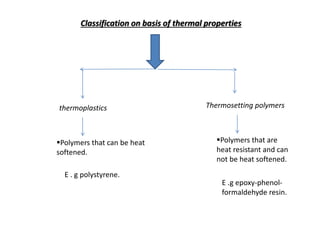
Classification on basis of thermal properties
thermoplastics Thermosetting polymers
Polymers that can be heat
softened.
Polymers that are
heat resistant and can
not be heat softened.
E . g polystyrene.
E .g epoxy-phenol-
formaldehyde resin.
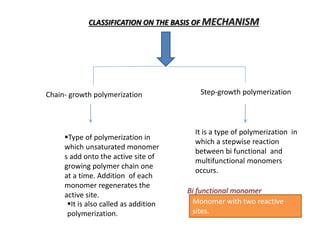
CLASSIFICATION ON THE BASIS OF MECHANISM
Chain- growth polymerization Step-growth polymerization
Type of polymerization in
which unsaturated monomer
s add onto the active site of
growing polymer chain one
at a time. Addition of each
monomer regenerates the
active site.
It is also called as addition
polymerization.
It is a type of polymerization in
which a stepwise reaction
between bi functional and
multifunctional monomers
occurs.
Bi functional monomer
Monomer with two reactive
sites.
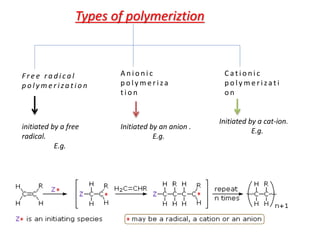
Types of polymeriztion
F r e e r a d i c a l
p o l y m e r i za t i o n
A n i o n i c
p o l y m e r i z a
t i o n
C a t i o n i c
p o l y m e r i z a t i
o n
initiated by a free
radical.
E.g.
Initiated by an anion .
E.g.
Initiated by a cat-ion.
E.g.
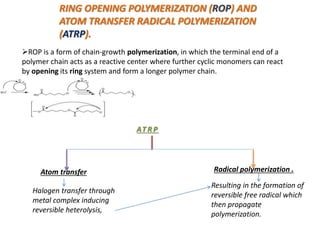
RING OPENING POLYMERIZATION (ROP) AND
ATOM TRANSFER RADICAL POLYMERIZATION
(ATRP).
ROP is a form of chain-growth polymerization, in which the terminal end of a
polymer chain acts as a reactive center where further cyclic monomers can react
by opening its ring system and form a longer polymer chain.
E.g.
AT R P
Atom transfer Radical polymerization .
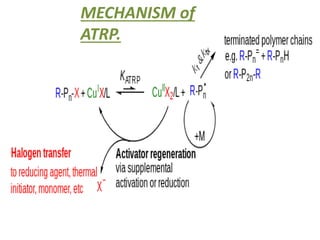
Halogen transfer through
metal complex inducing
reversible heterolysis,
Resulting in the formation of
reversible free radical which
then propagate
polymerization.
MECHANISM of
ATRP.
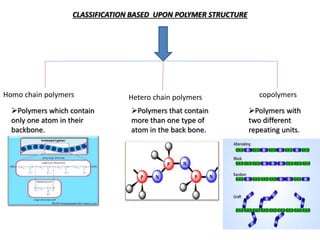
CLASSIFICATION BASED UPON POLYMER STRUCTURE
Homo chain polymers Hetero chain polymers copolymers
Polymers which contain
only one atom in their
backbone.
Polymers that contain
more than one type of
atom in the back bone.
Polymers with
two different
repeating units.
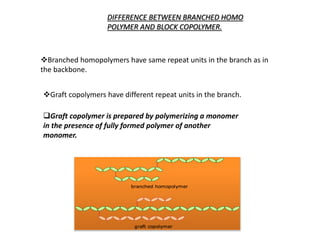
DIFFERENCE BETWEEN BRANCHED HOMO
POLYMER AND BLOCK COPOLYMER.
Branched homopolymers have same repeat units in the branch as in
the backbone.
Graft copolymers have different repeat units in the branch.
Graft copolymer is prepared by polymerizing a monomer
in the presence of fully formed polymer of another
monomer.
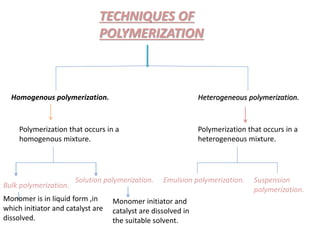
TECHNIQUES OF
POLYMERIZATION
Homogenous polymerization. Heterogeneous polymerization.
Polymerization that occurs in a
homogenous mixture.
Polymerization that occurs in a
heterogeneous mixture.
Bulk polymerization.
Solution polymerization. Emulsion polymerization. Suspension
polymerization.
Monomer is in liquid form ,in
which initiator and catalyst are
dissolved.
Monomer initiator and
catalyst are dissolved in
the suitable solvent.
MY NEXT PRESENTATION
COMING SOON.

polymers and polymerization.

  • 1.
  • 2.
    POLYMER Large molecules formedby combination of small molecules (monomers) are called as polymers. E . g polyethylene , proteins etc. POLYMERIZATION The process of formation of polymer from its monomer is called as polymerization. Polymerization starts when a reactive site on one of the monomers is produced . For production of reactive site ,initiator is used.
  • 3.
    CLASSIFICATION OF POLYMERS BASIS OFCLASSIFICATION Polymers are classified on the basis of; Sources of polymers Thermal behavior Mechanism of polymerization Structure of polymer
  • 4.
    CLASSIFICATION ON BASISSOURCES NATURAL POLYMERS SEMI-SYNTHETIC POLYMERS SYNTHETIC POLYMERS Polymers that are isolated from natural sources. •These polymers are synthesized from natural polymers. Polymers that are synthesized by chemical reactions in laboratories and industries. E . g cellulose, starch, etc. E . g cellulose acetate , rayon etc. E . g nylon, polyethylen e etc.
  • 5.
    Classification on basisof thermal properties thermoplastics Thermosetting polymers Polymers that can be heat softened. Polymers that are heat resistant and can not be heat softened. E . g polystyrene. E .g epoxy-phenol- formaldehyde resin.
  • 6.
    CLASSIFICATION ON THEBASIS OF MECHANISM Chain- growth polymerization Step-growth polymerization Type of polymerization in which unsaturated monomer s add onto the active site of growing polymer chain one at a time. Addition of each monomer regenerates the active site. It is also called as addition polymerization. It is a type of polymerization in which a stepwise reaction between bi functional and multifunctional monomers occurs. Bi functional monomer Monomer with two reactive sites.
  • 7.
    Types of polymeriztion Fr e e r a d i c a l p o l y m e r i za t i o n A n i o n i c p o l y m e r i z a t i o n C a t i o n i c p o l y m e r i z a t i o n initiated by a free radical. E.g. Initiated by an anion . E.g. Initiated by a cat-ion. E.g.
  • 8.
    RING OPENING POLYMERIZATION(ROP) AND ATOM TRANSFER RADICAL POLYMERIZATION (ATRP). ROP is a form of chain-growth polymerization, in which the terminal end of a polymer chain acts as a reactive center where further cyclic monomers can react by opening its ring system and form a longer polymer chain. E.g. AT R P Atom transfer Radical polymerization . Halogen transfer through metal complex inducing reversible heterolysis, Resulting in the formation of reversible free radical which then propagate polymerization.
  • 9.
  • 10.
    CLASSIFICATION BASED UPONPOLYMER STRUCTURE Homo chain polymers Hetero chain polymers copolymers Polymers which contain only one atom in their backbone. Polymers that contain more than one type of atom in the back bone. Polymers with two different repeating units.
  • 11.
    DIFFERENCE BETWEEN BRANCHEDHOMO POLYMER AND BLOCK COPOLYMER. Branched homopolymers have same repeat units in the branch as in the backbone. Graft copolymers have different repeat units in the branch. Graft copolymer is prepared by polymerizing a monomer in the presence of fully formed polymer of another monomer.
  • 12.
    TECHNIQUES OF POLYMERIZATION Homogenous polymerization.Heterogeneous polymerization. Polymerization that occurs in a homogenous mixture. Polymerization that occurs in a heterogeneous mixture. Bulk polymerization. Solution polymerization. Emulsion polymerization. Suspension polymerization. Monomer is in liquid form ,in which initiator and catalyst are dissolved. Monomer initiator and catalyst are dissolved in the suitable solvent.
  • 15.