
HEIGHT MEASUREMENT FROM AERIAL PHOTOGRAPH
Presented By:
Avijit Ghorai
1. What is the Aerial Photo?
2. Geometric Types
3. Vertical Aerial Photograph
4. Geometry and components of vertical photograph
5. Height measurement of Aerial Photograph
CONTENT
• Height measurement based on Relief Displacement
• Height measurement based on Shadow length
• Height measurement based on Stereoscopic parallax
What is Aerial Photography?
Aerial photography (or airborne imagery) is the taking
of photographs from an aircraft or other flying object.
Platforms for aerial photography include fixed-
wing aircraft, helicopters, unmanned aerial vehicles (UAVs or
"drones"), balloons, rockets, kites, parachutes,
1. Vertical aerial photograph:
- camera Tilt <3⁰ from the vertical
2. Low oblique Aerial Photograph:
-inclined about 30° from the vertical
3. High oblique Aerial Photograph:
-camera inclined about 60° from the
vertical
Fig: geometric types of Aerial photograph
Source:
https://www.google.co.in/search?q=geometric+types+of+aerial+photograp
h&rlz=1C1GCEA_enIN787IN787&source=lnms&tbm=isch&sa=X&ved=0ahU
KEwjEuLi_jLLeAhUYWX0KHdAkB7sQ_AUIDigB&biw=1396&bih=686#imgrc=
v3kb2wganwsysM:
Taking Vertical Aerial Photographs
Most vertical Aerial photographs are taken with frame cameras along flight lines. The line traced on
the ground directly beneath the aircraft during acquisition of photography is called the ‘Nadir line’.
This line connects the image centres of the vertical photographs.
Fig: photographic coverage along a flight strip: a)condition during
exposure, b)resulting photography
Each vertical aerial photograph overlaps the next photograph in the flight line by approximately
60%(referred to as stereoscopic overlap). And the sidelap require 20-40%. This overlap is very
important because it provides at least two and some times three photographic view of each object in
the real world along a flight line.
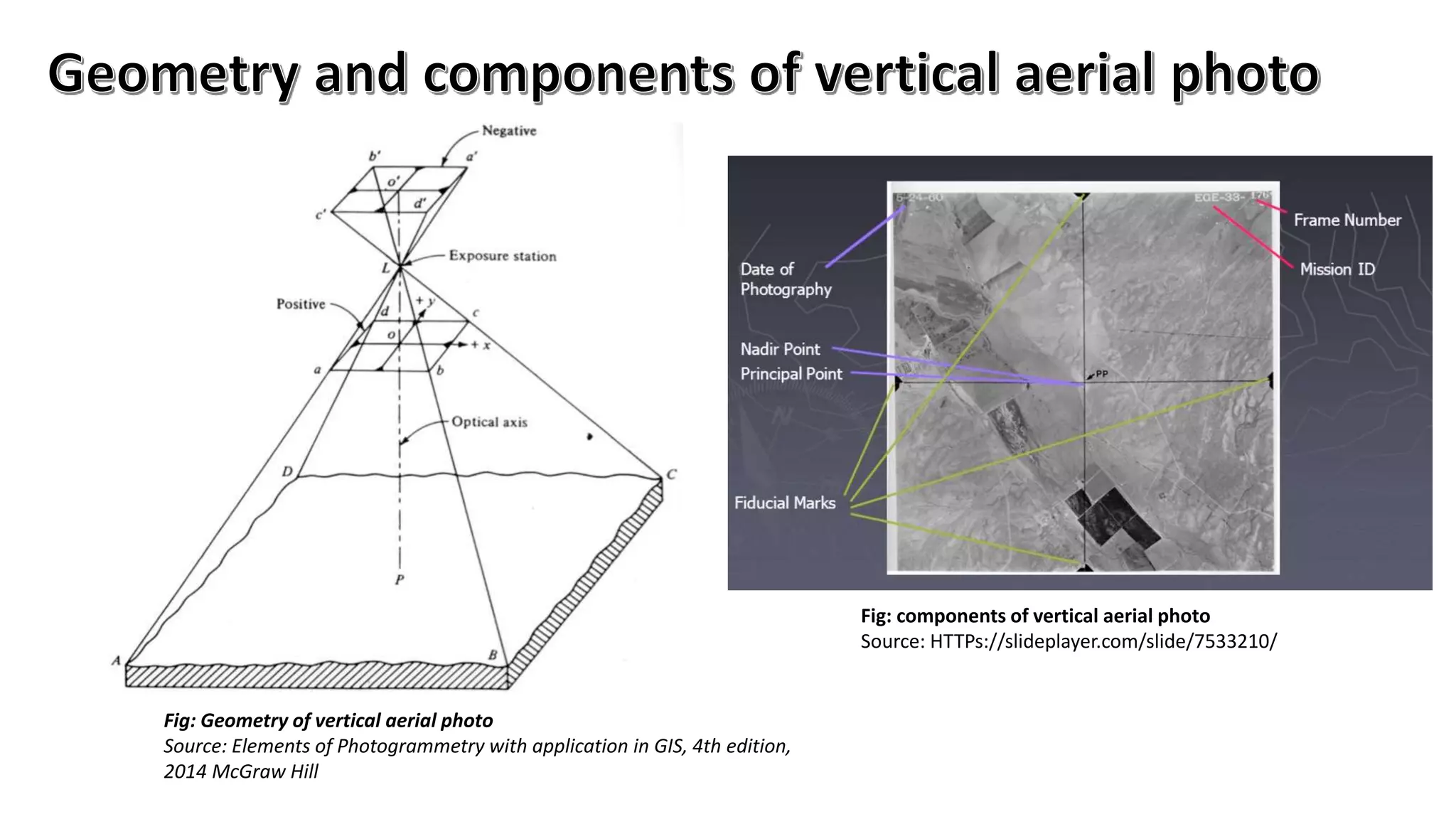
Fig: Geometry of vertical aerial photo
Source: Elements of Photogrammetry with application in GIS, 4th edition,
2014 McGraw Hill
Fig: components of vertical aerial photo
Source: HTTPs://slideplayer.com/slide/7533210/
Height Measurement of Aerial Photograph
Method:1
Displacement is shift in the location of an object
in a photo, which does not change the
perspective characteristics of the photo..
Source:
https://www.google.co.in/search?q=height+measurement+from+relief+displaceme
nt&rlz=1C1GCEA_enIN787IN787&source=lnms&tbm=isch&sa=X&ved=0ahUKEwi0uf-
D1ZHeAhUXEnIKHWotDnUQ_AUIDigB&biw=1536&bih=754#imgrc=sV3kAkvRVSxKo
M:
Causes of Relief Displacement
The amount of relief displacement depends upon:
A. Height of the Object:
When the distance of objects from the nadir point is
remain same. But the object height increased or
decreased.
Higher object is more displaced.
B. The distance of the objects from nadir point
When the distance of object is more from nadir point,
the relief displacement will be more.
C. Focal Length
When the focal length of camera lens is
increased, the
relief displacement will be more. On the
other hand, when
the focal length of camera lens is
decreased, the relief
displacement will be less.
D. Flying height or altitude
If the focal length of the camera lens remain
constant. When the flying height increased, the
relief displacement will be decrease.
E. The height of the object in relation to datum plane
F. Effect of the field of view
Normal angle of view will result in smaller relief
displacement (shift on the photograph of a point because of
its relief (height).
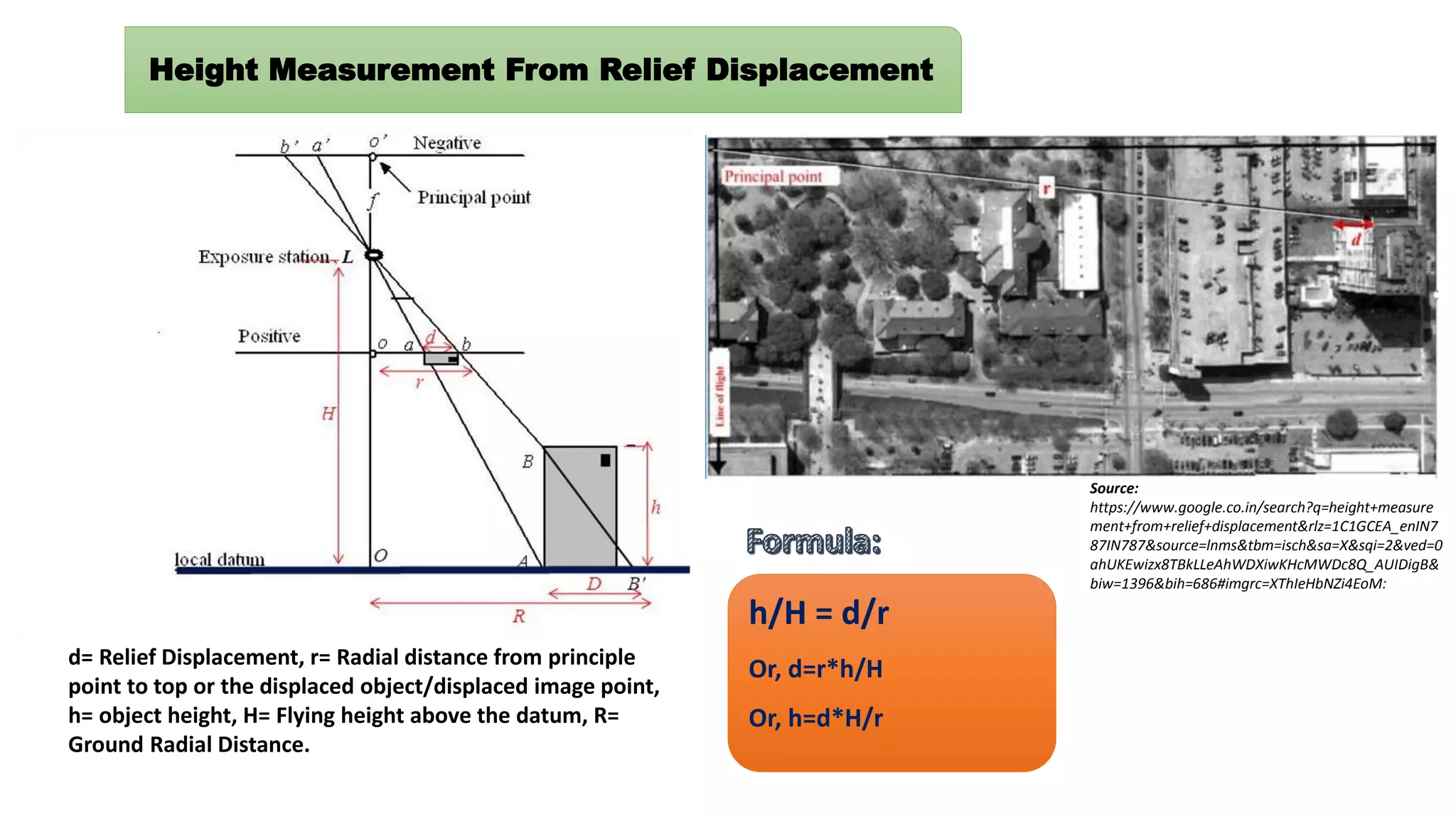
Height Measurement From Relief Displacement
d= Relief Displacement, r= Radial distance from principle
point to top or the displaced object/displaced image point,
h= object height, H= Flying height above the datum, R=
Ground Radial Distance.
h/H = d/r
Or, d=r*h/H
Or, h=d*H/r
Source:
https://www.google.co.in/search?q=height+measure
ment+from+relief+displacement&rlz=1C1GCEA_enIN7
87IN787&source=lnms&tbm=isch&sa=X&sqi=2&ved=0
ahUKEwizx8TBkLLeAhWDXiwKHcMWDc8Q_AUIDigB&
biw=1396&bih=686#imgrc=XThIeHbNZi4EoM:
Method: 2
Source:
https://www.google.co.in/search?q=Height+Measurement+Based+on+Shadow+Length+of+aerial
+photo&rlz=1C1GCEA_enIN787IN787&tbm=isch&source=lnms&sa=X&ved=0ahUKEwiY-
Ozq25HeAhUYFHIKHZifBl0Q_AUICigB&biw=1396&bih=686&dpr=1.38#imgrc=KwADsqxBzEdJtM:
Formula:
tan e =height(H) / Shadow length(L)
Or, H=L*tan e
The tower on the nearby parking
structure, the shadow length is 20feet
and angle(e) is 30⁰. So the height of
the object is..
h=L*tan e
=20’*tan 30⁰
=11.547feet.
Method: 3
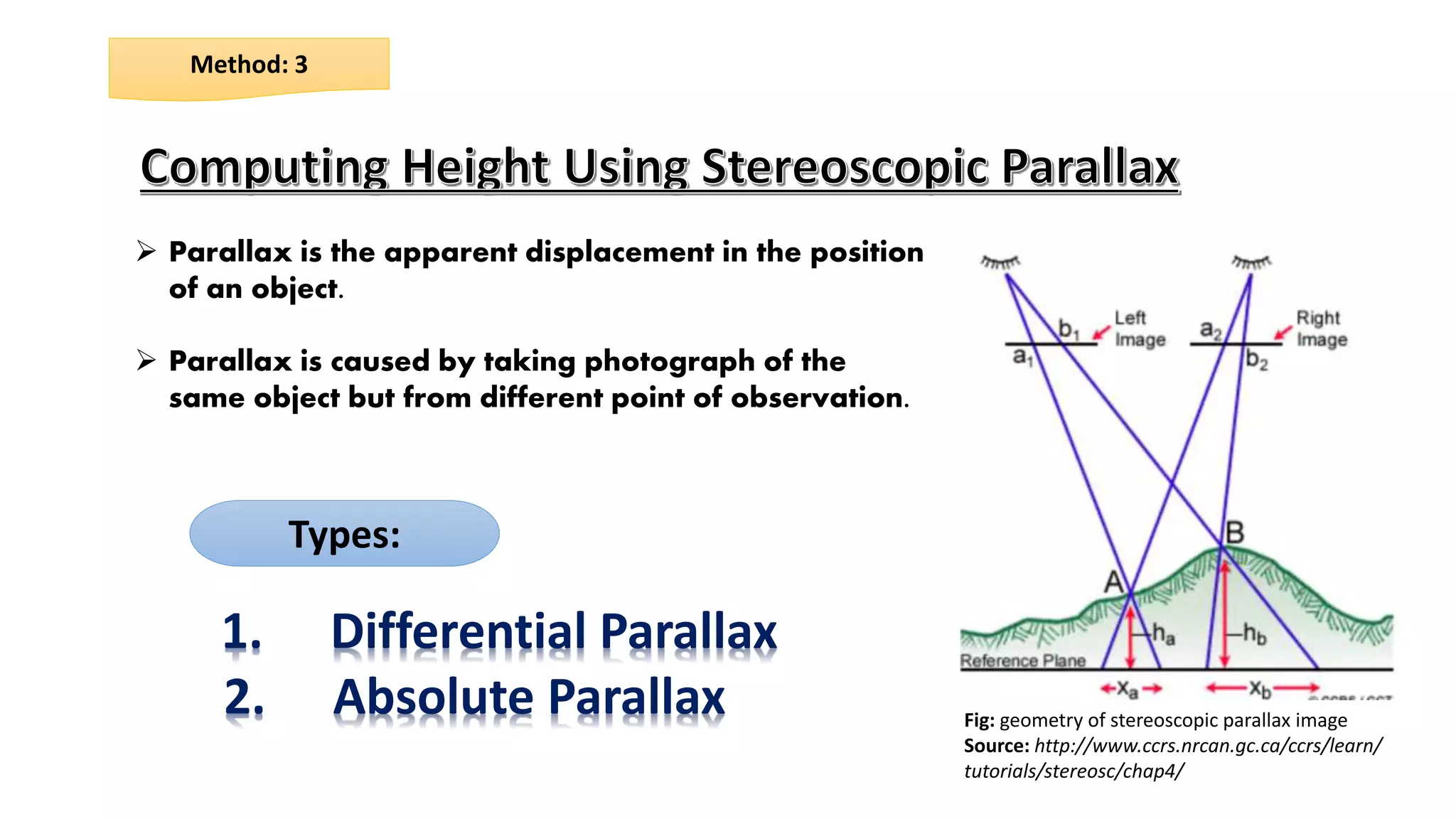
 Parallax is the apparent displacement in the position
of an object.
 Parallax is caused by taking photograph of the
same object but from different point of observation.
Types:
1. Differential Parallax
2. Absolute Parallax Fig: geometry of stereoscopic parallax image
Source: http://www.ccrs.nrcan.gc.ca/ccrs/learn/
tutorials/stereosc/chap4/
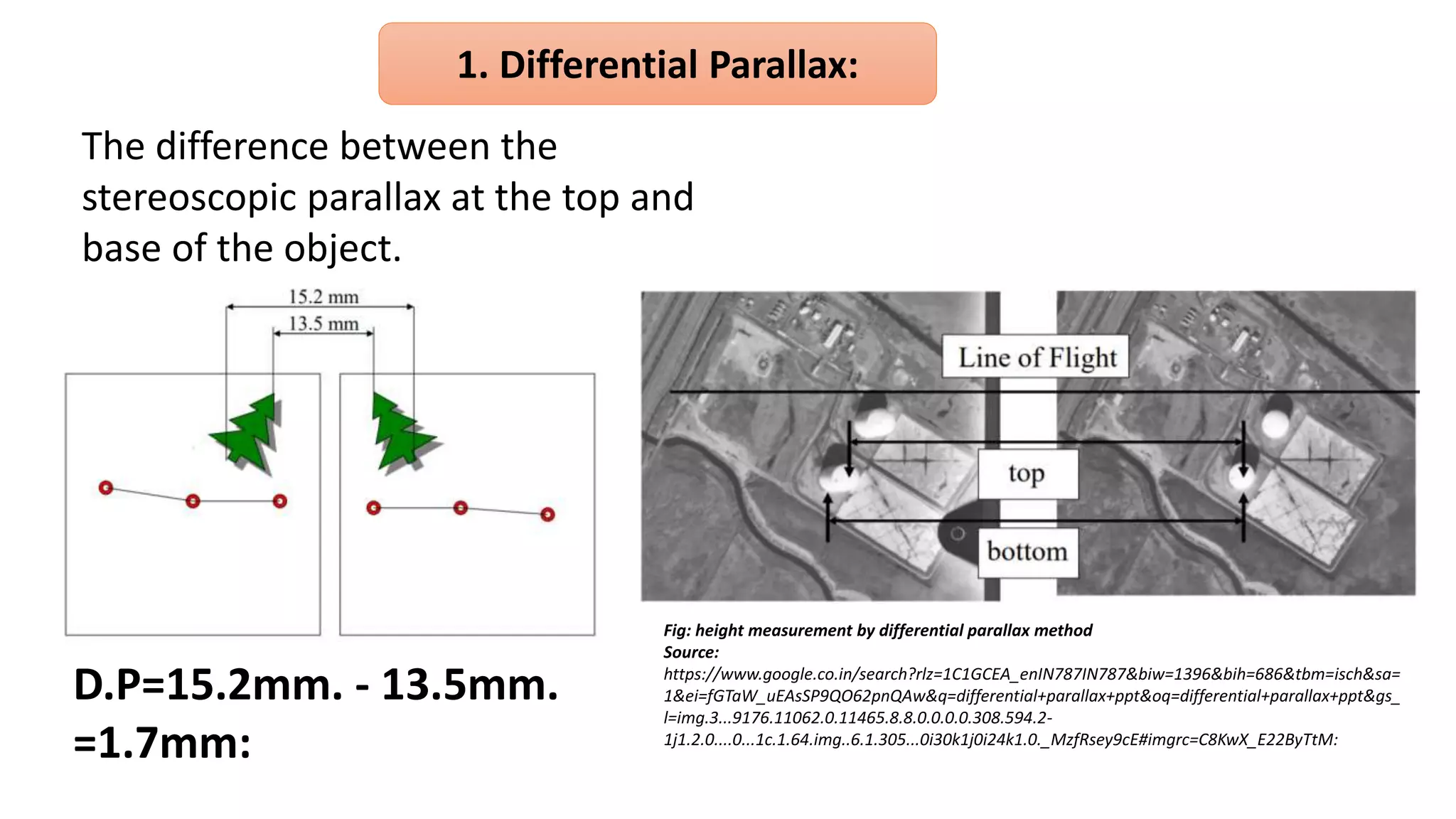
1. Differential Parallax:
The difference between the
stereoscopic parallax at the top and
base of the object.
D.P=15.2mm. - 13.5mm.
=1.7mm:
Fig: height measurement by differential parallax method
Source:
https://www.google.co.in/search?rlz=1C1GCEA_enIN787IN787&biw=1396&bih=686&tbm=isch&sa=
1&ei=fGTaW_uEAsSP9QO62pnQAw&q=differential+parallax+ppt&oq=differential+parallax+ppt&gs_
l=img.3...9176.11062.0.11465.8.8.0.0.0.0.308.594.2-
1j1.2.0....0...1c.1.64.img..6.1.305...0i30k1j0i24k1.0._MzfRsey9cE#imgrc=C8KwX_E22ByTtM:
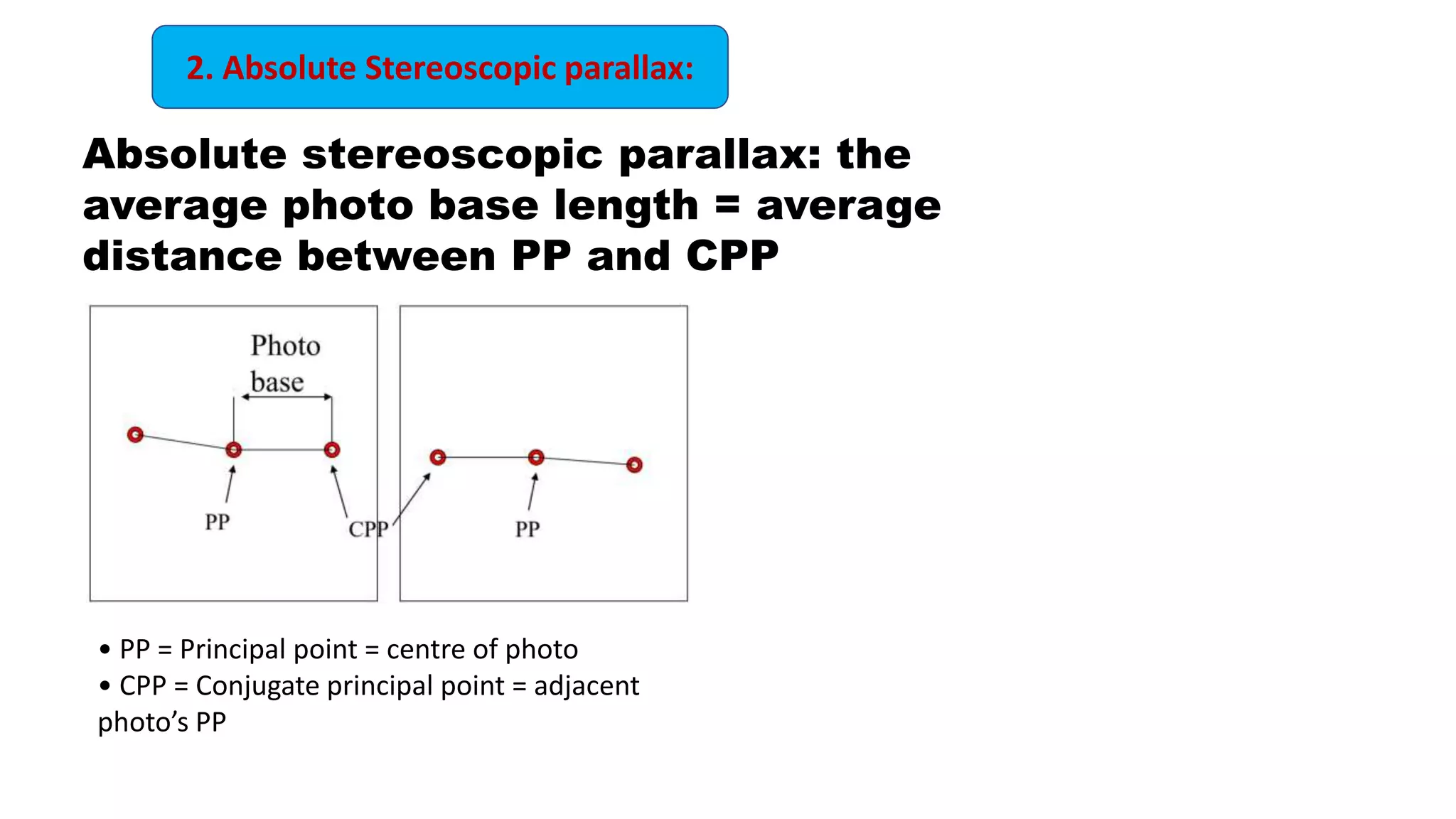
2. Absolute Stereoscopic parallax:
Absolute stereoscopic parallax: the
average photo base length = average
distance between PP and CPP
• PP = Principal point = centre of photo
• CPP = Conjugate principal point = adjacent
photo’s PP
Computing height using stereoscopic parallax
where,
h = object height
H = flying height
dP = differential parallax
b = average photo base length(absolute
parallax)
h = (H) * dP / (b + dP)
Bibliography
 Jensen, john R. (2004).Remote Sensing Of the Environment.2nd ed. Singapore: Pearson,137-178.
 Lillesand, Thomas M. Kiefer, Ralph W. and Chipman,Jonathan W.(2014).Remote Sensing And Image
Interpretation.6th ed.New Delhi:Wiley,123-145.
 Devi,Sunita,Veena.(2014).Measurement of Relief Displacement from Vertical Photograph. International Journal of
Science, Engineering and Technology Research (IJSETR),3(10).
 Linder,Wilfried.(2006).Digital Photogrammetry.2nd ed.Netherlands:Springer,11-28.
Thank You

Height measurement of aerial photography

  • 1.
    HEIGHT MEASUREMENT FROMAERIAL PHOTOGRAPH Presented By: Avijit Ghorai
  • 2.
    1. What isthe Aerial Photo? 2. Geometric Types 3. Vertical Aerial Photograph 4. Geometry and components of vertical photograph 5. Height measurement of Aerial Photograph CONTENT • Height measurement based on Relief Displacement • Height measurement based on Shadow length • Height measurement based on Stereoscopic parallax
  • 3.
    What is AerialPhotography? Aerial photography (or airborne imagery) is the taking of photographs from an aircraft or other flying object. Platforms for aerial photography include fixed- wing aircraft, helicopters, unmanned aerial vehicles (UAVs or "drones"), balloons, rockets, kites, parachutes,
  • 4.
    1. Vertical aerialphotograph: - camera Tilt <3⁰ from the vertical 2. Low oblique Aerial Photograph: -inclined about 30° from the vertical 3. High oblique Aerial Photograph: -camera inclined about 60° from the vertical Fig: geometric types of Aerial photograph Source: https://www.google.co.in/search?q=geometric+types+of+aerial+photograp h&rlz=1C1GCEA_enIN787IN787&source=lnms&tbm=isch&sa=X&ved=0ahU KEwjEuLi_jLLeAhUYWX0KHdAkB7sQ_AUIDigB&biw=1396&bih=686#imgrc= v3kb2wganwsysM:
  • 5.
    Taking Vertical AerialPhotographs Most vertical Aerial photographs are taken with frame cameras along flight lines. The line traced on the ground directly beneath the aircraft during acquisition of photography is called the ‘Nadir line’. This line connects the image centres of the vertical photographs. Fig: photographic coverage along a flight strip: a)condition during exposure, b)resulting photography Each vertical aerial photograph overlaps the next photograph in the flight line by approximately 60%(referred to as stereoscopic overlap). And the sidelap require 20-40%. This overlap is very important because it provides at least two and some times three photographic view of each object in the real world along a flight line.
  • 6.
    Fig: Geometry ofvertical aerial photo Source: Elements of Photogrammetry with application in GIS, 4th edition, 2014 McGraw Hill Fig: components of vertical aerial photo Source: HTTPs://slideplayer.com/slide/7533210/
  • 7.
    Height Measurement ofAerial Photograph Method:1 Displacement is shift in the location of an object in a photo, which does not change the perspective characteristics of the photo.. Source: https://www.google.co.in/search?q=height+measurement+from+relief+displaceme nt&rlz=1C1GCEA_enIN787IN787&source=lnms&tbm=isch&sa=X&ved=0ahUKEwi0uf- D1ZHeAhUXEnIKHWotDnUQ_AUIDigB&biw=1536&bih=754#imgrc=sV3kAkvRVSxKo M:
  • 8.
    Causes of ReliefDisplacement The amount of relief displacement depends upon: A. Height of the Object: When the distance of objects from the nadir point is remain same. But the object height increased or decreased. Higher object is more displaced.
  • 9.
    B. The distanceof the objects from nadir point When the distance of object is more from nadir point, the relief displacement will be more. C. Focal Length When the focal length of camera lens is increased, the relief displacement will be more. On the other hand, when the focal length of camera lens is decreased, the relief displacement will be less.
  • 10.
    D. Flying heightor altitude If the focal length of the camera lens remain constant. When the flying height increased, the relief displacement will be decrease. E. The height of the object in relation to datum plane
  • 11.
    F. Effect ofthe field of view Normal angle of view will result in smaller relief displacement (shift on the photograph of a point because of its relief (height).
  • 12.
    Height Measurement FromRelief Displacement d= Relief Displacement, r= Radial distance from principle point to top or the displaced object/displaced image point, h= object height, H= Flying height above the datum, R= Ground Radial Distance. h/H = d/r Or, d=r*h/H Or, h=d*H/r Source: https://www.google.co.in/search?q=height+measure ment+from+relief+displacement&rlz=1C1GCEA_enIN7 87IN787&source=lnms&tbm=isch&sa=X&sqi=2&ved=0 ahUKEwizx8TBkLLeAhWDXiwKHcMWDc8Q_AUIDigB& biw=1396&bih=686#imgrc=XThIeHbNZi4EoM:
  • 13.
    Method: 2 Source: https://www.google.co.in/search?q=Height+Measurement+Based+on+Shadow+Length+of+aerial +photo&rlz=1C1GCEA_enIN787IN787&tbm=isch&source=lnms&sa=X&ved=0ahUKEwiY- Ozq25HeAhUYFHIKHZifBl0Q_AUICigB&biw=1396&bih=686&dpr=1.38#imgrc=KwADsqxBzEdJtM: Formula: tan e=height(H) / Shadow length(L) Or, H=L*tan e The tower on the nearby parking structure, the shadow length is 20feet and angle(e) is 30⁰. So the height of the object is.. h=L*tan e =20’*tan 30⁰ =11.547feet.
  • 14.
    Method: 3  Parallaxis the apparent displacement in the position of an object.  Parallax is caused by taking photograph of the same object but from different point of observation. Types: 1. Differential Parallax 2. Absolute Parallax Fig: geometry of stereoscopic parallax image Source: http://www.ccrs.nrcan.gc.ca/ccrs/learn/ tutorials/stereosc/chap4/
  • 15.
    1. Differential Parallax: Thedifference between the stereoscopic parallax at the top and base of the object. D.P=15.2mm. - 13.5mm. =1.7mm: Fig: height measurement by differential parallax method Source: https://www.google.co.in/search?rlz=1C1GCEA_enIN787IN787&biw=1396&bih=686&tbm=isch&sa= 1&ei=fGTaW_uEAsSP9QO62pnQAw&q=differential+parallax+ppt&oq=differential+parallax+ppt&gs_ l=img.3...9176.11062.0.11465.8.8.0.0.0.0.308.594.2- 1j1.2.0....0...1c.1.64.img..6.1.305...0i30k1j0i24k1.0._MzfRsey9cE#imgrc=C8KwX_E22ByTtM:
  • 16.
    2. Absolute Stereoscopicparallax: Absolute stereoscopic parallax: the average photo base length = average distance between PP and CPP • PP = Principal point = centre of photo • CPP = Conjugate principal point = adjacent photo’s PP
  • 17.
    Computing height usingstereoscopic parallax where, h = object height H = flying height dP = differential parallax b = average photo base length(absolute parallax) h = (H) * dP / (b + dP)
  • 18.
    Bibliography  Jensen, johnR. (2004).Remote Sensing Of the Environment.2nd ed. Singapore: Pearson,137-178.  Lillesand, Thomas M. Kiefer, Ralph W. and Chipman,Jonathan W.(2014).Remote Sensing And Image Interpretation.6th ed.New Delhi:Wiley,123-145.  Devi,Sunita,Veena.(2014).Measurement of Relief Displacement from Vertical Photograph. International Journal of Science, Engineering and Technology Research (IJSETR),3(10).  Linder,Wilfried.(2006).Digital Photogrammetry.2nd ed.Netherlands:Springer,11-28.
  • 19.