Photogrammetry
Photogrammetry
Introduction
Introduction
►Definition of Photogrammetry:
Definition of Photogrammetry: the art,
the art,
science, and technology of obtaining
information about physical objects and
the environment by photographic and
electromagnetic images.
Basic Information
Basic Information
►Mapping from aerial photos is the best
Mapping from aerial photos is the best
mapping procedure yet developed for
most large projects.
 Used successfully for maps varying in scale
Used successfully for maps varying in scale
from 1:1,000,000 1:120 with contour
intervals as small as 1 foot.
 Topographic mapping is the most common
Topographic mapping is the most common
form. – U.S.G.S updated and done this way.
 Used to reconstruct a scaled 3-dimensional
Used to reconstruct a scaled 3-dimensional
optical model of the lands surface using a
stereoplotter
stereoplotter.
.
Basic Information
Basic Information
►Uses: Aerial photos
Uses: Aerial photos
 Aid: geological investigations, soil surveys,
Aid: geological investigations, soil surveys,
land surveys, tax mapping, reconnaissance
and military intelligence, urban and regional
development, transportation system
investigations, quantity estimates, shore
erosion, etc.
erosion, etc.
 Mathematical methods have been developed
Mathematical methods have been developed
to make precise 3-dimensional
measurements from photos.
►Phototriangulation: 3-dimensional positioning of
Phototriangulation: 3-dimensional positioning of
survey stations.
survey stations.
Basic Information Continued
 Photo has been used to take geometric
Photo has been used to take geometric
measurements of human bodies, artificial
human hearts, large radio telescopes, ships,
dams, buildings and very accurate
reproductions.
reproductions.
►In general it is not economical for small
In general it is not economical for small
projects – the cost break even point is
somewhere between 30 – 100 acres
depending on the situation.
Basic Information
Basic Information
►Photogrammetry cannot be used
Photogrammetry cannot be used
successfully over the following types of
terrain.
terrain.
 Deserts or plains, sandy beaches, and snow –
Deserts or plains, sandy beaches, and snow –
the photograph as uniform shades with little
texture.
texture.
 Deep canyons or high buildings that conceal
Deep canyons or high buildings that conceal
ground surface.
ground surface.
 Areas covered by dense forest.
Areas covered by dense forest.
2 Basic Categories
2 Basic Categories
►Metrical photogrammetry – obtaining
Metrical photogrammetry – obtaining
measurements from photos from which
ground positions, elevations, distances,
areas, and volumes can be computed and
topographic or planimetric maps can be
made.
made.
►Photo interpretation – evaluation of
Photo interpretation – evaluation of
existing features in a qualitative manner.
Types of Photogrammetry
►Aerial – series of photographs of an area
Aerial – series of photographs of an area
of terrain in sequence using a precision
camera.
camera.
►Terrestrial – photos taken from a fixed
Terrestrial – photos taken from a fixed
and usually known position on or near
the ground with the camera axis
horizontal or nearly so.
►Close range – camera close to object
Close range – camera close to object
being observed. Most often used when
direct measurement is impractical.
History
History
► The first use of photogrammetry was by Arago,
The first use of photogrammetry was by Arago,
a French geodesist, in 1840. This included
topographic and terrestrial.
► The first aerial photogrammetry was by the
The first aerial photogrammetry was by the
French in 1849 using kites and balloons.
► Laussedat (French) – father of photogrammetry.
Laussedat (French) – father of photogrammetry.
► 1
1st
st
in N. America – Deville, Surveyor General of
Canada.
Canada.
► U.S.G.S. adopted photogrammetry as mapping
U.S.G.S. adopted photogrammetry as mapping
process in 1894 – mapping border between
Canada and Alaska.
Canada and Alaska.
History
History
►Airplanes brought great change to
Airplanes brought great change to
photogrammetry.
photogrammetry.
 1
1st
st
used in 1913.
used in 1913.
 Used extensively in WWI – photo interpretation.
Used extensively in WWI – photo interpretation.
 Used in WWII – mapping for recon and
Used in WWII – mapping for recon and
intelligence.
intelligence.
►WWII – 1960 – used often, expensive and
WWII – 1960 – used often, expensive and
accuracy problems for engineering design.
►After mid 60’s – advent of computer and
After mid 60’s – advent of computer and
plotting has made photogrammetric
mapping accurate and affordable.
Photogrammetry for
Photogrammetry for
Engineering
Engineering
►Defined: Photogrammetry is the process
Defined: Photogrammetry is the process
of measuring images on a photograph.
►Modern photogrammetry also uses radar
Modern photogrammetry also uses radar
imaging, radiant electromagnetic energy
detection and x-ray imaging – called
remote sensing
remote sensing.
.
Basic Categories of
Basic Categories of
Photogrammetric Interpretation
►Metrical Photogrammetry – obtaining
Metrical Photogrammetry – obtaining
measurements from photos from which
ground positions, elevations, distances,
areas and volumes can be computed and
topographic or planimetric maps can be
made.
made.
►Photo interpretation – evaluation of
Photo interpretation – evaluation of
existing features in a qualitative manner
– timber stands, water pollution, soils,
geological formations, crops, and military
interpretation.
interpretation.
Geometry of Photographs
►Orthographic projection – each point
Orthographic projection – each point
projected normal to reference plane.
►Perspective projection – each point
Perspective projection – each point
projected through a central point, due to
points being at different elevations, they
look 3 dimensional.
look 3 dimensional.
►Principal point (center of photo) – located
Principal point (center of photo) – located
at the intersection of lines joining the
Fiducial points.
Fiducial points.
►To perform computations, one must
To perform computations, one must
know:
know:
 H = height above datum from which photos
H = height above datum from which photos
taken.
taken.
 f = focal length of camera lens – either in
f = focal length of camera lens – either in
inches or mm.
inches or mm.
►Items on photo:
Items on photo:
 Fiducial points
Fiducial points
 Date
Date
 Roll and Photo #
Roll and Photo #
Scale of a Vertical Photo
► S = or
S = or
► f = focal length 6” or 152.4 mm is common
f = focal length 6” or 152.4 mm is common
► H’ = height of plane above ground
H’ = height of plane above ground
► h = height (elevation) of ground
h = height (elevation) of ground
► H = height of place above datum [altimeter
H = height of place above datum [altimeter
reading (2% error)]
reading (2% error)]
f
f
H
H
’
’
f
f
H-
H-
h
h
Scale of a Vertical Photo
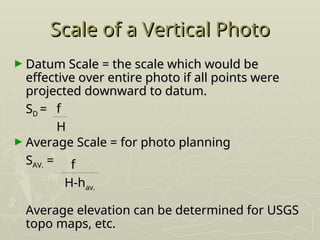
► Datum Scale = the scale which would be
Datum Scale = the scale which would be
effective over entire photo if all points were
projected downward to datum.
S
SD
D =
=
► Average Scale = for photo planning
Average Scale = for photo planning
S
SAV.
AV. =
=
Average elevation can be determined for USGS
topo maps, etc.
topo maps, etc.
f
f
H
H
f
f
H-h
H-hav.
av.
Relief Displacement
Relief Displacement
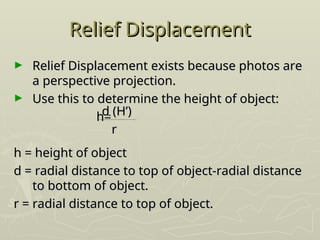
► Relief Displacement exists because photos are
Relief Displacement exists because photos are
a perspective projection.
► Use this to determine the height of object:
Use this to determine the height of object:
h=
h=
h = height of object
d = radial distance to top of object-radial distance
to bottom of object.
r = radial distance to top of object.
d (H’)
d (H’)
r
r
Planning and Executing Photo
Project
Project
► Basic Overall Process:
Basic Overall Process:
1.
1. Photography – obtain suitable photos.
Photography – obtain suitable photos.
2.
2. Control – obtain sufficient control through field
Control – obtain sufficient control through field
surveys and/or extension by photographic
methods.
methods.
3.
3. Map Compilation – plotting of planimetric
Map Compilation – plotting of planimetric
and/or topographic features.
4.
4. Map Completion – map editing and special field
Map Completion – map editing and special field
surveys.
surveys.
5.
5. Final Map Drafting
Final Map Drafting
Elements of Planning
1.
1. Conversion of requirements to project
Conversion of requirements to project
specs.
specs.
 Factors:
Factors:
1.
1. Purpose of photogrammetry
Purpose of photogrammetry
a)
a) Majority of projects for engineering involves making
Majority of projects for engineering involves making
topographic map in a stereoscopic plotting unit.
 Wide angle photography (152mm focal length) is required
Wide angle photography (152mm focal length) is required
for topographic mapping because it provides better vertical
accuracy.
accuracy.
 If area is heavily wooded, use f=210mm (standard angle)
If area is heavily wooded, use f=210mm (standard angle)
to allow more visibility through trees.
 Generally 60% overlap with 15-30% sidelap.
Generally 60% overlap with 15-30% sidelap.
 Orientation of flightlines is dictated more by economy than
Orientation of flightlines is dictated more by economy than
geometric considerations.
Elements of Planning
b)
b) Photos for mosaics should be flown as high as
Photos for mosaics should be flown as high as
possible.
possible.
 Reduces relief displacement.
Reduces relief displacement.
c)
c) Orthophotos – similar to topo maps, however,
Orthophotos – similar to topo maps, however,
should be taken normal to ground topo.
2.
2. Photo Scale: somewhat dependent on type of
Photo Scale: somewhat dependent on type of
plotter.
plotter.
 Essentially can be dependent on type of plotter you
Essentially can be dependent on type of plotter you
need to see and dividing it by the resolving power of
the photo equipment.
 Also affected by map accuracy and area
Also affected by map accuracy and area
configuration.
configuration.
Elements of Planning
3.
3. Allowed scale variation.
Allowed scale variation.
 Variation caused by difference in ground elevation and
Variation caused by difference in ground elevation and
flying height.
flying height.
 Longer focal length reduces scale variation.
Longer focal length reduces scale variation.
 If flying height remains constant and ground elevation
If flying height remains constant and ground elevation
increases the area covered by photo becomes less.
 Overlap becomes less
Overlap becomes less
 Viewfinder needed to control overlap and flightline spacing,
Viewfinder needed to control overlap and flightline spacing,
thus eliminating possible gaps.
4.
4. Relief displacement
Relief displacement
 Affects mosaics most.
Affects mosaics most.
 Large amount of relief displacement will make it difficult to
Large amount of relief displacement will make it difficult to
form continuous picture desired in mosaics.
Elements of Planning
 Relief displacement decreases as flying height
Relief displacement decreases as flying height
increases, the focal length must also be increased.
 Relief displacement has no adverse affect on map
Relief displacement has no adverse affect on map
making with stereo.
making with stereo.
 With greater relief displacement, elevations can be
With greater relief displacement, elevations can be
measured and plotted more accurately.
5.
5. Tilt
Tilt
 Amount in direction of flight (y tilt).
Amount in direction of flight (y tilt).
 Will cause overlap to be greater on one end than other.
Will cause overlap to be greater on one end than other.
 Amount normal direction of flight (x tilt).
Amount normal direction of flight (x tilt).
 Will increase sidelap on one side and decrease on other.
Will increase sidelap on one side and decrease on other.
 Y tilt corrected by viewfinder.
Y tilt corrected by viewfinder.
 X tilt corrected by increasing planned sidelap.
X tilt corrected by increasing planned sidelap.
Elements of Planning
6.
6. Crab and Drift
Crab and Drift
 Crab – angle formed between flightline and edges of
Crab – angle formed between flightline and edges of
photo in direction of flight and caused by not having
focal plane square with direction of flight at time of
exposure.
exposure.
 Corrected by rotation of camera on vertical axis through
Corrected by rotation of camera on vertical axis through
viewfinder.
viewfinder.
 Reduces coverage, but sidelap compensates.
Reduces coverage, but sidelap compensates.
 Drift – plane not staying on flightline.
Drift – plane not staying on flightline.
 Most common cause of re-flights and gaps.
Most common cause of re-flights and gaps.
Elements of Planning
7.
7. Flying height: determined after sidelap and
Flying height: determined after sidelap and
overlap determined.
overlap determined.
 Factors affecting:
Factors affecting:
1.
1. Desired scale, relief displacement, and tilt.
Desired scale, relief displacement, and tilt.
2.
2. Precision of equipment used.
Precision of equipment used.
 Greater precision, greater possible flying height.
Greater precision, greater possible flying height.
 By doubling flying height, ground coverage increased
By doubling flying height, ground coverage increased
4 times, thus less ground control and fewer photos.
 Vertical accuracy most important in topographic
Vertical accuracy most important in topographic
mapping.
mapping.
1.
1. Flying height is related to contour interval desired.
Flying height is related to contour interval desired.
 Relationship called C-factor (precision factor)
Relationship called C-factor (precision factor)
 Flying height = desired contour interval x C-factor
Flying height = desired contour interval x C-factor
 C-factor is the value used to compute flying height which
C-factor is the value used to compute flying height which
will produce photos satisfactory to obtain the desired
vertical accuracy of the maps.
Elements of Planning
8.
8. Direction or orientation of terrain
Direction or orientation of terrain
 Arrange to fly along ridges, not across.
Arrange to fly along ridges, not across.
2.
2. Gathering material and people.
Gathering material and people.
1.
1. Existing photos, maps, survey data,
Existing photos, maps, survey data,
instruments and personnel.
3.
3. Determine specifications and conditions
Determine specifications and conditions
for operation.
for operation.
4.
4. Preparing final plans.
Preparing final plans.
1.
1. Scheduling
Scheduling
2.
2. Surveying instructions
Surveying instructions
5.
5. Cost estimating and replanning.
Cost estimating and replanning.
Flight Design
Flight Design
A.
A. Considerations
Considerations
1.
1. Project boundaries
Project boundaries
2.
2. Existing and planned control
Existing and planned control
3.
3. Time schedule
Time schedule
4.
4. Final product needed
Final product needed
5.
5. Optimum flying season
Optimum flying season
6.
6. Found cover conditions
Found cover conditions
B.
B. Objectives
Objectives
1.
1. Determine optimum conditions for spacing of photos
Determine optimum conditions for spacing of photos
along flightlines.
along flightlines.
2.
2. Number and spacing of fligtlines to cover area.
Number and spacing of fligtlines to cover area.
3.
3. Plan must account for allowable deviations.
Plan must account for allowable deviations.
4.
4. Distance between flightlines on fllightway.
Distance between flightlines on fllightway.
Flight Design
Flight Design
C.
C. Flight Patterns
Flight Patterns
1.
1. Totally dependent on overlap and sidelap.
Totally dependent on overlap and sidelap.
 Under ideal conditions with 9”x 9” photo with 6” focal
Under ideal conditions with 9”x 9” photo with 6” focal
length, and overlap of 57%, and sidelap of 13% will
provide maximum stereo coverage with no gaps.
 If additional safety factor desired, overlap can be increased
If additional safety factor desired, overlap can be increased
to 70-75% and sidelap can be increased to 50%.
Computation of Flight Plan
► Data required to compute flight map lines, time
Data required to compute flight map lines, time
interval between exposures, and amount of film
needed.
needed.
1.
1. Focal length of camera.
Focal length of camera.
2.
2. Flying height above datum or photo scale for certain
Flying height above datum or photo scale for certain
elevation.
elevation.
3.
3. Size of photo.
Size of photo.
4.
4. Size of area to be photographed.
Size of area to be photographed.
5.
5. Positions of outer flight lines with respect to boundary.
Positions of outer flight lines with respect to boundary.
6.
6. Overlap.
Overlap.
7.
7. Sidelap.
Sidelap.
8.
8. Scale of flight map.
Scale of flight map.
9.
9. Ground speed of aircraft.
Ground speed of aircraft.
Example
Example
Area – 15 miles N-S & 8.5 miles E-W
Photos – 9” x 9”
Photos – 9” x 9”
Save tobe 1:12000 @ 700’ above elevation
Overlap – 60%
Overlap – 60%
Sidelap – 35%
Sidelap – 35%
Ground speed of plane – 150 mph
Flight lines to be laid out N-S on a map @ a
scale of 1:62500
scale of 1:62500
Outer flight lines coincide with E & W
boundary
boundary
1.
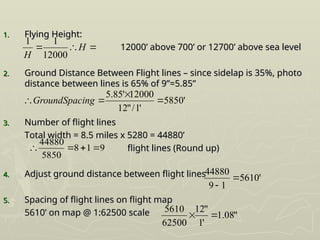
1. Flying Height:
Flying Height:
12000’ above 700’ or 12700’ above sea level
2.
2. Ground Distance Between Flight lines – since sidelap is 35%, photo
Ground Distance Between Flight lines – since sidelap is 35%, photo
distance between lines is 65% of 9”=5.85”
3.
3. Number of flight lines
Number of flight lines
Total width = 8.5 miles x 5280 = 44880’
flight lines (Round up)
4.
4. Adjust ground distance between flight lines
Adjust ground distance between flight lines
5.
5. Spacing of flight lines on flight map
Spacing of flight lines on flight map
5610’ on map @ 1:62500 scale
'
5850
'
1
/
"
12
12000
'
85
.
5



 ing
GroundSpac


 H
H 12000
1
1
9
1
8
5850
44880




'
5610
1
9
44880


"
08
.
1
'
1
"
12
62500
5610


6.
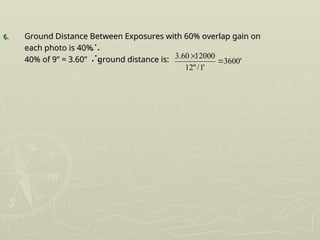
6. Ground Distance Between Exposures with 60% overlap gain on
Ground Distance Between Exposures with 60% overlap gain on
each photo is 40%
each photo is 40%
40% of 9” = 3.60” ground distance is:

 '
3600
'
1
/
"
12
12000
60
.
3



Aerial photogrammetry-basic concepts and primer.ppt

  • 1.
  • 2.
    Introduction Introduction ►Definition of Photogrammetry: Definitionof Photogrammetry: the art, the art, science, and technology of obtaining science, and technology of obtaining information about physical objects and information about physical objects and the environment by photographic and the environment by photographic and electromagnetic images. electromagnetic images.
  • 3.
    Basic Information Basic Information ►Mappingfrom aerial photos is the best Mapping from aerial photos is the best mapping procedure yet developed for mapping procedure yet developed for most large projects. most large projects.  Used successfully for maps varying in scale Used successfully for maps varying in scale from 1:1,000,000 1:120 with contour from 1:1,000,000 1:120 with contour intervals as small as 1 foot. intervals as small as 1 foot.  Topographic mapping is the most common Topographic mapping is the most common form. – U.S.G.S updated and done this way. form. – U.S.G.S updated and done this way.  Used to reconstruct a scaled 3-dimensional Used to reconstruct a scaled 3-dimensional optical model of the lands surface using a optical model of the lands surface using a stereoplotter stereoplotter. .
  • 4.
    Basic Information Basic Information ►Uses:Aerial photos Uses: Aerial photos  Aid: geological investigations, soil surveys, Aid: geological investigations, soil surveys, land surveys, tax mapping, reconnaissance land surveys, tax mapping, reconnaissance and military intelligence, urban and regional and military intelligence, urban and regional development, transportation system development, transportation system investigations, quantity estimates, shore investigations, quantity estimates, shore erosion, etc. erosion, etc.  Mathematical methods have been developed Mathematical methods have been developed to make precise 3-dimensional to make precise 3-dimensional measurements from photos. measurements from photos. ►Phototriangulation: 3-dimensional positioning of Phototriangulation: 3-dimensional positioning of survey stations. survey stations.
  • 5.
    Basic Information Continued BasicInformation Continued  Photo has been used to take geometric Photo has been used to take geometric measurements of human bodies, artificial measurements of human bodies, artificial human hearts, large radio telescopes, ships, human hearts, large radio telescopes, ships, dams, buildings and very accurate dams, buildings and very accurate reproductions. reproductions. ►In general it is not economical for small In general it is not economical for small projects – the cost break even point is projects – the cost break even point is somewhere between 30 – 100 acres somewhere between 30 – 100 acres depending on the situation. depending on the situation.
  • 6.
    Basic Information Basic Information ►Photogrammetrycannot be used Photogrammetry cannot be used successfully over the following types of successfully over the following types of terrain. terrain.  Deserts or plains, sandy beaches, and snow – Deserts or plains, sandy beaches, and snow – the photograph as uniform shades with little the photograph as uniform shades with little texture. texture.  Deep canyons or high buildings that conceal Deep canyons or high buildings that conceal ground surface. ground surface.  Areas covered by dense forest. Areas covered by dense forest.
  • 7.
    2 Basic Categories 2Basic Categories ►Metrical photogrammetry – obtaining Metrical photogrammetry – obtaining measurements from photos from which measurements from photos from which ground positions, elevations, distances, ground positions, elevations, distances, areas, and volumes can be computed and areas, and volumes can be computed and topographic or planimetric maps can be topographic or planimetric maps can be made. made. ►Photo interpretation – evaluation of Photo interpretation – evaluation of existing features in a qualitative manner. existing features in a qualitative manner.
  • 8.
    Types of Photogrammetry Typesof Photogrammetry ►Aerial – series of photographs of an area Aerial – series of photographs of an area of terrain in sequence using a precision of terrain in sequence using a precision camera. camera. ►Terrestrial – photos taken from a fixed Terrestrial – photos taken from a fixed and usually known position on or near and usually known position on or near the ground with the camera axis the ground with the camera axis horizontal or nearly so. horizontal or nearly so. ►Close range – camera close to object Close range – camera close to object being observed. Most often used when being observed. Most often used when direct measurement is impractical. direct measurement is impractical.
  • 9.
    History History ► The firstuse of photogrammetry was by Arago, The first use of photogrammetry was by Arago, a French geodesist, in 1840. This included a French geodesist, in 1840. This included topographic and terrestrial. topographic and terrestrial. ► The first aerial photogrammetry was by the The first aerial photogrammetry was by the French in 1849 using kites and balloons. French in 1849 using kites and balloons. ► Laussedat (French) – father of photogrammetry. Laussedat (French) – father of photogrammetry. ► 1 1st st in N. America – Deville, Surveyor General of in N. America – Deville, Surveyor General of Canada. Canada. ► U.S.G.S. adopted photogrammetry as mapping U.S.G.S. adopted photogrammetry as mapping process in 1894 – mapping border between process in 1894 – mapping border between Canada and Alaska. Canada and Alaska.
  • 10.
    History History ►Airplanes brought greatchange to Airplanes brought great change to photogrammetry. photogrammetry.  1 1st st used in 1913. used in 1913.  Used extensively in WWI – photo interpretation. Used extensively in WWI – photo interpretation.  Used in WWII – mapping for recon and Used in WWII – mapping for recon and intelligence. intelligence. ►WWII – 1960 – used often, expensive and WWII – 1960 – used often, expensive and accuracy problems for engineering design. accuracy problems for engineering design. ►After mid 60’s – advent of computer and After mid 60’s – advent of computer and plotting has made photogrammetric plotting has made photogrammetric mapping accurate and affordable. mapping accurate and affordable.
  • 11.
    Photogrammetry for Photogrammetry for Engineering Engineering ►Defined:Photogrammetry is the process Defined: Photogrammetry is the process of measuring images on a photograph. of measuring images on a photograph. ►Modern photogrammetry also uses radar Modern photogrammetry also uses radar imaging, radiant electromagnetic energy imaging, radiant electromagnetic energy detection and x-ray imaging – called detection and x-ray imaging – called remote sensing remote sensing. .
  • 12.
    Basic Categories of BasicCategories of Photogrammetric Interpretation Photogrammetric Interpretation ►Metrical Photogrammetry – obtaining Metrical Photogrammetry – obtaining measurements from photos from which measurements from photos from which ground positions, elevations, distances, ground positions, elevations, distances, areas and volumes can be computed and areas and volumes can be computed and topographic or planimetric maps can be topographic or planimetric maps can be made. made. ►Photo interpretation – evaluation of Photo interpretation – evaluation of existing features in a qualitative manner existing features in a qualitative manner – timber stands, water pollution, soils, – timber stands, water pollution, soils, geological formations, crops, and military geological formations, crops, and military interpretation. interpretation.
  • 13.
    Geometry of Photographs Geometryof Photographs ►Orthographic projection – each point Orthographic projection – each point projected normal to reference plane. projected normal to reference plane. ►Perspective projection – each point Perspective projection – each point projected through a central point, due to projected through a central point, due to points being at different elevations, they points being at different elevations, they look 3 dimensional. look 3 dimensional. ►Principal point (center of photo) – located Principal point (center of photo) – located at the intersection of lines joining the at the intersection of lines joining the Fiducial points. Fiducial points.
  • 14.
    ►To perform computations,one must To perform computations, one must know: know:  H = height above datum from which photos H = height above datum from which photos taken. taken.  f = focal length of camera lens – either in f = focal length of camera lens – either in inches or mm. inches or mm. ►Items on photo: Items on photo:  Fiducial points Fiducial points  Date Date  Roll and Photo # Roll and Photo #
  • 15.
    Scale of aVertical Photo Scale of a Vertical Photo ► S = or S = or ► f = focal length 6” or 152.4 mm is common f = focal length 6” or 152.4 mm is common ► H’ = height of plane above ground H’ = height of plane above ground ► h = height (elevation) of ground h = height (elevation) of ground ► H = height of place above datum [altimeter H = height of place above datum [altimeter reading (2% error)] reading (2% error)] f f H H ’ ’ f f H- H- h h
  • 16.
    Scale of aVertical Photo Scale of a Vertical Photo ► Datum Scale = the scale which would be Datum Scale = the scale which would be effective over entire photo if all points were effective over entire photo if all points were projected downward to datum. projected downward to datum. S SD D = = ► Average Scale = for photo planning Average Scale = for photo planning S SAV. AV. = = Average elevation can be determined for USGS Average elevation can be determined for USGS topo maps, etc. topo maps, etc. f f H H f f H-h H-hav. av.
  • 17.
    Relief Displacement Relief Displacement ►Relief Displacement exists because photos are Relief Displacement exists because photos are a perspective projection. a perspective projection. ► Use this to determine the height of object: Use this to determine the height of object: h= h= h = height of object h = height of object d = radial distance to top of object-radial distance d = radial distance to top of object-radial distance to bottom of object. to bottom of object. r = radial distance to top of object. r = radial distance to top of object. d (H’) d (H’) r r
  • 18.
    Planning and ExecutingPhoto Planning and Executing Photo Project Project ► Basic Overall Process: Basic Overall Process: 1. 1. Photography – obtain suitable photos. Photography – obtain suitable photos. 2. 2. Control – obtain sufficient control through field Control – obtain sufficient control through field surveys and/or extension by photographic surveys and/or extension by photographic methods. methods. 3. 3. Map Compilation – plotting of planimetric Map Compilation – plotting of planimetric and/or topographic features. and/or topographic features. 4. 4. Map Completion – map editing and special field Map Completion – map editing and special field surveys. surveys. 5. 5. Final Map Drafting Final Map Drafting
  • 19.
    Elements of Planning Elementsof Planning 1. 1. Conversion of requirements to project Conversion of requirements to project specs. specs.  Factors: Factors: 1. 1. Purpose of photogrammetry Purpose of photogrammetry a) a) Majority of projects for engineering involves making Majority of projects for engineering involves making topographic map in a stereoscopic plotting unit. topographic map in a stereoscopic plotting unit.  Wide angle photography (152mm focal length) is required Wide angle photography (152mm focal length) is required for topographic mapping because it provides better vertical for topographic mapping because it provides better vertical accuracy. accuracy.  If area is heavily wooded, use f=210mm (standard angle) If area is heavily wooded, use f=210mm (standard angle) to allow more visibility through trees. to allow more visibility through trees.  Generally 60% overlap with 15-30% sidelap. Generally 60% overlap with 15-30% sidelap.  Orientation of flightlines is dictated more by economy than Orientation of flightlines is dictated more by economy than geometric considerations. geometric considerations.
  • 20.
    Elements of Planning Elementsof Planning b) b) Photos for mosaics should be flown as high as Photos for mosaics should be flown as high as possible. possible.  Reduces relief displacement. Reduces relief displacement. c) c) Orthophotos – similar to topo maps, however, Orthophotos – similar to topo maps, however, should be taken normal to ground topo. should be taken normal to ground topo. 2. 2. Photo Scale: somewhat dependent on type of Photo Scale: somewhat dependent on type of plotter. plotter.  Essentially can be dependent on type of plotter you Essentially can be dependent on type of plotter you need to see and dividing it by the resolving power of need to see and dividing it by the resolving power of the photo equipment. the photo equipment.  Also affected by map accuracy and area Also affected by map accuracy and area configuration. configuration.
  • 21.
    Elements of Planning Elementsof Planning 3. 3. Allowed scale variation. Allowed scale variation.  Variation caused by difference in ground elevation and Variation caused by difference in ground elevation and flying height. flying height.  Longer focal length reduces scale variation. Longer focal length reduces scale variation.  If flying height remains constant and ground elevation If flying height remains constant and ground elevation increases the area covered by photo becomes less. increases the area covered by photo becomes less.  Overlap becomes less Overlap becomes less  Viewfinder needed to control overlap and flightline spacing, Viewfinder needed to control overlap and flightline spacing, thus eliminating possible gaps. thus eliminating possible gaps. 4. 4. Relief displacement Relief displacement  Affects mosaics most. Affects mosaics most.  Large amount of relief displacement will make it difficult to Large amount of relief displacement will make it difficult to form continuous picture desired in mosaics. form continuous picture desired in mosaics.
  • 22.
    Elements of Planning Elementsof Planning  Relief displacement decreases as flying height Relief displacement decreases as flying height increases, the focal length must also be increased. increases, the focal length must also be increased.  Relief displacement has no adverse affect on map Relief displacement has no adverse affect on map making with stereo. making with stereo.  With greater relief displacement, elevations can be With greater relief displacement, elevations can be measured and plotted more accurately. measured and plotted more accurately. 5. 5. Tilt Tilt  Amount in direction of flight (y tilt). Amount in direction of flight (y tilt).  Will cause overlap to be greater on one end than other. Will cause overlap to be greater on one end than other.  Amount normal direction of flight (x tilt). Amount normal direction of flight (x tilt).  Will increase sidelap on one side and decrease on other. Will increase sidelap on one side and decrease on other.  Y tilt corrected by viewfinder. Y tilt corrected by viewfinder.  X tilt corrected by increasing planned sidelap. X tilt corrected by increasing planned sidelap.
  • 23.
    Elements of Planning Elementsof Planning 6. 6. Crab and Drift Crab and Drift  Crab – angle formed between flightline and edges of Crab – angle formed between flightline and edges of photo in direction of flight and caused by not having photo in direction of flight and caused by not having focal plane square with direction of flight at time of focal plane square with direction of flight at time of exposure. exposure.  Corrected by rotation of camera on vertical axis through Corrected by rotation of camera on vertical axis through viewfinder. viewfinder.  Reduces coverage, but sidelap compensates. Reduces coverage, but sidelap compensates.  Drift – plane not staying on flightline. Drift – plane not staying on flightline.  Most common cause of re-flights and gaps. Most common cause of re-flights and gaps.
  • 24.
    Elements of Planning Elementsof Planning 7. 7. Flying height: determined after sidelap and Flying height: determined after sidelap and overlap determined. overlap determined.  Factors affecting: Factors affecting: 1. 1. Desired scale, relief displacement, and tilt. Desired scale, relief displacement, and tilt. 2. 2. Precision of equipment used. Precision of equipment used.  Greater precision, greater possible flying height. Greater precision, greater possible flying height.  By doubling flying height, ground coverage increased By doubling flying height, ground coverage increased 4 times, thus less ground control and fewer photos. 4 times, thus less ground control and fewer photos.  Vertical accuracy most important in topographic Vertical accuracy most important in topographic mapping. mapping. 1. 1. Flying height is related to contour interval desired. Flying height is related to contour interval desired.  Relationship called C-factor (precision factor) Relationship called C-factor (precision factor)  Flying height = desired contour interval x C-factor Flying height = desired contour interval x C-factor  C-factor is the value used to compute flying height which C-factor is the value used to compute flying height which will produce photos satisfactory to obtain the desired will produce photos satisfactory to obtain the desired vertical accuracy of the maps. vertical accuracy of the maps.
  • 25.
    Elements of Planning Elementsof Planning 8. 8. Direction or orientation of terrain Direction or orientation of terrain  Arrange to fly along ridges, not across. Arrange to fly along ridges, not across. 2. 2. Gathering material and people. Gathering material and people. 1. 1. Existing photos, maps, survey data, Existing photos, maps, survey data, instruments and personnel. instruments and personnel. 3. 3. Determine specifications and conditions Determine specifications and conditions for operation. for operation. 4. 4. Preparing final plans. Preparing final plans. 1. 1. Scheduling Scheduling 2. 2. Surveying instructions Surveying instructions 5. 5. Cost estimating and replanning. Cost estimating and replanning.
  • 26.
    Flight Design Flight Design A. A.Considerations Considerations 1. 1. Project boundaries Project boundaries 2. 2. Existing and planned control Existing and planned control 3. 3. Time schedule Time schedule 4. 4. Final product needed Final product needed 5. 5. Optimum flying season Optimum flying season 6. 6. Found cover conditions Found cover conditions B. B. Objectives Objectives 1. 1. Determine optimum conditions for spacing of photos Determine optimum conditions for spacing of photos along flightlines. along flightlines. 2. 2. Number and spacing of fligtlines to cover area. Number and spacing of fligtlines to cover area. 3. 3. Plan must account for allowable deviations. Plan must account for allowable deviations. 4. 4. Distance between flightlines on fllightway. Distance between flightlines on fllightway.
  • 27.
    Flight Design Flight Design C. C.Flight Patterns Flight Patterns 1. 1. Totally dependent on overlap and sidelap. Totally dependent on overlap and sidelap.  Under ideal conditions with 9”x 9” photo with 6” focal Under ideal conditions with 9”x 9” photo with 6” focal length, and overlap of 57%, and sidelap of 13% will length, and overlap of 57%, and sidelap of 13% will provide maximum stereo coverage with no gaps. provide maximum stereo coverage with no gaps.  If additional safety factor desired, overlap can be increased If additional safety factor desired, overlap can be increased to 70-75% and sidelap can be increased to 50%. to 70-75% and sidelap can be increased to 50%.
  • 28.
    Computation of FlightPlan Computation of Flight Plan ► Data required to compute flight map lines, time Data required to compute flight map lines, time interval between exposures, and amount of film interval between exposures, and amount of film needed. needed. 1. 1. Focal length of camera. Focal length of camera. 2. 2. Flying height above datum or photo scale for certain Flying height above datum or photo scale for certain elevation. elevation. 3. 3. Size of photo. Size of photo. 4. 4. Size of area to be photographed. Size of area to be photographed. 5. 5. Positions of outer flight lines with respect to boundary. Positions of outer flight lines with respect to boundary. 6. 6. Overlap. Overlap. 7. 7. Sidelap. Sidelap. 8. 8. Scale of flight map. Scale of flight map. 9. 9. Ground speed of aircraft. Ground speed of aircraft.
  • 29.
    Example Example Area – 15miles N-S & 8.5 miles E-W Area – 15 miles N-S & 8.5 miles E-W Photos – 9” x 9” Photos – 9” x 9” Save tobe 1:12000 @ 700’ above elevation Save tobe 1:12000 @ 700’ above elevation Overlap – 60% Overlap – 60% Sidelap – 35% Sidelap – 35% Ground speed of plane – 150 mph Ground speed of plane – 150 mph Flight lines to be laid out N-S on a map @ a Flight lines to be laid out N-S on a map @ a scale of 1:62500 scale of 1:62500 Outer flight lines coincide with E & W Outer flight lines coincide with E & W boundary boundary
  • 30.
    1. 1. Flying Height: FlyingHeight: 12000’ above 700’ or 12700’ above sea level 12000’ above 700’ or 12700’ above sea level 2. 2. Ground Distance Between Flight lines – since sidelap is 35%, photo Ground Distance Between Flight lines – since sidelap is 35%, photo distance between lines is 65% of 9”=5.85” distance between lines is 65% of 9”=5.85” 3. 3. Number of flight lines Number of flight lines Total width = 8.5 miles x 5280 = 44880’ Total width = 8.5 miles x 5280 = 44880’ flight lines (Round up) flight lines (Round up) 4. 4. Adjust ground distance between flight lines Adjust ground distance between flight lines 5. 5. Spacing of flight lines on flight map Spacing of flight lines on flight map 5610’ on map @ 1:62500 scale 5610’ on map @ 1:62500 scale ' 5850 ' 1 / " 12 12000 ' 85 . 5     ing GroundSpac    H H 12000 1 1 9 1 8 5850 44880     ' 5610 1 9 44880   " 08 . 1 ' 1 " 12 62500 5610  
  • 31.
    6. 6. Ground DistanceBetween Exposures with 60% overlap gain on Ground Distance Between Exposures with 60% overlap gain on each photo is 40% each photo is 40% 40% of 9” = 3.60” ground distance is: 40% of 9” = 3.60” ground distance is:   ' 3600 ' 1 / " 12 12000 60 . 3  