UTD
Session – 2019
Presentation topic on : USES OF VARIOUS PHOTOGRAMMETRY
What is Photogrammetry?
The classical definition of Photogrammetry is the process of deriving
metric information about an object through measurement made on the
photograph of the object. Photogrammetry is the science of making
measurements from photographs. Photogrammetry means the measuring
of features on a photograph.
This is concerned about metric or measurement aspect of the process. In
addition to this photo interpretation aspect is also involved while the
technology is used for mapping where feature collection is required.
Photogrammetry describes from three words:
‘photo’ – light
‘gram’ – drawing
‘metry’ – measurement
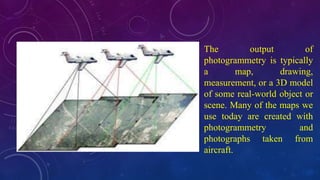
The output of
photogrammetry is typically
a map, drawing,
measurement, or a 3D model
of some real-world object or
scene. Many of the maps we
use today are created with
photogrammetry and
photographs taken from
aircraft.
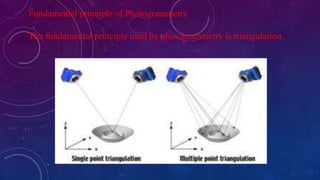
Fundamental principle of Photogrammetry
The fundamental principle used by photogrammetry is triangulation.
Branch of Photogrammetry
Photogrammetry can be classified based on camera location during photography. On
this basis we have
1. Aerial Photogrammetry
2. Terrestial Photogrammetry
3. Space Photogrammetry
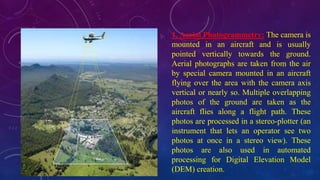
1. Aerial Photogrammetry: The camera is
mounted in an aircraft and is usually
pointed vertically towards the ground.
Aerial photographs are taken from the air
by special camera mounted in an aircraft
flying over the area with the camera axis
vertical or nearly so. Multiple overlapping
photos of the ground are taken as the
aircraft flies along a flight path. These
photos are processed in a stereo-plotter (an
instrument that lets an operator see two
photos at once in a stereo view). These
photos are also used in automated
processing for Digital Elevation Model
(DEM) creation.
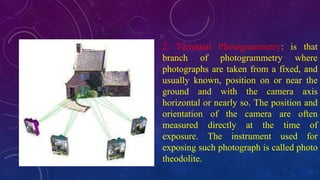
2. Terrestial Photogrammetry: is that
branch of photogrammetry where
photographs are taken from a fixed, and
usually known, position on or near the
ground and with the camera axis
horizontal or nearly so. The position and
orientation of the camera are often
measured directly at the time of
exposure. The instrument used for
exposing such photograph is called photo
theodolite.
3. Space Photogrammetry: The space photogrammetry embraces all
aspects of extraterrestrial photography and subsequent measurement
wherein the camera may be fixed on earth, contained in an artificial
satellite, or positioned on the moon or a planet.
Types of Photogrammetry
There are two types of photogrammetry as follows:
1. Interpretative Photogrammetry.
2. Metric Photogrammetry.
A. Planimetric mapping.
B. Topographical mapping.
Interpretative Photogrammetry
Interpretative photogrammetry involves recognizing and identifying
objects and judging their significance through careful and systematic
analysis from photographic images.
Metric Photogrammetry
It consists of making precise measurements on photographs and other
information to determine relative locations of points.
Classification of Aerial Photographs
Aerial photographs which are normally used for mapping and photo
interpretation can be classified in to two main categories viz. vertical
and tilted.
Vertical Photograph:
An aerial photograph taken with the optical axis of the camera held
in a vertical or nearly vertical position is classified as vertical
photograph. When the geometry of a vertical photograph is
considered, the photograph is assumed to be taken with the optical
axis truly vertical.
Tilted Photograph:
In practice, the camera axis is nearly held vertical. But due to
unavoidable aircraft tilts the camera axis is unintentionally tilted from the
vertical. Then the resulting photograph is called tilted photograph.
If tilt of the camera axis from the plumb line is less than 3 degree the
photograph is called vertical. For tilt more than 3 degree, it is called tilted
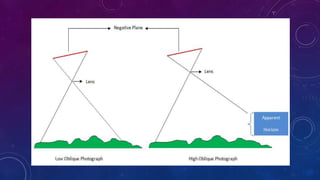
photograph. Tilted photograph may again be classified in two categorizes
viz. low oblique and high oblique.
Requirements of Photogrammetry Technology
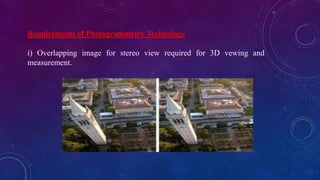
i) Overlapping image for stereo view required for 3D vewing and
measurement.
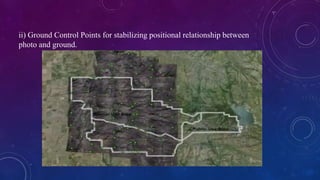
ii) Ground Control Points for stabilizing positional relationship between
photo and ground.
Advantages of Photogrammetry
• Cover areas quickly.
• Low costs.
• Easy to obtain/access information from air.
• Illustrates great detail.
Applications of Photogrammetry
1. To prepare planimetric topographical maps (Surveying/mapping).
2. To determine the space position of ground objects.
3. For acquisition of military intelligence (Military/artificial
intelligence).
4. To classify soil (Forestry/agriculture).
5. For the interpretation of geology (Geology/archaeology).
6. Assessment of crop damage due to floods or other natural
calamities.
7. To prepare a composite picture of ground.
8. To relocate existing property boundaries.
9. In the field of medicine.
GPS & GIS

GPS & GIS

  • 1.
    UTD Session – 2019 Presentationtopic on : USES OF VARIOUS PHOTOGRAMMETRY
  • 2.
    What is Photogrammetry? Theclassical definition of Photogrammetry is the process of deriving metric information about an object through measurement made on the photograph of the object. Photogrammetry is the science of making measurements from photographs. Photogrammetry means the measuring of features on a photograph. This is concerned about metric or measurement aspect of the process. In addition to this photo interpretation aspect is also involved while the technology is used for mapping where feature collection is required.
  • 3.
    Photogrammetry describes fromthree words: ‘photo’ – light ‘gram’ – drawing ‘metry’ – measurement
  • 4.
    The output of photogrammetryis typically a map, drawing, measurement, or a 3D model of some real-world object or scene. Many of the maps we use today are created with photogrammetry and photographs taken from aircraft.
  • 5.
    Fundamental principle ofPhotogrammetry The fundamental principle used by photogrammetry is triangulation.
  • 6.
    Branch of Photogrammetry Photogrammetrycan be classified based on camera location during photography. On this basis we have 1. Aerial Photogrammetry 2. Terrestial Photogrammetry 3. Space Photogrammetry
  • 7.
    1. Aerial Photogrammetry:The camera is mounted in an aircraft and is usually pointed vertically towards the ground. Aerial photographs are taken from the air by special camera mounted in an aircraft flying over the area with the camera axis vertical or nearly so. Multiple overlapping photos of the ground are taken as the aircraft flies along a flight path. These photos are processed in a stereo-plotter (an instrument that lets an operator see two photos at once in a stereo view). These photos are also used in automated processing for Digital Elevation Model (DEM) creation.
  • 8.
    2. Terrestial Photogrammetry:is that branch of photogrammetry where photographs are taken from a fixed, and usually known, position on or near the ground and with the camera axis horizontal or nearly so. The position and orientation of the camera are often measured directly at the time of exposure. The instrument used for exposing such photograph is called photo theodolite.
  • 9.
    3. Space Photogrammetry:The space photogrammetry embraces all aspects of extraterrestrial photography and subsequent measurement wherein the camera may be fixed on earth, contained in an artificial satellite, or positioned on the moon or a planet.
  • 10.
    Types of Photogrammetry Thereare two types of photogrammetry as follows: 1. Interpretative Photogrammetry. 2. Metric Photogrammetry. A. Planimetric mapping. B. Topographical mapping.
  • 11.
    Interpretative Photogrammetry Interpretative photogrammetryinvolves recognizing and identifying objects and judging their significance through careful and systematic analysis from photographic images. Metric Photogrammetry It consists of making precise measurements on photographs and other information to determine relative locations of points.
  • 12.
    Classification of AerialPhotographs Aerial photographs which are normally used for mapping and photo interpretation can be classified in to two main categories viz. vertical and tilted. Vertical Photograph: An aerial photograph taken with the optical axis of the camera held in a vertical or nearly vertical position is classified as vertical photograph. When the geometry of a vertical photograph is considered, the photograph is assumed to be taken with the optical axis truly vertical.
  • 13.
    Tilted Photograph: In practice,the camera axis is nearly held vertical. But due to unavoidable aircraft tilts the camera axis is unintentionally tilted from the vertical. Then the resulting photograph is called tilted photograph. If tilt of the camera axis from the plumb line is less than 3 degree the photograph is called vertical. For tilt more than 3 degree, it is called tilted photograph. Tilted photograph may again be classified in two categorizes viz. low oblique and high oblique.
  • 15.
    Requirements of PhotogrammetryTechnology i) Overlapping image for stereo view required for 3D vewing and measurement.
  • 16.
    ii) Ground ControlPoints for stabilizing positional relationship between photo and ground.
  • 17.
    Advantages of Photogrammetry •Cover areas quickly. • Low costs. • Easy to obtain/access information from air. • Illustrates great detail.
  • 18.
    Applications of Photogrammetry 1.To prepare planimetric topographical maps (Surveying/mapping). 2. To determine the space position of ground objects. 3. For acquisition of military intelligence (Military/artificial intelligence). 4. To classify soil (Forestry/agriculture). 5. For the interpretation of geology (Geology/archaeology). 6. Assessment of crop damage due to floods or other natural calamities. 7. To prepare a composite picture of ground. 8. To relocate existing property boundaries. 9. In the field of medicine.