Phonological Awareness
Phonological awareness is the understanding that……
Spoken language can be broken into smaller units:
• Sentences into words
• Words into syllables
• Syllables into onset-rimes
• Words/syllables into phonemes
Phonological awareness is an important predictor of
reading success
Phonological awareness
“The tiger jumps across the river” - sentence
- words
The ti-ger jumps a-cross the ri-ver - syllables
/ðə ˈtaɪɡə dʒʌmps əˈkrɒs ðə ˈrɪvə / - phonemes
the tiger jumps across the river
phoneme
• The smallest unit of spoken language sounds
• Vowels, consonants
• Transcribed using the IPA (International
Phonetic Alphabet) system e.g., /bʌs/,
/dʒɪˈrɑːf /
• Phonemes are not the same as letters
(graphemes)
graphemes
How many graphemes in the word ‘through’?
th r ough 3 graphemes
θ r u: phonemes
phonics
• PHONICS is knowing how letter names and
phonemes relate to each other
• Also known as ‘letter-sound correspondence’
(grapheme-phoneme correspondence)
Phonological awareness
Phonics
Auditory skills and phonological
awareness
• The ability to hear and discriminate phonemes
require adequate “auditory skills” and/or
“perceptual skills”
• Auditory  perception  production
Map or mat?
Star or start?
Cool or pool?
Auditory and visual skills, and letter-
sound correspondence
• The ability to hear and discriminate phonemes require
adequate “auditory skills” and “auditory perceptual skills”
• The ability to see and discriminate reversible letters require
adequate “visual skills” and “visual perceptual skills”
• The ability to associate letter with sounds requires
integration of auditory and visual skills
Auditory  perception  production
(b,d,p or q)
Visual  perception  production
Continuum for the development of
phonological awareness
Rhyme & alteration  sentence segmentation
 syllable blending & segmenting  onset-
rime blending & segmenting  phoneme
blending, segmenting, & manipulation
*also known as phonemic awareness
Early developing
Late developing
Teaching phonological awareness
The majority of students at risk for reading
difficulties have poor phonological awareness
and can profit from explicit instructions in
learning letter-sound correspondences, and
blending, segmenting, and manipulating
phonemes as early as possible
Letter-sound correspondence
Teaching letter-sound
correspondences
• Expert estimates of the number of speech
sounds or phonemes in English vary from 40
to 52
• For purposes of teaching students, most
estimates are about 44
• In learning to read and write, students learn
more than 100 spellings (graphemes) for these
phonemes
Teaching letter-sound
correspondences cont…..
• The largest division of phonemes is
consonants (C) or vowels (V)
• The English language also makes use of
consonant digraphs and consonant blends.
– Consonant digraph – two consonants that
represent one sound (ph for /f/)
– Consonant blend – combines the sounds of two or
more consonants so that they are clustered
together. (bl, spl)
Phonemes: vowels
Short Example Long Example
I kit i: fleece
ɛ dress ɛ: bear
æ trap ɑ: palm
ɒ lot ɔː thought
ʊ foot u: goose
ʌ up ɜ: nurse
ə bonus
Phonemes: consonants
Diagraphs & diphthongs
ch,ck, gh, kn, ng, ph, sc, sh, th, wh, wr, ai, ay, ay,
ee, ie, oa, oe, ow
Consonant blend
bl,cl, sc, sl, pl, br, fr, st, sw, str, sch
Guidelines for teaching letter-sound
correspondence
• Students use grapheme-phoneme correspondences
to decode words
• Struggling readers benefit from learning to blend
and segment sounds so that they can decode and
spell words
• A number of programs have been developed using
systematic approaches to introduce the letter-
sound relationships and how to blend sounds to
read words (e.g: Jolly phonics, catch up literacy)
Guidelines for teaching letter-sound
correspondences
• Teach one phoneme at a time. Start with phonemes that
occur frequently in simple words (e.g., /a/, /m/, /t/)
• Letters that look familiar and have similar sounds (e.g., b
and d) should be separated in the instructional sequence to
avoid confusion
• Generally, short vowels are taught before long vowels
• Lower case letters are taught first
• Start by teaching the sounds of the letters, not their
names.
• Teach blending and segmenting in oral as well as written
language
• Highlight the first phoneme of words
Guidelines for teaching letter-sound
correspondences
• Teach that some letters can represent more than one
sound. For each letter, teach the most frequent sound,
and then teach other sounds (e.g., /c/ in cat then /s/ in
city)
• Teach that different letters can make the same sound
(e.g., /s/ in sit and city)
• Teach that sounds can be represented by a single letter
or a combination of letters (e.g., /e/ in me and meet)
• Add a kinesthetic component by having students trace
or write the letter as they say the phoneme
• Colour-code consonants or vowels
Can you read this?
I cnduo’t bvleiee taht I culod aulaclty uesdtannrd waht I
was rdnaieg. Unisg the icndeblire pweor of the hmuan
mnid, aocdcrnig to rseecrah at Cmabrigde Uinervtisy, it
dseno’t mttaer in what oderr the lterets in a wrod are,
the olny irpoamtnt tihng is taht the frsit and lsat ltteer be
in the rhgit pclae. The rset can be a taotl mses and you
can still raed it whoutit a pboerlm. Tihs is bucseae the
huamn mnid deos not raed ervey ltteer by istlef, but the
wrod as a wlohe.
ACTIVITY 1
In your group, discuss the following questions
What is the main focus of the LINUS books in …
• phonological awareness skills?
Why?
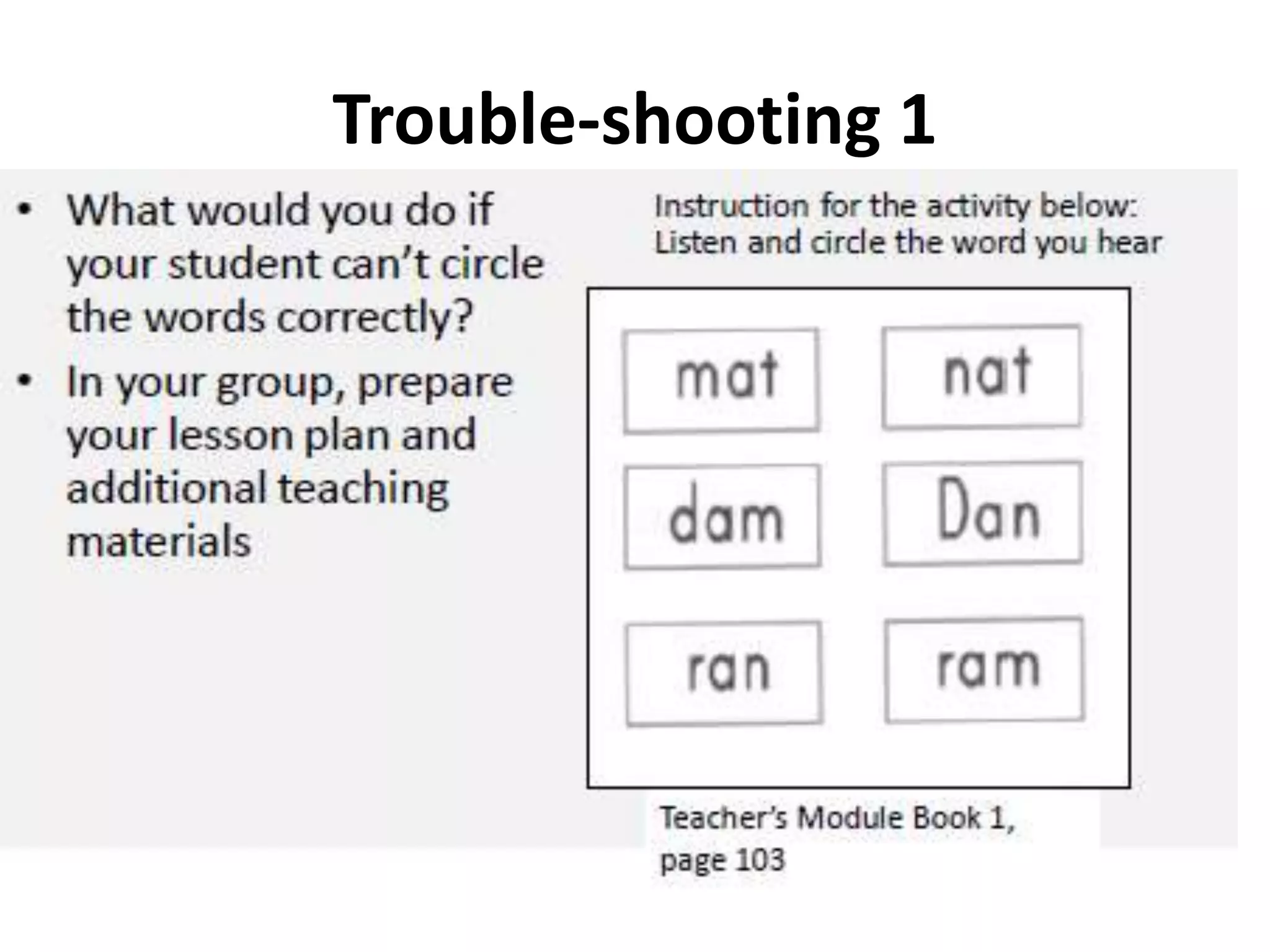
Trouble-shooting 1
Trouble shooting 2
Reflection
• What do you think of the adaptations that you
have to make?
• What can you do to teach phonological
awareness effectively?

Phonological awareness

  • 1.
  • 2.
    Phonological Awareness Phonological awarenessis the understanding that…… Spoken language can be broken into smaller units: • Sentences into words • Words into syllables • Syllables into onset-rimes • Words/syllables into phonemes Phonological awareness is an important predictor of reading success
  • 3.
    Phonological awareness “The tigerjumps across the river” - sentence - words The ti-ger jumps a-cross the ri-ver - syllables /ðə ˈtaɪɡə dʒʌmps əˈkrɒs ðə ˈrɪvə / - phonemes the tiger jumps across the river
  • 4.
    phoneme • The smallestunit of spoken language sounds • Vowels, consonants • Transcribed using the IPA (International Phonetic Alphabet) system e.g., /bʌs/, /dʒɪˈrɑːf / • Phonemes are not the same as letters (graphemes)
  • 5.
    graphemes How many graphemesin the word ‘through’? th r ough 3 graphemes θ r u: phonemes
  • 6.
    phonics • PHONICS isknowing how letter names and phonemes relate to each other • Also known as ‘letter-sound correspondence’ (grapheme-phoneme correspondence)
  • 7.
  • 8.
    Auditory skills andphonological awareness • The ability to hear and discriminate phonemes require adequate “auditory skills” and/or “perceptual skills” • Auditory  perception  production Map or mat? Star or start? Cool or pool?
  • 9.
    Auditory and visualskills, and letter- sound correspondence • The ability to hear and discriminate phonemes require adequate “auditory skills” and “auditory perceptual skills” • The ability to see and discriminate reversible letters require adequate “visual skills” and “visual perceptual skills” • The ability to associate letter with sounds requires integration of auditory and visual skills Auditory  perception  production (b,d,p or q) Visual  perception  production
  • 10.
    Continuum for thedevelopment of phonological awareness Rhyme & alteration  sentence segmentation  syllable blending & segmenting  onset- rime blending & segmenting  phoneme blending, segmenting, & manipulation *also known as phonemic awareness Early developing Late developing
  • 11.
    Teaching phonological awareness Themajority of students at risk for reading difficulties have poor phonological awareness and can profit from explicit instructions in learning letter-sound correspondences, and blending, segmenting, and manipulating phonemes as early as possible
  • 12.
  • 13.
    Teaching letter-sound correspondences • Expertestimates of the number of speech sounds or phonemes in English vary from 40 to 52 • For purposes of teaching students, most estimates are about 44 • In learning to read and write, students learn more than 100 spellings (graphemes) for these phonemes
  • 14.
    Teaching letter-sound correspondences cont….. •The largest division of phonemes is consonants (C) or vowels (V) • The English language also makes use of consonant digraphs and consonant blends. – Consonant digraph – two consonants that represent one sound (ph for /f/) – Consonant blend – combines the sounds of two or more consonants so that they are clustered together. (bl, spl)
  • 15.
    Phonemes: vowels Short ExampleLong Example I kit i: fleece ɛ dress ɛ: bear æ trap ɑ: palm ɒ lot ɔː thought ʊ foot u: goose ʌ up ɜ: nurse ə bonus
  • 16.
  • 17.
    Diagraphs & diphthongs ch,ck,gh, kn, ng, ph, sc, sh, th, wh, wr, ai, ay, ay, ee, ie, oa, oe, ow
  • 18.
    Consonant blend bl,cl, sc,sl, pl, br, fr, st, sw, str, sch
  • 19.
    Guidelines for teachingletter-sound correspondence • Students use grapheme-phoneme correspondences to decode words • Struggling readers benefit from learning to blend and segment sounds so that they can decode and spell words • A number of programs have been developed using systematic approaches to introduce the letter- sound relationships and how to blend sounds to read words (e.g: Jolly phonics, catch up literacy)
  • 20.
    Guidelines for teachingletter-sound correspondences • Teach one phoneme at a time. Start with phonemes that occur frequently in simple words (e.g., /a/, /m/, /t/) • Letters that look familiar and have similar sounds (e.g., b and d) should be separated in the instructional sequence to avoid confusion • Generally, short vowels are taught before long vowels • Lower case letters are taught first • Start by teaching the sounds of the letters, not their names. • Teach blending and segmenting in oral as well as written language • Highlight the first phoneme of words
  • 21.
    Guidelines for teachingletter-sound correspondences • Teach that some letters can represent more than one sound. For each letter, teach the most frequent sound, and then teach other sounds (e.g., /c/ in cat then /s/ in city) • Teach that different letters can make the same sound (e.g., /s/ in sit and city) • Teach that sounds can be represented by a single letter or a combination of letters (e.g., /e/ in me and meet) • Add a kinesthetic component by having students trace or write the letter as they say the phoneme • Colour-code consonants or vowels
  • 24.
    Can you readthis? I cnduo’t bvleiee taht I culod aulaclty uesdtannrd waht I was rdnaieg. Unisg the icndeblire pweor of the hmuan mnid, aocdcrnig to rseecrah at Cmabrigde Uinervtisy, it dseno’t mttaer in what oderr the lterets in a wrod are, the olny irpoamtnt tihng is taht the frsit and lsat ltteer be in the rhgit pclae. The rset can be a taotl mses and you can still raed it whoutit a pboerlm. Tihs is bucseae the huamn mnid deos not raed ervey ltteer by istlef, but the wrod as a wlohe.
  • 29.
    ACTIVITY 1 In yourgroup, discuss the following questions What is the main focus of the LINUS books in … • phonological awareness skills? Why?
  • 30.
  • 31.
  • 32.
    Reflection • What doyou think of the adaptations that you have to make? • What can you do to teach phonological awareness effectively?