
Phonological
awareness in children
Based on compilation by J. Sheils & Y. Sawyers
Contents
 Level 1: Exposure to Nursery Rhymes
 Level 2: Word awareness
 Level 3: Rhyme recognition and production
 Level 4: Recognition and production of syllables
 Level 5: Recognition and production of initial sounds
 Level 6: Recognition and production of final sounds
 Level 7: Blending Phonemes
 Level 8: Phonemic segmentation
 Level 9: Phoneme Manipulation
Level 1:
Exposure to Nursery Rhymes
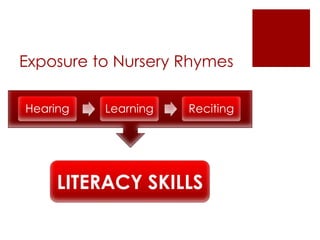
Hearing Learning Reciting
LITERACY SKILLS
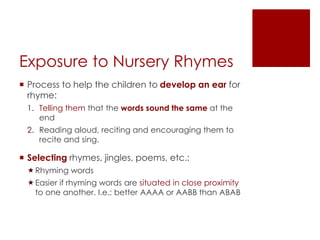
Exposure to Nursery Rhymes
 Process to help the children to develop an ear for
rhyme:
1. Telling them that the words sound the same at the
end
2. Reading aloud, reciting and encouraging them to
recite and sing.
 Selecting rhymes, jingles, poems, etc.:
Rhyming words
Easier if rhyming words are situated in close proximity
to one another. I.e.: better AAAA or AABB than ABAB
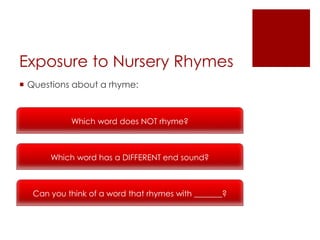
Exposure to Nursery Rhymes
 Questions about a rhyme:
Which word does NOT rhyme?
Can you think of a word that rhymes with _______?
Which word has a DIFFERENT end sound?
Exposure to Nursery Rhymes
 Some suggestions
• One, two, three, four, five
• 1, 2, tie my show
• Five little monkeys jumping on the bed
• Number Rhyme
• Five little fishes swimming in the pool
Numbers
• It’s raining, it’s pouring
• Rain rain go away
• In Autumn when the trees are brown
• Red and yellow
Weather, seasons,…
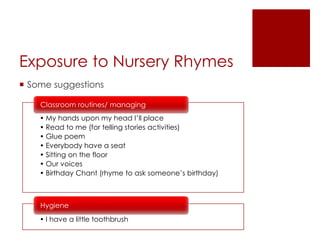
Exposure to Nursery Rhymes
 Some suggestions
• My hands upon my head I’ll place
• Read to me (for telling stories activities)
• Glue poem
• Everybody have a seat
• Sitting on the floor
• Our voices
• Birthday Chant (rhyme to ask someone’s birthday)
Classroom routines/ managing
• I have a little toothbrush
Hygiene
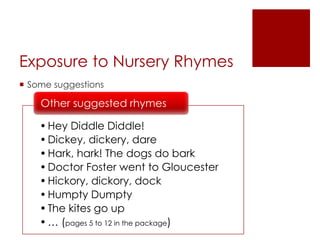
Exposure to Nursery Rhymes
 Some suggestions
•Hey Diddle Diddle!
•Dickey, dickery, dare
•Hark, hark! The dogs do bark
•Doctor Foster went to Gloucester
•Hickory, dickory, dock
•Humpty Dumpty
•The kites go up
•… (pages 5 to 12 in the package)
Other suggested rhymes
Level 2:
Word awareness
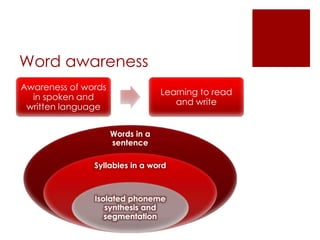
Word awareness
Awareness of words
in spoken and
written language
Learning to read
and write
Words in a
sentence
Syllables in a word
Isolated phoneme
synthesis and
segmentation
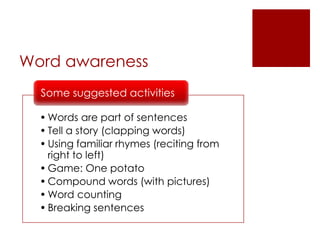
Word awareness
• Words are part of sentences
• Tell a story (clapping words)
• Using familiar rhymes (reciting from
right to left)
• Game: One potato
• Compound words (with pictures)
• Word counting
• Breaking sentences
Some suggested activities
Level 3:
Recognition & Production of Rhyme
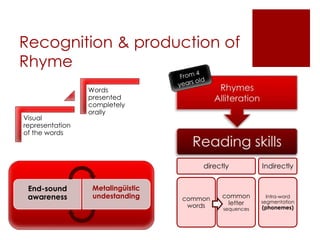
Recognition & production of
Rhyme
Visual
representation
of the words
Words
presented
completely
orally
End-sound
awareness
Metalingüistic
undestanding
directly
common
words
common
letter
sequences
Indirectly
Intra-word
segmentation
(phonemes)
•Body name game
•Rhyming game (different variations: songs,
poems, clap rap,…)
•Put your thumbs up
•Making Funny Sentences
•Pebble game
•You can come sailing on my ship
•Silly Rhymes Big Book
•Did you ever ever…?
•…
Some suggested activities
Recognition & production of
Rhyme
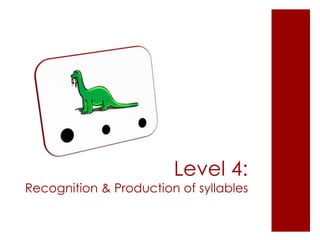
Level 4:
Recognition & Production of syllables
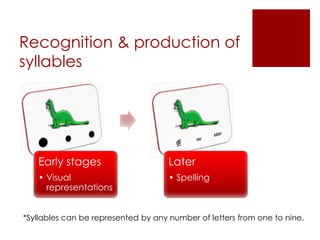
Recognition & production of
syllables
Early stages
• Visual
representations
Later
• Spelling
*Syllables can be represented by any number of letters from one to nine.
• Clapping syllables
• Silly syllable puppet
• Ticki Ticki Tembo
• Bibbity Bibbity Bumble Bee
• Clap Clap your hands
• Syllable groups
• Teacher may we?
• Feel the syllables
Some suggested activities
Recognition & production of
Syllables
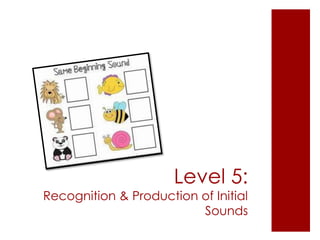
Level 5:
Recognition & Production of Initial
Sounds
Recognition & production of
Initial Sounds
Initial sound activities show children that:
• words contain phonemes
• introduces how phonemes sound
and feel when spoken in isolation
Individual phonemes are more difficult because
of “co-articulation”
• Phoneme train
• I’m thinking of Something
• Beds and boulders, bees and bows
• Simon says
• Ride the train
• Going shopping
• I went on a trip
• Personal tongue twisters
• Initial sound clap
• Circle swap shop
• …
Some suggested activities
Recognition & production of
Initial Sounds
Level 6:
Recognition & Production of Final
Sounds
Recognition & production of
Final Sounds
Final sound activities show children that:
• words contain phonemes
• introduces how phonemes sound
and feel when spoken in isolation
Individual phonemes are more difficult because
of “co-articulation”
•Can you say?
•Final Sound Song
•Last Sound Last
•Secret sound
•Beginning, middle or end?
•Bag game
•…
Some suggested activities
Recognition & production of
Final Sounds
Level 7 & 8:
Blending phonemes &
Phonemic segmentation
Blending phonemes &
Phonemic Segmentation
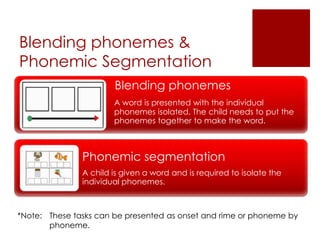
Blending phonemes
• A word is presented with the individual
phonemes isolated. The child needs to put the
phonemes together to make the word.
Phonemic segmentation
A child is given a word and is required to isolate the
individual phonemes.
*Note: These tasks can be presented as onset and rime or phoneme by
phoneme.
•Guess it
•Mystery Sentences
•Mail Game
•Old McDonals had a box
•If you think you know
•Sound it out song
•Boingy Elastic Band Game
•Segmentation Cheer/Chant
•Using a Phoneme Frame
•Bag Game
•Phoneme blocks
•Drawing Lines on Pictures
•…
Some suggested activities
Blending phonemes &
Phonemic Segmentation
Level 9:
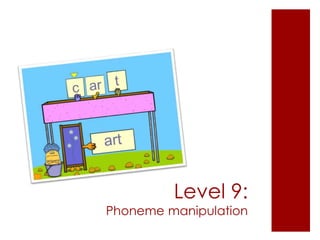
Phoneme manipulation
Phoneme manipulation is the ability to:
• Delete initial and final phonemes in words.
• Delete the first phoneme of a consonant
blend as well as substitute one phoneme for
another.
It’s sited that approximately 7 years od age
children are able to perform phoneme deletion
tasks adequately.
• Simon says
• Row row your boat
• Consonant Riddles
• Alien Game
• Switcheroo
• Pick it out
• What’s missing?
• Help a puppet to say words correctly
• …
Some suggested activities
Phonemic manipulation
The end

Phonological awareness

  • 1.
    Phonological awareness in children Basedon compilation by J. Sheils & Y. Sawyers
  • 2.
    Contents  Level 1:Exposure to Nursery Rhymes  Level 2: Word awareness  Level 3: Rhyme recognition and production  Level 4: Recognition and production of syllables  Level 5: Recognition and production of initial sounds  Level 6: Recognition and production of final sounds  Level 7: Blending Phonemes  Level 8: Phonemic segmentation  Level 9: Phoneme Manipulation
  • 3.
    Level 1: Exposure toNursery Rhymes
  • 4.
    Exposure to NurseryRhymes Hearing Learning Reciting LITERACY SKILLS
  • 5.
    Exposure to NurseryRhymes  Process to help the children to develop an ear for rhyme: 1. Telling them that the words sound the same at the end 2. Reading aloud, reciting and encouraging them to recite and sing.  Selecting rhymes, jingles, poems, etc.: Rhyming words Easier if rhyming words are situated in close proximity to one another. I.e.: better AAAA or AABB than ABAB
  • 6.
    Exposure to NurseryRhymes  Questions about a rhyme: Which word does NOT rhyme? Can you think of a word that rhymes with _______? Which word has a DIFFERENT end sound?
  • 7.
    Exposure to NurseryRhymes  Some suggestions • One, two, three, four, five • 1, 2, tie my show • Five little monkeys jumping on the bed • Number Rhyme • Five little fishes swimming in the pool Numbers • It’s raining, it’s pouring • Rain rain go away • In Autumn when the trees are brown • Red and yellow Weather, seasons,…
  • 8.
    Exposure to NurseryRhymes  Some suggestions • My hands upon my head I’ll place • Read to me (for telling stories activities) • Glue poem • Everybody have a seat • Sitting on the floor • Our voices • Birthday Chant (rhyme to ask someone’s birthday) Classroom routines/ managing • I have a little toothbrush Hygiene
  • 9.
    Exposure to NurseryRhymes  Some suggestions •Hey Diddle Diddle! •Dickey, dickery, dare •Hark, hark! The dogs do bark •Doctor Foster went to Gloucester •Hickory, dickory, dock •Humpty Dumpty •The kites go up •… (pages 5 to 12 in the package) Other suggested rhymes
  • 10.
  • 11.
    Word awareness Awareness ofwords in spoken and written language Learning to read and write Words in a sentence Syllables in a word Isolated phoneme synthesis and segmentation
  • 12.
    Word awareness • Wordsare part of sentences • Tell a story (clapping words) • Using familiar rhymes (reciting from right to left) • Game: One potato • Compound words (with pictures) • Word counting • Breaking sentences Some suggested activities
  • 13.
    Level 3: Recognition &Production of Rhyme
  • 14.
    Recognition & productionof Rhyme Visual representation of the words Words presented completely orally End-sound awareness Metalingüistic undestanding directly common words common letter sequences Indirectly Intra-word segmentation (phonemes)
  • 15.
    •Body name game •Rhyminggame (different variations: songs, poems, clap rap,…) •Put your thumbs up •Making Funny Sentences •Pebble game •You can come sailing on my ship •Silly Rhymes Big Book •Did you ever ever…? •… Some suggested activities Recognition & production of Rhyme
  • 16.
    Level 4: Recognition &Production of syllables
  • 17.
    Recognition & productionof syllables Early stages • Visual representations Later • Spelling *Syllables can be represented by any number of letters from one to nine.
  • 18.
    • Clapping syllables •Silly syllable puppet • Ticki Ticki Tembo • Bibbity Bibbity Bumble Bee • Clap Clap your hands • Syllable groups • Teacher may we? • Feel the syllables Some suggested activities Recognition & production of Syllables
  • 19.
    Level 5: Recognition &Production of Initial Sounds
  • 20.
    Recognition & productionof Initial Sounds Initial sound activities show children that: • words contain phonemes • introduces how phonemes sound and feel when spoken in isolation Individual phonemes are more difficult because of “co-articulation”
  • 21.
    • Phoneme train •I’m thinking of Something • Beds and boulders, bees and bows • Simon says • Ride the train • Going shopping • I went on a trip • Personal tongue twisters • Initial sound clap • Circle swap shop • … Some suggested activities Recognition & production of Initial Sounds
  • 22.
    Level 6: Recognition &Production of Final Sounds
  • 23.
    Recognition & productionof Final Sounds Final sound activities show children that: • words contain phonemes • introduces how phonemes sound and feel when spoken in isolation Individual phonemes are more difficult because of “co-articulation”
  • 24.
    •Can you say? •FinalSound Song •Last Sound Last •Secret sound •Beginning, middle or end? •Bag game •… Some suggested activities Recognition & production of Final Sounds
  • 25.
    Level 7 &8: Blending phonemes & Phonemic segmentation
  • 26.
    Blending phonemes & PhonemicSegmentation Blending phonemes • A word is presented with the individual phonemes isolated. The child needs to put the phonemes together to make the word. Phonemic segmentation A child is given a word and is required to isolate the individual phonemes. *Note: These tasks can be presented as onset and rime or phoneme by phoneme.
  • 27.
    •Guess it •Mystery Sentences •MailGame •Old McDonals had a box •If you think you know •Sound it out song •Boingy Elastic Band Game •Segmentation Cheer/Chant •Using a Phoneme Frame •Bag Game •Phoneme blocks •Drawing Lines on Pictures •… Some suggested activities Blending phonemes & Phonemic Segmentation
  • 28.
  • 29.
    Phoneme manipulation Phoneme manipulationis the ability to: • Delete initial and final phonemes in words. • Delete the first phoneme of a consonant blend as well as substitute one phoneme for another. It’s sited that approximately 7 years od age children are able to perform phoneme deletion tasks adequately.
  • 30.
    • Simon says •Row row your boat • Consonant Riddles • Alien Game • Switcheroo • Pick it out • What’s missing? • Help a puppet to say words correctly • … Some suggested activities Phonemic manipulation
  • 31.