
Teaching Speaking & Listening through Communicative Activities Erin Lowry English Language Fellow Workshop for Universidad Católica del Occidente November 12, 2007
The Challenge To integrate skills To provide opportunities for authentic communication contexts To give a reason for communication (information gaps) To assess these skills in an objective manner
TEACHING LISTENING
What Makes Listening Difficult? Clustering Redundancy Reduced forms Performance variables Colloquial language Rate of delivery Stress, rhythm, and intonation Interaction
Principles for Teaching Listening Expose Sts to different ways of processing information Bottom-up vs. Top-down Expose Sts to different types of listening Teach a variety of tasks Consider text, difficulty, and authenticity Helgeson, 2003
Types of Classroom Listening Reactive Intensive Responsive Selective Extensive Interactive Brown, 2001
Principles for Designing Listening Techniques Use techniques that are intrinsically motivating Use authentic language and contexts Carefully consider the form of listeners’ responses Encourage the development of listening strategies Include bottom-up and top-down listening techniques Brown, 2001
Successful Listening Activities Purpose for Listening A form of response (doing, choosing, answering, transferring, condensing, duplicating, extending, conversing) Repetition depends on T objectives and students’ level A motivating listening text is authentic and relates to students’ interests and needs Have the skills integrated Stages: Pre-task , While-task, Post-task
Listening Strategies Teach student  how  to listen Looking for keywords Looking for nonverbal cues to meaning Predicting a speaker’s purpose by the context of the spoken discourse Associating information with one’s existing background knowledge (activating schema) Guessing meanings Seeking clarification Listening for the general gist For tests of listening comprehension, various test-taking strategies
Easy-to-plan Pre-Listening Activities Brainstorming Think-Pair-Share Word Webbing/Mind Mapping Team Interview
Easy-to-plan Listening Tasks Agree or disagree (with explanation) Create Venn diagrams List characteristics, qualities, or features Strip story (sequencing game) Match speech to visuals Compare and contrast to another speech or text Give advice
More Listening Tasks Compare and contrast to your own experience Create your own version of the missing section Plan a solution to the problem Share reactions Create a visual Reenact your own version
Easy to Plan Post-listening Assessments Guess the meaning of unknown vocabulary Analyze the speaker’s intentions List the number of people involved and their function in the script Analyze the success of communication in the script Brainstorm alternative ways of expression
TEACHING SPEAKING
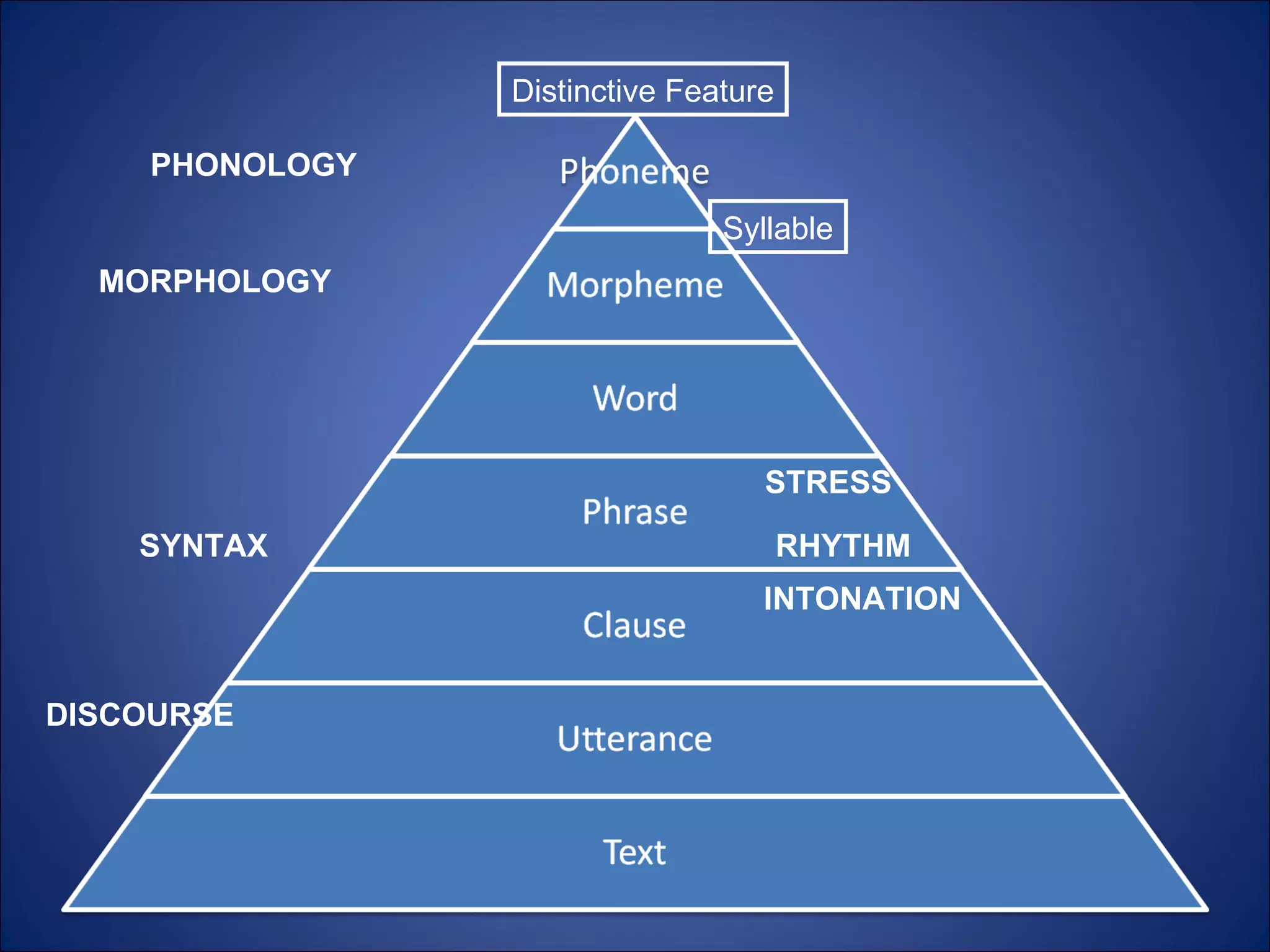
Distinctive Feature Syllable PHONOLOGY MORPHOLOGY SYNTAX DISCOURSE STRESS RHYTHM INTONATION
What Makes Speaking Difficult? Clustering Redundancy Reduced forms Performance variables Colloquial language Rate of delivery Stress, rhythm & intonation Interaction
Principles of Teaching Speaking Beginners Provide something for the learners to talk about Create opportunities for students to interact by using groupwork or pairwork Manipulate physical arrangements to promote speaking practice Bailey, 2005
Principles of Teaching Speaking Intermediate Plan speaking tasks that involve negotiation for meaning Design both transactional and interpersonal speaking activities Personalize the speaking activities whenever possible Bailey, 2005
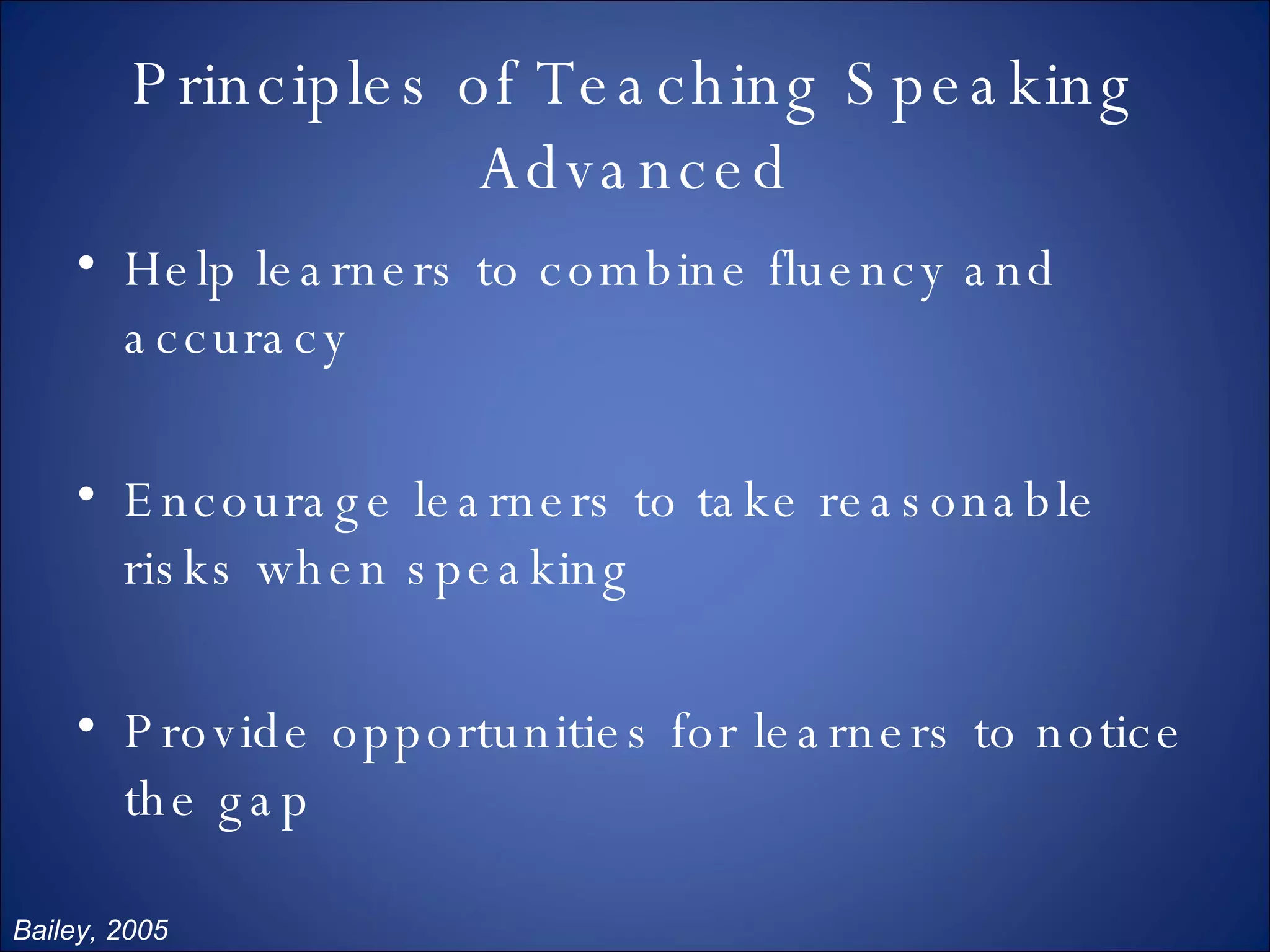
Principles of Teaching Speaking Advanced Help learners to combine fluency and accuracy Encourage learners to take reasonable risks when speaking Provide opportunities for learners to notice the gap Bailey, 2005
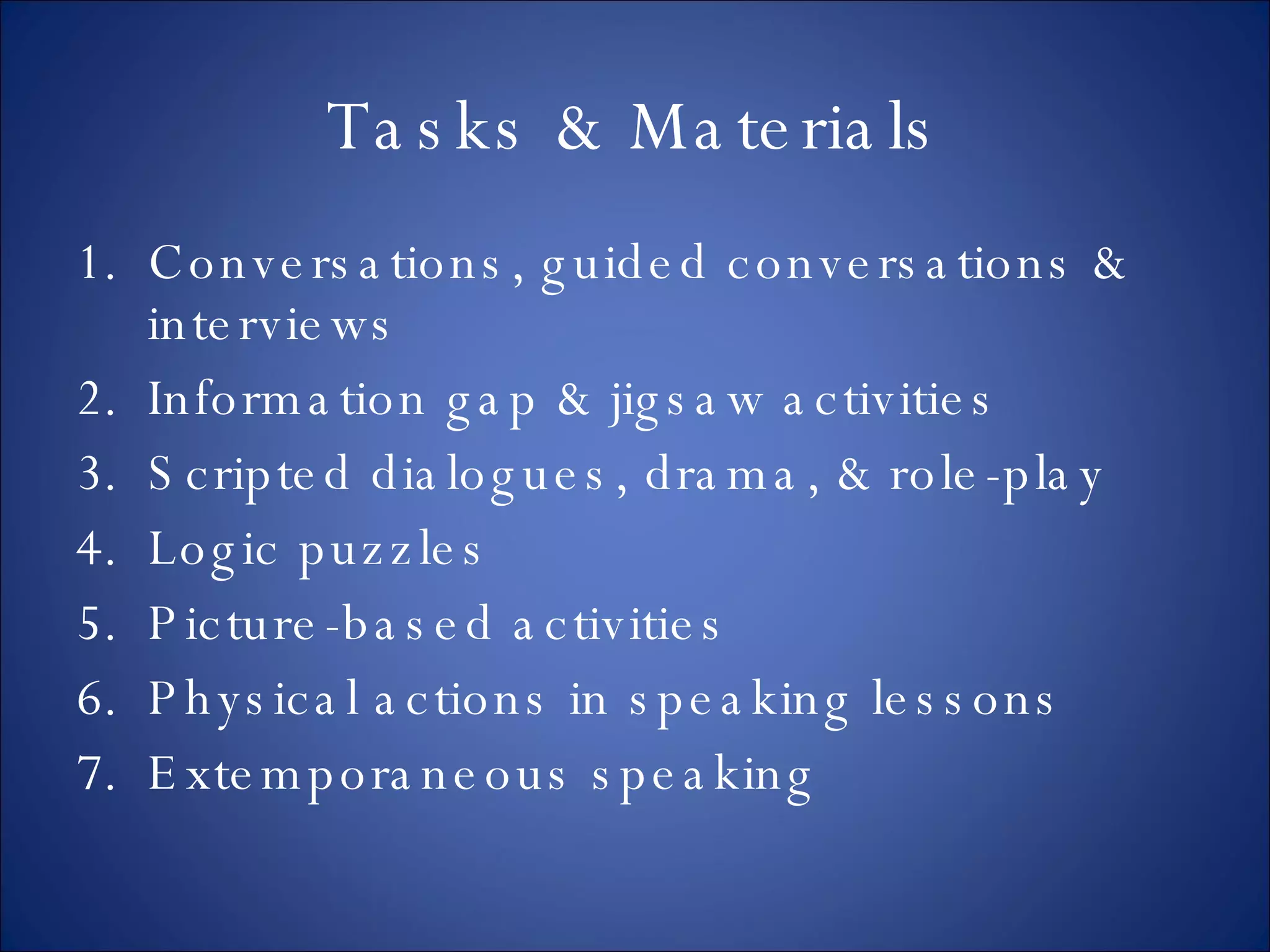
Tasks & Materials Conversations, guided conversations & interviews Information gap & jigsaw activities Scripted dialogues, drama, & role-play Logic puzzles Picture-based activities Physical actions in speaking lessons Extemporaneous speaking
Questions? Email:  [email_address] Website: http://elowry.wikidot.com Blog:  http://irwyn12.blogspot.com
References Bailey, K.M. (2005).  Practical English Language Teaching: Speaking . New York: McGraw-Hill.  Bishop, G. (2006).  AP State English Lecturers Retraining Program Teacher’s Handboook . Senior ELF Seminar Series given in Hyderabad, India.  Brown, H.D. (2001).  Teaching by principles: An interactive approach to language pedagogy . White Plains, NY: Longman. Helgesen, M. (2003). Listening. In D. Nunan (Ed.).  Practical English Language Teaching . New York: McGraw-Hill. Liao, X.A. (2001). Information Gap in Communicative Classrooms. EL Forum, 39 (4). Retrieved from  http://exchanges.state.gov/forum/vols/vol39/no4/p38.htm . Lynch, T. (2003).  Communication in the language classroom . Oxford: Oxford University Press. Richards, J.C. & Renandya, W.A. (eds.) (2002).  Methodology in language teaching: an anthology of current practice.  Cambridge: Cambridge University Press. Slagoski, J.D. (2006). Teaching Listening Skills.  Senior ELF Seminar given in Samara, Russia.  Retrieved  from  http://slagoski.googlepages.com/downloadpresentations .

Teaching Speaking & Listening

  • 1.
    Teaching Speaking &Listening through Communicative Activities Erin Lowry English Language Fellow Workshop for Universidad Católica del Occidente November 12, 2007
  • 2.
    The Challenge Tointegrate skills To provide opportunities for authentic communication contexts To give a reason for communication (information gaps) To assess these skills in an objective manner
  • 3.
  • 4.
    What Makes ListeningDifficult? Clustering Redundancy Reduced forms Performance variables Colloquial language Rate of delivery Stress, rhythm, and intonation Interaction
  • 5.
    Principles for TeachingListening Expose Sts to different ways of processing information Bottom-up vs. Top-down Expose Sts to different types of listening Teach a variety of tasks Consider text, difficulty, and authenticity Helgeson, 2003
  • 6.
    Types of ClassroomListening Reactive Intensive Responsive Selective Extensive Interactive Brown, 2001
  • 7.
    Principles for DesigningListening Techniques Use techniques that are intrinsically motivating Use authentic language and contexts Carefully consider the form of listeners’ responses Encourage the development of listening strategies Include bottom-up and top-down listening techniques Brown, 2001
  • 8.
    Successful Listening ActivitiesPurpose for Listening A form of response (doing, choosing, answering, transferring, condensing, duplicating, extending, conversing) Repetition depends on T objectives and students’ level A motivating listening text is authentic and relates to students’ interests and needs Have the skills integrated Stages: Pre-task , While-task, Post-task
  • 9.
    Listening Strategies Teachstudent how to listen Looking for keywords Looking for nonverbal cues to meaning Predicting a speaker’s purpose by the context of the spoken discourse Associating information with one’s existing background knowledge (activating schema) Guessing meanings Seeking clarification Listening for the general gist For tests of listening comprehension, various test-taking strategies
  • 10.
    Easy-to-plan Pre-Listening ActivitiesBrainstorming Think-Pair-Share Word Webbing/Mind Mapping Team Interview
  • 11.
    Easy-to-plan Listening TasksAgree or disagree (with explanation) Create Venn diagrams List characteristics, qualities, or features Strip story (sequencing game) Match speech to visuals Compare and contrast to another speech or text Give advice
  • 12.
    More Listening TasksCompare and contrast to your own experience Create your own version of the missing section Plan a solution to the problem Share reactions Create a visual Reenact your own version
  • 13.
    Easy to PlanPost-listening Assessments Guess the meaning of unknown vocabulary Analyze the speaker’s intentions List the number of people involved and their function in the script Analyze the success of communication in the script Brainstorm alternative ways of expression
  • 14.
  • 15.
    Distinctive Feature SyllablePHONOLOGY MORPHOLOGY SYNTAX DISCOURSE STRESS RHYTHM INTONATION
  • 16.
    What Makes SpeakingDifficult? Clustering Redundancy Reduced forms Performance variables Colloquial language Rate of delivery Stress, rhythm & intonation Interaction
  • 17.
    Principles of TeachingSpeaking Beginners Provide something for the learners to talk about Create opportunities for students to interact by using groupwork or pairwork Manipulate physical arrangements to promote speaking practice Bailey, 2005
  • 18.
    Principles of TeachingSpeaking Intermediate Plan speaking tasks that involve negotiation for meaning Design both transactional and interpersonal speaking activities Personalize the speaking activities whenever possible Bailey, 2005
  • 19.
    Principles of TeachingSpeaking Advanced Help learners to combine fluency and accuracy Encourage learners to take reasonable risks when speaking Provide opportunities for learners to notice the gap Bailey, 2005
  • 20.
    Tasks & MaterialsConversations, guided conversations & interviews Information gap & jigsaw activities Scripted dialogues, drama, & role-play Logic puzzles Picture-based activities Physical actions in speaking lessons Extemporaneous speaking
  • 21.
    Questions? Email: [email_address] Website: http://elowry.wikidot.com Blog: http://irwyn12.blogspot.com
  • 22.
    References Bailey, K.M.(2005). Practical English Language Teaching: Speaking . New York: McGraw-Hill. Bishop, G. (2006). AP State English Lecturers Retraining Program Teacher’s Handboook . Senior ELF Seminar Series given in Hyderabad, India. Brown, H.D. (2001). Teaching by principles: An interactive approach to language pedagogy . White Plains, NY: Longman. Helgesen, M. (2003). Listening. In D. Nunan (Ed.). Practical English Language Teaching . New York: McGraw-Hill. Liao, X.A. (2001). Information Gap in Communicative Classrooms. EL Forum, 39 (4). Retrieved from http://exchanges.state.gov/forum/vols/vol39/no4/p38.htm . Lynch, T. (2003). Communication in the language classroom . Oxford: Oxford University Press. Richards, J.C. & Renandya, W.A. (eds.) (2002). Methodology in language teaching: an anthology of current practice. Cambridge: Cambridge University Press. Slagoski, J.D. (2006). Teaching Listening Skills. Senior ELF Seminar given in Samara, Russia. Retrieved from http://slagoski.googlepages.com/downloadpresentations .