TEACHING
   READING
  THROUGH
   PHONICS
KSSR YEAR 2 TRAINING
       KUNAK
         2011
        -CCJ-
                  -CCJ-
TEACHING READING TO
LEVEL 1 PUPILS
 REFLECT…
 How  do you teach reading to Level 1 pupils?
 What is your favourite
  approach/technique/strategy for teaching
  reading?
 What activities do you normally conduct in
  your reading classes?


                                                 -CCJ-
TWO MAIN METHODS OF
   TEACHING READING
 Phonics: Children learn reading by associating the
  sounds of English and the letters or combination of
  letters that produce them.
 Whole-Language (Look and Say): Children learn
  reading by memorizing words as whole unit.
 KBSR: Whole-language

 KSSR:      Phonics


                                                -CCJ-
PHONICS
    the main approach advocated by MoE for
 …is
 the teaching of reading in KSSR.
 What   do you know about Phonics?

Activity 1: Jot down everything that you know or any
ideas that you have about Phonics on a piece of paper.

Activity 2: In your group, match the terminologies to
the correct definitions/explanations.

                     Tasksheet                  -CCJ-
-CCJ-
TERMINOLOGIES
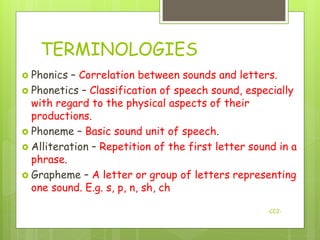
 Phonics – Correlation between sounds and letters.
 Phonetics – Classification of speech sound, especially
  with regard to the physical aspects of their
  productions.
 Phoneme – Basic sound unit of speech.
 Alliteration – Repetition of the first letter sound in a
  phrase.
 Grapheme – A letter or group of letters representing
  one sound. E.g. s, p, n, sh, ch

                                                   -CCJ-
TERMINOLOGIES
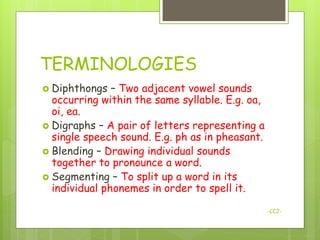
 Diphthongs   – Two adjacent vowel sounds
  occurring within the same syllable. E.g. oa,
  oi, ea.
 Digraphs – A pair of letters representing a
  single speech sound. E.g. ph as in pheasant.
 Blending – Drawing individual sounds
  together to pronounce a word.
 Segmenting – To split up a word in its
  individual phonemes in order to spell it.

                                                 -CCJ-
TERMINOLOGIES
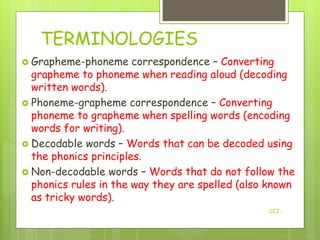
 Grapheme-phoneme     correspondence – Converting
  grapheme to phoneme when reading aloud (decoding
  written words).
 Phoneme-grapheme correspondence – Converting
  phoneme to grapheme when spelling words (encoding
  words for writing).
 Decodable words – Words that can be decoded using
  the phonics principles.
 Non-decodable words – Words that do not follow the
  phonics rules in the way they are spelled (also known
  as tricky words).
                                                 -CCJ-
PHONICS
PRESENTATION SLIDES FROM BPK


                               -CCJ-
TEACHING READING USING
THE PHONICS METHOD


 Now that we already know what
 Phonics is, how would we use it to
 teach reading in our classroom?


                                      -CCJ-
What does it involve?
Teaching  letters (graphemes)
Teaching sounds (phonemes)
Teaching letter-sound
 (grapheme-phoneme) and sound-
 letter (phoneme-grapheme)
 correspondence
                                 -CCJ-
Children are taught how to read
by teaching them how to…
…blend component sounds all
 through a word.
…segment words into their
 component sounds.


                               -CCJ-
ACTIVITIES FOR
BLENDING
Some Ideas for Classroom Teaching


                                    -CCJ-
Activities for Blending
 Adults   Modeling Oral Blending
    “This is a story b-oo-k.”
    “Please s-i-t.”
    The caterpillar likes f-oo-d.”


                                      -CCJ-
Activities for Blending
 Toy   Talk
    Introduce to the children a soft toy that can
     only speak in „sound-talk‟.
    Teacher: “What would Charlie wants for
         breakfast today?”
    Charlie: “Ch-ee-se.”
    Teacher demonstrates how to blend the
     sound to form the word „cheese‟.
    Other variation: Robot Talk. Introduce a
     robot doing sound-talk in robot voice.
                                                 -CCJ-
Activities for Blending
 Which   One?
    Lay out a selection of pictures. E.g. moon,
     leaf, cake, pie (words from „The Very Hungry
     Caterpillar‟).
    Sound-talking toy says the names of the
     objects in the pictures in sound-talk.
    With teacher‟s guidance, children put the
     sound together and say the word.


                                                    -CCJ-
Activities for Blending
I   Spy
    Lay out a selection of objects or pictures of
     objects.
    “I spy with my little eye a l-ea-f.”
    Children say the name of the object and hold
     it up.


                                                 -CCJ-
-CCJ-
-CCJ-
ACTIVITIES FOR
SEGMENTING
Some Ideas for Classroom Teaching


                                    -CCJ-
Activities for Segmenting
 Toy   Talk
    Invite a group of pupils to talk to the toy in
     sound-talk.
    Teacher: “Let‟s tell Charlie what this is.”
               (Pointing to a book).
    Children: “B-oo-k”.
    Leave the sound-talk toy freely available to
     the children to practise and experiment with
     sound-talk.
                                                      -CCJ-
Activities for Segmenting
 Say   the Sounds
    Choose some objects with three-phoneme
     names that you are sure the children know
     and hide them in a box or bag.
    Allow one child to see an object then say the
     separate sounds in the name of the object
     (e.g. p-e-n).
    The other children blend the sound together
     to make the word.
                                                     -CCJ-
Activities for Segmenting
 Count   the Phonemes
    When children are used to oral blending,
     introduce the idea of counting how many
     phonemes they can hear.
    E.g. “m-oo-n, moon. How many phonemes can
     we hear? Let‟s use our fingers to help us: m-
     oo-n; one, two, three phonemes.”


                                                     -CCJ-
More Blending and Segmenting
Activities
 Activitiesfrom Scholastic Red
 Phoneme Segmentation
 Strategies for Tricky Words


                                  -CCJ-
Points to Consider…
 Children who can hear phonemes in words
  and sound them out accurately are
  generally well placed to make a good start
  in reading and writing.
 Children need to hear the sounds in the
  word spoken in sound-talk immediately
  followed by the whole word. The purpose is
  to model oral blending and immediately give
  the whole word.
                                                -CCJ-
Points to Consider…
 Segment     and blend only the last word in a
  sentence or phrase. Over time and with lots
  of repetition, children will get to know the
  routine and provide the blended word.
 Toy is preferable to a puppet because
  children can watch the teacher‟s face and
  mouth to see the sounds being articulated.
 Enunciate phonemes very clearly, avoid „uh‟
  e.g. „sss‟ and not „suh‟; „mmm‟ and not „muh‟.

                                               -CCJ-
Points to Consider…
 Avoid   words with adjacent consonant, e.g.
  „sp‟ as in „spoon‟ as these will probably be
  too difficult for children at early stages of
  practising blending and segmenting.
 Once children have been introduced to
  blending and segmenting, they should be
  practised hand in hand as they are
  reversible processes.

                                              -CCJ-
-CCJ-
-CCJ-
Group Task
 Select  three words from the story „The
  Very Hungry Caterpillar‟ by Eric Carle that
  you would like to teach to your pupils during
  your reading class.
 Plan blending and segmenting activities to
  teach the words to your pupils.
 Conduct a demo mini lesson on blending and
  segmenting.

                                              -CCJ-

Teaching reading through phonics

  • 1.
    TEACHING READING THROUGH PHONICS KSSR YEAR 2 TRAINING KUNAK 2011 -CCJ- -CCJ-
  • 2.
    TEACHING READING TO LEVEL1 PUPILS  REFLECT…  How do you teach reading to Level 1 pupils?  What is your favourite approach/technique/strategy for teaching reading?  What activities do you normally conduct in your reading classes? -CCJ-
  • 3.
    TWO MAIN METHODSOF TEACHING READING  Phonics: Children learn reading by associating the sounds of English and the letters or combination of letters that produce them.  Whole-Language (Look and Say): Children learn reading by memorizing words as whole unit.  KBSR: Whole-language  KSSR: Phonics -CCJ-
  • 4.
    PHONICS the main approach advocated by MoE for  …is the teaching of reading in KSSR.  What do you know about Phonics? Activity 1: Jot down everything that you know or any ideas that you have about Phonics on a piece of paper. Activity 2: In your group, match the terminologies to the correct definitions/explanations. Tasksheet -CCJ-
  • 5.
  • 6.
    TERMINOLOGIES  Phonics –Correlation between sounds and letters.  Phonetics – Classification of speech sound, especially with regard to the physical aspects of their productions.  Phoneme – Basic sound unit of speech.  Alliteration – Repetition of the first letter sound in a phrase.  Grapheme – A letter or group of letters representing one sound. E.g. s, p, n, sh, ch -CCJ-
  • 7.
    TERMINOLOGIES  Diphthongs – Two adjacent vowel sounds occurring within the same syllable. E.g. oa, oi, ea.  Digraphs – A pair of letters representing a single speech sound. E.g. ph as in pheasant.  Blending – Drawing individual sounds together to pronounce a word.  Segmenting – To split up a word in its individual phonemes in order to spell it. -CCJ-
  • 8.
    TERMINOLOGIES  Grapheme-phoneme correspondence – Converting grapheme to phoneme when reading aloud (decoding written words).  Phoneme-grapheme correspondence – Converting phoneme to grapheme when spelling words (encoding words for writing).  Decodable words – Words that can be decoded using the phonics principles.  Non-decodable words – Words that do not follow the phonics rules in the way they are spelled (also known as tricky words). -CCJ-
  • 9.
  • 10.
    TEACHING READING USING THEPHONICS METHOD  Now that we already know what Phonics is, how would we use it to teach reading in our classroom? -CCJ-
  • 11.
    What does itinvolve? Teaching letters (graphemes) Teaching sounds (phonemes) Teaching letter-sound (grapheme-phoneme) and sound- letter (phoneme-grapheme) correspondence -CCJ-
  • 12.
    Children are taughthow to read by teaching them how to… …blend component sounds all through a word. …segment words into their component sounds. -CCJ-
  • 13.
    ACTIVITIES FOR BLENDING Some Ideasfor Classroom Teaching -CCJ-
  • 14.
    Activities for Blending Adults Modeling Oral Blending  “This is a story b-oo-k.”  “Please s-i-t.”  The caterpillar likes f-oo-d.” -CCJ-
  • 15.
    Activities for Blending Toy Talk  Introduce to the children a soft toy that can only speak in „sound-talk‟.  Teacher: “What would Charlie wants for breakfast today?”  Charlie: “Ch-ee-se.”  Teacher demonstrates how to blend the sound to form the word „cheese‟.  Other variation: Robot Talk. Introduce a robot doing sound-talk in robot voice. -CCJ-
  • 16.
    Activities for Blending Which One?  Lay out a selection of pictures. E.g. moon, leaf, cake, pie (words from „The Very Hungry Caterpillar‟).  Sound-talking toy says the names of the objects in the pictures in sound-talk.  With teacher‟s guidance, children put the sound together and say the word. -CCJ-
  • 17.
    Activities for Blending I Spy  Lay out a selection of objects or pictures of objects.  “I spy with my little eye a l-ea-f.”  Children say the name of the object and hold it up. -CCJ-
  • 18.
  • 19.
  • 20.
    ACTIVITIES FOR SEGMENTING Some Ideasfor Classroom Teaching -CCJ-
  • 21.
    Activities for Segmenting Toy Talk  Invite a group of pupils to talk to the toy in sound-talk.  Teacher: “Let‟s tell Charlie what this is.” (Pointing to a book).  Children: “B-oo-k”.  Leave the sound-talk toy freely available to the children to practise and experiment with sound-talk. -CCJ-
  • 22.
    Activities for Segmenting Say the Sounds  Choose some objects with three-phoneme names that you are sure the children know and hide them in a box or bag.  Allow one child to see an object then say the separate sounds in the name of the object (e.g. p-e-n).  The other children blend the sound together to make the word. -CCJ-
  • 23.
    Activities for Segmenting Count the Phonemes  When children are used to oral blending, introduce the idea of counting how many phonemes they can hear.  E.g. “m-oo-n, moon. How many phonemes can we hear? Let‟s use our fingers to help us: m- oo-n; one, two, three phonemes.” -CCJ-
  • 24.
    More Blending andSegmenting Activities  Activitiesfrom Scholastic Red  Phoneme Segmentation  Strategies for Tricky Words -CCJ-
  • 25.
    Points to Consider… Children who can hear phonemes in words and sound them out accurately are generally well placed to make a good start in reading and writing.  Children need to hear the sounds in the word spoken in sound-talk immediately followed by the whole word. The purpose is to model oral blending and immediately give the whole word. -CCJ-
  • 26.
    Points to Consider… Segment and blend only the last word in a sentence or phrase. Over time and with lots of repetition, children will get to know the routine and provide the blended word.  Toy is preferable to a puppet because children can watch the teacher‟s face and mouth to see the sounds being articulated.  Enunciate phonemes very clearly, avoid „uh‟ e.g. „sss‟ and not „suh‟; „mmm‟ and not „muh‟. -CCJ-
  • 27.
    Points to Consider… Avoid words with adjacent consonant, e.g. „sp‟ as in „spoon‟ as these will probably be too difficult for children at early stages of practising blending and segmenting.  Once children have been introduced to blending and segmenting, they should be practised hand in hand as they are reversible processes. -CCJ-
  • 28.
  • 29.
  • 30.
    Group Task  Select three words from the story „The Very Hungry Caterpillar‟ by Eric Carle that you would like to teach to your pupils during your reading class.  Plan blending and segmenting activities to teach the words to your pupils.  Conduct a demo mini lesson on blending and segmenting. -CCJ-