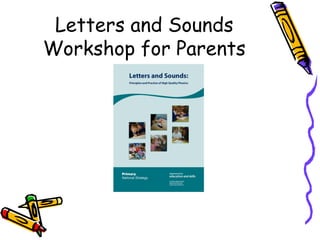
Letters and Sounds
Workshop for Parents
Learning Intentions
— To understand the importance of phonics.
— To get an idea of how phonics is taught BFS Naples.
— To understand the progression through phonic phases and
how to support and develop children’s learning.
— What can I do at home?
What is phonics?
Quite simply…
The sounds that make up
words!
Reading and writing are like a code:
phonics is one of the ways we teach the
child to crack the code of reading and
writing.
https://www.youtube.com/watch?v=wCLg
6DsYuyw
Why is teaching this way effective?
Phonics is important…but it is not the
ONLY element of reading!
• I use the pictures to help me.
• I use punctuation to help me make
sense of what I am reading.
• I go back and read a word or
sentence again if I don’t understand
it.
• I read on to see if I can work out the
meaning of a word I don’t know.
• Asking and answering questions.
PHONICS – key elements
• Correct pronunciation
• Correct vocabulary
• We all need to use the same
language at home and at school.
https://www.youtube.com/watch?v=EYx1
CyDMZSc
How to say the sounds.
Some Definitions
A Phoneme
This is the smallest
unit of sound in a
word.
How many phonemes can
you hear in
cat? (CVC)
GRAPHEME
• Letters representing a phoneme
e.g.
c ai igh
Children need to practise
recognising the grapheme and
saying the phoneme that it
represents.
Once children are good with
single phonemes…
• DIGRAPHS – 2 letters that make 1
sound
ll ss zz oa ai
• TRIGRAPHS – 3 letters that make 1
sound
igh dge
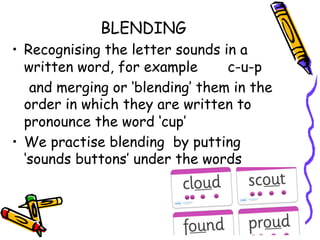
BLENDING
• Recognising the letter sounds in a
written word, for example c-u-p
and merging or ‘blending’ them in the
order in which they are written to
pronounce the word ‘cup’
• We practise blending by putting
‘sounds buttons’ under the words
Put the sound buttons under
these words
speed crayon
slight toast
broom foil
crawl jumper
Put the sound buttons under
these words
speed crayon
slight toast
broom foil
crawl jumper
SEGMENTING
• ‘Chopping Up’ the word to spell it out
• The opposite of blending
• Use your ‘ROBOT ARMS’ or ‘Phoneme
Fingers’.
https://www.youtube.com/watch?v=S8Pe
i0_joeE
Segmenting Activity
• Use your ‘robot arms’ to say how
many phonemes in each word.
• shelf
• dress
• sprint
• string
Did you get it right?
• shelf = sh – e – l – f = 4 phonemes
• dress = d - r - e – ss = 4 phonemes
• sprint = s – p – r – i – n – t = 6 phonemes
• string = s – t – r – i – ng = 5 phonemes
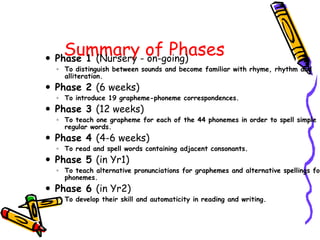
Summary of Phases
— Phase 1 (Nursery - on-going)
◦ To distinguish between sounds and become familiar with rhyme, rhythm and
alliteration.
— Phase 2 (6 weeks)
◦ To introduce 19 grapheme-phoneme correspondences.
— Phase 3 (12 weeks)
◦ To teach one grapheme for each of the 44 phonemes in order to spell simple
regular words.
— Phase 4 (4-6 weeks)
◦ To read and spell words containing adjacent consonants.
— Phase 5 (in Yr1)
◦ To teach alternative pronunciations for graphemes and alternative spellings for
phonemes.
— Phase 6 (in Yr2)
◦ To develop their skill and automaticity in reading and writing.
Phase 1
• Your child will be learning to:
– Have fun with sounds
– Listen carefully
– Develop their vocabulary
– Speak confidently to you, other adults and children
– Tune into sounds
– Listen and remember sounds
– Talk about sounds
– Understand that spoken words are made up of
different sounds
Phase 2
•Set 1: s, a, t, p
•Set 2: i, n, m, d
•Set 3: g, o, c, k
•Set 4: ck, e, u, r
•Set 5: h, b, f, ff, l, ll, ss
Phase 3
• Set 6: j, v, w, x
• Set 7: y, z, zz, qu
• Consonant digraphs: ch, sh,
th, ng
• Vowel digraphs: ai, ee, igh, oa,
oo, ar, or, ur, ow, oi, ear, air,
ure, er
Phase 4
•This phase consolidates
all the children have
learnt in the previous
phases.
Phase 5
• Children will be taught new
graphemes and alternative
pronunciations for these
graphemes.
• Vowel digraphs: wh, ph, ay, ou, ie,
ea, oy, ir, ue, aw, ew, oe, au
• Split digraphs: a_e, e_e, i_e,
o_e, u_e
Phase 6
• The focus is on learning spelling
rules for suffixes.
-s -es -ing -ed
-er -est -y -en
-ful -ly -ment -ness
What does a Phonics lesson
look like?
Revisit/review Flashcards to practice
phonemes learnt so far.
Teach Teach new phoneme air
Practice Buried treasure
Air, zair, fair, hair, lair, pair,
vair, sair, thair
Apply Read captions:
The goat had a long beard.
The quack was right in his ear.
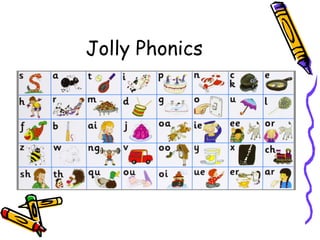
Jolly Phonics
TRICKY WORDS
• Words that are not phonically decodable
but they are also taught in the Letters and
Sounds scheme-don’t sound out!
e.g. was, the, they, come
• Some words are Key words in the early
stages of reading and may be given to
learn how to read and spell quickly.
What can I do at home?
• Just knowing some of this information will support you
when you are reading with your child. You will know
whether or not they are able to sound out a word or
whether you should tell them the word and help them be
more confident and fluent.
• Find out from your child’s teacher what phase they are
working on.
• Play rhyming games, read rhyming books-ask your child
what rhymes with?
• Play blending and segmenting games
• Notice words/letters in the environment.
• Talk about what is a word/letter /sentence and locate
• Play matching pairs – with key words or individual
sounds/pictures.
• Key words or tricky words on the stairs/bingo
• Clap syllables in words
• Flashcard letters and words – how quickly can they read
them?
Resources online
http://www.letters-and-sounds.com
http://www.ictgames.com
Education City
Any Questions?

Phonics-Presentation-For-Parents.pdf

  • 1.
  • 2.
    Learning Intentions — Tounderstand the importance of phonics. — To get an idea of how phonics is taught BFS Naples. — To understand the progression through phonic phases and how to support and develop children’s learning. — What can I do at home?
  • 3.
    What is phonics? Quitesimply… The sounds that make up words! Reading and writing are like a code: phonics is one of the ways we teach the child to crack the code of reading and writing.
  • 4.
  • 5.
    Phonics is important…butit is not the ONLY element of reading! • I use the pictures to help me. • I use punctuation to help me make sense of what I am reading. • I go back and read a word or sentence again if I don’t understand it. • I read on to see if I can work out the meaning of a word I don’t know. • Asking and answering questions.
  • 6.
    PHONICS – keyelements • Correct pronunciation • Correct vocabulary • We all need to use the same language at home and at school.
  • 7.
  • 8.
    Some Definitions A Phoneme Thisis the smallest unit of sound in a word. How many phonemes can you hear in cat? (CVC)
  • 9.
    GRAPHEME • Letters representinga phoneme e.g. c ai igh Children need to practise recognising the grapheme and saying the phoneme that it represents.
  • 10.
    Once children aregood with single phonemes… • DIGRAPHS – 2 letters that make 1 sound ll ss zz oa ai • TRIGRAPHS – 3 letters that make 1 sound igh dge
  • 11.
    BLENDING • Recognising theletter sounds in a written word, for example c-u-p and merging or ‘blending’ them in the order in which they are written to pronounce the word ‘cup’ • We practise blending by putting ‘sounds buttons’ under the words
  • 12.
    Put the soundbuttons under these words speed crayon slight toast broom foil crawl jumper
  • 13.
    Put the soundbuttons under these words speed crayon slight toast broom foil crawl jumper
  • 14.
    SEGMENTING • ‘Chopping Up’the word to spell it out • The opposite of blending • Use your ‘ROBOT ARMS’ or ‘Phoneme Fingers’. https://www.youtube.com/watch?v=S8Pe i0_joeE
  • 15.
    Segmenting Activity • Useyour ‘robot arms’ to say how many phonemes in each word. • shelf • dress • sprint • string
  • 16.
    Did you getit right? • shelf = sh – e – l – f = 4 phonemes • dress = d - r - e – ss = 4 phonemes • sprint = s – p – r – i – n – t = 6 phonemes • string = s – t – r – i – ng = 5 phonemes
  • 17.
    Summary of Phases —Phase 1 (Nursery - on-going) ◦ To distinguish between sounds and become familiar with rhyme, rhythm and alliteration. — Phase 2 (6 weeks) ◦ To introduce 19 grapheme-phoneme correspondences. — Phase 3 (12 weeks) ◦ To teach one grapheme for each of the 44 phonemes in order to spell simple regular words. — Phase 4 (4-6 weeks) ◦ To read and spell words containing adjacent consonants. — Phase 5 (in Yr1) ◦ To teach alternative pronunciations for graphemes and alternative spellings for phonemes. — Phase 6 (in Yr2) ◦ To develop their skill and automaticity in reading and writing.
  • 18.
    Phase 1 • Yourchild will be learning to: – Have fun with sounds – Listen carefully – Develop their vocabulary – Speak confidently to you, other adults and children – Tune into sounds – Listen and remember sounds – Talk about sounds – Understand that spoken words are made up of different sounds
  • 19.
    Phase 2 •Set 1:s, a, t, p •Set 2: i, n, m, d •Set 3: g, o, c, k •Set 4: ck, e, u, r •Set 5: h, b, f, ff, l, ll, ss
  • 20.
    Phase 3 • Set6: j, v, w, x • Set 7: y, z, zz, qu • Consonant digraphs: ch, sh, th, ng • Vowel digraphs: ai, ee, igh, oa, oo, ar, or, ur, ow, oi, ear, air, ure, er
  • 21.
    Phase 4 •This phaseconsolidates all the children have learnt in the previous phases.
  • 22.
    Phase 5 • Childrenwill be taught new graphemes and alternative pronunciations for these graphemes. • Vowel digraphs: wh, ph, ay, ou, ie, ea, oy, ir, ue, aw, ew, oe, au • Split digraphs: a_e, e_e, i_e, o_e, u_e
  • 23.
    Phase 6 • Thefocus is on learning spelling rules for suffixes. -s -es -ing -ed -er -est -y -en -ful -ly -ment -ness
  • 24.
    What does aPhonics lesson look like? Revisit/review Flashcards to practice phonemes learnt so far. Teach Teach new phoneme air Practice Buried treasure Air, zair, fair, hair, lair, pair, vair, sair, thair Apply Read captions: The goat had a long beard. The quack was right in his ear.
  • 25.
  • 26.
    TRICKY WORDS • Wordsthat are not phonically decodable but they are also taught in the Letters and Sounds scheme-don’t sound out! e.g. was, the, they, come • Some words are Key words in the early stages of reading and may be given to learn how to read and spell quickly.
  • 32.
    What can Ido at home? • Just knowing some of this information will support you when you are reading with your child. You will know whether or not they are able to sound out a word or whether you should tell them the word and help them be more confident and fluent. • Find out from your child’s teacher what phase they are working on. • Play rhyming games, read rhyming books-ask your child what rhymes with? • Play blending and segmenting games • Notice words/letters in the environment. • Talk about what is a word/letter /sentence and locate • Play matching pairs – with key words or individual sounds/pictures. • Key words or tricky words on the stairs/bingo • Clap syllables in words • Flashcard letters and words – how quickly can they read them?
  • 33.
  • 34.