Joan Heinsohn, Molly Sherer, Kim Zieroth, Mary Bahe
What is Phonemic Awareness?
                 (PA)

    The understanding, identifying,
    and manipulation of how sounds
    work in spoken words. (Put
    Reading First, pg. 2).
 
• This is an oral/spoken not written skill

• These sounds are called phonemes

• These oral sounds/phonemes can be
  combined to create spoken words
Wait a minute……
Is P h o n e m i c Aw are n e s s and
   P h o n o lo g i c al
Aw are n e s s the same thing?


                       OR
What is Phonological Awareness?
                (PoA)


The “identifying and manipulating larger
parts of spoken language, such as words,
syllables, and onsets and rimes, as well as
phonemes” (Put Reading First pg. 3).
Sub categories in POA-

• Rhymes – oral/spoken words

• Syllables – written words

• Onset – oral/spoken in syllables (words)
  – A sound before the vowel (ex. Chow – ch (/ch/)

• Individual Phonemes (FA) – oral/spoken words
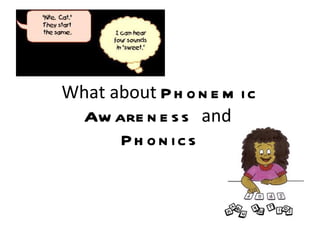
What about P h o n e m i c
 Aw are n e s s and
      Ph on ics
Phonemic Awareness                           Phonics
P H O N E M IC A W A R E N W S S          P H O N IC S


           Auditory                         Visual
       Speech based                       Print based
 Speech sounds to letters            Letters have sounds
         Phonemes                    Letter pronunciation
                                        Letter & word
 Phoneme discrimination
                                        identification
  Natural units of sounds          Artificial code (alphabet)
Why do we teach/expose students to
               PA?
      “PA predicts reading ability.”

• Helps Children learn to read-
  – Children need to hear the phonemes before they can
    link them to graphemes- otherwise they will struggle
    in reading
  – Improve Comprehension through fluency, decoding,
    and vocabulary
• Improves children’s spelling- through segmenting
  words into phonemes
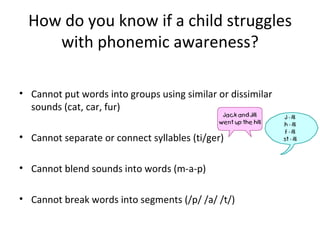
How do you know if a child struggles
     with phonemic awareness?

• Cannot put words into groups using similar or dissimilar
  sounds (cat, car, fur)

• Cannot separate or connect syllables (ti/ger)

• Cannot blend sounds into words (m-a-p)

• Cannot break words into segments (/p/ /a/ /t/)
T e a c h e r s n e e d t o b e a b le
    t o s e le c t a s s e s s m e n t
    me tho d s to ma tc h the
 k in d s o f in f o r m a t io n t h e y
• Word Identification
                      w a nt.
•    -DIBELS (Dynamic Indicators of Basic Early Literacy Skills)
•     *Initial Sounds Fluency
•         Given individually
•         Recognize & produce initial sound in an orally presented word
•           * Phoneme Segmentation Fluency
•         *Individual test
•         *Measures ability to segment 3 or 4 phoneme words into their
    individual
•          phonemes fluently
•    -Yopp Singer Phonemic Test (Also Spanish)
•         *Rubber band Stretch to model segmentation
• Comprehension: Running records, response to literature or print,
  reading conferences
•      -QRI (Qualitative Reading Inventory)
•      -DIBELS (Dynamic Indicators of Basic Early Literacy Skills)
•      -CELF (Clinical Evaluation of Language Fundamentals)
• Motivation: Shared reading, independent reading, read-alouds,
  surveys,
•      -CAP(Creative Assessment Packet)
•      -Reading Self-Concept Scale
• Montoring Progress
• *Students should be assessed 2-3 times per year until goal
  reached
• *Teacher monitor/record informally ( Ex.-student group chart with
  point system)
How can we work on phonemic
             awareness?
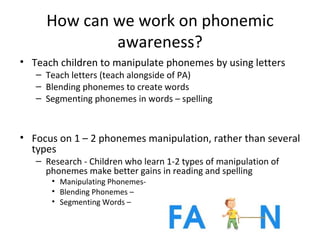
• Teach children to manipulate phonemes by using letters
   – Teach letters (teach alongside of PA)
   – Blending phonemes to create words
   – Segmenting phonemes in words – spelling


• Focus on 1 – 2 phonemes manipulation, rather than several
  types
   – Research - Children who learn 1-2 types of manipulation of
     phonemes make better gains in reading and spelling
      • Manipulating Phonemes-
      • Blending Phonemes –
      • Segmenting Words –
How should we teach PA?
• Small Group Direct and Explicit Instruction-
  – Feedback from teacher and classmates
• At Instructional level of students
• Skill Activities –
  – Identifying Phonemes
     • Guess the name game
  – Categorize Phonemes
     • Odd word out
     • Who goes together
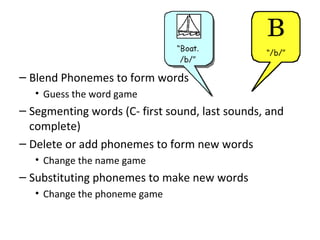
– Blend Phonemes to form words
   • Guess the word game
– Segmenting words (C- first sound, last sounds, and
  complete)
– Delete or add phonemes to form new words
   • Change the name game
– Substituting phonemes to make new words
   • Change the phoneme game

Phonemic Awareness

  • 1.
    Joan Heinsohn, MollySherer, Kim Zieroth, Mary Bahe
  • 2.
    What is PhonemicAwareness? (PA) The understanding, identifying, and manipulation of how sounds work in spoken words. (Put Reading First, pg. 2).  
  • 3.
    • This isan oral/spoken not written skill • These sounds are called phonemes • These oral sounds/phonemes can be combined to create spoken words
  • 4.
    Wait a minute…… IsP h o n e m i c Aw are n e s s and P h o n o lo g i c al Aw are n e s s the same thing? OR
  • 5.
    What is PhonologicalAwareness? (PoA) The “identifying and manipulating larger parts of spoken language, such as words, syllables, and onsets and rimes, as well as phonemes” (Put Reading First pg. 3).
  • 6.
    Sub categories inPOA- • Rhymes – oral/spoken words • Syllables – written words • Onset – oral/spoken in syllables (words) – A sound before the vowel (ex. Chow – ch (/ch/) • Individual Phonemes (FA) – oral/spoken words
  • 7.
    What about Ph o n e m i c Aw are n e s s and Ph on ics
  • 8.
    Phonemic Awareness Phonics P H O N E M IC A W A R E N W S S P H O N IC S Auditory Visual Speech based Print based Speech sounds to letters Letters have sounds Phonemes Letter pronunciation Letter & word Phoneme discrimination identification Natural units of sounds Artificial code (alphabet)
  • 9.
    Why do weteach/expose students to PA? “PA predicts reading ability.” • Helps Children learn to read- – Children need to hear the phonemes before they can link them to graphemes- otherwise they will struggle in reading – Improve Comprehension through fluency, decoding, and vocabulary • Improves children’s spelling- through segmenting words into phonemes
  • 10.
    How do youknow if a child struggles with phonemic awareness? • Cannot put words into groups using similar or dissimilar sounds (cat, car, fur) • Cannot separate or connect syllables (ti/ger) • Cannot blend sounds into words (m-a-p) • Cannot break words into segments (/p/ /a/ /t/)
  • 12.
    T e ac h e r s n e e d t o b e a b le t o s e le c t a s s e s s m e n t me tho d s to ma tc h the k in d s o f in f o r m a t io n t h e y • Word Identification w a nt. • -DIBELS (Dynamic Indicators of Basic Early Literacy Skills) • *Initial Sounds Fluency • Given individually • Recognize & produce initial sound in an orally presented word • * Phoneme Segmentation Fluency • *Individual test • *Measures ability to segment 3 or 4 phoneme words into their individual • phonemes fluently • -Yopp Singer Phonemic Test (Also Spanish) • *Rubber band Stretch to model segmentation
  • 13.
    • Comprehension: Runningrecords, response to literature or print, reading conferences • -QRI (Qualitative Reading Inventory) • -DIBELS (Dynamic Indicators of Basic Early Literacy Skills) • -CELF (Clinical Evaluation of Language Fundamentals) • Motivation: Shared reading, independent reading, read-alouds, surveys, • -CAP(Creative Assessment Packet) • -Reading Self-Concept Scale • Montoring Progress • *Students should be assessed 2-3 times per year until goal reached • *Teacher monitor/record informally ( Ex.-student group chart with point system)
  • 14.
    How can wework on phonemic awareness? • Teach children to manipulate phonemes by using letters – Teach letters (teach alongside of PA) – Blending phonemes to create words – Segmenting phonemes in words – spelling • Focus on 1 – 2 phonemes manipulation, rather than several types – Research - Children who learn 1-2 types of manipulation of phonemes make better gains in reading and spelling • Manipulating Phonemes- • Blending Phonemes – • Segmenting Words –
  • 15.
    How should weteach PA? • Small Group Direct and Explicit Instruction- – Feedback from teacher and classmates • At Instructional level of students • Skill Activities – – Identifying Phonemes • Guess the name game – Categorize Phonemes • Odd word out • Who goes together
  • 16.
    – Blend Phonemesto form words • Guess the word game – Segmenting words (C- first sound, last sounds, and complete) – Delete or add phonemes to form new words • Change the name game – Substituting phonemes to make new words • Change the phoneme game