Downloaded 44 times
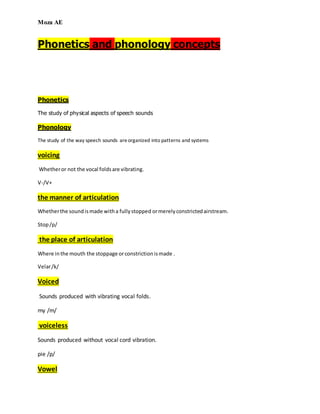
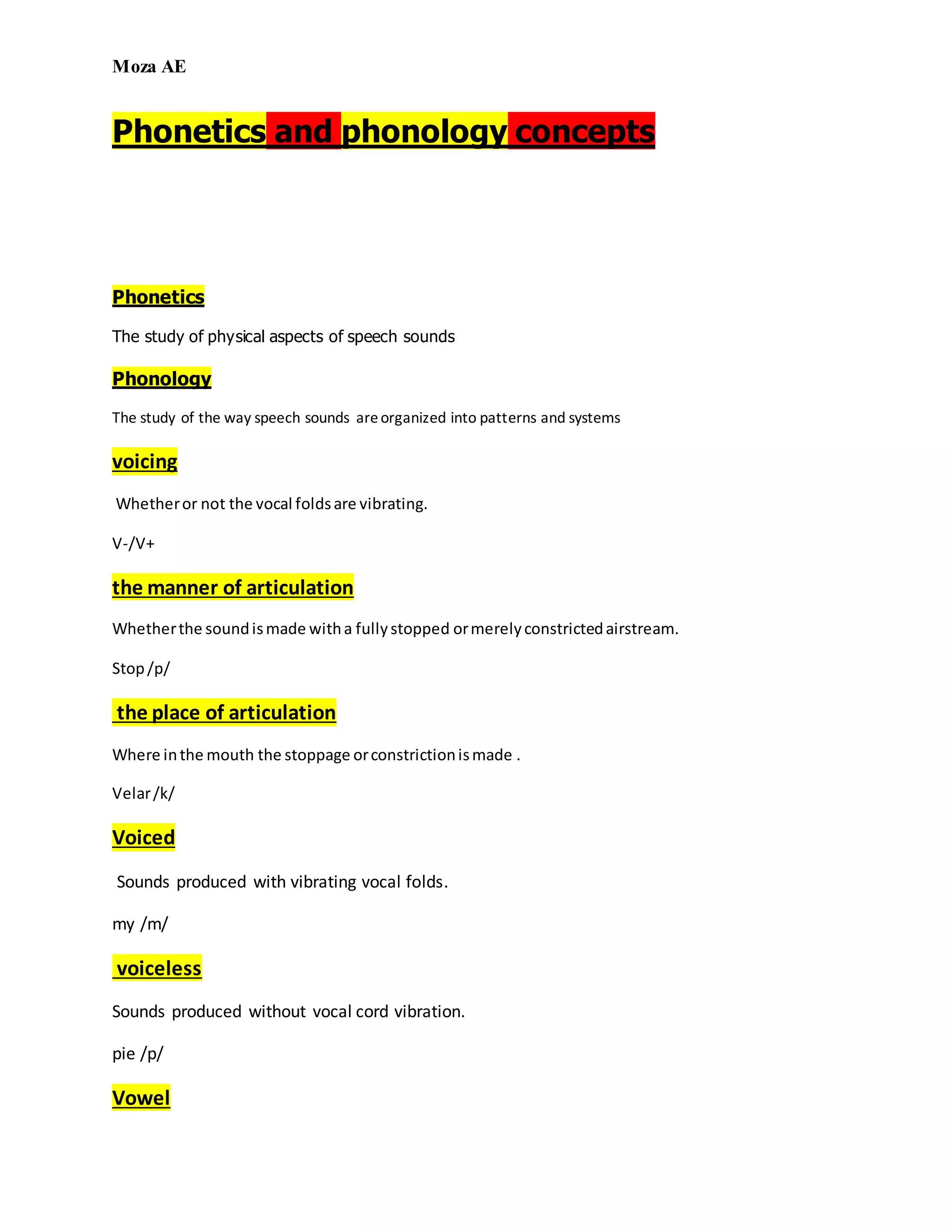
![Moza AE
speech sound produced by humans when the breath flows out through the mouth without
being blocked by the teeth, tongue, or lips.
/e/
Diphthong
a vowel sound in which the tongue changes position to produce the sound of two vowels.
/ei/
phoneme
the smallest contrastive unit in the sound system of a language.
/h/
allophone
a phonetic variant of a phoneme in a particular language.
[p] and [ph] are allophones of the phoneme /p/
SYLLABLE:
A syllable is a sound, or group of sounds, produced by a single chest pulse and containing a
vowel.
Too /tu:/ is one syllable
Consonant
a speech sound which is pronounced by stopping the air fromflowing easily
through the mouth.
[b],
Cluster](https://image.slidesharecdn.com/phonetic-170130154333/85/Phonetic-and-phonology-concepts-2-320.jpg)
![Moza AE
when two consonants of different places of articulation are produced together in the same
syllable.
blue /blu:/
homophone
a word that has sounds the same as another, but will have different spelling and meaning.
(Knight- Night / Here –Hear)
Homographs
are words that are SPELLED the same, but have DIFFERENT meanings.
(Tear-Tear)
Bilabial
sounds are made by bringing both lips together to stop the airstream
[b] by clubbing cub
Labiodental
sounds are made by bringing the top teeth into contact with
the bottom lip and forcing air between the two to create the fricatives.
[f] feel raffle tough
dental
sounds are made by placing the tip of the tongue between
the top and bottom teeth and forcing air through. Again, these are both
fricatives
[T] thigh ether mouth bath (noun)](https://image.slidesharecdn.com/phonetic-170130154333/85/Phonetic-and-phonology-concepts-3-320.jpg)
![Moza AE
Alveolar
sounds are made by bringing the tongue and the alveolar ridge
(the bony ridge just behind the top teeth) together to create either a stop or
Fricative
[t] tub boating boat [s] sip fussy grace
palatal
sounds are made by bringing the blade of the tongue to,
or close to, the alveo-palatal area of the roof of the mouth to create fricatives
and affricates:
[d3] gin edger edge
Velar
sounds are created by stopping the airstream by bringing the back
of the tongue into contact with the velum:
[g] good bagger tug
Glottal
sounds are created by either narrowing the vocal folds sufficiently
to create a fricative or closing them to create a stop:
[h] hat cahoots [?] butter.
stops
full stoppage of the airstream somewhere
in the oral cavity between the vocal folds and the lips
[p], [b],[m])](https://image.slidesharecdn.com/phonetic-170130154333/85/Phonetic-and-phonology-concepts-4-320.jpg)
![Moza AE
fricatives
constriction of the airstream in the oral cavity producing
turbulence and noise
[f], [v]
affricates
full stoppage of the airstream followed immediately by constriction
[tS]](https://image.slidesharecdn.com/phonetic-170130154333/85/Phonetic-and-phonology-concepts-5-320.jpg)

This document provides an overview of key concepts in phonetics and phonology. It defines phonetics as the study of physical aspects of speech sounds and phonology as how speech sounds are organized into patterns and systems. It discusses concepts like voicing, manner and place of articulation, vowels, diphthongs, phonemes, allophones, syllables, consonants, consonant clusters, homophones, homographs, and places and manners of articulation including bilabial, labiodental, dental, alveolar, palatal, velar, and glottal. It provides examples for each concept.


