PHONETICS
Dr. V. Sabariraja
Head, Department of English,
Shri Nehru Maha Vidyalaya College of Arts and Science,
Coimbatore
Phonetics:
The Sounds of Language
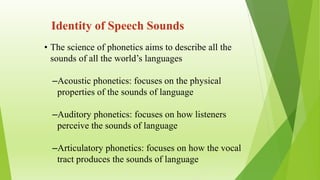
Identity of Speech Sounds
• The science of phonetics aims to describe all the
sounds of all the world’s languages
–Acoustic phonetics: focuses on the physical
properties of the sounds of language
–Auditory phonetics: focuses on how listeners
perceive the sounds of language
–Articulatory phonetics: focuses on how the vocal
tract produces the sounds of language
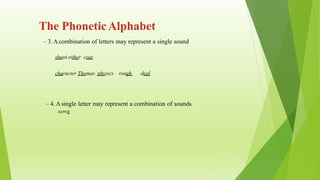
The PhoneticAlphabet
– 3.Acombination of letters may represent a single sound
shoot either coat
character Thomas physics rough deal
– 4. Asingle letter may represent a combination of sounds
xerox
The PhoneticAlphabet
• In 1888 the International Phonetic Alphabet
(IPA) was invented in order to have a system in
which there was a one- to-one correspondence
between each sound in language and each
phonetic symbol
• Someone who knows the IPAknows how to
pronounce any word in any language
Sound Segments
• Knowing a language includes knowing the sounds of that
language
• Phonetics is the study of speech sounds
• We are able to segment a continuous stream of speech into
distinct parts and recognize the parts in other words
• Everyone who knows a language knows how to segment
sentences into words and words into sounds
Identity of Speech Sounds
• Our linguistic knowledge allows us to ignore
nonlinguistic differences in speech (such as individual
pitch levels, rates of speed, coughs)
• We are capable of making sounds that are not speech
sounds in English but are in other languages
– tsk that signals disapproval in English is a speech sound
in languages such as Xhosa and Zulu where it is
combined with other sounds just like t or k is in English
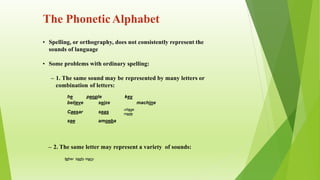
The PhoneticAlphabet
• Spelling, or orthography, does not consistently represent the
sounds of language
• Some problems with ordinary spelling:
– 1. The same sound may be represented by many letters or
combination of letters:
he people key
believe seize machine
Caesar seas
see amoeba
– 2. The same letter may represent a variety of sounds:
village
made
father badly many
The Phonetic Alphabet
– 4. Some letters in a word may not be
pronounced at all
autumn
pterodactyl
psychology
sword
lamb
write
resign
corps
knot
– 5. There may be no letter to represent a
sound that occurs in a word
cute
use
The PhoneticAlphabet
• Dialectal and individual differences affect
pronunciation, but the sounds of English are:
The Phonetic Alphabet
• Using IPA symbols, we can now represent the pronunciation
of words unambiguously:
Articulatory Phonetics
 Most speech sounds are produced by pushing air through the vocal cords
– Glottis = the opening between the vocal cords
– Larynx = ‘voice box’
– Pharynx = tubular part of the throat above the larynx
– Oral cavity = mouth
– Nasal cavity = nose and the passages connecting it to the throat and sinuses
Consonants: Place of Articulation
• Consonants are sounds produced with some restriction
or closure in the vocal tract
• Consonants are classified based in part on where in
the vocal tract the airflow is being restricted (the
place of articulation)
• The major places of articulation are:
bilabial, labiodental, interdental, alveolar, palatal,
velar, uvular, and glottal
Consonants: Place of Articulation
• Bilabials: [p] [b] [m]
– Produced by bringing both lips together
• Labiodentals: [f] [v]
– Produced by touching the bottom lip to the upper teeth
• Interdentals [θ] [ð]
– Produced by putting the tip of the tongue between the teeth
Consonants: Place of Articulation
• Alveolars: [t] [d] [n] [s] [z] [l] [r]
– All of these are produced by raising the tongue to the alveolar ridge in
some way
• [t, d, n]: produced by the tip of the tongue touching the alveolar
ridge (or just in front of it)
• [s, z]: produced with the sides of the front of the tongue raised but the
tip lowered to allow air to escape
• [l]: the tongue tip is raised while the rest of the tongue remains down so
air can escape over the sides of the tongue (thus [l] is a lateral sound)
• [r]: air escapes through the central part of the mouth; either the tip of
the tongue is curled back behind the alveolar ridge or the top of the
tongue is bunched up behind the alveolar ridge
Consonants: Place of Articulation
• Palatals: [ʃ] [ʒ] [ʧ] [ʤ][ʝ]
– Produced by raising the front part of the tongue to the palate
• Velars: [k] [g] [ŋ]
– Produced by raising the back of the tongue to the soft palate or velum
• Uvulars: [ʀ] [q] [ɢ]
– Produced by raising the back of the tongue to the uvula
• Glottals: [h] [Ɂ]
– Produced by restricting the airflow through the open glottis ([h]) or by
stopping the air completely at the glottis (a glottal stop: [Ɂ])
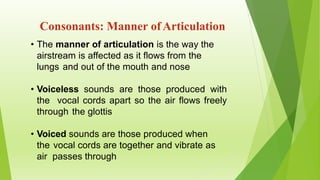
Consonants: Manner of Articulation
• The manner of articulation is the way the
airstream is affected as it flows from the
lungs and out of the mouth and nose
• Voiceless sounds are those produced with
the vocal cords apart so the air flows freely
through the glottis
• Voiced sounds are those produced when
the vocal cords are together and vibrate as
air passes through
Consonants: Manner of Articulation
• The voiced/voiceless distinction is important in
English because it helps us distinguish words like:
rope/robe
[rop]/[rob]
fine/vine
[faɪn]/[vaɪn]
seal/zeal
[sil]/[zil]
• But some voiceless sounds can be further
distinguished as aspirated or unaspirated
aspirated unaspirated
pool [phul]
tale
kale
[thel]
[khel]
spool
stale
scale
[spul]
[stel]
[skel]
Consonants: Manner of Articulation
• Oral sounds are those produced with the velum raised to prevent air from
escaping out the nose
• Nasal sounds are those produced with the velum lowered to allow air
to escape out the nose
• So far we have three ways of classifying sounds based on phonetic
features: by voicing, by place of articulation, and by nasalization
– [p] is a voiceless, bilabial, oral sound
– [n] is a voiced, alveolar, nasal sound
Consonants: Manner of Articulation
• Stops: [p] [b] [m] [t] [d] [n] [k] [g] [ŋ] [ʧ][ʤ] [Ɂ]
–Produced by completely stopping the air flow in the
oral cavity for a fraction of a second
•All other sounds are continuants, meaning that the
airflow is continuous through the oral cavity
• Fricatives: [f] [v] [θ] [ð] [s] [z] [ʃ] [ʒ] [x] [ɣ] [h]
–Produced by severely obstructing the airflow so as to
cause friction
Consonants: Manner of Articulation
• Affricates: [ʧ] [ʤ]
–Produced by a stop closure that is released with a lot of
friction
• Liquids: [l] [r]
–Produced by causing some obstruction of the airstream in
the mouth, but not enough to cause any real friction
• Glides: [j] [w]
–Produced with very little obstruction of the airstream and
are always followed by a vowel
Consonants: Manner of Articulation
• Approximants: [w] [j] [r] [l]
– Sometimes liquids and glides are put together into one category because the
articulators approximate a frictional closeness but do not actually cause
friction
• Trills and flaps: [r]* [ɾ]
– Trills are produced by rapidly vibrating an articulator
– Flaps are produced by a flick of the tongue against the alveolar ridge
• Clicks:
– Produced by moving air in the mouth between various articulators
– The disapproving sound tsk in English is a consonant in Zulu and some
other southern African languages
– The lateral click used to encourage a horse in English is a consonant in
Xhosa
*The textbook uses [r] to represent the central liquid as in the word ready rather than as a trill
Vowels
• Vowels are classified by how high or low the tongue is, if the
tongue is in the front or back of the mouth, and whether or not
the lips are rounded
• High vowels: [i] [ɪ] [u] [ʊ]
• Mid vowels: [e] [ɛ] [o] [ə] [ʌ] [ɔ]
• Low vowels: [æ] [a]
• Front vowels: [i] [ɪ] [e] [ɛ] [æ]
• Central vowels: [ə] [ʌ]
• Back vowels: [u] [ɔ] [o] [æ] [a]
Vowels
Vowels
• Round vowels: [u] [ʊ] [o] [ɔ]
– Produced by rounding the lips
– English has only back round vowels, but other languages such as French and
Swedish have front round vowels
• Diphthongs: [aɪ] [aʊ] [ɔɪ]
– A sequence of two vowel sounds (as opposed to the monophthongs we have
looked at so far)
• Nasalization:
– Vowels can also be pronounced with a lowered velum, allowing air to pass
through the nose
– In English, speakers nasalize vowels before a nasal sound, such as in the words
beam, bean, and bingo
– The nasalization is represented by a diacritic, an extra mark placed with the
symbol:
Vowels
• Tense vowels:
–Are produced with
greater tension in the tongue
–May occur at the end of words
• Lax vowels:
–Are produced with less tongue tension
–May not occur at the end of words
Vowels
Major Phonetic Classes
• Noncontinuants: the airstream is totally obstructed in the oral cavity
– Stops and affricates
• Continuants: the airstream flows continuously out of the mouth
– All other consonants and vowels
• Obstruents: the airstream has partial or full obstruction
– Non-nasal stops, fricatives, and affricates
• Sonorants: air resonates in the nasal or oral cavities
– Vowels, nasal stops, liquids, and glides
Major Phonetic Classes: Consonantal
• Consonantal: there is some restriction of the airflow during
articulation
– All consonants except glides
• Consonantal sounds can be further subdivided:
– Labials: [p] [b] [m] [f] [v] [w] [ʍ]
• Articulated with the lips
– Coronals: [θ] [ð] [t] [d] [n] [s] [z] [ʃ] [ʒ] [ʧ][ʤ] [l] [r]
• Articulated by raising the tongue blade
Major Phonetic Classes
• Consonantal categories cont.:
– Anteriors: [p] [b] [m] [f] [v] [θ] [ð] [t] [d] [n] [s] [z]
•Produced in the front part of the mouth (from the alveolar
area forward)
–Sibilants: [s] [z] ] [ʃ] [ʒ] [ʧ][ʤ]
•Produced with a lot of friction that causes a hissing sound,
which is a mixture of high-‐frequency sounds
• Syllabic Sounds: sounds that can function as the core of a
syllable
– Vowels, liquids, and nasals
Prosodic Features
• Prosodic, or suprasegmental features of sounds, such as
length, stress and pitch, are features above the segmental
values such as place and manner of articulation
• Length: in some languages, such as Japanese, the length of
a consonant or a vowel can change the meaning of a word:
– biru [biru] “building”
– saki [saki] “ahead”
biiru [biːru] “beer”
sakki [sakːi] “before”
Prosodic Features
• Stress: stressed syllables are louder, slightly higher in pitch, and
somewhat longer than unstressed syllables
–The noun digest has the stress on the first syllable
–The verb digest has the stress on the second syllable
–English is a stress-timed language, meaning that at least one
syllable is stressed in an English word
•French functions differently, so when English speakers learn
French they put stress on certain syllables which contributes to
their foreign accent
Tone and Intonation
• Tone languages are languages that use pitch to
contrast the meaning of words
•For example, in Thai, the string of sounds [naː]
can be said with 5 different pitches and can thus
have 5 different meanings:
Tone and Intonation
• Intonation languages (like English) have varied pitch
contour across an utterance, but pitch is not used to
distinguish words
–However, intonation may affect the meaning of a whole
sentence:
•John is here said with falling intonation is a statement
•John is here said with rising intonation is a question
Phonetics of Signed Languages
• Signs can be broken down into segmental features similar to the phonetic features of
speech sounds (such as place and manner of articulation)
– And just like spoken languages, signed languages of the world vary in these features
– Signs are formed by three major features:
• 1. The configuration of the hand (handshape)
• 2. The movement of the hand and arm towards or away from the body
• 3. The location of the hand in signing space
• The configuration of the hand (handshape)
• The movement of the hand and arm
• The location of the hand in signing space
“I ASPIRE TO BE A GIVER.
A GIVER OF LOVE,
A GIVER OF VIBES,
A GIVER OF STRENGTH”
Consultation
Dr. V. SABARIRAJA
SOFT SKILL, IELTS, TOEFL, PTE & GRE
Contact : 9942162643
Email: sabari_lit@yahoo.co.in
https://www.linkedin.com/in/sabari-raja-67239524
https://www.facebook.com/sabulit
https://www.instagram.com/sabarienglish/

Phonetics.pptx

  • 1.
    PHONETICS Dr. V. Sabariraja Head,Department of English, Shri Nehru Maha Vidyalaya College of Arts and Science, Coimbatore
  • 5.
  • 6.
    Identity of SpeechSounds • The science of phonetics aims to describe all the sounds of all the world’s languages –Acoustic phonetics: focuses on the physical properties of the sounds of language –Auditory phonetics: focuses on how listeners perceive the sounds of language –Articulatory phonetics: focuses on how the vocal tract produces the sounds of language
  • 7.
    The PhoneticAlphabet – 3.Acombinationof letters may represent a single sound shoot either coat character Thomas physics rough deal – 4. Asingle letter may represent a combination of sounds xerox
  • 8.
    The PhoneticAlphabet • In1888 the International Phonetic Alphabet (IPA) was invented in order to have a system in which there was a one- to-one correspondence between each sound in language and each phonetic symbol • Someone who knows the IPAknows how to pronounce any word in any language
  • 9.
    Sound Segments • Knowinga language includes knowing the sounds of that language • Phonetics is the study of speech sounds • We are able to segment a continuous stream of speech into distinct parts and recognize the parts in other words • Everyone who knows a language knows how to segment sentences into words and words into sounds
  • 10.
    Identity of SpeechSounds • Our linguistic knowledge allows us to ignore nonlinguistic differences in speech (such as individual pitch levels, rates of speed, coughs) • We are capable of making sounds that are not speech sounds in English but are in other languages – tsk that signals disapproval in English is a speech sound in languages such as Xhosa and Zulu where it is combined with other sounds just like t or k is in English
  • 11.
    The PhoneticAlphabet • Spelling,or orthography, does not consistently represent the sounds of language • Some problems with ordinary spelling: – 1. The same sound may be represented by many letters or combination of letters: he people key believe seize machine Caesar seas see amoeba – 2. The same letter may represent a variety of sounds: village made father badly many
  • 12.
    The Phonetic Alphabet –4. Some letters in a word may not be pronounced at all autumn pterodactyl psychology sword lamb write resign corps knot – 5. There may be no letter to represent a sound that occurs in a word cute use
  • 13.
    The PhoneticAlphabet • Dialectaland individual differences affect pronunciation, but the sounds of English are:
  • 14.
    The Phonetic Alphabet •Using IPA symbols, we can now represent the pronunciation of words unambiguously:
  • 15.
    Articulatory Phonetics  Mostspeech sounds are produced by pushing air through the vocal cords – Glottis = the opening between the vocal cords – Larynx = ‘voice box’ – Pharynx = tubular part of the throat above the larynx – Oral cavity = mouth – Nasal cavity = nose and the passages connecting it to the throat and sinuses
  • 16.
    Consonants: Place ofArticulation • Consonants are sounds produced with some restriction or closure in the vocal tract • Consonants are classified based in part on where in the vocal tract the airflow is being restricted (the place of articulation) • The major places of articulation are: bilabial, labiodental, interdental, alveolar, palatal, velar, uvular, and glottal
  • 17.
  • 18.
    Consonants: Place ofArticulation • Bilabials: [p] [b] [m] – Produced by bringing both lips together • Labiodentals: [f] [v] – Produced by touching the bottom lip to the upper teeth • Interdentals [θ] [ð] – Produced by putting the tip of the tongue between the teeth
  • 19.
    Consonants: Place ofArticulation • Alveolars: [t] [d] [n] [s] [z] [l] [r] – All of these are produced by raising the tongue to the alveolar ridge in some way • [t, d, n]: produced by the tip of the tongue touching the alveolar ridge (or just in front of it) • [s, z]: produced with the sides of the front of the tongue raised but the tip lowered to allow air to escape • [l]: the tongue tip is raised while the rest of the tongue remains down so air can escape over the sides of the tongue (thus [l] is a lateral sound) • [r]: air escapes through the central part of the mouth; either the tip of the tongue is curled back behind the alveolar ridge or the top of the tongue is bunched up behind the alveolar ridge
  • 20.
    Consonants: Place ofArticulation • Palatals: [ʃ] [ʒ] [ʧ] [ʤ][ʝ] – Produced by raising the front part of the tongue to the palate • Velars: [k] [g] [ŋ] – Produced by raising the back of the tongue to the soft palate or velum • Uvulars: [ʀ] [q] [ɢ] – Produced by raising the back of the tongue to the uvula • Glottals: [h] [Ɂ] – Produced by restricting the airflow through the open glottis ([h]) or by stopping the air completely at the glottis (a glottal stop: [Ɂ])
  • 21.
    Consonants: Manner ofArticulation • The manner of articulation is the way the airstream is affected as it flows from the lungs and out of the mouth and nose • Voiceless sounds are those produced with the vocal cords apart so the air flows freely through the glottis • Voiced sounds are those produced when the vocal cords are together and vibrate as air passes through
  • 22.
    Consonants: Manner ofArticulation • The voiced/voiceless distinction is important in English because it helps us distinguish words like: rope/robe [rop]/[rob] fine/vine [faɪn]/[vaɪn] seal/zeal [sil]/[zil] • But some voiceless sounds can be further distinguished as aspirated or unaspirated aspirated unaspirated pool [phul] tale kale [thel] [khel] spool stale scale [spul] [stel] [skel]
  • 23.
    Consonants: Manner ofArticulation • Oral sounds are those produced with the velum raised to prevent air from escaping out the nose • Nasal sounds are those produced with the velum lowered to allow air to escape out the nose • So far we have three ways of classifying sounds based on phonetic features: by voicing, by place of articulation, and by nasalization – [p] is a voiceless, bilabial, oral sound – [n] is a voiced, alveolar, nasal sound
  • 24.
    Consonants: Manner ofArticulation • Stops: [p] [b] [m] [t] [d] [n] [k] [g] [ŋ] [ʧ][ʤ] [Ɂ] –Produced by completely stopping the air flow in the oral cavity for a fraction of a second •All other sounds are continuants, meaning that the airflow is continuous through the oral cavity • Fricatives: [f] [v] [θ] [ð] [s] [z] [ʃ] [ʒ] [x] [ɣ] [h] –Produced by severely obstructing the airflow so as to cause friction
  • 25.
    Consonants: Manner ofArticulation • Affricates: [ʧ] [ʤ] –Produced by a stop closure that is released with a lot of friction • Liquids: [l] [r] –Produced by causing some obstruction of the airstream in the mouth, but not enough to cause any real friction • Glides: [j] [w] –Produced with very little obstruction of the airstream and are always followed by a vowel
  • 26.
    Consonants: Manner ofArticulation • Approximants: [w] [j] [r] [l] – Sometimes liquids and glides are put together into one category because the articulators approximate a frictional closeness but do not actually cause friction • Trills and flaps: [r]* [ɾ] – Trills are produced by rapidly vibrating an articulator – Flaps are produced by a flick of the tongue against the alveolar ridge • Clicks: – Produced by moving air in the mouth between various articulators – The disapproving sound tsk in English is a consonant in Zulu and some other southern African languages – The lateral click used to encourage a horse in English is a consonant in Xhosa *The textbook uses [r] to represent the central liquid as in the word ready rather than as a trill
  • 29.
    Vowels • Vowels areclassified by how high or low the tongue is, if the tongue is in the front or back of the mouth, and whether or not the lips are rounded • High vowels: [i] [ɪ] [u] [ʊ] • Mid vowels: [e] [ɛ] [o] [ə] [ʌ] [ɔ] • Low vowels: [æ] [a] • Front vowels: [i] [ɪ] [e] [ɛ] [æ] • Central vowels: [ə] [ʌ] • Back vowels: [u] [ɔ] [o] [æ] [a]
  • 30.
  • 31.
    Vowels • Round vowels:[u] [ʊ] [o] [ɔ] – Produced by rounding the lips – English has only back round vowels, but other languages such as French and Swedish have front round vowels • Diphthongs: [aɪ] [aʊ] [ɔɪ] – A sequence of two vowel sounds (as opposed to the monophthongs we have looked at so far) • Nasalization: – Vowels can also be pronounced with a lowered velum, allowing air to pass through the nose – In English, speakers nasalize vowels before a nasal sound, such as in the words beam, bean, and bingo – The nasalization is represented by a diacritic, an extra mark placed with the symbol:
  • 32.
    Vowels • Tense vowels: –Areproduced with greater tension in the tongue –May occur at the end of words • Lax vowels: –Are produced with less tongue tension –May not occur at the end of words
  • 33.
  • 34.
    Major Phonetic Classes •Noncontinuants: the airstream is totally obstructed in the oral cavity – Stops and affricates • Continuants: the airstream flows continuously out of the mouth – All other consonants and vowels • Obstruents: the airstream has partial or full obstruction – Non-nasal stops, fricatives, and affricates • Sonorants: air resonates in the nasal or oral cavities – Vowels, nasal stops, liquids, and glides
  • 35.
    Major Phonetic Classes:Consonantal • Consonantal: there is some restriction of the airflow during articulation – All consonants except glides • Consonantal sounds can be further subdivided: – Labials: [p] [b] [m] [f] [v] [w] [ʍ] • Articulated with the lips – Coronals: [θ] [ð] [t] [d] [n] [s] [z] [ʃ] [ʒ] [ʧ][ʤ] [l] [r] • Articulated by raising the tongue blade
  • 36.
    Major Phonetic Classes •Consonantal categories cont.: – Anteriors: [p] [b] [m] [f] [v] [θ] [ð] [t] [d] [n] [s] [z] •Produced in the front part of the mouth (from the alveolar area forward) –Sibilants: [s] [z] ] [ʃ] [ʒ] [ʧ][ʤ] •Produced with a lot of friction that causes a hissing sound, which is a mixture of high-‐frequency sounds • Syllabic Sounds: sounds that can function as the core of a syllable – Vowels, liquids, and nasals
  • 37.
    Prosodic Features • Prosodic,or suprasegmental features of sounds, such as length, stress and pitch, are features above the segmental values such as place and manner of articulation • Length: in some languages, such as Japanese, the length of a consonant or a vowel can change the meaning of a word: – biru [biru] “building” – saki [saki] “ahead” biiru [biːru] “beer” sakki [sakːi] “before”
  • 38.
    Prosodic Features • Stress:stressed syllables are louder, slightly higher in pitch, and somewhat longer than unstressed syllables –The noun digest has the stress on the first syllable –The verb digest has the stress on the second syllable –English is a stress-timed language, meaning that at least one syllable is stressed in an English word •French functions differently, so when English speakers learn French they put stress on certain syllables which contributes to their foreign accent
  • 39.
    Tone and Intonation •Tone languages are languages that use pitch to contrast the meaning of words •For example, in Thai, the string of sounds [naː] can be said with 5 different pitches and can thus have 5 different meanings:
  • 40.
    Tone and Intonation •Intonation languages (like English) have varied pitch contour across an utterance, but pitch is not used to distinguish words –However, intonation may affect the meaning of a whole sentence: •John is here said with falling intonation is a statement •John is here said with rising intonation is a question
  • 41.
    Phonetics of SignedLanguages • Signs can be broken down into segmental features similar to the phonetic features of speech sounds (such as place and manner of articulation) – And just like spoken languages, signed languages of the world vary in these features – Signs are formed by three major features: • 1. The configuration of the hand (handshape) • 2. The movement of the hand and arm towards or away from the body • 3. The location of the hand in signing space • The configuration of the hand (handshape) • The movement of the hand and arm • The location of the hand in signing space
  • 42.
    “I ASPIRE TOBE A GIVER. A GIVER OF LOVE, A GIVER OF VIBES, A GIVER OF STRENGTH”
  • 43.
  • 44.
    Dr. V. SABARIRAJA SOFTSKILL, IELTS, TOEFL, PTE & GRE Contact : 9942162643 Email: sabari_lit@yahoo.co.in https://www.linkedin.com/in/sabari-raja-67239524 https://www.facebook.com/sabulit https://www.instagram.com/sabarienglish/