Lecture 2
Laith Al-Asadi
Interpretation of prescription
 Prescription is an order for medication issued by a
physician, dentist, or other properly licensed medical
practitioner. A prescription designates a specific
medication and dosage to be prepared by a pharmacist
and administered to a particular patient.
Prescription
 A prescription is usually written on preprinted forms
containing the traditional symbol (meaning ‘‘recipe,’’
‘‘take thou,’’ or ‘‘you take’’), name, address, telephone
number, and other pertinent information regarding the
physician or other prescriber
 In addition, blank spaces are used by the prescriber to
provide information about the patient, the
medication desired, and the directions for use.
 A prescription written by a veterinarian generally
includes the animal species and/ or pet’s name and the
name of the owner.
Prescription
 A written prescription may be presented at the
pharmacy by the patient or caregiver, or it may be
transmitted from the prescriber by telephone or by
other electronic means.
 In the latter instances, the pharmacist immediately
reduces the order to a properly written form or
computer entry.
Types of prescription
Two broad categories of prescriptions:
 (1) those written for a single component or
prefabricated product and not requiring compounding
or admixture by the pharmacist, and
 (2) those written for more than a single component
and requiring compounding.
Prescription contents
 A prescription may include the chemical or generic name
of the substance or the manufacturer’s brand or
trademark name.
 Prescriptions requiring compounding contain the
quantities of each ingredient required. Medications are
prepared into various types of dosage forms (e.g., tablets,
syrups, injections)
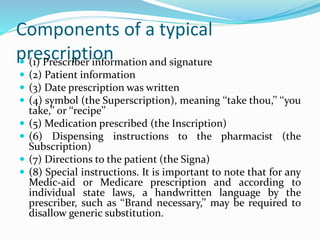
Components of a typical
prescription
 (1) Prescriber information and signature
 (2) Patient information
 (3) Date prescription was written
 (4) symbol (the Superscription), meaning ‘‘take thou,’’ ‘‘you
take,’’ or ‘‘recipe’’
 (5) Medication prescribed (the Inscription)
 (6) Dispensing instructions to the pharmacist (the
Subscription)
 (7) Directions to the patient (the Signa)
 (8) Special instructions. It is important to note that for any
Medic-aid or Medicare prescription and according to
individual state laws, a handwritten language by the
prescriber, such as ‘‘Brand necessary,’’ may be required to
disallow generic substitution.
Electronic prescription
 The use of electronic means for the generation and
transmission of prescriptions is accepted throughout
the United States. In the inpatient or outpatient
setting, a medication order, for a patient is entered
into an automated data entry system as a personal
computer (PC) or a handheld device loaded with e-
prescribing software and sent to a pharmacy as an e-
prescription. When received, a pharmacist
immediately reduces the order to a hard copy and/or
stores it as a computer file.
Advantages of electronic
prescription
 Among the advantages cited fore-prescriptions over
traditional paper prescriptions are: reduced errors
due to prescription legibility; concurrent software
screens for drug interactions; reduced incidence of
altered or forged prescriptions; efficiency for both
prescriber and pharmacist; and, convenience to the
patient, whose prescription would likely be ready for
pick-up upon arrival at the pharmacy.
Hospital prescriptions
 A typical medication order form used in the hospital setting
 In addition, other forms may be used within a hospital by
specialized units such as infectious disease, cardiac care,
pediatrics, obstetrics, orthopedics, and others.
 Drug-specific forms also may be used, as for heparin dosing,
electrolyte infusions, and morphine sulfate in patient-controlled
anesthesia.
 Many different types of health care institutions, as acute care
facilities, outpatient clinics, intermediate- and long-term care
facilities, cancer treatment centers, and a host of others utilize
medication order forms designed to meet their specific
requirements.
 Clinical drug investigators likewise may use specific
medication order forms for their study protocols.
Range of Prescription and Medication Order Calculations
 The form
 Content
 Interpretation of prescriptions and institutional
medication orders
Range of Prescription and
Medication Order Calculations
Doses: including the following
 quantity of a prescribed dose
 the total number of doses prescribed
 the number of days the prescribed medication will
last.
 Compliance: the patient’s or caregiver’s compliance in
meeting the prescribed directions for dosing
 Examples:
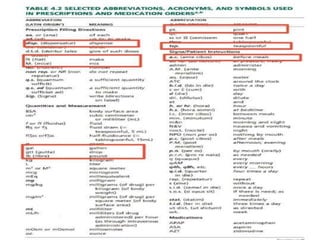
- Hydrochlorothiazide 50 mg
- No. XC
- Sig. s.i.d AM for HBP
If the prescription was filled initially on April 15, on
about what date should the patient return to have the
prescription refilled?
Doses
 Drug concentration: the quantity of an active therapeutic
ingredient to use to achieve the desired drug
concentration.
 Rate of drug administration: the quantity of drug
administered per unit of time to meet prescribed dosing
schedule (e.g., mg/min, drops/minute, or mL/hr for the
administration of an intravenous fluid).
 Compounding: the quantities of active and inactive
components to use in the extemporaneous preparation of a
pharmaceutical product, including the use of stock
solutions and/or prefabricated dosage units in the process.
Practice example
Penicillin V Potassium Oral Solution 125 mg/5 mL
- Disp.————mL Sig. 5 mL q.i.d for 10 d
- How many milliliters of medicine should be
dispensed?
Answer: 5 mL times 4 (doses per day) equals 20 mL
times 10 (days) equals 200 mL.
Range of Prescription and
Medication Order Calculations
 Chemical-physical factors: including calculations to
make solutions isotonic, iso-osmotic, equimolar, or
buffered.
 Pharmacoeconomics: including medication costs,
cost-benefit analysis, cost-effectiveness analysis,
alternative treatment plans, and medication pricing.
Prescription and Medication Order
Accuracy
It is the responsibility of the pharmacist to ensure that each
prescription and medication order received is correct in its form
and content; is appropriate for the patient being treated; and is
subsequently filled, labeled, dispensed, and administered
accurately. In essence, each medication should be:
• therapeutically appropriate for the patient;
• prescribed at the correct dose;
• dispensed in the correct strength and dosage form;
• correctly labeled with complete instructions for the patient or
caregiver; and
• for the patient in a hospital or other health care facility, each
medication must be administered to the correct patient, at the
correct time, and by the correct rate and route of administration.
Use of Roman Numerals on
Prescriptions
 Roman numerals commonly are used in prescription
writing to designate quantities, as the:
 (1) quantity of medication to be dispensed and/or
 (2) quantity of medication to be taken by the patient
per dose. The student may recall the eight letters of
fixed values used in the Roman system
Military time
 Military time is used not only in the military but in
civilian life as well, such as in hospitals, other patient-
care institutions, emergency services
Pharmaceutical calculations 2

Pharmaceutical calculations 2

  • 1.
  • 2.
    Interpretation of prescription Prescription is an order for medication issued by a physician, dentist, or other properly licensed medical practitioner. A prescription designates a specific medication and dosage to be prepared by a pharmacist and administered to a particular patient.
  • 3.
    Prescription  A prescriptionis usually written on preprinted forms containing the traditional symbol (meaning ‘‘recipe,’’ ‘‘take thou,’’ or ‘‘you take’’), name, address, telephone number, and other pertinent information regarding the physician or other prescriber  In addition, blank spaces are used by the prescriber to provide information about the patient, the medication desired, and the directions for use.  A prescription written by a veterinarian generally includes the animal species and/ or pet’s name and the name of the owner.
  • 4.
    Prescription  A writtenprescription may be presented at the pharmacy by the patient or caregiver, or it may be transmitted from the prescriber by telephone or by other electronic means.  In the latter instances, the pharmacist immediately reduces the order to a properly written form or computer entry.
  • 6.
    Types of prescription Twobroad categories of prescriptions:  (1) those written for a single component or prefabricated product and not requiring compounding or admixture by the pharmacist, and  (2) those written for more than a single component and requiring compounding.
  • 8.
    Prescription contents  Aprescription may include the chemical or generic name of the substance or the manufacturer’s brand or trademark name.  Prescriptions requiring compounding contain the quantities of each ingredient required. Medications are prepared into various types of dosage forms (e.g., tablets, syrups, injections)
  • 9.
    Components of atypical prescription  (1) Prescriber information and signature  (2) Patient information  (3) Date prescription was written  (4) symbol (the Superscription), meaning ‘‘take thou,’’ ‘‘you take,’’ or ‘‘recipe’’  (5) Medication prescribed (the Inscription)  (6) Dispensing instructions to the pharmacist (the Subscription)  (7) Directions to the patient (the Signa)  (8) Special instructions. It is important to note that for any Medic-aid or Medicare prescription and according to individual state laws, a handwritten language by the prescriber, such as ‘‘Brand necessary,’’ may be required to disallow generic substitution.
  • 11.
    Electronic prescription  Theuse of electronic means for the generation and transmission of prescriptions is accepted throughout the United States. In the inpatient or outpatient setting, a medication order, for a patient is entered into an automated data entry system as a personal computer (PC) or a handheld device loaded with e- prescribing software and sent to a pharmacy as an e- prescription. When received, a pharmacist immediately reduces the order to a hard copy and/or stores it as a computer file.
  • 12.
    Advantages of electronic prescription Among the advantages cited fore-prescriptions over traditional paper prescriptions are: reduced errors due to prescription legibility; concurrent software screens for drug interactions; reduced incidence of altered or forged prescriptions; efficiency for both prescriber and pharmacist; and, convenience to the patient, whose prescription would likely be ready for pick-up upon arrival at the pharmacy.
  • 13.
    Hospital prescriptions  Atypical medication order form used in the hospital setting  In addition, other forms may be used within a hospital by specialized units such as infectious disease, cardiac care, pediatrics, obstetrics, orthopedics, and others.  Drug-specific forms also may be used, as for heparin dosing, electrolyte infusions, and morphine sulfate in patient-controlled anesthesia.  Many different types of health care institutions, as acute care facilities, outpatient clinics, intermediate- and long-term care facilities, cancer treatment centers, and a host of others utilize medication order forms designed to meet their specific requirements.  Clinical drug investigators likewise may use specific medication order forms for their study protocols.
  • 15.
    Range of Prescriptionand Medication Order Calculations  The form  Content  Interpretation of prescriptions and institutional medication orders
  • 16.
    Range of Prescriptionand Medication Order Calculations Doses: including the following  quantity of a prescribed dose  the total number of doses prescribed  the number of days the prescribed medication will last.  Compliance: the patient’s or caregiver’s compliance in meeting the prescribed directions for dosing
  • 17.
     Examples: - Hydrochlorothiazide50 mg - No. XC - Sig. s.i.d AM for HBP If the prescription was filled initially on April 15, on about what date should the patient return to have the prescription refilled?
  • 18.
    Doses  Drug concentration:the quantity of an active therapeutic ingredient to use to achieve the desired drug concentration.  Rate of drug administration: the quantity of drug administered per unit of time to meet prescribed dosing schedule (e.g., mg/min, drops/minute, or mL/hr for the administration of an intravenous fluid).  Compounding: the quantities of active and inactive components to use in the extemporaneous preparation of a pharmaceutical product, including the use of stock solutions and/or prefabricated dosage units in the process.
  • 19.
    Practice example Penicillin VPotassium Oral Solution 125 mg/5 mL - Disp.————mL Sig. 5 mL q.i.d for 10 d - How many milliliters of medicine should be dispensed? Answer: 5 mL times 4 (doses per day) equals 20 mL times 10 (days) equals 200 mL.
  • 20.
    Range of Prescriptionand Medication Order Calculations  Chemical-physical factors: including calculations to make solutions isotonic, iso-osmotic, equimolar, or buffered.  Pharmacoeconomics: including medication costs, cost-benefit analysis, cost-effectiveness analysis, alternative treatment plans, and medication pricing.
  • 21.
    Prescription and MedicationOrder Accuracy It is the responsibility of the pharmacist to ensure that each prescription and medication order received is correct in its form and content; is appropriate for the patient being treated; and is subsequently filled, labeled, dispensed, and administered accurately. In essence, each medication should be: • therapeutically appropriate for the patient; • prescribed at the correct dose; • dispensed in the correct strength and dosage form; • correctly labeled with complete instructions for the patient or caregiver; and • for the patient in a hospital or other health care facility, each medication must be administered to the correct patient, at the correct time, and by the correct rate and route of administration.
  • 22.
    Use of RomanNumerals on Prescriptions  Roman numerals commonly are used in prescription writing to designate quantities, as the:  (1) quantity of medication to be dispensed and/or  (2) quantity of medication to be taken by the patient per dose. The student may recall the eight letters of fixed values used in the Roman system
  • 24.
    Military time  Militarytime is used not only in the military but in civilian life as well, such as in hospitals, other patient- care institutions, emergency services