PHARMACEUTICAL
CALCULATIONS
Reshma Fathima K
Assistant Professor
Calculations Involved In Dispensing
• To have a complete understanding of various types of calculations, which are
involved in dispensing, it is desirable that the pharmacist should have a thorough
knowledge regarding weights and measures which are used in calculations.
• There are two systems of weights and measures
Measurement of weight in imperial system: Weight is a measure of the
gravitational force acting on the body and its directly proportional to its mass.
The imperial system is divided into two parts for the purpose of measurement of
weight. These are:
• Avoirdupois system
• Apothecaries system
Avoirdupois system:
In this system the pound is the standard unit for weighing and all
measures of mass are derived from the Imperial Standard Pound (Lb),
thus:
• 1 Lb: 16oz (avoir)
• 1 Lb: 7000 grains
• 1 oz (avoir) = 7000/16 grains
= 437.5 grains
APOTHECARIES SYSTEM: This system is also known as the Troy system. The grain is the standard weight in this system
and all other weights are derived from it.
20 grains (gr) = 1 scruple
60 grains = 1 drachm
480 grains = 1 ounce
(apothe)
8 drachms = 1 ounce
12 ounces = 1 pound
5760 grains = 1 pound (apothe)
Measurement of capacity in Imperial System
The standard units for capacity is the same in both the avoirdupois and
apothecaries systems. The gallon is the standard unit and all other
measures of capacity are derived from it
1 gallon (c) = 160 fluid ounces
1/4th of a gallon = 1 quart
1/8th of a gallon = 1 pint
1/160th of a gallon = 1 fl ounce
1/8th of a fl ounce = 1 fl drachm
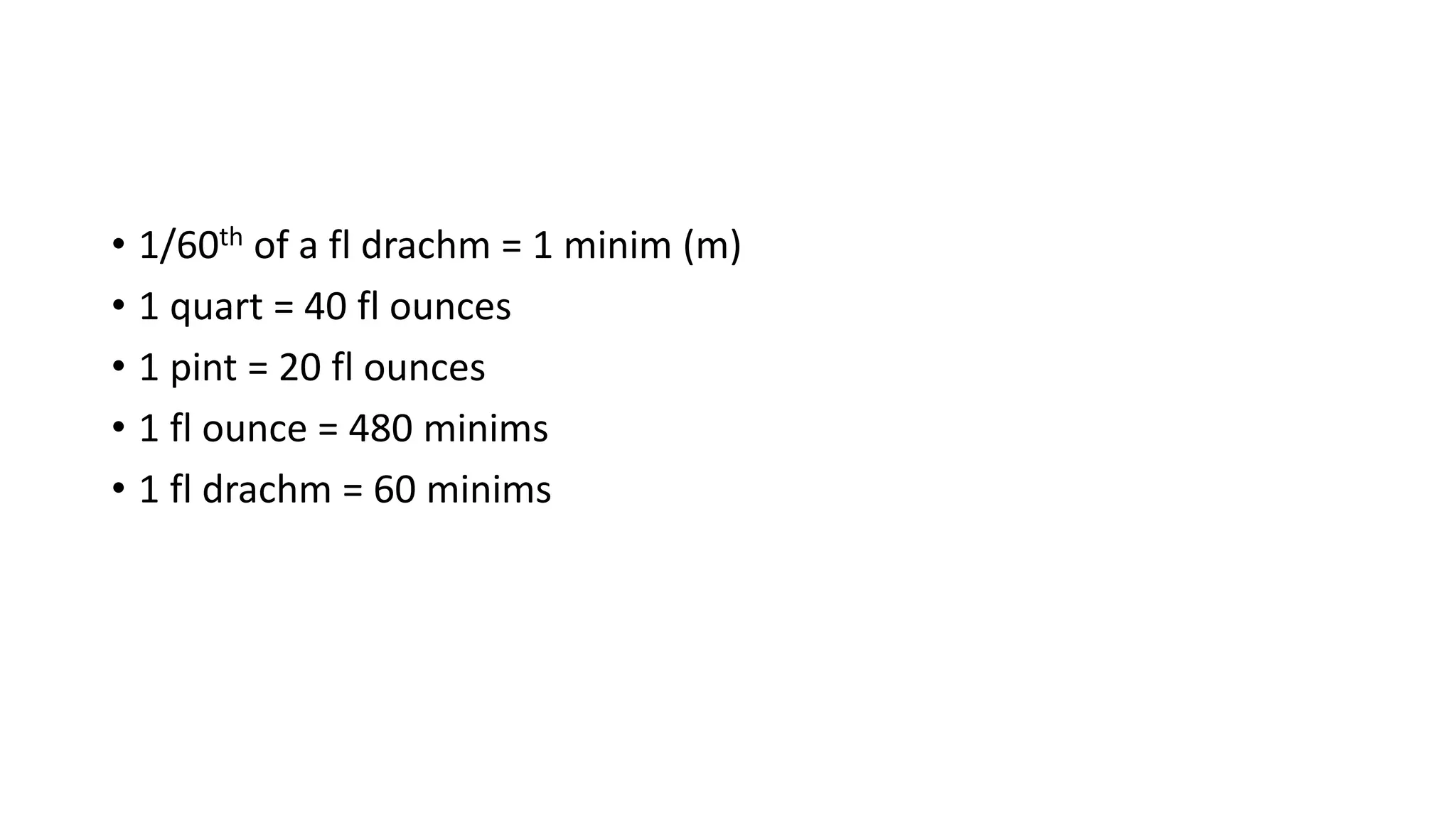
• 1/60th of a fl drachm = 1 minim (m)
• 1 quart = 40 fl ounces
• 1 pint = 20 fl ounces
• 1 fl ounce = 480 minims
• 1 fl drachm = 60 minims
THE METRIC SYSTEM
• The metric system is used in the Indian pharmacopoeia for the
measurement of weight and capacity. The metric system in India was
implemented from 1st April 1964 in pharmacy profession.
• Measurement of weight in metric system: A kilogram is the standard
unit for measurement of weight and all measures are derived from it
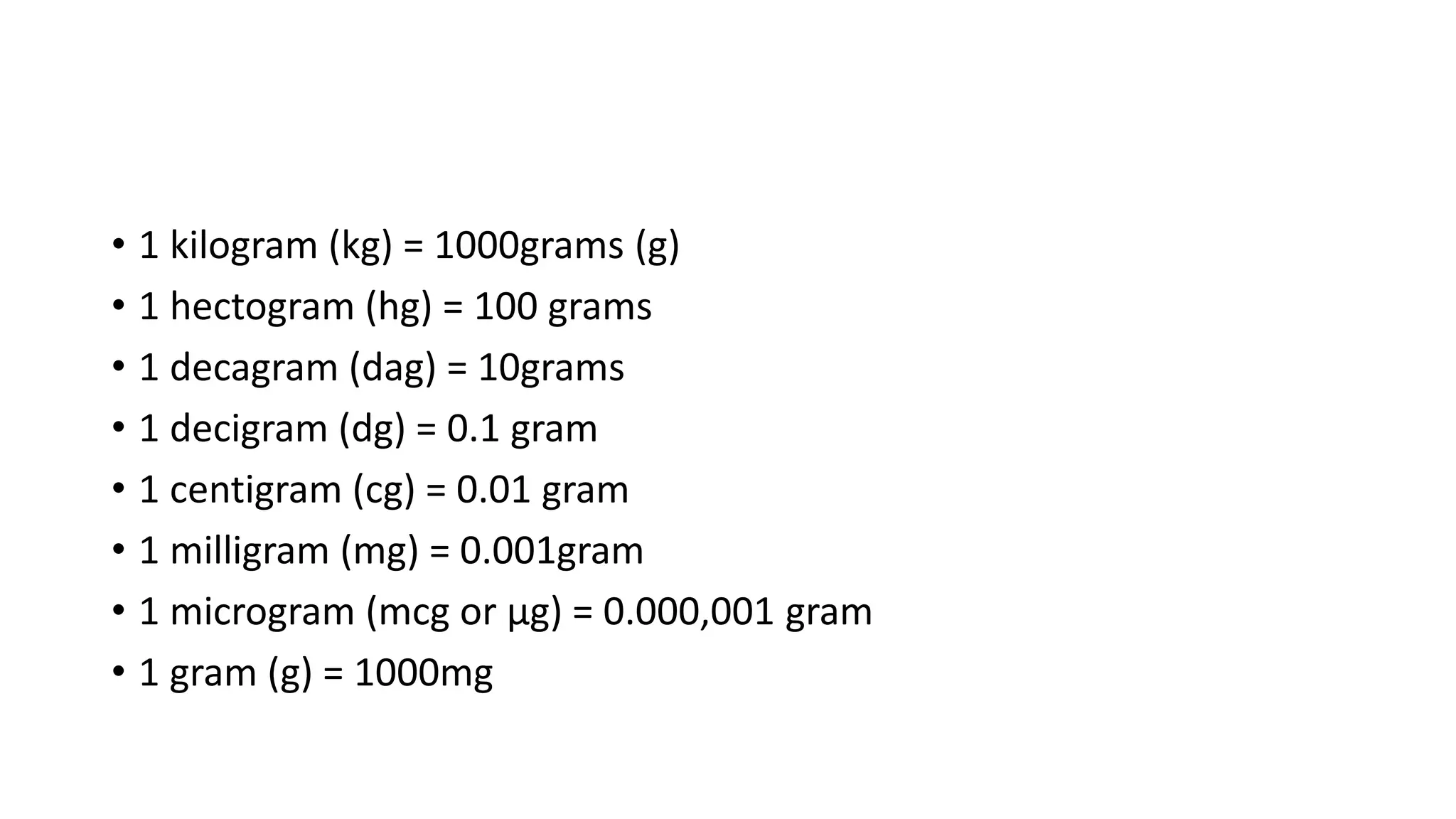
• 1 kilogram (kg) = 1000grams (g)
• 1 hectogram (hg) = 100 grams
• 1 decagram (dag) = 10grams
• 1 decigram (dg) = 0.1 gram
• 1 centigram (cg) = 0.01 gram
• 1 milligram (mg) = 0.001gram
• 1 microgram (mcg or µg) = 0.000,001 gram
• 1 gram (g) = 1000mg
• Measurement of capacity : A litre is the standard unit for
measurement of capacity and all measures of capacity are derived
from it.
• 1 litre (lt) = 1000 millilitre (ml)
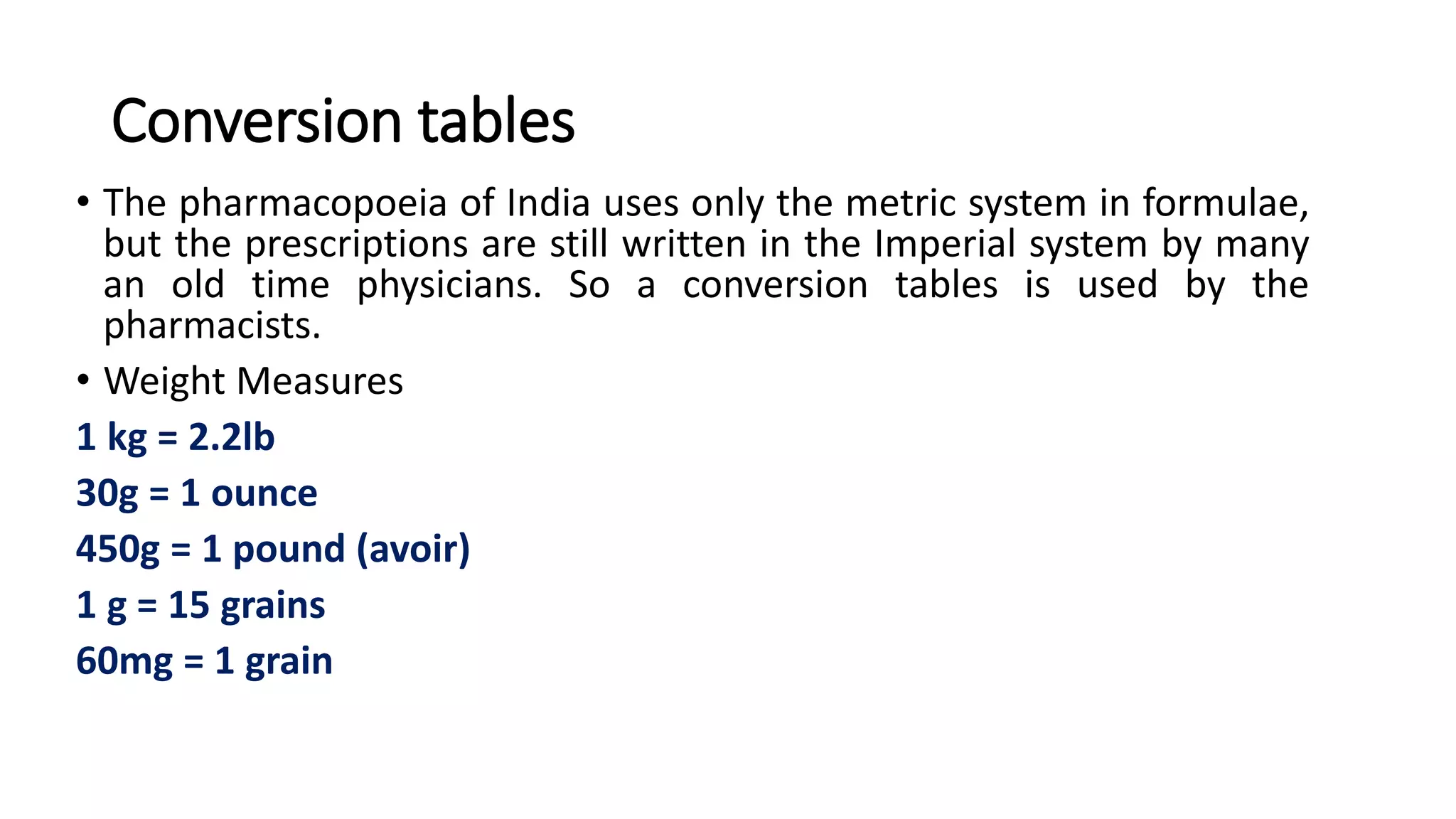
Conversion tables
• The pharmacopoeia of India uses only the metric system in formulae,
but the prescriptions are still written in the Imperial system by many
an old time physicians. So a conversion tables is used by the
pharmacists.
• Weight Measures
1 kg = 2.2lb
30g = 1 ounce
450g = 1 pound (avoir)
1 g = 15 grains
60mg = 1 grain
• Capacity measures
1000ml = 1 quart
500ml = 1 pint
30ml = 1 fluid ounce
4 ml = 1 fluid drachm
1ml = 15 minims
0.06ml = 1 minim
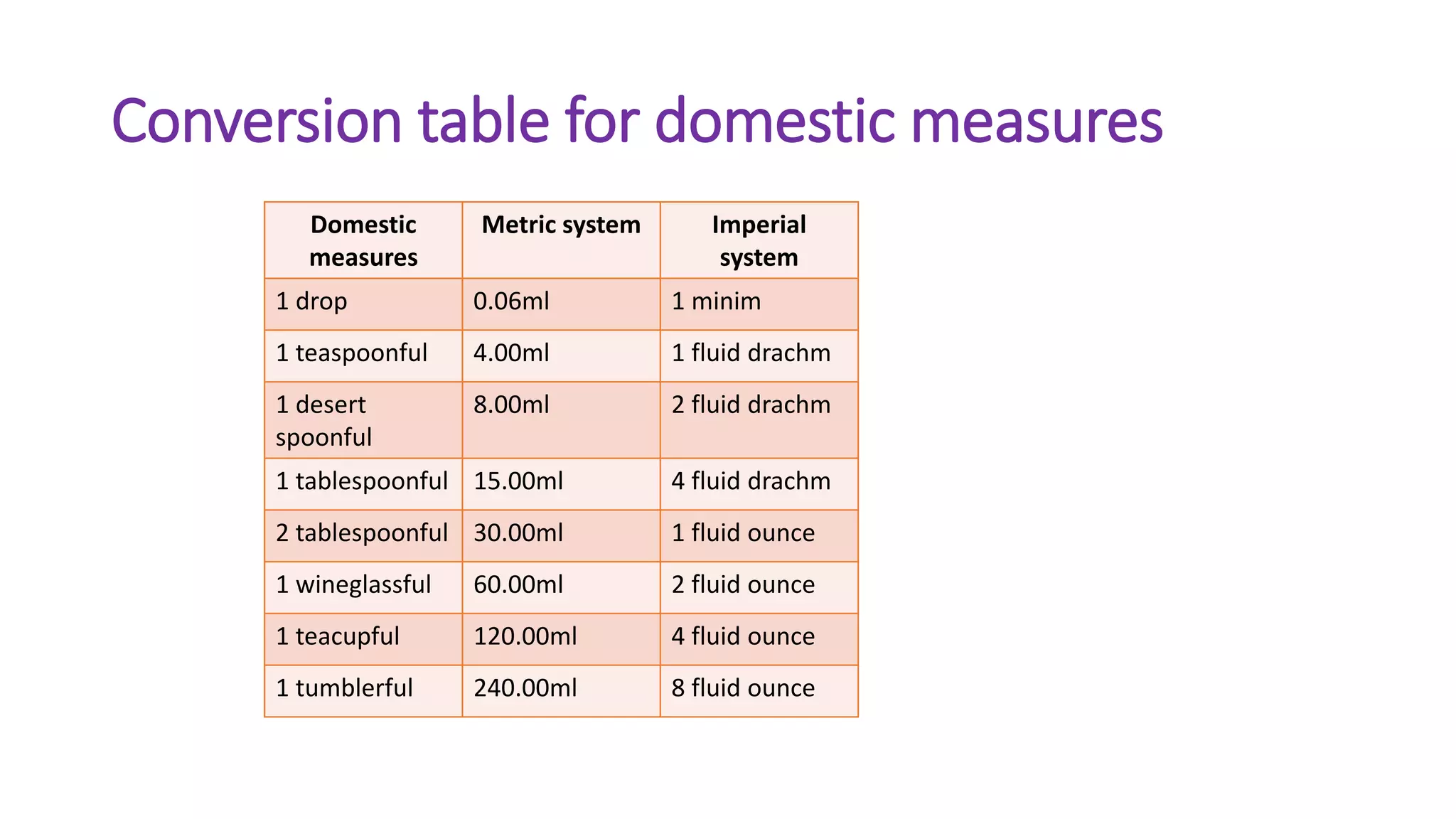
Conversion table for domestic measures
Domestic
measures
Metric system Imperial
system
1 drop 0.06ml 1 minim
1 teaspoonful 4.00ml 1 fluid drachm
1 desert
spoonful
8.00ml 2 fluid drachm
1 tablespoonful 15.00ml 4 fluid drachm
2 tablespoonful 30.00ml 1 fluid ounce
1 wineglassful 60.00ml 2 fluid ounce
1 teacupful 120.00ml 4 fluid ounce
1 tumblerful 240.00ml 8 fluid ounce
CALCULATIONS
• Calculations based on density: Density is defined as the mass of a
substance per unit volume. It has the units of mass over volume.
• Specific gravity is defined as the ratio of the mass of a substance in air
to that of an equal volume of water.
• In the metric system, both density and specific gravity are numerically
equal. The equations for calculating density, weight, and volume are
as follows:
• Density =
𝑾𝒆𝒊𝒈𝒉𝒕
𝑽𝒐𝒍𝒖𝒎𝒆
• Weight= Density x Volume
• Volume =
𝑾𝒆𝒊𝒈𝒉𝒕
𝑫𝒆𝒏𝒔𝒊𝒕𝒚
• Calculate the volume of 2 kg of glycerin. The density of glycerin is
1.25g/ml
• Volume = weight/ density
=
2000𝑔
1.25𝑔/𝑚𝑙
= 1600ml
• Calculate the weight of 250ml of alcohol whose density is 0.816g/ml.
• Weight = Density x volume
= 0.816 x 250
= 204.0g
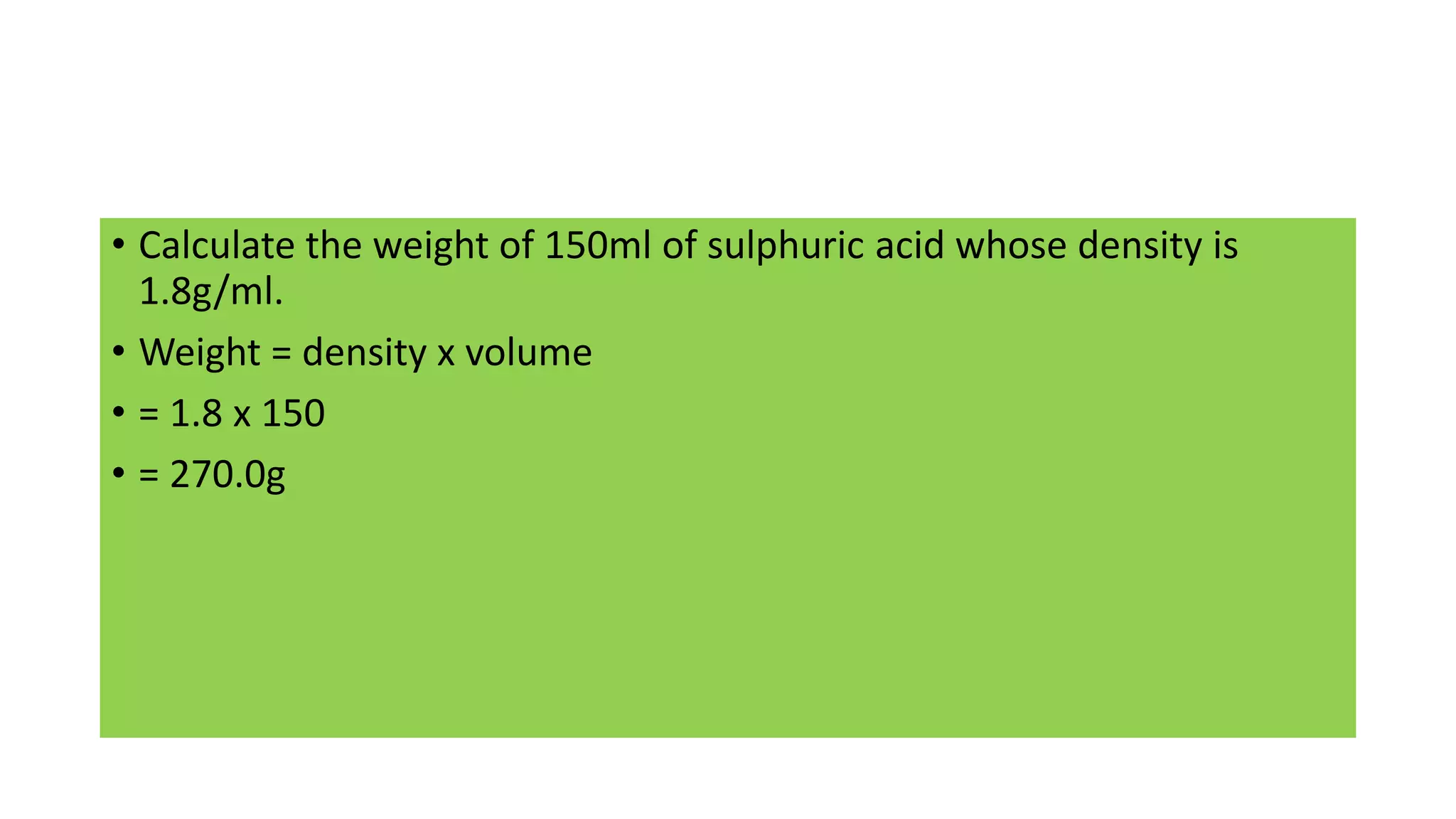
• Calculate the weight of 150ml of sulphuric acid whose density is
1.8g/ml.
• Weight = density x volume
• = 1.8 x 150
• = 270.0g
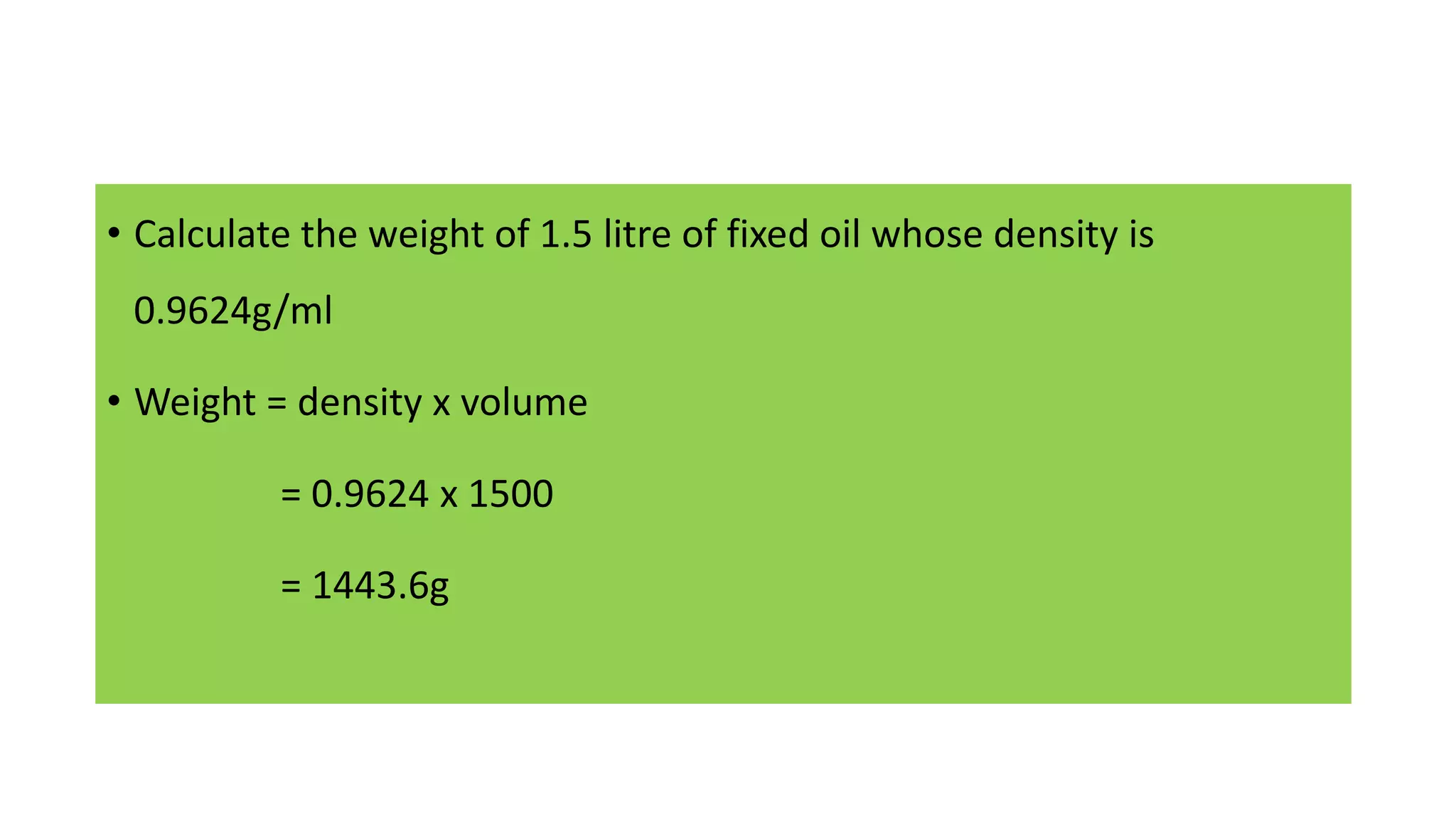
• Calculate the weight of 1.5 litre of fixed oil whose density is
0.9624g/ml
• Weight = density x volume
= 0.9624 x 1500
= 1443.6g
ALCOHOL DILUTIONS
• The dilute alcohols are made from 95% alcohol which contains 95 parts by volume of ethyl alcohol
and 5 parts by volume of water.
• When alcohol gets mixed with water, the following change takes place
• There is rise in temperature
• There is contraction in volume
• There is turbid appearance in the solution, because solubility of air is more in alcohol than in
water. When alcohol is diluted with water, minute bubbles of air get evolved from the alcohol and
make the turbid appearance.
Note : when alcohol is diluted with water, it is necessary to cool the mixture to
about 20 o C and then final volume is made up.
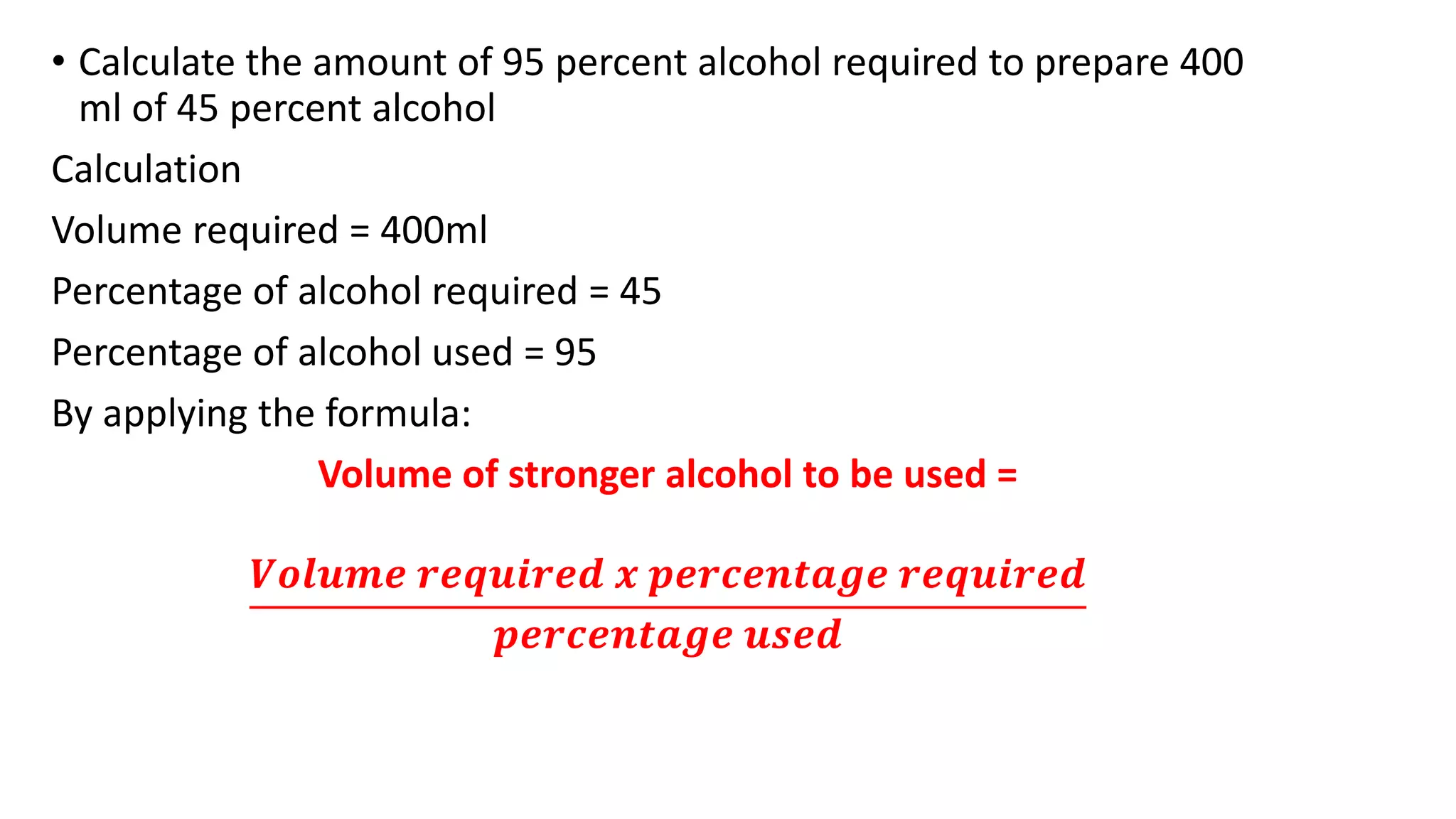
• Calculate the amount of 95 percent alcohol required to prepare 400
ml of 45 percent alcohol
Calculation
Volume required = 400ml
Percentage of alcohol required = 45
Percentage of alcohol used = 95
By applying the formula:
Volume of stronger alcohol to be used =
𝑽𝒐𝒍𝒖𝒎𝒆 𝒓𝒆𝒒𝒖𝒊𝒓𝒆𝒅 𝒙 𝒑𝒆𝒓𝒄𝒆𝒏𝒕𝒂𝒈𝒆 𝒓𝒆𝒒𝒖𝒊𝒓𝒆𝒅
𝒑𝒆𝒓𝒄𝒆𝒏𝒕𝒂𝒈𝒆 𝒖𝒔𝒆𝒅
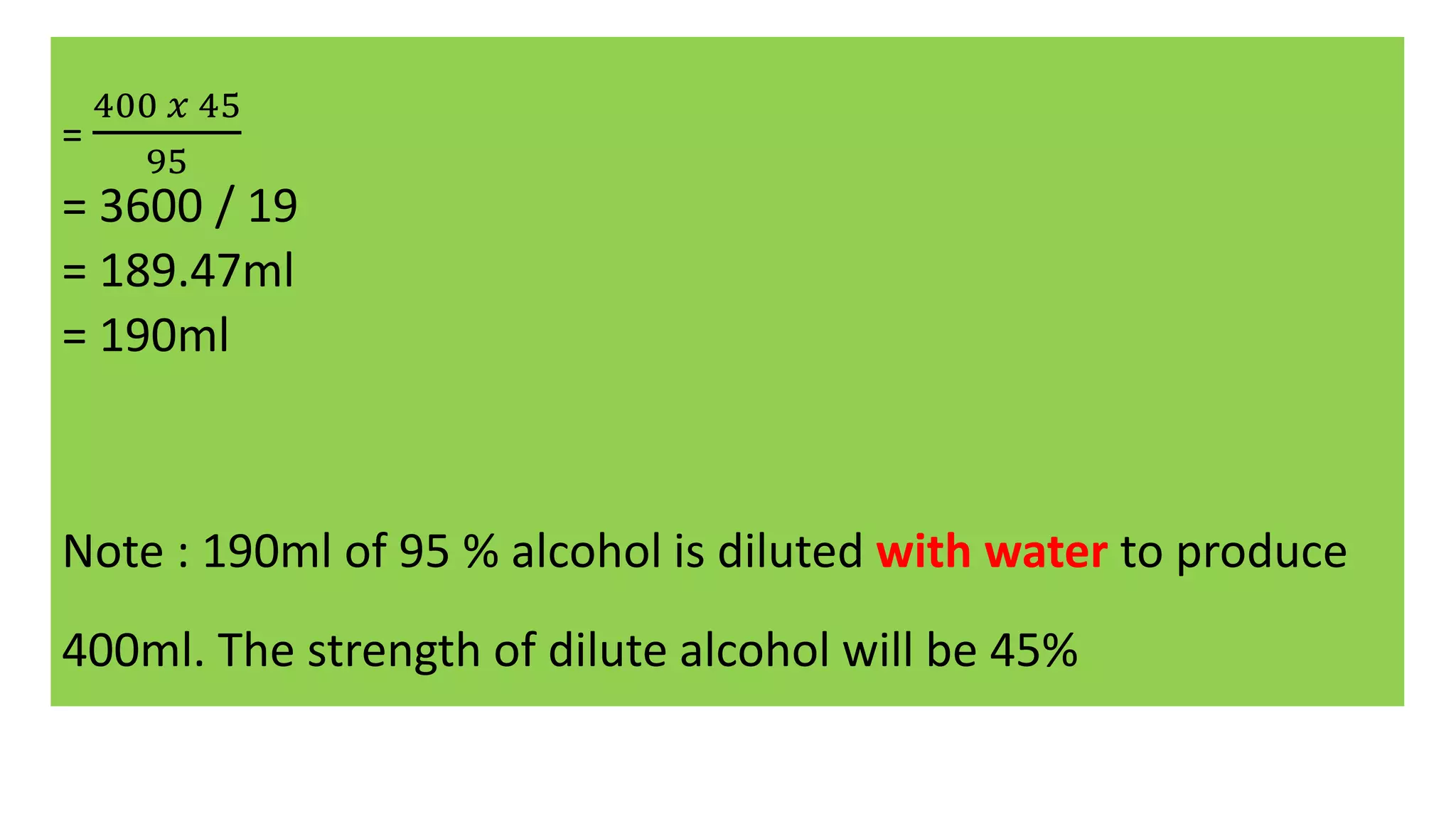
=
400 𝑥 45
95
= 3600 / 19
= 189.47ml
= 190ml
Note : 190ml of 95 % alcohol is diluted with water to produce
400ml. The strength of dilute alcohol will be 45%
Alligation Method
• When the calculation involves mixing of two similar preparations of
different strength, to produce a preparation of intermediate strength,
the alligation method is used. The method is recommended for the
purpose of checking the calculations.
• For calculation purpose, the figures are written as given below:
Stronger
percentage
Weaker
percentage
REQUIRED
PERCENTAGE
REQUIRED PERCENTAGE
– WEAKER PERCENTAGE
STRONGER PERCENTAGE –
REQUIRED PERCENTAGE
• The following example illustrates the use of this method:
Example: calculate the volume of 95 percent alcohol required to
prepare 600ml of 70 percent alcohol
Volume required = 600ml
Percentage of alcohol required = 70
Percentage of alcohol used = 95
By using alligation method:
95
0
70
70-0 = 70
95-70 = 25
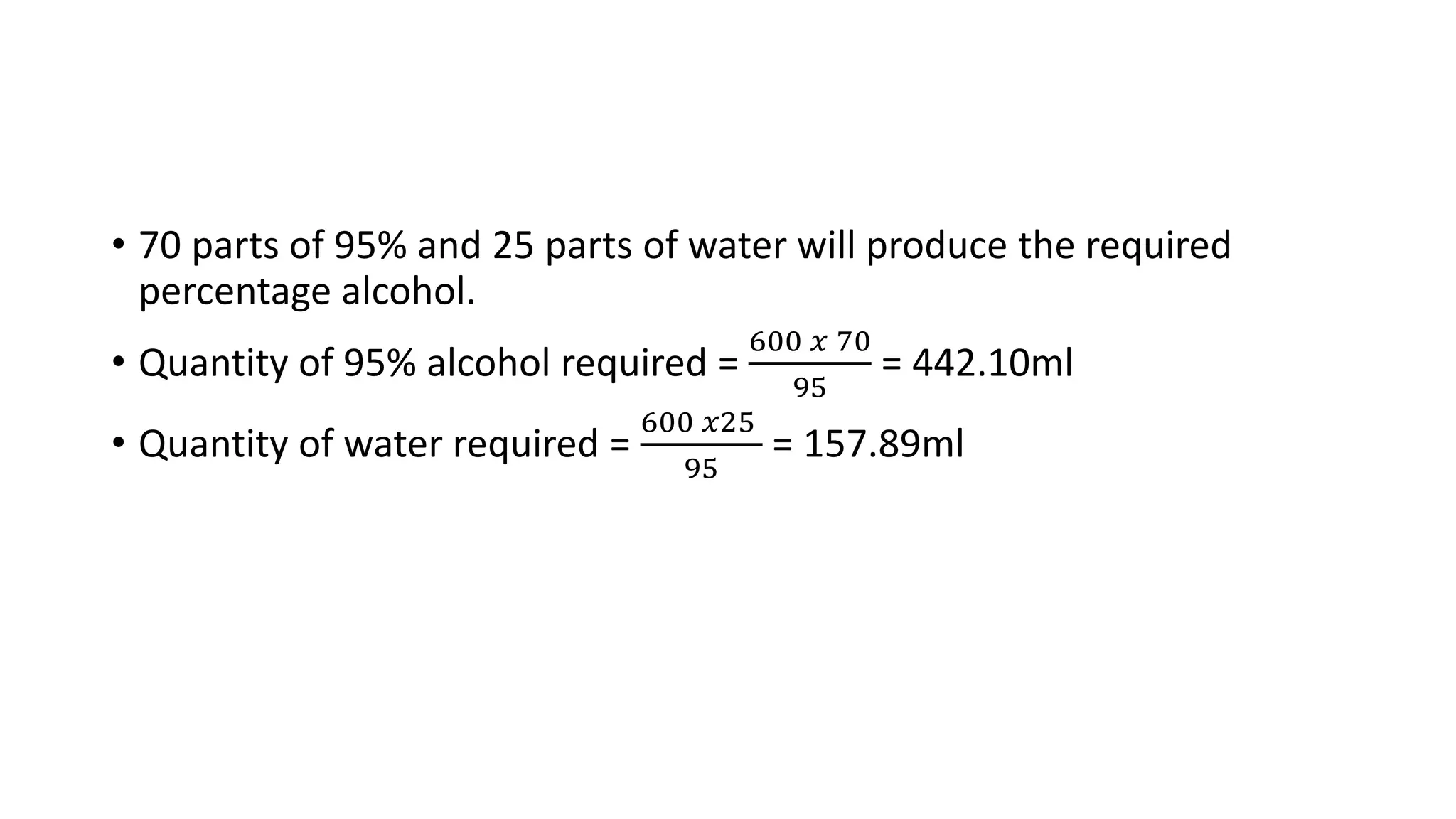
• 70 parts of 95% and 25 parts of water will produce the required
percentage alcohol.
• Quantity of 95% alcohol required =
600 𝑥 70
95
= 442.10ml
• Quantity of water required =
600 𝑥25
95
= 157.89ml
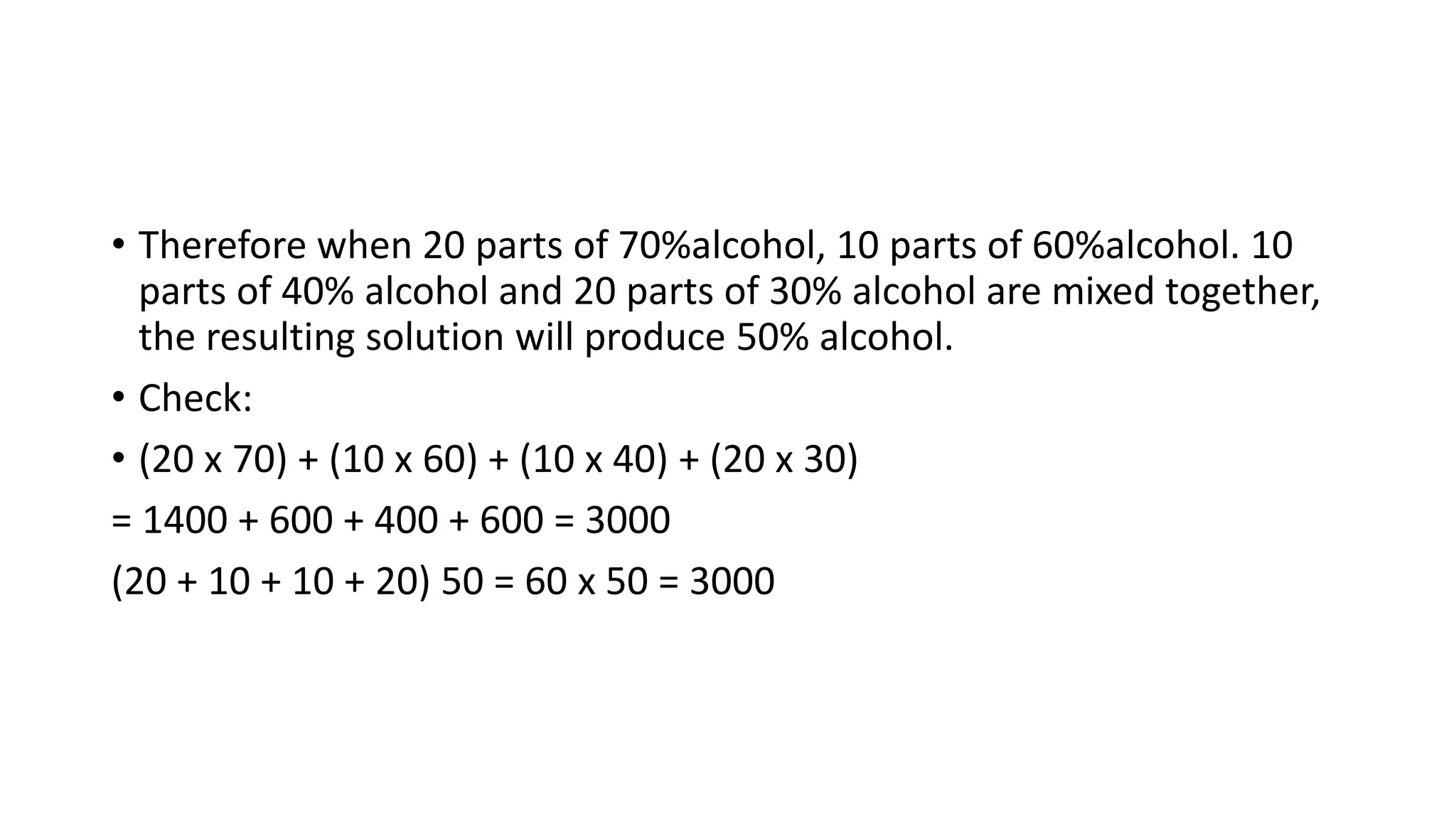
• Calculate the amount of 70%, 60%, 40%, and 30% alcohol should be
mixed to get 50% alcohol
Using alligation method
50
20 parts of 70%alcohol
10 parts of 60% alcohol
10 parts of 40% alcohol
20 parts of 30% alcohol
70
60
40
30
• Therefore when 20 parts of 70%alcohol, 10 parts of 60%alcohol. 10
parts of 40% alcohol and 20 parts of 30% alcohol are mixed together,
the resulting solution will produce 50% alcohol.
• Check:
• (20 x 70) + (10 x 60) + (10 x 40) + (20 x 30)
= 1400 + 600 + 400 + 600 = 3000
(20 + 10 + 10 + 20) 50 = 60 x 50 = 3000
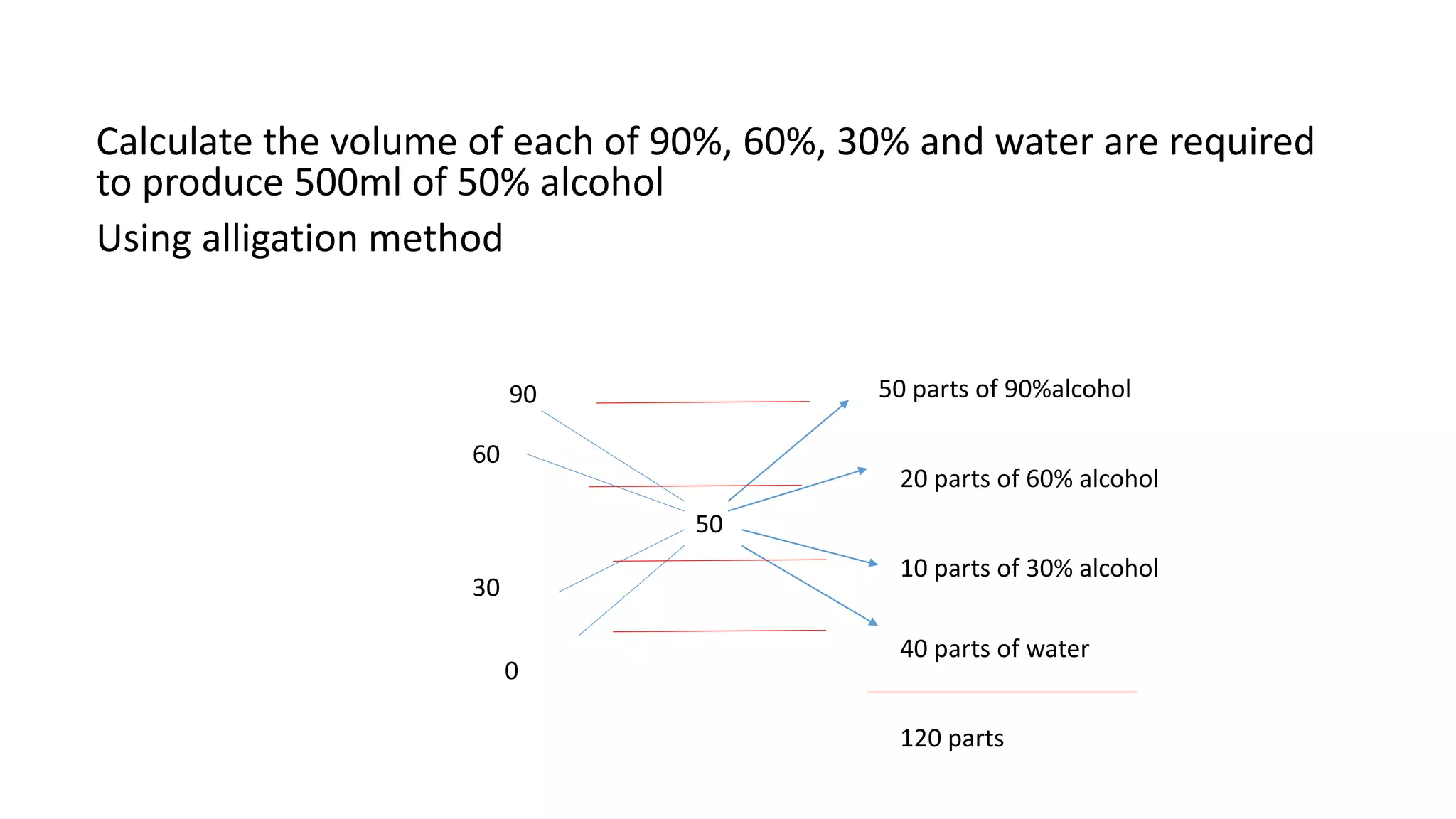
Calculate the volume of each of 90%, 60%, 30% and water are required
to produce 500ml of 50% alcohol
Using alligation method
50
50 parts of 90%alcohol
20 parts of 60% alcohol
10 parts of 30% alcohol
40 parts of water
90
60
30
0
120 parts
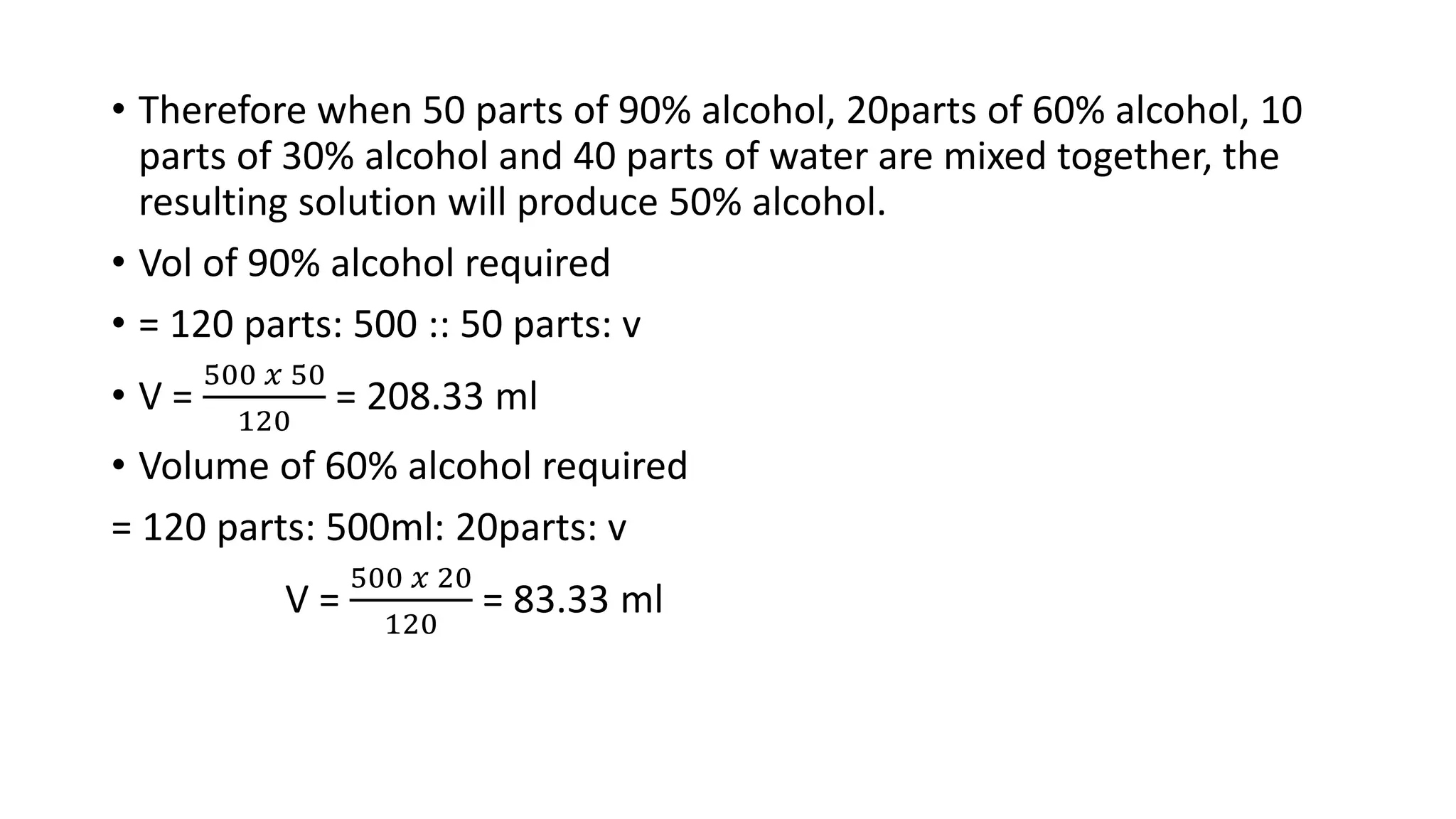
• Therefore when 50 parts of 90% alcohol, 20parts of 60% alcohol, 10
parts of 30% alcohol and 40 parts of water are mixed together, the
resulting solution will produce 50% alcohol.
• Vol of 90% alcohol required
• = 120 parts: 500 :: 50 parts: v
• V =
500 𝑥 50
120
= 208.33 ml
• Volume of 60% alcohol required
= 120 parts: 500ml: 20parts: v
V =
500 𝑥 20
120
= 83.33 ml
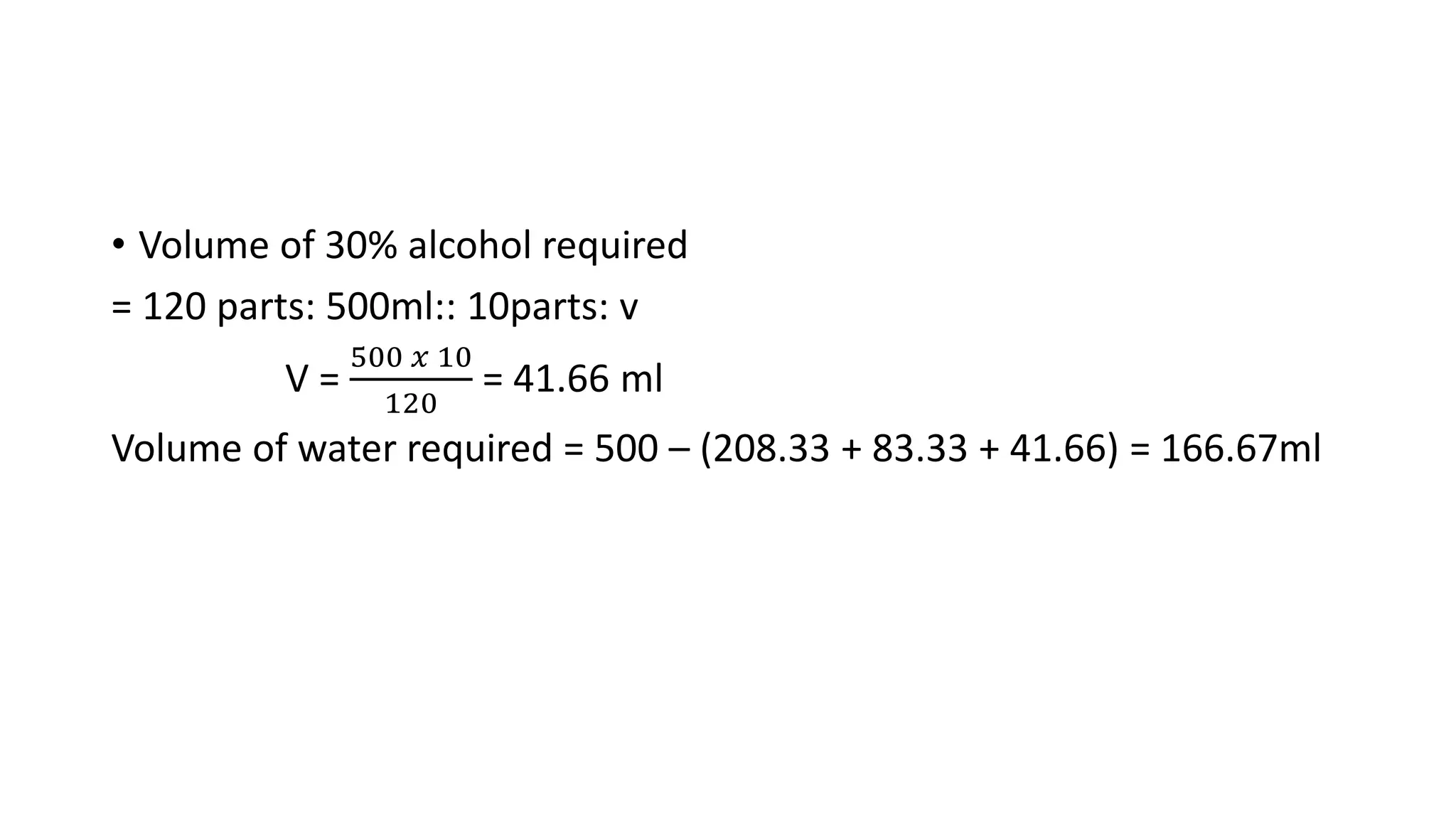
• Volume of 30% alcohol required
= 120 parts: 500ml:: 10parts: v
V =
500 𝑥 10
120
= 41.66 ml
Volume of water required = 500 – (208.33 + 83.33 + 41.66) = 166.67ml
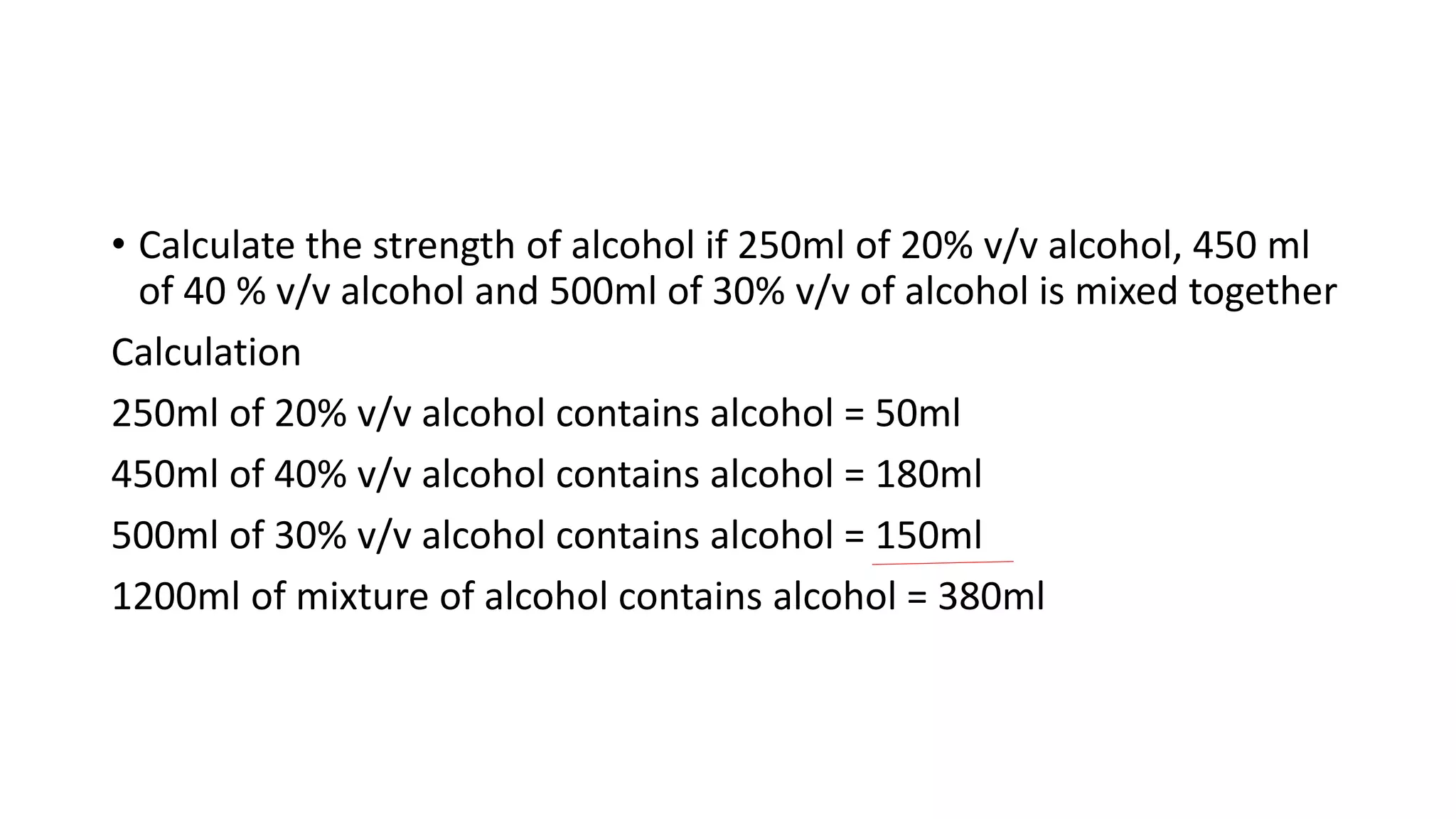
• Calculate the strength of alcohol if 250ml of 20% v/v alcohol, 450 ml
of 40 % v/v alcohol and 500ml of 30% v/v of alcohol is mixed together
Calculation
250ml of 20% v/v alcohol contains alcohol = 50ml
450ml of 40% v/v alcohol contains alcohol = 180ml
500ml of 30% v/v alcohol contains alcohol = 150ml
1200ml of mixture of alcohol contains alcohol = 380ml
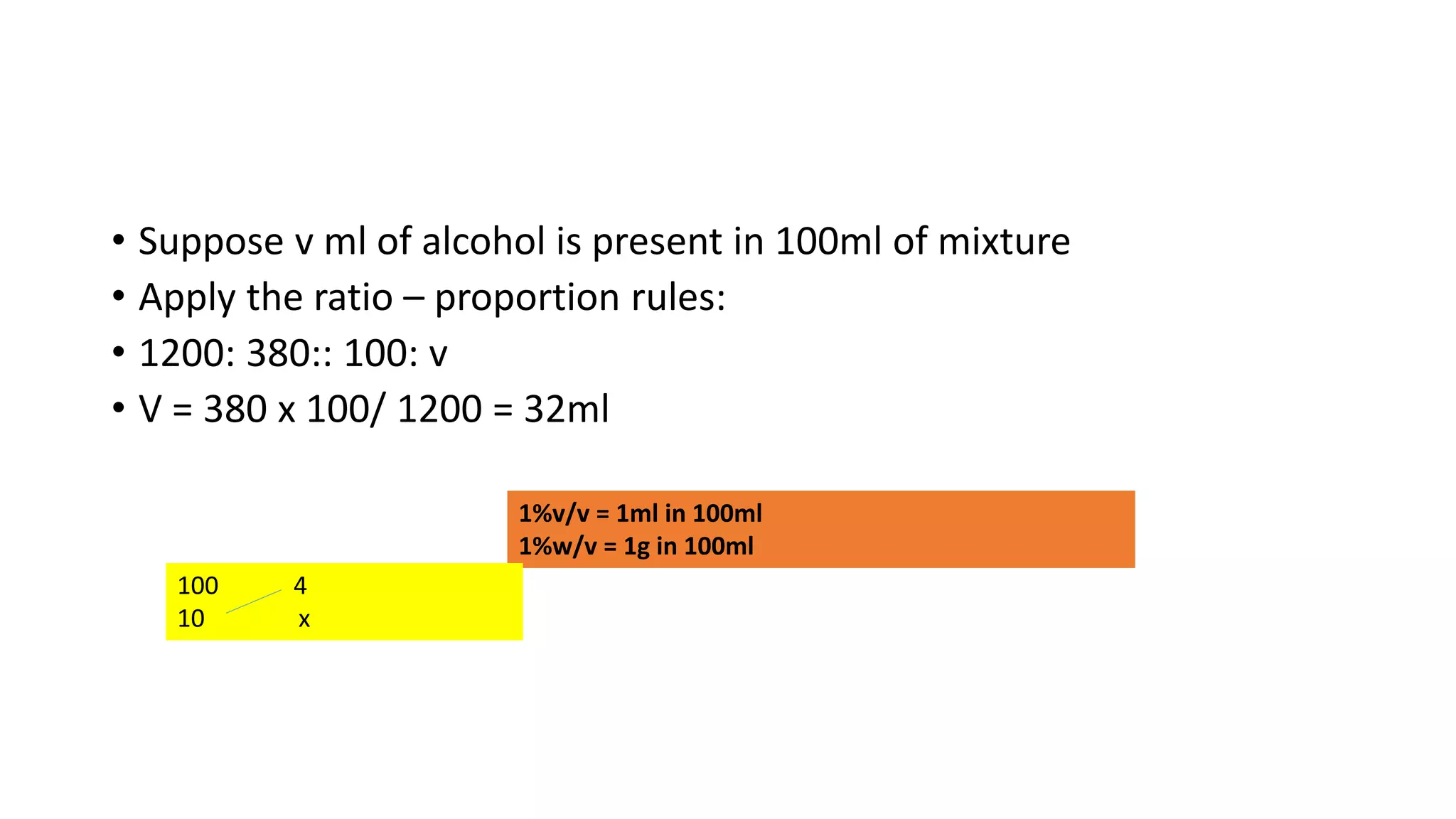
• Suppose v ml of alcohol is present in 100ml of mixture
• Apply the ratio – proportion rules:
• 1200: 380:: 100: v
• V = 380 x 100/ 1200 = 32ml
1%v/v = 1ml in 100ml
1%w/v = 1g in 100ml
100 4
10 x
• Calculate the proportion of 15%, 8%, and 3% alcohol required to
make 6% of alcohol.
6
3 parts of 15% alcohol
3 parts of 8% alcohol
9 + 2 (11 parts) of 3%
alcohol
15
8
3
Therefore when 3 parts of 15% alcohol, 3 parts of 8% alcohol, and 11 parts of 3 % alcohol are mixed together, the
resulting solution will produce 6% alcohol
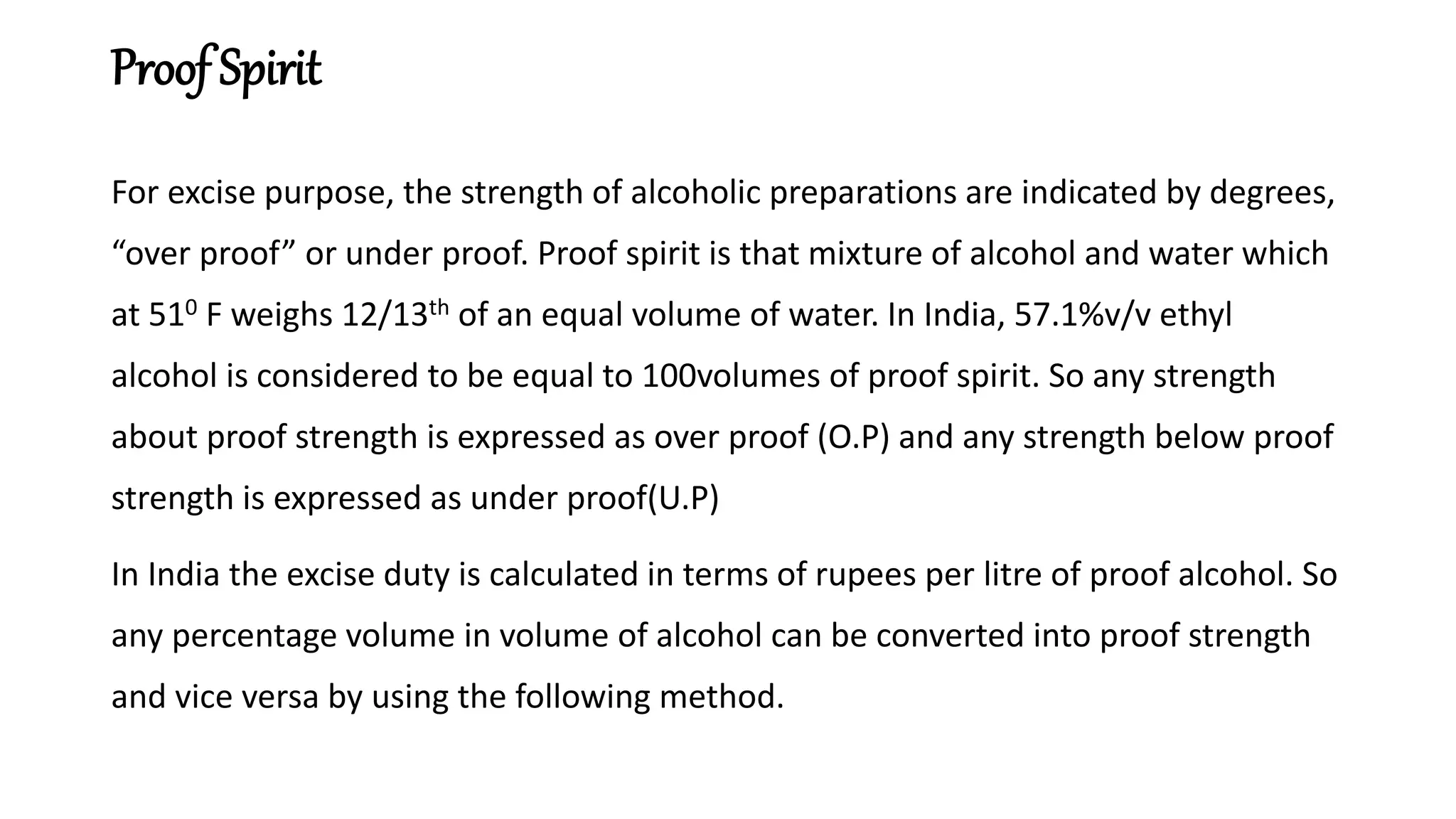
• Calculate the volume of 20%, 15%, and 5% alcohol required to make
150ml of 8% of alcohol.
8
3 parts of 20% alcohol
3 parts of 15% alcohol
12 + 7 (19 parts) of 5%
alcohol
20
15
5
Therefore when 3 parts of 20% alcohol, 3 parts of 15% alcohol, and 19 parts of 5 % alcohol are mixed together,
the resulting solution will produce 8% alcohol
Total parts =
3+3+12+7= 25
parts
• Vol of 20% alcohol required
• = 25parts: 150ml :: 3parts: v
• V =
150 𝑥 3
25
= 18 ml
• Volume of 15% alcohol required
= 25 parts: 150ml: 3parts: v
V =
150 𝑥 3
25
= 18 ml
• Volume of 5% alcohol required
= 25 parts: 150ml: 19parts: v
V =
150 𝑥 19
25
= 114 ml
Proof Spirit
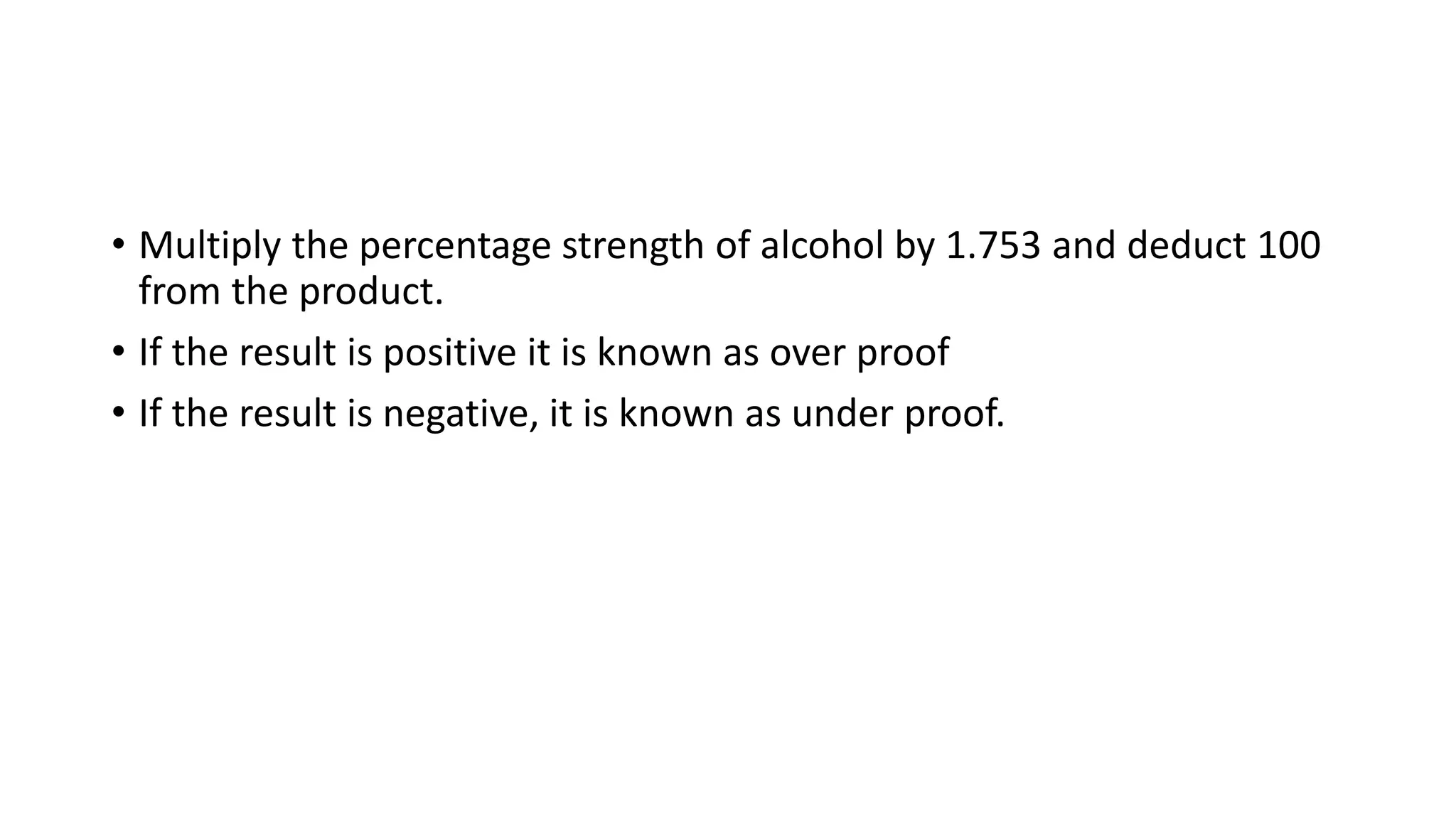
For excise purpose, the strength of alcoholic preparations are indicated by degrees,
“over proof” or under proof. Proof spirit is that mixture of alcohol and water which
at 510 F weighs 12/13th of an equal volume of water. In India, 57.1%v/v ethyl
alcohol is considered to be equal to 100volumes of proof spirit. So any strength
about proof strength is expressed as over proof (O.P) and any strength below proof
strength is expressed as under proof(U.P)
In India the excise duty is calculated in terms of rupees per litre of proof alcohol. So
any percentage volume in volume of alcohol can be converted into proof strength
and vice versa by using the following method.
• Multiply the percentage strength of alcohol by 1.753 and deduct 100
from the product.
• If the result is positive it is known as over proof
• If the result is negative, it is known as under proof.
• The figure 1.753 is obtained as follows:
• 57.1 volumes of ethyl alcohol = 100 volume of proof spirit
• 1 volume of ethyl alcohol =
100
57.1
= 1.753 volume of proof spirit.
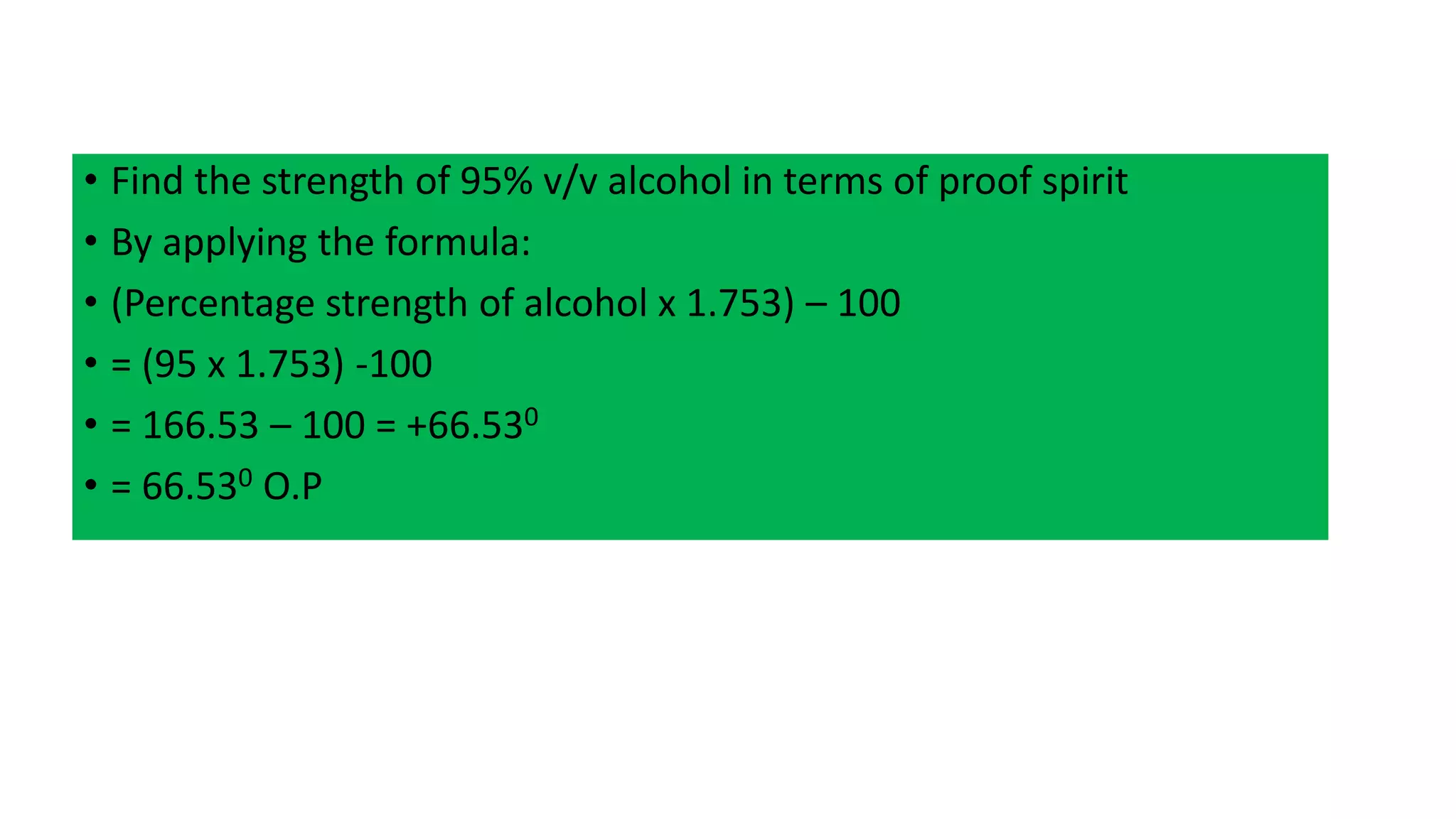
• Find the strength of 95% v/v alcohol in terms of proof spirit
• By applying the formula:
• (Percentage strength of alcohol x 1.753) – 100
• = (95 x 1.753) -100
• = 166.53 – 100 = +66.530
• = 66.530 O.P
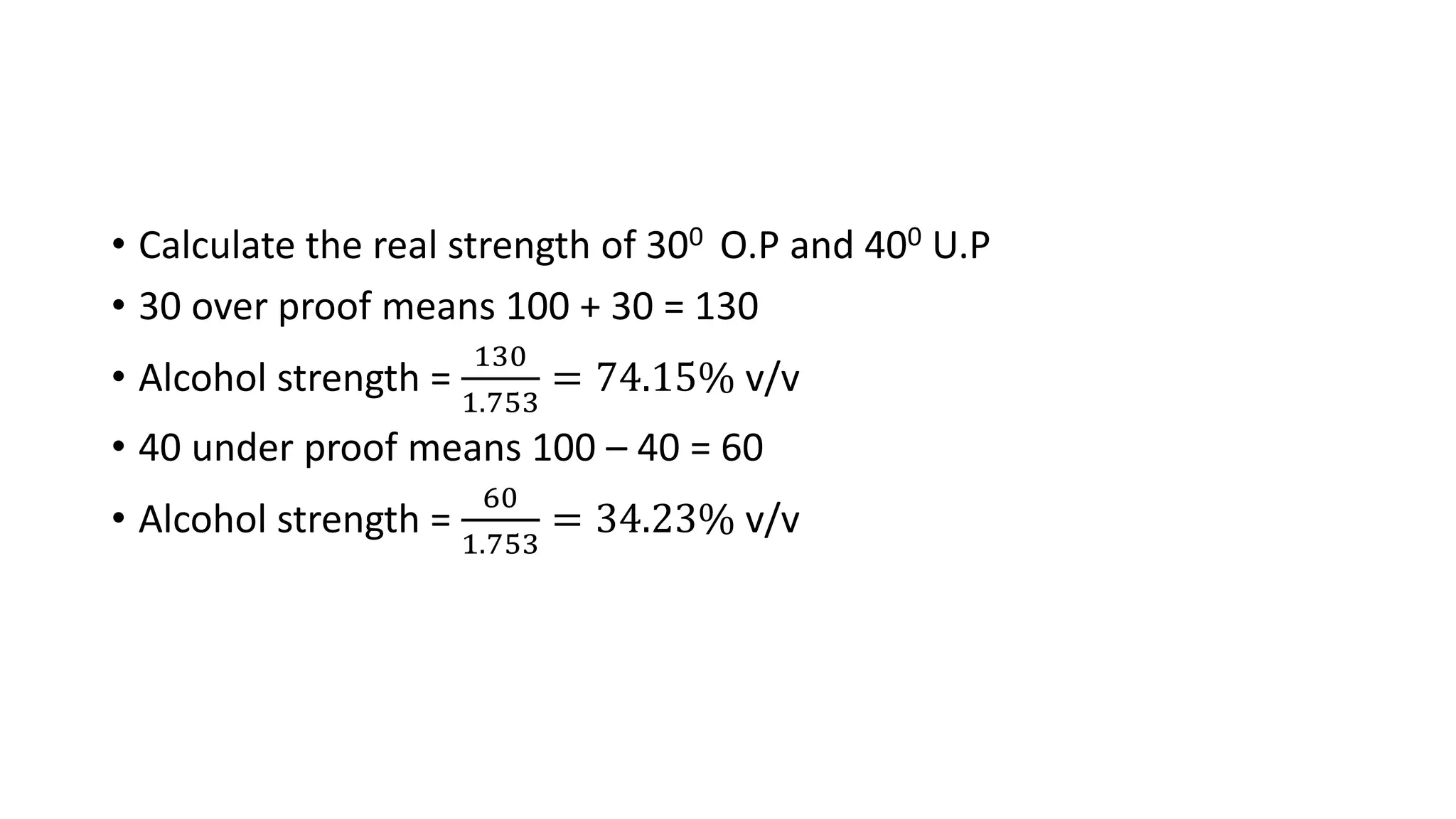
• Calculate the real strength of 300 O.P and 400 U.P
• 30 over proof means 100 + 30 = 130
• Alcohol strength =
130
1.753
= 74.15% v/v
• 40 under proof means 100 – 40 = 60
• Alcohol strength =
60
1.753
= 34.23% v/v
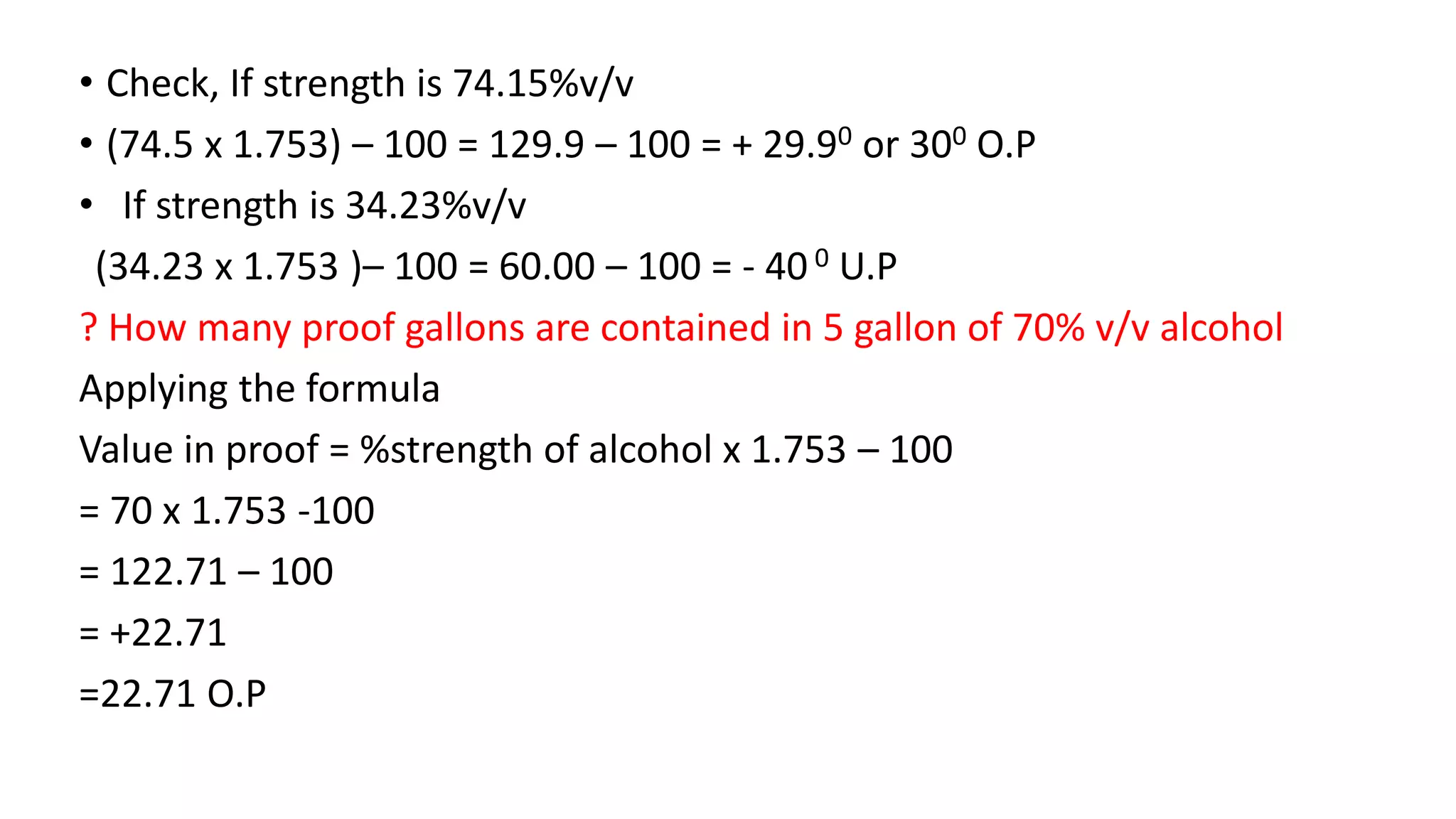
• Check, If strength is 74.15%v/v
• (74.5 x 1.753) – 100 = 129.9 – 100 = + 29.90 or 300 O.P
• If strength is 34.23%v/v
(34.23 x 1.753 )– 100 = 60.00 – 100 = - 40 0 U.P
? How many proof gallons are contained in 5 gallon of 70% v/v alcohol
Applying the formula
Value in proof = %strength of alcohol x 1.753 – 100
= 70 x 1.753 -100
= 122.71 – 100
= +22.71
=22.71 O.P
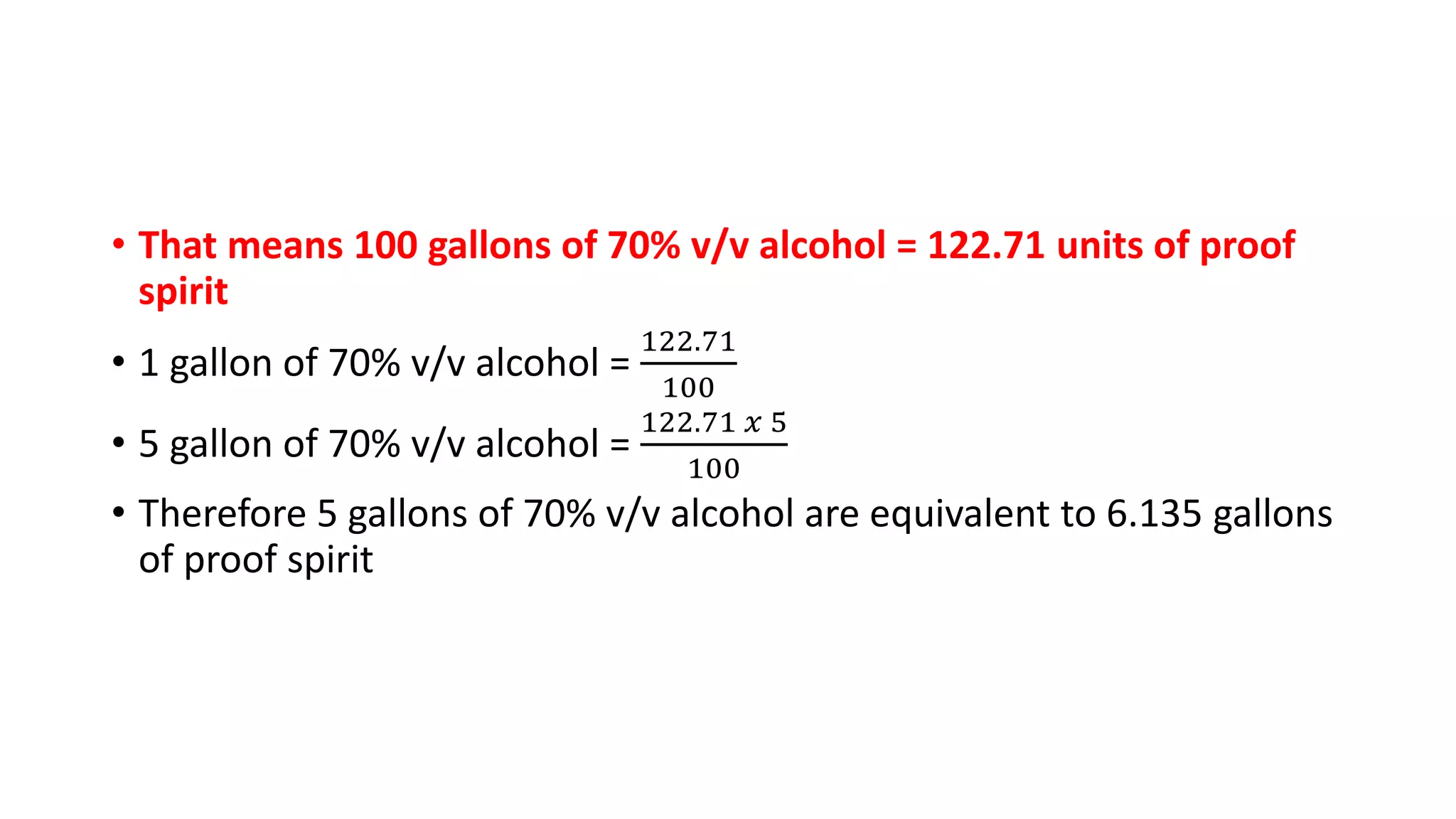
• That means 100 gallons of 70% v/v alcohol = 122.71 units of proof
spirit
• 1 gallon of 70% v/v alcohol =
122.71
100
• 5 gallon of 70% v/v alcohol =
122.71 𝑥 5
100
• Therefore 5 gallons of 70% v/v alcohol are equivalent to 6.135 gallons
of proof spirit
Calculate the following degree of proof spirit into % v/v strength of alcohol
75.00 U.P 14.26%v/v
54.80 U.P 25.8%v/v
35.30 O.P 77.19%v/v
44.60 O.P 82.48%v/v
18.40 O.P 67.54%v/v
Calculate the following strength of alcohol into proof spirit
50.6%v/v
47.31%v/v
79.87%v/v
25.78%v/v
70.74%v/vv
ISOTONIC SOLUTIONS
• Solutions having the same osmotic pressure are called iso-osmotic. It
is not necessary that solutions which are iso-osmotic will also be
isotonic. If a red blood cell is in contact with the solution that has the
same osmotic pressure as that of blood plasma, the cell wall will
neither swell nor shrink i.e. it will retain its tone and therefore the
solution is said to be isotonic.
• To determine whether or not a solution is isotonic with erythrocytes, it is
necessary to determine the concentration of the solute at which the cells
retain their normal size and shape. The parenteral solutions and
ophthalmic solutions need adjustment to iso-osmoticity and iso-tonicity
• The solutions which are not having the same osmotic pressure are called
“paratonic. While comparing a solution with the one of known osmotic
pressure those which exert a greater pressure are called hypertonic and
those with a lower pressure are called hypotonic. Blood plasma contains
0.88% of inorganic salts, mainly sodium chloride, which make the
contribution to osmotic pressure.
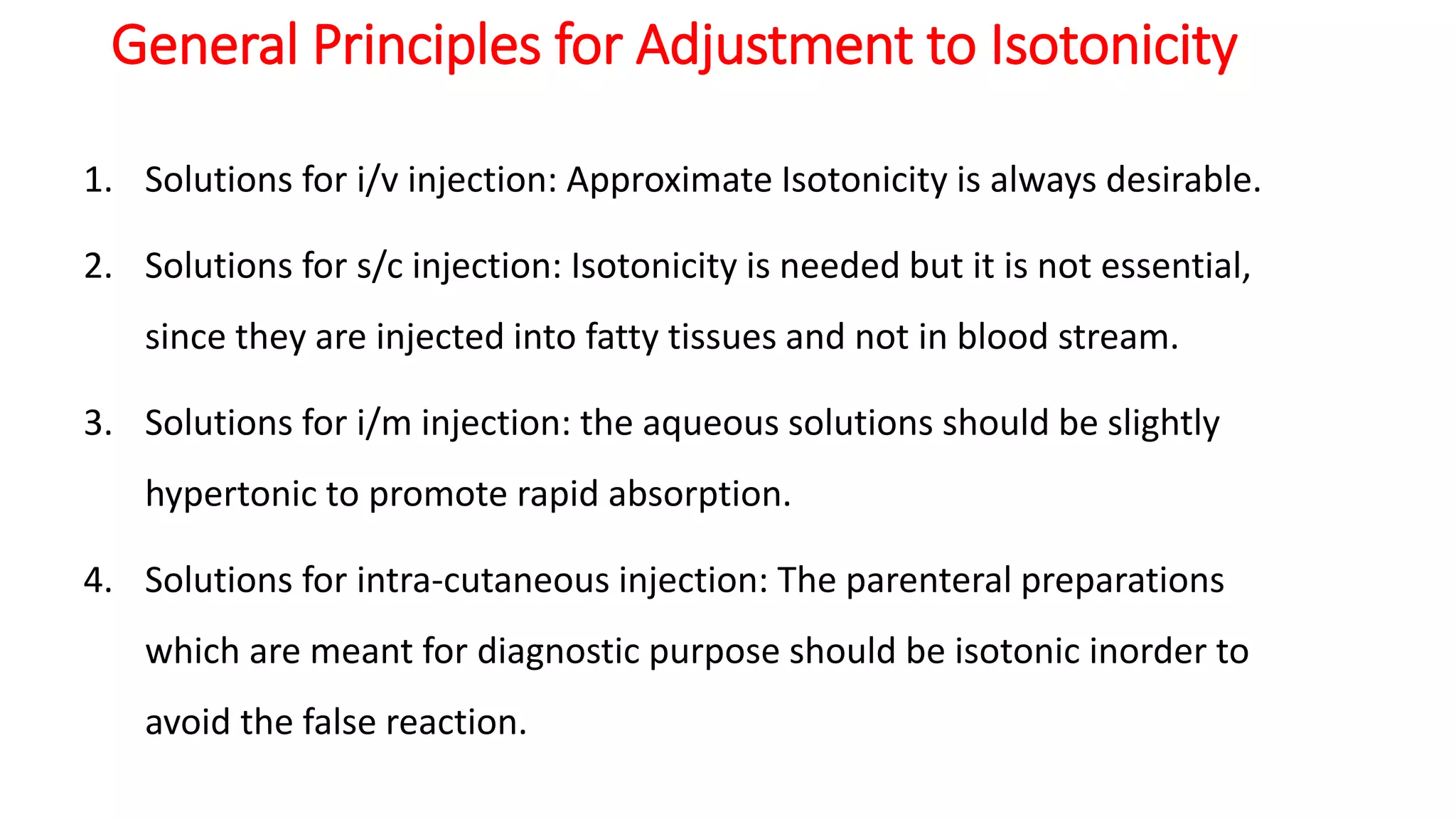
General Principles for Adjustment to Isotonicity
1. Solutions for i/v injection: Approximate Isotonicity is always desirable.
2. Solutions for s/c injection: Isotonicity is needed but it is not essential,
since they are injected into fatty tissues and not in blood stream.
3. Solutions for i/m injection: the aqueous solutions should be slightly
hypertonic to promote rapid absorption.
4. Solutions for intra-cutaneous injection: The parenteral preparations
which are meant for diagnostic purpose should be isotonic inorder to
avoid the false reaction.
1. Solutions for intra-thecal injection: These must be isotonic, because the
volume of C.S.F is only 60 to 80 ml. Hence, a small volume of a paratonic
solution will disturb the osmotic pressure and may cause vomiting and
other side effects.
2. Solutions used for nasal drops: Isotonicity is needed, since paratonic
solution may cause irritation.
3. Solutions used as eye drops and eye lotions: Eye lotion should be isotonic
with lachrymal secretion, since a large volume is brought in contact with
the eye. Eye drops may not be isotonic, because only a small volume is
used which quickly get diluted by the lachrymal secretion
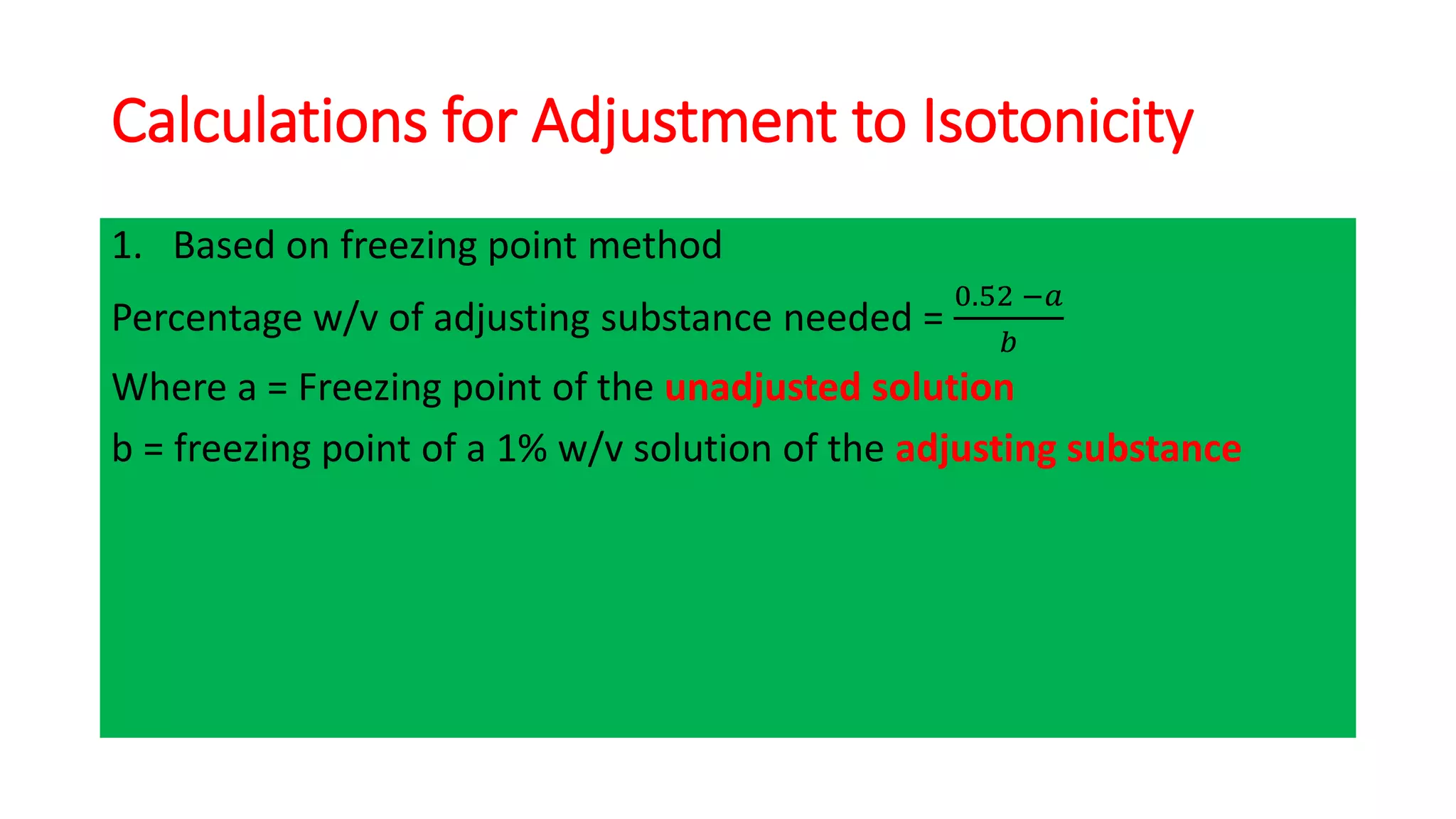
Calculations for Adjustment to Isotonicity
1. Based on freezing point method
Percentage w/v of adjusting substance needed =
0.52 −𝑎
𝑏
Where a = Freezing point of the unadjusted solution
b = freezing point of a 1% w/v solution of the adjusting substance
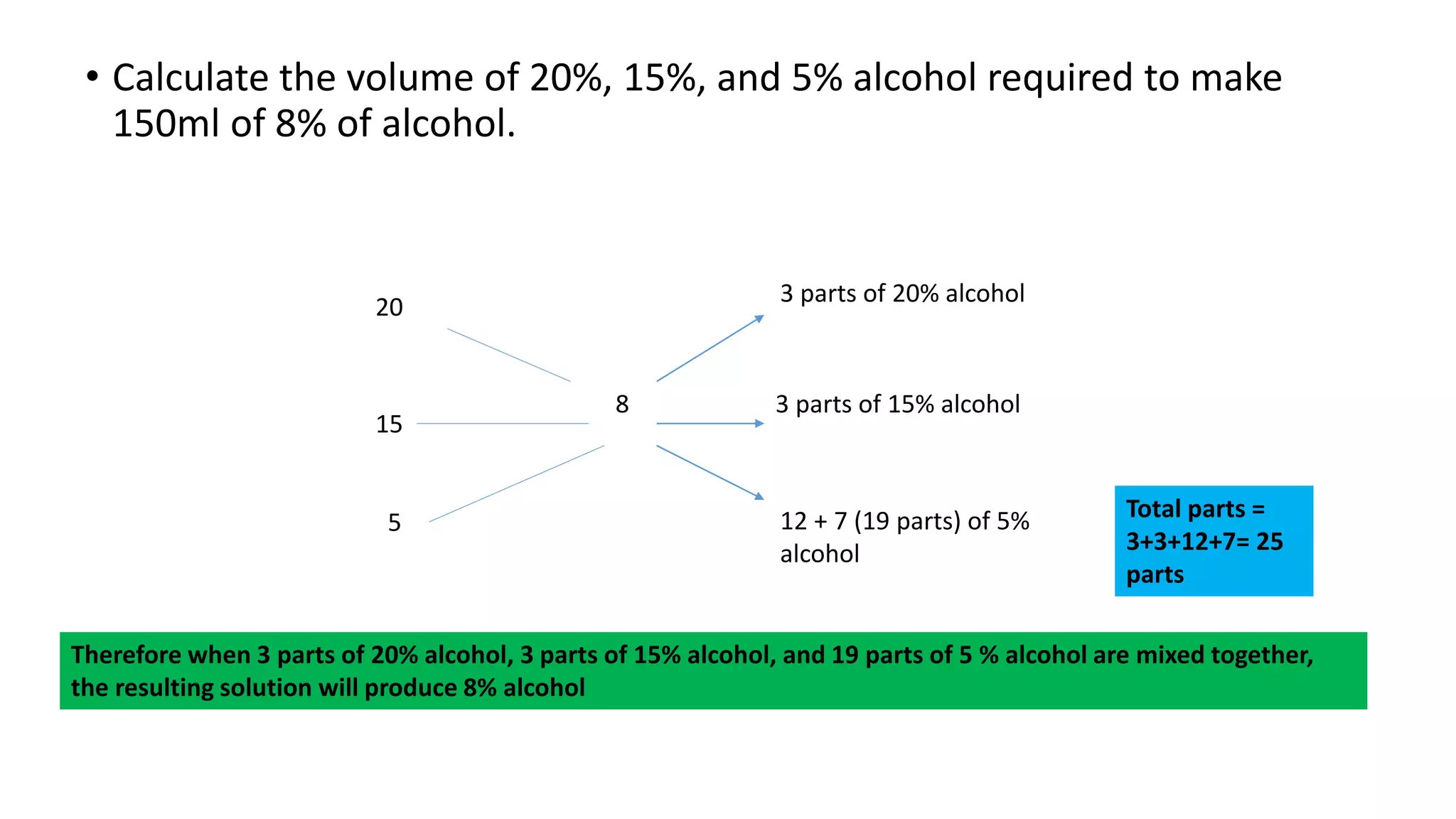
• Based on molecular concentration
Percentage w/v of adjusting substance required =
0.03𝑀
𝑁
Where M = Gram molecular weight of the substance
N = Number of ions into which the substance is ionized.
• Find out the proportion of procaine hydrochloride which will yield a
solution iso-osmotic with blood plasma
(given: the freezing point of a 1%w/v solution of procaine
hydrochloride is – 0.122 0 C)
By applying the formula
Percentage w/v of procaine hydrochloride required =
0.52 −𝑎
𝑏
0.52 −0.00
0.122
= 4.26%w/v.
• Find the concentration of sodium chloride required to make 1.5
percent solution of cocaine hydrochloride iso-osmotic with blood
plasma
• (given the freezing point of 1%w/v solution of cocaine hydrochloride
is -0.09 0 C. The freezing point of 1%w/v solution of sodium chloride is
– 0.576 0 C)
• Percentage w/v of sodium chloride required =
0.52 −(0.09 𝑥 1.5)
0.576
=
0.668%w/v

Pharmaceutical calculations

  • 1.
  • 2.
    Calculations Involved InDispensing • To have a complete understanding of various types of calculations, which are involved in dispensing, it is desirable that the pharmacist should have a thorough knowledge regarding weights and measures which are used in calculations. • There are two systems of weights and measures Measurement of weight in imperial system: Weight is a measure of the gravitational force acting on the body and its directly proportional to its mass. The imperial system is divided into two parts for the purpose of measurement of weight. These are:
  • 3.
    • Avoirdupois system •Apothecaries system Avoirdupois system: In this system the pound is the standard unit for weighing and all measures of mass are derived from the Imperial Standard Pound (Lb), thus:
  • 4.
    • 1 Lb:16oz (avoir) • 1 Lb: 7000 grains • 1 oz (avoir) = 7000/16 grains = 437.5 grains APOTHECARIES SYSTEM: This system is also known as the Troy system. The grain is the standard weight in this system and all other weights are derived from it. 20 grains (gr) = 1 scruple 60 grains = 1 drachm 480 grains = 1 ounce (apothe) 8 drachms = 1 ounce 12 ounces = 1 pound 5760 grains = 1 pound (apothe)
  • 5.
    Measurement of capacityin Imperial System The standard units for capacity is the same in both the avoirdupois and apothecaries systems. The gallon is the standard unit and all other measures of capacity are derived from it 1 gallon (c) = 160 fluid ounces 1/4th of a gallon = 1 quart 1/8th of a gallon = 1 pint 1/160th of a gallon = 1 fl ounce 1/8th of a fl ounce = 1 fl drachm
  • 6.
    • 1/60th ofa fl drachm = 1 minim (m) • 1 quart = 40 fl ounces • 1 pint = 20 fl ounces • 1 fl ounce = 480 minims • 1 fl drachm = 60 minims
  • 7.
    THE METRIC SYSTEM •The metric system is used in the Indian pharmacopoeia for the measurement of weight and capacity. The metric system in India was implemented from 1st April 1964 in pharmacy profession. • Measurement of weight in metric system: A kilogram is the standard unit for measurement of weight and all measures are derived from it
  • 8.
    • 1 kilogram(kg) = 1000grams (g) • 1 hectogram (hg) = 100 grams • 1 decagram (dag) = 10grams • 1 decigram (dg) = 0.1 gram • 1 centigram (cg) = 0.01 gram • 1 milligram (mg) = 0.001gram • 1 microgram (mcg or µg) = 0.000,001 gram • 1 gram (g) = 1000mg
  • 9.
    • Measurement ofcapacity : A litre is the standard unit for measurement of capacity and all measures of capacity are derived from it. • 1 litre (lt) = 1000 millilitre (ml)
  • 10.
    Conversion tables • Thepharmacopoeia of India uses only the metric system in formulae, but the prescriptions are still written in the Imperial system by many an old time physicians. So a conversion tables is used by the pharmacists. • Weight Measures 1 kg = 2.2lb 30g = 1 ounce 450g = 1 pound (avoir) 1 g = 15 grains 60mg = 1 grain
  • 11.
    • Capacity measures 1000ml= 1 quart 500ml = 1 pint 30ml = 1 fluid ounce 4 ml = 1 fluid drachm 1ml = 15 minims 0.06ml = 1 minim
  • 12.
    Conversion table fordomestic measures Domestic measures Metric system Imperial system 1 drop 0.06ml 1 minim 1 teaspoonful 4.00ml 1 fluid drachm 1 desert spoonful 8.00ml 2 fluid drachm 1 tablespoonful 15.00ml 4 fluid drachm 2 tablespoonful 30.00ml 1 fluid ounce 1 wineglassful 60.00ml 2 fluid ounce 1 teacupful 120.00ml 4 fluid ounce 1 tumblerful 240.00ml 8 fluid ounce
  • 13.
    CALCULATIONS • Calculations basedon density: Density is defined as the mass of a substance per unit volume. It has the units of mass over volume. • Specific gravity is defined as the ratio of the mass of a substance in air to that of an equal volume of water. • In the metric system, both density and specific gravity are numerically equal. The equations for calculating density, weight, and volume are as follows: • Density = 𝑾𝒆𝒊𝒈𝒉𝒕 𝑽𝒐𝒍𝒖𝒎𝒆 • Weight= Density x Volume • Volume = 𝑾𝒆𝒊𝒈𝒉𝒕 𝑫𝒆𝒏𝒔𝒊𝒕𝒚
  • 14.
    • Calculate thevolume of 2 kg of glycerin. The density of glycerin is 1.25g/ml • Volume = weight/ density = 2000𝑔 1.25𝑔/𝑚𝑙 = 1600ml
  • 15.
    • Calculate theweight of 250ml of alcohol whose density is 0.816g/ml. • Weight = Density x volume = 0.816 x 250 = 204.0g
  • 16.
    • Calculate theweight of 150ml of sulphuric acid whose density is 1.8g/ml. • Weight = density x volume • = 1.8 x 150 • = 270.0g
  • 17.
    • Calculate theweight of 1.5 litre of fixed oil whose density is 0.9624g/ml • Weight = density x volume = 0.9624 x 1500 = 1443.6g
  • 18.
    ALCOHOL DILUTIONS • Thedilute alcohols are made from 95% alcohol which contains 95 parts by volume of ethyl alcohol and 5 parts by volume of water. • When alcohol gets mixed with water, the following change takes place • There is rise in temperature • There is contraction in volume • There is turbid appearance in the solution, because solubility of air is more in alcohol than in water. When alcohol is diluted with water, minute bubbles of air get evolved from the alcohol and make the turbid appearance. Note : when alcohol is diluted with water, it is necessary to cool the mixture to about 20 o C and then final volume is made up.
  • 19.
    • Calculate theamount of 95 percent alcohol required to prepare 400 ml of 45 percent alcohol Calculation Volume required = 400ml Percentage of alcohol required = 45 Percentage of alcohol used = 95 By applying the formula: Volume of stronger alcohol to be used = 𝑽𝒐𝒍𝒖𝒎𝒆 𝒓𝒆𝒒𝒖𝒊𝒓𝒆𝒅 𝒙 𝒑𝒆𝒓𝒄𝒆𝒏𝒕𝒂𝒈𝒆 𝒓𝒆𝒒𝒖𝒊𝒓𝒆𝒅 𝒑𝒆𝒓𝒄𝒆𝒏𝒕𝒂𝒈𝒆 𝒖𝒔𝒆𝒅
  • 20.
    = 400 𝑥 45 95 =3600 / 19 = 189.47ml = 190ml Note : 190ml of 95 % alcohol is diluted with water to produce 400ml. The strength of dilute alcohol will be 45%
  • 21.
    Alligation Method • Whenthe calculation involves mixing of two similar preparations of different strength, to produce a preparation of intermediate strength, the alligation method is used. The method is recommended for the purpose of checking the calculations. • For calculation purpose, the figures are written as given below:
  • 22.
  • 23.
    • The followingexample illustrates the use of this method: Example: calculate the volume of 95 percent alcohol required to prepare 600ml of 70 percent alcohol Volume required = 600ml Percentage of alcohol required = 70 Percentage of alcohol used = 95 By using alligation method:
  • 24.
  • 25.
    • 70 partsof 95% and 25 parts of water will produce the required percentage alcohol. • Quantity of 95% alcohol required = 600 𝑥 70 95 = 442.10ml • Quantity of water required = 600 𝑥25 95 = 157.89ml
  • 26.
    • Calculate theamount of 70%, 60%, 40%, and 30% alcohol should be mixed to get 50% alcohol Using alligation method 50 20 parts of 70%alcohol 10 parts of 60% alcohol 10 parts of 40% alcohol 20 parts of 30% alcohol 70 60 40 30
  • 27.
    • Therefore when20 parts of 70%alcohol, 10 parts of 60%alcohol. 10 parts of 40% alcohol and 20 parts of 30% alcohol are mixed together, the resulting solution will produce 50% alcohol. • Check: • (20 x 70) + (10 x 60) + (10 x 40) + (20 x 30) = 1400 + 600 + 400 + 600 = 3000 (20 + 10 + 10 + 20) 50 = 60 x 50 = 3000
  • 28.
    Calculate the volumeof each of 90%, 60%, 30% and water are required to produce 500ml of 50% alcohol Using alligation method 50 50 parts of 90%alcohol 20 parts of 60% alcohol 10 parts of 30% alcohol 40 parts of water 90 60 30 0 120 parts
  • 29.
    • Therefore when50 parts of 90% alcohol, 20parts of 60% alcohol, 10 parts of 30% alcohol and 40 parts of water are mixed together, the resulting solution will produce 50% alcohol. • Vol of 90% alcohol required • = 120 parts: 500 :: 50 parts: v • V = 500 𝑥 50 120 = 208.33 ml • Volume of 60% alcohol required = 120 parts: 500ml: 20parts: v V = 500 𝑥 20 120 = 83.33 ml
  • 30.
    • Volume of30% alcohol required = 120 parts: 500ml:: 10parts: v V = 500 𝑥 10 120 = 41.66 ml Volume of water required = 500 – (208.33 + 83.33 + 41.66) = 166.67ml
  • 31.
    • Calculate thestrength of alcohol if 250ml of 20% v/v alcohol, 450 ml of 40 % v/v alcohol and 500ml of 30% v/v of alcohol is mixed together Calculation 250ml of 20% v/v alcohol contains alcohol = 50ml 450ml of 40% v/v alcohol contains alcohol = 180ml 500ml of 30% v/v alcohol contains alcohol = 150ml 1200ml of mixture of alcohol contains alcohol = 380ml
  • 32.
    • Suppose vml of alcohol is present in 100ml of mixture • Apply the ratio – proportion rules: • 1200: 380:: 100: v • V = 380 x 100/ 1200 = 32ml 1%v/v = 1ml in 100ml 1%w/v = 1g in 100ml 100 4 10 x
  • 33.
    • Calculate theproportion of 15%, 8%, and 3% alcohol required to make 6% of alcohol. 6 3 parts of 15% alcohol 3 parts of 8% alcohol 9 + 2 (11 parts) of 3% alcohol 15 8 3 Therefore when 3 parts of 15% alcohol, 3 parts of 8% alcohol, and 11 parts of 3 % alcohol are mixed together, the resulting solution will produce 6% alcohol
  • 34.
    • Calculate thevolume of 20%, 15%, and 5% alcohol required to make 150ml of 8% of alcohol. 8 3 parts of 20% alcohol 3 parts of 15% alcohol 12 + 7 (19 parts) of 5% alcohol 20 15 5 Therefore when 3 parts of 20% alcohol, 3 parts of 15% alcohol, and 19 parts of 5 % alcohol are mixed together, the resulting solution will produce 8% alcohol Total parts = 3+3+12+7= 25 parts
  • 35.
    • Vol of20% alcohol required • = 25parts: 150ml :: 3parts: v • V = 150 𝑥 3 25 = 18 ml • Volume of 15% alcohol required = 25 parts: 150ml: 3parts: v V = 150 𝑥 3 25 = 18 ml • Volume of 5% alcohol required = 25 parts: 150ml: 19parts: v V = 150 𝑥 19 25 = 114 ml
  • 36.
    Proof Spirit For excisepurpose, the strength of alcoholic preparations are indicated by degrees, “over proof” or under proof. Proof spirit is that mixture of alcohol and water which at 510 F weighs 12/13th of an equal volume of water. In India, 57.1%v/v ethyl alcohol is considered to be equal to 100volumes of proof spirit. So any strength about proof strength is expressed as over proof (O.P) and any strength below proof strength is expressed as under proof(U.P) In India the excise duty is calculated in terms of rupees per litre of proof alcohol. So any percentage volume in volume of alcohol can be converted into proof strength and vice versa by using the following method.
  • 37.
    • Multiply thepercentage strength of alcohol by 1.753 and deduct 100 from the product. • If the result is positive it is known as over proof • If the result is negative, it is known as under proof.
  • 38.
    • The figure1.753 is obtained as follows: • 57.1 volumes of ethyl alcohol = 100 volume of proof spirit • 1 volume of ethyl alcohol = 100 57.1 = 1.753 volume of proof spirit.
  • 39.
    • Find thestrength of 95% v/v alcohol in terms of proof spirit • By applying the formula: • (Percentage strength of alcohol x 1.753) – 100 • = (95 x 1.753) -100 • = 166.53 – 100 = +66.530 • = 66.530 O.P
  • 40.
    • Calculate thereal strength of 300 O.P and 400 U.P • 30 over proof means 100 + 30 = 130 • Alcohol strength = 130 1.753 = 74.15% v/v • 40 under proof means 100 – 40 = 60 • Alcohol strength = 60 1.753 = 34.23% v/v
  • 41.
    • Check, Ifstrength is 74.15%v/v • (74.5 x 1.753) – 100 = 129.9 – 100 = + 29.90 or 300 O.P • If strength is 34.23%v/v (34.23 x 1.753 )– 100 = 60.00 – 100 = - 40 0 U.P ? How many proof gallons are contained in 5 gallon of 70% v/v alcohol Applying the formula Value in proof = %strength of alcohol x 1.753 – 100 = 70 x 1.753 -100 = 122.71 – 100 = +22.71 =22.71 O.P
  • 42.
    • That means100 gallons of 70% v/v alcohol = 122.71 units of proof spirit • 1 gallon of 70% v/v alcohol = 122.71 100 • 5 gallon of 70% v/v alcohol = 122.71 𝑥 5 100 • Therefore 5 gallons of 70% v/v alcohol are equivalent to 6.135 gallons of proof spirit
  • 43.
    Calculate the followingdegree of proof spirit into % v/v strength of alcohol 75.00 U.P 14.26%v/v 54.80 U.P 25.8%v/v 35.30 O.P 77.19%v/v 44.60 O.P 82.48%v/v 18.40 O.P 67.54%v/v Calculate the following strength of alcohol into proof spirit 50.6%v/v 47.31%v/v 79.87%v/v 25.78%v/v 70.74%v/vv
  • 44.
    ISOTONIC SOLUTIONS • Solutionshaving the same osmotic pressure are called iso-osmotic. It is not necessary that solutions which are iso-osmotic will also be isotonic. If a red blood cell is in contact with the solution that has the same osmotic pressure as that of blood plasma, the cell wall will neither swell nor shrink i.e. it will retain its tone and therefore the solution is said to be isotonic.
  • 45.
    • To determinewhether or not a solution is isotonic with erythrocytes, it is necessary to determine the concentration of the solute at which the cells retain their normal size and shape. The parenteral solutions and ophthalmic solutions need adjustment to iso-osmoticity and iso-tonicity • The solutions which are not having the same osmotic pressure are called “paratonic. While comparing a solution with the one of known osmotic pressure those which exert a greater pressure are called hypertonic and those with a lower pressure are called hypotonic. Blood plasma contains 0.88% of inorganic salts, mainly sodium chloride, which make the contribution to osmotic pressure.
  • 46.
    General Principles forAdjustment to Isotonicity 1. Solutions for i/v injection: Approximate Isotonicity is always desirable. 2. Solutions for s/c injection: Isotonicity is needed but it is not essential, since they are injected into fatty tissues and not in blood stream. 3. Solutions for i/m injection: the aqueous solutions should be slightly hypertonic to promote rapid absorption. 4. Solutions for intra-cutaneous injection: The parenteral preparations which are meant for diagnostic purpose should be isotonic inorder to avoid the false reaction.
  • 47.
    1. Solutions forintra-thecal injection: These must be isotonic, because the volume of C.S.F is only 60 to 80 ml. Hence, a small volume of a paratonic solution will disturb the osmotic pressure and may cause vomiting and other side effects. 2. Solutions used for nasal drops: Isotonicity is needed, since paratonic solution may cause irritation. 3. Solutions used as eye drops and eye lotions: Eye lotion should be isotonic with lachrymal secretion, since a large volume is brought in contact with the eye. Eye drops may not be isotonic, because only a small volume is used which quickly get diluted by the lachrymal secretion
  • 48.
    Calculations for Adjustmentto Isotonicity 1. Based on freezing point method Percentage w/v of adjusting substance needed = 0.52 −𝑎 𝑏 Where a = Freezing point of the unadjusted solution b = freezing point of a 1% w/v solution of the adjusting substance
  • 49.
    • Based onmolecular concentration Percentage w/v of adjusting substance required = 0.03𝑀 𝑁 Where M = Gram molecular weight of the substance N = Number of ions into which the substance is ionized.
  • 50.
    • Find outthe proportion of procaine hydrochloride which will yield a solution iso-osmotic with blood plasma (given: the freezing point of a 1%w/v solution of procaine hydrochloride is – 0.122 0 C) By applying the formula Percentage w/v of procaine hydrochloride required = 0.52 −𝑎 𝑏 0.52 −0.00 0.122 = 4.26%w/v.
  • 51.
    • Find theconcentration of sodium chloride required to make 1.5 percent solution of cocaine hydrochloride iso-osmotic with blood plasma • (given the freezing point of 1%w/v solution of cocaine hydrochloride is -0.09 0 C. The freezing point of 1%w/v solution of sodium chloride is – 0.576 0 C) • Percentage w/v of sodium chloride required = 0.52 −(0.09 𝑥 1.5) 0.576 = 0.668%w/v