Pharmaceutical Calculations
Lec 6:
Percentage, Ratio Strength, and
Other Expressions of Concentration
Pharmacist
Hussein kadhim alkufi
MSc in pharmaceutics
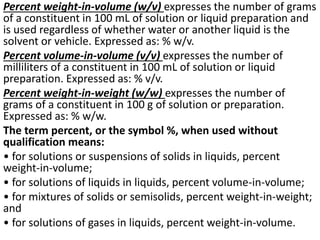
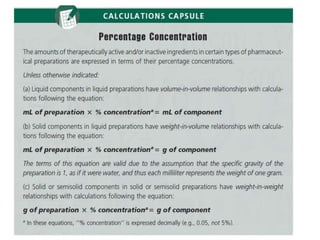
Percent weight-in-volume (w/v) expresses the number of grams
of a constituent in 100 mL of solution or liquid preparation and
is used regardless of whether water or another liquid is the
solvent or vehicle. Expressed as: % w/v.
Percent volume-in-volume (v/v) expresses the number of
milliliters of a constituent in 100 mL of solution or liquid
preparation. Expressed as: % v/v.
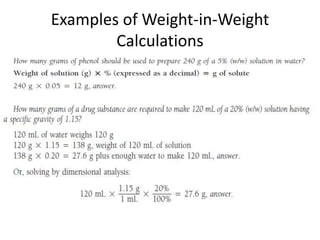
Percent weight-in-weight (w/w) expresses the number of
grams of a constituent in 100 g of solution or preparation.
Expressed as: % w/w.
The term percent, or the symbol %, when used without
qualification means:
• for solutions or suspensions of solids in liquids, percent
weight-in-volume;
• for solutions of liquids in liquids, percent volume-in-volume;
• for mixtures of solids or semisolids, percent weight-in-weight;
and
• for solutions of gases in liquids, percent weight-in-volume.
The term percent and its corresponding sign (%) mean ‘‘by the hundred’’ or ‘‘in a hundred,’’
and percentage means ‘‘rate per hundred’’; so 50 percent (or 50%) and a percentage of 50 are
equivalent expressions. A percent may also be expressed as a ratio, represented as a common
or decimal fraction. For example, 50% means 50 parts in 100 of the same kind, and may be
expressed as 50⁄100 or 0.50. Percent, therefore, is simply another fraction of such frequent and
familiar use that its numerator is expressed but its denominator is left understood. It should be
noted that percent is always an abstract quantity and that, as such, it may be applied to
anything.
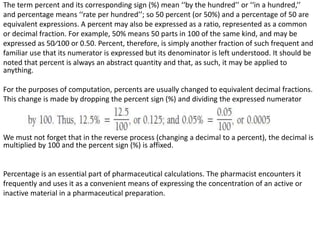
For the purposes of computation, percents are usually changed to equivalent decimal fractions.
This change is made by dropping the percent sign (%) and dividing the expressed numerator
We must not forget that in the reverse process (changing a decimal to a percent), the decimal is
multiplied by 100 and the percent sign (%) is affixed.
Percentage is an essential part of pharmaceutical calculations. The pharmacist encounters it
frequently and uses it as a convenient means of expressing the concentration of an active or
inactive material in a pharmaceutical preparation.
Percentage Weight-in-Volume
In a true expression of percentage (i.e., parts per 100
parts), the percentage of a liquid preparation (e.g.,
solution, suspension, lotion) would represent the
grams of solute or constituent in 100 g of the liquid
preparation. However, in practice, the pharmacist
most frequently uses a different definition of
percentage for solutions and for other liquid
preparations, one in which the parts of the
percentage represent grams of a solute or constituent
in 100 mL of solution or liquid preparation.
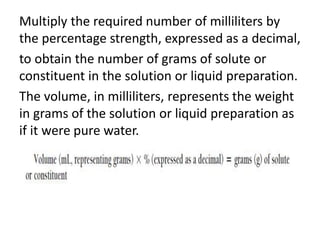
Multiply the required number of milliliters by
the percentage strength, expressed as a decimal,
to obtain the number of grams of solute or
constituent in the solution or liquid preparation.
The volume, in milliliters, represents the weight
in grams of the solution or liquid preparation as
if it were pure water.
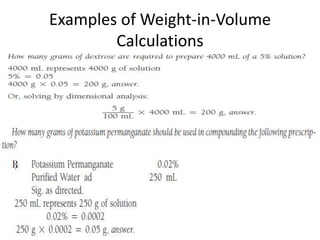
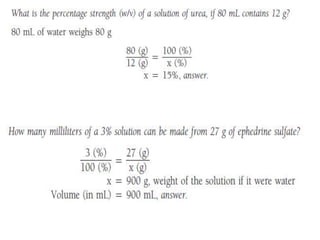
Examples of Weight-in-Volume
Calculations
Percentage Volume-in-Volume
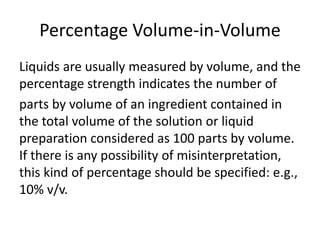
Liquids are usually measured by volume, and the
percentage strength indicates the number of
parts by volume of an ingredient contained in
the total volume of the solution or liquid
preparation considered as 100 parts by volume.
If there is any possibility of misinterpretation,
this kind of percentage should be specified: e.g.,
10% v/v.
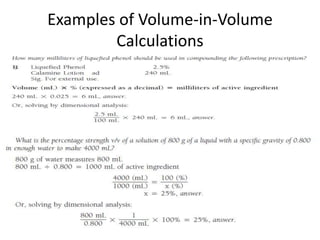
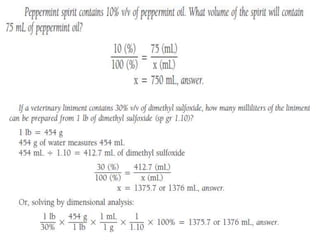
Examples of Volume-in-Volume
Calculations
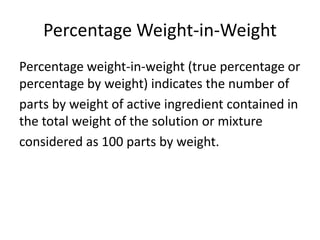
Percentage Weight-in-Weight
Percentage weight-in-weight (true percentage or
percentage by weight) indicates the number of
parts by weight of active ingredient contained in
the total weight of the solution or mixture
considered as 100 parts by weight.
Examples of Weight-in-Weight
Calculations
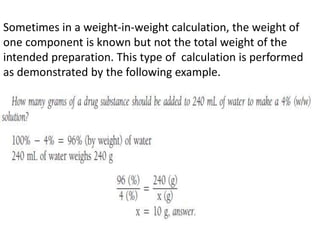
Sometimes in a weight-in-weight calculation, the weight of
one component is known but not the total weight of the
intended preparation. This type of calculation is performed
as demonstrated by the following example.
It is usually impossible to prepare a specified volume
of a solution or liquid preparation of given weight-in-
weight percentage strength because the volume
displaced by the active ingredient cannot be known in
advance. If an excess is acceptable, we may make a
volume somewhat more than that specified by taking
the given volume to refer to the solvent or vehicle and
from this quantity calculating the weight of the
solvent or vehicle (the specific gravity of the solvent or
vehicle must be known). Using this weight, we may
follow the method just described to calculate the
corresponding weight of the active ingredient needed.
If the weight of the finished solution or liquid
preparation is not given when calculating its percentage
strength, other data must be supplied from which it may
be calculated: the weights of both ingredients, for
instance, or the volume and specific gravity of the
solution or liquid preparation.
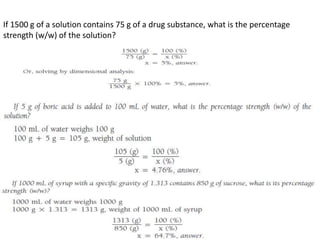
If 1500 g of a solution contains 75 g of a drug substance, what is the percentage
strength (w/w) of the solution?
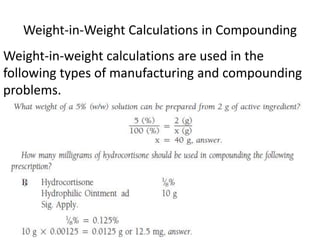
Weight-in-Weight Calculations in Compounding
Weight-in-weight calculations are used in the
following types of manufacturing and compounding
problems.
Ratio Strength
The concentrations of weak solutions are frequently expressed
in terms of ratio strength. Because all percentages are a ratio of
parts per hundred, ratio strength is merely another way of
expressing
the percentage strength of solutions or liquid preparations
(and, less frequently, of mixtures of solids).
For example, 5% means 5 parts per 100 or 5=100. Although 5
parts per 100 designates a ratio strength, it is customary to
translate this designation into a ratio, the first figure of which
is 1; thus, 5:100 = 1:20.
When a ratio strength, for example, 1:1000, is used to
designate a concentration, it is to be interpreted as follows:
• For solids in liquids = 1 g of solute or constituent in
1000 mL of solution or liquid preparation.
• For liquids in liquids = 1 mL of constituent in 1000
mL of solution or liquid preparation.
• For solids in solids = 1 g of constituent in 1000 g of
mixture.
The ratio and percentage strengths of any solution or
mixture of solids are proportional, and either is easily
converted to the other by the use of proportion.
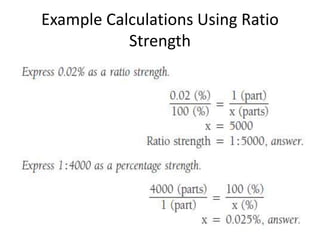
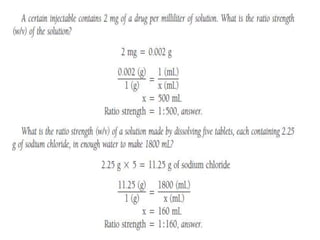
Example Calculations Using Ratio
Strength
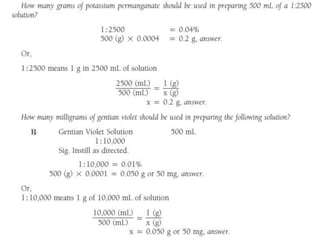
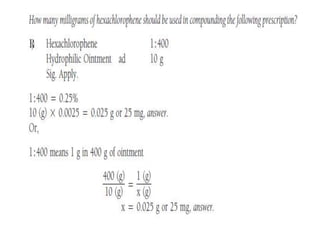
Percentage and ratio strength

Percentage and ratio strength

  • 1.
    Pharmaceutical Calculations Lec 6: Percentage,Ratio Strength, and Other Expressions of Concentration Pharmacist Hussein kadhim alkufi MSc in pharmaceutics
  • 2.
    Percent weight-in-volume (w/v)expresses the number of grams of a constituent in 100 mL of solution or liquid preparation and is used regardless of whether water or another liquid is the solvent or vehicle. Expressed as: % w/v. Percent volume-in-volume (v/v) expresses the number of milliliters of a constituent in 100 mL of solution or liquid preparation. Expressed as: % v/v. Percent weight-in-weight (w/w) expresses the number of grams of a constituent in 100 g of solution or preparation. Expressed as: % w/w. The term percent, or the symbol %, when used without qualification means: • for solutions or suspensions of solids in liquids, percent weight-in-volume; • for solutions of liquids in liquids, percent volume-in-volume; • for mixtures of solids or semisolids, percent weight-in-weight; and • for solutions of gases in liquids, percent weight-in-volume.
  • 4.
    The term percentand its corresponding sign (%) mean ‘‘by the hundred’’ or ‘‘in a hundred,’’ and percentage means ‘‘rate per hundred’’; so 50 percent (or 50%) and a percentage of 50 are equivalent expressions. A percent may also be expressed as a ratio, represented as a common or decimal fraction. For example, 50% means 50 parts in 100 of the same kind, and may be expressed as 50⁄100 or 0.50. Percent, therefore, is simply another fraction of such frequent and familiar use that its numerator is expressed but its denominator is left understood. It should be noted that percent is always an abstract quantity and that, as such, it may be applied to anything. For the purposes of computation, percents are usually changed to equivalent decimal fractions. This change is made by dropping the percent sign (%) and dividing the expressed numerator We must not forget that in the reverse process (changing a decimal to a percent), the decimal is multiplied by 100 and the percent sign (%) is affixed. Percentage is an essential part of pharmaceutical calculations. The pharmacist encounters it frequently and uses it as a convenient means of expressing the concentration of an active or inactive material in a pharmaceutical preparation.
  • 5.
    Percentage Weight-in-Volume In atrue expression of percentage (i.e., parts per 100 parts), the percentage of a liquid preparation (e.g., solution, suspension, lotion) would represent the grams of solute or constituent in 100 g of the liquid preparation. However, in practice, the pharmacist most frequently uses a different definition of percentage for solutions and for other liquid preparations, one in which the parts of the percentage represent grams of a solute or constituent in 100 mL of solution or liquid preparation.
  • 6.
    Multiply the requirednumber of milliliters by the percentage strength, expressed as a decimal, to obtain the number of grams of solute or constituent in the solution or liquid preparation. The volume, in milliliters, represents the weight in grams of the solution or liquid preparation as if it were pure water.
  • 7.
  • 9.
    Percentage Volume-in-Volume Liquids areusually measured by volume, and the percentage strength indicates the number of parts by volume of an ingredient contained in the total volume of the solution or liquid preparation considered as 100 parts by volume. If there is any possibility of misinterpretation, this kind of percentage should be specified: e.g., 10% v/v.
  • 10.
  • 12.
    Percentage Weight-in-Weight Percentage weight-in-weight(true percentage or percentage by weight) indicates the number of parts by weight of active ingredient contained in the total weight of the solution or mixture considered as 100 parts by weight.
  • 13.
  • 14.
    Sometimes in aweight-in-weight calculation, the weight of one component is known but not the total weight of the intended preparation. This type of calculation is performed as demonstrated by the following example.
  • 15.
    It is usuallyimpossible to prepare a specified volume of a solution or liquid preparation of given weight-in- weight percentage strength because the volume displaced by the active ingredient cannot be known in advance. If an excess is acceptable, we may make a volume somewhat more than that specified by taking the given volume to refer to the solvent or vehicle and from this quantity calculating the weight of the solvent or vehicle (the specific gravity of the solvent or vehicle must be known). Using this weight, we may follow the method just described to calculate the corresponding weight of the active ingredient needed.
  • 16.
    If the weightof the finished solution or liquid preparation is not given when calculating its percentage strength, other data must be supplied from which it may be calculated: the weights of both ingredients, for instance, or the volume and specific gravity of the solution or liquid preparation.
  • 18.
    If 1500 gof a solution contains 75 g of a drug substance, what is the percentage strength (w/w) of the solution?
  • 19.
    Weight-in-Weight Calculations inCompounding Weight-in-weight calculations are used in the following types of manufacturing and compounding problems.
  • 20.
    Ratio Strength The concentrationsof weak solutions are frequently expressed in terms of ratio strength. Because all percentages are a ratio of parts per hundred, ratio strength is merely another way of expressing the percentage strength of solutions or liquid preparations (and, less frequently, of mixtures of solids). For example, 5% means 5 parts per 100 or 5=100. Although 5 parts per 100 designates a ratio strength, it is customary to translate this designation into a ratio, the first figure of which is 1; thus, 5:100 = 1:20. When a ratio strength, for example, 1:1000, is used to designate a concentration, it is to be interpreted as follows:
  • 21.
    • For solidsin liquids = 1 g of solute or constituent in 1000 mL of solution or liquid preparation. • For liquids in liquids = 1 mL of constituent in 1000 mL of solution or liquid preparation. • For solids in solids = 1 g of constituent in 1000 g of mixture. The ratio and percentage strengths of any solution or mixture of solids are proportional, and either is easily converted to the other by the use of proportion.
  • 22.