The document discusses prescriptions and electronic prescribing. It defines a prescription as an order from a medical practitioner for medicine or treatment for a patient. It explains the parts of a prescription including patient information, medication, and instructions. Electronic prescribing allows doctors to transmit prescriptions directly to pharmacies digitally, improving accuracy and reducing errors compared to handwritten prescriptions. While it provides benefits, electronic prescribing also faces challenges such as accidental errors and security issues.
At the endof the lecture the students will be able to:
Define prescription.
Explain the different parts of prescription.
Interpret the information on the prescription.
Process the prescription order / Handle the prescription.
Define the different types of prescription.
Define Electronic prescribing and how it works.
Compare the advantages and disadvantages of Electronic
prescribing.
3.
Prescription is anorder from a physician,
dentist or any other registered medical
practitioner to a pharmacist for the supply of
medicine ,dressing or appliance for the
patient.
4.
The conceptof prescriptions dates back to the beginning of
history. So long as there were medications and a writing
system to capture directions for preparation and usage, there
were prescriptions.
Modern prescriptions are actually "extemporaneous
prescriptions" from the Latin (ex tempore) for "at/from
time"."Extemporaneous" means the prescription is written on
the spot for a specific patient with a specific ailment. This is
distinguished from a non-extemporaneous prescription which
is a generic recipe for a general ailment.
5.
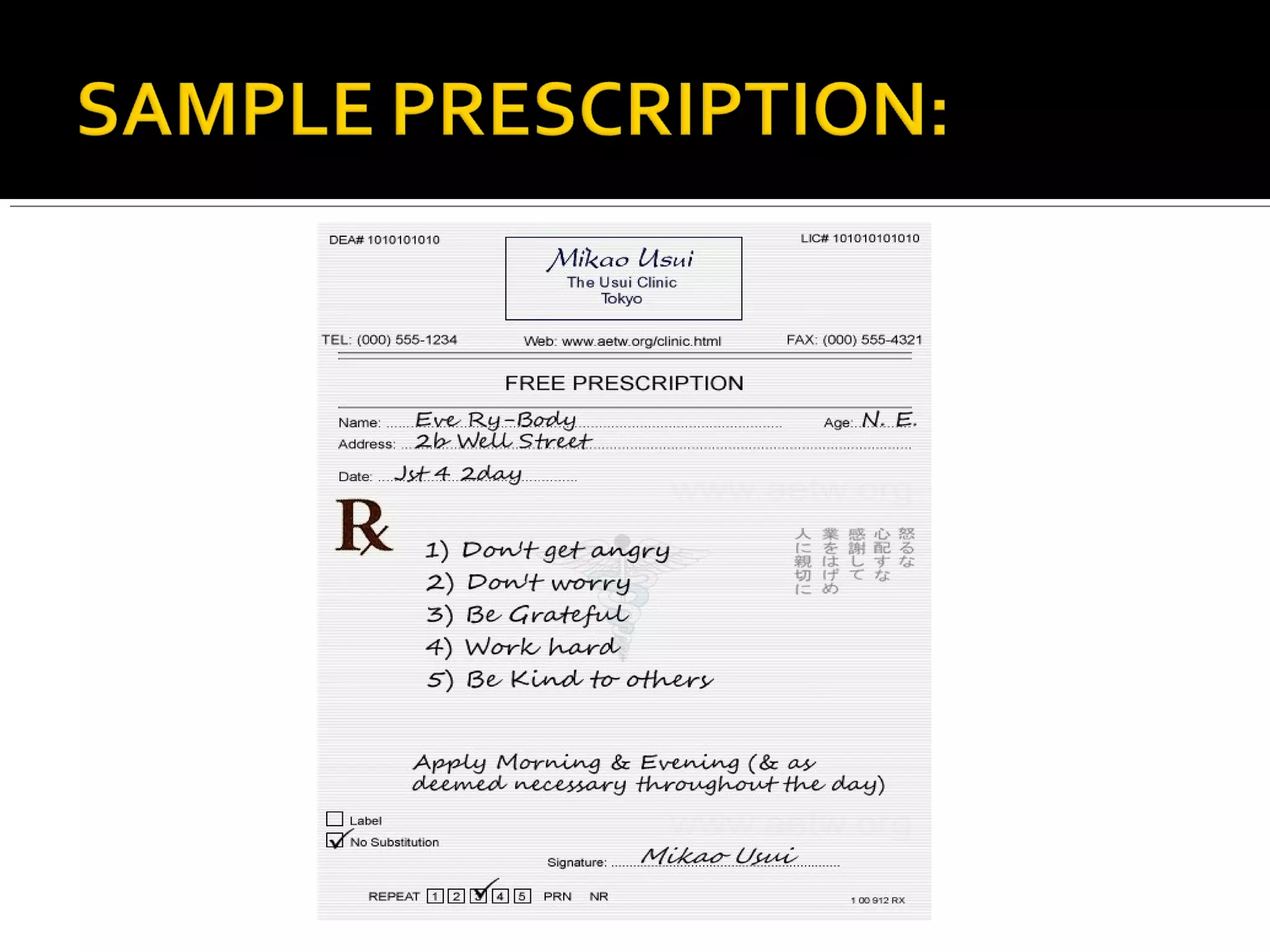
Prescribers officeinformation
Patient information
Date
Rx symbol or Superscription
Medication prescribed or Inscription
Dispensing directions to the pharmacist or
Subscription
Direction for patient or Signatura
Refill ,special labeling ,and /or other instructions
Signature and registration number of prescriber
7.
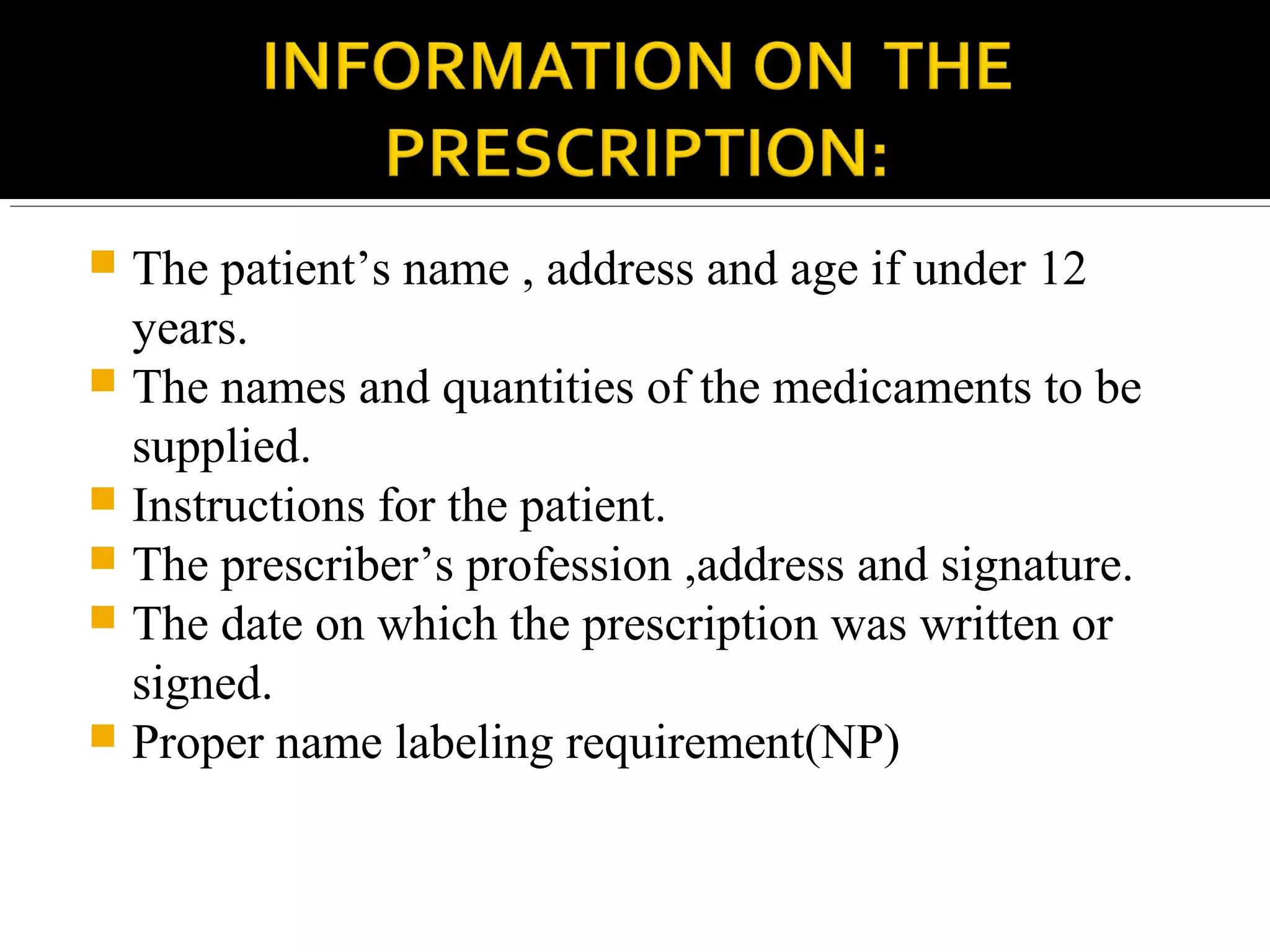
The patient’sname , address and age if under 12
years.
The names and quantities of the medicaments to be
supplied.
Instructions for the patient.
The prescriber’s profession ,address and signature.
The date on which the prescription was written or
signed.
Proper name labeling requirement(NP)
8.
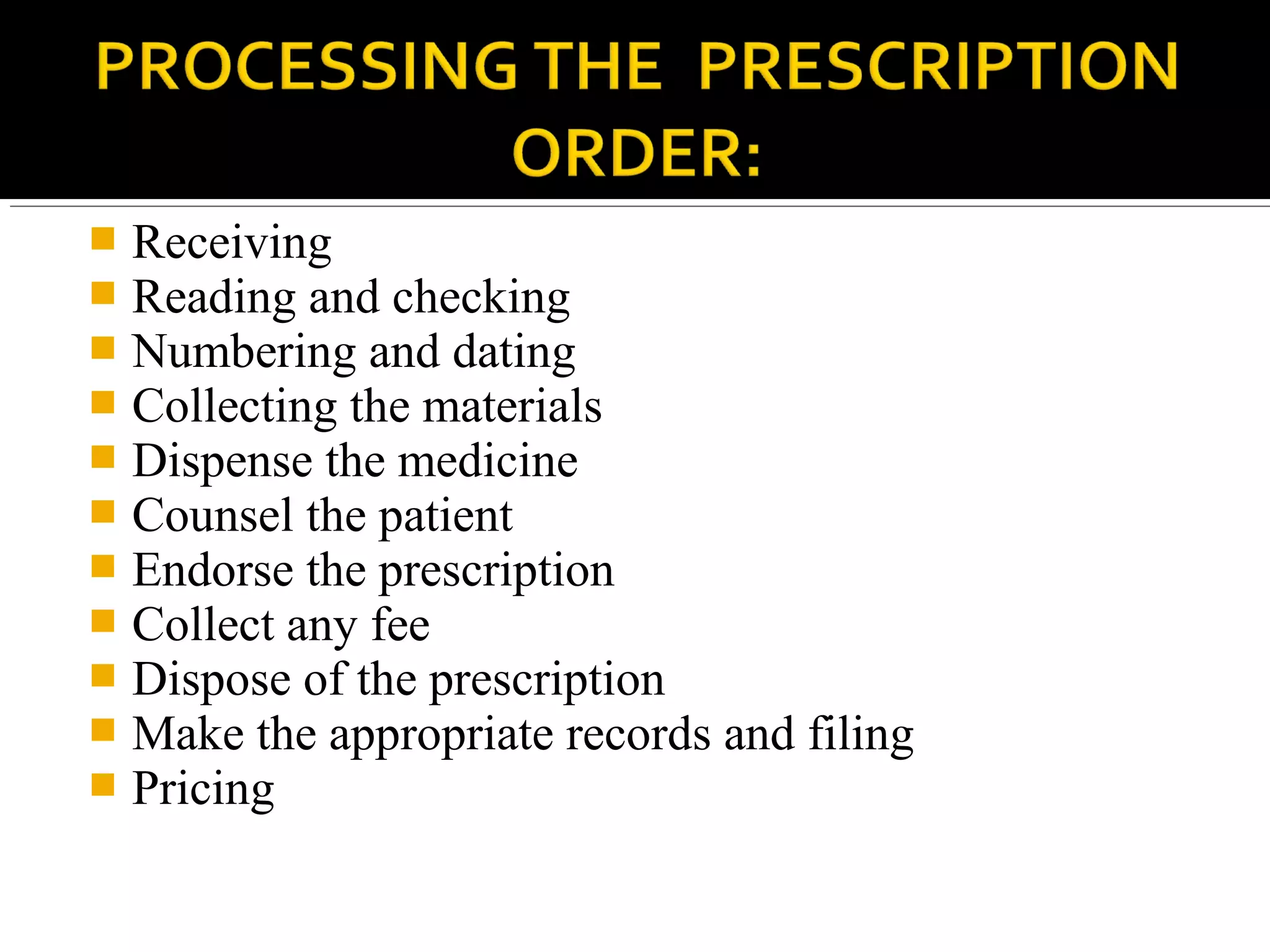
Receiving
Readingand checking
Numbering and dating
Collecting the materials
Dispense the medicine
Counsel the patient
Endorse the prescription
Collect any fee
Dispose of the prescription
Make the appropriate records and filing
Pricing
9.
NHS prescription
Private prescription
Prescription for hospital inpatients
Prescription for hospital outpatients
Prescription for patients discharged from the
hospital.
10.
NHS form-------------Retain until the end of month
Private form for prescription only medicine
----------------------- Retain to 2 years
Hospital inpatient form ------------- Return to ward
Hospital outpatient form --------------- Retain in
pharmacy (usually 2 years)
11.
Medication errorsaffect more then 1.5 million Americans
each year in hospitals alone, according to the Institute of
Medicine.
Error can be made in the following areas:
Similar spellings / pronunciations / names
Inderal and Adderrall
Zyrtec and Zantac
Celebrex and Cerebyx
Others include Aciphex (for stomach reflux) and Aricept (for
memory), Allegra (for allergies) and Viagra (for erectile
dysfunction) or Fosomax (for bone) and Flomax (for veins
and arteries).
12.
Incorrect dosage
Drug interactions
Human error
Doctors, notorious for bad handwriting, may choose the right
drug, but the pharmacist may read it incorrectly.
Sometimes the prescription gets transferred by phone from
the doctor's office to the pharmacy, but the people making or
receiving the phone calls make mistakes.
13.
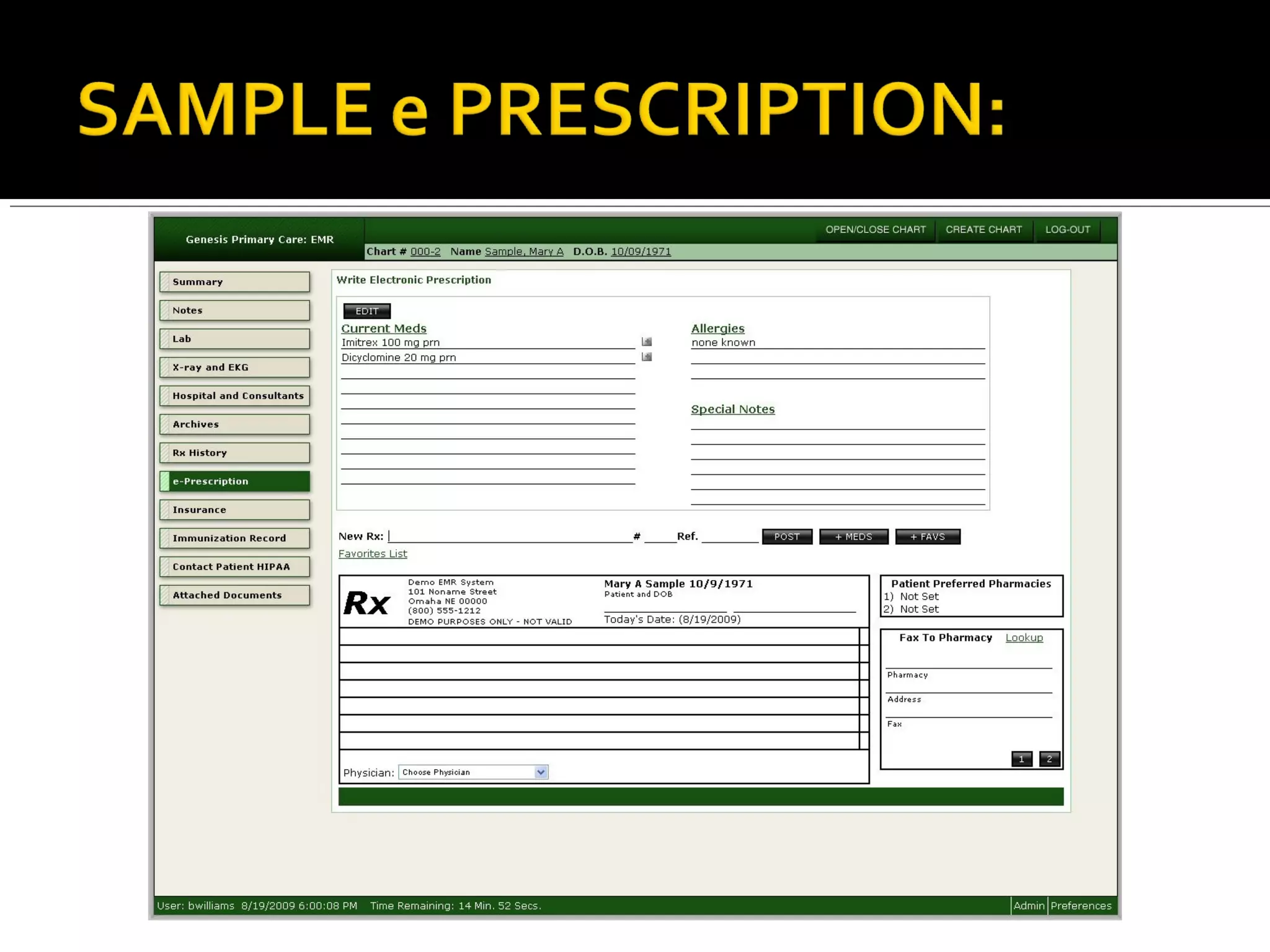
Electronic prescribing ore-prescribing is the
electronic transmission of prescription
information from the prescriber's computer to
a pharmacy computer.
15.
The doctorlogs on to the system and authenticates their
identity.(i.e. log on their passwords)
The doctor looks up the patient in the system.
A drug is chosen, with parameters including strength,
quantity, directions, and number of refills .
The patient's active medication list and known allergies are
reviewed for potential adverse drug reactions
16.
The softwaremay suggest alternative drugs that are either
more effective or less costly.
Select a pharmacy that will process the order, and place the
order.
The connection may be direct peer-to-peer, but usually it is
indirectly routed over a commercial network of pharmacies
such as Sure Scripts or eRx Network.
17.
Orders takethe form of standardized electronic messages that
both the prescriber's system and the pharmacist's system must
implement.
The order appears in the pharmacists computer system, where
it may be filled.
The patient shows up at the pharmacy to pick up and pay for
their medications.
18.
It improvesbeneficiary health outcomes
It improves quality and efficiency
It helps in reducing costs by actively promoting
appropriate drug usage
It speeds up the process of renewing medications
It reduces the incidence of drug interaction
It saves the time of pharmacist
19.
Each prescriptioncan be checked electronically
Reducing / eliminating the error.
Information on prescription can be linked with the
patient’s medical records.
Refill request can be expedited.
Facilitation of data transfer between physician and
pharmacist.
20.
Accidental dataentry errors such as selecting the wrong
patient or clicking on the wrong choice in a menu of dosages.
Inadvertently divulging protected health information on the
internet through inadequate security practices
Inability to use electronic prescribing when the power is out
22.
THANX FOR ATTENTION
REFERENCES:
Pharmaceutical practice
DM Collett
Pg # 61 -72
The science and practice of pharmacy
Remington
Pg #1823-1839